The most popular advice on account planning template enterprise sales is also the reason many plans fail. Teams obsess over the template. They argue about fields, colors, tabs, and whether the QBR version should live in Confluence, Salesforce, or a spreadsheet. Then the plan gets filled out, presented once, and starts aging immediately.
That approach is outdated. In enterprise sales, a static account plan is like using a printed road map while the route keeps changing. New executives join. Priorities shift. Hiring patterns change. Product launches create urgency. Competitive pressure appears where none existed a month ago. If the plan doesn't move with the account, it stops being strategy and becomes documentation.
The template still matters. Standard structure helps teams align around the same customer context, key contacts, competitors, and next actions. But the key advantage comes from the system around the template. The strongest teams treat account planning as an operating rhythm built on current intelligence, clear ownership, and consistent follow-through.
Key Takeaways
- Static account plans go stale in days. Most plans are built once, presented once, and forgotten — by then a new VP joined, priorities shifted, and the document no longer reflects reality.
- The template is the easy part. What matters is the operating rhythm around it: live intelligence, clear ownership, and a follow-through cadence that updates the plan as the account changes.
- A modern plan has six live components: stakeholder map, executive priorities, signals, whitespace, competitive context, and next 30/60/90-day actions — each tied to a source that refreshes automatically.
- Account intelligence platforms automate the maintenance. Pulling earnings calls, hiring, leadership changes, and news into the plan continuously turns it from quarterly homework into a daily-use working document.
See Salesmotion in action
Take a self-guided interactive tour — no signup required.
Why Most Account Plans Fail on Day Two
Traditional account planning is broken. Not because planning is a bad idea, but because teams often treat the plan like a quarterly homework assignment instead of a live operating tool.

A rep spends hours collecting notes, building slides, updating a stakeholder map, and polishing a summary for leadership. The document looks complete. Then the account changes. A new VP arrives. A champion goes quiet. Procurement tightens control. Suddenly the plan is no longer wrong in an obvious way. It's worse than that. It's stale in ways nobody notices until a deal slips.
The static template problem
Public templates are useful because they standardize core fields. Atlassian and similar planning formats organize account name, account manager, revenue, industry, employees, contacts, competitors, relationship strength, plan period, and review dates in one collaborative document, which helps teams align on customer goals and challenges in one place through a shared planning structure in Atlassian's sales account planning template.
But standardization alone doesn't solve the underlying problem. A useful contrarian perspective is that a perfect static template can become obsolete quickly unless it is tied to signal detection and review cadence, as discussed in Salesmotion's account planning guide.
A good-looking account plan can still be operationally useless if nobody knows what changed since last week.
The old model assumes the account is stable enough to revisit on a fixed schedule. Enterprise accounts aren't. That's why reps often feel that planning is administrative work rather than selling work. The plan isn't wrong because it lacks fields. It's wrong because it can't keep up.
What actually works
A modern account plan behaves more like a dashboard than a document. It should answer three questions fast:
- What matters now
- What changed recently
- What should we do next
That shift changes rep behavior. Instead of building a large document once a quarter, teams review a lightweight strategic foundation and continuously update the pieces that move. That usually means stakeholder changes, buying signals, competitive activity, and near-term actions.
For managers, this is also an efficiency issue. If your team is still doing planning as a periodic batch exercise, it's worth rethinking how reps spend their time and where planning creates friction in the broader selling workflow, especially in discussions around sales efficiency.
The living plan standard
The account plan that survives day two has a few clear traits:
- It is shared. Sales, SDRs, marketing, and customer success can all use it.
- It is selective. Not every account deserves deep planning.
- It is current. Signals trigger updates between formal reviews.
- It drives action. Every insight leads to an owner and next step.
If the document only exists for an internal review, it won't shape execution. If it informs outreach, meeting prep, stakeholder strategy, and risk management every week, it becomes valuable.

“Salesmotion helps you spot signals from prospect accounts, news items / job hiring alerts etc that indicate that now is a good time to reach out with a well-crafted message.”
Rob Douglas
Director of Sales, icit business intelligence
The Modern Enterprise Account Plan Framework
A useful account plan is a working system with a clear operating view, decision points, and owners. The template matters less than the mechanics behind it. If the team cannot update it quickly, use it in live deal reviews, and act on changes inside the account, the format will not save it.
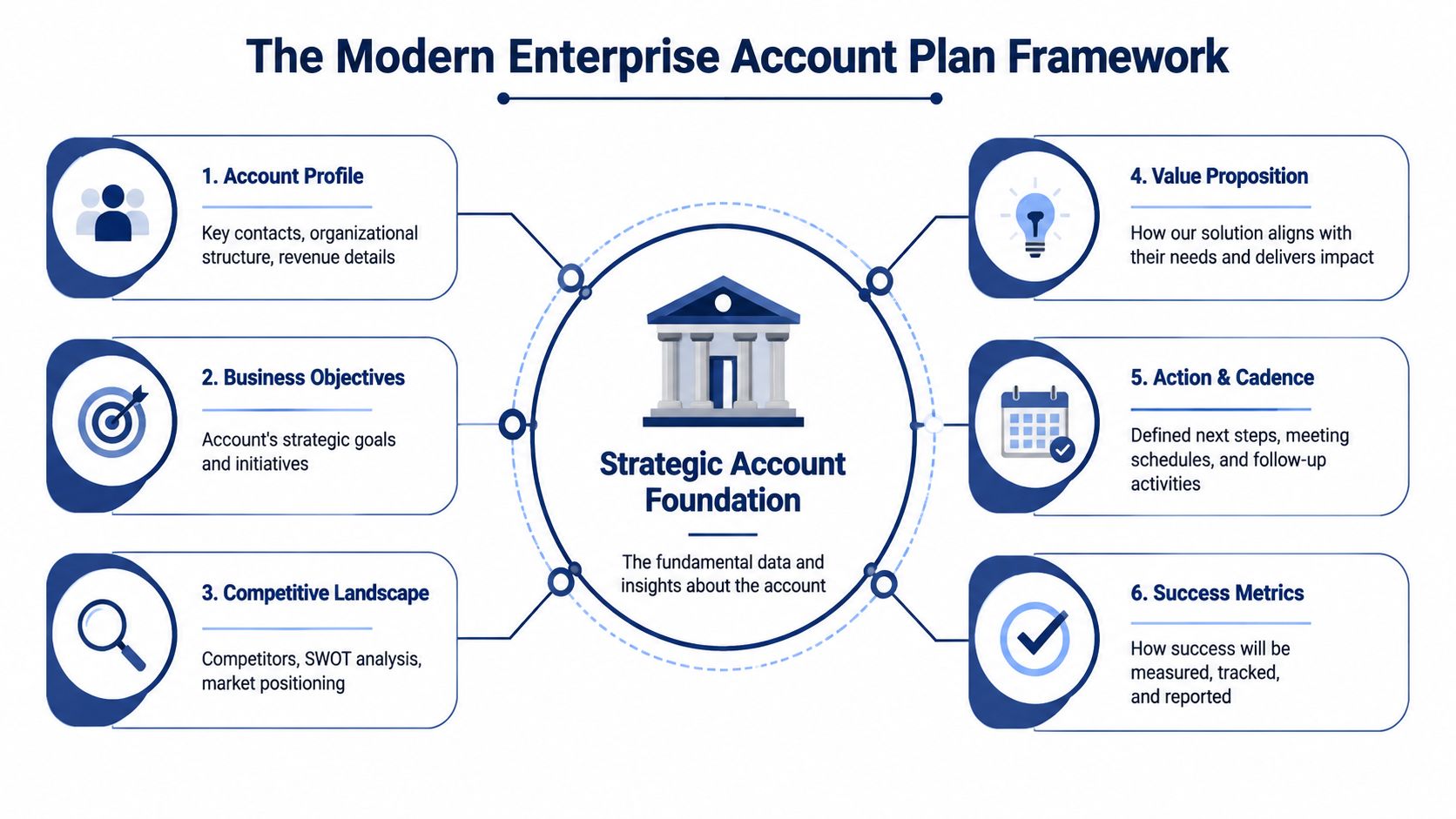
The framework that holds up in enterprise sales has two layers. First, a stable strategic foundation that does not change every week. Second, a set of dynamic fields that should change as new information comes in. Teams that mix those together usually create bloated plans that are painful to maintain. Teams that separate them keep the plan usable.
A practical framework should cover eight areas.
Executive Summary
Why it matters: Anyone joining a call or forecast review should understand the account in minutes.
Write this like an operator's brief, not a company description.
Include concise answers to questions like:
- What is happening in the account right now?
- Why does this account matter strategically?
- What is the current sales motion, expansion path, or renewal risk?
- What are the top priorities for the next 90 days?
Good summaries have a point of view. Weak ones read like copied research.
Account Overview
Why it matters: Strategy gets sharper when the team understands how the business actually runs.
Capture the core account facts and business backdrop:
- Revenue, industry, employee count, business model, major geographies
- Org structure, business units, reporting lines, and operating model
- Stated strategic priorities, known initiatives, and current pressures
- Current customer status, product footprint, and internal history
The trade-off here is depth versus maintenance. Reps do not need a research memo. They need enough context to identify where urgency, budget control, and execution risk are likely to sit.
Buying Committee Map
Why it matters: Enterprise deals slow down when coverage is limited to one supportive contact.
Map the buying group by role and influence:
- Who is the decision maker?
- Who is the champion?
- Which stakeholders influence technical, financial, or operational approval?
- Who could block progress, actively or subtly?
Good account teams also capture each person's priorities, concerns, and likely bias. A security lead cares about risk. A finance approver cares about cost control and proof. An operations leader may care more about disruption than price.
Whitespace Analysis
Why it matters: Expansion planning gets better when it is tied to business change, not product catalogs.
This section should answer:
- What products or services do they use today?
- What could they buy but haven't?
- Which departments, geographies, or teams remain untouched?
- What gaps exist between their stated priorities and current solution footprint?
Reps frequently get overoptimistic about large accounts. Large accounts are not automatically large opportunities. Real whitespace depends on adoption, political access, budget timing, and whether the next use case is attached to an active business priority.
Signal Monitoring Plan
Why it matters: A static plan misses the events that create timing and urgency.
Watch for triggers such as:
- Executive hires or departures
- Hiring spikes or org restructuring
- Funding, earnings commentary, product launches, or investor messaging
- Public statements that suggest urgency, budget shifts, or operational change
This field should not be passive. Define what the team watches, who owns monitoring, and what action each signal should trigger. Teams that want to reduce manual research should build this around automated sales research workflows instead of leaving it to rep memory.
Competitive Landscape
Why it matters: Every account has incumbent vendors, internal preferences, and switching friction.
Document:
- Incumbent vendors and where they are deployed
- Recent vendor changes or proof of consolidation activity
- Known strengths of the incumbent in this account
- Weak points, dissatisfaction, or areas where the incumbent is vulnerable
Keep this account-specific. Generic battlecard language rarely helps in a live opportunity review. The useful version explains why the incumbent is hard to displace and where the opening exists.
Relationship Map
Why it matters: Access can look healthy while influence is still thin.
Track the relationship network:
- Which stakeholders know your team directly
- Where relationships are strong, weak, or missing
- Which connections are single-threaded
- Where internal allies can create introductions
This view helps managers spot a common failure early. The deal looks active in CRM, but the team has not built enough coverage above, below, and across the initial contact.
Action Plan for the next 90 days
Why it matters: Planning only matters if it changes execution.
A strong 90-day plan includes:
- Specific meetings to secure
- Stakeholders to engage
- Messaging angles tied to current priorities
- Clear owners for each action and a review date
A simple structure works best:
| Milestone | Owner | Purpose |
|---|---|---|
| Executive outreach | AE | Create top-level alignment |
| Champion enablement | AE and SE | Equip internal advocate |
| Cross-functional review | Manager and team | Reassess risk and opportunity |
| Competitive update | AE | Adjust positioning and next steps |
The strongest framework is easy to scan and hard to ignore. It gives leadership a clean view of account health, and it gives reps a repeatable way to update strategy as conditions change.
From Manual Research to Automated Intelligence
Most account plans fail long before the strategy fails. They fail during research.
A rep opens ten browser tabs, skims a company site, checks LinkedIn, hunts for press releases, reads old CRM notes, and tries to piece together a coherent view of the account. That process is slow, inconsistent, and easy to abandon when the quarter gets busy.
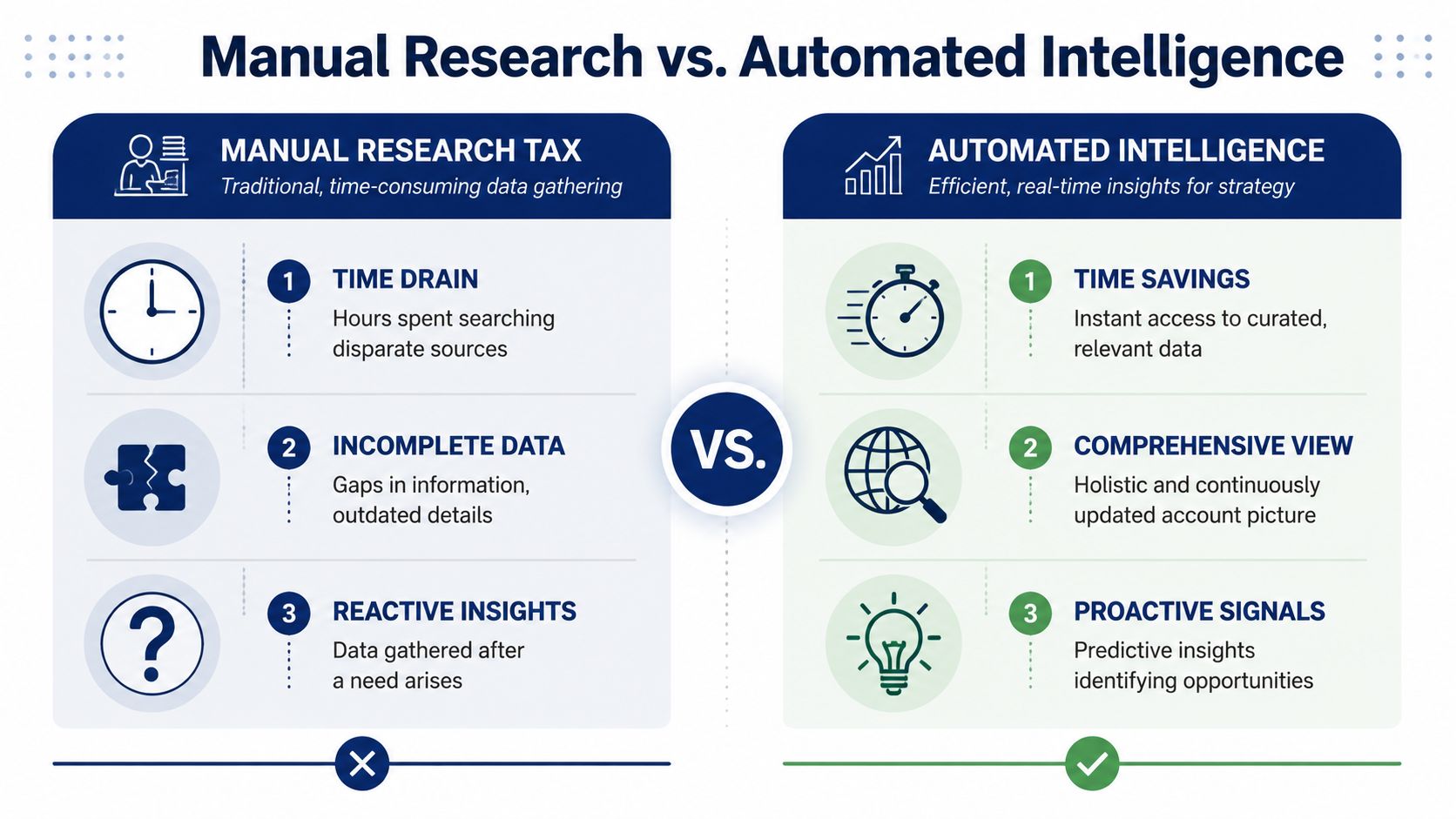
The manual research tax
The old workflow usually looks like this:
| Plan area | Manual workflow | Common failure |
|---|---|---|
| Account overview | Search company site, filings, LinkedIn | Facts are incomplete or already outdated |
| Org structure | Infer hierarchy from profiles and notes | Missing stakeholders stay invisible |
| Strategic priorities | Read press releases and executive commentary | Reps capture headlines but miss implications |
| Competitive landscape | Ask around, rely on memory, scan old opportunities | Competitive context becomes anecdotal |
| Signals | Check news occasionally | Important changes are noticed too late |
That's why the discipline has shifted from static, rep-owned planning to more data-driven and cross-functional planning focused on growth and risk, with modern plans pulling in firmographics, technographics, engagement, and real-time signals as described in Varicent's view of enterprise account planning.
What automation should do
Automation shouldn't replace account strategy. It should replace repetitive data gathering.
A useful research workflow pre-builds the foundation of the plan so the rep can spend more time interpreting the account than collecting background. That means generating a current company overview, surfacing strategic initiatives, highlighting potential risks, and organizing recent changes into something a seller can act on.
Practical rule: If your reps spend more time gathering account data than discussing how to win the account, the process is upside down.
One option in this category is Salesmotion, which automatically generates the research foundation for account plans, including company overview, SWOT, strategic priorities, and recent signals, so reps can focus on stakeholder strategy and execution instead of manual collection. That broader shift toward automation is part of why more teams are adopting workflows around sales research automation.
The rep's job changes for the better
When the research layer is automated, the seller's work becomes more valuable:
- Interpret the account. Decide what matters, not just what exists.
- Build the point of view. Connect company priorities to your solution.
- Map the politics. Understand who benefits, who resists, and why.
- Turn insight into movement. Translate account context into next actions.
That is a far better use of enterprise sales time than manually copying company details into a template.

“Automatic account profile detail I can use to manage my territory. Using Salesmotion AI to generate value statements per persona, account, etc. Using Salesmotion to give me a starting point based on new hires, or news alerts is critical.”
Adam Wainwright
Head of Revenue, Cacheflow
Activating Your Plan with Signals and Cadence
A plan only matters if it changes behavior this week. The missing piece for numerous teams is operational discipline. They have a document, but they don't have a trigger model or a review rhythm.
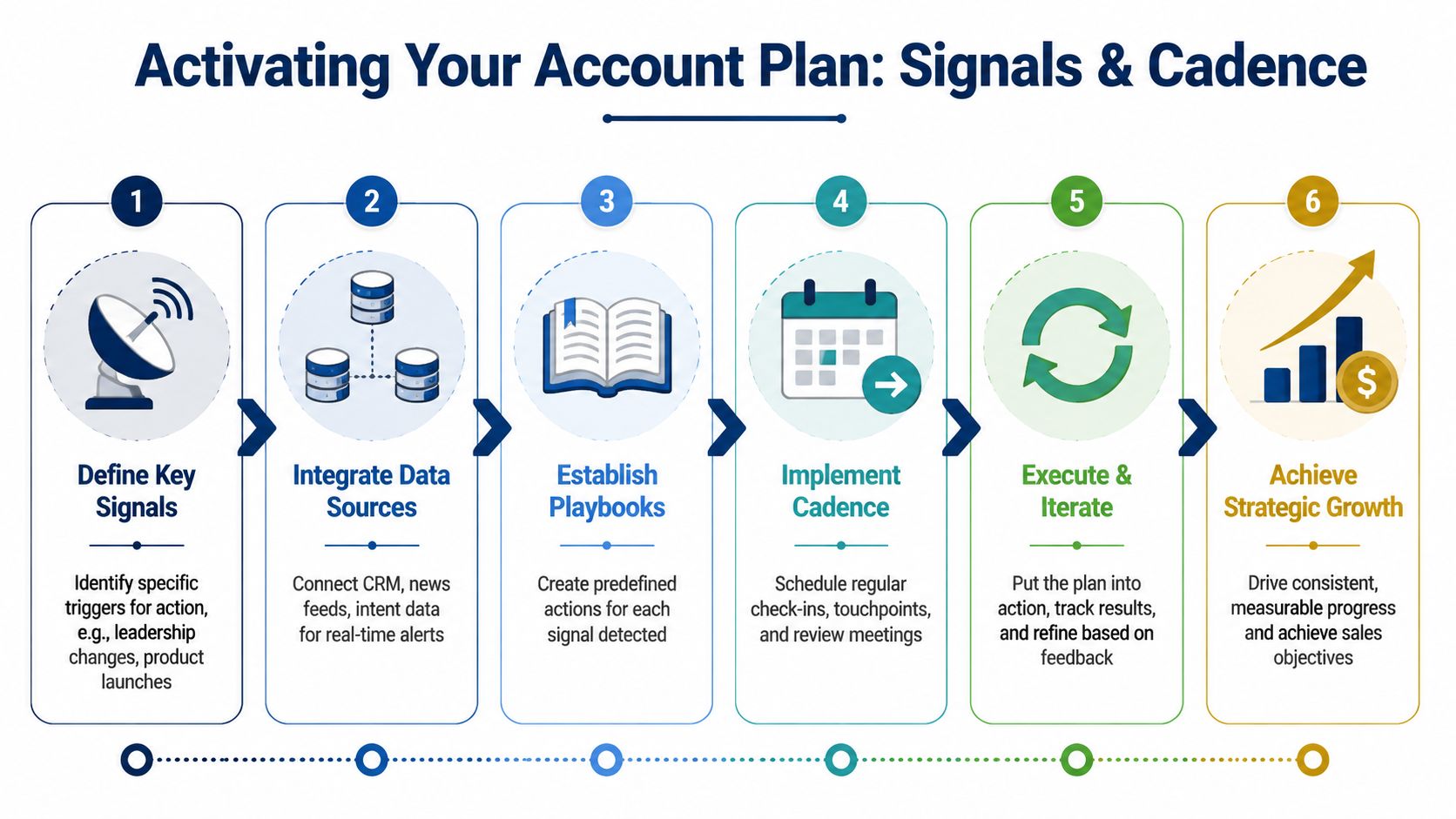
Most templates still don't answer the key question of which accounts deserve attention today. A more effective approach combines the plan with external signals like earnings, hiring, and executive moves so teams prioritize based on momentum rather than static fit, which is the core operational gap described in Saleshood's strategic account planning perspective.
Build a signal monitoring plan
A useful signal plan starts with a short list of triggers that should force a review of the account. Don't monitor everything. Monitor what changes buying conditions.
Good trigger categories include:
- Leadership changes: New CRO, CIO, CFO, or BU leader
- Organization shifts: Team expansion, restructuring, new regional buildout
- Strategic announcements: Product launch, transformation initiative, cost focus
- Market events: Funding, acquisition, partnership, or public competitive move
Then pair each trigger with an action. That's the part teams skip.
| Signal | Why it matters | Required action |
|---|---|---|
| New executive hire | Fresh priorities and possible budget resets | Update stakeholder map and tailor outreach |
| Hiring surge in target team | Indicates investment area | Revisit whitespace and use case relevance |
| Product announcement | Signals execution pressure | Align messaging to launch risk or enablement need |
| Public cost initiative | May create urgency around consolidation | Reframe value around efficiency and spend control |
A concrete example
Say your target account hires a new revenue operations leader. That single event should change multiple parts of the account plan.
First, update the buying committee map. The new leader may not control budget yet, but they could influence tooling decisions quickly. Second, revisit the whitespace analysis. If your product helps with forecasting, process visibility, or productivity, the use case may now be more relevant. Third, change the action plan. The next step is no longer generic outreach. It's targeted outreach tied to the executive's likely mandate.
That's what a living plan looks like. A signal arrives. The plan changes. The team acts.
Signals are only useful when they are linked to a playbook and a review cadence.
Set the cadence
You don't need a complicated operating model. You need consistency.
A simple rhythm works:
- Daily review: Check significant signal changes across priority accounts
- Weekly stand-up: Review what changed, what it means, and who owns the next step
- Monthly manager review: Inspect account movement, stalled actions, and coverage gaps
- Quarterly reset: Rework assumptions, priorities, and near-term milestones
For teams that want more structure around execution timing and follow-up design, it helps to align signal response with practical sales cadence templates.
The point isn't more meetings. The point is keeping the plan connected to motion.
Mapping Stakeholders and Crafting Talk Tracks
Enterprise deals are shaped by people, not org charts alone. You can have the right account, the right use case, and decent timing, then still lose because you misunderstood the committee.
A workable stakeholder map has to move past labels. “Champion” isn't enough. You need to know what that champion wants, how much influence they really have, and whether they can carry your message when you're not in the room.
A realistic stakeholder picture
Take a fictional enterprise account with a broad sales transformation initiative.
The VP of Sales Operations is your champion. They want process consistency and better visibility. The CRO is the decision maker. They care about forecast confidence and execution across regions. The Head of IT is an influencer with veto power if the rollout looks messy. Procurement is the blocker late in the cycle, especially if an incumbent vendor already has a broad contract footprint.
That map tells you something important. One message won't work for all four people.
For teams trying to expand stakeholder coverage more systematically, practical methods for identifying the right contacts matter as much as the messaging itself, especially when using a process like finding decision makers in a company.
Turn intelligence into talk tracks
Good talk tracks sound informed without sounding scripted. They connect one relevant observation to one credible reason to talk.
Here's how that looks in practice:
- For the champion: “You're likely being asked to improve visibility across the sales org. I'd be happy to compare how other teams structure rollout when they need adoption across multiple regions.”
- For the CRO: “You've added leadership capacity recently, which usually raises the need for consistent forecasting and execution. It may be worth sharing where we help leadership teams tighten operating rhythm.”
- For the IT leader: “If a new initiative is going to touch multiple teams, implementation risk becomes part of the decision early. We can walk through how security, integration, and rollout are usually handled.”
- For procurement: “If vendor consolidation is part of the discussion, we should clarify where we reduce overlap and where the transition effort would sit.”
What reps often get wrong
The most common mistake is writing one broad message and sending variations of it to everyone. That isn't multi-threading. It's repetition.
A better standard is:
- Anchor to one issue each person would care about
- Use account context, not generic pain points
- Ask for the next useful conversation, not the entire deal
- Refresh the talk track when the account changes
When a stakeholder map is live, messaging improves fast because the rep stops pitching the company and starts speaking to the person.
Measuring Success and Driving Accountability
Account planning usually breaks after the kickoff, not during it.
The document gets filled out, reviewed, and saved. Then the deal evolves, people change roles, priorities shift, and the plan stays frozen. That is why measuring the quality of the system matters more than grading the template. A static plan can look polished and still be useless by next week.
The fix is simple in principle and harder in practice. Separate the metrics that show business results from the behaviors that keep account intelligence current.
Track lagging outcomes and leading behaviors
Lagging indicators show whether the account strategy produced revenue outcomes. Leading indicators show whether the team is doing the work that keeps the strategy tied to reality.
Altify notes in its account planning template guidance that teams should track clear KPIs so account planning becomes repeatable and visible. That part is right. The mistake many enterprise sales teams make is stopping at win rate and pipeline movement, then wondering why plans go stale between quarter reviews.
Use lagging metrics to judge the account over time:
- Win rate
- Average deal size
- Sales cycle length
- Deal count within planned accounts
Use leading metrics to manage the account every week:
- New stakeholders engaged
- Meetings created in new business units or functions
- Whitespace opportunities identified
- Competitive risks surfaced and addressed
- Action items completed by the agreed date
- Plan updates made after meaningful account signals
Leading indicators matter because they expose drift early.
A rep can show healthy pipeline while the account is getting weaker. Maybe the team is still single-threaded. Maybe the champion has gone quiet. Maybe a new executive arrived and no one updated the plan. If managers only inspect late-stage outcomes, they catch the problem after the account has already moved against them.
Good account planning creates accountability before revenue shows up.
Put the plan into the management rhythm
Account plans fail when they live outside the operating cadence. If the only recurring inspection is pipeline review, reps will optimize for stage movement and forecast language. They will not consistently update stakeholder coverage, threat analysis, or whitespace hypotheses unless leadership asks for those things every week.
Use a simple review structure:
| Meeting | What to inspect |
|---|---|
| Weekly 1:1 | New signals, stakeholder movement, blocked actions |
| Deal review | Relationship coverage, competitive position, next milestone |
| Team review | Which accounts gained momentum and why |
| QBR | Progress against account objectives and reset of 90-day plan |
Accountability gets real. Five follow-up meetings with the same friendly contact do not strengthen account position. One conversation with an economic buyer, security lead, or regional operator often does.
I have seen teams improve plan quality fast once managers start asking operational questions instead of document questions. Do we have new information? Did the account strategy change because of it? Who owns the next action, and by when? That cadence forces the plan to behave like a system instead of a file.
What good accountability looks like
Strong teams inspect a small set of questions consistently:
- Has the account plan changed since the last meaningful signal?
- Are we building relationships across the buying group or relying on one contact?
- Do next steps reflect current account conditions, or are they generic follow-ups?
- Have we learned anything new about risk, competition, budget, or timing?
- Is there a clear owner for each action in the next 30 days?
If those answers stay vague, the problem is not the template. The problem is operating discipline.
If your team still treats account planning like a quarterly document exercise, tools that support continuous account intelligence can help. Salesmotion helps revenue teams turn account research and signals into action by automating the research foundation, monitoring account changes, and surfacing context sales teams can use in planning, outreach, and weekly execution.