Your reps are probably working hard and still missing the moment that matters.
I've seen talented SDRs and AEs spend half a day building lists, polishing generic emails, and calling accounts that had no reason to care that week. Then a different account hires a new executive, raises fresh capital, posts a cluster of strategic roles, or starts talking publicly about transformation, and nobody notices. That isn't a rep problem. It's a prioritization problem.
Buying signals in B2B sales fix that. They tell you which accounts are changing, which ones are spending, and which ones are more likely to take a meeting right now. If your team is still choosing accounts from static lists and hoping volume makes up for bad timing, you're forcing them to sell uphill.
Stop Selling to Cold Accounts
I've sat in too many pipeline reviews where the activity numbers looked busy and the outcomes looked awful. Reps had sent emails, made calls, and worked through lists. What they didn't have was timing.

The old model is simple. Pick a territory. Pull a list. Send the same pitch to everyone who roughly matches your ICP. If response rates are bad, send more. That's how teams burn morale and pipeline at the same time. If that's still your motion, start by rethinking what cold outreach should actually look like.
What buying signals actually tell you
A buying signal is an observable change or behavior that suggests an account may be entering a buying window. Sometimes it's direct, like a demo request. Sometimes it's contextual, like a new executive hire, a funding announcement, or a hiring surge in a department your product supports.
The point isn't academic. It's operational. You stop asking, "Who fits our market?" and start asking, "Who has a reason to change now?"
Practical rule: Don't let reps start with account lists. Make them start with account movement.
Why the old way breaks down
Static outbound assumes prospects are passively waiting to be interrupted. That isn't how modern buying works. Buyers research on their own, align internally, and evaluate options before most vendors ever get a chance to talk to them.
So random outreach feels random to the buyer because it is random. There's no event. No urgency. No relevance beyond broad firmographics.
A better motion looks like this:
- Watch for change: leadership hires, funding, expansion, strategic hiring, earnings language, M&A.
- Tie outreach to that change: give the buyer a clear "why now."
- Move fast: signals lose value when they sit in a spreadsheet or Slack thread for days.
I've seen reps go from ignored to welcomed because they showed up with context instead of a template.
See Salesmotion in action
Take a self-guided interactive tour — no signup required.
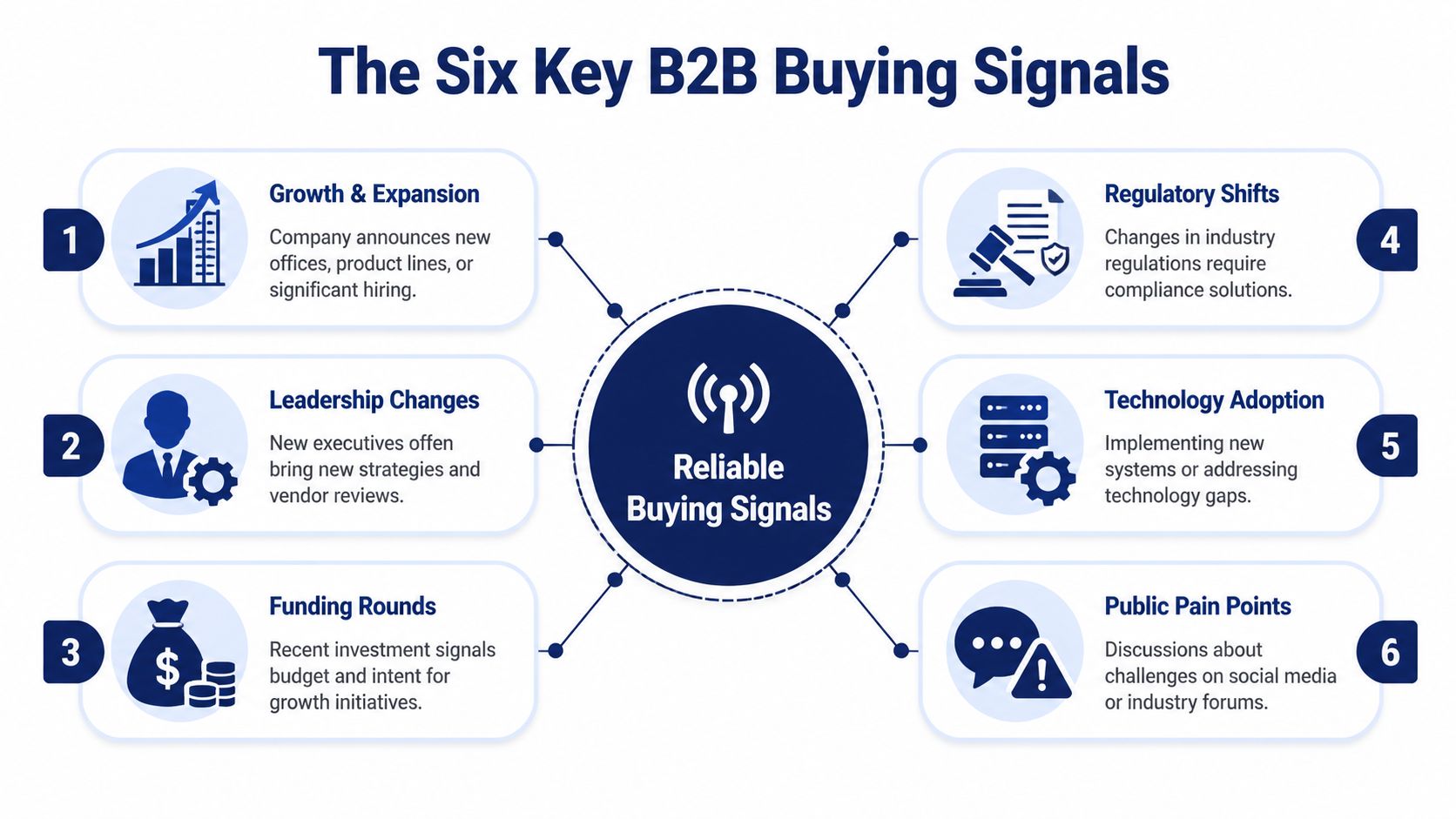
The Six Buying Signals That Actually Matter
A rep sees 40 "signals" in a week. One company posted three jobs. Another got quoted in a trade article. A third launched a podcast. None of that means the account is ready to buy. I've seen teams bury their reps in noise, then act surprised when outbound turns into random activity with a reply rate to match.
Use a stricter filter. Prioritize signals tied to budget, ownership change, operational pressure, or a clear initiative. If you need the broader context for how these triggers fit into an outbound system, read this guide to intent data in B2B sales.
Leadership changes
New executives create buying windows fast. They review tools, question inherited process, and want proof they can improve results early in their tenure. I've seen reps miss this because they stay buried with old contacts who lost influence the minute a new VP or C-level leader walked in.
Use the hire as the trigger, but do the extra work. Read the executive's background. Look at what they changed in their last role. Then tie your outreach to the priorities they were likely hired to fix.
If a company hires a VP of Engineering, don't send a generic note about productivity. Reach out with a point of view on scaling delivery, tightening QA, improving platform visibility, or reducing coordination drag across teams. The signal is the hire. The message is the pressure that comes with the hire.
Funding rounds
Funding creates urgency because expectations change overnight. Board pressure rises. Hiring plans expand. Teams get told to grow faster without breaking execution.
That gives you a reason to contact the account, but only if you connect the capital to the operational mess that usually follows. A weak email says, "Congrats on the raise." A strong email says, "You now have growth targets, new hiring plans, and more complexity across systems. Here's where teams in your position usually lose time."
Good funding outreach usually points to one of three problems:
- scaling manual workflows
- fixing handoff gaps between teams
- improving reporting and execution visibility for leadership
Hiring surges and headcount growth
Hiring only matters when there's a pattern. One open role means almost nothing. Sustained hiring in a function you serve usually means the company is building capacity, assigning budget, and preparing for change.
I've seen sales teams overreact to random job posts and underreact to sustained growth in the exact department their product supports. That's backward. If the company is steadily adding RevOps, sales managers, security engineers, or customer success leaders, that tells you where internal attention and spending are going.
This is also the point where many teams confuse raw intent with useful intent. A better operating model separates casual research from signals tied to an active business initiative. If you want another perspective on turning those patterns into outbound action, Orbit AI's take on buyer intent strategies is a useful companion read.
One job post is a data point. A hiring pattern is a buying signal.
Earnings call insights
Earnings calls are one of the best sources of signal quality because executives speak plainly about priorities, pressure, and planned investment. Reps ignore them because they sound tedious. That's a mistake.
Listen for language that maps directly to your category. If leadership keeps mentioning efficiency, margin pressure, platform consolidation, AI deployment, customer retention, or international expansion, those are not abstract themes. They are operating directives that will force teams to review process and tools.
Use a simple interpretation model:
| Signal from earnings call | What the rep should infer |
|---|---|
| Digital investment | Teams may be replacing systems or redesigning workflows |
| Efficiency language | Leaders may be cutting tool sprawl or pushing productivity gains |
| Expansion plans | New regions and teams usually create process gaps |
| AI initiative | Broader software evaluation may already be in motion |
The mistake is hearing the signal and replying with a standard pitch. Use the company's own language back to them and tie it to a specific problem you solve.
M&A activity
Mergers and acquisitions break clean systems. Reporting gets messy. Tool overlap becomes political. Teams inherit workflows they never chose and then get told to standardize fast.
That pain creates opportunity for products that help with integration, governance, visibility, and process cleanup. I've seen strong reps do well here because they don't pretend the buyer wants a friendly introduction. They address the problem directly. The account has duplicated tools, confused ownership, and pressure to consolidate. Start there.
Expansion signals
New office openings, new geographies, and market expansion matter because they create coordination problems. More regions mean more systems, more process variance, and more chances for execution to drift.
This signal is useful when it lines up with a stronger trigger or with a category that supports rollout, standardization, compliance, or cross-functional coordination. On its own, it rarely deserves top priority. Paired with executive hiring, funding, or a clear transformation initiative, it becomes much more actionable.
The six signals above matter for one reason. Each gives your team a credible reason to say why this account may need to change now. That is the standard. If a signal doesn't sharpen timing, relevance, or urgency, it doesn't belong in your outbound system.

“Consolidation of prospect company information that I can use frequently to be way better informed when I'm doing my outbound, preparing for a meeting, or building relationships. Ease of use and Customer Support is excellent.”
Werner Schmidt
CEO & Co-Founder, Lative
How to Detect and Prioritize Signals at Scale
Initial efforts often begin with good intentions and inadequate systems. A rep checks LinkedIn. Someone sets up Google Alerts. RevOps builds a spreadsheet. Marketing forwards news clippings. Within a month, nobody trusts the feed because it's noisy, late, and disconnected from action.

Manual tracking breaks at team scale
Manual research works for a handful of strategic accounts. It fails when a team needs coverage across segments, territories, and active pipeline.
The problem isn't effort. It's volume and consistency. Signals show up across earnings transcripts, investor updates, hiring pages, LinkedIn, press releases, podcasts, and executive interviews. Reps won't monitor all of that reliably while also prospecting, following up, and running meetings.
Here's the side-by-side reality:
| Approach | What happens in practice |
|---|---|
| Manual checks | Reps find some signals, miss most, and act late |
| Shared spreadsheets | Context gets lost and ownership gets fuzzy |
| Automated monitoring | Relevant triggers surface fast enough to matter |
Use a weighted scoring matrix
Most programs typically unravel at this point. Teams collect signals but don't prioritize them. So a minor press mention gets treated like a new CFO hire. That's how reps learn to ignore alerts.
The smarter move is a weighted scoring model across signal categories such as behavioral, verbal, digital, and contextual. The exact weights depend on your motion, but the principle is fixed: not all triggers deserve the same response.
Salesmotion's write-up on buying intent data workflows makes this point well. Quantifying and prioritizing signals with a weighted scoring matrix is critical, and businesses using intent data can see 78% higher lead-to-customer conversion rates when they focus on high-value signals rather than noise (Salesmotion on buying signals).
A practical matrix should account for four things:
- Signal strength: a demo request or executive hire beats a generic article mention.
- ICP fit: the best signal on the wrong account is still a bad use of time.
- Recency: old signals are reference points, not triggers.
- Clustering: multiple related signals from one account beat isolated events.
Operational advice: Reps shouldn't evaluate raw news. They should receive prioritized alerts with the "so what" already attached.
Automation is the only sane option
Modern tools monitor far more sources than any rep can cover manually. In practice, that means tracking hiring, exec moves, earnings, filings, news, social activity, and other public signals in one flow.
Tools differ, but the bar is the same. You want automated monitoring, account-level prioritization, and direct routing into the systems reps already use. Salesmotion, for example, monitors 1,000+ sources and delivers signal context into Slack, email, or CRM so teams don't have to stitch the story together by hand.
That matters because signal-based selling isn't a research hobby. It's a response system.
The Signal-to-Outreach Playbook
A signal that doesn't change rep behavior is just trivia. The value comes from turning account movement into outreach that feels informed, timely, and specific.
And yes, the old blast model is still losing. Teams using a signal-based playbook see 18% average response rates and shorter cycles by 20-30% when they act on real-time signals and personalize around a clear "why now" message (Emlen's signal-based selling playbook).
Playbook one for a new VP of Engineering
This is one I've seen work repeatedly.
A target account hires a new VP of Engineering. Most reps ignore it or send a generic congratulations email. A good rep reads it for what it is: a leadership reset. The new VP is expected to improve velocity, clean up execution, and make smarter tooling decisions.
Who to contact
- Primary: new VP of Engineering
- Secondary: Head of Platform, Director of DevOps, CTO if involved
- Supporting contacts: Engineering Operations, Product leader tied to delivery bottlenecks
What to say
Subject: Congrats on the new engineering chapter at [Company]
Saw you joined [Company] to lead engineering. When new VPs step in, they usually get pressure from both sides fast. Ship faster, improve predictability, and do it without creating more tool sprawl.
We help engineering leaders tighten up development pipeline workflows when teams are scaling or resetting process. If that's on your plate, I can share how I'd assess the gaps first.
Worth a quick conversation next week?
This works because the message is anchored to a real event and a real likely priority. It doesn't pretend you know their entire roadmap. It shows you understand the job they just took on.
Playbook two for a funding announcement
Funding is not the pitch. The consequence of funding is the pitch.
Best angle
Tie the raise to the pressure that follows. More hiring. More systems. More urgency. More expectations from leadership and investors.
Suggested email
Subject: After the raise, execution usually gets harder
Congrats on the recent funding. Once a company shifts into growth mode, teams usually run into the same issue fast. The processes that worked before don't hold up under more headcount, more reporting demands, and faster delivery expectations.
We work with teams at that stage when they need to remove friction without slowing growth. If that challenge is already showing up, I can share a few patterns we're seeing across scaling teams.
Multi-threading note
Don't stop at the CEO or founder. Bring in the functional leader who will own the problem. In many cases that's operations, finance, revenue leadership, or engineering, depending on your category.
Playbook three for earnings call language
This playbook works well when executives publicly name a strategic initiative.
Let's say a company talks about "digital investment" or "sales transformation" across recent earnings commentary. That's not a cue to send them a brochure. It's a cue to mirror their own language back to them and offer a relevant point of view.
Short outreach structure
- Reference the specific initiative.
- State the likely operational implication.
- Connect your product to that implication.
- Ask for a focused conversation, not a broad intro call.
Example:
Subject: Following the sales transformation priority
I noticed the company has been talking publicly about sales transformation and operational investment. When that becomes a board-level priority, teams usually end up reworking systems, process visibility, and handoffs at the same time.
That's typically where we help. If this initiative is active, I can show you how other teams structure the rollout without creating extra process drag.
One more practical point. Reps who build credibility before outreach do better in these conversations. If your team needs help with that, this guide to LinkedIn personal branding is useful because buyers do check who they're hearing from.
If you want the mechanics for routing signals into outbound faster, this workflow for turning signals into outbound actions is the kind of process teams should standardize.
Send fewer emails. Make each one explain why this account should care right now.

“This is my singular place that very simply summarizes a company's top initiatives, strategies and connects them to my solution. Something I would spend hours researching manually, now it's automated.”
Derek Rosen
Director, Strategic Accounts, Guild Education
Measuring Success and Scoring Your Accounts
If your signal program can't prove pipeline impact, it won't survive budget season. "Reps like it" isn't a metric. You need to show that signal-sourced work produces better opportunities, faster movement, and stronger focus.
Track the right KPIs
A clean dashboard for buying signals in B2B sales should answer four questions:
- Are reps acting fast enough
- Which signals create opportunities
- Which signals produce wins
- Which accounts deserve more coverage
The most useful KPIs are usually:
| KPI | Why it matters |
|---|---|
| Signal-to-outreach latency | Shows whether reps are acting while the signal is fresh |
| Intent-to-opportunity rate | Tells you whether your prioritization is working |
| Win rate by signal type | Separates strong triggers from weak ones |
| Pipeline velocity for signal-sourced opps | Shows whether timing improves deal movement |
Use Fit, Intent, and Timing
The simplest model that works is Fit / Intent / Timing.
According to Martal's framework, a Fit/Intent/Timing model can drive up to 78% higher lead-to-customer conversion rates, and teams that respond within less than 5 minutes to Tier 1 signals benefit from 21x higher conversion compared with responding in 30 minutes (Martal on signal scoring and response speed).
Here's how to apply it without overcomplicating the model.
Fit asks whether the account belongs in your ICP. Industry, size, use case, existing stack, and territory all matter here.
Intent looks at the strength of the trigger. A demo request, repeat pricing interest, or executive change tied to your category should score far higher than broad awareness activity.
Timing answers whether the account is in motion now. Recency and signal clustering matter more than raw volume.
Keep the scoring practical
You don't need a giant RevOps science project. You need a system reps trust.
A practical scoring setup should:
- Weight meaningful signals higher: executive hires, funding, and strong first-party engagement should outrank weak news mentions.
- Reward clusters: an account with multiple relevant signals in a short window should move up fast.
- Decay stale data: old signals should lose influence over time.
- Route by urgency: high-intent accounts go to AEs, medium-intent to SDRs, low-intent to nurture.
If your team wants a more technical look at how to improve your lead scoring, that resource is useful. Just don't let lead scoring become detached from real-world buying movement.
I've seen too many scoring models die because they looked impressive in Salesforce and meant nothing to sellers. Keep it obvious. If a rep can't explain why an account is ranked high, the model is broken.
Conclusion Stop Guessing and Start Selling
Your rep starts the day with 200 accounts and no reason to call any of them first. So they do what weak sales motions always do. They default to the loudest manager, the oldest list, or the easiest email to send. That is how teams stay busy and miss pipeline.
Timing is not optional in B2B sales. Buyers research on their own, compare vendors before they reply, and ignore outreach that shows up without context. Landbase notes that buyers complete much of their evaluation before they contact a vendor, and a large share of those interactions happen through digital channels (Landbase on intent signal statistics). If your team is still treating every target account like it deserves the same sequence, you are paying for activity instead of progress.
I've seen this play out over and over. Teams that run on static account lists burn SDR time, clutter inboxes, and call it discipline. Teams that run on signals know why they are reaching out, why now, and what changed inside the account. Those teams get more replies because their outreach matches a real business moment.
That is the standard. Build a system that detects signals automatically, scores them in a way reps can trust, and gives your team a response playbook for the signals that matter most.
Cold outreach still has a place. Effective cold outreach starts with a trigger, not a guess. Give reps accounts that are hiring into pain, changing leadership, reviewing vendors, showing first-party intent, raising capital, or expanding their stack. Then give them messaging tied to that event, not another generic value prop.
If you want more pipeline, stop asking reps to hunt in the dark. Give them signal, priority, and a clear next move.
If you want to see the buying signals already hiding inside your target accounts, book a live demo of Salesmotion. You’ll see how account signals surface, how they’re prioritized, and how your team can turn them into timely outreach instead of more random prospecting.