Gartner predicts that by 2028, AI agents will outnumber sellers 10 to 1. The same prediction includes a detail most vendors leave out: fewer than 40% of sellers will say those agents actually improved their productivity.
That gap between deployment and impact is the real story of AI sales agents in 2026. The technology works. Most implementations don't. The difference comes down to what kind of agent you deploy and how it connects to the signals your reps actually need.
TL;DR: AI sales agents are autonomous software that handles prospecting, research, and outreach without manual input. The ROI is real (86% of teams report positive returns in year one), but most deployments fail because they automate the wrong tasks. The agents that work best connect to live buying signals, not just CRM data.
What Is an AI Sales Agent (And What Isn't One)?
An AI sales agent is software that executes sales tasks autonomously. Not "suggests next steps" or "drafts an email if you click three buttons." It monitors data, makes decisions, and takes action without a rep initiating every step.
This distinction matters because the market lumps three very different things under the "AI sales agent" label: CRM copilots that autocomplete fields, chatbots that answer FAQ questions, and actual autonomous agents that run multi-step workflows end to end.
According to Salesforce's own research, reps spend only 28% of their time actually selling. The remaining 72% goes to CRM updates, internal meetings, email, scheduling, and research. AI sales agents target that 72%, but the approach matters enormously. An agent that auto-fills CRM fields saves minutes. An agent that monitors buying signals across your territory, builds research briefs, and drafts personalized outreach saves hours.
The AI agent market hit $7.8 billion in 2025 and is growing at 45% annually according to Precedence Research. Gartner expects 40% of enterprise applications to feature task-specific AI agents by end of 2026, up from less than 5% in 2025. That is one of the steepest adoption curves for any enterprise technology in recent memory.
See Salesmotion on a real account
Book a 15-minute demo and see how your team saves hours on account research.
Three Types of AI Sales Agents
Not all AI sales agents solve the same problem. The category breaks into three distinct types, each targeting a different part of the sales workflow.
CRM-Embedded Copilots
These live inside your existing CRM and augment what reps already do. Salesforce's Agentforce, HubSpot's Breeze AI, and Microsoft Copilot for Dynamics 365 all fall here.
What they do well: Auto-capture meeting notes, summarize deal activity, surface next-best actions from CRM data, and generate forecasts. Agentforce alone has reached $540 million in ARR, making it one of the fastest-growing AI products in enterprise software.
Where they fall short: They only see what's inside the CRM. If the signal lives outside your system (a leadership change on LinkedIn, an earnings call mention of a strategic initiative, a competitor loss reported in the news), CRM copilots miss it entirely. They make reps faster at working inside the CRM. They don't make reps smarter about what's happening in their accounts.
Autonomous SDR Agents
These replace or supplement human SDRs for outbound prospecting. Artisan's Ava, Piper by Qualified, and similar tools find leads, write cold emails, manage sequences, and book meetings with minimal human input.
What they do well: Volume. An AI SDR qualifies leads at $15 each versus $50 for manual efforts according to ScaleVise, while handling 3.5x the volume. They respond to inbound leads in under five minutes, compared to the 24-hour average for human teams. Contacting a lead within five minutes makes you 21x more likely to convert.
Where they fall short: Speed without context produces spam at scale. If the agent doesn't know why an account matters right now (what changed, what initiative is underway, who moved into a new role), the outreach reads like every other automated sequence. High volume, low relevance.
Signal-to-Action Intelligence Agents
These monitor external data sources, build account intelligence, and generate outreach anchored to real events. Instead of starting with a contact list and blasting emails, they start with a signal (a leadership change, earnings commentary, a funding round, a job posting pattern) and work forward to research, context, and personalized messaging.
What they do well: They solve the hardest part of selling: knowing what to say and why to say it now. Instead of "Hi {First_Name}, I noticed your company is growing," the outreach references the specific initiative the CFO mentioned on last quarter's earnings call or the VP of Revenue Operations role the company posted last week.
Where they fall short: They require enough account volume to justify the investment, and the intelligence is only as good as the data sources being monitored. Teams with fewer than 50 target accounts may not see enough signal volume to justify a dedicated platform.
| Capability | CRM Copilots | Autonomous SDRs | Signal-to-Action Agents |
|---|---|---|---|
| Data source | CRM records | Contact databases | 1,000+ external sources |
| Primary value | Internal efficiency | Outbound volume | Contextual relevance |
| Rep involvement | High (assists) | Low (autonomous) | Medium (reviews and sends) |
| Best for | Deal management | High-volume prospecting | Account-based, enterprise sales |

“The Business Development team gets 80 to 90 percent of what they need in 15 minutes. That is a complete shift in how our reps work.”
Andrew Giordano
VP of Global Commercial Operations, Analytic Partners
The ROI Data: What 2026 Research Shows
The returns are real, but unevenly distributed.
86% of sales teams using AI report positive ROI within the first year, according to research from Sopro and HubSpot. Salesforce found that 83% of AI-using sales teams reported revenue growth, compared to 66% without, a 17-point gap. McKinsey estimates AI-enabled sales teams see 3 to 15% revenue increases and 10 to 20% ROI improvements.
Here is where it gets interesting. IBM's longitudinal data shows AI-enabled operating profit growing from 2.4% in 2022 to 7.7% in 2024. The ROI compounds over time as teams learn to use agents more effectively. It is not a one-time lift. It is a trajectory.
The flip side: Gartner warns that 40%+ of agentic AI projects risk cancellation by 2027 if governance, observability, and ROI clarity aren't established. Forrester predicts enterprises will defer 25% of planned AI spending into 2027 because fewer than one-third currently link AI initiatives to tangible financial growth.
The pattern is clear: AI sales agents deliver real ROI when deployed against specific, measurable problems. They fail when treated as a side project or a box to check.
Why Most AI Agent Deployments Fail
The implementation gap is not a technology problem. It is a strategy problem.
Research from Lyzr found that 62% of businesses lack a clear starting point for AI agents. Another 41% treat them as side projects rather than embedding them in core workflows. And 32% stall after the pilot phase, unable to move from experiment to production.
The root cause in most cases: agents without signals are just faster spam.
A CRM copilot that auto-generates follow-up emails based on deal stage is useful. But if the email says "just checking in" because the system has no idea what is actually happening at the account, it is automated mediocrity. An autonomous SDR that sends 500 cold emails per day sounds impressive until you realize the reply rate is 0.3% because none of the messages reference anything the prospect cares about right now.
The teams getting results connect their agents to live data. 73% of sales professionals say AI uncovers insights they could not find manually, but only when the AI has access to the right inputs: news, earnings calls, hiring patterns, leadership changes, competitive moves, and technology adoption signals.
This is where signal-based selling changes the equation. Instead of automating outreach and hoping it lands, signal-based agents identify which accounts are entering a buying window before a rep ever opens a discovery call.

“The moment we turned on Salesmotion, it became essential. No more hours on LinkedIn or Google to figure out who we're talking to. It's just there, served up to you, so it's always 'go time.'”
Adam Wainwright
Head of Revenue, Cacheflow
How Signal-Based Agents Change the Workflow
Here is what the workflow looks like when signals drive the process instead of templates.
1. Signal fires. A target account posts a VP of Revenue Operations role on LinkedIn. The same week, their CEO mentions "sales transformation" on an earnings call.
2. Research auto-generates. The agent pulls context from over 1,000 sources: the earnings transcript, recent news, leadership changes, hiring patterns, competitive moves, and technology stack data. It builds a one-click account brief that would take a rep 30 to 60 minutes to assemble manually.
3. Outreach drafts. Instead of a generic "I noticed your company is hiring" email, the agent drafts messaging anchored to the specific initiative: the sales transformation the CEO mentioned, the new role they are hiring for, and how other companies at a similar stage approached the same challenge.
4. Rep reviews and sends. The rep spends five minutes reviewing context and personalizing the message, not 90 minutes researching and drafting from scratch.
Salesmotion runs this workflow across entire territories. Teams like Frontify saw self-sourced pipeline grow 4x and Analytic Partners grew qualified pipeline 40% year over year by replacing manual research with signal-driven intelligence. The difference is not just speed. It is relevance. When outreach references a real initiative from a real earnings call, the response rate is fundamentally different from template-based sequences.
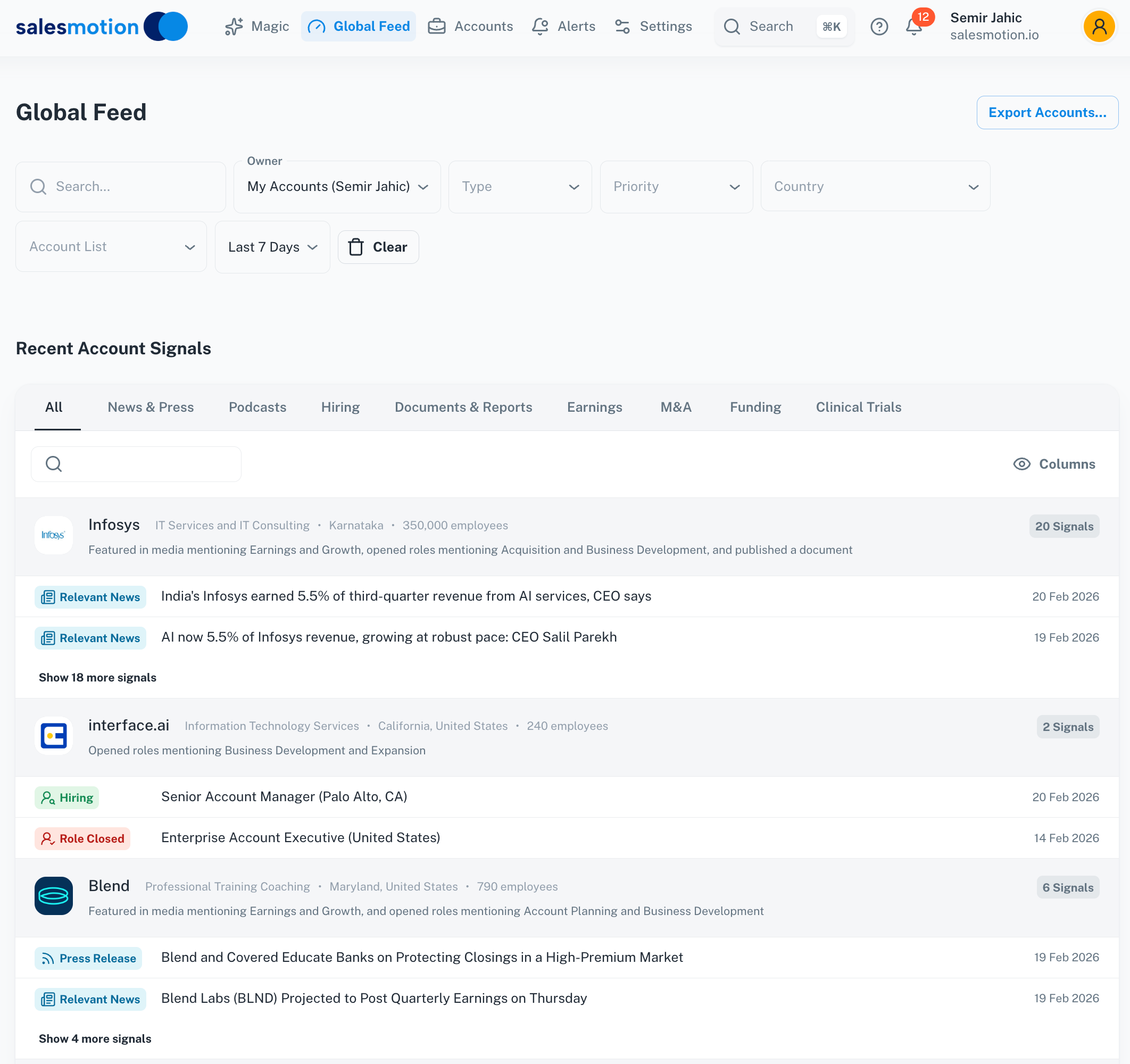 Real-time signal feed surfacing leadership changes, funding events, earnings insights, and hiring patterns across a sales territory.
How Three Specialized Agents Chain Together
The signal-to-action workflow above is not one monolithic agent. It is three purpose-built agents that hand off to each other automatically:
-
Signal Agent monitors 1,000+ data sources continuously: earnings calls, leadership changes, hiring surges, funding rounds, product launches, competitive displacements, and SEC filings. When a relevant event fires on a target account, it surfaces the signal with context and routes it to the right rep.
-
Research Agent takes over when a signal needs deeper context. It compiles a full account brief in under two minutes: the signal that triggered it, the company's strategic priorities from recent earnings, related leadership changes, hiring patterns, technology stack, competitive landscape, and suggested talking points. This is the brief that would take a rep 45 to 90 minutes to build manually.
-
Outreach Agent drafts personalized messaging anchored to the research brief. It does not write generic templates. It references the specific initiative from the earnings call, the executive who stated it, and connects your solution to their stated priority. The rep reviews and sends in under five minutes.
The chain matters because each agent builds on the output of the one before it. The Outreach Agent does not just know that a leadership change happened. It knows that the new CRO came from a company that already uses your product category, that the CEO mentioned "sales transformation" on last quarter's call, and that the company posted 8 sales operations roles in the past 30 days. That depth of context is what separates signal-to-action agents from autonomous SDRs that blast volume without understanding.
What to Look for When Evaluating AI Sales Agents
Not every team needs the same type of agent. Start with your biggest bottleneck.
If reps waste time on CRM data entry and deal updates, a CRM copilot might be enough. If you need more outbound volume but your SDR team is maxed out, an autonomous SDR agent makes sense. If reps spend hours researching accounts before calls and still go in underprepared, a signal-to-action agent will have the biggest impact.
Questions to ask before you buy:
- What data does the agent access? CRM-only agents miss most of what matters. Look for agents that pull from public filings, news, job postings, earnings calls, and technology signals.
- How does the agent handle context? Can it connect a hiring signal to an earnings call mention to a competitive loss, or does it treat each signal as an isolated event?
- What does "autonomous" actually mean? Some vendors call a suggestion engine an "agent." Ask for a demo where the agent completes a full workflow without manual intervention.
- How fast is time to value? If implementation takes three months and a dedicated admin, the ROI math changes dramatically. Cacheflow saw full platform utilization within 24 hours of signing up.
- Does it integrate where reps work? The best intelligence is worthless if it lives in a separate tab. Look for Salesforce, HubSpot, or email integration so signals surface inside the tools reps already use.
- What governance exists? SailPoint research found that 80% of businesses experienced unauthorized boundary actions from agents. Ask about guardrails, audit trails, and data access controls.
Key Takeaways
- AI sales agents are not one category. CRM copilots, autonomous SDRs, and signal-to-action agents solve fundamentally different problems.
- The ROI is real: 86% of teams report positive returns in year one, and the gains compound over time.
- But 40%+ of deployments risk failure because they automate the wrong tasks or lack governance.
- Agents without live buying signals produce volume without relevance, which is just faster spam.
- Signal-based agents that monitor external sources, build contextual briefs, and draft anchored outreach deliver the highest impact for account-based and enterprise sales teams.
- Before buying, identify your team's biggest bottleneck and choose the agent type that directly addresses it.
- For teams evaluating specific AI agent vendors, our Poggio alternatives and Rox alternatives guides compare options across pricing, capabilities, and use cases.
Frequently Asked Questions
What is the difference between an AI sales agent and a chatbot?
A chatbot responds to inbound questions using pre-programmed scripts or FAQ databases. An AI sales agent acts autonomously across multiple steps: monitoring signals, researching accounts, generating outreach, and following up. Chatbots are reactive and narrow. Agents are proactive and multi-step. Gartner distinguishes them by noting that agents are "business-data dependent" and capable of independent reasoning, while chatbots follow predefined conversation trees.
Can AI sales agents replace SDRs?
Not entirely, but they change the role significantly. AI SDR agents handle high-volume prospecting, lead qualification, and initial outreach at a fraction of the cost. ScaleVise estimates $15 per qualified lead versus $50 manually. Human SDRs still add value for complex deal navigation, relationship building, and creative problem-solving. The trend is toward hybrid teams where agents handle research and first touches while humans handle conversations that require judgment.
What is the ROI of AI sales agents?
86% of sales teams using AI report positive ROI within the first year. Revenue growth is 17 percentage points higher for AI-using teams (83% vs. 66%, per Salesforce). McKinsey estimates 3 to 15% revenue increases and 10 to 20% ROI improvements. The key variable is implementation quality, not the technology itself.
How do AI sales agents use buying signals?
Signal-based agents monitor external data sources like news, earnings calls, job postings, SEC filings, and technology adoption data for events that indicate an account may be entering a buying window. When a signal fires (a leadership change, a strategic initiative announcement, or a competitive displacement), the agent automatically researches the account, builds context, and generates personalized outreach anchored to that specific event. This is fundamentally different from agents that only work with static CRM data.
Will AI agents replace salespeople?
No. Gartner predicts that by 2028, AI agents will outnumber sellers 10 to 1, but the agents handle research, qualification, and administrative work while humans handle relationships, negotiation, and strategic decision-making. The winning model is not fewer reps. It is the same number of reps spending more of their time on actual selling, backed by agents that handle the other 72%.
What are the best AI sales agents for signal monitoring and drafting outreach from account briefs?
For teams that need AI agents specifically for signal monitoring and signal-anchored outreach, Salesmotion's three-agent system — Signal Agent, Research Agent, and Outreach Agent — is purpose-built for this workflow. The Signal Agent monitors 1,000+ sources for buying signals (earnings calls, leadership changes, funding, hiring). The Research Agent compiles signals into cited account briefs. The Outreach Agent drafts personalized messages tied to real events. Other options in the signal-to-action category include Regie.ai (AI-generated email sequences), 11x.ai (fully autonomous AI SDR "Alice"), and Clay (custom enrichment + AI outreach). The key difference is depth of intelligence: Salesmotion starts with management intent and public signals, while most competitors start with contact databases and templates.
How does Salesmotion compare to Clay, Regie.ai, and 11x for AI sales agents?
Each solves a different problem. Clay is a data enrichment platform with AI capabilities — great for building prospect lists and custom workflows, but requires RevOps expertise. Regie.ai generates AI-written email sequences and has autonomous SDR agents, but doesn't monitor buying signals from public sources. 11x.ai offers fully autonomous AI SDR "Alice" that replaces human SDRs entirely, but operates from contact databases rather than account intelligence. Salesmotion is an account intelligence platform that monitors 1,000+ sources for buying signals and management intent, then generates research briefs and signal-anchored outreach. See our detailed comparisons: Salesmotion vs Clay, Salesmotion vs Regie.ai, Salesmotion vs 11x.