In 1996, a sales team at PTC was struggling with the same problem every enterprise org faces: too many deals in the pipeline, not enough closing. Dick Dunkel and his colleagues built a qualification framework called MEDDIC that helped PTC grow from $300M to $1B in revenue over four years. As Darius Lahoutifard, one of the original PTC practitioners and founder of MEDDIC Academy, puts it: "All these symptoms are related to the same illness: inability to qualify."
Three decades later, the framework has evolved into MEDDPICC, and it is now the most widely adopted qualification methodology in enterprise B2B SaaS. 73% of SaaS companies selling above $100K ARR use some version of it. Organizations that fully adopt MEDDPICC report 18% higher win rates and 24% larger deal sizes. Between 2021 and 2022, MEDDPICC adoption doubled from 11% to 21% among B2B sales organizations.
But here is the uncomfortable truth most MEDDPICC training skips: the framework only works when your data is fresh and your reps actually use it. I will break down all eight elements, show you when MEDDPICC outperforms simpler frameworks, share the criticism you need to hear, and explain why the methodology breaks at scale without automated intelligence.
TL;DR: MEDDPICC is an eight-element qualification framework (Metrics, Economic Buyer, Decision Criteria, Decision Process, Paper Process, Implicate the Pain, Champion, Competition) built for complex enterprise deals. It improves win rates and deal sizes significantly. The catch: it falls apart when CRM data goes stale, and it over-indexes on late-stage qualification while under-weighting early-stage buyer motivation. Pairing MEDDPICC with real-time account signals turns it from a static checklist into a living deal strategy.
What Is MEDDPICC and Where Did It Come From?
MEDDPICC stands for Metrics, Economic Buyer, Decision Criteria, Decision Process, Paper Process, Implicate the Pain, Champion, and Competition. Dick Dunkel created the original MEDDIC framework at PTC in 1996, where it became the engine behind one of the most remarkable growth stories in enterprise software history. Lahoutifard, who later founded MEDDIC Academy to formalize the training, describes the philosophy simply: "Sales is science, but sellers are artists."
Andy Whyte, founder of MEDDICC Ltd, expanded and popularized the framework through his book and training programs. The "PP" and extra "C" were added later to address two realities of modern enterprise selling: procurement complexity and competitive dynamics.
The framework works because it forces rigor. Every letter represents a qualification dimension that, if left uncovered, can kill an otherwise promising deal.

“Salesmotion is helping Cytel elevate our enterprise sales performance by embedding account intelligence directly into our workflow. The platform gives our commercial team real-time visibility into key account movements.”
Jonathan Burr
Chief Commercial Officer, Cytel
The 8 Elements of MEDDPICC Explained
Metrics: Quantifiable Business Outcomes
Metrics answer the question: "What measurable results will this buyer achieve?" This is not about your product features. It is about the buyer's numbers.
Strong metrics examples include revenue growth percentages, cost reduction targets, time-to-market improvements, and headcount avoided. According to HubSpot's 2025 State of Sales Report, 72% of deals fail because buyers do not see value. Mutually agreed metrics eliminate that ambiguity.
Ask your champion: "If this project succeeds, what number changes on your dashboard in 12 months?" If they cannot answer, you have not qualified the deal.
Economic Buyer: The Person With Budget Authority
The economic buyer is the individual who can say yes when everyone else says no, and say no when everyone else says yes. They control the budget. In enterprise deals, this is typically a VP, SVP, or C-level executive.
Research from Ebsta and Pavilion's 2025 B2B Sales Benchmarks found that early decision-maker involvement boosts win rates by 55%, while delayed engagement reduces win rates by 113%. Getting to the economic buyer early is not optional -- it is the single biggest lever on deal velocity.
Common mistakes reps make with the economic buyer:
- Confusing a technical evaluator with a budget holder
- Accepting "my boss will approve it" without verifying
- Failing to map the economic buyer's personal success metrics
- Never getting a direct conversation with them
You need access. Not second-hand information relayed through your champion, but a real conversation where you understand what success looks like from the budget holder's perspective.
Decision Criteria: What the Buyer Evaluates
Decision criteria are the specific requirements the buying committee uses to compare options. These fall into three categories: technical requirements (integrations, security, scalability), business requirements (ROI timeline, implementation effort, vendor stability), and personal requirements (career risk, team adoption, executive visibility).
Your job is not just to learn the criteria. It is to shape them. The best reps work with their champion to ensure the decision criteria reflect strengths that align with their solution. This is not manipulation. It is consultative selling. You are helping the buyer think through what actually matters.
Decision Process: How the Organization Buys
The decision process maps the steps, people, and timeline between "we like this" and "we signed the contract." This includes:
- Who evaluates the product (and in what order)
- What approvals are required
- Whether there is a formal RFP or vendor scoring process
- The expected timeline from evaluation to decision
Reps who skip this step get blindsided. A deal you thought was closing in Q1 suddenly needs board approval, a security review, and a pilot, pushing it to Q3. Map the process early. Ask: "Walk me through every step from here to a signed agreement."
Paper Process: Legal, Procurement, and Security
The Paper Process is the "PP" that differentiates MEDDPICC from MEDDIC, and it exists because 28% of deals fail when buyers cannot secure internal approval. In regulated industries like financial services and healthcare, the paper process can add months to a deal.
Paper process includes:
- Legal review: redline cycles, liability clauses, indemnification
- Procurement: vendor onboarding, PO creation, payment terms
- Security review: SOC 2 audits, penetration testing, data privacy assessments
- Compliance: industry-specific regulations (HIPAA, GDPR, SOX)
Start mapping the paper process in discovery, not after verbal agreement. Ask your champion: "Once your team decides to move forward, what does procurement look like? Who signs off and how long does it typically take?"
Implicate the Pain: Connect Symptoms to Root Cause
"Identify Pain" was the original MEDDIC phrase. MEDDPICC upgrades it to "Implicate the Pain" because identification alone is not enough. You need the buyer to feel the full weight of the problem.
This works in three layers:
- Surface pain: "Our reps spend too much time researching accounts."
- Business impact: "That means each rep loses 6+ hours per week they could spend selling."
- Personal implication: "Which is why your team missed quota last quarter and your board is asking questions."
The third layer is where deals get funded. When a problem threatens someone's job performance, budget, or career trajectory, it moves from "nice to solve" to "must solve now."
Champion: Internal Advocate With Power and Influence
A true champion has three qualities: power (organizational influence to push deals forward), access (direct line to the economic buyer), and personal motivation (they benefit if your solution succeeds).
Do not confuse a coach with a champion. A coach likes you and shares information. A champion actively sells on your behalf inside the organization, navigates internal politics, and puts their reputation on the line.
Test your champion by asking them to do something: set up a meeting with the economic buyer, share internal evaluation criteria, or present your solution to the buying committee. If they will not act, they are a coach, not a champion. For a deeper playbook, see our guide to champion tracking in B2B sales.
Competition: Direct, Indirect, and Status Quo
Competition in MEDDPICC goes beyond "who else are they evaluating." There are three types:
- Direct competitors: other vendors in your category
- Indirect competitors: alternative approaches (building in-house, using a different type of tool)
- Status quo: the most dangerous competitor. Doing nothing is free and requires zero change management.
To win against status quo, you must make the cost of inaction crystal clear. That is why "Implicate the Pain" and "Competition" work together. When the buyer truly feels the pain and understands the cost of doing nothing, status quo loses its appeal.
See Salesmotion on a real account
Book a 15-minute demo and see how your team saves hours on account research.
The MEDDPICC Criticism You Need to Hear
No framework is perfect, and MEDDPICC has a meaningful blind spot that most trainers gloss over.
Keenan, author of Gap Selling, makes a sharp observation: "80% of the sale happens in the first 2 decisions -- why should I change, and why now? MEDDPICC leans heavily on Decision 3: the economic buyer and paper process." In other words, MEDDPICC is excellent at managing the mechanics of a deal once a buyer is committed to change, but it does less to help reps create that commitment in the first place.
This matters because of what Matt Dixon found in his research for The JOLT Effect. After studying 2.5 million sales conversations, Dixon concluded that 40-60% of the average sales pipeline stalls out due to buyer indecision, not competitive loss. Buyers are not choosing a competitor over you. They are choosing to do nothing because the risk of change feels greater than the cost of the status quo.
MEDDPICC's "Implicate the Pain" element is supposed to address this, but in practice, most reps treat it as a checkbox -- they identify a pain, note it in the CRM, and move on to mapping the decision process. They skip the hard work of quantifying the cost of inaction with real metrics and making the buyer feel it at a personal level.
The fix is not to abandon MEDDPICC. It is to front-load the framework with stronger discovery. Before you start filling in Decision Criteria and Paper Process fields, make sure the buyer has answered two questions with conviction: Why should we change? and Why now? Without those answers, the rest of MEDDPICC is an exercise in managing a deal that was never real.
Salesmotion's Take
I used MEDDPICC at both Salesforce and Clari. The framework itself is sound, but it assumes reps have time to do deep account research for every element -- especially Metrics, Economic Buyer research, and Identified Pain. In practice, that research takes hours per account, and most reps simply skip it or guess. The real bottleneck was never knowing the framework; it was having the data to fill it in.

Semir Jahic
CEO & Co-Founder, Salesmotion
MEDDPICC vs. Other Sales Qualification Frameworks
Not every deal needs MEDDPICC. Choosing the right framework depends on your deal complexity, sales cycle, and average deal size. Here is how the most popular frameworks compare:
| Framework | Best For | Deal Size | Cycle Length | Stakeholders | Key Strength |
|---|---|---|---|---|---|
| MEDDPICC | Complex enterprise sales | $100K+ | 3-12 months | 5-15+ | Full deal qualification + procurement |
| MEDDIC | Mid-market to enterprise | $50K-$500K | 2-9 months | 3-10 | Core qualification without procurement |
| BANT | Transactional sales | $5K-$50K | Under 60 days | 1-3 | Quick lead qualification |
| SPIN | Consultative selling | $25K-$250K | 1-6 months | 2-8 | Needs discovery + pain development |
When to use MEDDPICC over MEDDIC: Choose MEDDPICC when you are selling into organizations with formal procurement processes, security reviews, or regulatory compliance requirements. If your deals regularly stall after verbal agreement, the Paper Process element will save you.
When BANT is enough: For deals under $50K with one or two decision makers and a short cycle, BANT works fine. Do not over-engineer qualification for transactional sales.
When to blend frameworks: Many top-performing teams use BANT for lead qualification at the top of the funnel, then switch to MEDDPICC once a deal enters the pipeline. SPIN Selling techniques layer well into the "Implicate the Pain" element, especially when you need to build the case for change before mapping the buying process.

“Salesmotion empowers me to cultivate a great buyer experience. I'm able to challenge prospects' thinking and be a trusted consultative seller. A major part of this is Salesmotion insights.”
Austin Friesen
Account Executive, FY25 #1 President's Club, Clari
Why MEDDPICC Breaks at Scale
Here is where most MEDDPICC guides stop. They give you the framework, tell you to train your team, and move on. But I have watched MEDDPICC fail at dozens of organizations, and the failure pattern is always the same.
Problem 1: Reps do not fill in the fields. MEDDPICC only works if qualification data lives somewhere accessible. In practice, reps enter data once and never update it. A Salesforce report showed that 70% of CRM data is outdated, incomplete, or inaccurate. Your MEDDPICC fields are no exception.
Problem 2: The data goes stale immediately. Your champion left the company. The economic buyer changed. A competitor launched a new product. The prospect announced layoffs. None of this shows up in your CRM fields unless someone manually updates them, and they will not.
Problem 3: The signals that matter live outside the CRM. Leadership changes, earnings calls, hiring surges, funding rounds, M&A activity, product launches. These are the events that make or break MEDDPICC qualification, and they live in press releases, SEC filings, job boards, and news feeds. No CRM captures them automatically.
The result? Your reps fill out MEDDPICC fields during deal review, the data reflects a snapshot from two months ago, and your forecast is built on stale information.
How Account Intelligence Fills the Gap
The fix is not more training or stricter CRM enforcement. It is automated company intelligence that feeds real-time signals directly into your deal qualification workflow.
Here is a concrete example of how this works in practice:
Signal: An account intelligence platform detects that your prospect's VP of Engineering (your champion's boss and economic buyer) just left the company, based on a LinkedIn leadership change signal.
Platform action: The account is automatically flagged as at-risk. The rep receives an alert with context: who left, their replacement (if announced), and the potential impact on the deal.
Rep action: Instead of discovering this three weeks later during a deal review, the rep immediately reaches out to their champion: "I saw David moved on. How does this affect the evaluation timeline? Should we loop in the new VP?"
Outcome: The deal is re-qualified in real time. The rep builds a relationship with the new economic buyer before competitors even notice the change. That is signal-based selling applied to qualification: the change in the account, not a calendar reminder, drives the next action.
This is what operationalized MEDDPICC looks like. Not static CRM fields, but live intelligence flowing into qualification decisions every day.
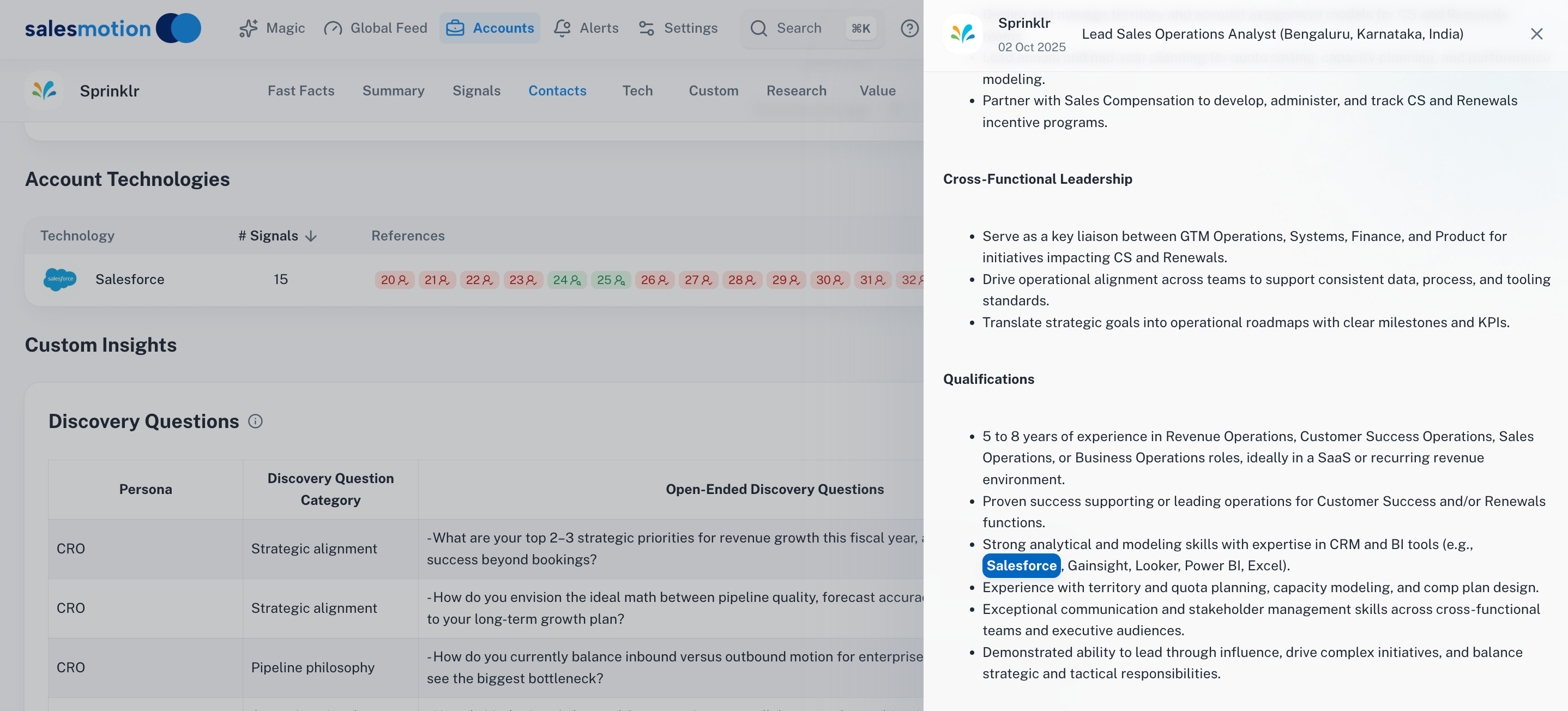 An account intelligence platform enriches CRM data with tech stack details, custom discovery fields, and real-time firmographic changes so reps can qualify deals with current information.
How to Implement MEDDPICC on Your Team
Rolling out MEDDPICC is not about a one-day training session. Research from Korn Ferry shows organizations with consistent methodology reinforcement achieve 27% higher win rates than those with one-time training. Here is a phased approach:
Phase 1: Foundation (Weeks 1-2)
- Train the team on all eight elements with deal-specific examples
- Create MEDDPICC scorecards in your CRM (one field per element)
- Identify 5-10 active deals to retroactively qualify
Phase 2: Reinforcement (Weeks 3-8)
- Run weekly deal reviews using MEDDPICC as the framework
- Coach reps on the weakest elements (usually Paper Process and Implicate the Pain)
- Set minimum qualification thresholds for deals to advance stages
Phase 3: Optimization (Months 3-6)
- Analyze which MEDDPICC elements correlate with won deals in your data
- Pair the framework with account intelligence signals to automate data freshness
- Build dashboards showing qualification completeness vs. win rates
Phase 4: Culture (Ongoing)
- Make MEDDPICC the language of your deal reviews
- Celebrate reps who disqualify bad deals early (saves resources for winnable ones)
- Track pipeline quality, not just pipeline volume
Real-World MEDDPICC Scoring Example
Here is how a scored deal might look for a $200K enterprise software sale:
| Element | Status | Score | Notes |
|---|---|---|---|
| Metrics | Defined | 3/3 | Buyer targets 25% reduction in research time |
| Economic Buyer | Identified, no access | 1/3 | VP Sales confirmed as EB, meeting requested |
| Decision Criteria | Partially mapped | 2/3 | Technical criteria known, business criteria pending |
| Decision Process | Mapped | 3/3 | 4-step process with clear timeline |
| Paper Process | Unknown | 0/3 | Have not asked about procurement yet |
| Implicate Pain | Surface only | 1/3 | Pain identified but not quantified |
| Champion | Confirmed | 3/3 | Director actively selling internally |
| Competition | Partially known | 2/3 | One direct competitor identified |
Total: 15/24 (63%). This deal has gaps in Paper Process and Economic Buyer access. A disciplined team would not advance this to forecast committed until those scores improve.
The best sales leaders I know require a minimum score threshold (usually 70%+) before a deal enters the commit forecast. This single practice improves forecast accuracy more than any other operational change.
Key Takeaways
- MEDDPICC adds Paper Process and Competition to the original MEDDIC framework, making it the most thorough qualification methodology for complex enterprise deals with formal procurement.
- Each of the eight elements addresses a distinct failure mode. Skip one, and that is likely where your deal will stall or die.
- Use MEDDPICC for deals over $100K with 5+ stakeholders and multi-month cycles. For simpler deals, BANT or MEDDIC may be sufficient.
- The framework has a blind spot: it excels at managing deals where buyer commitment already exists, but does less to create that commitment. Front-load discovery to address "why change" and "why now" before mapping the buying process.
- Score every deal against all eight elements. Set minimum thresholds before advancing deals to commit forecast.
- Champion validation is the single most predictive element. Test your champion by asking them to act, not just inform.
Related Reading
- Personalize outreach at scale — how to brief reps on enterprise stakeholders so MEDDPICC champions actually engage.
- What is a trigger event? — the "why now" signals that move deals out of stuck implication and into procurement.
- Cold calling signals 2026 — using real-time account intelligence to enter deals already qualified.
Frequently Asked Questions
What is the difference between MEDDIC and MEDDPICC?
MEDDIC has six elements: Metrics, Economic Buyer, Decision Criteria, Decision Process, Identify Pain, and Champion. MEDDPICC adds two: Paper Process (the legal, procurement, and security steps required to close) and Competition (direct competitors, indirect alternatives, and status quo). Choose MEDDPICC when your deals involve formal procurement cycles, regulatory compliance, or competitive evaluations. For mid-market deals with simpler buying processes, MEDDIC covers the essentials.
How long does it take to implement MEDDPICC across a sales team?
Most organizations reach baseline proficiency in 3-4 months with consistent reinforcement. The first two weeks focus on training and CRM setup. Weeks 3-8 involve coached deal reviews where reps apply the framework to active deals. Full cultural adoption, where MEDDPICC becomes the default language for deal strategy, typically takes 6 months. The biggest mistake is treating it as a one-time training event instead of an ongoing operating rhythm.
Can MEDDPICC work for inside sales or smaller deals?
MEDDPICC was designed for complex enterprise sales, and applying all eight elements to a $10K deal with one decision maker creates unnecessary overhead. For smaller deals, consider using BANT for qualification or MEDDIC without the Paper Process and Competition elements. The sweet spot for full MEDDPICC is deals above $100K with multiple stakeholders, 3+ month sales cycles, and formal procurement requirements. That said, individual elements like Implicate the Pain and Champion are valuable at any deal size.
What is the most important element of MEDDPICC?
Champion is the most predictive element of deal success. Without an internal advocate who has power, access to the economic buyer, and personal motivation, even perfectly qualified deals stall. Research shows that B2B buying groups now average 6-10 decision makers, making an internal champion essential to navigate consensus-driven purchasing. Metrics is a close second because, as HubSpot data shows, 72% of deals fail when buyers do not see clear value.
How do I keep MEDDPICC data fresh in the CRM?
This is the hardest operational challenge with MEDDPICC. B2B data decays at 25-30% per year, and CRM fields filled during discovery are often outdated by the time you reach negotiation. Three approaches help: require MEDDPICC updates at every stage gate (not just once), use automated account intelligence platforms that surface leadership changes, funding events, and competitive moves in real time, and run weekly pipeline reviews where reps must verbally verify each element. The combination of process discipline and automated signals keeps qualification accurate.