Signal-based selling tools fall into three layers: signal collection (ZoomInfo, 6sense), relationship and community signals (UserGems, Common Room), and signal-to-action platforms that turn a trigger into outreach (Octave, Salesmotion). The best buying signals tool depends on which layer you are missing. For teams that want detection, research, and action in one workflow, Salesmotion runs all three natively: it monitors 1,000+ sources, scores accounts against your ICP, and drafts signal-anchored outreach a rep can send. Below we compare the leading tools by use case, signal coverage, and pricing.
TL;DR: Most "signal" vendors only collect signals. They tell you something happened, then leave the research and outreach to you. When you evaluate signal-based selling tools, the deciding question is whether the tool acts on the signal or just reports it. Salesmotion, UserGems, and Octave act; ZoomInfo, 6sense, and Common Room mostly detect. Pricing ranges from $85/mo to six figures a year.
Signal-Based Selling Tools at a Glance
| Tool | Best for | Signal types covered | Acts on signals? | All 3 layers native? | Starting price |
|---|---|---|---|---|---|
| Salesmotion | Detection + research + outreach in one workflow | Leadership, funding, hiring, M&A, earnings, tech moves, custom topics (1,000+ sources) | Yes, drafts email + LinkedIn | Yes | $85/mo individual |
| ZoomInfo | Broad intent + contact database backbone | Intent topics, scoops, technographics | Partial (Engage add-on) | No | Not published; consumption-based |
| UserGems | Job-change and champion tracking | Job changes, champion movement, 30+ signal types | Triggers and plays | No | $3,000/mo |
| Common Room | First-party product, website, community signals | Website visits, product usage, social, community | Partial (workflows) | No | $2,500/mo (annual) |
| Octave | Turning signals you already have into messaging | Relies on signals you feed it | Yes (messaging) | No | Free / $149/mo |
| Clay | DIY enrichment and custom signal automation | Anything via 150+ integrations, build it yourself | Yes (via sequences) | No | Free / $185/mo |
| 6sense | Enterprise predictive intent and ABM | Predictive intent, anonymous web traffic | Partial | No | Not published; Vendr median $62,440/yr |
The columns that matter most are the middle two. Plenty of tools detect signals. Very few close the loop from "this account just hired a new CRO" to "here is a researched, ready-to-edit message referencing it."
See Salesmotion on a real account
Book a 15-minute demo and see how your team saves hours on account research.
What Is Signal-Based Selling?
Signal-based selling is the practice of timing and tailoring outreach around observable buying signals: leadership changes, funding rounds, hiring surges, earnings commentary, M&A, and technology moves. Instead of working a static list top to bottom, reps work the accounts showing evidence of change right now. We cover the full methodology in our signal-based selling playbook, so this section stays short.
The three layers of a signal stack
Every signal-based selling motion needs three capabilities. Collection: detecting that something happened. Intelligence: understanding what it means for your pitch and who to contact. Engagement: getting a relevant message out while the signal is fresh. Most teams buy a different tool for each layer, then lose deals in the handoffs between them.
Buying signals vs. intent data
They are not the same thing. Intent data infers interest from anonymous web behavior, like spikes in topic research across a publisher network. Buying signals are concrete, attributable events: a named company filed an 8-K, posted six sales roles, or appointed a new CRO. Intent tells you someone in the building might be curious. A buying signal tells you exactly what changed and gives the rep something specific to say. Our guide to intent data providers covers the inference side in depth.
Signals that actually convert
The highest-converting B2B signals share one trait: they predict budget movement. Leadership changes (new executives spend in their first 90 days), funding rounds, hiring surges in a relevant function, earnings call language about new initiatives, and M&A activity. We ranked these in our guide to buying triggers.

“The account and contact signals are key for reaching out at important times, and the value-add messaging it creates unique to every contact helps save time and efficiency.”
Daniel Pitman
Mid-Market Account Executive, Black Swan Data
How We Evaluated These Tools
Four criteria, applied to every tool on this list:
- Signal breadth and freshness. How many sources does it monitor, and how fast does a real-world event show up in the product?
- Detection vs. action. Does the tool act on the signal (research, scoring, drafted outreach), or does it stop at an alert?
- ICP scoring. Can it rank accounts against your ideal customer profile so reps know which signal to work first?
- Time-to-value. How long from contract to a rep actually using it? Enterprise intent platforms routinely take a quarter to deploy; the best tools here take a day.
We weighted "acts on the signal" heaviest, because that is where the category is heading. Gartner predicts over 40% of agentic AI projects will be canceled by end of 2027, largely because tools that generate activity without business value get cut first. Signal tools that just produce more alerts to triage are in that category. Tools that remove work survive budget reviews.
The Best Signal-Based Selling Tools, Reviewed
1. Salesmotion: best for detection, research, and outreach in one workflow
Verdict: The only tool on this list that runs all three layers natively, so a buying signal becomes a sourced account brief and a drafted message without switching vendors.
Salesmotion monitors 1,000+ public and private sources for leadership changes, funding, hiring patterns, earnings commentary, M&A, and custom topics you define. Each signal lands in a scored account view, so reps see which accounts are entering a buying window, not just a raw feed. From there, the research agent assembles a cited account brief, and the outreach agent drafts email and LinkedIn messages anchored to the specific signal. A rep reviews, edits, and sends.
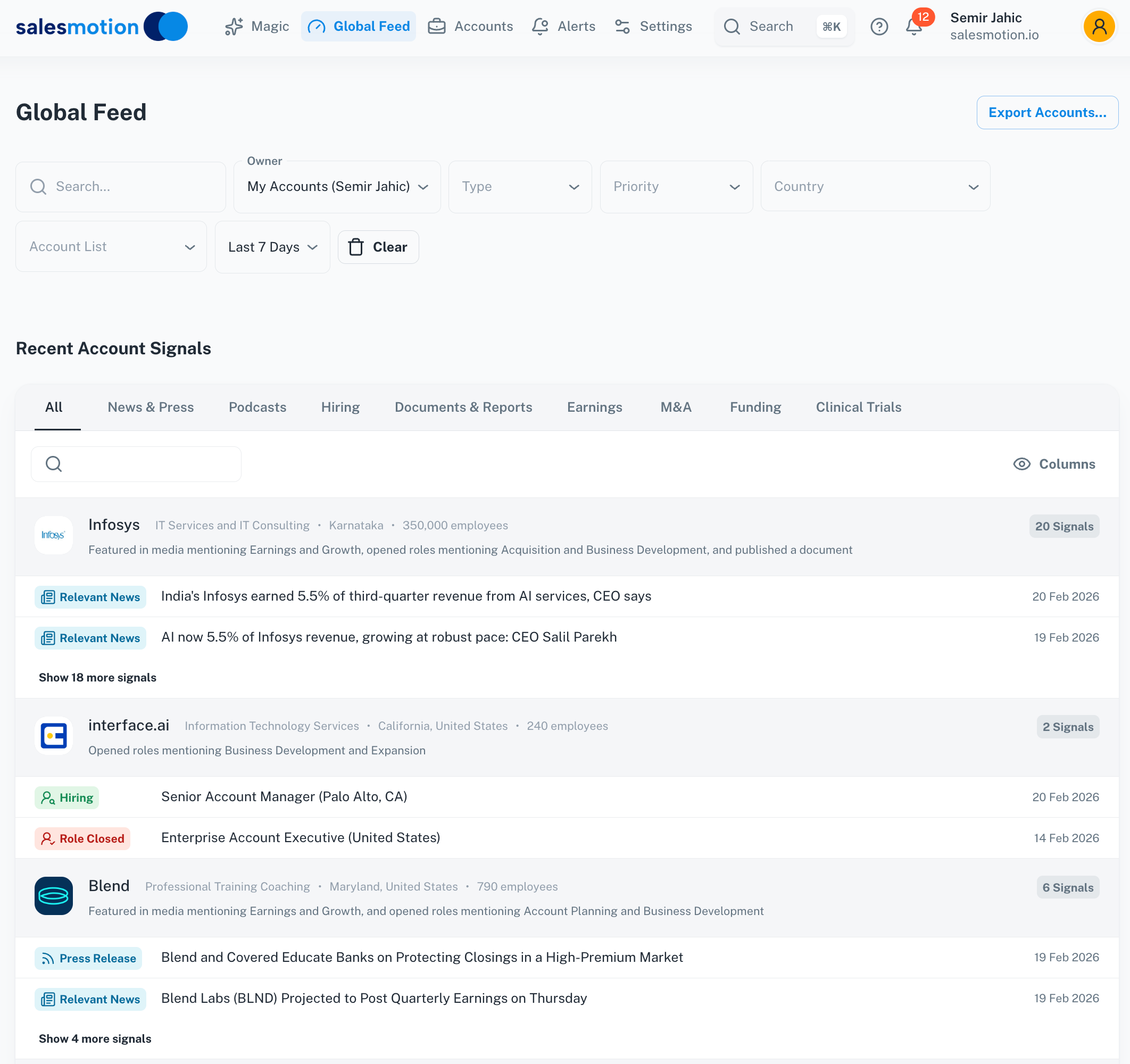 The signal feed surfaces leadership changes, earnings mentions, and hiring surges across every account in a territory.
Best for: AEs and teams who want one workflow from signal to send. Analytic Partners grew qualified pipeline 40% year over year and cut account research from 3 hours to 15 minutes on it.
Limitation: It is account intelligence, not a contact database replacement. Verified contacts are included, but if you need millions of exportable records for list building, pair it with a database tool.
Pricing: $85/mo self-serve individual plan, monthly billing, no annual commitment. Custom pricing for teams and enterprise with unlimited users on team plans. See pricing.
2. ZoomInfo: best for a broad intent and contact-data backbone
Verdict: The biggest B2B database with intent layered on top, but signals are an add-on to contact data, not the core workflow.
ZoomInfo pairs its contact database with intent topics, "scoops," and technographics. If your bottleneck is finding phone numbers and emails at scale, it remains the default. As a signal tool, it tells you a topic is trending at an account, then leaves research and messaging to you (or to its separately priced Engage and Copilot products).
 ZoomInfo positions itself as a go-to-market intelligence platform built around its contact database.
Best for: Teams that need a data backbone first and treat signals as a secondary filter.
Limitation: Consumption-based pricing makes spend hard to forecast, and annual contracts are the norm.
Pricing: Not published — ZoomInfo's own pricing page says so, because pricing is consumption-based. Vendr reports an average contract value of $33,500 across 1,012 anonymized deals. Full breakdown in our ZoomInfo pricing guide.
3. UserGems: best for job-change and champion-tracking signals
Verdict: The strongest tool for one specific signal family: people who already know you moving into new buying roles.
UserGems tracks past champions, users, and buyers as they change jobs, then triggers plays when one lands somewhere in your ICP. It has expanded to 30+ signal types and added AI outbound (Gem-E), but relationship signals remain the core strength. Job-change-sourced pipeline converts well because trust already exists.
 UserGems centers its platform on champion tracking and job-change signals.
Best for: Teams with a large customer or user base to mine for warm paths.
Limitation: Its picture starts from your CRM contacts. Signals at accounts where you have no prior relationships are not the focus.
Pricing: Core starts at $3,000/mo ($36K/yr) plus an implementation fee. Full breakdown in our UserGems pricing guide.
4. Common Room: best for first-party product, website, and community signals
Verdict: Excellent at capturing signals your own properties generate, less focused on external market signals.
Common Room aggregates website visits, product usage, community chatter, and social activity into unified buyer profiles, then routes plays through workflows. If buyers touch your docs, GitHub, Slack community, or site before talking to sales, it captures intent most tools miss.
 Common Room focuses on turning first-party buyer activity into pipeline.
Best for: Product-led and community-led companies with meaningful first-party traffic.
Limitation: External signals (earnings, exec moves, funding at cold accounts) are thinner, and pricing scales with contacts enriched.
Pricing: Essential starts at $2,500/mo billed annually. Details in our Common Room pricing breakdown.
5. Octave: best for turning signals you already have into messaging
Verdict: A strong positioning and messaging layer that assumes you already own the detection problem.
Octave builds a context layer from your offerings, personas, and playbooks, then generates messaging, call prep, and battle cards grounded in that context. Feed it a signal and it produces a sharp, on-positioning angle. It does not monitor the market for you at depth, so it pairs with a detection layer rather than replacing one.
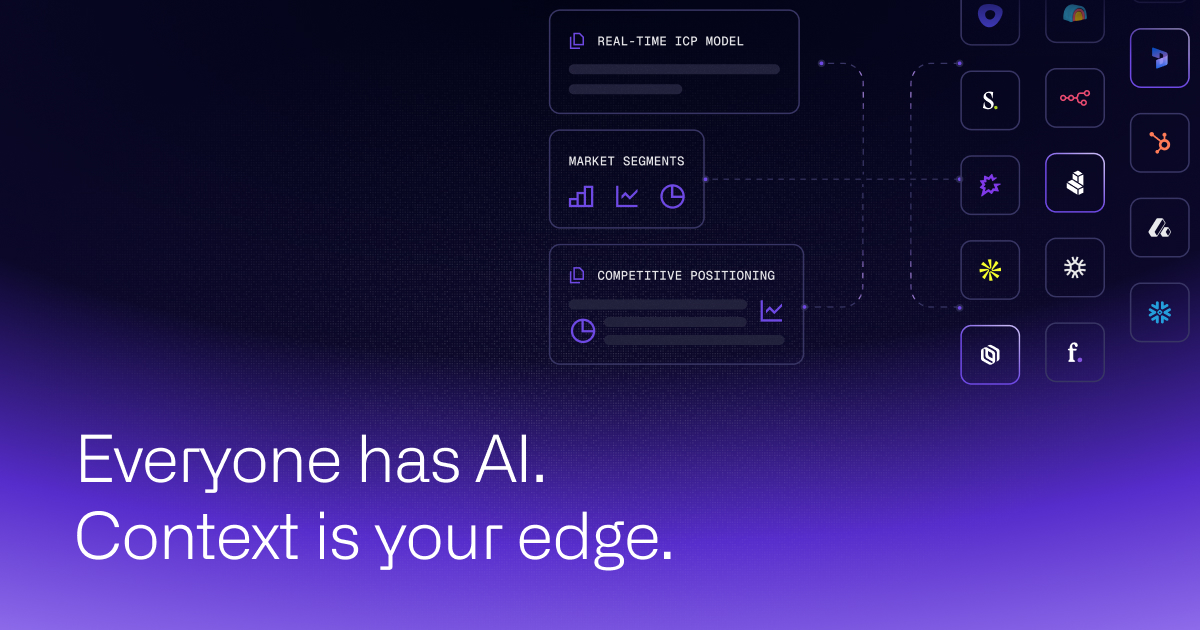 Octave positions context as the differentiator for AI-generated GTM messaging.
Best for: Teams with solid signal sources but weak, generic messaging.
Limitation: Output quality depends on signals and context you supply. No native territory-wide signal detection.
Pricing: Free Lite plan; Core at $149/mo; higher tiers to $999/mo.
6. Clay: best for DIY enrichment and custom signal automation
Verdict: The most flexible option on this list, if you have someone technical to build and maintain the workflows.
Clay is a spreadsheet-style workbench connecting 150+ data providers with AI agents. You can build nearly any signal workflow: scrape job postings, watch news, enrich, score, and push to sequences. The trade-off is that you are the architect, and credit consumption needs active management.
 Clay gives GTM engineers building blocks for custom signal and enrichment workflows.
Best for: GTM engineers and ops-heavy teams that want full control.
Limitation: Real maintenance burden. Workflows break, credits drain, and reps rarely self-serve.
Pricing: Free tier; Launch at $185/mo after the March 2026 repricing. See our Clay pricing breakdown.
7. 6sense: best for enterprise predictive intent and ABM
Verdict: The enterprise standard for predictive intent, with cost and deployment weight to match.
6sense de-anonymizes web traffic and applies predictive models to estimate where accounts sit in their buying journey. For large ABM programs coordinating ads, SDRs, and field sales, the predictive layer is genuinely differentiated. For teams under a few hundred employees, it is usually overkill.
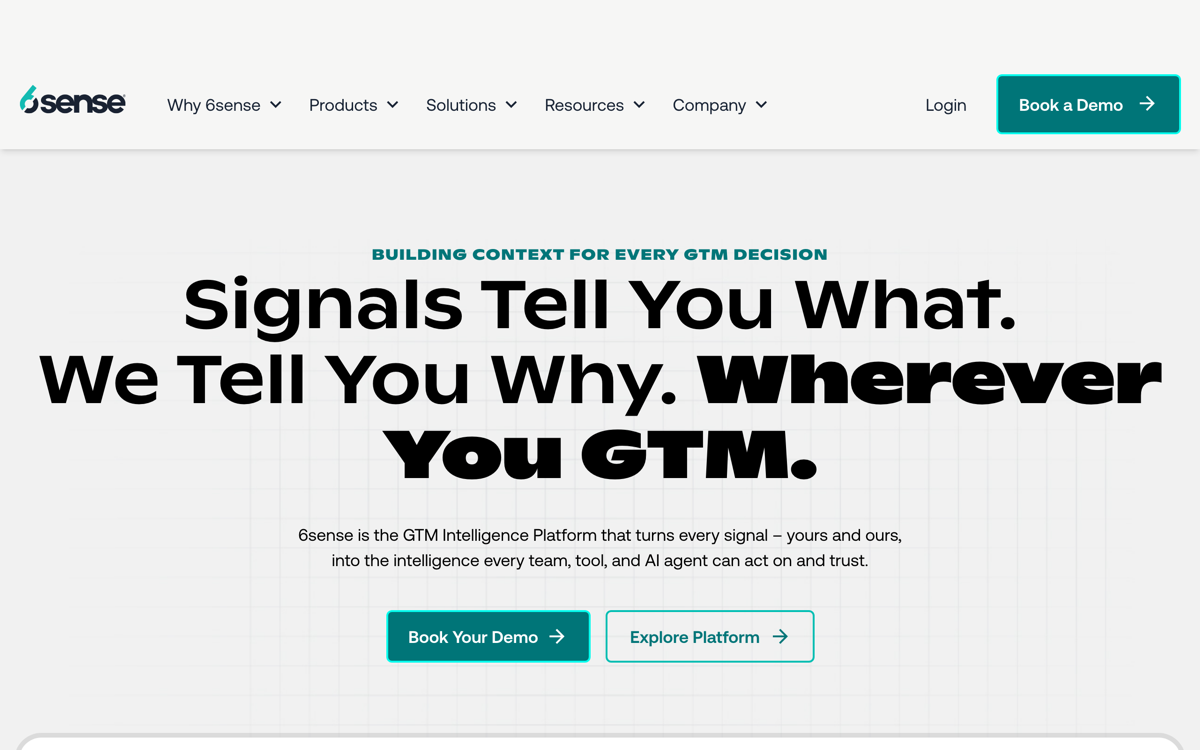 6sense leads with predictive context: signals tell you what, the platform tells you why.
Best for: Enterprise GTM orgs with dedicated RevOps and ABM budgets.
Limitation: Vendr puts the median contract at $62,440/yr, deployments run a quarter, and reps cannot always explain the scores to their managers.
Pricing: Not published, and there is no free plan on the current pricing page. See our 6sense pricing guide.

“Automatic account profile detail I can use to manage my territory. Using Salesmotion AI to generate value statements per persona, account, etc. Using Salesmotion to give me a starting point based on new hires, or news alerts is critical.”
Adam Wainwright
Head of Revenue, Cacheflow
How to Choose a Signal-Based Selling Tool
Start by diagnosing which layer you are missing, not by comparing feature lists.
If reps say "I never know which account to work first," you are missing collection and scoring. If they know what happened but send generic outreach anyway, you are missing the action layer. If outreach is fine but always late, your signals are stale or trapped in a tool nobody opens.
Here is what the full loop looks like when one platform owns it:
- Trigger: A target account announces a new VP of Revenue Operations and posts four sales ops roles in the same week.
- Platform action: The account gets flagged, its ICP score rises, and the account brief updates: new leader, hiring surge, plus an earnings call mention of "go-to-market efficiency."
- Rep action: The rep opens a pre-drafted email referencing the new VP's mandate, edits two lines, and sends it the same morning.
- Outcome: Discovery starts with a consultative conversation about an initiative the buyer is publicly funding. Customers like Incredible Health increased quarterly meetings booked by 50% working this way.
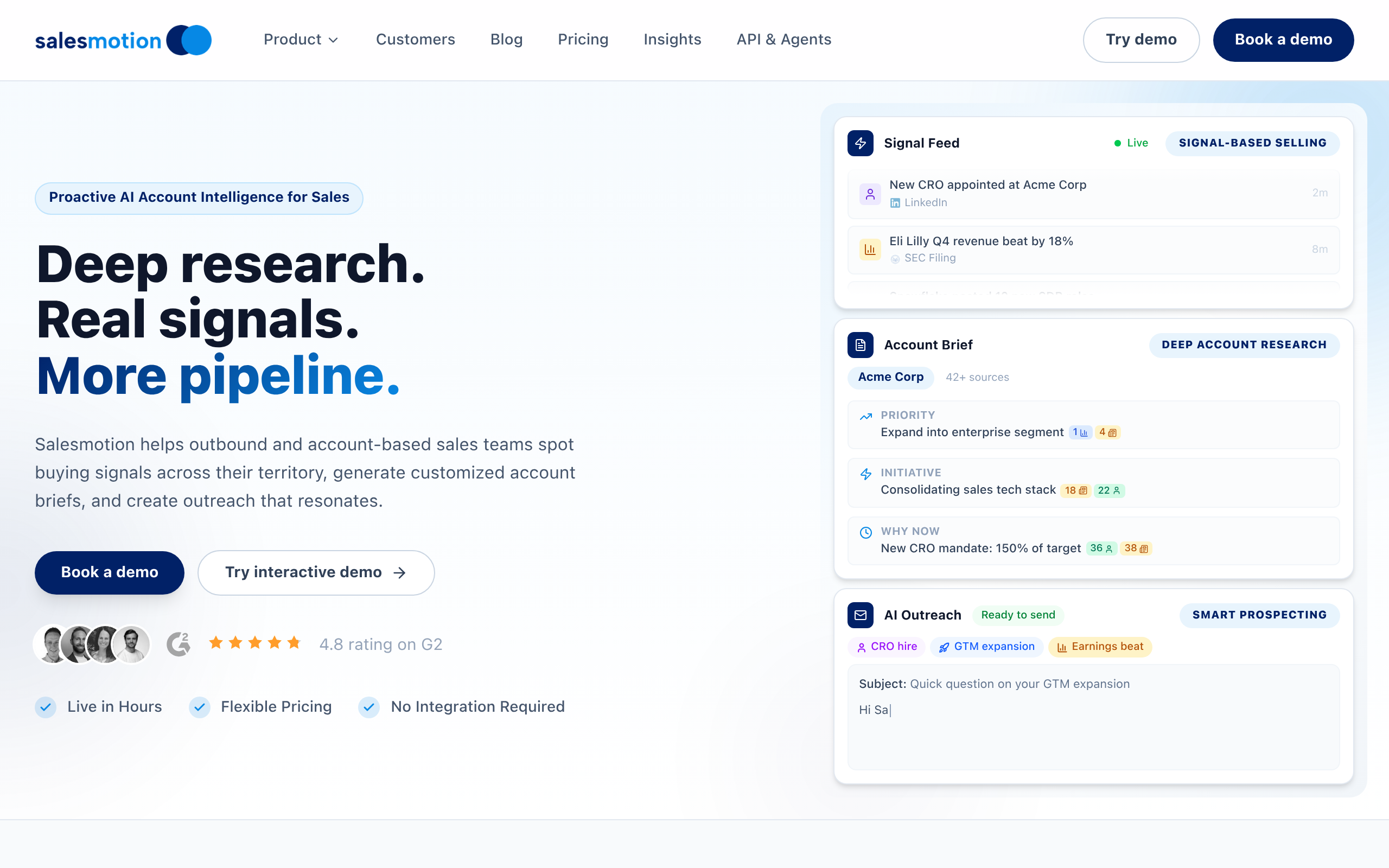 One workflow from signal detection to drafted outreach, starting at $85/mo.
Decision shortcut:
Choose ZoomInfo if you need a contact-data backbone. Choose UserGems if your best deals come from past champions. Choose Common Room if your buyers touch your product and community first. Choose Octave if you have signals but weak messaging. Choose Clay if you want to build your own stack. Choose Salesmotion if you want detection, research, and outreach connected in one workflow.
Key Takeaways
- Signal-based selling tools split into three layers: collection, intelligence, and engagement. Most vendors cover one.
- The deciding evaluation question is whether the tool acts on signals (research, scoring, drafted outreach) or just reports them.
- Buying signals are concrete, attributable events; intent data is inferred from anonymous behavior. Most teams switching tools actually want the former.
- Enterprise intent platforms (6sense, ZoomInfo) publish no pricing, and Vendr puts their typical contracts at $62,440 median and $33,500 average respectively; action-layer tools start under $200/mo.
- Match the tool to your gap: warm relationships (UserGems), first-party signals (Common Room), messaging (Octave), custom builds (Clay), or all three layers in one (Salesmotion).
Frequently Asked Questions
What is the best signal-based selling tool in 2026?
It depends on the layer you are missing. Salesmotion is the strongest all-in-one option, combining 1,000+ source monitoring, ICP scoring, and drafted outreach from $85/mo. UserGems leads for job-change signals, Common Room for first-party signals, and 6sense for enterprise predictive intent.
What is the difference between buying signals and intent data?
Buying signals are concrete, named events: a funding round, an executive hire, an earnings call statement. Intent data infers interest from anonymous web research activity. Signals give reps something specific to reference in outreach; intent data mostly tells marketing which accounts to watch.
Can I just use ChatGPT for buying-signal research?
You can research one account at a time, but ChatGPT does not monitor your territory, cite sources reliably, or alert you when something changes. We ran the comparison in detail in Salesmotion vs ChatGPT for account research.
How are real-time buying signals different from a lead list?
A lead list is a static snapshot that decays the day it is exported. Real-time buying signals are events tied to accounts, so priorities reorder themselves as the market moves. Reps work accounts showing evidence of change this week, not whoever was next in the spreadsheet.
How much do signal-based selling tools cost?
Self-serve options run $85 to $200 per month. Mid-market signal platforms publish their entry tiers: UserGems Core at $36,000 a year and Common Room Essential at $2,500 a month billed annually. Enterprise intent platforms publish nothing — Vendr reports a median annual contract of $62,440 for 6sense and an average of $33,500 for ZoomInfo.
Do I need a separate tool to act on buying signals?
With most vendors, yes: detection lives in one tool, research in another, and outreach in a third. That handoff is where speed dies. Platforms that draft signal-anchored outreach natively remove the gap between knowing and acting, which is the entire point of signal-based selling.
See every buying signal in your territory, with the research and outreach already prepared. Book a demo or explore the interactive demo.