Most sales teams evaluating Clay start with the same question: "How much will this actually cost us?" The answer is more complicated than any pricing page suggests, and it changed substantially in spring 2026, when Clay introduced its Launch and Growth plans and a credit system split into separate Data Credits and Actions. Your real spend still depends on how many enrichments you run, which data providers you query, and whether your team can build and optimize workflows efficiently. Vendr reports a median of $59,996 a year across 96 purchases, with a range of $16,500 to $170,000.
This guide breaks down every current Clay pricing tier, explains what changed in the spring 2026 overhaul, how the new dual-credit system works in practice, and the hidden costs that most breakdowns skip.
TL;DR: Clay's self-serve pricing runs from free (100 Data Credits/month) to $185/month on Launch and $495/month on Growth, then custom Enterprise on an annual commitment; Vendr reports a median of $59,996 a year across 96 purchases. Since spring 2026, Clay charges in two currencies, Data Credits for marketplace enrichments and Actions for workflow operations, and enrichments that return no result are not charged. The real cost depends on enrichment volume, data provider mix, and whether your team has the technical resources to build and maintain Clay workflows.
 Clay is a credit-based data workflow builder — powerful for GTM engineers, with a learning curve to match.
Clay
Free–$495/mo
credit-based · Launch and Growth tiers
Salesmotion
From $85/mo
monthly contract · verified contacts included
Clay is a workflow builder you operate. Salesmotion is the agent team that does the work for you, account by account.
- 3 AI agents on every account: signals, research briefs, drafted outreach
- Live in an hour, monthly billing, no annual contract
- Verified contacts included; CRM integration on custom team & enterprise plans
Clay vs Salesmotion at a Glance
Clay is a workflow builder; Salesmotion delivers Clay-grade signal selling without the Clay learning curve — out-of-the-box agents instead of workflows you assemble and maintain.
| Clay | Salesmotion | |
|---|---|---|
| Starting price (paid) | $185/mo (Launch, annual ~$167/mo), with a 14-day trial; free tier | $85/mo individual; custom team pricing (unlimited users on team plans) |
| Pricing transparency | Published self-serve tiers; Enterprise custom | Published pricing; self-serve monthly individual plan, no annual commitment |
| Contract | Monthly or annual (~10% discount); Enterprise requires annual | Monthly individual plan; flexible team terms |
| Learning curve | Steep — you build and maintain enrichment workflows | Low — ready-to-use Signal, Research, and Outreach agents |
See the product in action
Take a self-guided tour of the Salesmotion platform — no signup required.
Key Takeaways
- Clay charges by usage, not seats. All plans include unlimited seats, but since spring 2026 you draw from two separate pools: Data Credits (marketplace enrichments) and Actions (workflow operations).
- The Growth plan ($495/month) is the first tier with native CRM auto-sync, a big jump from Launch at $185/month.
- Existing customers can stay on the legacy Starter, Explorer, and Pro plans indefinitely, per Clay.
- Data Credit rollover is capped at 2x your monthly allocation, and Actions reset monthly without rolling over. If you don't use credits consistently, you lose them.
- Top-up credits carry a 30% premium on Launch and Growth (50% on legacy plans), which can still spike costs during high-volume months.
- Annual billing saves about 10% and delivers credits upfront, but is a 12-month commitment made before you know your actual usage patterns.
- For teams that want account intelligence without building and maintaining DIY workflows, finished platforms offer a faster path to value at predictable cost.

“The moment we turned on Salesmotion, it became essential. No more hours on LinkedIn or Google to figure out who we're talking to. It's just there, served up to you, so it's always 'go time.'”
Adam Wainwright
Head of Revenue, Cacheflow
Clay Plans Overview
Clay overhauled its pricing in spring 2026, introducing two new self-serve plans alongside the legacy Starter, Explorer, and Pro tiers. Here is how the current lineup compares:
| Plan | Monthly Price | Annual Price (per month) | Data Credits/Month | Actions/Month | CRM Integration |
|---|---|---|---|---|---|
| Free | $0 | $0 | 100 | 500 | No |
| Launch | $185 | ~$167 | 2,500 | 15,000 | No |
| Growth | $495 | ~$446 | 6,000 | 40,000 | Yes |
| Enterprise | Custom | Custom | 100,000+ | 200,000+ | Yes |
All plans include unlimited seats. Pricing is entirely usage-based, so team size does not affect your subscription cost. The real variable is how many Data Credits and Actions your workflows consume each month. Existing customers on the legacy Starter, Explorer, and Pro plans can stay on them; more on that below.
Free Plan: Good for Testing, Not for Selling
Clay's free tier gives you 100 Data Credits and 500 Actions per month, with a 200-row limit per table and access to 150+ data providers. That sounds generous until you run a real enrichment workflow: fully enriching a contact with email, company, and phone data consumes multiple Data Credits per record, so a few dozen contacts can exhaust your monthly allocation.
The free plan also excludes phone number enrichment entirely. For sales teams, that is a dealbreaker. Phone numbers are one of the highest-value data points for outbound, and Clay includes them from the Launch plan up.
Where the free plan works: testing Clay's interface, building a proof-of-concept table, or evaluating whether the column-based workflow builder fits your team's technical comfort level. Where it falls short: any real prospecting or enrichment volume.
See Salesmotion on a real account
Book a 15-minute demo and see how your team saves hours on account research.
Launch Plan: The New Entry Point
At $185/month (roughly $167/month on annual billing), the Launch plan provides 2,500 Data Credits and 15,000 Actions per month, with a 50,000-row limit per table. You unlock phone number enrichments, job change, company news and social listening signals, email sending via Clay or integrations, and Functions.
The critical gap: native CRM auto-sync starts on Growth. On Launch, getting data into Salesforce, HubSpot, or another CRM means manual exports, CSV uploads, or building custom integrations through third-party tools like Zapier. For any team running a CRM-centric sales process, this adds friction and maintenance overhead.
For context, fully enriching a contact with email verification, company data, and a phone number consumes multiple Data Credits depending on which providers you use, though Clay says its most-used enrichments now cost 50% fewer credits on average. Teams running outbound campaigns at meaningful scale will still hit the 2,500-credit ceiling fast.
Growth Plan: CRM Sync Finally Included
The Growth plan costs $495/month (roughly $446/month annual) with 6,000 Data Credits and 40,000 Actions per month. This is the first tier with native CRM auto-sync, plus warehouse sync, HTTP API integrations, webhooks, web intent signals, unlimited ad audiences, and priority support.
If your sales process runs through Salesforce or HubSpot, Growth is your minimum viable plan. The combination of CRM sync and full API access lets technical teams build sophisticated enrichment and prospecting workflows. But "technical teams" is the operative phrase. You need someone who understands Clay's column-based architecture, can troubleshoot enrichment errors, and can optimize credit consumption across multi-step workflows.
Legacy Plans: Starter, Explorer, and Pro (Grandfathered)
If you signed up before the spring 2026 change, you may still be on one of Clay's legacy plans: Starter, Explorer, or Pro.
Clay says customers can stay on legacy plans indefinitely, and through December 31, 2026 it is letting them try newer products such as Audiences, Account Agents, and Workflows. If you outgrow your legacy plan, compare your effective per-credit cost before moving to Launch, Growth, or Enterprise, since top-ups carry a 50% premium on legacy plans against 30% on the new ones.
Enterprise Plan: Custom Everything
Clay's Enterprise plan requires an annual commitment and offers custom allocations (100,000+ Data Credits and 200,000+ Actions a month), bulk enrichment, SSO, role-based access control, and a dedicated growth strategist.
Across the Clay purchases it tracks, Vendr reports a median of $59,996 a year across 96 purchases, with a range of $16,500 to $170,000. Pricing depends on credit volume, support level, and any custom integrations. Enterprise customers can also roll over up to 15% of their prior year's purchased credits.
Enterprise makes sense for large RevOps teams running Clay as core infrastructure across multiple business units. For most mid-market sales teams, the Growth plan covers the essentials.
How Clay's Credit System Actually Works
Since spring 2026, Clay's pricing model revolves around two separate currencies:
Data Credits purchase third-party data from Clay's marketplace — email finding, phone numbers, firmographics, technographics, and Claygent AI research. Clay says its most-used enrichments now cost 50% fewer credits on average, but multi-provider waterfall enrichments and phone numbers remain the most expensive operations.
Actions measure platform orchestration work — running workflows, formatting data, routing requests between tables. Clay says it scoped Launch and Growth so that 90% of customers never hit a usage limit; for enrichment-heavy teams, Data Credits are the meter to watch.
The math still compounds. A lead enrichment workflow that finds an email, verifies it, pulls company data, and finds a phone number draws on multiple marketplace providers per contact. On the Launch plan (2,500 Data Credits/month), high-volume outbound teams will hit the ceiling well before month-end; Growth's 6,000 credits buys more headroom but not unlimited scale.
One point in Clay's favour: enrichments that return no result are not charged. Clay's pricing page states that if an enrichment returns no result, you are not charged Data Credits or Actions, which materially improves cost predictability.
Hidden Costs and the Top-Up Trap
Clay's published pricing tells half the story. Here are the costs that surface after you start using the platform:
Top-up markup. When you exhaust monthly Data Credits mid-cycle, Clay offers top-ups at a 30% premium on Launch and Growth (50% on legacy plans). During a high-volume prospecting push, this adds up quickly.
Rollover cap. Unused Data Credits roll over to the next month, but only up to 2x your monthly allocation — on Growth with 6,000 credits/month, you can accumulate a maximum of 12,000. Actions reset monthly and never roll over. If you have a quiet month followed by a busy quarter, those caps limit your flexibility.
Workflow building time. Clay is a workflow builder, not a finished product. Someone on your team needs to design tables, configure enrichment columns, troubleshoot failed actions, and optimize credit usage. For teams without a RevOps engineer or a technically fluent sales ops person, this represents a real labor cost.
Third-party tool costs. Clay includes a native email sequencer from the Launch plan. Phone dialing runs through integrations, so call-heavy teams still pair it with a dialer or a sales engagement platform.
Data provider API keys. Clay connects to 150+ providers. Some providers in the directory are available only with your own API key; those are billed by the provider, and each run uses one Action.
Clay vs. Finished Platforms: The Build vs. Buy Decision
Clay is fundamentally a workflow builder. It gives you the components to construct your own sales intelligence system from data providers, AI agents, and enrichment steps. The flexibility is real, but so is the assembly required.
Finished account intelligence platforms take a different approach. Instead of giving you raw building blocks, they deliver ready-to-use research, signals, and insights without requiring your team to build or maintain workflows.
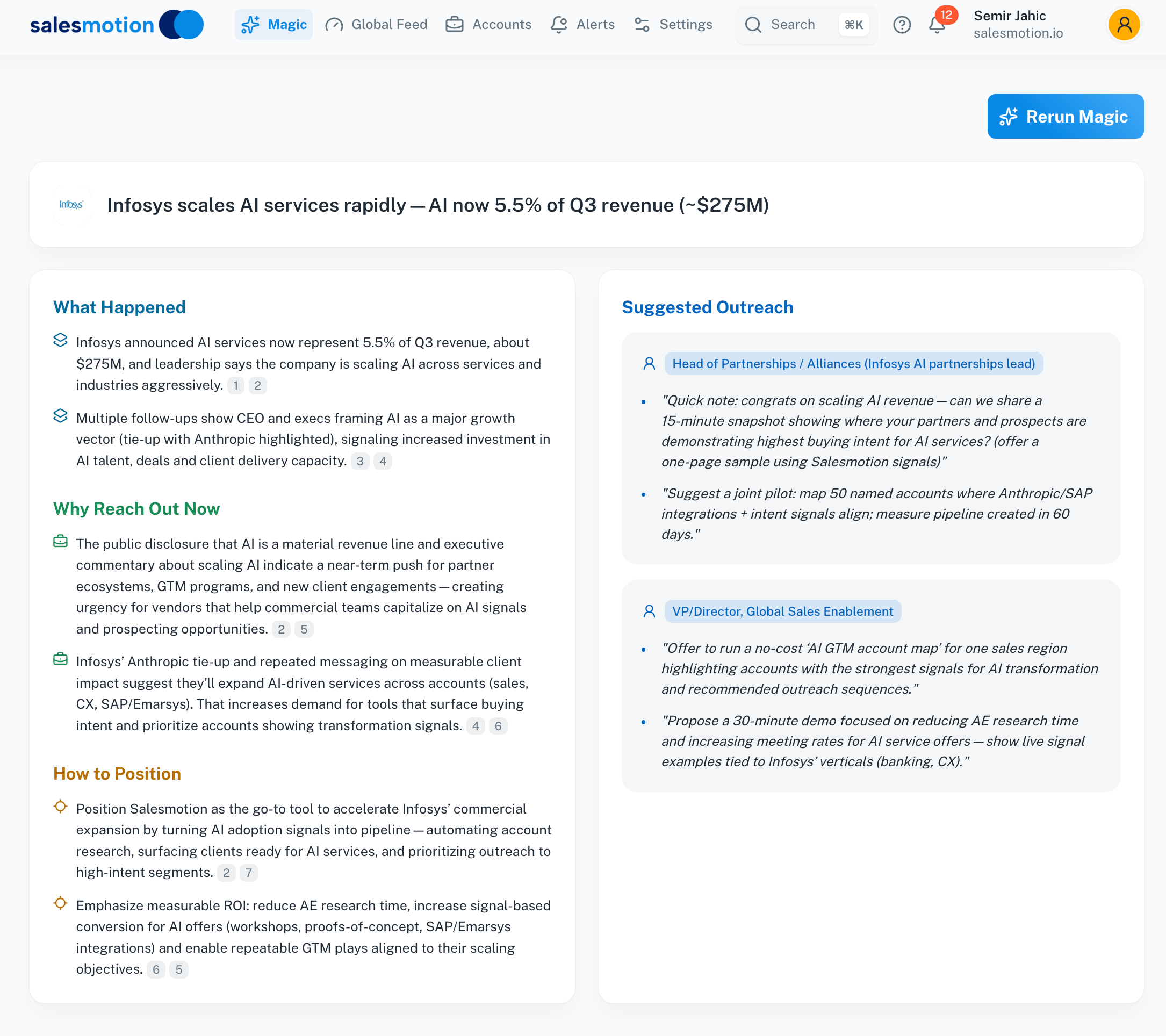 This is what "finished" looks like: the what-happened, why-reach-out-now, and suggested-outreach analysis arrives ready to use — no tables, enrichment columns, or credit budgeting required.
The trade-off breaks down along three dimensions:
Time to value. Clay requires workflow design, testing, and optimization before you see results. Finished platforms deliver value on day one because the intelligence layer is already built.
Ongoing maintenance. Clay workflows need regular attention. Data providers change APIs, enrichment columns break, and credit optimization requires monitoring. A finished platform handles this behind the scenes.
Total cost of ownership. Clay's subscription price is only part of the equation. Add the cost of a RevOps engineer's time to build and maintain workflows, any dialer or sales engagement tools you add, and the marked-up top-up credits during high-volume months. For context, Salesmotion offers a self-serve monthly individual plan at $85/month with no annual commitment, plus custom team pricing with unlimited users on team plans — and it includes CRM integration and requires no workflow building. Pricing scales by accounts monitored rather than headcount, making it far more cost-effective than per-seat models. Teams get continuous account intelligence and buying signals without the DIY tax.
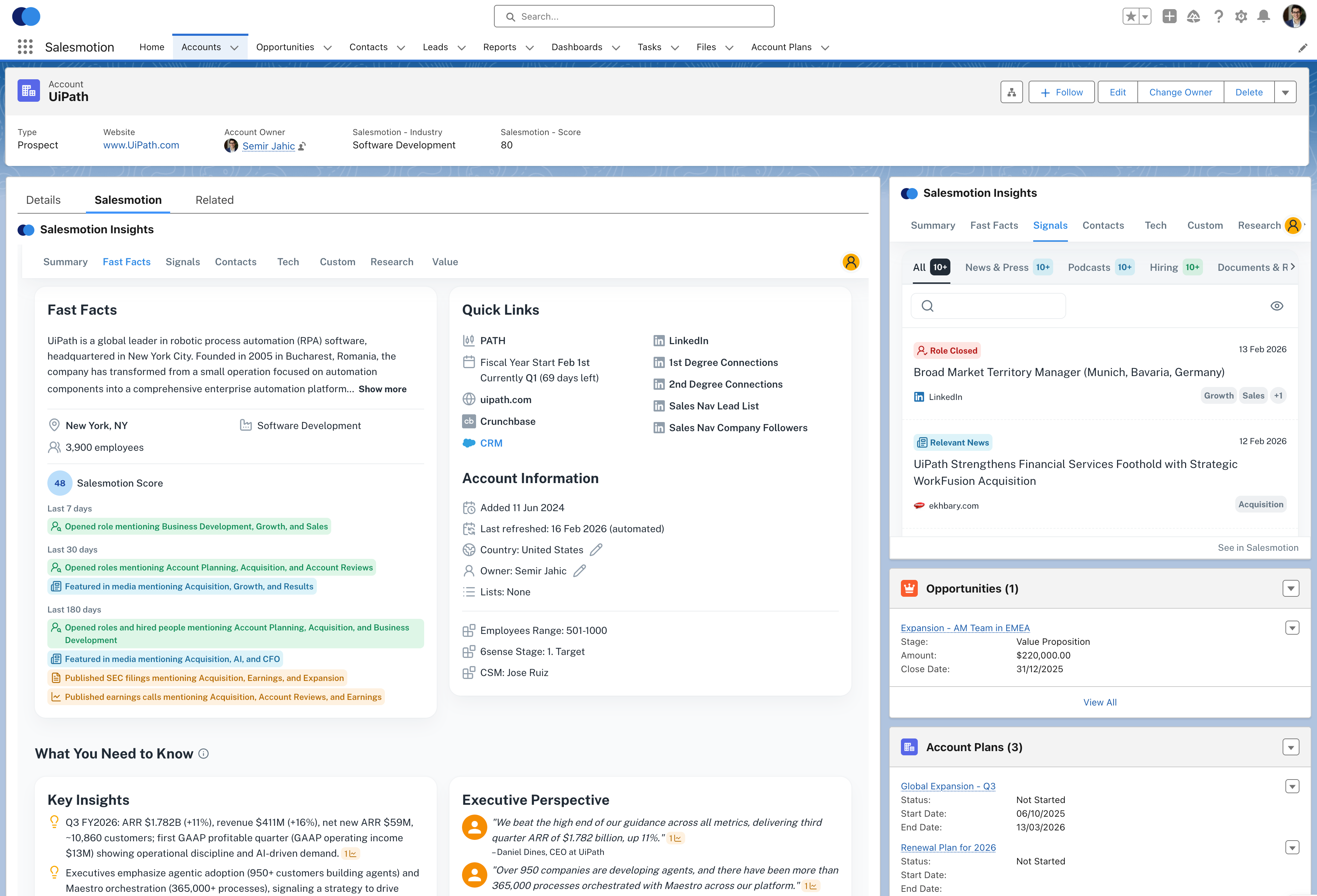 Salesmotion's account intelligence embedded directly in a Salesforce record — CRM integration comes included rather than gated behind a $495/month tier, with no workflow to build or maintain.
Who should choose Clay: RevOps teams with engineering resources who want maximum flexibility over their data workflows and are comfortable with ongoing platform maintenance.
Who should choose a finished platform: Sales teams that want intelligence delivered ready to use, without dedicating headcount to building and maintaining enrichment workflows. If that sounds like you, start with our roundup of Clay alternatives or the head-to-head Clay vs Salesmotion comparison.
Frequently Asked Questions
How much does Clay cost?
Clay's current self-serve plans cost $185/month for Launch (about $167/month on annual billing, roughly $2,000/year) and $495/month for Growth (about $446/month annual, roughly $5,350/year), and paid plans start with a 14-day trial. The free plan includes 100 Data Credits and 500 Actions per month. Enterprise is custom-priced on an annual commitment; Vendr reports a median of $59,996 a year across 96 purchases, with a range of $16,500 to $170,000. Your actual spend depends on credit consumption and whether you need top-ups during high-volume months.
What are Clay's pricing plans?
Clay has four plans: Free, Launch, Growth and Enterprise. Free includes 100 Data Credits and 500 Actions a month; Launch starts at $185 a month with 2,500 Data Credits and 15,000 Actions; Growth starts at $495 a month with 6,000 Data Credits and 40,000 Actions; Enterprise is custom-priced on an annual commitment. Annual billing saves 10%, and every plan includes unlimited seats. Customers on the legacy Starter, Explorer and Pro plans can stay on them.
Does Clay have a free trial for enrichment?
Yes. Clay's pricing page offers a 14-day trial and says no credit card is required to start. There is also a permanent Free plan with 100 Data Credits and 500 Actions a month and up to 200 rows per table; phone enrichment starts on Launch. If an enrichment returns no result, Clay does not charge Data Credits or Actions.
Does Clay charge per user or per seat?
No. All Clay plans include unlimited seats. Pricing is based entirely on usage — Data Credits for marketplace enrichments and Actions for workflow operations — not team size. This makes Clay cost-effective for large teams with moderate credit needs, but expensive for small teams with heavy enrichment volume.
What changed in Clay's spring 2026 pricing update?
In spring 2026, Clay introduced two new plans (Launch at $185/month and Growth at $495/month) alongside its legacy Starter, Explorer, and Pro tiers, and split usage into separate Data Credits and Actions. Clay says its most-used enrichments now cost 50% fewer credits on average, enrichments that return no result are not charged, native CRM auto-sync is included from the $495 Growth tier, and top-ups carry a 30% premium on the new plans against 50% on legacy plans. Existing customers can stay on legacy plans indefinitely.
What happens when you run out of Clay credits?
You can purchase top-up Data Credits at a 30% premium on Launch and Growth. Unused Data Credits roll over monthly, but the rollover cap is 2x your monthly allocation (Actions reset monthly and do not roll over). If you consistently exceed your credit budget, upgrading to a higher plan tier usually costs less than buying top-ups repeatedly.
Is Clay worth it for small sales teams?
It depends on technical resources. Clay's credit costs are reasonable on higher-tier plans, but small teams often lack the RevOps expertise to build and maintain workflows efficiently. The learning curve is steep, and credits spent on workflow testing add up. Small teams may get more value from a finished platform that delivers intelligence without the assembly required.
How does Clay compare to all-in-one sales intelligence tools?
Clay offers more customization than most all-in-one platforms, but requires significantly more setup and maintenance. Traditional sales intelligence tools provide a complete experience out of the box, including CRM integration, signal monitoring, and prospecting. Clay excels as a data enrichment engine for technically sophisticated teams. The choice depends on whether your organization values flexibility (Clay) or speed to value (finished platforms). See our full Clay alternatives breakdown for a detailed comparison.
Related Articles
- Clay Alternatives: Top Platforms for B2B Sales Teams
- Clay vs. Finished Intelligence: DIY Workflows Compared
- How to Choose Sales Intelligence Tools
- B2B Sales Intelligence Pricing Compared
Clay Inside Claude
Clay also exposes its data providers, research agents, and prebuilt workflows through an MCP server, so reps can run workflows from Claude, ChatGPT, or Codex without opening the platform. New accounts receive free credits on first connect, and workspace admins set per-rep credit limits.
If you are weighing that against other MCP options, see Clay MCP vs Salesmotion MCP, which compares what each server exposes rather than the platforms as a whole.