About 20% of your CRM contacts will change jobs in the next year. New executives spend roughly 70% of their budget within the first 100 days at a new company. That combination makes job change tracking one of the highest-ROI plays in B2B sales. UserGems started with this signal and has since built an AI command center for outbound and ABM around it, and the platform has earned a 4.7/5 rating on G2. But how much does UserGems actually cost? UserGems publishes its tier pricing on its website, from $40,000 a year for Core, though enterprise quotes and negotiated contracts can differ from the published price. This guide breaks down what UserGems pricing looks like in 2026, what you get at each tier, and where the hidden costs live.
TL;DR: UserGems publishes its pricing per year: Core at $40,000/year, Advanced at $75,000/year, and Elite at $150,000/year, each with unlimited users and a one-time implementation fee of $3,000 to $10,000. Vendr reports a median of $30,500 a year across 173 purchases, with a range of $13,300 to $69,530. The platform has expanded beyond job change tracking to include 30+ native signals, Gem-E AI agents (Research, Writing, Orchestration), an MCP for Claude and ChatGPT, ABM orchestration, and website visitor ID. For teams that want outbound built on public-source research (full earnings transcripts, SEC filings, clinical trials), plug-and-play alternatives like Salesmotion offer a different approach with monthly contracts starting at $85/mo.
 UserGems positions itself as an AI command center for outbound and ABM. Source: usergems.com
UserGems vs Salesmotion at a Glance
| UserGems | Salesmotion | |
|---|---|---|
| Starting price | $40,000/year (Core) | $85/mo individual plan |
| Implementation fee | $3,000-$10,000 one-time | None — plug and play, live in hours |
| Contract terms | Priced per year | Self-serve monthly, no annual commitment |
| Team pricing | Tiered by credits, unlimited users ($40K-$150K/year published) | Custom team pricing (unlimited users on team plans) |
| Core focus | Signals, scoring and AI agents for outbound and ABM | Deep account research from 1,000+ sources + 50+ signal types |
| Free trial | No free plan or trial listed | No — but the monthly individual plan lets you start without a contract |
UserGems
From $40,000/yr
published tiers · unlimited users
Salesmotion
From $85/mo
monthly contract · verified contacts included
UserGems unifies CRM, first-party and buyer signals for outbound and ABM. Salesmotion reads 1,000+ public sources per account and drafts the outreach.
- 3 AI agents on every account: signals, research briefs, drafted outreach
- Live in an hour, monthly billing, no annual contract
- Verified contacts included; CRM integration on custom team & enterprise plans
See the product in action
Take a self-guided tour of the Salesmotion platform — no signup required.
What Does UserGems Do?
UserGems is a pipeline generation platform that started with job change tracking and champion monitoring and has since expanded into a broader signal and automation platform. When a past customer, prospect, or internal champion moves to a new company, UserGems flags the change and surfaces it as a warm lead inside your CRM — and that core use case remains a strength.
The pitch is compelling. Champions at a target account can increase your chances of closing a deal by 114%, shorten sales cycles by about 12%, and drive 54% bigger deal sizes, according to UserGems' own research. These are strong numbers, and they reflect a real pattern: buyers who already know your product convert faster than cold prospects.
UserGems now offers 30+ native signal types beyond job changes, including buyer intent data, website visitor identification, M&A activity, 10-K filings, earnings reports, and hiring changes. The platform also includes Gem-E, the orchestration layer of what UserGems calls its AI Command Center, which handles list building, personalized email generation, and multi-touch sequencing, and extends into buying stage mapping, contact-level intent tracking, and ad audience syncing to LinkedIn, Google, and Meta. In September 2026 UserGems launched a Research Agent, an updated Writing Agent, and UserGems MCP, which brings the platform into Claude and ChatGPT.
UserGems integrates with Salesforce, HubSpot, Dynamics, and Marketo, and pushes sequences into Outreach, Salesloft, and Gong Engage. The platform scores accounts and contacts across 600+ ICP criteria with transparent, editable models.
UserGems' Research Agent draws on public sources, your CRM, and call transcripts to find signals and feed outbound. Salesmotion is built for a different job: cited account briefs from 1,000+ public sources, with earnings call analysis, strategic initiative summaries, competitive landscape context, and AI-generated talking points ready for pre-call preparation.

“Automatic account profile detail I can use to manage my territory. Using Salesmotion AI to generate value statements per persona, account, etc. Using Salesmotion to give me a starting point based on new hires, or news alerts is critical.”
Adam Wainwright
Head of Revenue, Cacheflow
UserGems Pricing Breakdown
UserGems publishes its pricing tiers, priced per year. Here is what the UserGems pricing page lists:
| Plan | Published Price | Implementation Fee | What Is Included |
|---|---|---|---|
| Core | $40,000/year | $3,000 one-time | Unlimited users; 4M credits |
| Advanced | $75,000/year | $5,000 one-time | Unlimited users; 10M credits |
| Elite | $150,000/year | $10,000 one-time | Unlimited users; 25M credits |
| Enterprise | Quote-only | Not published | Custom credit volume and deployment scope |
A few details worth noting:
Published prices are the anchor, not always the street price. Vendr reports a median of $30,500 a year across 173 purchases, with a range of $13,300 to $69,530. Your quote depends on credit volume and negotiation.
Costs scale with credits. Each tier comes with a credit allowance that your signal monitoring and enrichment draw down. Every tier includes unlimited users, so the tier you need is set by credit volume, not by how many reps log in.
Priced per year with an upfront implementation fee. UserGems prices per year and charges a one-time implementation fee of $3,000 to $10,000 depending on tier. UserGems offers a money-back guarantee if you do not see ROI in closed-won revenue.
No free plan or trial listed. Unlike tools such as Apollo.io or Lusha that offer free tiers for testing, the UserGems pricing page lists no free plan or trial. UserGems does offer a data accuracy test on your own records before you buy.
What You Get at Each Tier
Core Plan ($40,000/year)
All three tiers include the full feature set, including CRM integration (Salesforce or HubSpot), the Research Agent, UserGems MCP, contact-level intent, and buying stages. They differ by credit volume. Core includes 4M credits, which UserGems sizes for a TAM of 2,000 to 4,000 accounts.
For teams running a focused champion tracking play, this tier delivers the core value. The variable to watch is credit volume: a larger TAM or a heavier monitoring footprint points to the next tier.
Advanced Plan ($75,000/year)
Advanced raises the allowance to 10M credits, which UserGems sizes for a TAM of 4,000 to 10,000 accounts, with a $5,000 implementation fee.
This tier makes sense for mid-market and enterprise sales teams with larger databases and more complex account structures.
Elite Plan ($150,000/year)
Elite carries the largest allowance at 25M credits, which UserGems sizes for a TAM of 10,000+ accounts. At $150,000/year plus a $10,000 implementation fee, this tier is built for large revenue organizations running champion tracking, intent, and AI outbound at full scale.
When negotiating at the upper tiers, Vendr names Champify as the competitive alternative to raise in the conversation.

“The Business Development team gets 80 to 90 percent of what they need in 15 minutes. That is a complete shift in how our reps work.”
Andrew Giordano
VP of Global Commercial Operations, Analytic Partners
Hidden Costs and Limitations
The published price is only part of the picture. Here are the costs and terms to model alongside it:
Credit limits. UserGems pricing is tied to a credit allowance per tier rather than seat count. If your monitoring footprint is growing, model what happens when you exhaust the allowance mid-term, and get the overage rate in writing.
Implementation fees. The one-time setup fee of $3,000 to $10,000 is easy to miss when comparing annual costs. On a Core contract, it adds roughly 7.5% to your first-year spend.
Renewal terms. UserGems' standard agreement renews automatically for the same term unless either party gives 30 days' notice, and caps renewal price increases at the greater of 7% a year or the change in CPI.
Supplementary tools. UserGems covers 30+ native signals, a Research Agent, and AI-written outreach via Gem-E, oriented toward pipeline generation and outbound automation. Teams that want cited account briefs built from full earnings calls, SEC filings, news, and competitive landscape analysis may add a dedicated account intelligence platform for pre-call preparation and strategic account planning.
Automation depth vs. research depth. UserGems invests heavily in outbound automation (AI email generation, sequencing, ad audience syncing), with research that feeds those workflows. Salesmotion is purpose-built for cited account briefs. If your team's bottleneck is outbound volume, UserGems covers that well. If your bottleneck is account understanding and call prep, compare the research output of each side by side.
How UserGems Compares to Alternatives
When evaluating UserGems, the relevant comparison is not just price. It is the scope of intelligence you receive for that price.
| Feature | UserGems | ZoomInfo | LinkedIn Sales Nav | Salesmotion |
|---|---|---|---|---|
| Starting price | $40,000/year + $3,000 setup | Not published; Vendr median $33,500/year | Core $1,079.88/license/year | From $85/mo |
| Pricing model | Tiered by credits, unlimited users | Consumption-based | Per license | Account-based, unlimited users on team plans |
| Job change tracking | Yes (core strength) | Buyer signals in Copilot | Yes (alerts on saved leads) | Yes |
| Signal types | 30+ native (job changes, contact-level intent, M&A, hiring, 10-K filings, earnings reports) | Copilot buyer signals; Streaming Intent add-on | Alerts and Buyer Intent | 50+ (earnings, leadership, funding, competitive, hiring) |
| AI capabilities | Gem-E agents (Research, Writing, Orchestration) + MCP | Copilot AI sales agent | Account IQ, Lead IQ, Message Assist | Three AI agents (Signal, Research, Outreach) |
| Outbound messaging | Writing Agent sequences via Outreach, Salesloft, Gong Engage | Copilot-drafted messaging | InMail with Message Assist | Research-backed messaging → lemlist |
| Signal depth | Signal alerts, scoring and Research Agent | Copilot account summaries and deal briefs | Account IQ insights | Full earnings transcripts, SEC filings, clinical trials |
| On-demand account research | Research Agent + MCP | Copilot research | Account IQ | Cited briefs from 1,000+ public sources |
| Contract terms | Priced per year | Annual subscriptions; monthly billing not standard | Annual or monthly | Monthly available, no lock-in |
| Time to value | Typically 3-4 weeks (per UserGems) | Not published | Not published | Hours (plug and play) |
| G2 rating | 4.7/5 | 4.5/5 | 4.3/5 | 4.8/5 (26 reviews) |
A few things stand out in this comparison.
UserGems is strong on pipeline generation and outbound automation. With 30+ signal types, AI-powered email generation via Gem-E, and ABM orchestration, UserGems has evolved well beyond its job-change-tracking roots. The platform excels at turning signals into automated outbound sequences.
ZoomInfo is a contact database first. Its Copilot layer adds buyer signals, account summaries, and drafted outreach on top of the database.
LinkedIn Sales Navigator alerts you when saved leads change job or role, and adds Account IQ, Lead IQ, and Message Assist for research and drafting.
Salesmotion approaches the problem differently. Where UserGems focuses on signal-driven automation and ABM orchestration across CRM, first-party, and buyer signals, Salesmotion gives every rep three AI agents (Signal, Research, and Outreach) focused on deep research-backed intelligence and outbound. It synthesizes account intelligence from 1,000+ public sources — full earnings call transcripts with executive quotes, SEC filings, clinical trials for life sciences, podcasts, job ads, and more — into SWOT-style account briefs, and the Outreach Agent writes messaging anchored to that research, pushed directly into lemlist. Reps can also generate a cited brief on any account on demand. The platform is plug and play (live in hours) with monthly contracts starting at $85/month — no annual lock-in required. Unlimited users on team plans means your entire team gets access without per-seat charges. Teams like Analytic Partners have used this intelligence to grow qualified pipeline 40% year over year.
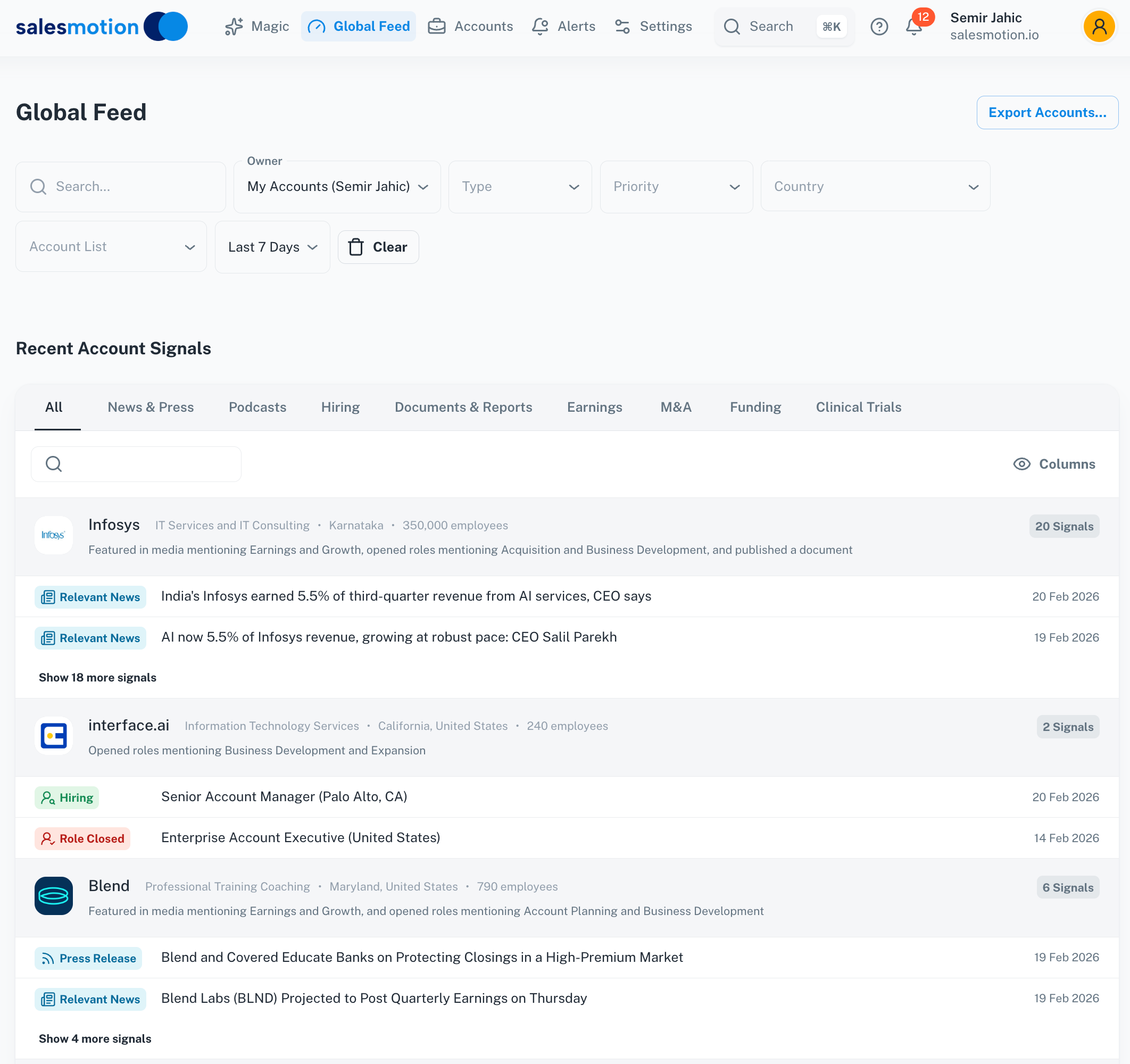 Salesmotion's global feed surfaces earnings, hiring, role changes, M&A, and news signals across your whole territory — job changes are one signal type among 50+.
Who Should (and Should Not) Buy UserGems
UserGems is a strong fit if:
- Your primary pipeline source is champion tracking and past-customer job changes
- You want AI-powered outbound automation (Gem-E) to scale pipeline generation
- You have a mature CRM with thousands of contacts worth monitoring
- You need ABM orchestration with contact-level intent and ad audience syncing
- You are comfortable with a $40,000+/year published entry price
UserGems is a weaker fit if:
- You need public-source research behind your outbound messaging: messages built on earnings call quotes, SEC filings, and competitive context
- You want a cited research brief on every target account as the starting point for prospecting
- You are a smaller team that wants to start fast with monthly contracts and no annual lock-in
- You want pricing that does not scale with credit volume or carry a $3,000+ implementation fee
- You do not need ABM orchestration, website visitor ID, or first-party data ingestion
The sales intelligence market is projected to reach $10.25 billion by 2032, growing at 11.3% annually. That growth is being driven by platforms that combine multiple signal types, AI-powered research, and automated outreach into unified workflows.
How to Evaluate Job Change Tracking ROI
Before signing a UserGems contract, run this simple ROI calculation:
-
Count your trackable champions. How many past customers, closed-lost contacts, and known champions are in your CRM? If the number is under 2,000, the math on a $40,000+/year tool gets tight.
-
Estimate conversion rate. UserGems reports that previous customers are 3x more likely to buy again. Apply a multiplier you can defend to your current cold outbound conversion rate.
-
Calculate pipeline value. Multiply expected conversions by your average deal size. If the resulting pipeline value is less than 5x the annual contract cost, the ROI is marginal.
-
Factor in supplementary costs. Add the cost of tools you still need for account research, competitive intel, and outreach. A signal-based selling approach that consolidates these workflows into one platform often delivers better total cost of ownership.
-
Compare alternatives. Request demos from at least two other platforms to benchmark pricing and capability. See our UserGems alternatives guide and UserGems vs Salesmotion comparison for detailed breakdowns. Platforms with published pricing pages make this comparison straightforward and give you leverage in negotiations.
Key Takeaways
- UserGems publishes pricing per year: Core at $40,000/year, Advanced at $75,000/year, and Elite at $150,000/year, plus one-time implementation fees of $3,000-$10,000. Vendr reports a median of $30,500 a year across 173 purchases, with a range of $13,300 to $69,530.
- UserGems has expanded significantly beyond job change tracking. The platform now offers 30+ native signals, AI-powered outbound via Gem-E, a Research Agent, an MCP for Claude and ChatGPT, and ABM orchestration. G2 reviewers rate it 4.7/5.
- Costs to model include credit allowances per tier and one-time implementation fees. UserGems' standard agreement caps renewal increases at the greater of 7% a year or the change in CPI. Teams that want cited public-source research behind outbound messaging may add a dedicated account intelligence tool.
- UserGems excels at signal-to-automated-outbound, ABM orchestration, and first-party data workflows. Platforms like Salesmotion also generate outbound messaging and build it on research from 1,000+ public sources (full earnings transcripts, SEC filings, clinical trials), with plug-and-play setup and monthly contracts.
- UserGems prices per year and lists no free trial, so ask for its data accuracy test on your own records before you sign, and budget for the full year.
- Run an ROI calculation before signing: count trackable champions, estimate conversion rates, and factor in the total cost of your sales intelligence stack.
Frequently Asked Questions
How much does UserGems cost?
UserGems publishes three tiers priced per year: Core at $40,000/year, Advanced at $75,000/year and Elite at $150,000/year. Every tier includes unlimited admin and end users. One-time implementation fees run $3k/$5k/$10k by tier. Vendr reports a median of $30,500 a year across 173 purchases, with a range of $13,300 to $69,530.
Does UserGems offer a free trial or free plan?
The UserGems pricing page lists no free plan or free trial, and every tier is bought through a sales conversation. UserGems does offer a data accuracy test on your own records before you buy, and a money-back guarantee if you do not see ROI in closed-won revenue.
What is the difference between UserGems and a full account intelligence platform?
UserGems started as a job change tracking tool and has expanded to include 30+ native signals, Gem-E AI agents for research and outbound, ABM orchestration, website visitor identification, and first-party data ingestion. A platform like Salesmotion also generates outbound messaging and builds it on research from 1,000+ public sources: full earnings transcripts, SEC filings, clinical trials, podcasts. The key differences: UserGems adds ABM orchestration, visitor ID, and internal data. Salesmotion adds cited public-source intelligence and plug-and-play monthly pricing from $85/mo.
Is UserGems worth it?
For teams with a large CRM database of past customers and champions worth monitoring, UserGems delivers strong ROI, and G2 reviewers rate it 4.7/5. For teams with fewer than 2,000 trackable contacts, the math on a $40,000+/year starting price (plus implementation fee) gets thin. Smaller teams may get better returns from a platform with a lower entry price and monthly terms.
What are the best UserGems alternatives?
The strongest UserGems alternatives depend on what you need most: Salesmotion for deep research-backed outbound and 50+ signal types with monthly pricing, ZoomInfo for contact database scale, Apollo.io for budget-friendly all-in-one prospecting, Cognism for phone-verified European data, and Champify for Salesforce-native champion tracking at a lower price point. Most buyers shortlist two or three and compare on signal depth, contract terms, and total cost.
How does UserGems pricing compare to flat-rate account intelligence platforms?
UserGems starts at $40,000/year plus implementation fees and scales with credit volume, reaching $150,000/year at the Elite tier, with unlimited users on every tier. Both UserGems and platforms like Salesmotion track multiple signal types and generate outbound messaging. The key differences: UserGems adds ABM orchestration, website visitor ID, and first-party data, and is priced per year. Salesmotion provides cited public-source intelligence (full earnings transcripts, clinical trials, SEC filings) and offers monthly contracts from $85/mo with plug-and-play setup.