Common Room raised its entry price sharply in the past year, and most buyers researching Common Room pricing don't know it yet. The $1,000-per-month Starter tier you'll still find quoted across the web is gone. The published entry point on Common Room's pricing page is now the Essential plan at $2,500 per month, billed annually. That's $30,000 per year before add-ons.
This guide breaks down what each Common Room plan costs in 2026, where the credit systems and contact caps push spend higher, and how the platform compares to alternatives built for enterprise account teams rather than community-led motions.
Update (October 10, 2026): Zoom acquired Common Room on 17 July 2026 for $266.8 million in cash, per Zoom's 10-Q. The published pricing has not changed since. Read our full analysis of what the Zoom acquisition means for Common Room customers.
TL;DR: Common Room pricing starts at $2,500/month billed annually ($30,000/year) for the Essential plan with 5 seats and 100k contacts. Advanced and Enterprise tiers are quote-only, and Vendr reports a median annual contract of $27,250 across 76 purchases, ranging from $10,000 to $85,800. Costs scale with contacts enriched, credits consumed, and seats, not just team size. Teams that need account intelligence built on public business events should compare Salesmotion, which starts at $85/mo on a self-serve monthly individual plan with custom team pricing (unlimited users on team plans).
 Common Room positions itself as a buyer intelligence platform. Its published entry price is $2,500/month billed annually; everything above that tier is quote-only.
Common Room
From $2,500/mo
Essential tier · billed annually
Salesmotion
From $85/mo
monthly contract · verified contacts included
Common Room unifies product, community and web signals on the person. Salesmotion researches the account from 1,000+ public sources and drafts the outreach.
- 3 AI agents on every account: signals, research briefs, drafted outreach
- Live in an hour, monthly billing, no annual contract
- Verified contacts included; CRM integration on custom team & enterprise plans
Common Room vs Salesmotion at a Glance
| Common Room | Salesmotion | |
|---|---|---|
| Starting price | $2,500/mo billed annually ($30,000/yr) | $85/mo individual, self-serve |
| Pricing transparency | Entry tier published; Advanced and Enterprise quote-only | Published pricing |
| Contract | Annual billing on the published plan | Monthly, no annual commitment |
| Users included | 5 seats (Essential), 15 (Advanced), 30 (Enterprise) | Custom team pricing (unlimited users on team plans) |
| Usage limits | Contact caps, RoomieAI and Prospector credits, IP enrichment caps | No credits |
| Signal focus | First-party, product, community and intent signals, with RoomieAI research | 50+ signal types across 1,000+ sources (earnings, M&A, hiring, leadership, news) |
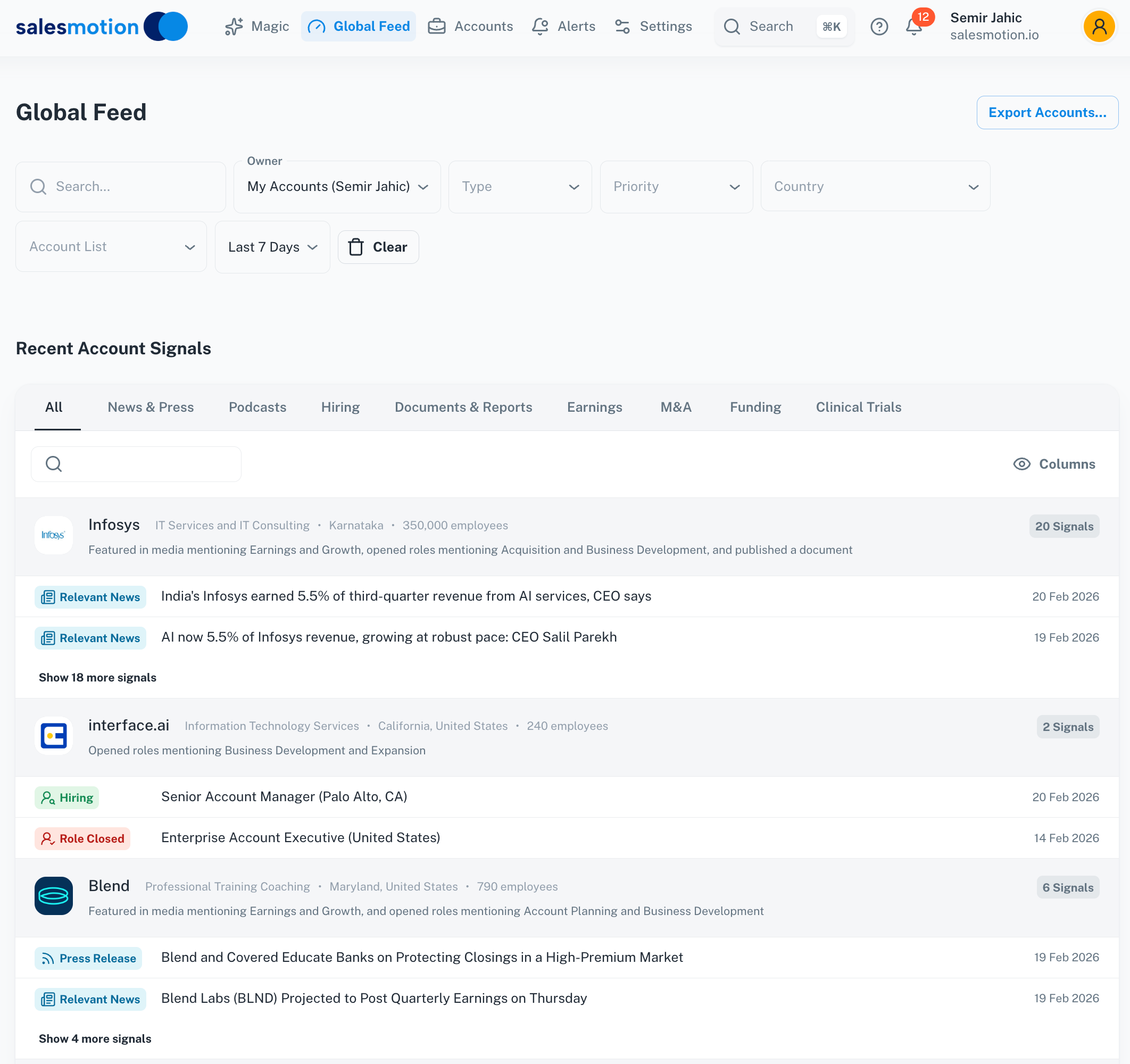 Salesmotion's Global Feed tracks earnings, hiring, M&A, funding, and news signals across every monitored account. Salesmotion is built around these public business events.
For a feature-by-feature breakdown, see Common Room vs Salesmotion. If you're already sure the pricing model doesn't fit, start with our guide to the best Common Room alternatives.
See Salesmotion on a real account
Book a 15-minute demo and see how your team saves hours on account research.
Key Takeaways
- Common Room's published Essential plan costs $2,500/month billed annually ($30,000/year) for 5 seats and up to 100,000 contacts. Advanced and Enterprise are quote-only.
- The older Starter tier at $1,000/mo, still cited across third-party sites, no longer appears on Common Room's pricing page. Budget against the current tiers, not cached figures.
- Vendr reports a median annual contract of $27,250 across 76 purchases, ranging from $10,000 to $85,800, a little under the $30,000 Essential list price.
- Every tier carries usage meters: RoomieAI research credits, Prospector credits, phone number credits, IP enrichments, and Bombora intent topics. Hitting any cap means an upgrade conversation or add-on spend.
- Common Room is a buyer intelligence platform that grew out of community signals and now spans enrichment, prospecting, intent, ads and AI research. Enterprise account teams that need earnings, M&A, and leadership-change signals should evaluate account intelligence platforms alongside it.
- Contact-based pricing compounds. Enrichment grows your contact count whether or not reps use those contacts, so model 12-24 months of volume before signing.

“The account and contact signals are key for reaching out at important times, and the value-add messaging it creates unique to every contact helps save time and efficiency.”
Daniel Pitman
Mid-Market Account Executive, Black Swan Data
Common Room Pricing Plans in 2026
Common Room currently lists three tiers: Essential, Advanced, and Enterprise. Only Essential has a published price. Here's what the pricing page shows as of October 2026:
| Plan | Price | Seats | Contacts | RoomieAI Credits | Prospector Credits | IP Enrichments/Year |
|---|---|---|---|---|---|---|
| Essential | $2,500/mo (billed annually) | 5 | Up to 100k | 5,000 | 2,500 | 240k |
| Advanced | Custom quote | 15 | Up to 250k | 7,500 | 7,500 | 480k |
| Enterprise | Custom quote | 30 | Up to 750k | 10,000 | 15,000 | 960k |
All tiers include unlimited alerts, workflows, and segments, plus Person360 identity resolution, job change tracking, and core CRM, Slack, and email integrations.
Essential: $2,500/Month, Billed Annually
The Essential plan covers 5 seats, up to 100,000 contacts, 5,000 RoomieAI research credits, 2,500 Prospector credits, 240,000 website IP enrichments per year, 5 Bombora intent topics, and ticketed support.
At $30,000 per year, this is no longer a starter-team price point. It works out to $500 per seat per month if you fill all 5 seats, and the credit allocations are sized for a focused motion, not a full outbound team running enrichment all day.
Advanced and Enterprise: Quote-Only
Advanced (15 seats, 250k contacts) and Enterprise (30 seats, 750k contacts, dedicated CSM, unlimited website deanonymization) require a sales conversation. Common Room doesn't publish prices for either.
Buyer-reported benchmarks help triangulate. Vendr reports a median annual contract of $27,250 across 76 purchases, ranging from $10,000 to $85,800. Treat those figures as buyer-reported, not list prices.
What Happened to the Starter Plan?
If you've seen Common Room pricing quoted at $1,000/month, that reflects the previous tier structure that many third-party sites still cite. The current pricing page shows no such plan. Practically, this means the published cost of entry has more than doubled, and buyers comparing cached 2025 numbers against a 2026 quote are in for a surprise.
Hidden Costs and Pricing Gotchas
The list price is the floor. Four mechanics push real-world Common Room spend higher.
Credit Meters on Everything
Common Room meters usage across at least five dimensions: RoomieAI research credits, Prospector credits (contact sourcing), phone number credits (100 on Essential and Advanced, 200 on Enterprise), website IP enrichments, and Bombora intent topics (5 on Essential, 10 on Advanced, 25 on Enterprise).
Each meter is an upgrade trigger. A team that leans on Prospector for outbound contact sourcing will exhaust 2,500 credits quickly, so ask what additional credits cost before you sign.
Contact Volume Creep
Common Room enriches contacts automatically as signals fire. Your contact count grows whether or not reps actively work those contacts. A team monitoring 500 target accounts can generate tens of thousands of enriched contacts within months, pushing toward the 100k Essential cap and an Advanced quote.
According to SaaStr, businesses now spend an average of $7,900 per employee annually on SaaS, up 27% in two years. Usage-based meters are a major driver of that inflation.
Annual Billing on the Published Plan
The $2,500/month Essential price is billed annually. There's no published monthly billing option, so the real commitment is $30,000 upfront or contracted for the year. Teams that want to trial signal-based selling on a monthly budget can't do it here.
Renewal Repricing on Grown Databases
Because pricing scales with contacts and usage, your renewal quote reflects 12 months of database growth. Buyers report 10-20% discounts off list on initial 12-month agreements (per Vendr), but that leverage shrinks at renewal once your workflows depend on the platform. Negotiate a renewal cap upfront.

“This is my singular place that very simply summarizes a company's top initiatives, strategies and connects them to my solution. Something I would spend hours researching manually, now it's automated.”
Derek Rosen
Director, Strategic Accounts, Guild Education
Is Common Room Worth It in 2026?
For the right team, yes. Common Room grew out of product-led and community-led growth motions, and it's genuinely strong there. It now spans enrichment, prospecting, intent, ads and AI research as well. If your pipeline starts with free-tier signups, open-source activity, Slack communities, or website visits, Common Room's Person360 identity resolution and community signal aggregation are hard to match. PLG companies tracking developer engagement across GitHub, Discord, and product usage get real value at the Essential price.
The calculation changes for enterprise account teams. If you sell six-figure deals into named accounts, the signals that move your deals mostly happen outside digital channels: a new CRO is hired, an earnings call flags a cost-cutting initiative, a competitor loses a contract, a strategic acquisition closes. Community activity rarely precedes a $500k enterprise purchase. Common Room is built around first-party, product, community and intent signals; those public business events are what Salesmotion is built around.
Here's what that gap looks like in practice for an enterprise rep:
- Trigger: A target account's quarterly earnings call mentions a "vendor consolidation initiative" and the CFO flags software spend review.
- Platform action: Salesmotion picks up the earnings signal, summarizes the relevant commentary, and updates the account brief with the initiative, the executives quoted, and suggested talking points.
- Rep action: The rep opens outreach referencing the consolidation initiative by name, positioned against the exact pain the CFO described.
- Outcome: Discovery starts half-done. The first meeting is a consultative conversation about a live initiative, not a cold pitch.
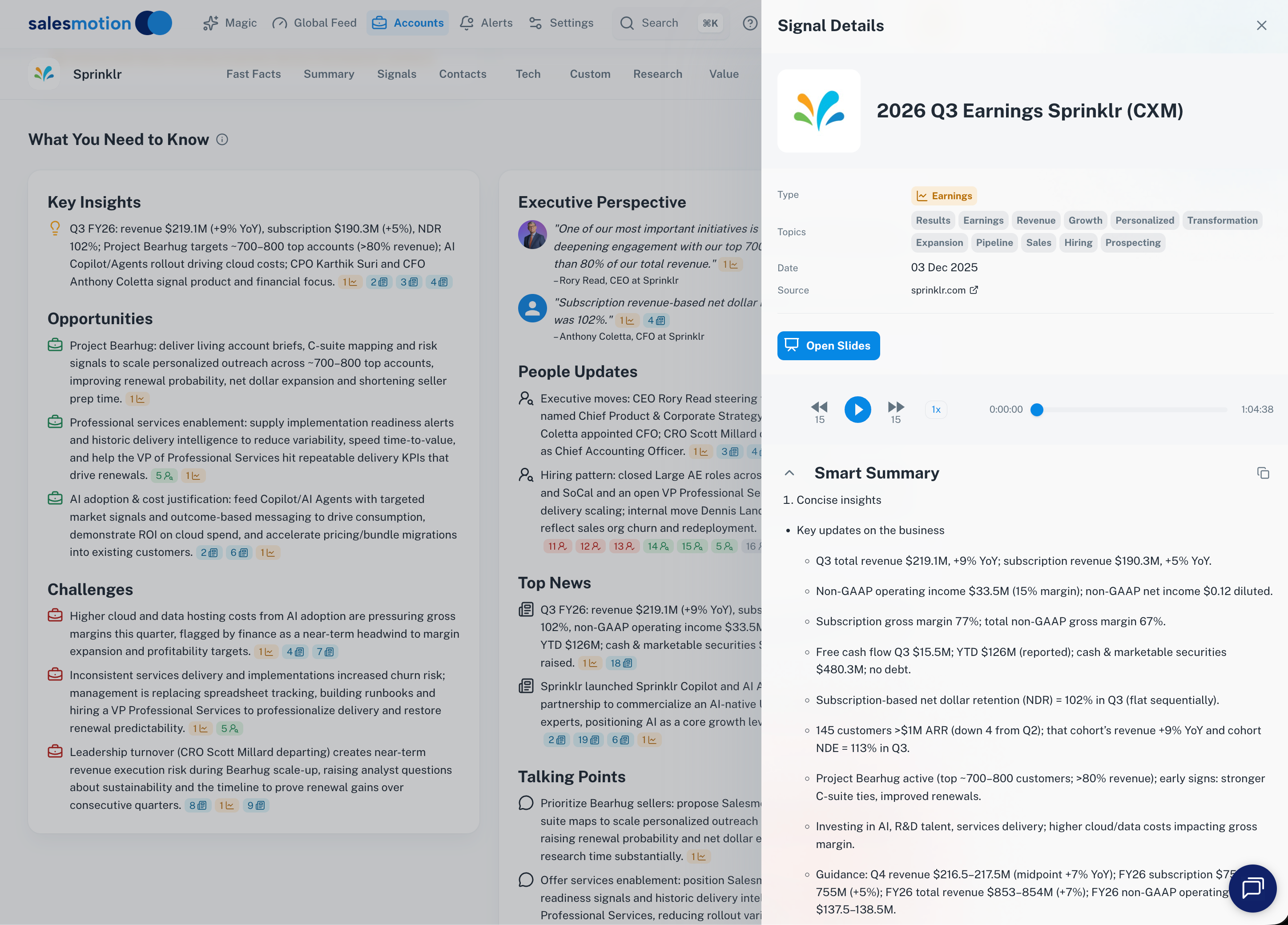 A Salesmotion earnings signal breaks a quarterly report into deal-relevant bullets next to the full account summary. Earnings analysis is one of 50+ signal types tracked across 1,000+ sources, alongside AI agents that research accounts and draft outreach.
That's the core positioning difference. Common Room builds buyer intelligence from first-party, product, community and intent signals, with RoomieAI for account and contact research. Salesmotion is account intelligence for enterprise account teams: 50+ signal types across 1,000+ sources, with AI agents that do the research and draft the outreach. Teams like Guild Education use it to prep strategic accounts with $20M+ deal sizes, saving reps 6+ hours a week on research. Analytic Partners grew qualified pipeline 40% year over year after consolidating research into one platform.
Salesmotion's Take
Common Room is a good product, and for community-led companies the price is defensible. What I'd push back on is the framing that community signals are buying signals for everyone. We sell to enterprise account teams, and in those deals I've never seen a Discord thread predict a seven-figure purchase. Earnings language, leadership changes, and strategic initiatives do, repeatedly. Before you commit $30k a year, list the last ten deals you closed and write down the event that actually opened each one. Buy the tool that watches for that event. If it's product signups and community activity, buy Common Room. If it's what executives say and do, that's the gap we built Salesmotion for.

Semir Jahic
CEO & Co-Founder, Salesmotion
Common Room Alternatives and Competitors
If the pricing model or signal coverage doesn't fit, these are the four platforms buyers most often evaluate against Common Room. Our full Common Room alternatives guide covers the complete landscape.
Salesmotion monitors 1,000+ sources for real-world business events: earnings calls, M&A, funding, hiring patterns, leadership changes, and strategic initiatives, with AI agents that research accounts and draft signal-anchored outreach. Pricing is published: $85/mo for the self-serve monthly individual plan with no annual commitment, and custom team pricing with unlimited users on team plans. Best for enterprise account teams that need buying signals beyond digital channels. See the pricing comparison for the full breakdown.
UserGems is strongest on people-based signals (job changes and champion movement) within a library of 30+ native signals. When a past champion lands at a new company, UserGems flags it for outreach. Its published Core tier is $40,000/year, with unlimited admin and end users (see our UserGems pricing breakdown). A strong fit if champion tracking is your primary play. Compare options in our UserGems alternatives guide.
Champify also tracks job changes and champion movement, with a Salesforce-native workflow. Its published pricing starts from $2,000/month for Core, with Pro from $3,000/month and Enterprise from $6,000/month. Best for teams with large existing CRM contact bases who want relationship-driven pipeline. See our Champify alternatives guide for the trade-offs.
Unify is a warm-outbound automation platform: website visitor identification, intent signals, and AI agents that sequence outreach. It publishes a free forever plan for up to 3 seats, then Base at $20 and Pro at $60 per seat per month, with enrichment metered by credits. Strong for automated outbound at volume; model credit use alongside seats. Our Unify alternatives guide compares it against signal-first platforms.
Frequently Asked Questions
How much does Common Room cost?
Common Room's published Essential plan costs $2,500 per month billed annually, or $30,000 per year, and includes 5 seats, up to 100,000 contacts, 5,000 RoomieAI research credits, and 2,500 Prospector credits. Advanced and Enterprise plans are quote-only. Vendr reports a median annual contract of $27,250 across 76 purchases, ranging from $10,000 to $85,800.
Does Common Room have a free plan or free trial?
No. As of October 2026, Common Room's pricing page lists no free tier and no self-serve trial, and every plan's button is "Request demo". Prospective buyers go through a demo and sales process. If you want to test signal-based selling without an annual commitment, look at platforms with self-serve monthly plans.
Is Common Room worth it?
For product-led and community-led teams, often yes. If your pipeline originates from product signups, open-source activity, communities, and website visits, Common Room's signal aggregation and Person360 identity resolution are among the best available, and $30,000/year is defensible against the pipeline it sources. For enterprise account teams, the math is weaker: deals are driven by earnings commentary, leadership changes, and strategic initiatives, which is the ground Salesmotion is built around, rather than Common Room's first-party, product and community signals. Map your last ten closed deals to the events that opened them before deciding.
What are the best Common Room alternatives?
The strongest Common Room alternatives depend on your motion. Salesmotion fits enterprise account teams that need 50+ signal types across 1,000+ sources with AI research and outreach agents, starting at $85/mo self-serve. UserGems and Champify fit teams whose primary signal is job changes and champion movement. Unify fits teams automating warm outbound from website and intent signals. Most buyers shortlist by identifying which one or two signal types actually drive their pipeline.
Does Common Room require an annual contract?
The published Essential plan is billed annually, and the pricing page does not state billing terms for the quote-based Advanced and Enterprise plans. No monthly billing option is published. Vendr reports 10-20% discounts off list on 12-month agreements, and negotiating a renewal price cap upfront matters because contact-based pricing means your database (and therefore your quote) grows over the contract term.