Most B2B teams evaluating 6sense have the same first question: what does it actually cost? The answer is harder to find than it should be. 6sense does not publish pricing or contract terms for its paid configurations, and every quote comes through a sales conversation. Vendr reports a median annual contract value of $62,220 across 386 purchases, with a range of $11,234 to $176,511 depending on modules, credits, and add-ons. This 6sense pricing breakdown covers every configuration, the costs most reviews skip, and how the platform compares to modern alternatives.
TL;DR: 6sense does not publish pricing. Every configuration is custom-quoted, and Vendr reports a median annual contract value of $62,220 across 386 purchases, with a range of $11,234 to $176,511. Onboarding, additional data credits, and the RevOps time needed to run the platform add to the true cost. For teams that need account intelligence without a quote-only commitment, transparent alternatives exist at a fraction of the price.
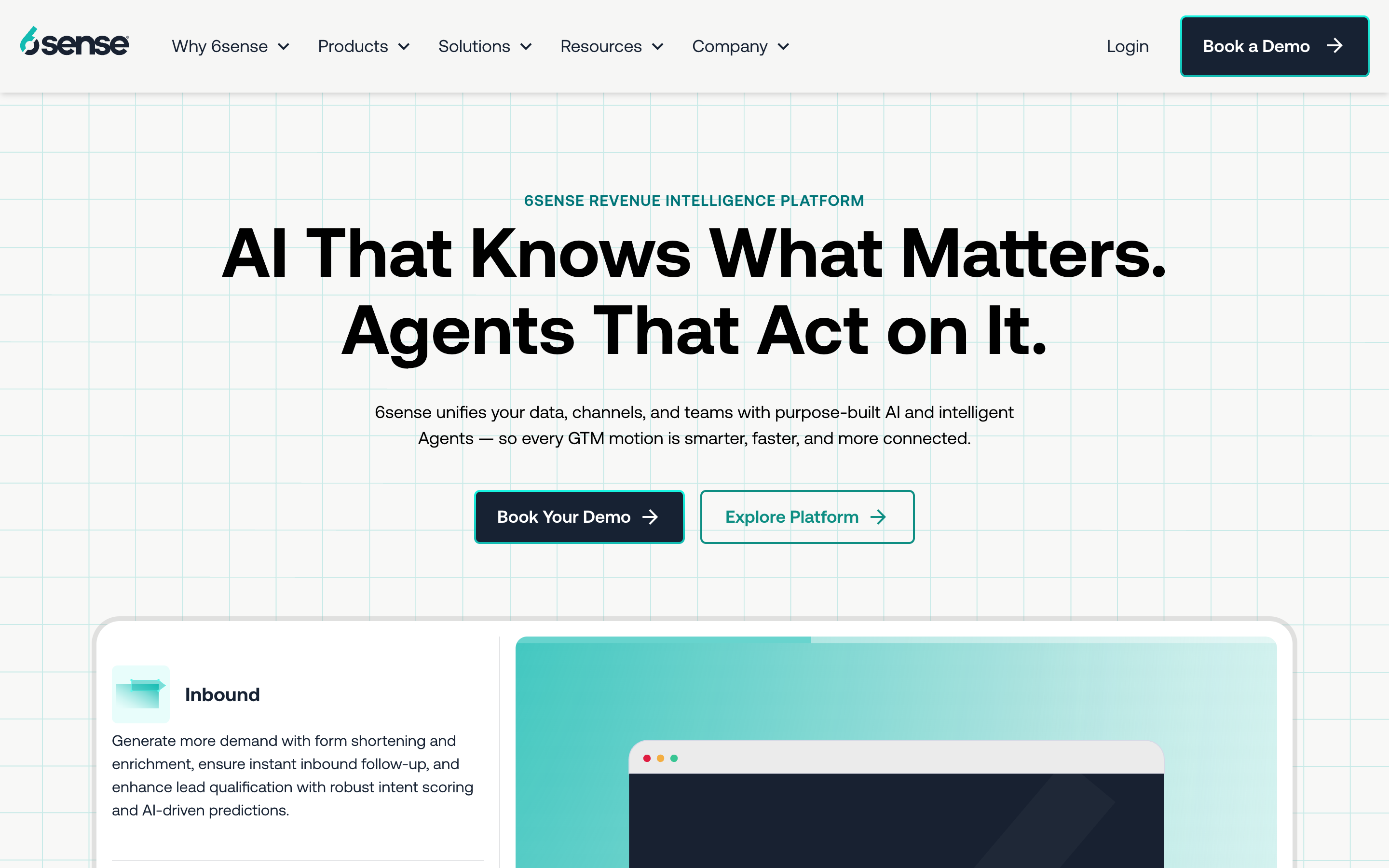 6sense leads with AI that predicts in-market accounts, all pricing is custom-quoted.
Cost is only half the question. A RevOps leader at a 10,000-person diagnostics firm described the moment the evaluation usually starts, and it has nothing to do with the line item. It was renewal season, and reps kept asking the same thing about the account scores landing in their CRM: why is this account a 92, and what actually fired. Nobody on the floor could answer it, so reps quietly reverted to gut feel. The scores were doing their job for marketing, but on the sales floor a number with no visible cause does not turn into a first line of outreach. That gap, not just the price, is why teams put the renewal on the table.
6sense
Custom, quote-only
no published price · Vendr median $62k/yr
Salesmotion
From $85/mo
monthly contract · verified contacts included
6sense scores accounts with predictive intent for marketing and sales. Salesmotion shows reps cited buying signals from earnings calls, filings and hiring data.
- 3 AI agents on every account: signals, research briefs, drafted outreach
- Live in an hour, monthly billing, no annual contract
- Verified contacts included; CRM integration on custom team & enterprise plans
6sense vs Salesmotion at a Glance
| 6sense | Salesmotion | |
|---|---|---|
| Starting price | Custom quotes only; Vendr's marketplace data spans $11,234-$176,511/year | $85/mo individual; custom team pricing |
| Pricing transparency | Not published — sales conversation required | Published pricing; self-serve monthly individual plan, no annual commitment |
| Contract | Not published; terms come with the quote | Monthly individual plan; flexible team terms |
| Users included | Quoted per configuration; data credits meter contact unlocks and exports | Unlimited users on team plans; research uncapped |
See Salesmotion on a real account
Book a 15-minute demo and see how your team saves hours on account research.
Key Takeaways
- 6sense does not publicly list pricing for paid plans. You must talk to sales to get a quote, which makes budget planning difficult before the first conversation.
- Vendr reports a median annual contract value of $62,220 across 386 purchases, with the top of the observed range at $176,511.
- Credits are the variable to pin down. 6sense uses data credits to unlock and export emails, phone numbers, and enriched records, and its pricing page states no credit quantities or credit prices.
- Implementation is a guided onboarding, not self-serve. Ask for the timeline and any onboarding fee as a line item in the quote.
- Negotiation leverage is real. Quote-only pricing means the first number is a starting position, and end-of-quarter timing plus a live competitive evaluation are the standard ways buyers move it.
- Teams that need account intelligence rather than enterprise ABM orchestration can get comparable signal coverage without a five-figure commitment.

“The Business Development team gets 80 to 90 percent of what they need in 15 minutes. That is a complete shift in how our reps work.”
Andrew Giordano
VP of Global Commercial Operations, Analytic Partners
6sense Pricing Plans Overview
6sense sells three configurations, and quotes all of them. Here is what each includes.
| Configuration | Annual Cost | Credits | Key Features |
|---|---|---|---|
| Sales Intelligence + Data Credits | Custom-quoted | Custom pool | Contact data enrichment, company data, Chrome extension, CRM sync |
| Sales Intelligence + Predictive AI | Custom-quoted | Not named in this configuration | AI account summaries, persona map, 3rd-party intent, technographics |
| Sales Intelligence + Data Credits + Predictive AI | Custom-quoted | Custom pool | Full platform: predictive models, data credits, Sales Copilot, orchestration |
Configurations per 6sense's pricing page, which replaced the older Team, Growth and Enterprise tier names in May 2025. No prices are published for any of them; Vendr reports a median annual contract value of $62,220 across 386 purchases.
Sales Intelligence + Data Credits
This package focuses on contact and company data enrichment without the predictive AI layer. You get a custom credit pool for unlocking contact details, CRM integration, and the web app.
What this configuration leaves out is the Predictive AI layer. Without it, you are buying contact and company data on a quote, which puts it in direct competition with tools that publish a rate card.
Sales Intelligence + Predictive AI
This tier adds 6sense's core differentiator: AI-driven predictive models that score accounts by buying stage (Awareness, Consideration, Decision, Purchase). You also get third-party intent data, technographics, psychographics, and intelligent workflows.
Enterprise: The Full Platform
The top configuration combines everything: data credits, predictive AI, Sales Copilot, advanced orchestration, multi-product support, and priority customer success. This is 6sense's flagship offering for large ABM teams with the budget and headcount to operationalize it. The top of Vendr's observed range is $176,511 a year.
6sense also sells an Advertising product; no price is published for it.
Ask how the quote scales with the number of accounts you want 6sense to monitor and score. It is the first variable to pin down before a quote conversation.
The Credit System: What Most Reviews Miss
6sense's credit-based model is the part of the quote to read most closely. Here is how it works.
6sense's pricing page says credits are used to unlock and export emails, phone numbers and enriched contact and company records. It states no credit quantities, credit prices or rollover terms, so ask how many credits the quote includes, whether unused credits roll over, and what additional credits cost, and get the answers into the contract.
The practical impact: a sales team of 20 reps each researching 10 new accounts per week could unlock 800+ contacts per month. If your credit pool does not cover that volume, you face a choice between rationing access or buying more credits.
The trade-off with any credit model is that broader adoption draws the pool down faster. The more your team uses the platform, the sooner you reach the allotment.

“The moment we turned on Salesmotion, it became essential. No more hours on LinkedIn or Google to figure out who we're talking to. It's just there, served up to you, so it's always 'go time.'”
Adam Wainwright
Head of Revenue, Cacheflow
Hidden Costs Beyond the License Fee
The sticker price is only part of the total investment. Here are the costs to ask about beyond the licence fee.
Implementation fees. Implementation is a guided onboarding, not self-serve. It involves CRM configuration, data integration, segment creation, and workflow setup. 6sense does not publish an implementation fee, so ask for it as a separate line item in the quote.
Onboarding and training time. 6sense does not publish an implementation timeline. Your marketing ops or RevOps team will spend time learning the platform before it generates value, so ask for the expected onboarding schedule and count that time as a cost.
RevOps time. Segments, intent models, and reporting need an owner. This is not a cost 6sense charges, but plan for the administrator time before you sign.
Renewal terms. 6sense does not publish billing or contract terms; every configuration is quoted. Ask for the term length, renewal notice period and any monthly option in writing before you compare quotes.
Adding these up, a mid-market team quoted at Vendr's $62,220 median should budget for more than that in year one once onboarding and administrator time are counted.
Is 6sense Worth the Investment?
That depends entirely on your team size, budget, and what you need from the platform.
6sense makes sense if you are a mid-market or enterprise organization with 50+ sellers, a dedicated ABM strategy, an existing RevOps team to manage the platform, and budget for a commitment somewhere in the range Vendr observes, where the median is $62,220 and the top end is $176,511. For these teams, 6sense's predictive scoring and intent data can drive measurable pipeline impact.
6sense is likely overkill if you are a team under 50 sellers, need account intelligence more than ABM orchestration, do not have a dedicated platform administrator, or cannot wait through a guided implementation before seeing value.
The G2 rating tells part of the story. 6sense holds a 4.3/5 rating, against 4.7/5 for Apollo.io and 4.5/5 for ZoomInfo.
For teams that need real-time account signals, research automation, and CRM-integrated intelligence without enterprise ABM overhead, the market has shifted. Platforms focused on account intelligence now deliver comparable signal coverage with faster time-to-value and simpler pricing.
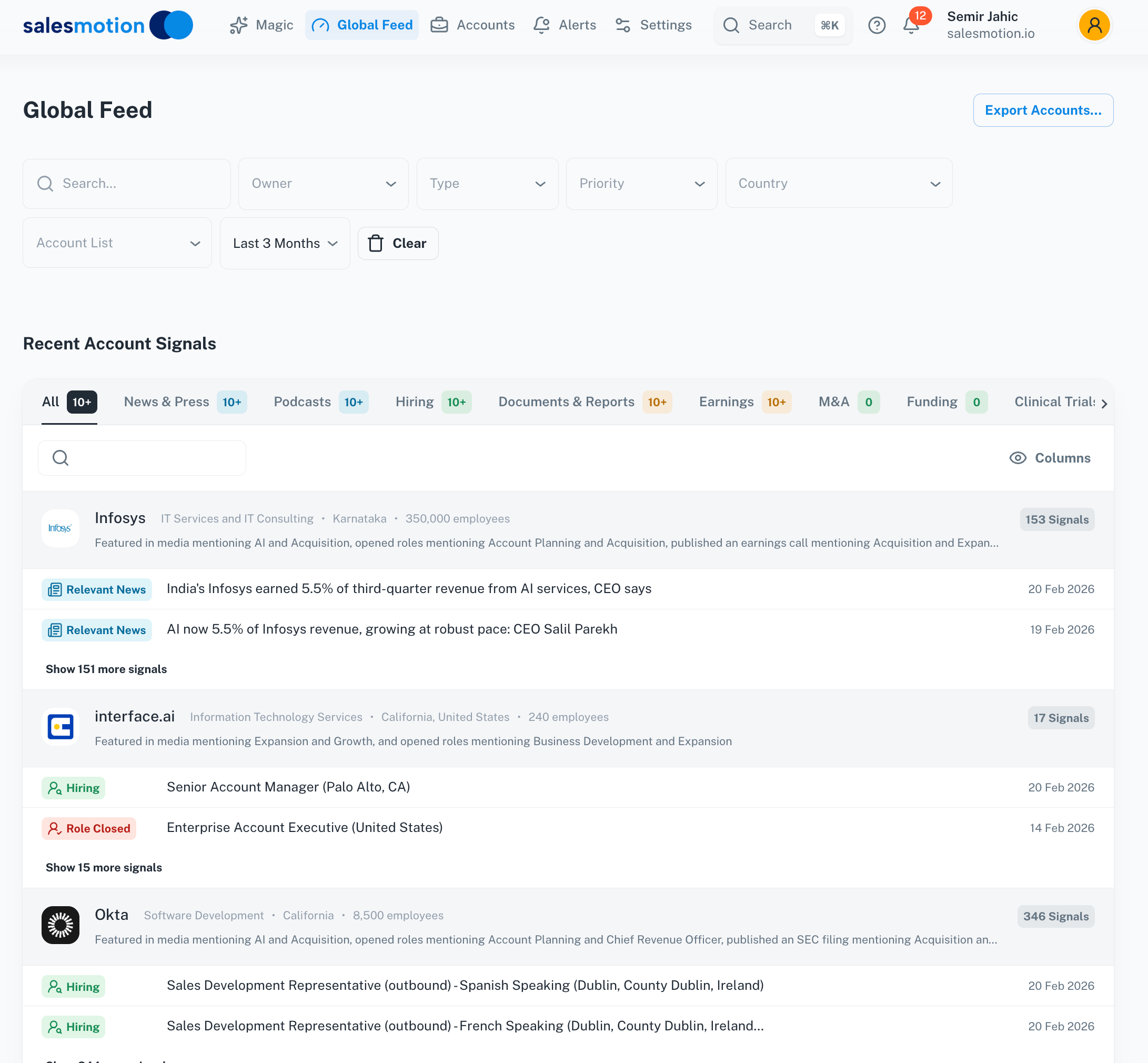 A live signal feed covering news, hiring, earnings, M&A, and funding events across accounts — a useful benchmark to hold against the signal coverage in a 6sense quote.
Why teams actually leave 6sense
When buyers walk away at renewal, the reasons cluster into three, and only one of them is the sticker price.
Adoption is the real bet, not the data. The most consistent thing buyers describe is that prior tools failed because reps never adopted them, not because the data was wrong. The field numbers are stark: one team had roughly 80 licensed users and 3 daily actives, another saw only about 10% of reps ever touch the tool. Against that risk, an annual commitment is a wager that adoption will arrive before the term ends. The healthier framing is the inverse: you keep a tool because reps use it, not because you signed. Contract length is an adoption hedge, not just a negotiation lever.
The cost is tied to a term, not to usage. The dollar figure is not the whole objection. It is the dollar figure committed for the full contract term, whatever that term turns out to be, if usage stalls partway through. For a team still proving whether signal-based selling changes rep behavior, committing a year of budget before the intelligence sticks is the exact risk they are trying to avoid.
The score is not the catalyst. A predictive score bundles content consumption, web behavior, and firmographics into one number that tells a rep which account to work, and 6sense's RevvyAI adds insights and talking points grounded in that account activity. The buyers we hear from also want the named public event behind the interest (the new CFO, the initiative on the earnings call) with a source link. Without it, the rep ends up doing that research anyway.
How 6sense Compares to Account Intelligence Alternatives
For teams evaluating whether they need full ABM orchestration or focused account intelligence, here is how 6sense compares to a modern alternative built for signal-driven revenue teams at a fraction of the cost.
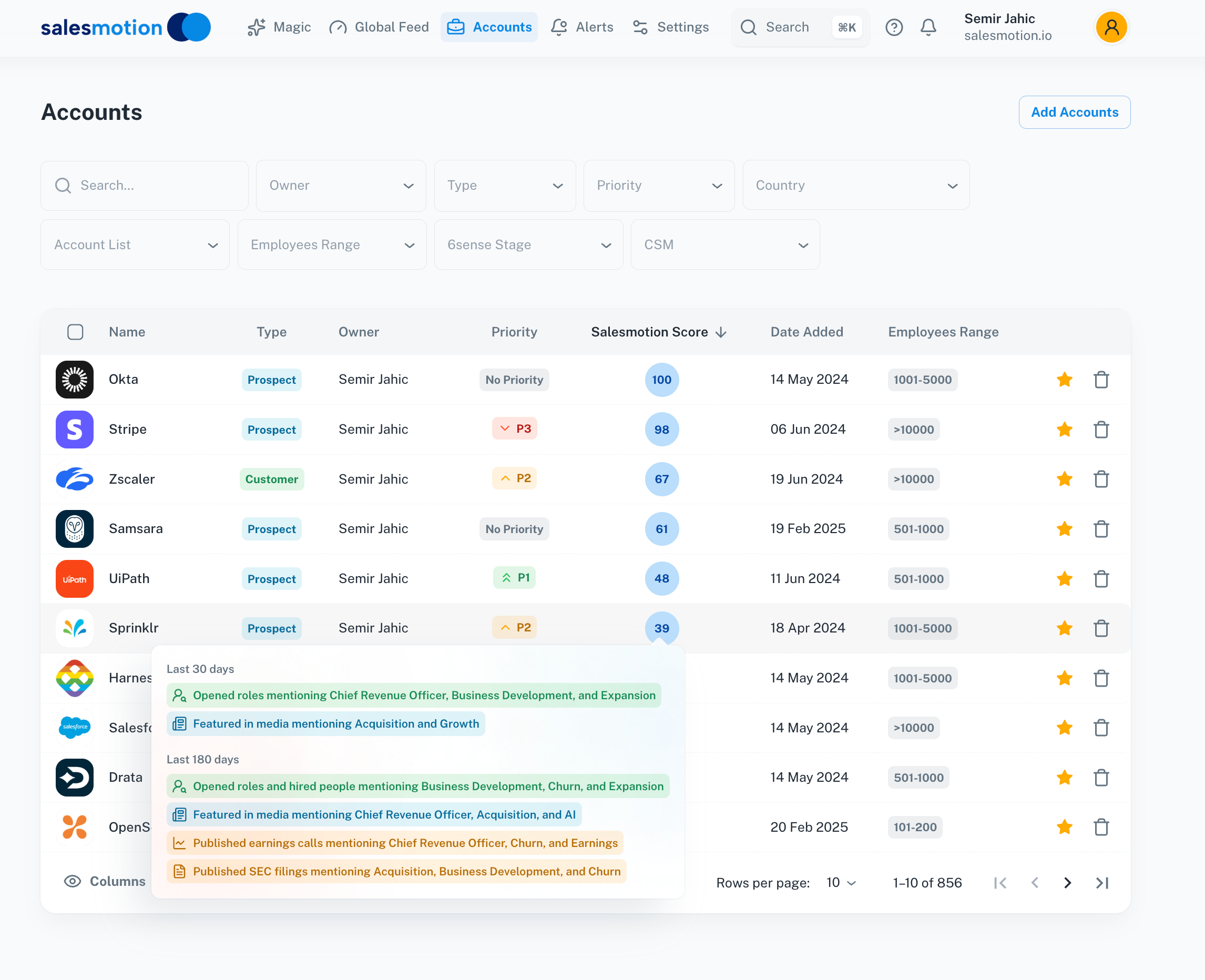 Account scores with the underlying signals expanded — a counterpart to 6sense's predictive scores worth seeing before you compare quotes.
| Dimension | 6sense | Salesmotion |
|---|---|---|
| Starting price | Custom-quoted; Vendr's lowest observed deal is $11,234/year | From $85/mo |
| Pricing model | Quoted per configuration + data credits | Account-based (unlimited users on team plans) |
| Median annual cost | $62,220 across 386 purchases (Vendr) | Custom (Team) |
| Contract length | Not published | Flexible |
| Implementation time | Guided onboarding; timeline not published | Days |
| Credit system | Yes (data credits) | Contact credits only (200/mo on Individual); research uncapped |
| G2 rating | 4.3/5 | 4.8/5 |
| Primary strength | Predictive ABM, intent data | Account signals, research automation |
| Best for | Enterprise ABM teams with RevOps | Revenue teams of any size needing account intelligence |
| Signal types | Intent data, web deanonymization, technographics, Sales Alerts | Leadership changes, earnings, funding, hiring, product launches, 1,000+ sources |
| Costs beyond the licence | Onboarding, RevOps time, additional credits | None |
The core trade-off: 6sense gives you predictive models and intent data at enterprise prices. An account intelligence platform gives you real-time signals from 1,000+ public sources, automated research, and CRM-integrated intelligence at a price point that does not require VP-level budget approval.
The difference shows up in how reps use each output. A number prioritizes; it tells a rep which account to work first. A named event creates urgency; it puts a clock on the conversation and gives the rep a reason the prospect has to act now rather than next quarter. The most common reason deals stall is the absence of a compelling event, and a visible catalyst (a new CFO, a strategic initiative named on the last earnings call) is what supplies one.
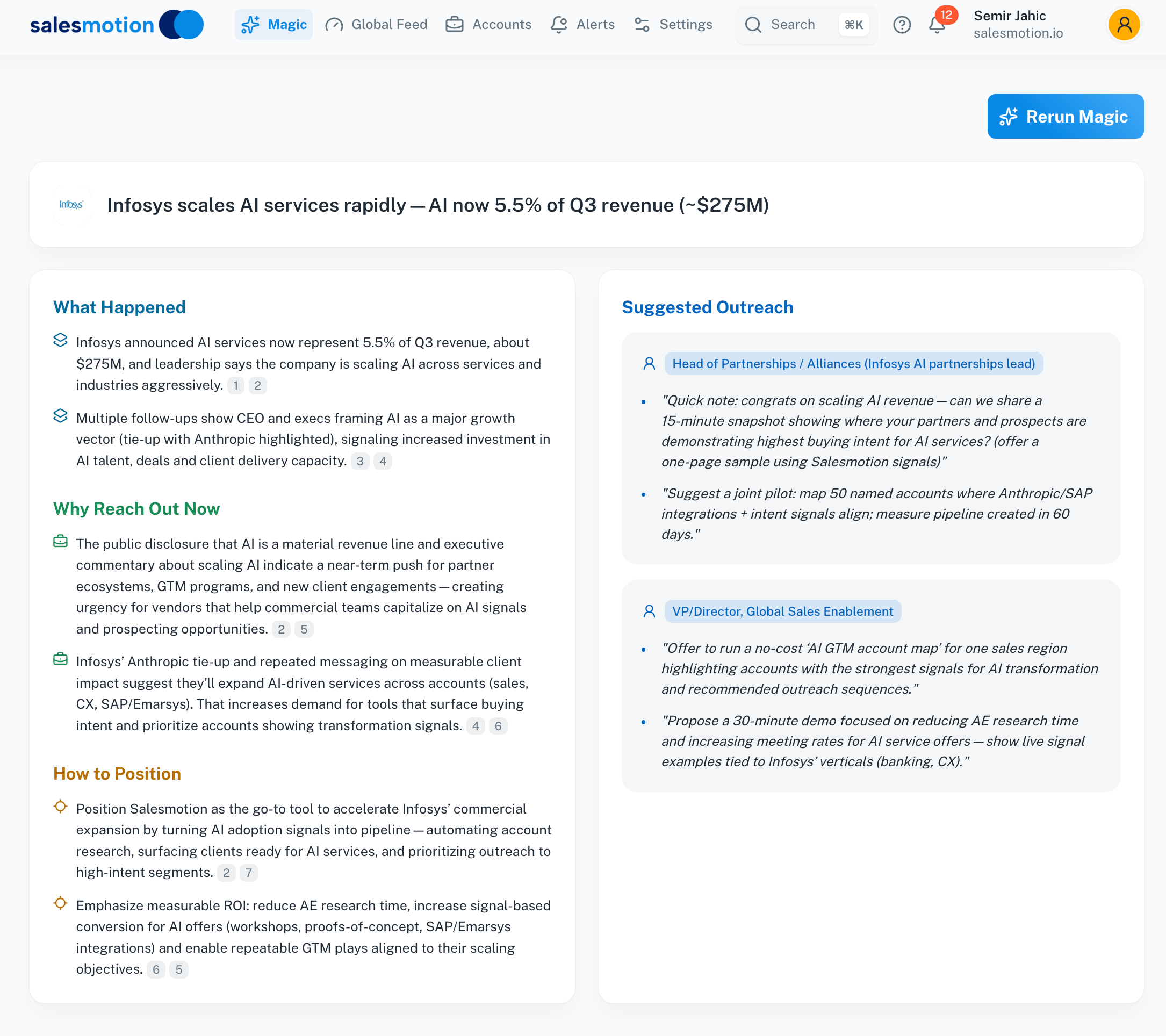 Automated research in practice: what happened at the account, why to reach out now, and persona-specific outreach suggestions — the workflow to weigh against 6sense's Sales Copilot.
For a deeper feature-by-feature breakdown, see the full 6sense vs alternative comparison.
How should you evaluate a 6sense alternative?
If your reasons for evaluating are adoption risk, contract commitment, and score transparency, then score quality matters less than four criteria that map directly to those concerns.
Signal transparency. Can a rep see exactly what fired and why, in plain language, not a number? A new CFO, a strategic initiative named on the last earnings call, a specific job posting, a clinical-trial phase transition. The named catalyst is what becomes the first line of an email; the score is not. This is the difference between knowing which account to work and knowing what to say and why to reach out today.
Contract flexibility as a retention hedge. Monthly rolling beats annual lock-in while you are still building the adoption habit. The point is not the discount. You should be able to leave, which is exactly why teams stay.
Account-based pricing, not seat rationing. Per-seat models force you to choose who gets access, and the rep who most needs the signal often does not have a license. Account-based pricing with unlimited users removes that fight. See per-seat vs account-based pricing for sales tools for the full trade-off.
Same-day setup. Connect the CRM, import the accounts, get intelligence the same day, instead of a multi-week implementation before the first signal lands.
This is the three-agents shape: a Signal Agent surfaces the actual event, a Research Agent turns roughly three hours of manual account work into about five minutes, and an Outreach Agent drafts against the specific signal. Reps in the field describe the manual version of this as 10-15 minutes of back-and-forth across a list tool, an enricher, a title filter, and each company website just to reach out to one account. A transparent signal removes that loop; an opaque score leaves the rep still researching.
There is also a consolidation answer to the common objection, why add another tool. When the signal and the reason behind it live in one place, the stitched-together point tools stop earning their line item. At Clari, Enterprise Sales Director Lynn Powers hit her annual number in 6 months. At Cytel, Head of Sales Operations Lyndsay Thomson consolidated five research sources into one and cut research time by 50%. Setup is not the barrier it is with enterprise ABM either; Incredible Health was live in 3 days, per VP of Sales Joe DeFrance.
How to Negotiate a Better 6sense Deal
If you decide 6sense is the right fit, negotiation can significantly reduce your costs. The width of Vendr's observed range, $11,234 at the bottom and $176,511 at the top, is itself the argument that the first number you are given is a starting position.
Time your purchase at end-of-quarter. 6sense sales reps have quarterly targets like everyone else, and the final weeks of a fiscal quarter are when a quote is most movable.
Bring competitive alternatives. Mentioning that you are evaluating Demandbase, ZoomInfo, or other 6sense alternatives creates urgency and gives the rep an internal reason to ask for approval on a lower number.
Ask about contract length. 6sense does not publish a standard term. Shorter commitments reduce risk, especially for first-time buyers, and are worth trading a discount for.
Negotiate implementation fees separately. Ask for any implementation fee as its own line item, so it can be negotiated separately from the licence.
Involve your CFO. Showing budget constraints at the executive level signals that you are serious about limits, not just negotiating for sport.
Frequently Asked Questions
How much does 6sense cost per year?
6sense does not publish a price for any of its three configurations; each one is quoted. Vendr reports a median annual contract value of $62,220 across 386 purchases, with a range of $11,234 to $176,511. Where you land inside that range depends mostly on how many accounts you want monitored and whether you take predictive AI, data credits, or both.
Does 6sense offer monthly billing?
6sense does not publish billing or contract terms; every configuration is quoted. Ask for the term length, renewal notice period and any monthly option in writing before you compare quotes.
What are 6sense's hidden costs?
Beyond the license fee, ask about implementation and onboarding (6sense publishes neither a fee nor a timeline), the RevOps time needed to run the platform, and the cost of additional data credits if your team exceeds the allocated pool. Get each as a line item so you can compare first-year cost, not only the contract value on the quote.
Is 6sense worth it for small teams?
For teams under 50 sellers without dedicated marketing ops or RevOps resources, 6sense is typically difficult to justify. The platform requires significant operational investment to configure, maintain, and optimize. Smaller teams often find better ROI with focused sales intelligence platforms that offer faster implementation and simpler pricing structures.
What do 6sense reviews say about pricing and value?
6sense holds a 4.3/5 rating on G2, and its own site highlights being named a Leader in The Forrester Wave: Revenue Marketing Platforms for B2B, Q1 2026. When you read reviews, filter for teams of your size and look at how they describe pricing, onboarding time, and the RevOps resources needed to get value.
How is signal-based intelligence different from 6sense intent data?
6sense intent data scores accounts on likely buying stage using its proprietary Signalverse intent data. Signal-based intelligence surfaces the specific catalyst behind the interest: the new CFO, the strategic initiative on the earnings call, the job posting, the clinical-trial phase change. A score tells a rep which account to work. A named signal tells the rep what to say and why to reach out now, which is what turns a number into a first line of outreach.
Can I switch off 6sense without an annual contract?
6sense does not publish its contract terms, so the term, renewal and notice period are whatever your order form says; check it before you plan a switch. Commitment length is one of the reasons buyers we speak with evaluate alternatives, especially teams burned by tools their reps never adopted. A monthly rolling contract reframes the term as an adoption hedge: you keep the tool because the team uses it, not because the term has not expired.
What are the best 6sense alternatives?
The best alternative depends on your primary need. For account intelligence and real-time buying signals at a fraction of 6sense's cost, Salesmotion offers three AI agents (Signal, Research, and Outreach) that monitor 1,000+ sources for buying triggers, generate cited account briefs, and draft signal-anchored outreach, starting at $85/month for individuals (self-serve monthly plan, no annual commitment) with custom team pricing and unlimited users on team plans. For contact databases, ZoomInfo and Apollo.io offer strong options. For pure intent data, Bombora specializes in research behavior tracking. For a full comparison of options, see our 6sense alternatives page and pricing comparison.
Are there cheaper and easier alternatives to 6sense?
Yes. A median annual contract value of $62,220 in Vendr's data, a guided implementation, and the RevOps time the platform needs put 6sense out of reach for many teams. Several alternatives deliver comparable signal intelligence at a fraction of the cost with dramatically faster deployment. Salesmotion, for example, starts at $85/month for individuals; teams get custom pricing with unlimited users on team plans. There's no annual contract on the individual plan, research is uncapped, and teams typically go live within 24 hours rather than weeks. The platform covers buying signals (leadership changes, earnings calls, funding, hiring), account research, and AI-drafted outreach in a single system, eliminating the need to bolt on separate tools for each capability. For teams that need ABM orchestration specifically (programmatic advertising, multi-channel campaign management), Demandbase offers a 6sense-comparable platform. But for teams whose primary need is identifying which accounts to pursue and why, a focused account intelligence platform delivers faster ROI without a five- or six-figure commitment.