We went through ZoomInfo's pricing so you don't have to. After talking to buyers who've been through renewal cycles and reviewing hundreds of user reviews, here's what ZoomInfo pricing actually looks like in 2026. The short version: there is no list price to look up, and the quote you get is the beginning of the conversation, not the end of it.
ZoomInfo remains one of the largest B2B contact databases on the market, with 500M+ contacts and 100M+ companies. But it prices on consumption, quoted per organization, which makes budgeting harder than it looks. The one public benchmark worth anchoring to: Vendr's marketplace data shows a median ZoomInfo contract of $33,500 a year, based on 1,576 purchases.
TL;DR: ZoomInfo does not publish list pricing. Its own pricing page says so, because pricing is consumption-based and quoted per organization. Vendr reports a median ZoomInfo contract of $33,500 a year, based on 1,576 purchases. ZoomInfo Lite is a permanent free tier with 10 credits a month, and ZoomInfo offers a free trial of its paid sales plans. For teams that need account intelligence over raw contact data, alternatives like Salesmotion offer flexible account-based pricing starting at $85/month with unlimited users on team plans.
 ZoomInfo positions itself as the go-to-market intelligence platform — pricing is consumption-based and quote-only.
ZoomInfo
Custom, consumption-based
no published price · Vendr median $33.5k/yr
Salesmotion
From $85/mo
monthly contract · verified contacts included
ZoomInfo is the largest contact and company database. Salesmotion tells you which accounts to work now and why, with verified contacts included, from $85/mo.
- 3 AI agents on every account: signals, research briefs, drafted outreach
- Live in an hour, monthly billing, no annual contract
- Verified contacts included; CRM integration on custom team & enterprise plans
ZoomInfo vs Salesmotion at a Glance
| ZoomInfo | Salesmotion | |
|---|---|---|
| Starting price | Not published; $33,500 median contract per Vendr | $85/mo individual, self-serve |
| Pricing transparency | Not published; quoted per organization | Published pricing |
| Free tier | ZoomInfo Lite, 10 credits/month | Interactive demo |
| Users included | Quoted per organization | Custom team pricing (unlimited users) |
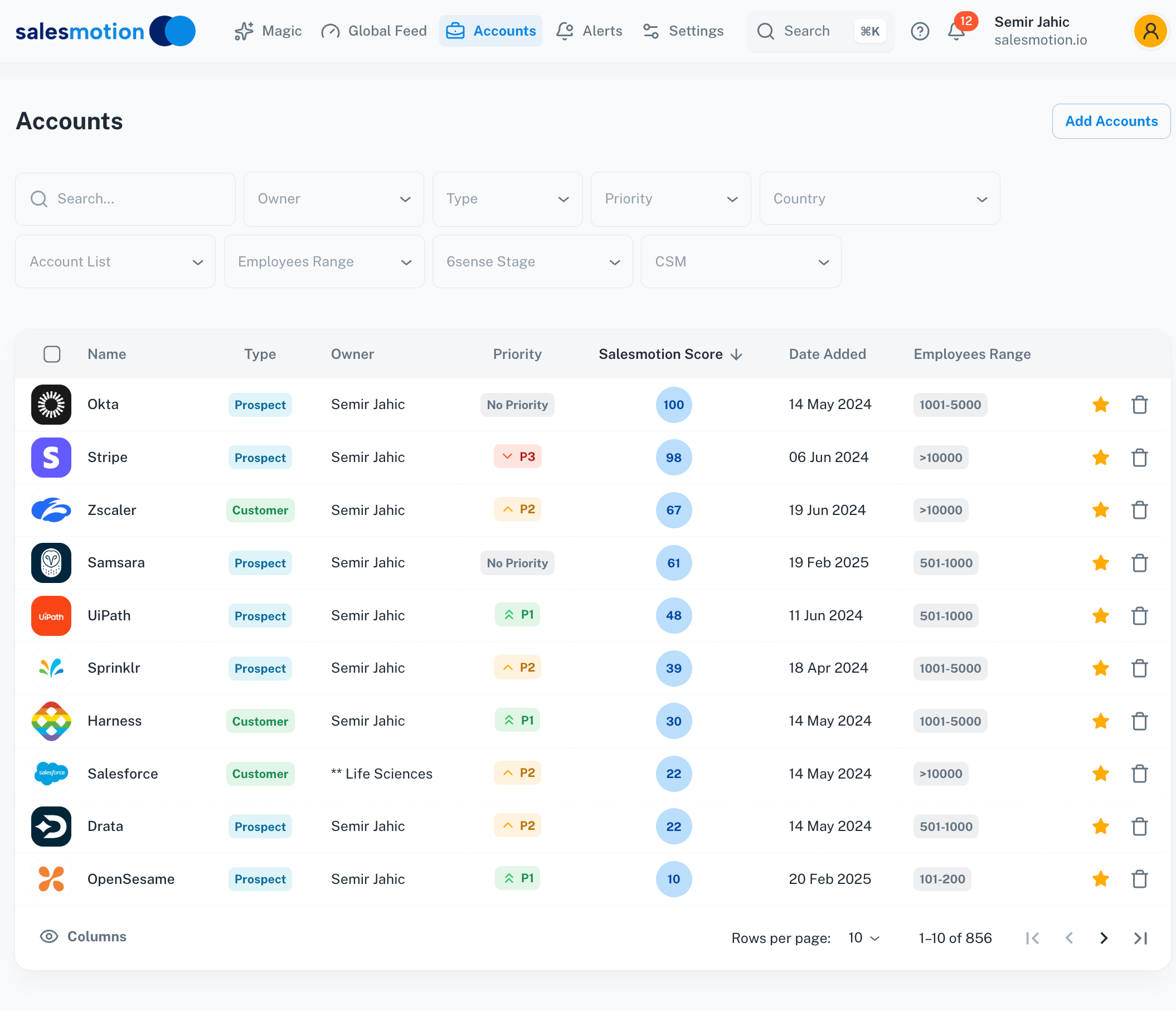 Salesmotion's account dashboard ranks a rep's territory by signal-based score, built from public-source signals on each account.
For a full feature-by-feature breakdown, see ZoomInfo vs Salesmotion. If the contract terms alone are a dealbreaker, start with our guide to the best ZoomInfo alternatives. And if you are leaving because you need buying signals rather than raw contact data, we compared the signal-first options in ZoomInfo alternatives for buying signals.
See Salesmotion on a real account
Book a 15-minute demo and see how your team saves hours on account research.
Key Takeaways
- ZoomInfo does not publish list pricing. Its pricing page explains that costs are consumption-based, so the tier names you see quoted around the web are not a rate card you can hold them to.
- The best public benchmark is Vendr's marketplace data: a median contract of $33,500 a year based on 1,576 purchases, with buyers saving 22% on average.
- Credits meter usage, and whether unused credits roll over depends on the contract; ZoomInfo's own guide tells buyers to ask. Right-sizing your credit allocation is the single biggest lever on the quote.
- Auto-renewal clauses are real. Vendr puts the usual notice period at 30-90 days and advises negotiating it to 90-120, so diary the date the day you sign.
- Vendr also puts typical escalation clauses at 5-10% a year, which is negotiable if you raise it before signing rather than at renewal.
- Teams focused on account intelligence and signals rather than raw contact volume should evaluate account-based alternatives that don't charge per seat.

“The Business Development team gets 80 to 90 percent of what they need in 15 minutes. That is a complete shift in how our reps work.”
Andrew Giordano
VP of Global Commercial Operations, Analytic Partners
What ZoomInfo Actually Publishes
ZoomInfo doesn't publish pricing on its website, and it says why: pricing is consumption-based, so what you pay depends on how much data you pull and which parts of the platform you switch on. You have to talk to sales to get a quote, and those quotes vary significantly based on team size, credit volume, and negotiation leverage.
What ZoomInfo does publish is the product line and plan names: on the sales side ZoomInfo Professional, Copilot Advanced and Copilot Enterprise, alongside marketing plans, GTM Workspace, GTM Studio for workflows, and API and MCP access through GTM.AI. Which of those you license, and at what data volume, is what the quote is really about. If you are specifically evaluating the Copilot layer, our ZoomInfo Copilot alternatives guide compares the top options.
The most useful public benchmark is Vendr's verified purchase data, which shows a median ZoomInfo contract of $33,500 a year, based on 1,576 purchases. Vendr also reports buyers saving 22% on average, which tells you roughly how much air is in a first quote.
At the top end, Vendr's observed range runs from $7,233 to $156,053 a year.
What Drives Your Number Up
Three things move a ZoomInfo quote more than anything else:
- Credit volume. Credits meter usage, and whether unused credits roll over depends on the contract. Overestimate here and you pay for data you never pull.
- Seat count. ZoomInfo describes its pricing as consumption-based: paid plans include a minimum number of seats, and extra seats are an add-on.
- Modules. Streaming Intent, international data, sales engagement (Engage), and API and MCP access are sold as add-ons to base plans, not features that come along for the ride.
Hidden Costs and Gotchas
The contract price you negotiate with ZoomInfo's sales team is the floor, not the ceiling. Several costs tend to surface after signing.
Credit Overages
ZoomInfo's credit system works like a prepaid plan: usage draws down a credit allocation, and running through it before the contract year ends means buying more.
Whether unused credits roll over depends on the contract; ZoomInfo's own pricing guide tells buyers to ask. Get the answer in writing, along with the top-up rate.
Per-Seat Scaling
ZoomInfo says paid plans include a minimum number of seats and scale with headcount, with additional seats sold as an add-on, and Vendr describes the pricing as per seat. Ask whether your negotiated rate extends to seats added mid-contract.
Add-On Stacking
ZoomInfo's own pricing guide lists several add-ons to its base plans:
- Streaming Intent: available as an add-on to base plans
- Sales engagement (Engage): add-on to base plans
- International data: add-on
- Additional seats: per-seat cost beyond the included user count
- API and MCP access: add-on
The number you negotiated for core search is rarely the number you end up with once these stack up.
Auto-Renewal and Price Hikes
ZoomInfo contracts auto-renew: its own pricing guide tells buyers to confirm the notice period required to cancel or renegotiate before auto-renewal triggers. Vendr puts the usual notice period at 30-90 days and advises negotiating it to 90-120. Miss the window and the contract renews for another term.
Vendr also notes that ZoomInfo contracts commonly carry an escalation clause of 5-10% a year, so Year 2 is priced before you have any usage data to argue with. Cap it at signing, not at renewal.

“The moment we turned on Salesmotion, it became essential. No more hours on LinkedIn or Google to figure out who we're talking to. It's just there, served up to you, so it's always 'go time.'”
Adam Wainwright
Head of Revenue, Cacheflow
Is ZoomInfo Worth It in 2026 for Outbound Sales?
The honest answer: it depends on what your team actually needs.
For large enterprises with 20+ seat requirements and a primary focus on North American contact data, ZoomInfo delivers genuine value. The database is massive (500M+ contacts, 100M+ companies, 120M+ direct dials), the CRM integrations are mature, and the platform has been the market standard for years. If your team's bottleneck is finding email addresses and direct dials, ZoomInfo solves that well.
But for outbound sales teams in 2026, the bottleneck has shifted. Most teams don't struggle to find contacts. They struggle to know which accounts to prioritize, why to call them right now, and what to say when they get them on the phone. ZoomInfo is fundamentally a contact database. It tells you who to call. Its Copilot layer adds buyer signals, account summaries and drafted outreach on top of the database. Salesmotion is built around source-cited account research: earnings calls, filings, hiring and leadership changes monitored per account.
This matters because the cost-per-insight math changes when you factor in the full outbound workflow. Before renewing, check how your team actually covers:
- Buying signal detection (leadership changes, funding, hiring surges, earnings mentions)
- Account research (competitive intelligence, strategic initiatives, financial performance)
- Personalized outreach (signal-anchored messaging, not generic templates)
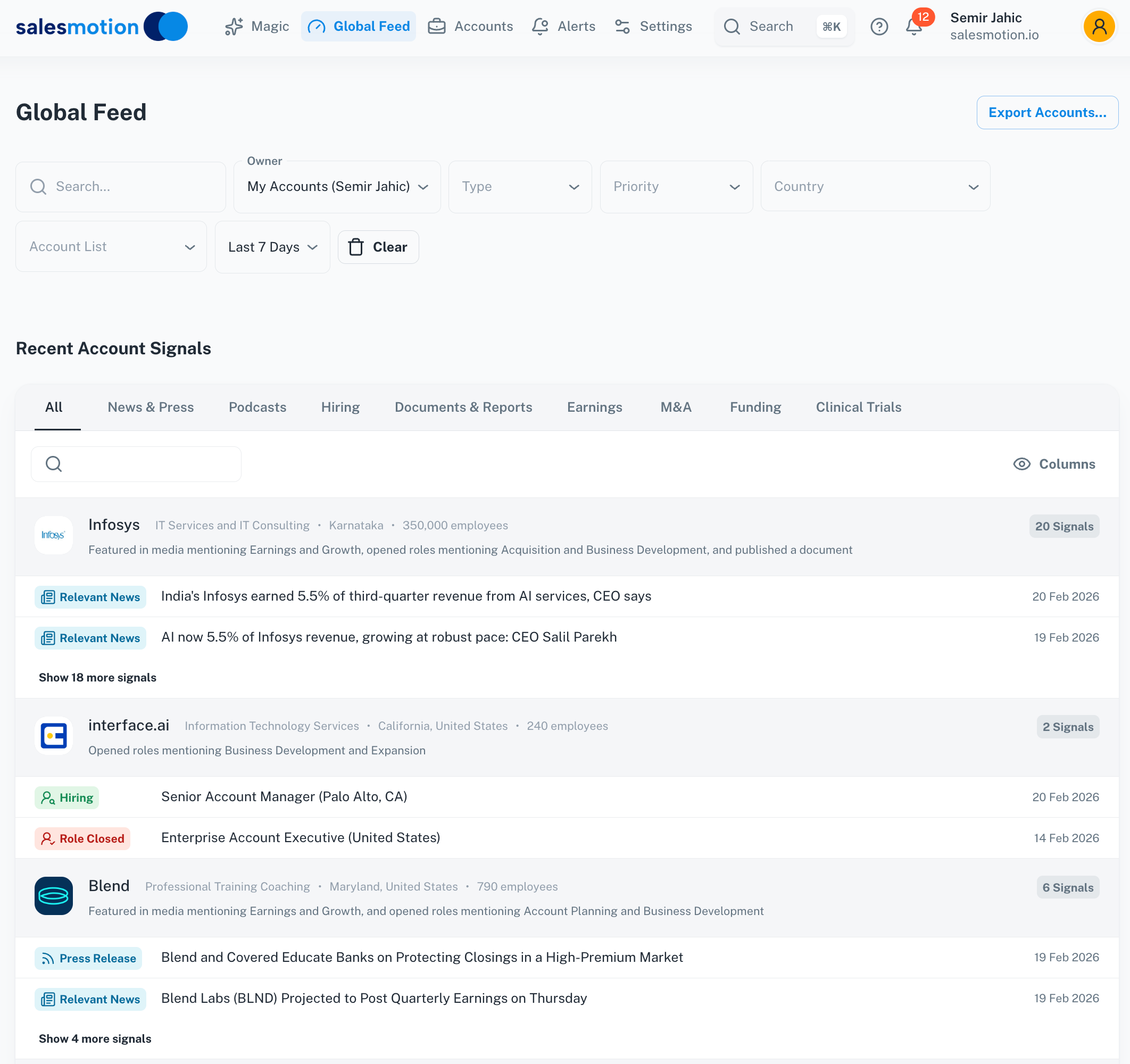 Salesmotion's Global Feed surfaces earnings, hiring, and news signals across every monitored account, each linked to its source.
When you stack a ZoomInfo contract (Vendr reports a median of $33,500 a year) with ZoomInfo's Streaming Intent add-on or a third-party intent provider, plus manual research time of 3-5 hours per rep per week, an outbound stack built around ZoomInfo carries a second budget line and a third one you never see on an invoice.
Teams like Analytic Partners found that putting an account intelligence platform at the center of their research cut research time by 85% (from 3 hours to 15 minutes per account) and grew qualified pipeline by 40% year over year. Cacheflow cut meeting prep time by 60% and tripled deal sizes within 6 months.
For teams evaluating whether ZoomInfo is worth renewing or adopting in 2026, the key question isn't whether the contact data is good (it is). The question is whether a contact database alone solves your actual outbound challenge, or whether you need an intelligence layer that tells reps which accounts to work and what to say.
Salesmotion's Take
Nobody questions ZoomInfo's database — it's among the biggest, and for raw coverage it earns the reputation. But the objection that comes up in almost every renewal conversation I'm part of is different: "it's complicated and full of information, but a rep can't look at a territory and know what to do." That's tool fatigue, and it's exactly why so many teams are consolidating their stack right now. A five-figure spend that still leaves reps toggling between LinkedIn, news, and earnings filings to build context isn't an intelligence problem you've solved — it's one you've paid a premium to keep. The win isn't more records; it's handing a rep their accounts already ranked, with the "why now" attached. That's the bar we hold ourselves to.

Semir Jahic
CEO & Co-Founder, Salesmotion
ZoomInfo vs Salesmotion: Pricing Comparison
For teams evaluating whether a contact database or an account intelligence platform better fits their needs, here's how the pricing stacks up:
| Factor | ZoomInfo | Salesmotion |
|---|---|---|
| Annual Price | Not published; $33,500 median per Vendr | From $85/mo |
| Pricing Model | Consumption-based (seat minimums + credits) | Account-based (unlimited users on team plans) |
| Seats Included | Quoted per organization | Unlimited on team plans |
| Credit System | Yes | No credits |
| Monthly Option | Not standard (annual subscriptions) | Yes ($85/mo) |
| Renewal Escalation | 5-10% clause typical, per Vendr | No automatic increases |
| Core Capability | Contact and company data + Copilot AI layer | Account intelligence + buying signals |
| Intent Data | Streaming Intent add-on | Included (all plans) |
| G2 Rating | 4.5/5 | 4.8/5 |
| Free Tier | ZoomInfo Lite, 10 credits/month | Interactive demo |
The fundamental difference isn't just price. ZoomInfo starts from a database of contacts and companies and layers Copilot on top. An account intelligence platform starts from the account: it monitors accounts for buying signals, tracks leadership changes, analyzes earnings calls, and surfaces strategic initiatives, so reps know which accounts to prioritize and what to say when they reach out.
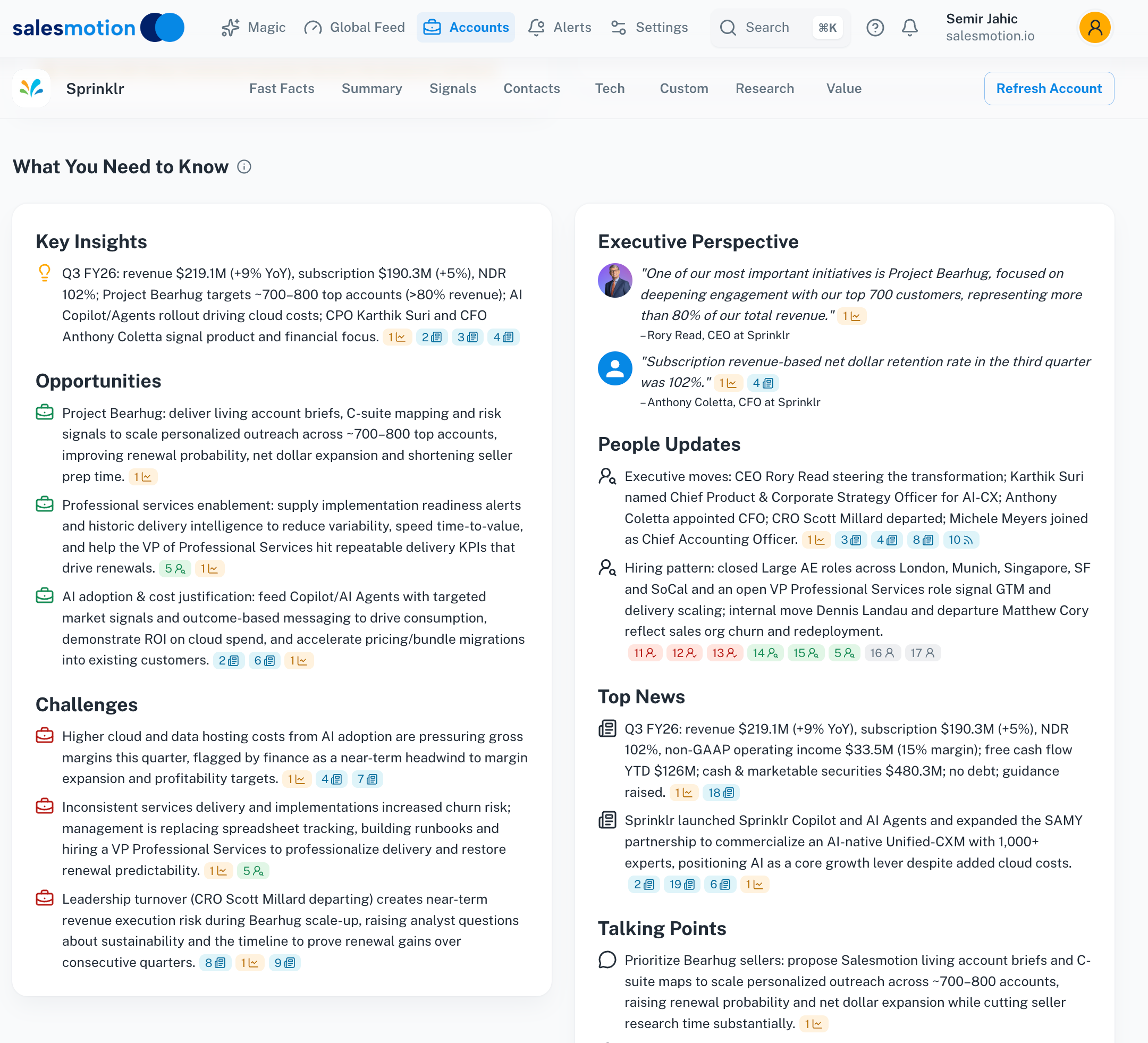 A Salesmotion account summary condenses earnings commentary, executive quotes, hiring patterns, and talking points into one brief — the research work that otherwise comes out of a rep's selling time.
For teams already using ZoomInfo for contact data and looking to add account intelligence, both tools can work together. For teams evaluating their sales intelligence stack from scratch, the pricing comparison page breaks down the full feature set.
How to Negotiate a Better ZoomInfo Price
If you decide ZoomInfo is the right fit, you can likely negotiate a lower rate. Here's what works:
-
Get competitive quotes first. ZoomInfo's sales team is more flexible when you have alternatives on the table. Request quotes from Apollo, Cognism, and other competitors before your ZoomInfo call.
-
Right-size your credit allocation. Audit your actual usage for the past 6 months. Buying headroom you never use is the most common way teams inflate their own quote.
-
Negotiate the renewal cap. Vendr puts typical escalation clauses on ZoomInfo contracts at 5-10% a year. Push that down in writing before you sign, because you will not get a better hearing at renewal.
-
Time it to quarter-end. Sales teams are usually most flexible at quarter and year-end, and Vendr reports buyers saving 22% on average.
-
Read the notice period. Vendr puts the usual notice period at 30-90 days and advises negotiating it to 90-120. Put the date in a calendar the week you sign.
Frequently Asked Questions
How much does ZoomInfo cost?
ZoomInfo does not publish list pricing. Its own pricing page explains that no dollar figures are given because pricing is consumption-based and quoted per organization. The best public benchmark is Vendr's verified purchase data: a median contract of $33,500 a year based on 1,576 purchases, with a range of $7,233 to $156,053.
How much is ZoomInfo per month?
ZoomInfo's paid plans are annual subscriptions, and ZoomInfo says monthly billing is not standard, so there is no monthly rate to compare. ZoomInfo Lite is free with 10 credits a month. Teams needing month-to-month flexibility should consider alternatives with more flexible billing options.
Does ZoomInfo have a free version?
Yes. ZoomInfo Lite is a permanent free tier that provides access to its database with 10 monthly credits (25 with Community Edition), a Chrome extension, and HubSpot integration. There's no time limit, no annual commitment, and no credit card required. Ten credits a month is limited for a full sales workflow, so teams prospecting daily will need a paid plan.
Does ZoomInfo offer a free trial?
Yes. ZoomInfo's pricing page shows a "Start free trial" button on each of its paid sales plans: ZoomInfo Professional, Copilot Advanced and Copilot Enterprise. The page does not state how long the trial runs. The trial is separate from ZoomInfo Lite, the permanent free tier with 10 credits a month.
Does ZoomInfo charge per seat?
ZoomInfo describes its pricing as consumption-based: paid plans include a minimum number of seats, extra seats are an add-on, and credits meter usage. Vendr describes ZoomInfo as charging per seat, with per-seat pricing decreasing with volume. Either way, seat count is one of the main inputs to your quote alongside credit volume and add-ons. Some account intelligence platforms use org-based pricing that doesn't penalize team growth.
What happens if I run out of ZoomInfo credits?
When your credit allocation is exhausted mid-contract, you'll need to purchase additional credits. Whether unused credits roll over depends on the contract; ZoomInfo's own guide tells buyers to ask. To avoid surprise costs, track your credit consumption monthly and negotiate the top-up rate into your initial contract rather than at the point you need it.
Is ZoomInfo worth it?
ZoomInfo remains valuable for teams whose primary bottleneck is finding contact data (emails, direct dials, org charts). The database covers 500M+ contacts and 100M+ companies, and the CRM integrations are mature. However, for outbound teams in 2026, the challenge has shifted from finding contacts to knowing which accounts to prioritize, why to call them now, and what to say. ZoomInfo's Copilot layer adds buyer signals, account summaries and drafted outreach on top of the database. Salesmotion is built around source-cited account research: earnings calls, filings, hiring and leadership changes monitored per account. Teams at Vendr's $33,500 median should check what they still add on top for intent data, account research, and personalization. For teams that need account intelligence alongside contact data, account-based platforms that combine signals, research, and prospecting in a single system can deliver better ROI at a fraction of the cost.
What is ZoomInfo's cancellation policy?
ZoomInfo's paid plans are annual subscriptions that auto-renew, and its pricing guide does not spell out cancellation terms: it tells buyers to confirm the notice period required to cancel or renegotiate before auto-renewal triggers. Vendr puts the usual notice period at 30-90 days and advises negotiating it to 90-120. Missing it means the contract renews for another term, so get the cancellation terms in writing before you sign.
How do you negotiate down ZoomInfo pricing?
Start from the public benchmark: Vendr says buyers save 22% on average on ZoomInfo, against a median contract of $33,500 a year based on 1,576 purchases. Vendr also says per-seat pricing decreases with volume, reports annual price escalation clauses of typically 5-10%, and advises negotiating the notice period to 90-120 days, so seat count, the renewal cap and the notice period are the terms to raise before you sign. ZoomInfo's pricing guide tells buyers to ask whether unused credits roll over and to confirm the notice period before auto-renewal triggers.