A phase two readout lands on Friday. The asset looks promising, a flagship brand is approaching loss of exclusivity, and the board wants an external program before the next planning cycle. The team has a target list, but no shared view of which company to call first, what kind of deal to offer, or what would make the group walk away.
That's where biopharma business development earns its keep. The job isn't to collect interesting assets. It's to turn a live portfolio need into a qualified opportunity, a workable transaction and a partnership the organization can execute.
What Biopharma Business Development Is For
By Monday, the team needs to translate urgency into a decision. Suppose the phase two asset could fill a gap in the company's immunology franchise, but its trial design may not support the label the commercial team needs. A useful BD lead doesn't push the asset forward just because the readout is fresh. They bring research, clinical, finance and commercial colleagues around the same question: does this program solve a defined portfolio problem on terms the company can carry?
That is biopharma business development in plain language. The team finds external assets, tests their fit and negotiates rights so the company can build its pipeline without having to invent every program internally. A deal might fill a therapeutic-area or modality gap, replace a product's expected contribution as exclusivity fades, or give a company access to a capability it doesn't have in-house.
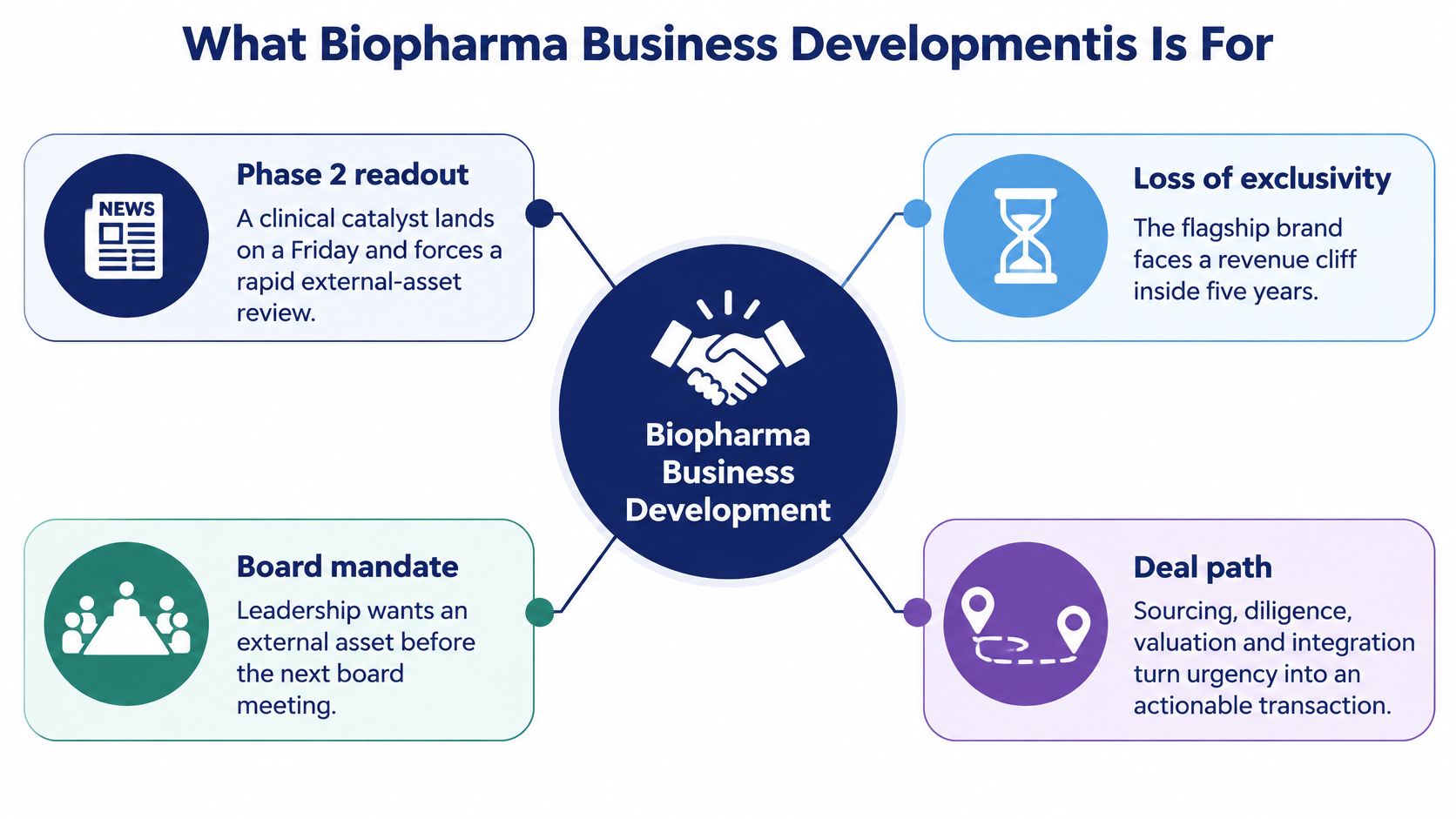
The pressure is rarely just scientific. A promising asset may arrive too early to help with a near-term revenue gap. A later-stage program may fit the timing but demand a purchase price or development commitment the company can't support. The team has to weigh the rights it can secure, the control it needs after signing, and the cash and risk it can take on before the asset proves itself.
Three neighboring functions often get blurred on org charts:
- Competitive intelligence maps competitors, trials, assets and exclusivity timelines. Its job is to make external conditions legible.
- Business development places the bet. It decides which opportunities merit a conversation and negotiates the rights and obligations.
- Alliance management runs the relationship after signature, keeping decisions, responsibilities and information moving between partners.
That distinction matters because an industry report isn't a deal strategy, and a signed contract isn't a working partnership. The internal customers for BD include research, clinical, medical, market access, legal, finance and the chief executive. Each group sees a different risk, so the deal team needs a shared thesis rather than a collection of disconnected opinions.
Think of the portfolio as a set of bets made with other people's molecules. The currency isn't just money. It's also rights, milestones, control and calendar time. A useful life sciences business development resource can help teams keep the external activity organized, but the deal thesis still has to come from the company's own priorities.
Practical rule: Start with the portfolio gap and the timing. Then ask which external asset can fill it, and what structure makes that possible.
Deal Structures BD Teams Actually Use
Start with the choice of structure, not the seller's preferred term sheet. The right form depends on what the company needs to control, what it can fund and how much uncertainty it's willing to carry.
| Structure | Control | Typical economics | Best when | Main risk |
|---|---|---|---|---|
| In-licensing | Licensee holds defined rights by asset, indication or territory | Upfront, milestones and a royalty on sales | You need a pipeline asset faster than internal R&D | IP, CMC or trial design missed in diligence |
| Co-development | Shared cost and joint governance | Cost sharing plus profit sharing or split milestones | Each side has a capability the other lacks | Deadlock and blurred accountability |
| Commercialization or co-promote | Developer keeps the asset; partner sells a region or channel | Supply price, co-promote fee or profit split | An approved or late-stage asset needs a stronger commercial footprint | Forecast fights and channel conflict |
| M&A or asset purchase | Buyer owns the company or asset | Cash, stock or contingent value rights | The fit is durable and integration is feasible | Overpaying, culture clash or pipeline concentration |
In-licensing is a practical route when you need defined rights faster than internal discovery and development can deliver them. Say a company wants to add a phase two immunology program in a region where it already has clinical and commercial capabilities. It could license that territory, fund agreed development work and pay royalties if the product sells. The company gets a defined role without buying the entire organization.
Co-development makes sense when each party brings something essential. One partner might own a bispecific platform while the other has a clinical franchise and experience in the target disease. The partners share development work and set up joint governance. That can align incentives, but it also creates a decision problem: if the committee can't resolve disagreements about protocol changes, budgets or next steps, shared responsibility can become nobody's responsibility.
Commercialization or co-promotion fits a different gap. A developer may have an approved rare-disease drug and a label, but limited reach in a particular market or channel. A partner can contribute commercial capability while the developer retains ownership. The economics may involve supply terms, a fee for promotion or a share of profit. Teams should agree how forecasts, territories and customer ownership will work before those disagreements reach the field.
M&A or an asset purchase suits a strategic fit the buyer wants to own outright. A company might acquire a business to build capabilities ahead of a future exclusivity gap, using cash, stock or contingent value rights tied to later performance. Ownership gives the buyer more control, but it also puts integration, culture and pipeline concentration on the buyer's side of the ledger.
Control on paper only helps if the organization can make decisions and deliver the work after signing.
Use the structure to make the risk explicit. A license can limit the commitment to a defined asset or territory; an acquisition brings the whole organization or asset into the buyer's hands. Co-development shares responsibilities, while a commercialization deal can separate ownership from selling. Match the arrangement to the control you need and the cash you're prepared to put at risk before proof.

“Salesmotion has been a game-changer for me. I used to spend 12 hours a week on prospect research, now it's down to 4. Plus I'm finding stuff I was totally missing - podcasts, news mentions, the good bits.”
George Treschi
Account Executive, FY25 President's Club, Sigma
Scorecards and Pitfalls That Decide the Go
Score the asset before a term sheet makes the price feel like the main question. A high headline value can distract a team from a weak trial design, a short exclusivity runway or a partner that can't finance the plan. Put the criteria on paper first, agree on what counts as a hard stop, then compare the opportunity with the company's actual portfolio needs.
| Criterion | What good looks like | Red flag | Weight |
|---|---|---|---|
| Strategic fit | Matches the therapeutic area, modality and a real planning-horizon revenue gap | Outside the stated franchise | High |
| Scientific and clinical | Endpoints and comparator support the intended label | Unpriced single-pivotal risk | High |
| IP and exclusivity | Patent estate and regulatory exclusivity cover the payback period | Exclusivity ends inside the payback window | High |
| Deal economics | Base-case NPV clears the hurdle after milestones | Value works only on heroic assumptions | High |
| Partner quality | Cash, CMC capability and people to execute the plan | Funding gap or key-person risk | Medium |
| Integration load | Named owners for medical, access and supply | No integration lead before close | Medium |
A phase two immunology asset could pass if its data support the intended development path, its protection covers the investment case and the partner can fund its obligations. It should fail if the team's economics only work under an optimistic forecast that assumes away trial risk. Model a base case, upside and downside, including upfront payments and milestones. If the asset only clears the hurdle in the upside case, that's a negotiation problem or a no, not a reason to relabel the forecast.
Use a clear pass-fail rule. Any red flag in a high-weight category stops the deal unless the chief executive explicitly accepts the risk in writing. That creates a record of the decision and prevents enthusiasm, sunk diligence effort or seller pressure from changing the standard.
For teams refining their investment criteria, this guide to how to screen small business deals offers a useful general framework for testing fit, financial logic and execution risk. The underlying discipline is similar: separate the appeal of the opportunity from the conditions required to make it work. In biopharma, a clinical pipeline analysis by indication and phase can help frame the portfolio context, but the company still needs to judge the asset against its own endpoints, market access assumptions and development capabilities.
A strong score doesn't remove the need to look for the failure modes that repeatedly derail deals:
- The famous asset sits outside the plan. Stop unless leadership is willing to rewrite the strategy and explain what takes priority instead.
- The exclusivity timeline doesn't support payback. Consider narrower rights, a different structure or a walk. Don't pretend the calendar will improve because the asset is attractive.
- A kill question has no owner. Assign someone to resolve the IP, CMC, safety or key trial-design issue. Otherwise, it can surface late, when the team has already committed time and negotiating strength.
- Change-of-control or diligence terms remain open. These provisions can decide who controls future decisions and what each party must deliver. Resolve them before debating whether a small change to the upfront will save the deal.
- Medical or supply has no voice in the close memo. Without those owners, the first joint committee may be unable to make practical decisions.
Track the health of the BD process as well as individual assets. Watch sourced opportunities, conversion through each gate, time between stages, deals against plan and the value of the external pipeline. Those measures help distinguish a weak funnel from a slow approval process. A clean no this quarter protects capacity for the asset that fits.
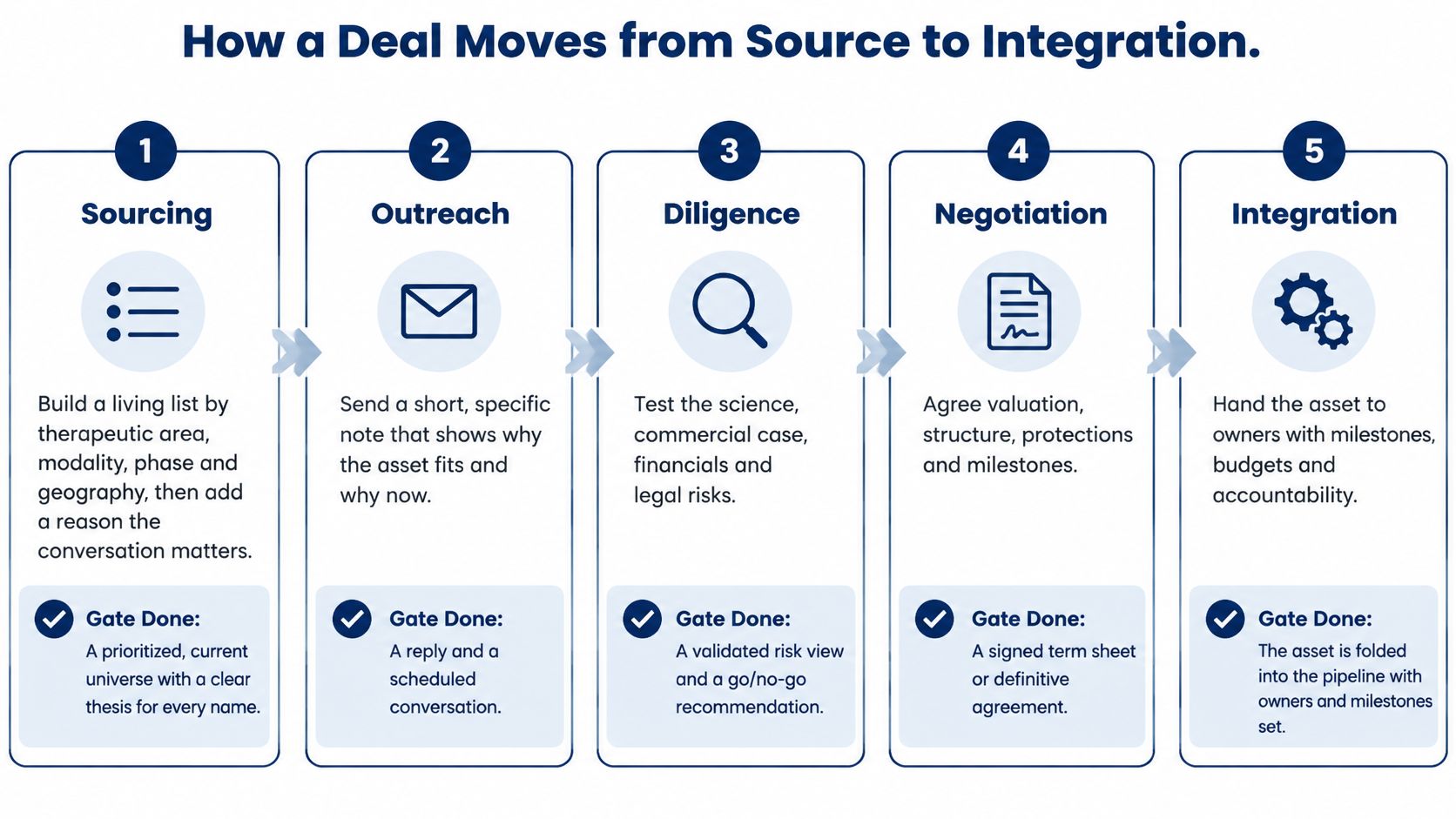
How a Deal Moves from Source to Integration
A deal process works when every gate has a decision and an artifact that moves the work forward. The team shouldn't carry every name from the target universe into full diligence. Build the evidence in layers, then spend serious time only when the opportunity has earned it.
-
Sourcing. Build a living universe by therapeutic area, modality, phase and geography. Add a reason to contact each priority company now: a phase move, financing, exclusivity gap on your side or leadership change on theirs. Done means a short list with a named hypothesis for every opportunity, not a spreadsheet of every company in the field. Artifact: a prioritized list with the thesis beside each name.
-
Qualification. Put the thesis, rough peak-sales logic, freedom-to-operate flags and ability to transact on one page. If the asset sits outside the franchise or the seller requires a structure the company can't fund, kill it early. Artifact: a one-page screen with a clear kill-or-advance recommendation.
-
Diligence. Once the screen passes, examine clinical design and data, CMC and supply, IP, regulatory exclusivity, safety and commercial assumptions. Test the commercial case with market access, not just the deal team's forecast. Give every workstream a named owner so legal isn't the first group to raise a CMC concern late in the process. Artifact: an integrated diligence view with risks, owners and a go-or-no-go recommendation.
-
Negotiation. Turn the scorecard into a term sheet. Set the upfront and milestones, territory, change-of-control protections, diligence obligations and who decides the next protocol. Artifact: a term sheet that reflects the approved deal thesis and names the decisions still to resolve.
-
Integration. Start before signature. Name medical, supply, pharmacovigilance and alliance leads, and put the first operating plan in the close memo. Artifact: a plan that assigns owners, milestones and budgets for the handoff.
Consider a European mid-cap licensing a phase two asset. It qualifies the opportunity against its franchise, then gives diligence owners time to test trial data, supply readiness and the access case. During negotiation, the parties settle who controls protocol decisions and what the licensee must fund. Before closing, the team assigns its internal leads and prepares the first joint development committee so the partnership can begin work under the agreed plan.
| Stage | Done looks like | Artifact |
|---|---|---|
| Sourcing | Living list by therapeutic area, modality, phase and geography, with a reason to act now | Short list with a named hypothesis |
| Qualification | One-page screen of thesis, peak-sales logic, freedom to operate and ability to transact | Kill or advance decision, targeted in about six weeks |
| Diligence | Clinical, CMC, IP, safety and an access-tested commercial case | Named owner per workstream; work planned in months, not years |
| Negotiation | Upfront versus milestones, territory, change-of-control, diligence and protocol control resolved | Term sheet built from the scorecard |
| Integration | Medical, supply, pharmacovigilance and alliance leads named before signature | First 90-day plan in the close memo |
Most avoidable delay happens between gates. A decision sits in someone's inbox, a meeting isn't scheduled, or a workstream owner doesn't know they're needed. Put the next decision, its owner and its deadline in the artifact before moving on.

“The Business Development team gets 80 to 90 percent of what they need in 15 minutes. That is a complete shift in how our reps work.”
Andrew Giordano
VP of Global Commercial Operations, Analytic Partners
How to Source Deals and Open Outreach
A sourcing routine should create a reason to call, not just a longer list. Fix the universe first, including private companies that may not have a polished deck or regular public profile. Then watch for changes that could alter the fit or the timing.

Use this weekly routine:
- Set the universe. Group potential partners by therapeutic area, modality, development phase and geography. Keep the list focused enough that the team can explain why each company belongs.
- Watch for live signals. Look for trial starts and phase moves, financing, partnership announcements, leadership changes in R&D or BD, earnings language about portfolio priorities and changes to your own exclusivity calendar.
- Write the why now. Before drafting outreach, state the event and its implication in one sentence. If the reason is only “we like your pipeline,” the message isn't ready.
- Build a brief. Summarize what changed, who is likely to decide, what you want and what structure you're prepared to discuss.
- Contact the right person. Usually that means the head of BD or the chief scientific officer. Mention one specific observation and ask for a short conversation.
- Log the touch. Keep the signal, note and follow-up together so the next event adds context instead of restarting the process.
For a broader comparison of sourcing approaches beyond large-company partnering, this guide to how independent sponsors source acquisitions shows how a focused thesis and a deliberate outreach process can shape deal flow. The same principle applies here: make the reason for contact specific, then give the other side a clear next step.
Two short hooks can be more useful than a polished generic introduction:
A competitor has started a phase three trial in your gap indication. “Your phase three start sharpens the timing question for our portfolio. We're evaluating regional rights to a phase two asset in the same indication. Would you be open to a conversation about whether a regional license could fit?”
A biotech has hired a chief medical officer after financing. “Your new CMO hire looks like a meaningful step toward the next protocol. How are you planning to resource that work? We'd welcome a short discussion about development options and the capabilities we could bring.”
Timing beats a prettier template because the trigger gives the recipient a reason to respond now. “We liked your science” competes with every banker's introduction and every generic partnering email. A signal-led note connects an event to a relevant question and makes the proposed discussion concrete. Salesmotion's biotech companies by modality resource can help teams organize the universe, but a human BD lead still needs to verify that the signal is real and that the proposed structure matches the company's scorecard.
Put the Next Deal on a Live Watchlist
Pick one franchise with a visible exclusivity or pipeline gap. Name five accounts that could help fill it. For each, write down the structure you'd consider, the scorecard red flag that would make you walk and the single event that should trigger a call in the next two weeks.
That's the operating system: structure, score, then signal. A static list can tell you who might fit. A live watchlist tells you why to contact them now, and what you're prepared to discuss when they reply.
Salesmotion's life sciences module finds drug developers by therapeutic area, phase and modality, and watches for trial starts, phase moves or raises. Cytel has seen 50% less research time. Jonathan Burr, Chief Commercial Officer at Cytel, said, “Salesmotion is helping Cytel elevate our enterprise sales performance by embedding account intelligence directly into our workflow. The platform gives our commercial team real-time visibility into key account movements.”
Use the biotech funding tracker to keep financing activity among potential partners in view. Load the five accounts, agree on the why-now events with the BD lead and send the first note when one of those events fires. The phase move won't wait for your next planning meeting.
Salesmotion helps teams research target accounts, monitor meaningful changes and turn timely signals into actionable outreach. Use it to keep a biopharma BD watchlist current and focused on the next relevant conversation. Visit Salesmotion to see how it can support your sourcing workflow.