Sales research is already being split into two jobs. AI handles the high-volume work of gathering signals, summarising public information, and assembling a usable first draft. Reps and managers still have to decide what matters, what changed, and how to turn that context into a message a buyer will respond to.
That is the operating model. Roughly 80% machine gathering and synthesis, 20% human judgment and strategic direction.
For revenue teams, the implication is straightforward. Stop paying sellers to spend hours collecting facts that software can compile in minutes. Start holding them accountable for the part AI cannot do well: prioritising the right accounts, interpreting timing, and forming a point of view that fits a specific buying group.
This also changes the standard for your tooling. A generic assistant can produce a summary. A sales intelligence workflow needs source control, account context, signal tracking, and output that supports action in the field. The gap between those two approaches is covered well in this comparison of ChatGPT vs sales intelligence tools.
Teams that get this split right improve research speed without lowering message quality. Teams that get it wrong create a different problem. Reps either stay stuck in manual prep, or they paste AI summaries into outreach and call it personalisation.
A business development rep at a software firm told us: "taking that information that artificial intelligence gives you and transforming that into outreach is very difficult". That is the second failure in one sentence: the summary arrives fast, and the hard part is still ahead of the rep.
Can AI Really Replace Sales Research
Gartner expects AI to become the default starting point for seller research workflows by 2027. That shift matters because it changes what revenue teams should automate, what they should still expect from reps, and where managers should measure quality.
AI can take over a large share of the collection work. It can pull public signals, condense long documents, and assemble an initial account view faster than a rep working tab by tab. That part of research was always process-heavy.
The harder part is deciding what deserves action.
A company can post strong hiring growth and still be a poor target this quarter. A funding round can signal urgency, or it can mean the team is focused on internal hiring and platform changes. A new executive can create an opening, or they can freeze decisions while they reassess vendors. AI can surface those facts. Sellers still have to judge the commercial meaning.
That is why the central question is not whether AI replaces sales research as a whole. The practical question is which parts of research should be automated, and which parts still need human judgment to turn raw context into pipeline.
The starting motion has changed. Reps no longer need to begin by hunting through transcripts, news pages, job boards, and LinkedIn updates just to build a basic account picture. The better motion is to start from machine-generated research, verify the signals, and then decide what the account team should do next. That operating model is different from asking a chatbot for a summary. If you are comparing the two approaches, this breakdown of ChatGPT vs. sales intelligence tools shows why source tracking and account context matter.
Strong reps are still doing research. They are doing higher-value research.
Their job is to pressure-test the brief, spot missing context, connect signals to deal timing, and form a point of view for a specific buyer group. That is the 20 percent that protects message quality and keeps AI-generated summaries from turning into generic outreach. AI handles the gathering. Humans decide what is worth pursuing and how to act on it.
The way I put it to sales leaders: we are not doing anything radically new. Researching accounts, working out where to spend your time, finding the right angle: salespeople have done that forever. What has changed is that you can now do it on every account you sell to, not a handful.
See Salesmotion in action
Take a self-guided interactive tour — no signup required.
The New 80/20 Rule for Sales Intelligence
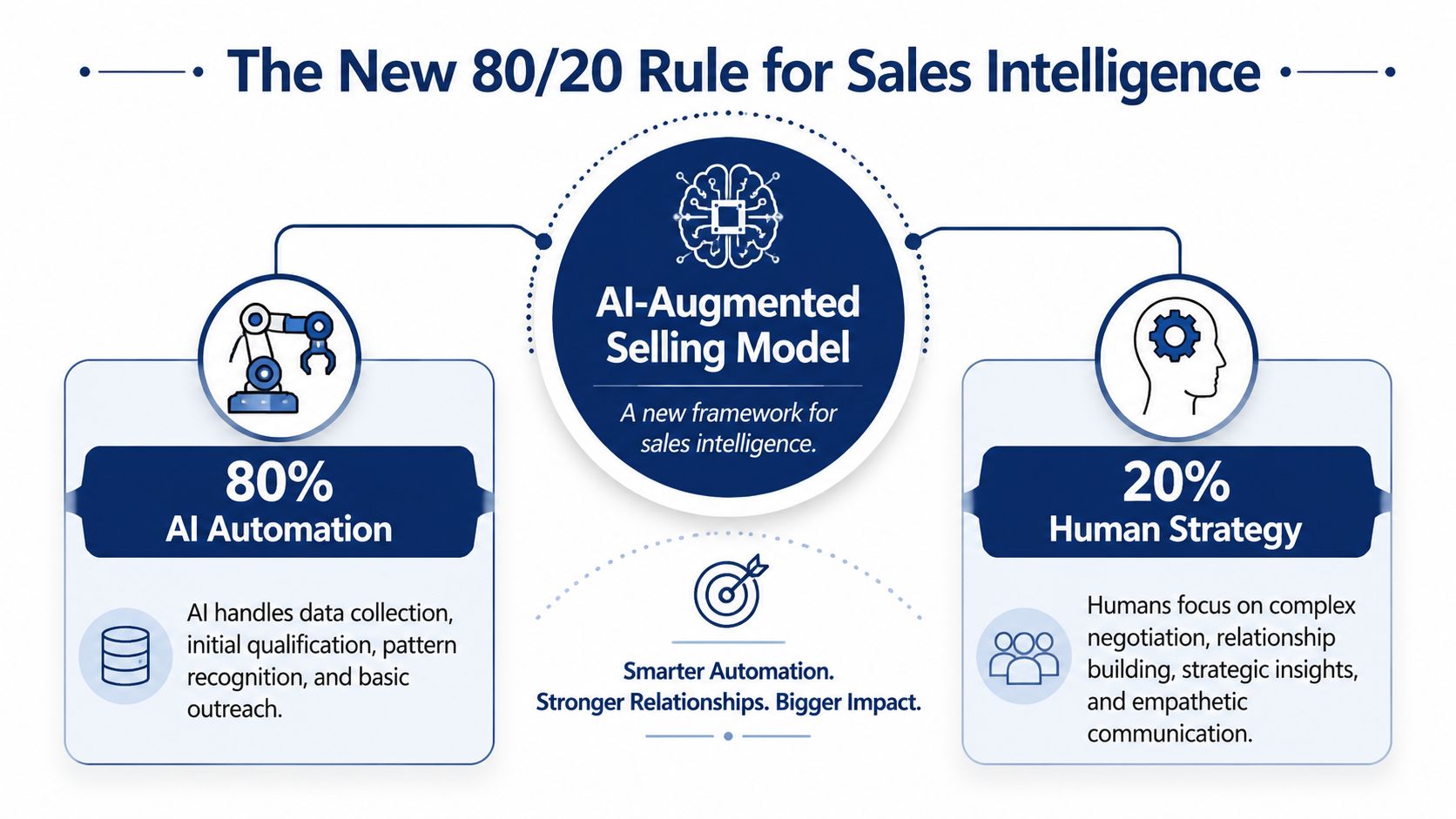
The cleanest way to run modern account research is an 80/20 split.
The 80% is the repetitive, data-heavy work that software should handle. The 20% is the human layer where context, prioritisation, and judgment decide whether the research helps win business.
What belongs in the 80%
Cognism notes that AI agents can process data from over 1,000 public sources, including earnings calls, SEC filings, press releases, and LinkedIn activity, to build structured account briefs in minutes. That work historically took a skilled sales rep 2 to 3 hours of manual research, and it covers the 80% of the workflow that is repetitive and data-intensive (Cognism on whether sales will be replaced by AI).
That 80% includes work like:
- Monitoring public signals such as executive moves, hiring shifts, product launches, investor commentary, and expansion activity
- Parsing dense documents like earnings transcripts, filings, and long-form interviews
- Summarising company context into a usable brief instead of a pile of links
- Drafting a first outreach pass based on public triggers and stakeholder roles
- Refreshing stale account research automatically instead of forcing reps to start over
The key point is that none of this requires a rep's best thinking. It requires coverage, speed, and consistency.
What belongs in the 20%
The remaining 20% is where deals are won or lost:
- Relationship context such as knowing your internal champion just had a rough quarter and won't sponsor a risky initiative
- Political reality such as the CFO blocking new vendors unless the project ties directly to a current executive priority
- Strategic prioritisation such as deciding which accounts deserve real effort this week given your territory and quota pressure
AI should give reps a point of departure, not a false sense of certainty.
That's the discipline. Use AI to compress the research tax. Use people to make the call.
What leaders should operationalise
If you're running a sales team, this model should show up in process, not just in tool adoption.
A workable operating model looks like this:
- AI gathers and structures the account context
- The rep reviews the brief and adds deal-specific judgment
- The manager inspects the rep's point of view, not whether they opened enough tabs
- Outreach gets approved based on relevance, not activity volume
When teams follow that model, AI doesn't dilute selling. It raises the floor on prep quality and gives strong reps more time to think.

“Salesmotion empowers me to cultivate a great buyer experience. I'm able to challenge prospects' thinking and be a trusted consultative seller. A major part of this is Salesmotion insights.”
Austin Friesen
Account Executive, FY25 #1 President's Club, Clari
What AI Masters in Account Research
AI is at its best when the task is broad, repetitive, and sourced from public information. That's exactly what most account research has been for years.
McKinsey states that advanced agentic AI systems can synthesise 1,000+ structured data points from earnings calls, SEC filings, and job postings into a unified account brief in under 5 minutes. The same work traditionally takes 2 to 3 hours of human analyst time (McKinsey on the economic potential of generative AI).
Where AI is already strong
In practice, AI handles several research motions well.
It can watch company news without getting distracted. It can scan earnings calls for initiatives tied to cost control, expansion, headcount, or platform consolidation. It can track leadership changes and connect them to likely budget or process shifts. It can pull financial context into a readable summary. It can also draft a credible first outreach note anchored to an actual event instead of a generic template.
That changes the rep's job. They no longer need to assemble raw material. They need to decide which signals deserve action.
Sales research task automation potential
| Research Task | AI Capability | Human Role |
|---|---|---|
| Monitoring company news | Fully automated | Decide whether the news creates a reason to engage now |
| Parsing earnings calls | Fully automated | Judge which comments matter for your solution and buyer |
| Tracking leadership changes | Fully automated | Interpret how the new leader changes political dynamics |
| Summarising company financials | Fully automated | Assess whether the account is worth pursuing now |
| Reviewing job postings | Fully automated | Connect hiring patterns to an actual pain or initiative |
| Drafting initial outreach | Partially automated | Personalise message, tone, and call to action |
| Building account plans | Partially automated | Prioritise stakeholders, timing, and deal path |
| Multi-threading strategy | Partially automated | Choose who to approach, in what order, and why |
What good use looks like
A strong rep might use AI research like this:
- For a public company: pull out comments from the latest earnings call that point to a margin initiative or technology shift
- For a growth-stage company: track a new CRO hire, look at open roles, and infer where commercial infrastructure is changing
- For a mature enterprise account: summarise filing language, leadership movement, and current press activity into one concise brief
A useful brief doesn't just tell a rep what happened. It gives them enough context to decide whether the change deserves action.
Where teams get this wrong is trusting AI output as if it were strategy. It isn't. It's an input. A strong account brief should save time and widen awareness. It should not replace account judgment.
The Irreplaceable Human Layer of Strategy

The part that still belongs to people is the part that carries risk.
PwC notes that while AI can process leads with high accuracy, it still has technical limits in emotional intelligence and non-verbal cue analysis. The validation and strategic interpretation phases still need human oversight so the output is relationship-aware, not just data-rich (PwC AI predictions).
What AI still misses
AI can tell you a company announced a transformation program. It can't reliably tell you whether your champion has the political capital to support one more initiative this quarter.
It can flag a CFO in the stakeholder map. It won't know that this CFO blocks nearly every new vendor by default unless the CEO has already blessed the project. It can spot a new VP hire. It can't read the subtext in a call where that leader sounds supportive in public but hesitant in private.
Those aren't edge cases. That's normal enterprise selling.
The human questions that matter
Good sales research isn't only about facts. It's about interpretation under uncertainty.
A rep still has to answer questions like:
- Is this account active or just noisy?
- Is the buyer motivated or merely being polite?
- Does this initiative have executive air cover?
- Should I spend time here or move to an account with a cleaner path?
Those calls depend on experience, account memory, and direct interaction.
Data can suggest momentum. Only a rep can decide whether that momentum is commercially real.
Why this matters more in larger deals
In transactional sales, AI can do a lot. In mid-market and enterprise sales, relevance matters more than volume.
A rep with relationship history knows the hidden context. They know the operations leader wants change but legal is overloaded. They know procurement is late in every cycle. They know the account says innovation matters, but the actual priority is risk reduction because last quarter went badly.
That's why the strongest model is not full automation. It's AI-augmented selling. The machine handles the research load. The human handles the decision.

“We have very limited bandwidth, but Salesmotion was up and running in days. The template made it easy to load our accounts and embedding it in Salesforce was simple. It was one of the easiest rollouts we've done.”
Andrew Giordano
VP of Global Commercial Operations, Analytic Partners
A Practical AI-Augmented Research Workflow
Teams don't need another theory. They need a repeatable operating rhythm.
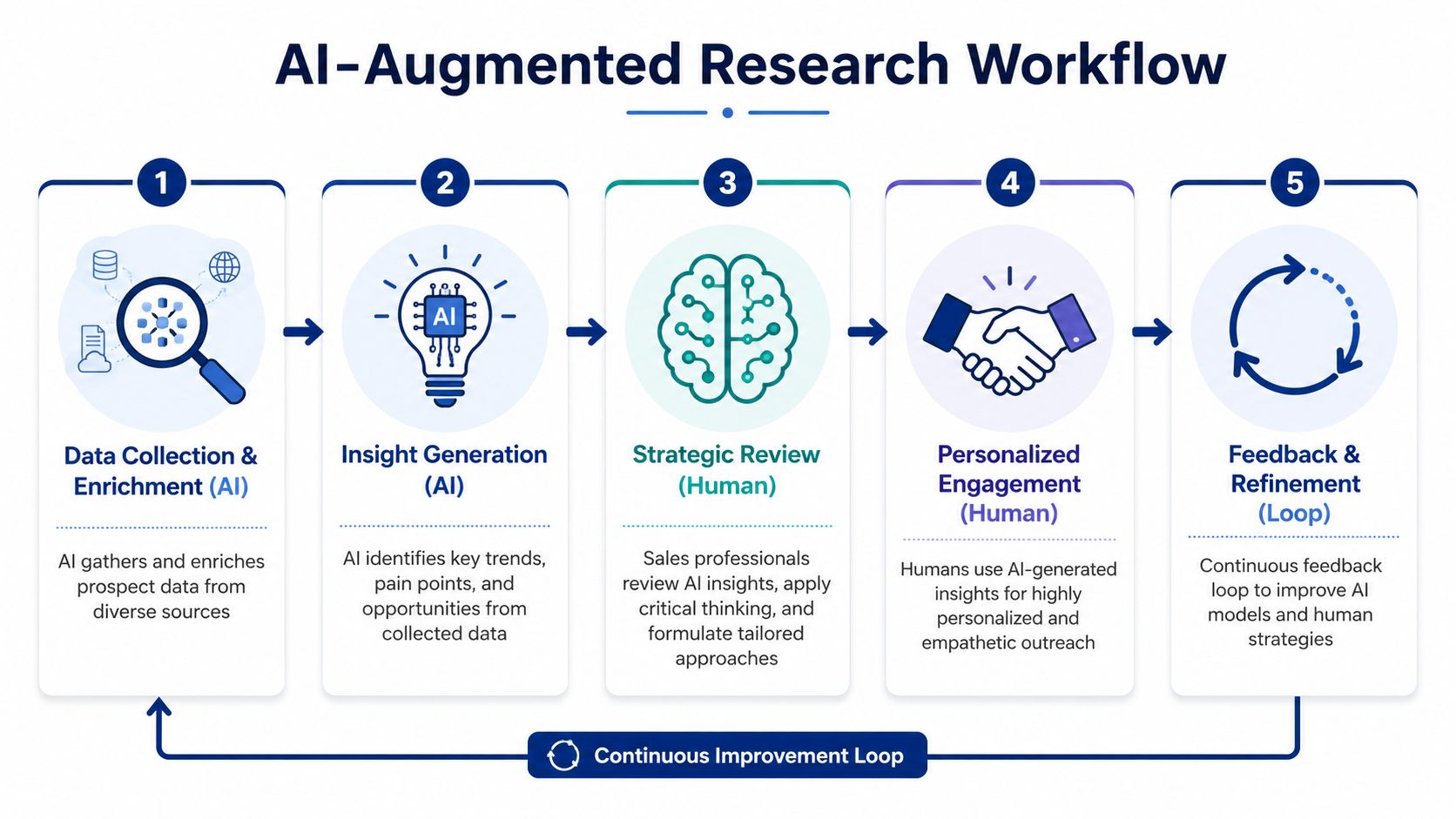
The most practical model I've seen is this. AI handles the heavy prep. The rep spends the final layer of time on interpretation, strategy, and personalisation. In one real workflow, the change is clear: research that used to take 2 hours per account drops to 30 minutes for the human layer. That remaining half hour is where the value sits. It's where the rep decides the angle, pressure-tests the signal, and shapes the outreach.
If you want the tooling view of this operating model, this breakdown of how to automate sales research with AI is a useful reference.
Step 1 builds the brief
Start with AI agents gathering public data and turning it into something coherent.
The output should include current initiatives, meaningful changes, leadership movement, hiring patterns, financial context, and likely implications for your category. A pile of links is not enough. The brief has to tell the rep what changed and why it may matter.
Step 2 tests the signal
The rep earns their keep at this point.
They review the brief and ask:
- Is this a real opening or just interesting information
- Who cares about this issue inside the account
- What's the likely obstacle
- Why now, specifically
That review should take the research from factual to commercial.
Step 3 personalises the message
Once the rep believes the signal is worth acting on, they shape the outreach.
That means changing the framing based on what they know about the account. A CFO-focused message will sound different from one aimed at a CRO or operations leader. If the account already knows your company, the email should reflect that. If a stakeholder just joined, the tone should acknowledge transition and priorities, not jump straight to a pitch.
The final draft should sound like a person who understands the account, not a tool that found a keyword.
Step 4 executes and learns
The workflow doesn't end at send.
Managers should review whether the signal led to engagement. Reps should note whether the AI brief missed context or over-weighted a trigger. RevOps should feed those patterns back into the process so teams improve targeting and messaging quality over time.
A clean workflow looks like this:
- AI collects and summarises
- Rep validates and prioritises
- Rep personalises and sends
- Team reviews outcomes and refines the model
That's the working version of AI-augmented selling. Fast research. Human judgment. Better timing.
How Salesmotion Puts This Model into Practice
This workflow works best when the tooling is built around the split between machine research and human judgment.
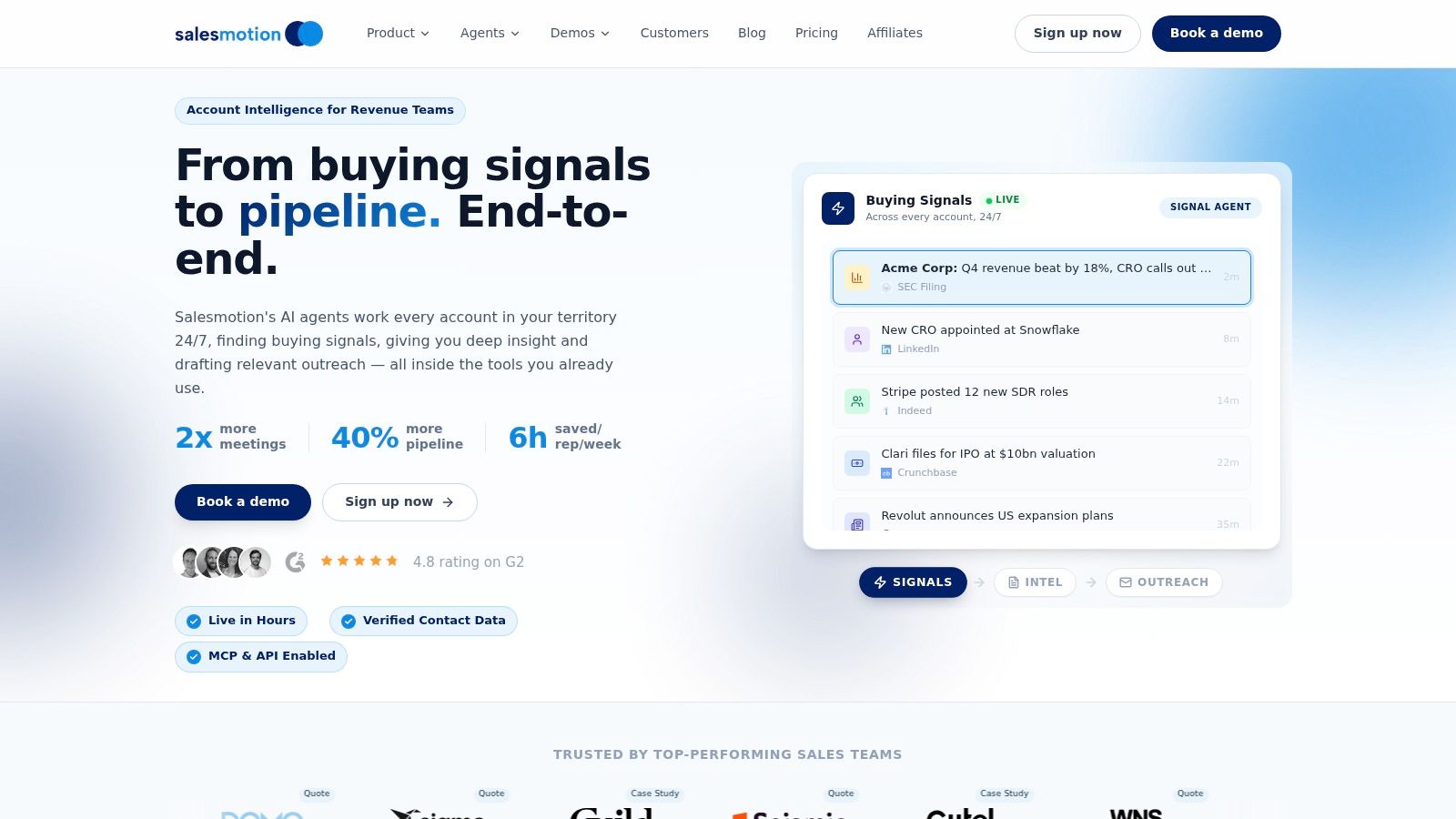
One example is Salesmotion account research, which is designed around three agents that mirror how strong teams already operate.
Three agents, three jobs
The Research Agent builds the account brief. It pulls from public sources, structures the context, and gives the rep a usable summary rather than a stream of raw updates.
The Signal Agent watches target accounts continuously and flags changes worth acting on. The important part isn't just alerting. It's telling the rep why the event matters to a deal or outreach motion.
The Outreach Agent uses that context to draft outreach tied to actual account activity. That means emails can start from a real initiative, stakeholder priority, or trigger instead of generic personalisation.
Why that model fits the way reps work
The value isn't that software writes everything. The value is that the rep starts from a stronger position.
Instead of spending time collecting fragmented context, the rep can review the brief, check whether it aligns with their account knowledge, and adjust the message before sending. That keeps the human in control of strategy while removing a large chunk of low-value prep work.
That's the model more revenue teams are moving toward. AI does the research. People do the thinking.
Measuring the ROI of Augmented Sales Research
Revenue leaders shouldn't buy into this model because it sounds modern. They should care because it changes the economics of selling.
McKinsey reports that AI-driven sales tools can produce a 50% increase in lead conversion rates and a 60% reduction in cost per lead by eliminating manual research time and letting reps focus on higher-value work (McKinsey on sales growth strategies). That's the right frame for ROI. Not novelty. Output.
If you want a finance lens on that business case, this guide to the ROI of sales intelligence tools is a helpful companion.
What to measure
Don't stop at time saved. Time saved matters only if it produces better selling behaviour.
Track outcomes such as:
- Lead conversion quality after research workflows change
- Pipeline velocity for accounts worked with signal-based outreach
- Rep focus on the accounts most likely to move now
- Message quality based on whether outreach is tied to a real reason to engage
What good ROI actually looks like
The strongest signal is not that reps are “using AI.” It's that they're showing up to accounts with a clearer point of view and spending more time in customer-facing work.
That's why the answer to can AI replace sales research needs a business answer, not a philosophical one. AI can remove the manual burden, standardise account prep, and improve efficiency. Human sellers still determine whether that research becomes a conversation, an opportunity, and eventually revenue.
If your team is still doing account research manually, it's worth looking at Salesmotion. It's built for the practical model described here: AI agents gather and monitor account intelligence, then reps review, personalise, and act on it with real context.