Most advice on CRO CDMO sales prospecting is too generic to be useful. It tells you to build a list, segment by company size, send personalized outreach, and follow up consistently. That advice isn't wrong. It's just too shallow for a market where buying decisions are tied to scientific milestones, operational constraints, and procurement paths that rarely look like normal B2B software sales.
If you sell into CROs and CDMOs, you're not selling into a simple department budget. You're stepping into organizations that live on program timing, sponsor pressure, compliance expectations, and relationship trust. A new facility announcement means one thing for a lab automation vendor, something else for a data platform, and something completely different for a specialist consultant. The signal only matters if you know how to interpret it.
That's the playbook that works. Not more activity. Better timing, tighter targeting, and outreach built around real operating change.
To see why generic advice falls short, picture a real morning. BD leaders at CROs describe the same daily ritual to us: pull a list from a vertical tool, bulk-enrich it, filter by clinical-ops and CEO titles, then open each sponsor site one by one to read the About, Pipeline, and Programs pages and infer what phase the lead asset is in. Ten to fifteen minutes of back and forth just to reach out to a single company. The hard part was never finding the sponsors. It was knowing which ones were about to need a CRO before the RFP went out.
TL;DR: CRO CDMO sales prospecting works when it starts from an operating change, not a static list. Watch for facility expansions, FDA inspection outcomes, partnerships, new capabilities, phase transitions and leadership changes, then match the message to the milestone and to the stakeholder who owns the consequence. The real opening is the six-to-nine-month window before a sponsor writes the RFP.
Understanding the CRO and CDMO Sales Landscape
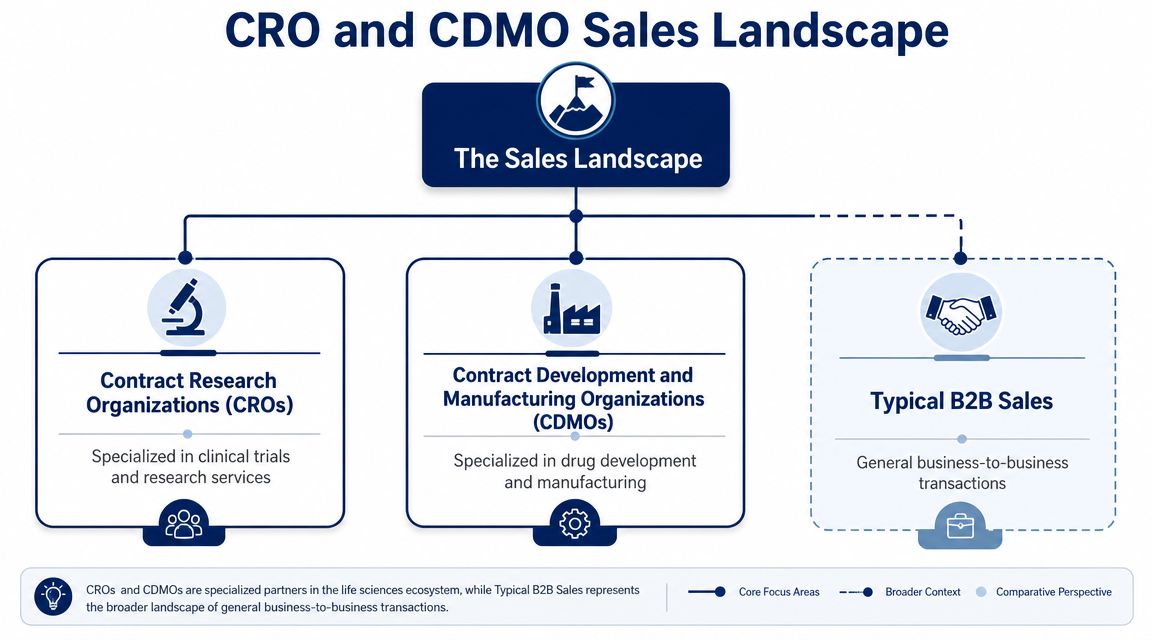
A Contract Research Organization (CRO) sells research and clinical services. A Contract Development and Manufacturing Organization (CDMO) develops and manufactures drug products. Both sit inside pharma outsourcing, but they don't behave like standard mid-market accounts.
The market is also too large to treat as a niche side bet. The global CRO services market was valued at USD 92.27 billion in 2025 and is projected to reach USD 199.28 billion by 2034, with North America holding 50.10% of the market in 2025, according to Fortune Business Insights' CRO services market forecast. That matters because it means the buyer universe is already meaningful, concentrated, and still expanding.
Right near the start, it helps to visualize why this market needs its own prospecting motion.
What they actually buy
CROs and CDMOs buy across a surprisingly wide stack. If you're new to this space, don't reduce them to “lab companies.”
They often buy:
- Software platforms for CRM, quality systems, LIMS, project management, BD intelligence, and workflow orchestration
- Lab equipment and instruments tied to analytical development, formulation, bioanalysis, sample handling, and manufacturing support
- Data and analytics tools for pipeline monitoring, trial intelligence, forecasting, market mapping, and sponsor targeting
- Consulting services around regulatory readiness, facility strategy, process optimization, and commercialization planning
- Outsourced specialist services when they need overflow capacity, niche assays, validation support, or technical capabilities they don't want to build internally
The buying motion changes depending on whether your offer touches science, operations, commercial execution, or compliance.
The unusual part about CROs
CROs are different because you may sell to them or through them.
If you sell a platform, instrument, or service that improves how the CRO operates, you're selling to them as the direct customer. But if your product helps the CRO serve sponsors better, extend its capabilities, or strengthen proposals, you may effectively be selling through the CRO into its sponsor base.
Practical rule: Always ask one question early. “Does this help the CRO run its business, or help the CRO win and deliver sponsor work?” The answer changes your stakeholder map and your ROI narrative.
Why generic prospecting falls apart
A normal B2B motion assumes a clear pain point, a budget owner, and a reasonably direct buying path. CRO and CDMO sales cycles are rarely that tidy. They're long, relationship-heavy, and often move through technical validation before broad rollout. Pilot-first is common because buyers want proof without operational disruption.
That's why broad messaging underperforms. “We help life sciences teams improve efficiency” is forgettable. “We noticed your new cell therapy capability launch will likely increase method transfer complexity across sponsors, and we help teams standardize that handoff” gets attention because it shows you understand the operating context.
If your team needs a better foundation for that kind of account prep, life sciences sales intelligence workflows are worth studying before you scale outreach.
See Salesmotion in action
Take a self-guided interactive tour — no signup required.
Decoding Buying Intent with Actionable Signals
Teams often miss intent because they look for explicit buying behavior instead of operating signals. In CRO CDMO sales prospecting, the strongest “why now” usually appears before a buyer fills out a form or takes a meeting.
The useful question isn't “who fits our ICP?” It's “what changed inside this account that makes our offer relevant now?” That matters even more in this category because buying criteria shift with program stage and partner type. One practical source on CRO, CMO, and CDMO selection notes that early engagement with an integrated partner can compress timelines, which is why CellCarta's view of CRO versus CMO versus CDMO decisions is so relevant to milestone-based prospecting.
This is the signal set I'd train a team on first.
Why the RFP is the wrong place to start
By the time a sponsor issues an RFP, the outcome is mostly decided. Sponsors issue RFPs to a pre-qualified shortlist of partners, not to the open market, as IntuitionLabs' breakdown of CRO selection describes. A cold bid arriving at RFP time is read as a courtesy bid against incumbents who have been in conversation for months. So the real opening sits earlier: the six-to-nine-month window before the RFP is written, anchored to catalysts rather than the calendar. Funding tends to surface about nine months out, phase transitions and IND filings sit closer in, and results activity can predict the next study within weeks.
The same logic applies by phase. A business development manager at a CRO told us they only prospect sponsors from preclinical to phase 2, because by phase 3 the CRO is already locked in.
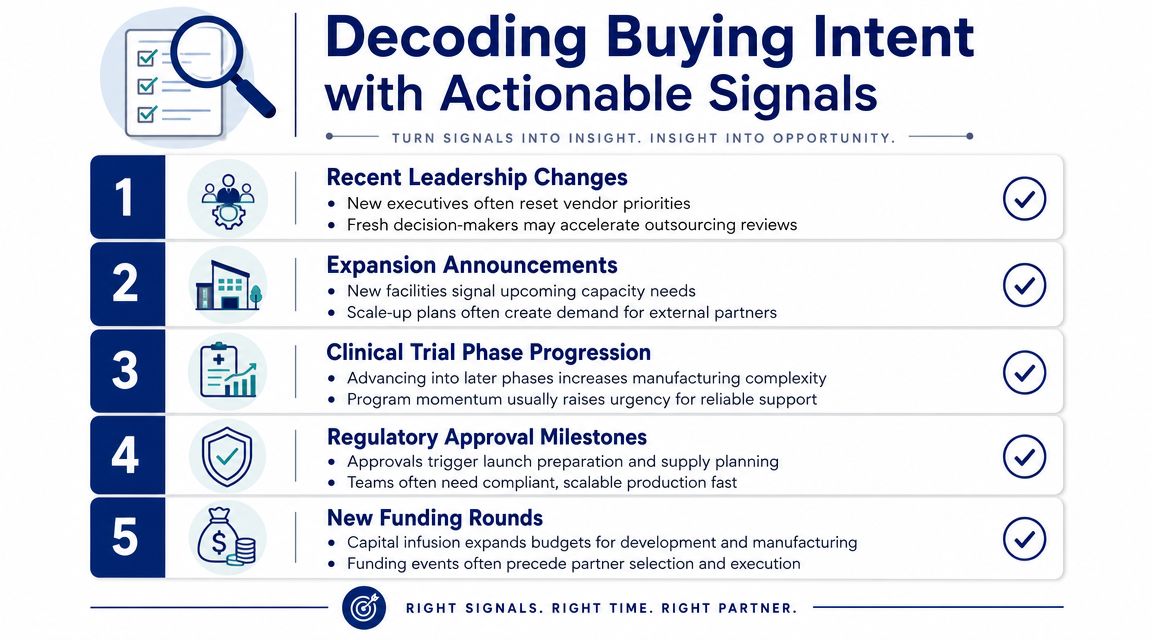
Signals that usually matter
| Signal | What it often means | Good outreach angle |
|---|---|---|
| New facility construction or expansion | Budget is already being allocated around capacity, staffing, systems, and readiness | Offer around ramp-up risk, standardization, commissioning support, or faster time to productive use |
| FDA inspection outcome | Quality, documentation, remediation, or readiness just moved up the priority list | Position around compliance support, process visibility, training, or operational control |
| Partnership announcement | New delivery expectations are coming, often with timeline pressure | Tie your message to speed, handoff quality, coordination, or sponsor-facing execution |
| New therapeutic area capability | The team is entering adjacent science and may lack mature workflows | Speak to enablement, technical fit, and credibility in that therapeutic context |
| Phase transition or trial results activity | A positive readout means the next, larger study is being scoped, often with a different partner profile; a primary-completion update predicts the next study within weeks | Reach out before the next-study RFP, tied to the specific stage change rather than generic growth language |
| Leadership change | Priorities may shift quickly, especially in BD, operations, or technical functions | Use the change as a reason to introduce a fresh point of view, not a generic welcome note |
How to read the signal, not just collect it
A facility expansion is not “good news.” It's a buying window. New square footage creates pressure around validation, staffing, throughput planning, equipment standardization, software stack decisions, and how quickly the team can commercialize the new capacity.
An FDA inspection outcome is similar. Even a favorable outcome can trigger buying because teams want to lock in process discipline while attention is high. If the outcome raises issues, urgency increases, but the tone of outreach must stay measured and useful.
When a CDMO announces new biologics capacity, don't lead with “congratulations.” Lead with the operational consequence. More clients, more transfers, more documentation load, more coordination risk.
Stage changes are usually stronger than generic interest
One of the biggest misses in this market is failing to map stage transitions to outreach plays. A biotech moving toward first-in-human work creates one kind of demand. A sponsor preparing tech transfer creates another. A CDMO planning commercial-scale readiness creates a different conversation again.
That's why blanket messaging like “we support growth-stage life sciences organizations” doesn't land. A buyer cares about the milestone in front of them, not your category language.
A business development lead at a clinical research services firm told us a finished phase one is his trigger, because a phase two follows, and that finding it six months late is too late.
Use triggers like these:
- Clinical progression: A sponsor entering a more execution-heavy stage often pressures both CRO and CDMO partners to add systems, analytics, and specialist support
- Capability launches: New modalities and new assay or manufacturing capabilities create tool gaps fast
- Commercial planning signals: These often indicate future complexity even before formal buying starts
If you want a practical model for working from trigger events instead of static lists, buying intent data in account-based prospecting is the right framework.

“The account and contact signals are key for reaching out at important times, and the value-add messaging it creates unique to every contact helps save time and efficiency.”
Daniel Pitman
Mid-Market Account Executive, Black Swan Data
Identifying Key Buyers and Prioritizing Accounts
The biggest mistake new teams make is assuming there's one buyer. There usually isn't. Effective CRO business development involves multiple stakeholders inside a complex procurement process, and smaller organizations often win on therapeutic expertise, responsiveness, and relationship quality, not just price, as discussed in Corstrate's guide to business development challenges for small and mid-sized CROs.
That should shape both your targeting and your messaging.
The buyers that matter most
VP of Business Development cares about sponsor acquisition, differentiation, proposal quality, and revenue growth. This person usually responds to anything that helps the organization win more work, sharpen positioning, or react faster to opportunities.
Chief Scientific Officer cares about technical credibility, delivery quality, scientific fit, and whether your solution strengthens the organization's ability to support client programs. If your message sounds purely commercial, you'll lose them fast.
Head of Operations focuses on throughput, capacity, quality, staffing pressure, handoffs, and operational reliability. This buyer wants lower friction and cleaner execution, not abstract transformation language.
A useful shortcut is to match the signal to the likely first conversation:
- Expansion or new facility: Start with operations
- New modality or therapeutic capability: Start with science
- Partnership or go-to-market shift: Start with business development
A simple prioritization model
Don't treat every triggered account the same. Score them based on fit and urgency.
Use a working model like this:
-
Strategic fit Does the CRO or CDMO match your ideal customer profile by service line, modality, geography, and complexity?
-
Signal strength
Is the event mild background noise, or a real operating change that creates a project? -
Stakeholder accessibility
Can you identify the likely owner and reach them with a credible point of view? -
Timing relevance
Is your solution useful now, or only after another milestone happens?
A smaller account with a live trigger often beats a larger account with vague potential.
Rank harder by stacking catalysts. A sponsor with fresh funding, a phase transition, and results activity all firing at once is a different priority than one with a single stale news mention. Filtering one catalyst type at a time hides that overlap, so the account where three signals line up never rises to the top on its own. Being able to filter and rank by several simultaneous catalysts is what CRO teams ask for when they describe their ideal workflow.
If you can't explain why this account should care this quarter, it shouldn't sit at the top of the list.
For teams trying to formalize this process, an account prioritization framework for signal-based selling is a better operating model than lead scoring based only on firmographics.
The High-Relevance Outreach Playbook
Signal-based prospecting only works if outreach sounds like it came from someone who understands the account. The bar is high in this market. Buyers can spot fake personalization in one sentence.
I like to build outreach around a simple pattern: signal, implication, question. Mention the specific event. Show that you understand the operational consequence. Ask for a short conversation around that specific issue, not a generic demo.
If the signal is a new biologics facility
First email:
Saw the announcement around your biologics expansion. Teams usually run into the same pressure point right after that kind of launch. New capacity is only valuable if transfer, documentation, and cross-functional handoffs scale with it. We help organizations tighten that operating layer. Worth comparing notes if this is on your team's radar.
Second touch on LinkedIn:
Short note referencing ramp-up complexity, especially where sponsor timelines start before internal workflows are fully standardized.
Third touch:
Offer a narrow discussion, such as how similar teams approach onboarding new programs into recently expanded capacity without increasing coordination drag.
If the signal is an FDA inspection outcome
Your tone matters. Don't sound opportunistic.
A better sequence:
- Email one: Acknowledge the milestone and reference the operational burden that follows any inspection cycle, especially around documentation discipline and process consistency.
- Follow-up: Share a practical observation about how teams often use inspection moments to justify process upgrades that were already overdue.
- Meeting ask: Suggest a short conversation focused on one workflow area you improve.
If the signal is a new partnership announcement
A partnership often means the organization just took on new expectations around timing, delivery confidence, or scientific breadth.
Good outreach sounds like this:
“Your recent partnership announcement suggests external commitments are increasing. That usually puts pressure on internal coordination well before revenue from the partnership is fully realized. We work with teams that need to absorb that complexity without slowing sponsor delivery.”
What not to send
Bad CRO CDMO sales prospecting emails usually fail in one of three ways:
- They pitch the category, not the trigger
- They use generic life sciences language with no operational point of view
- They ask for too much too early
Don't open with “we help CROs and CDMOs streamline operations.” That says nothing. Don't ask for a full demo in the first note unless the signal is extremely hot. In this market, a small, relevant conversation beats a hard CTA.
How the sequence should feel over time
This is a long sales cycle, so don't write like a transactional SDR. Write like someone who can stay useful over months.
A practical cadence looks like this:
- Early touches: Tie your message to the event and the likely business implication
- Mid-cycle touches: Add informed observations, targeted ideas, and light proof through relevance
- Later touches: Propose a pilot, scoped review, technical workshop, or stakeholder discussion
The goal isn't to “convert” a cold account in a week. It's to earn credibility early enough that when the budget, timeline, or internal project is real, your team is already known.

“All of the vendors that I've worked with, all of the onboarding that I have had to deal with, I will say, hands down, Salesmotion was the easiest that I have had.”
Lyndsay Thomson
Head of Sales Operations, Cytel
Navigating Objections and Tracking What Matters
In this market, objections are often real constraints, not brush-offs. Treat them seriously and you'll uncover whether there's a fit now, later, or not at all.
The measurement side matters just as much. If leadership judges this motion by meetings booked alone, they'll misread progress and push reps into bad behavior.
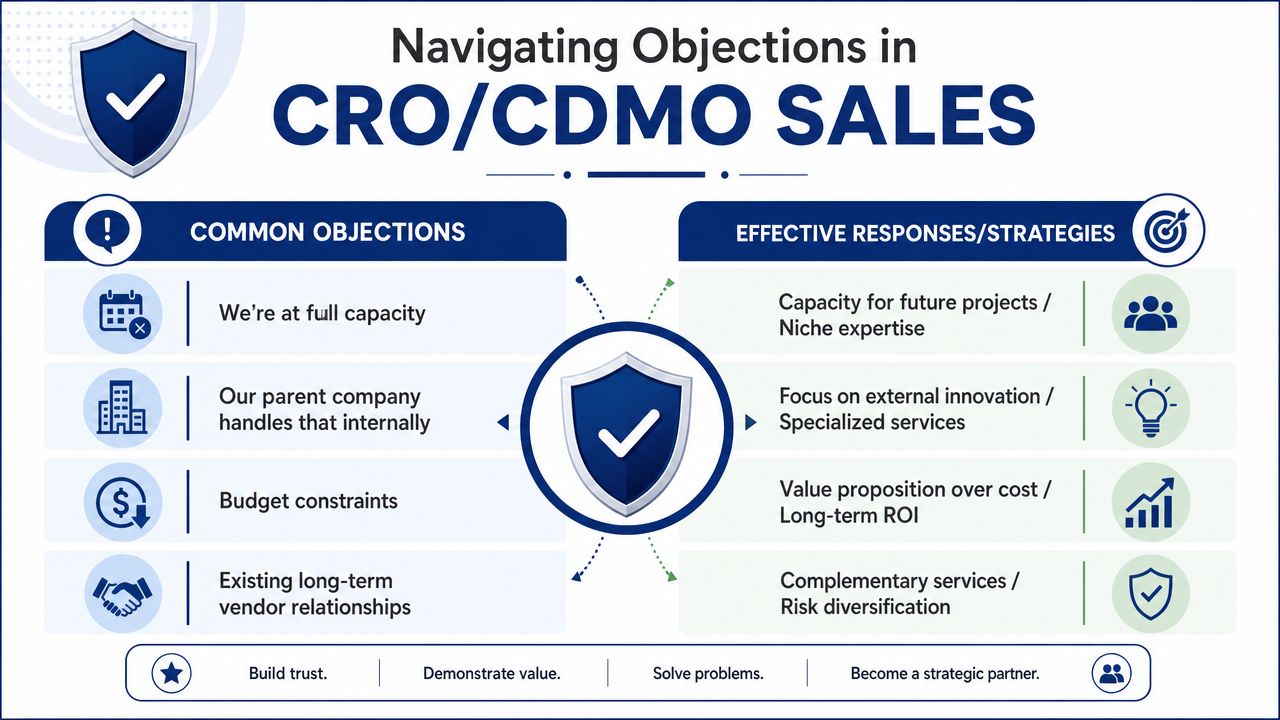
Objections that come up all the time
| Objection | What it often really means | Better response |
|---|---|---|
| We're at full capacity | The team is overloaded and doesn't want disruptive projects | Position around relieving pressure, reducing manual work, or supporting overflow without major change management |
| Our parent company handles that | Local need exists, but buying authority is centralized | Ask how evaluations are initiated locally and who influences the standard |
| We already have a preferred vendor | Switching risk feels high | Position as complementary, specialist, or pilot-ready rather than replacement-first |
| Budget is locked | Need may be real, but timing is wrong | Move to milestone-based follow-up tied to a future event |
Don't fight the objection. Diagnose the buying path behind it.
The KPIs that actually show momentum
For CDMOs especially, treating all inbound or all early interest as equal is a mistake. Industry guidance recommends tracking qualified RFPs, lead-to-RFP conversion rate, time from inquiry to contract, and marketing-sourced revenue, and notes that AI-supported RFP response can produce 40-60% faster turnaround times, according to Percepture's CDMO marketing guide.
For a sales leader, the implication is clear. You need metrics that reflect commercial progression, not surface activity.
Focus on:
- Qualified RFPs: Are you creating real opportunities with enough shape to pursue?
- Lead-to-RFP conversion rate: Is prospecting reaching accounts with actual demand?
- Time from inquiry to contract: Are your internal processes helping or slowing conversion?
- Marketing-sourced revenue: Is top-of-funnel activity turning into business, not just response volume?
If your team is prospecting well but RFP response is slow, the problem may not be prospecting at all. It may be internal coordination, content access, or proposal workflow.
Scaling Your Playbook with Autonomous Sales Agents
Manual CRO CDMO sales prospecting works at small scale. It breaks when you try to cover a broad target list consistently. There are too many signals to monitor, too much context to synthesize, and too much writing required to keep outreach relevant account by account.
That matters because the broader pharmaceutical CRO and CDMO market was valued at USD 233.93 billion in 2024 and is projected to reach USD 459.33 billion by 2032, with an 8.8% CAGR, according to Credence Research's pharmaceutical CRO and CDMO market outlook. When the market is expanding at that scale, more sellers chase the same accounts. Relevance and speed start to separate teams quickly.
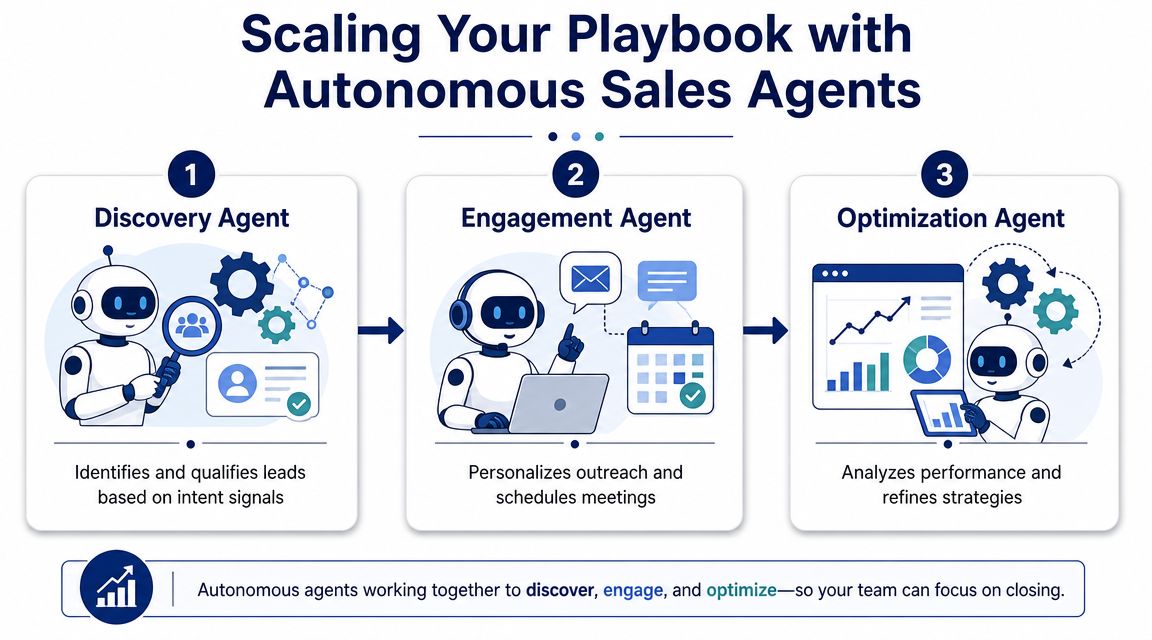
What should be automated
You don't want to automate judgment. You do want to automate the repetitive work around it.
That usually means:
- Account research: Building and refreshing briefs on target CROs and CDMOs
- Signal monitoring: Tracking facility updates, partnerships, hiring changes, inspection-related developments, and capability launches
- Draft outreach creation: Turning a live trigger into a usable first draft for email or LinkedIn
Platforms built for account intelligence are helpful. For example, AI agents for sales teams can operationalize the workflow from account research to signal detection to personalized outreach generation. Salesmotion is one example in this category, with separate agents for research, signal monitoring, and prospecting across target accounts.
The operating model that scales
A scalable motion looks like this:
- Define the account universe by service type, modality, geography, and commercial relevance.
- Map the signal taxonomy you care about, not just generic company news.
- Assign trigger-specific messaging paths so reps don't start from a blank page.
- Route alerts into existing workflows like CRM, email, or Slack.
- Let reps review and refine, rather than research from scratch.
That's the difference between “our reps should personalize more” and a system that produces timely, credible outreach every week.
The reason this has to run continuously, not when a rep finds a free afternoon, is that the cost of a missed signal is permanent. Get busy for a week, miss the feed, and you will never find that catalyst again. The territory math makes it worse. A solo rep covering an entire oncology book at $5-6M average contract values cannot afford fifteen minutes of manual research per account, so low-volume, high-dollar coverage demands compressed research. The Research Agent turns roughly three hours of account prep into about five minutes, the Signal Agent watches catalysts across the account universe so a phase transition or funding round surfaces the day it lands, and the Outreach Agent drafts the message anchored to the signal that fired. The judgment stays with the rep. The repetitive work does not.
The hard part isn't knowing that signals matter. The hard part is catching them consistently and acting before the moment passes.
Your CRO and CDMO Prospecting Checklist
If I were training a new team on CRO CDMO sales prospecting, I'd keep the core playbook tight.
What to lock in
-
Target the operating event, not the account list
A company becomes interesting when something changes. New capacity, new partnerships, regulatory pressure, and new technical capabilities create the opening. -
Match the message to the milestone
First-in-human pressure, tech transfer risk, capacity ramp-up, and sponsor growth all require different language. Generic “we help life sciences companies grow” outreach won't survive first contact. -
Start with the right stakeholder
Business development, science, and operations each see the problem differently. The same trigger should produce different outreach depending on who owns the consequence. -
Run a long-cycle motion
These deals often need trust before urgency turns into budget. Aim for informed follow-up, not aggressive conversion theater. -
Measure commercial progression
Track movement toward qualified opportunities and contracts. Volume metrics alone will push your team toward weak-fit activity.
The mindset that wins
The teams that do well here don't sound louder. They sound more informed. They know why the account should care now, who is most likely to care first, and what low-friction next step makes sense.
That's the insider advantage in this category. Not secret data. Better interpretation.
If your team wants a more systematic way to monitor CRO and CDMO account signals, build account briefs, and turn trigger events into usable outreach, take a look at Salesmotion. It's built for sales teams that need signal-based prospecting without doing all the research manually.