Most advice on sales intelligence assumes the hard part is finding contact data. In life sciences, that's usually the easy part. The hard part is knowing why this account matters right now, which team inside the account is being affected, and what changed in the clinical, regulatory, or competitive environment that makes your message relevant today instead of three months from now.
TL;DR: Life sciences sales intelligence turns clinical, regulatory, corporate, and people signals into timing and messaging for pharma, biotech, and medtech accounts. Track trial milestones, FDA and EMA activity, patent expirations, M&A, leadership hires, and KOL movement, then map each trigger to the stakeholders it affects and route it into the rep's workflow. Measure it by signal-to-meeting conversion, win rate, and research time saved.
That's why generic prospecting breaks down so fast in biotech, pharma, and medtech. A funding round matters. A new VP hire matters. But if you're selling into life sciences, a Phase II readout, an FDA submission, a patent cliff, a medical affairs buildout, or a shift in the competitive drug market often matters more. Those are the triggers that change budgets, urgency, headcount, vendor priorities, and buying committee behavior.
Life sciences sales intelligence is the discipline of turning those signals into action. Not just collecting news. Not just enriching CRM records. Converting scientific, regulatory, commercial, and organizational change into better timing, sharper account plans, and outreach that sounds informed.
Why Generic Sales Intelligence Fails in Life Sciences
The market for sales intelligence is clearly expanding. Fortune Business Insights values the global category at USD 4.85 billion in 2025 and projects it to reach USD 12.45 billion by 2034, with an 11.10% CAGR. It also reports that North America held 42.30% of market share in 2025, which tells you data-driven selling is already mainstream in the region where many life sciences commercial teams operate most heavily (Fortune Business Insights on the sales intelligence market).
That growth is real, but it also hides the main problem. Most tools in that broad category were built for horizontal B2B selling. They're good at company news, org charts, intent topics, and contact lookup. They're weak where life sciences gets interesting: clinical progression, regulatory timing, KOL influence, therapeutic-area competition, and the messy overlap between medical, clinical, and commercial stakeholders.
Generic signals are too shallow
A generic platform might tell you a biotech raised capital. That's useful.
A life sciences-specific program asks better questions:
- What asset is moving
- Which trial phase just changed
- What indication is involved
- Whether the company is expanding medical or commercial leadership
- Whether a regulatory event now changes vendor urgency
- Which stakeholders are likely to care first
If your tool can't answer those questions, your reps still have to do the work manually.
Practical rule: If a signal doesn't change who you contact, when you contact them, or what you say, it isn't sales intelligence. It's just information.
This is why many teams think they already have enough tooling but still struggle with timing and relevance. Their stack captures activity. It doesn't interpret life sciences context. That gap is exactly why generic tooling often creates more noise than action, which is also why many revenue teams find that their sales tech stack isn't enough.
Life sciences intelligence is a different discipline
In this market, the highest-value outreach often starts with a scientific or regulatory event, then expands into organizational mapping. Positive trial data can create urgency for commercial operations, medical affairs, analytics, patient recruitment support, market access planning, or field planning, depending on what you sell.
A new sales leader who wants to understand this category should study how specialized operators think about the broader ecosystem, not just prospecting software. Resources like Woolf Software for life sciences are useful because they reflect how purpose-built systems are becoming standard across regulated commercial workflows.
Here's the blunt version. If your reps are treating life sciences accounts like generic SaaS accounts with a more scientific logo, they're late before they start.
See Salesmotion in action
Take a self-guided interactive tour — no signup required.
Decoding the Signals That Predict Life Sciences Deals
The reason this category keeps getting more analytical is simple. The underlying analytics market is large and growing. Grand View Research estimates the AI in life science analytics market at USD 1.94 billion in 2024 and projects USD 4.84 billion by 2033, with North America accounting for 49.86% of revenue in 2024 (Grand View Research on AI in life science analytics). Commercial teams aren't moving toward deeper signal analysis by accident. They're buying into a broader analytics shift.
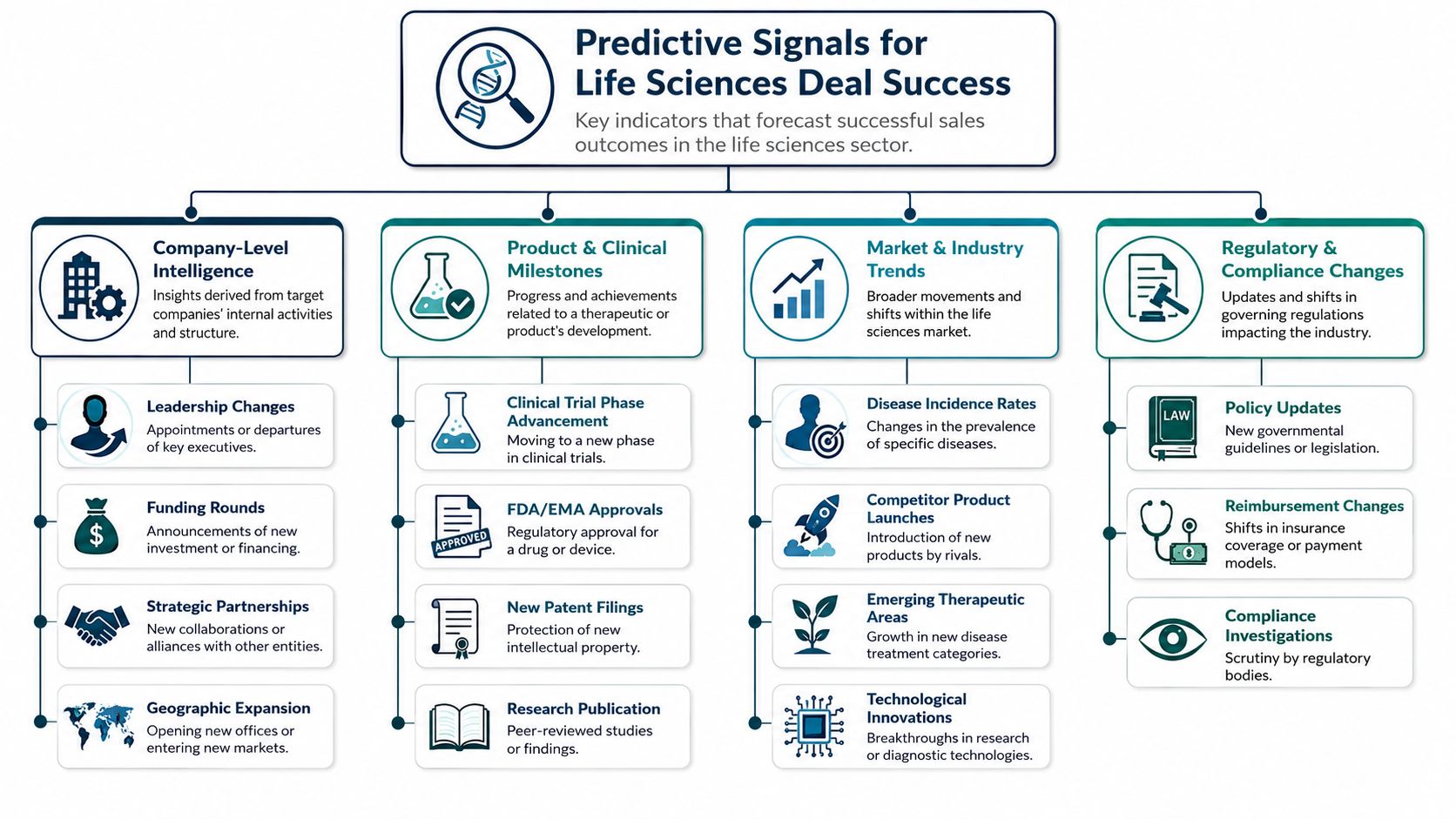
This is the practical filter I use. In life sciences, signals matter when they suggest one of four things: new urgency, new budget, new complexity, or new stakeholders.
Clinical milestones change urgency fastest
Clinical trial activity is one of the most valuable prospecting inputs in this market because it often precedes operational change.
The signals that usually matter most include:
- Phase II or Phase III trial initiations because teams often need new vendors, new workflows, or expanded support.
- Positive readouts because success creates momentum, internal pressure, and planning work across multiple functions.
- Trial delays or protocol changes because they often expose process gaps, resourcing issues, or execution friction.
- Site expansion and enrollment pressure because those can trigger demand for recruitment, analytics, and operational support.
A positive Phase II result isn't just “good news.” It can mean the account is shifting from proving efficacy to preparing for scale. Your message should reflect that.
Regulatory activity changes buying windows
Regulatory signals are valuable because they compress timelines.
Watch for:
- FDA or EMA submissions
- Approval decisions
- label expansions
- inspection or compliance-related pressure
- patent expirations and biosimilar entry risk
Patent expiration is especially important because it often changes competitive behavior long before the expiry date becomes a headline. Teams start thinking differently about pricing, market access, differentiation, field execution, and data support when exclusivity pressure gets closer.
Regulatory milestones are often less about celebration and more about operational consequence. Good reps anchor on the consequence.
That's also why generic intent data underperforms here. Intent platforms can tell you who's researching a topic. They rarely tell you that a regulatory clock just changed what the commercial team has to do next.
Corporate and market triggers reveal where spend is going
Not every meaningful signal is scientific. Some are strategic.
M&A in a therapeutic area can trigger integration work, portfolio reprioritization, territory changes, duplicate systems, and new decision-makers. Funding rounds can create buying capacity, but in life sciences the better question is whether the capital supports the programs or markets that connect to your offer.
Short version: don't chase every financing event. Chase the ones tied to assets, indications, geographies, or commercial builds relevant to what you sell.
For more examples of what to monitor, this breakdown of life sciences buying signals is a useful companion.
People and influence signals tell you who will shape the deal
Life sciences deals rarely live with one champion. You're often selling across clinical, medical, commercial, IT, procurement, and executive leadership.
The people signals that matter most include:
| Signal | Why it matters |
|---|---|
| New commercial leader | Often triggers a review of tools, vendors, territory design, or performance expectations |
| Medical affairs hire | Can signal field medical expansion, evidence strategy changes, or new stakeholder priorities |
| KOL movement or publication activity | Can change internal priorities and external influence networks |
| Org buildout in a therapeutic area | Usually points to strategic investment, not casual hiring |
The best teams don't just map the org chart. They map influence. A title tells you who sits where. A publication, conference role, or therapeutic-area network tells you who shapes decisions.

“Salesmotion is instrumental in helping me prioritize net-new accounts, understand their strategic initiatives, and cover more ground. With a lot of green-field accounts, I'm heavily leaning on the AI insights to tier my accounts and focus my time. The platform is incredibly intuitive and easy to use.”
Rob Webster
Enterprise Account Executive, Synthesia
Turning Life Sciences Intelligence into Actionable Plans
Finding signals is only half the job. The handoff between detection and execution is a common point of failure.
A useful account plan in life sciences is never static. It should change when the account changes. That sounds obvious, but many teams still build quarterly account plans that become outdated the moment a trial advances, a new leader joins, or a regulatory milestone moves.
Start with one trigger and fan out by stakeholder
Take a single event: an account gets a meaningful regulatory designation or moves closer to an approval milestone.
That one trigger can affect several groups differently:
- Commercial operations may need planning, forecasting, territory design, or launch readiness support.
- Medical affairs may need stronger coordination, evidence dissemination, or field alignment.
- Clinical operations may care about ongoing study execution and data continuity.
- Procurement or IT may get involved if the event pushes the account toward new systems or expanded vendors.
- Executive leadership may start scrutinizing execution risk more closely.
A weak account plan treats that event as a reason to send one email.
A strong account plan turns it into a coordinated hypothesis about the account.
Build the plan around impact, not headlines
Advanced intelligence systems can track 1,000+ sources and synthesize 42+ sources per account to detect things like clinical milestones and leadership moves (see our life sciences sales intelligence tools breakdown). But the primary value isn't source count. It's whether your team can convert a trigger into action before competitors do.
Here's the sequence that works better in practice:
-
Interpret the event Don't stop at “Phase III results announced.” Ask what internal work that event creates.
-
Map the likely buying committee Identify who owns the problem, who feels the pressure, who approves spend, and who can block progress.
-
Tailor the point of view The same event needs different messaging for a VP of Commercial Operations, a head of Medical Affairs, and a clinical leader.
-
Choose the right channel mix Some stakeholders respond to direct outreach. Others require a warmer path through shared context, industry credibility, or existing relationships.
Good life sciences outreach doesn't just explain what happened. It explains what the event means for that stakeholder's job.
What static plans get wrong
Static planning usually fails in three places:
- It overweights titles and misses actual influence.
- It treats all signals as equal even though some are urgent and some are background noise.
- It stops at research instead of defining the next action.
That's why organizational mapping matters so much in life sciences sales intelligence. Your buyer rarely acts alone. The team that notices the trigger first and updates the account plan fastest usually gets the first relevant conversation.
Automating Intelligence with AI-Powered Workflows
Manual research doesn't break because reps are lazy. It breaks because the work is structurally too large. In life sciences, the signal set spans trial registries, regulatory updates, company announcements, hiring patterns, scientific publications, changes in competitive dynamics, and stakeholder moves. No rep can monitor all of that well across a meaningful account list.
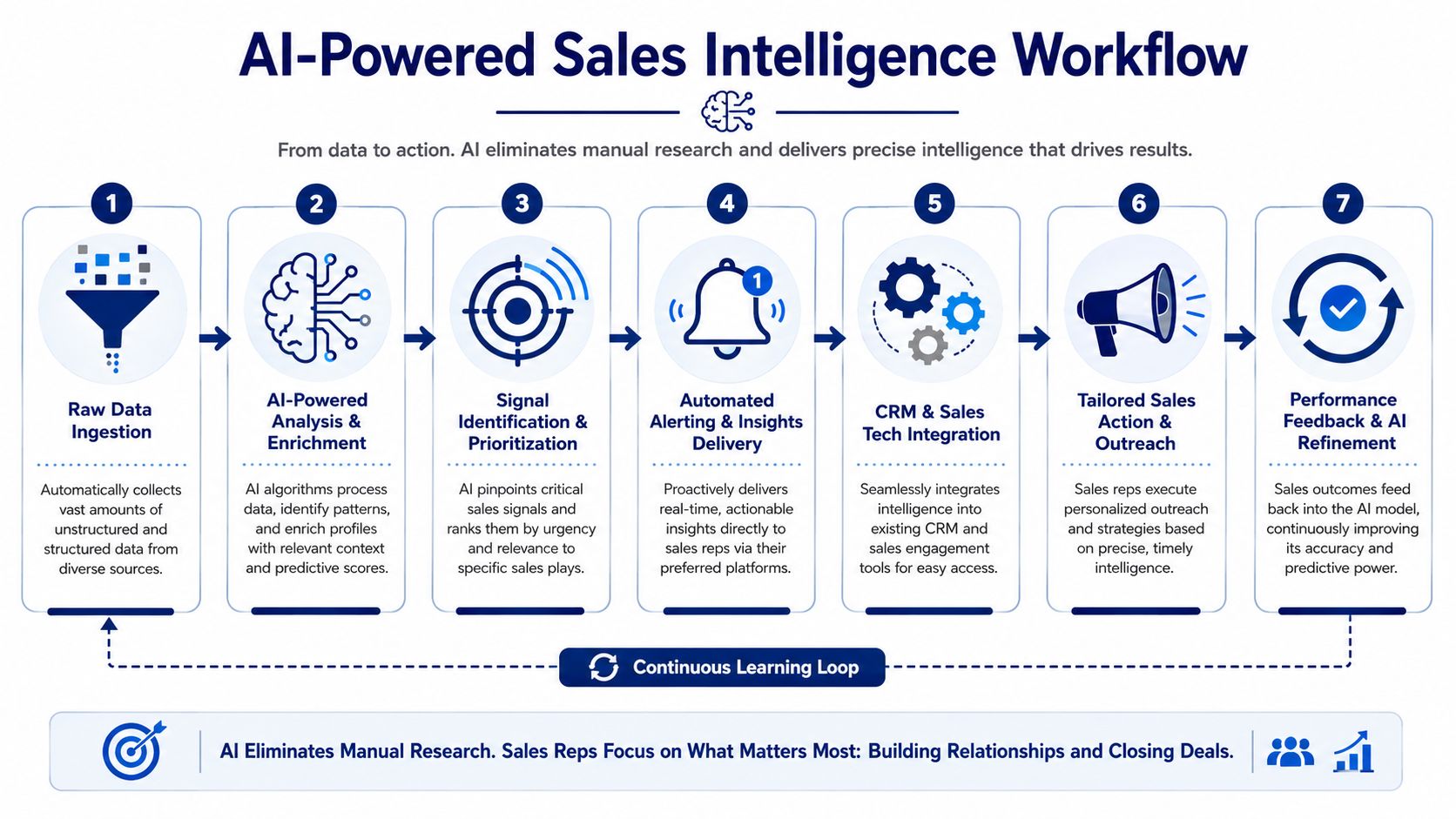
The better model is an automated workflow that does three things continuously: unify data, interpret relevance, and route action into the systems reps already use.
What the stack should actually do
The strongest intelligence programs use a three-layer architecture: a unified customer data layer, analytics dashboards, and predictive AI models. That structure matters in life sciences because signals are fragmented across engagement data, field activity, claims, and external market events, and AI is what converts that mix into prioritized action instead of static reporting (Globant on improving sales force effectiveness using data science).
In practical terms, that means your stack needs to handle:
- Identity resolution so one account doesn't splinter across subsidiaries, brands, trial programs, and CRM duplicates
- Cross-source enrichment so a leadership move can be interpreted alongside pipeline progress and commercial buildout
- Prioritization logic so reps know which accounts deserve attention now
- Workflow delivery into CRM, Slack, or email, not one more dashboard nobody checks
If a tool only surfaces alerts in its own interface, adoption usually fades.
Why agent-driven workflows fit this market
Life sciences selling has too many moving parts for a single generic automation rule. What works better is a set of specialized jobs running together: research, monitoring, and outreach.
One example is Salesmotion, which uses three AI agents. A Research Agent builds account context from public sources, a Signal Agent monitors target accounts for changes worth acting on, and an Outreach Agent drafts personalized outreach tied to those changes. That's a practical model for reducing manual research while keeping the signal and the message connected. Teams evaluating this kind of setup should look closely at how vendors automate sales research with AI.
What to automate first
Don't start by automating everything. Start with the pieces that reps do inconsistently.
- Account monitoring for trial, regulatory, hiring, and org changes
- Stakeholder refresh when teams expand or leadership changes
- Signal-to-message translation so outreach references a real reason to engage
- Alert routing into the rep's existing workflow
That sequence usually produces better behavior than starting with content generation alone. A polished email won't help if the trigger is weak or the timing is wrong.

“The Business Development team gets 80 to 90 percent of what they need in 15 minutes. That is a complete shift in how our reps work.”
Andrew Giordano
VP of Global Commercial Operations, Analytic Partners
Life Sciences Sales Playbooks Two Real-World Scenarios
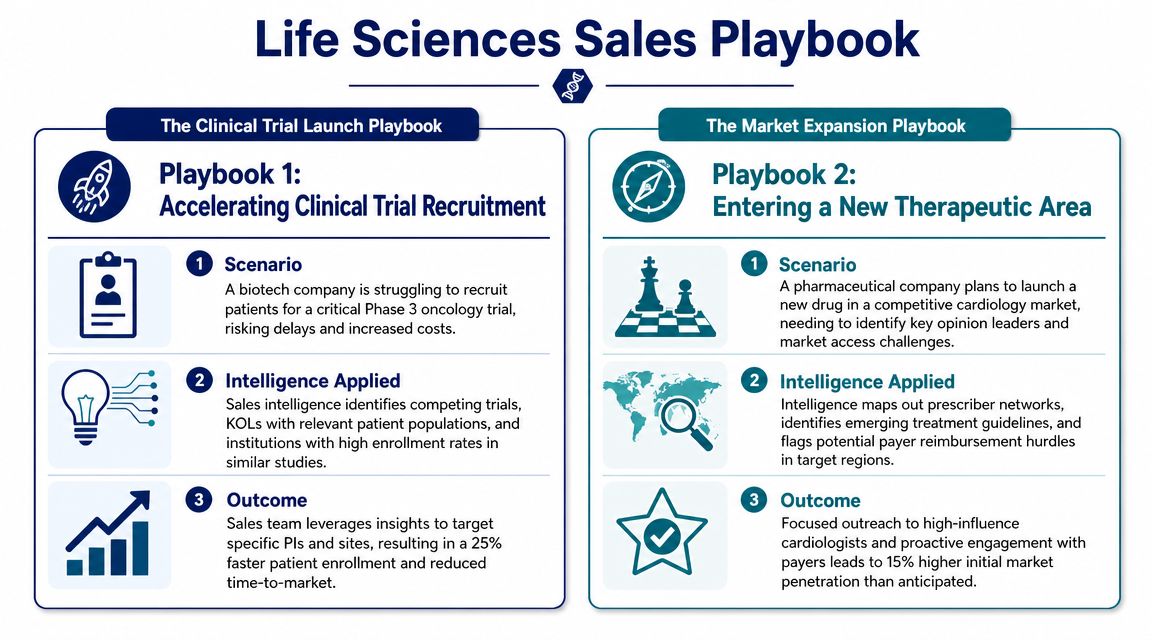
Theory gets clearer when you see the motion end to end. Here are two common scenarios where signal-driven selling outperforms generic prospecting.
Playbook one after a clinical milestone
A clinical-stage biotech announces positive Phase III results in a priority indication.
That headline matters, but the sales move isn't “congrats on the data.” The better move is to ask what the result now forces the company to do. Commercial planning may accelerate. Market access work may intensify. Medical teams may need tighter coordination. Vendor decisions that were previously easy to delay can become active.
A practical response looks like this:
- Research the commercial consequence by reviewing pipeline focus, current team structure, and recent hiring
- Target the right functional leaders, often commercial operations, launch, analytics, market access, or medical leadership depending on your offer
- Anchor the message in transition from trial success to execution pressure
- Reference specific context such as indication, asset stage, or team buildout, not a generic milestone mention
If you sell into pharma and biotech accounts regularly, the account structure and stakeholder mix in selling to pharmaceutical companies is worth keeping close at hand.
The best outreach after a clinical milestone sounds like operational empathy, not industry news summarization.
A weak email says you saw the announcement.
A strong email says you understand what that announcement likely changes inside the business.
Playbook two after a leadership change
A company hires a new executive in commercial or medical affairs.
This is one of the most underrated triggers in life sciences sales intelligence because leadership changes often create permission to revisit priorities. New leaders reassess vendors, team structure, reporting, metrics, and execution quality. They also bring prior preferences and operating assumptions.
The playbook should split into two tracks.
Track one goes to the new leader. Keep it short. Acknowledge the move. Show that you understand the context of the role and the business challenge they're walking into.
Track two goes to adjacent stakeholders already in seat. Those contacts often care less about congratulations and more about what the new leadership arrival means for execution, expectations, and change.
Here's a simple comparison:
| Stakeholder | Better angle |
|---|---|
| New VP or Head | Role transition, mandate, likely priorities |
| Direct reports or peer leaders | What may change in planning, systems, or operating rhythm |
| Executive sponsor | Risk reduction, speed to alignment, visibility across functions |
What doesn't work is blasting the same “noticed the recent hire” template to everyone in the org. That tells the account you spotted a signal. It doesn't prove you understand the business.
Measuring the ROI of Your Intelligence Program
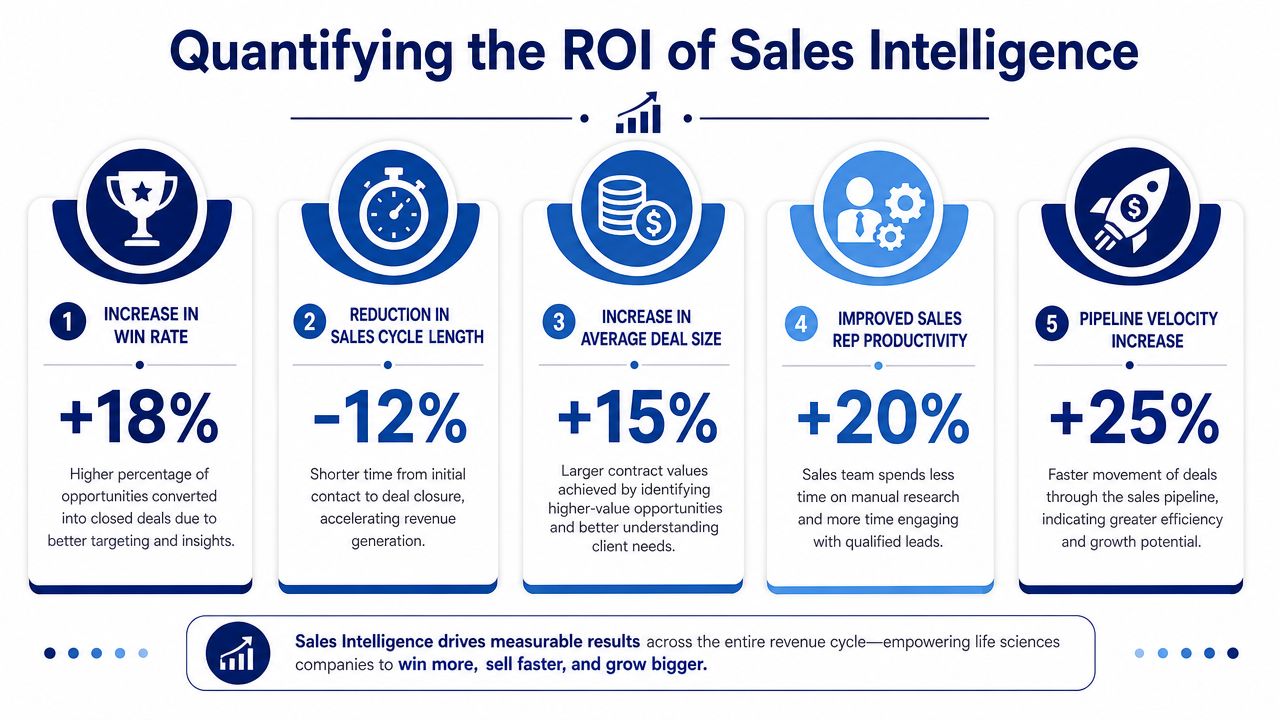
If you can't measure the program, it will eventually get reduced to “interesting alerts” and lose budget. Life sciences teams face enough pressure already. KPMG reports that 61% cite increased competition, 58% cite M&A activity, and 62% cite big data as major factors shaping life sciences sales strategy (KPMG on new trends in life sciences). In that environment, leaders need proof that intelligence changes outcomes, not just awareness.
Measure the handoff from signal to action
The first dashboard should focus on execution quality.
Track questions like:
- How many signals triggered outreach
- How quickly reps acted after an important event
- Which signal types produced meetings
- Whether account plans were updated after major triggers
- How much manual research work was removed from the rep workflow
These are leading indicators. They tell you whether the team is using intelligence properly.
Then measure commercial impact
The second layer should connect intelligence to pipeline outcomes.
A simple framework works well:
| Metric | Why it matters |
|---|---|
| Signal-to-meeting conversion | Shows whether your triggers are commercially relevant |
| Meeting-to-opportunity conversion on signal-sourced outreach | Separates curiosity from real buying motion |
| Win rate on signal-sourced deals | Tests whether timing and relevance improve deal quality |
| Sales cycle trend for signal-led opportunities | Indicates whether better timing reduces friction |
| Rep research time saved | Captures efficiency, not just pipeline effect |
Don't ask whether the platform found interesting accounts. Ask whether it changed rep behavior and improved pipeline quality.
Avoid vanity metrics
Open rates and raw alert counts rarely tell you much in this category. A life sciences intelligence program is working when reps prioritize better, contact the right stakeholders faster, and enter deals with a stronger point of view.
That's what earns budget renewal. Not the volume of news detected.
Your Next Move in Life Sciences Sales
The teams that win in this market don't just know more. They act earlier, with better context, and with more precision across complex buying groups.
That's the shift from generic prospecting to life sciences sales intelligence. You stop treating accounts as static lists of contacts. You start treating them as moving environments shaped by clinical progress, regulatory timing, therapeutic-area competition, organizational change, and stakeholder influence.
For a new sales leader, the practical move is straightforward:
Audit your current motion
Look at your current process and ask four direct questions:
- Which signals are we monitoring today
- Which high-value life sciences triggers are we missing
- How fast do those signals turn into outreach
- Do reps know what to do next when a trigger fires
If the answers are fuzzy, the issue usually isn't effort. It's system design.
Build for prioritization, not information overload
Many teams already have too much information. What they lack is a way to rank what matters and connect it to the next action.
A good program does three things well:
- Detects meaningful change
- Explains the commercial relevance
- Pushes a usable action into the rep workflow
That's the operational standard to aim for. Not “more data.” Better timing and clearer action.
Treat this as a revenue design problem
Life sciences accounts rarely buy because a rep sent one clever email. They buy because the seller recognized a moment of change, understood who inside the account would care most, and showed up with a relevant point of view before everyone else did.
That's what your intelligence system should support every day. If it can't, you don't have a life sciences sales intelligence program yet. You have disconnected research tasks spread across your team.
If you want to see what your reps may be missing, Salesmotion can show how your life sciences accounts are being monitored right now, including the signals surfacing across target accounts and how those triggers can turn into timely outreach and account action.