The most popular advice on market research is also the least useful for a sales team. Gather data, package it into a quarterly report, share it in a meeting, then move on. That process might satisfy planning needs, but it doesn't help a rep decide who to contact this morning, why now, and what to say.
If you want to know how to use market research in a way that drives revenue, stop treating it like a static document. Treat it like an operating system for daily sales decisions. Good research tells you what matters in a market. Great revenue execution ties that understanding to live account activity and turns it into action fast.
Stop Gathering Dust and Start Closing Deals
Most market research fails at the moment it should become valuable. It gets delivered as information, not translated into action. Marketing feels good because the project shipped. Leadership feels informed because the deck looks polished. Reps still open LinkedIn and news tabs and try to figure out outreach from scratch.
That model breaks because timing matters more than summaries. A market insight without a trigger is just context. A market insight attached to a live change inside an account becomes a reason to reach out.
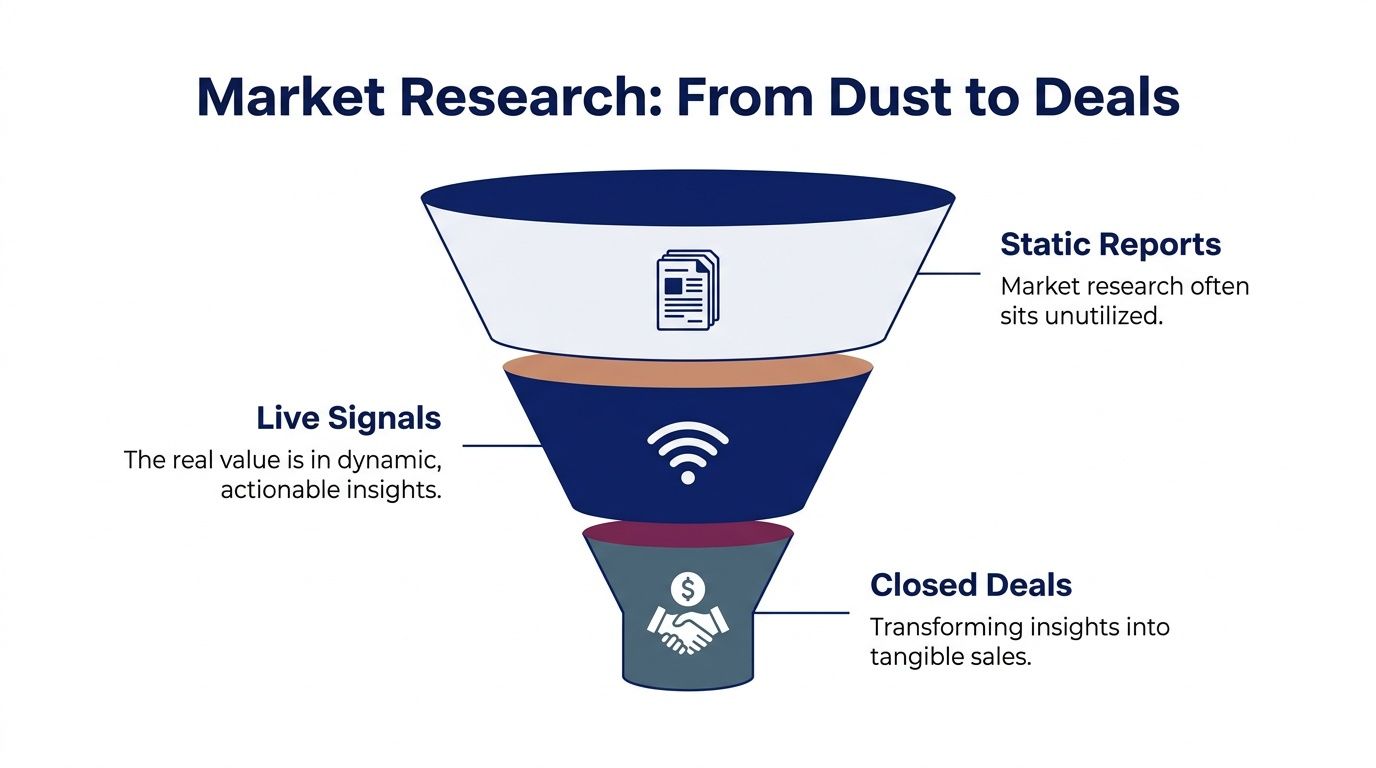
The gap is bigger than commonly admitted. While 72% of companies conduct market research, only 34% of sales teams report using it for immediate outreach decisions because research is typically static and quarterly rather than dynamic. This gap is why 68% of revenue leaders struggle to operationalize research findings into daily sales workflows, and why 89% of research projects fail to impact pipeline growth without a link to live signals (Luth Research on underserved market research gaps).
What static research gets wrong
A static report usually answers broad questions well enough:
- What changed in the market
- Who the main competitors are
- Where demand may be moving
- Which segments look attractive
Those are useful. They just aren't enough for frontline selling.
A rep doesn't need another market overview when an account has just hired a new operations leader, opened budget for a new initiative, announced expansion, or mentioned a strategic problem in public. The rep needs the signal, the business implication, and a suggested angle for outreach.
Market research isn't useless. Untimed market research is.
What a revenue team should do instead
The practical shift is simple. Move from research as a report to research as a trigger framework.
That means your market research should answer three questions:
- What conditions make an account more likely to buy
- Which public signals indicate those conditions are happening now
- How should sales respond when one of those signals appears
Strong teams differentiate themselves. They don't ask research to be interesting. They ask it to be usable.
When market research enters a sales workflow, it stops being a quarterly artifact and starts becoming a source of daily prioritization, better messaging, and cleaner pipeline creation. That's the version worth funding.
See Salesmotion in action
Take a self-guided interactive tour — no signup required.
Finding the Signals That Actually Matter
The first mistake teams make is watching everything. The second is watching nothing but generic intent noise. Neither helps. Good signal design starts with market fundamentals, then narrows into observable events that a rep can act on.
The right baseline comes from foundational market questions. Market research must answer quantifiable questions about demand, market size, economic indicators, location, market saturation, and pricing. Sales teams can translate these broad questions into specific triggers (U.S. Small Business Administration guidance on market research and competitive analysis).
Translate market questions into sales triggers
If demand is growing in a segment, don't stop at that conclusion. Ask what accounts do when demand grows. They may add headcount, expand into new regions, launch new product lines, or increase partner activity.
If pricing pressure is rising, don't just note it. Ask what operators do in response. They may look for efficiency tools, revise procurement priorities, or centralize workflows.
This is where target audience definition matters. If your segmentation is sloppy, your trigger list will be noisy. A useful reference is RedactAI's advice for target audience identification, especially if you're trying to tighten the jump from broad market segments to the actual accounts and personas sales should monitor.
Actionable Sales Signals from Market Data
| Signal Category | Specific Signal Example | Where to Find It | What It Means for Sales |
|---|---|---|---|
| Executive changes | New CRO, CFO, COO, or VP hire | Company press releases, LinkedIn, executive bios | New leaders often reassess tools, vendors, metrics, and operating models |
| Hiring trends | Multiple open roles in one function | Careers page, job boards, LinkedIn jobs | Budget and urgency may be building around that team's priorities |
| Strategic expansion | New market entry, office opening, product launch | Press releases, company blog, interviews | Expansion usually creates process strain, coordination gaps, and new spend categories |
| Financial events | Funding round, earnings commentary, investor update | Investor pages, earnings transcripts, filings | New capital or new commitments often change buying appetite and timelines |
| Organizational change | Reorg, team consolidation, acquisition | News coverage, executive posts, public statements | Internal change creates both risk and opportunity for process and systems vendors |
| Competitive pressure | Competitor named in public commentary | Earnings calls, interviews, webinars | The account is actively evaluating the problem space and alternatives |
| Operational pain | Public mention of efficiency, churn, margin, compliance, supply chain, hiring bottlenecks | Earnings calls, podcasts, interviews, blogs | Language used by leaders becomes messaging input for outreach |
| Audience movement | Increased posting around a topic, campaign, or initiative | LinkedIn, social media, community channels | The topic has internal visibility and may support a timely conversation |
Some teams also track softer digital cues, but the strongest signals are still real business events tied to budget, urgency, or executive attention. If you want a practical breakdown of event types that deserve rep attention, this guide to buying signals in B2B sales is a useful companion.
A good signal answers two questions immediately. Why does this matter, and who should act on it?
Separate trends from triggers
A broad trend shapes territory planning. A trigger creates outreach timing.
Use trends to decide where your team should spend time this quarter. Use triggers to decide which account gets the next call, the next email, or the next custom sequence today.
When people ask how to use market research, this is the missing move. Research doesn't stop at understanding the market. It becomes valuable when it helps sales spot the exact moment that understanding becomes commercially useful.

“Salesmotion empowers me to cultivate a great buyer experience. I'm able to challenge prospects' thinking and be a trusted consultative seller. A major part of this is Salesmotion insights.”
Austin Friesen
Account Executive, FY25 #1 President's Club, Clari
Turning Raw Data into Prioritized Accounts
Signal collection alone creates a different problem. Reps get flooded. RevOps gets buried in dashboards. Managers hear, "There are lots of interesting accounts," which usually means nobody knows where to focus.
That's why prioritization matters more than volume. Benchmark data indicates that 42% of market research initiatives fail to translate into actionable business decisions due to "data dumping" rather than insight synthesis. To be effective, analysis techniques must be explicitly tied to final business decisions (Luth Research on effective market research strategy).
Build a simple scoring model
Teams commonly score accounts by fit. Industry, company size, geography, tech stack, and segment are useful. Keep that. Then layer in dynamic signal scoring so your priority list reflects what's happening now, not just what looked attractive last quarter.
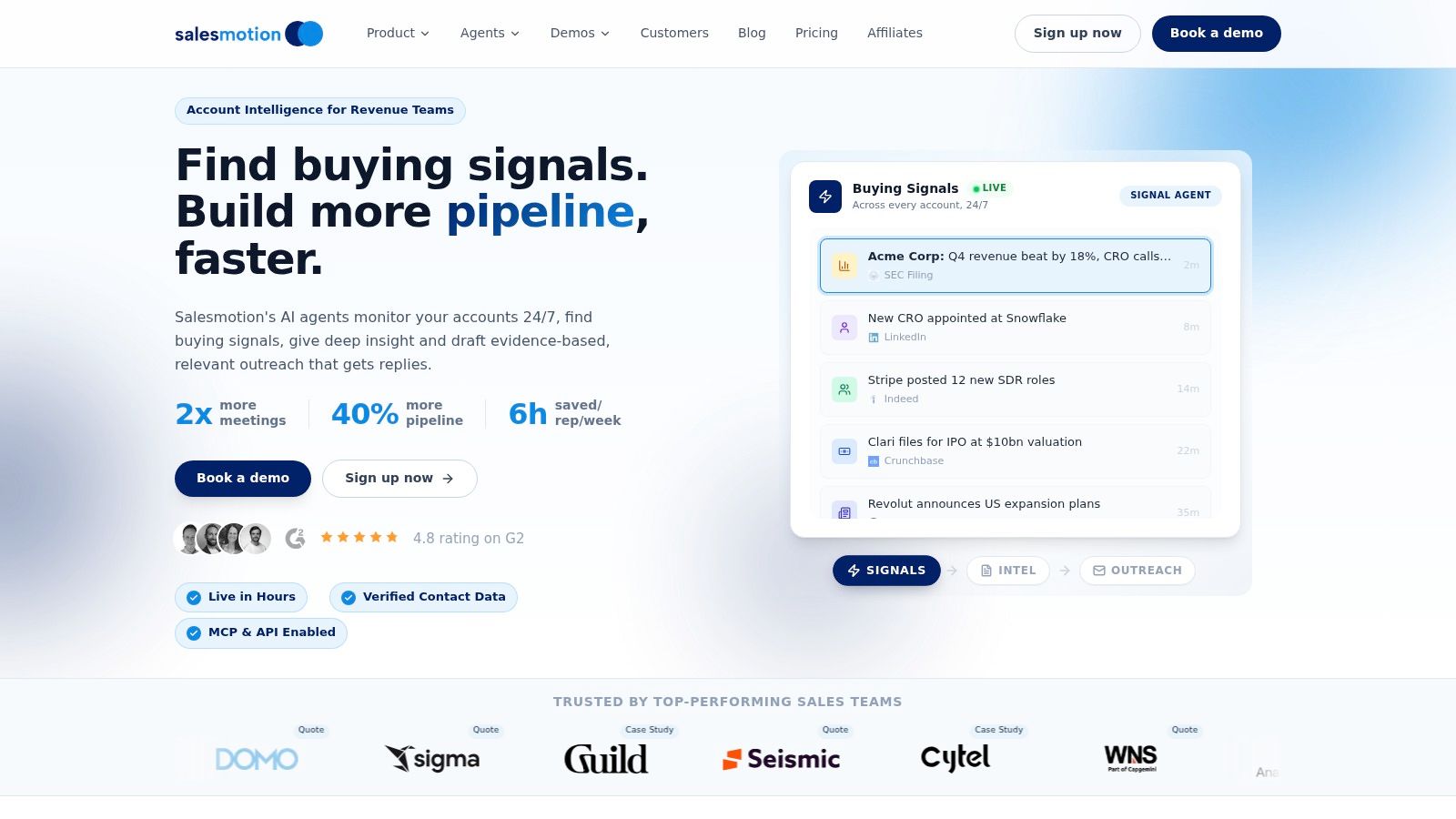
A practical model has three inputs:
-
Fit score
Core ICP traits. This tells you whether the account belongs in your universe at all. -
Signal strength
The importance of the event. A strategic hire usually matters more than a new blog post. -
Signal freshness
Timing. Something that happened this week usually deserves more attention than something mentioned months ago.
A workable weighting logic
Don't overengineer this. Start with common sense and adjust based on rep feedback and meeting quality.
For example:
- High-priority triggers include executive hires, funding announcements, major expansion moves, acquisitions, and public statements about a known pain area.
- Medium-priority triggers include function-specific hiring surges, product launches, or investor commentary that implies operational pressure.
- Low-priority triggers include general content publishing, routine social activity, or broad brand announcements with no obvious commercial angle.
The point isn't mathematical purity. The point is directional accuracy. Your model should help a manager say, "Call these ten accounts first," and have that decision feel obvious.
Practical rule: If a signal doesn't change rep behavior, it shouldn't be in the scoring model.
What reprioritization looks like in practice
Take two accounts with similar firmographic fit.
Account A matches your ICP well but hasn't changed in any visible way. Account B also fits, then posts several open roles tied to a new initiative, announces a regional expansion, and hires a new leader in the function you sell into. Account B should jump the line immediately.
That shift is where traditional list-based outbound starts to lose. Static tiers don't reflect live business movement. Signal-based prioritization does.
A strong framework also makes coaching easier. Instead of asking reps to "work smarter," you give them a ranked view of accounts with clear reasons behind the order. If you want to formalize that process, this account prioritization framework for sales teams gives a solid structure for turning fit and timing into a cleaner working list.
Crafting Outreach That Actually Resonates
A good signal doesn't write the email for you. It gives you the raw material for relevance. That's the difference between outreach that feels informed and outreach that feels automated.
Buyers quickly perceive the mismatch. A 2025 study by LinkedIn reveals that 82% of buyers reject outreach that doesn't reference their specific role's priorities, even when the underlying company research is accurate. The emerging trend is role-based research activation, yet 73% of teams still rely on manual mapping, slowing response time by 3–5 hours per account (LinkedIn findings referenced by Harvard Business School Online).

Generic outreach versus signal-based outreach
Here is the kind of email teams often still send:
Hi Sarah, I work with companies in your space to improve operational efficiency and team performance. I'd love to show you how we help organizations streamline workflows and drive results. Are you open to a quick chat next week?
Nothing is technically wrong with it. It's just interchangeable. It could go to anyone.
Now compare that with an email built from a real signal:
Hi Sarah, I saw your team is hiring into operations leadership and expanding distribution capacity. When companies make both moves at once, process gaps usually show up fast across forecasting, handoffs, and execution reporting.
Reaching out because this is often the point where teams decide whether to keep stitching workflows together or standardize before the new structure hardens. If that's on your plate, I can share how other operators frame that decision.
The second email works better because it answers the unspoken buyer questions. Why me. Why now. Why this topic.
One signal, different stakeholders
The same account event should not produce the same email for every contact. That's where many teams waste good research.
Say an account acquires another company.
For a CFO, the angle is usually cost control, integration risk, capital efficiency, and reporting consistency.
For a Head of Operations, the angle shifts toward process alignment, system duplication, service continuity, and execution friction.
For a CRO, the angle might be territory design, forecast stability, onboarding, and revenue process consistency.
Same trigger. Different stakes.
A simple way to map role-specific messaging:
-
For finance leaders
Lead with efficiency, control, cost of inconsistency, and timing around integration. -
For operational leaders
Focus on workflow breakdowns, cross-functional coordination, handoffs, and speed of execution. -
For commercial leaders
Tie the event to pipeline visibility, team productivity, coverage, and go-to-market alignment.
Use the company's words
The strongest messaging usually comes from language executives already use in public. If a leader talks about margin pressure, expansion complexity, service levels, or execution discipline in a call or interview, don't paraphrase into generic sales language. Use that framing.
That doesn't mean quoting them awkwardly. It means matching the problem definition they already recognize.
If your outreach could be sent to five other companies with no edits, it isn't personalized enough.
A practical outreach workflow
The cleanest workflow is short:
- Start with one verified trigger
- Identify the likely business implication
- Map that implication to the stakeholder's role
- Write one point of view, not a feature list
- End with a relevant next conversation
Teams that want to scale this without turning personalization into a rep time sink should study systems for personalizing cold outreach at scale. The best versions don't automate noise. They automate context assembly so reps can send something that sounds like a human paid attention.

“We have very limited bandwidth, but Salesmotion was up and running in days. The template made it easy to load our accounts and embedding it in Salesforce was simple. It was one of the easiest rollouts we've done.”
Andrew Giordano
VP of Global Commercial Operations, Analytic Partners
Operationalizing Research into Your Sales Workflow
A few talented reps can do this manually. They can monitor accounts, spot changes, interpret the signal, write a smart email, and log the result. That's not a system. That's heroics.
If you want consistency, market research has to live inside the tools your team already uses. It has to show up where reps work, with enough context to support a decision in seconds.
The minimum viable workflow
A workable setup usually includes:
-
Signal capture
Pull changes from public filings, earnings commentary, press releases, hiring pages, LinkedIn, news, and company-owned content. -
Signal routing
Deliver the alert somewhere reps actively monitor. Slack, email, and the CRM are the obvious choices. -
Context packaging
Don't send raw headlines. Send the event, why it matters, which roles likely care, and what action makes sense. -
Rep feedback
Let sellers mark whether the signal produced a conversation, bad timing, weak relevance, or a good account insight. -
Manager review
Revenue leaders should review which signals consistently convert into meetings and which ones create noise.
What adoption usually depends on
Teams don't ignore research because they hate insight. They ignore it because the process is clumsy.
Adoption improves when:
-
Alerts are selective
If every small company update creates a notification, reps tune out within days. -
Next steps are obvious
"Interesting article" is not useful. "New VP hired in your target function. Reach out with onboarding and scale angle" is useful. -
Feedback changes the model
Reps need to see that their responses shape what gets surfaced next. -
Ownership is clear
RevOps usually owns rules. Frontline managers own usage. Reps own action.
For teams also supporting content and search functions with lean resources, some of the workflow thinking in AI tools for lean SEO teams is relevant here too. The underlying lesson is the same. Automation only helps when it reduces manual sorting and pushes usable output into an existing operating rhythm.
Keep the process disciplined
Research quality still matters. Reliable market research uses methods that match the question, mixes approaches rather than relying on a single format, includes open-ended inputs to avoid forcing respondents into bad answer choices, and monitors data quality during collection so weak responses are caught before analysis. In practice, that means sales should consume cleaner intelligence, not just more of it.
A repeatable operating model also benefits from a layered research approach. Start with secondary research to understand the environment, use qualitative work to explore nuance, then validate at scale quantitatively when you need harder confidence for bigger decisions. Once you've built that foundation, automation becomes useful because it's activating a sound model, not amplifying shaky assumptions.
If you're thinking about the process side in more detail, this guide on automating sales research with AI is a good reference point for embedding alerts, context, and follow-up into daily selling motions.
Measuring What Matters Pipeline Growth
If you can't show business impact, market research gets cut back to a planning exercise. That's why measurement has to stay tied to pipeline behavior, not content production or dashboard activity.
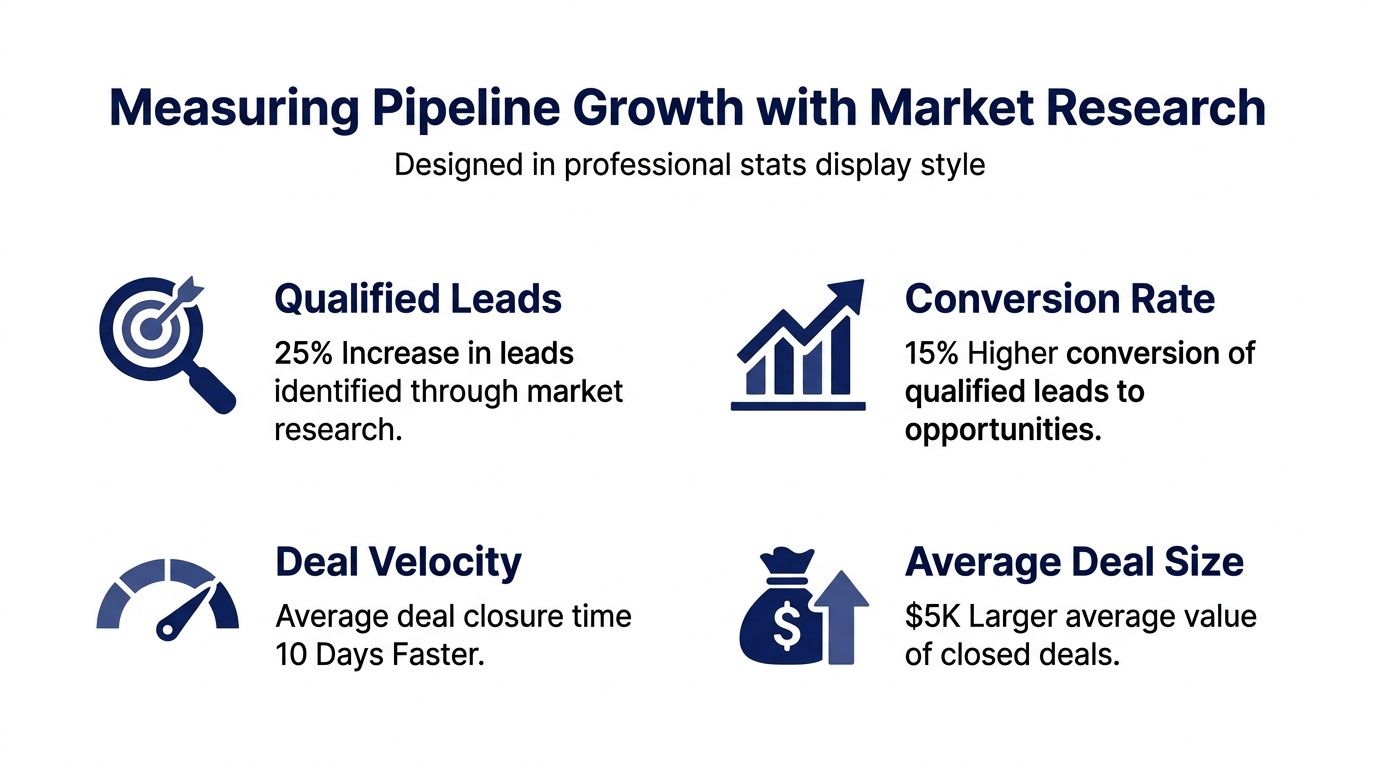
The right measurement model starts with one principle. Market research is not a one-time project but a continuous process. Companies that conduct research at consistent intervals to maintain a pulse on their audience adapt better to market changes. This requires combining multiple research approaches and continuous data quality monitoring.
The KPIs worth tracking
Ignore vanity metrics first. Open rates and raw activity counts have limited value unless they connect to pipeline movement.
Track outcomes like these:
-
Speed to lead on new signals
How quickly does a rep act after a meaningful trigger appears? -
Meeting rate from signal-based outreach
Are trigger-led messages creating more real conversations than generic sequencing? -
Pipeline created from prioritized accounts Is your scoring model pushing attention toward accounts that convert into opportunities?
-
Sales cycle movement
Do signal-led opportunities progress more cleanly because the outreach started with sharper timing and relevance? -
Signal quality by type
Which events consistently produce replies, meetings, or qualified opportunities?
Close the loop with attribution discipline
Many teams' understanding blurs at this point. They can describe the workflow, but they can't prove contribution.
Create a simple review cadence. Look at the signals that drove meetings, the accounts that moved after reprioritization, and the messaging patterns that produced momentum with specific personas. Then adjust weights, routing rules, and talk tracks.
If your team needs a cleaner framework for connecting sales activity to commercial outcomes, the expert guide by ReachLabs.ai is worth reading. It helps sharpen how teams think about influence versus direct contribution, which matters when you're defending investment in sales intelligence and research operations.
Research becomes revenue when you can trace a line from signal, to action, to conversation, to pipeline.
The practical answer to how to use market research isn't "collect more." It's "build a system that gets smarter every week." The teams that do this well don't just understand their market. They respond to it faster than competitors do.
If your team wants to move from static research to live, rep-ready signals, Salesmotion is built for that workflow. It helps revenue teams monitor target accounts, surface the changes that matter, and turn those signals into outreach and pipeline action without the manual research tax.