You probably know the feeling. Your team has a list of 200 accounts that matter, a sequence tool ready to go, and pressure to create pipeline now. The obvious move is to automate volume. The smarter move is to automate relevance.
Personalization is often still treated like a writing exercise. Add a first name. Mention the company. Reference a LinkedIn post. That isn't real personalization. It's cosmetic effort wrapped around the same generic pitch.
The problem with cold outreach at scale isn't that reps can't write. It's that they don't have a reliable system for finding a credible reason to reach out. Once you fix that, the writing gets much easier. The message stops sounding forced because it's anchored to something real happening at the account.
That's the shift that matters if you're serious about learning how to personalize cold outreach at scale. Stop asking reps to manually research everyone. Start building a workflow that monitors your account list for relevant signals, assembles the context automatically, drafts outreach around the trigger, and lets a rep make the final call before sending.
The Personalization Paradox in Sales
Monday morning, a rep opens the sequence queue and has 150 accounts to work. There are two obvious ways to proceed. Send the same message to all 150 and accept weak reply quality, or research each account manually and accept that half the list never gets touched. Neither option creates a dependable outbound motion.
That tension sits at the center of outbound. Teams want relevance, but they also need coverage. The mistake is treating that as a copywriting trade-off. It is a systems problem. If the workflow cannot surface timely buying signals and package the context around them, reps are forced to choose between speed and substance.
Why most personalization fails
Much of what passes for personalized outreach is still a generic pitch with a token detail added on top. "{{first_name}}" is mail merge. "Saw your recent LinkedIn post" is often filler. "Noticed you're hiring" is only useful when the message connects that hiring pattern to a plausible operational issue, such as territory design, ramp speed, pipeline coverage, or tool sprawl.
Buyers respond to a credible reason to talk now.
That is where shallow personalization breaks. It proves the sender found a fact. It does not prove the sender understands why the fact matters. A mention without an implication feels automated, even when a human wrote it.
For a practical definition of this approach, the overview of signal-based selling is useful. The core idea is simple. Relevance comes from change. Outreach works better when it is tied to an event, interpreted in context, and routed to the right account owner with enough detail to act.
Generic email gets ignored. Broken personalization gets remembered.
That is why the actual trade-off is ad hoc effort versus systemized relevance. Teams that rely on rep-by-rep research get flashes of quality but no consistency. Teams that build signal capture, enrichment, routing rules, and review steps can keep quality high across a much larger book of accounts.
The wrong mental model
The old model assumes every strong outbound email starts with a rep researching from scratch. That can work for a short list of named accounts. It fails once reps are carrying real territory volume, multiple sequences, and active opportunities at the same time.
A better operating model is straightforward:
| Approach | What drives the message | What usually happens |
|---|---|---|
| Generic sequencing | Static template | Fast output, weak relevance |
| Manual bespoke research | Rep effort | High quality, low throughput |
| Signal-based personalization | Account triggers plus structured context | Scalable relevance |
The third option is the one that holds up. Reps should not spend the day hunting for reasons to reach out. The system should monitor target accounts, detect changes that matter, and hand the rep a draft with the context already assembled. Human judgment still matters. It just gets applied at the point where it has the most impact.
What a real personalized email feels like
A useful personalized email does more than mention the account. It interprets the signal.
For example:
- Weak: "Congrats on the new funding."
- Better: "Saw the funding announcement. That usually creates pressure to hire fast and show early pipeline efficiency."
- Strong: "Your funding round and recent sales hiring suggest the team is scaling go-to-market quickly. In that stage, account coverage usually expands faster than research quality. Are reps working from clean account context today, or piecing it together manually?"
The difference is not writing style. It is signal interpretation. The strongest version gives the buyer a reason to care because it links a visible event to a likely business consequence. That is the standard for personalization that scales.
See Salesmotion in action
Take a self-guided interactive tour — no signup required.
A Framework for Signal-Based Relevance
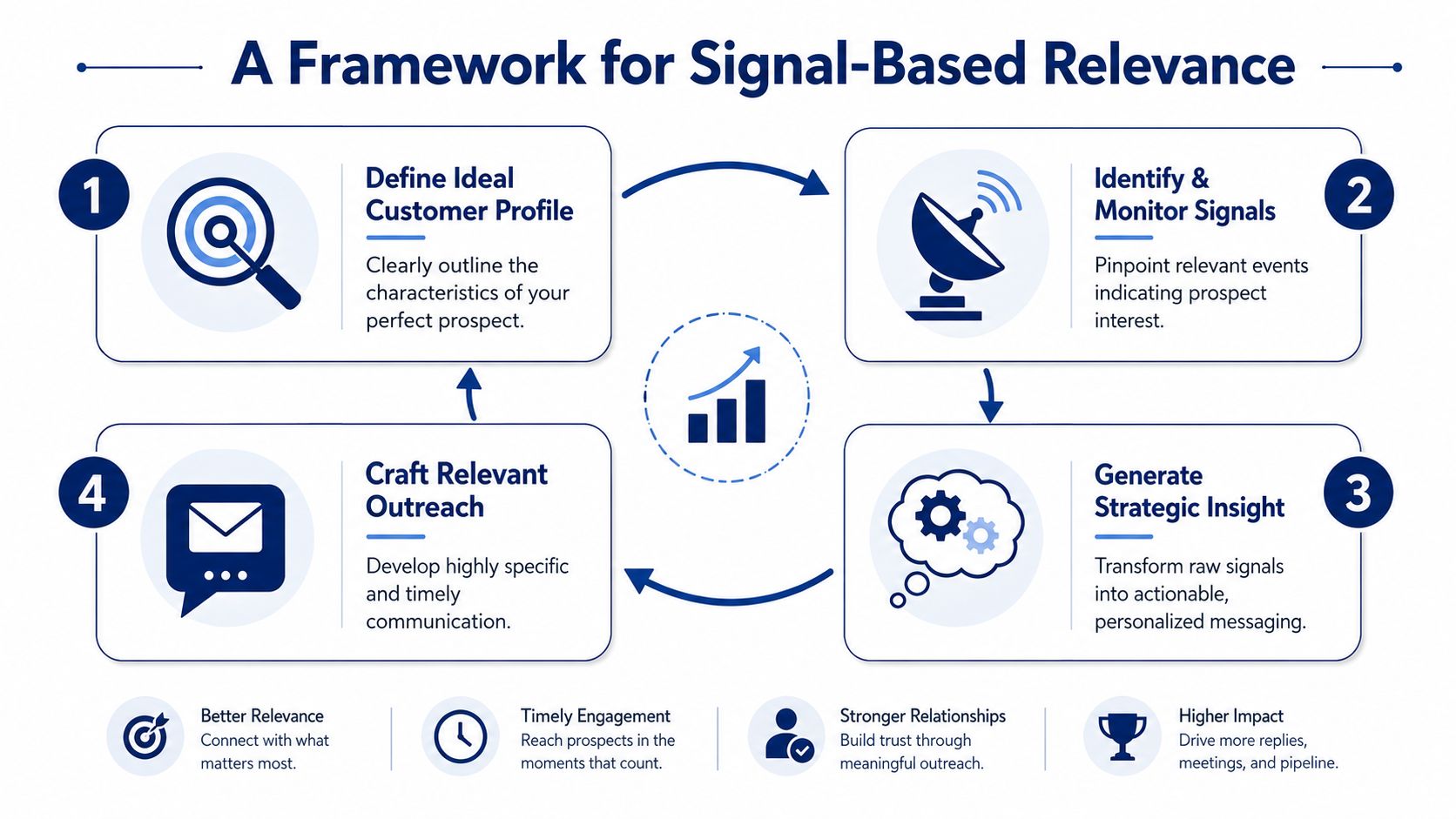
The cleanest way to personalize cold outreach at scale is to stop beginning with a blank page. Start with a signal.
The four-part operating model
Framework
1. Define your ICP and signal set
Know which accounts matter and which events actually indicate movement.2. Monitor those signals automatically
Track your target accounts continuously instead of asking reps to check manually.3. Package the research when a signal fires
Don't just alert the rep. Hand them context and the likely implication.4. Generate outreach tied to the trigger
Draft the email around the event, then let the rep review and send.
If you're new to the concept, this overview of signal-based selling is a useful primer on the category.
Why this works better than static personalization
Static personalization tells you who the prospect is. Signals tell you when outreach is relevant.
That distinction matters. You can know a company's industry, size, and tech stack and still have no idea why they should reply today. But if that same company just hired a new CRO, opened several territory roles, launched a product line, or expanded into a new market, now there's a live business context to work with.
An industry guide from Outbound Republic on signal-based outreach says average cold outreach response rates hover below 1%, while personalized outreach based on timely signals can reach 10% to 15% reply rates. That's the business case for building this as a system rather than treating personalization as a manual craft project.
What each step looks like in practice
This framework in a working RevOps environment looks like this:
-
Define ICP and triggers
Start with a narrow view of who should ever get outbound. Then define the events that create urgency for your offer. Good examples include executive hires, funding, expansion, hiring patterns, leadership changes, product launches, or strategic initiatives mentioned publicly. -
Set monitoring rules
Your account list should be watched continuously. Reps shouldn't be opening five browser tabs every morning to see if anything changed. The system should bring the update to them. -
Translate the event into insight
A signal by itself isn't enough. "New VP of Sales hired" is data. "New VP of Sales likely reviewing process, tooling, and team productivity in the first stretch of the role" is insight. -
Create a message with one point of relevance
Keep the outreach anchored to one strong signal, not a pile of disconnected facts. The buyer should understand immediately why you're reaching out now.
The key shift
Many believe the output is the email. It isn't. The output is timely context that makes a good email possible.
Once you operate that way, how to personalize cold outreach at scale stops being a copy problem and becomes what it really is: a data and workflow problem.

“The talking points are gold. If they're in Salesmotion, I know they're being discussed inside that business. That makes it easy to spark a real conversation, which is 90 percent of the battle.”
Andrew Giordano
VP of Global Commercial Operations, Analytic Partners
Building Your Signal Intelligence Engine
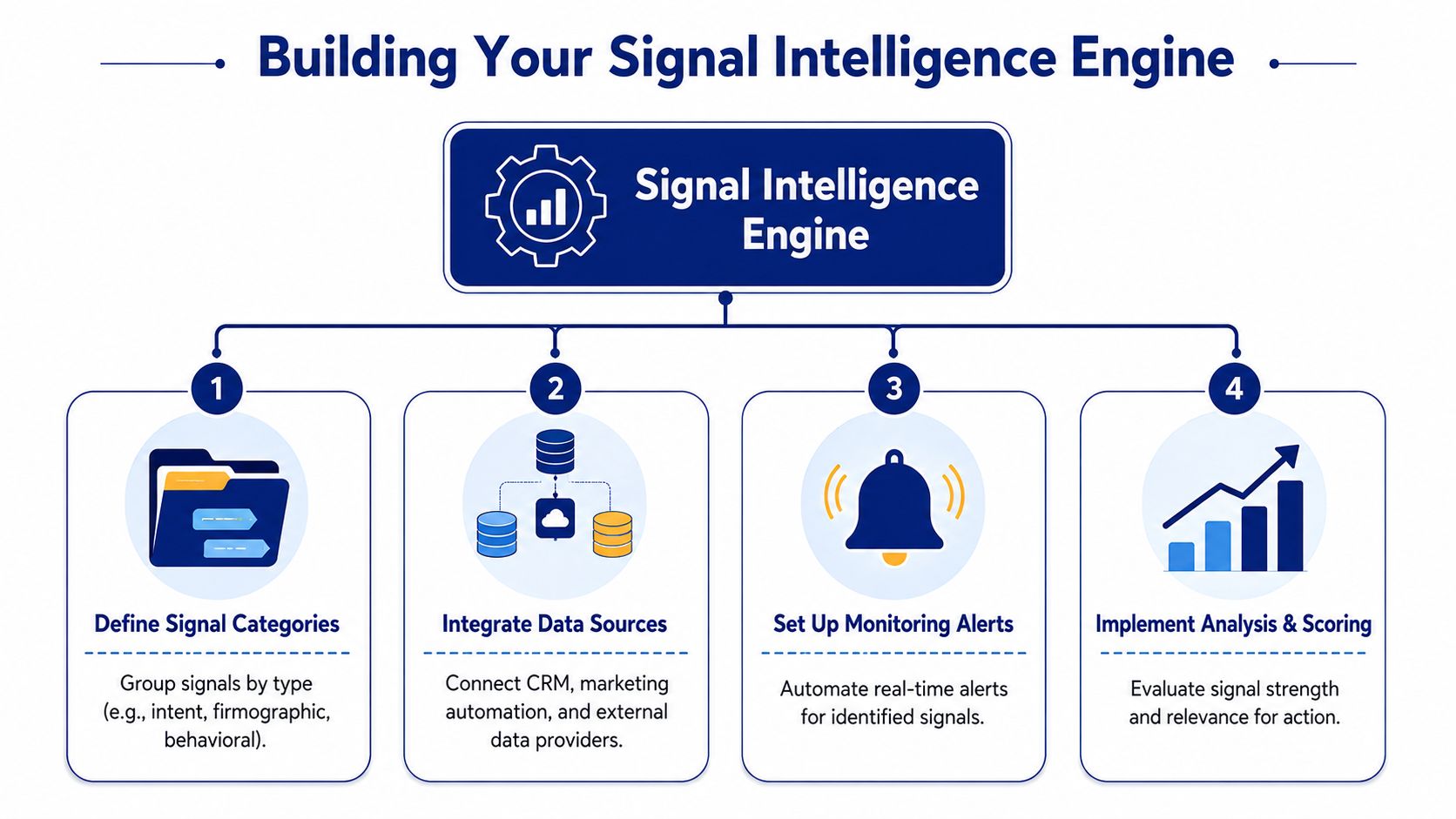
Signals are only useful if your team can detect them consistently and act on them without friction. That means building an engine, not just collecting alerts.
Start with categories, not random events
A common mistake is grabbing every possible trigger and flooding reps with noise. A better approach is to organize signals into categories tied to your value proposition.
For most B2B teams, the practical categories look like this:
-
Leadership change
New CRO, VP Sales, VP Marketing, RevOps leader, or business unit owner. These are strong because new leaders often reassess priorities, vendors, and workflows. -
Growth and expansion
Funding, new office openings, geographic expansion, product launches, partnership announcements. These signals often indicate new budget, urgency, or operational complexity. -
Hiring patterns
Job postings can reveal what the business is trying to build. If a company is hiring SDRs, RevOps, enablement, or implementation roles, that tells you something about the pressure they're under. -
Strategic intent Public statements in earnings materials, investor updates, press releases, interviews, podcasts, and leadership commentary. In these, you often find the language the buyer is already using internally.
Use a personalization hierarchy
Not every account deserves the same effort. That's not cynical. It's operational discipline.
A practical model from Firstsales on personalization at scale lays out a useful hierarchy: trigger-based messaging sees 15-25% reply rates, while generic messaging is under 1%. The same source recommends reserving the highest-effort, trigger-based personalization for your highest-value accounts and using broader messaging for lower tiers.
That gives you a simple way to allocate effort:
| Account tier | Personalization level | Typical input |
|---|---|---|
| Tier 1 | Trigger-based | Fresh signals plus account context |
| Tier 2 | Research-based or industry-led | Segment context plus selected triggers |
| Tier 3 | Role-based or company-level | Lighter segmentation and broad relevance |
This structure keeps your team from wasting senior rep time on low-value accounts while still preserving relevance where it counts.
Build the workflow around automation
The hard part isn't knowing that signals matter. The hard part is monitoring hundreds of accounts without creating a manual research tax.
A practical workflow usually includes:
- An intelligence layer that tracks account changes and compiles context
- A routing layer that sends alerts into Slack, CRM, or email
- A drafting layer that turns the signal into a suggested talk track
- A human review step before anything goes out
If you're evaluating ways to automate the research side, this piece on automating sales research with AI is relevant to the workflow design.
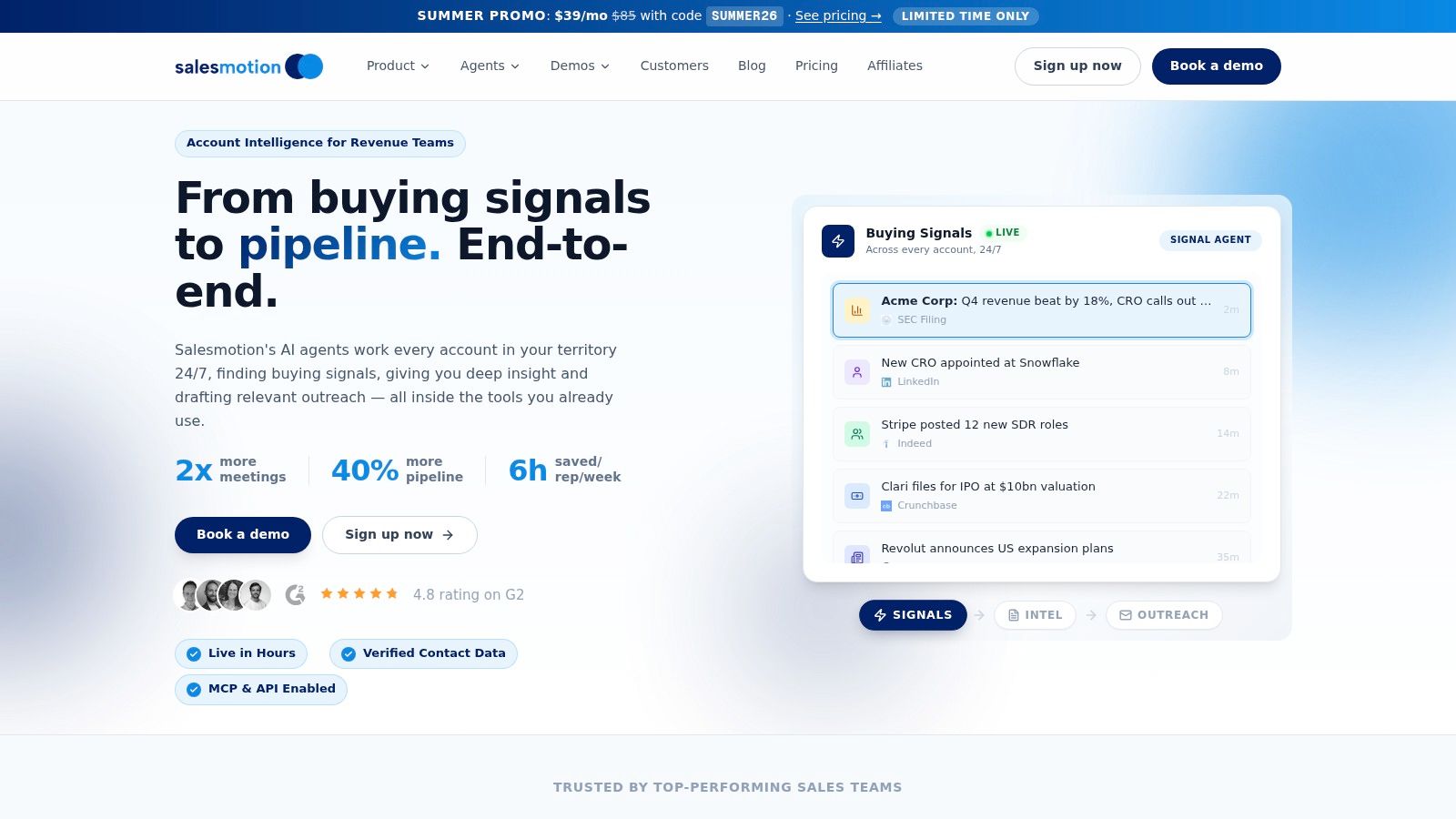
Salesmotion is one example of an intelligence layer built for this model. Its Research Agent assembles structured account briefs, its Signal Agent monitors accounts for trigger events, and its Prospector Agent drafts outreach anchored to the event and account context. In practice, that means the rep doesn't start with "Who is this account?" They start with "What changed, why does it matter, and what's my angle?"
Practical rule: If a signal creates more rep research work than selling opportunity, your system isn't finished yet.
What to watch out for
Three failure modes show up quickly:
-
Signal overload
Too many alerts with no prioritization. Reps stop trusting the feed. -
Weak mapping
The signal is real, but it doesn't connect cleanly to your offer. Not every event is outreach-worthy. -
No account tiering
Every account gets treated the same, so effort gets spread thin and message quality drops.
A signal engine should narrow focus, not expand chaos.
Generating Outreach from Triggers Not Templates
A signal doesn't write the email for you. It gives you the opening. The quality of outreach depends on whether your team can turn that trigger into a useful point of view.
Use the signal to build insight
Most reps stop too early.
They see funding and write, "Congrats on the raise." They see hiring and write, "Noticed you're growing the team." That's not insight. That's observation.
The structure that works is simple:
| Step | Question | Example |
|---|---|---|
| Signal | What happened? | Company hired a new VP of RevOps |
| Insight | What likely changes because of that? | New leader may be reviewing process consistency, tooling, and reporting |
| Message | Why should they care about your outreach now? | Your message connects that review window to a pain you solve |
Example one with funding
A weak version:
Congrats on the recent funding. Thought it might be a good time to connect.
That reads like everyone else's email.
A stronger version:
Saw the funding news and the hiring activity that followed. Companies in that phase usually push growth faster than internal systems can keep up. Are you already feeling that in outbound execution, or is the pressure showing up somewhere else first?
The email works because it doesn't worship the event. It interprets it.
Example two with hiring
Suppose the signal is several open sales roles.
Bad version:
I noticed you're hiring SDRs and thought our platform could help.
Better version:
You posted multiple SDR roles recently. When teams add outbound headcount quickly, message quality usually becomes uneven before volume does. Curious whether your team has a consistent way to turn account context into outreach, or if reps are still researching manually.
That creates a real conversation. It's grounded in an operational consequence the buyer can recognize.
Example three with leadership change
A new executive hire is one of the cleanest triggers in outbound because it naturally implies review and change.
Try this pattern:
- Reference the move
- Connect it to a likely mandate
- Ask a small question
Example:
Saw the new RevOps leadership change. New operators usually inherit a mix of tools, reporting habits, and prospecting workflows that don't fully match. Is outbound research one of the areas being standardized right now?
That feels timely without sounding invasive.
Keep the message structure tight
One industry guide from The Scale Lab on cold email personalization reports that personalized emails can reach 10-15%+ response rates, while generic cold emails average less than 1%. The same source also notes that practitioners often recommend one strong personalization point and testing 3-5 variants while measuring opens, responses, and conversion.
That advice matters because many teams overdo the research in the message. They pile in three announcements, two compliments, a product pitch, and a meeting ask. The result feels synthetic.
Keep one strong reason in the opener. Everything else should support that reason, not compete with it.
If you want examples of which trigger events create strong openings, this library of sales trigger events is a practical reference.
What AI should and shouldn't do here
AI is useful for compressing the draft process. It can take a trigger, structured account notes, and persona context and produce a solid first pass quickly. That's a real advantage.
But AI shouldn't be the final decision-maker on tone, relevance, or whether the trigger is meaningful enough to warrant outreach. The rep still needs to ask, "Would I respond to this if I were the buyer?" If the answer is no, don't send it.
That's the discipline often skipped.

“All of the vendors that I've worked with, all of the onboarding that I have had to deal with, I will say, hands down, Salesmotion was the easiest that I have had.”
Lyndsay Thomson
Head of Sales Operations, Cytel
Operationalizing Your Scaled Outreach Workflow
A signal-based outbound system breaks down in boring ways. The trigger is real, but it reaches the wrong persona. The draft sounds fine, but the CTA asks for a demo when the buyer is still diagnosing the problem. The sequence launches anyway because nobody owns the review step.
That is why scaled personalization is an operating model, not a prompt.
Put the rep in the review path
The cleanest setup is rep-reviewed automation. Let the system do the repetitive work. Keep the rep responsible for judgment.
A workflow that holds up under volume usually looks like this:
- A signal is detected on a target account.
- The system assembles context into a short brief with the trigger, likely business implication, and recommended contact.
- A draft message is created from that brief.
- The rep reviews the claim, recipient, tone, and ask.
- The engagement platform sends the message and handles follow-up steps.
That last review matters more than teams expect. I have seen solid signals wasted because the draft inferred too much, referenced stale context, or went to an executive who would never care about that trigger. The machine is good at monitoring and assembling inputs. The rep still needs to decide whether the outreach earns attention.
Separate signal intelligence from delivery
Teams usually need two layers in the stack, and combining them creates confusion.
-
Signal intelligence and drafting
This layer monitors accounts, pulls context from multiple sources, and turns that into a usable brief and first draft. -
Delivery and sequencing
This layer handles enrollment rules, step timing, channels, throttling, and reply management.
Keep those jobs separate. A sequencing platform should not decide why an account matters today. It should execute once your team already has a reason to reach out.
If you are defining those handoffs, this guide to outbound sales automation workflows is a useful reference for system boundaries and ownership.
Measure workflow quality, not vanity metrics
Many teams still optimize around open rates because opens are easy to report. That creates the wrong behavior. Subject lines get more attention than trigger quality, and the team mistakes activity for relevance.
Review the workflow where it can fail:
-
Reply rate by signal type
Which triggers start real conversations, not just clicks or opens? -
Meeting conversion by messaging angle
Which framing gets from interest to a booked conversation? -
Edit rate before send
Which drafts reps rewrite most often, and why? -
Trust breakers
Which messages include broken fields, weak assumptions, stale events, or wording that sounds scraped?
Those checks tell you whether your system is producing usable outreach or just producing volume.
Turn rep feedback into system rules
This is where RevOps earns its keep. Patterns should not live in Slack threads or in the heads of your best reps.
If leadership-change emails get replies from VP and C-level contacts, route those signals to senior sellers. If hiring triggers work better with directors than executives, change persona rules. If reps keep deleting a certain CTA because it feels too aggressive for the trigger, update the prompt and the sequence logic.
That is the loop. Monitor signals. Generate drafts. Review what gets edited, ignored, replied to, and booked. Then push those lessons back into routing, prompt structure, and QA rules.
The goal isn't to automate more emails. It's to build a system that improves judgment before the message is ever sent.
From Cold Outreach to Timely Conversations
The best outbound doesn't feel cold because it isn't random.
When you build around signals, your team stops interrupting buyers with generic sequencing and starts showing up when something meaningful changes. The message lands differently because it's tied to a live business moment, not a list upload.
That's the definitive answer to how to personalize cold outreach at scale. You don't ask reps to perform handcrafted research on every account. You build a system that watches the market, surfaces the right triggers, assembles the context, drafts a relevant message, and leaves the rep responsible for final judgment.
This also changes the role of the seller. Instead of acting like a sequence operator, the rep starts acting like a commercial advisor. They show up with context, timing, and a useful question. Buyers can feel the difference immediately.
If your current outreach still depends on templates first and research second, fix the order. Start with the trigger. Build the insight. Then write the email.
That's how volume stops killing relevance. And that's how outreach starts creating conversations worth having.
If your team wants a faster way to turn account signals into rep-ready outreach, Salesmotion is built for that workflow. It monitors target accounts for meaningful changes, assembles the research context, and drafts outreach tied to the trigger so reps can review and send without doing the manual research themselves.