Most reps are living in one of two bad workflows right now. They either blast generic sequences that could go to anyone, or they disappear into manual research and spend far too long writing one decent email.
Neither approach scales.
The emails that earn replies usually have one thing the average outbound message doesn't. A real reason to exist today. Not “just following up.” Not “wanted to reach out.” A concrete trigger that makes the outreach feel timely, relevant, and worth opening.
That's the value of company news. It gives you a credible reason to start a conversation. If you want a broader cold outbound foundation before you layer in signal-based messaging, this guide on cold email outreach is a useful companion.
Stop Sending Emails That Get Ignored
A rep sees a target account announce a new executive hire at 9:12 a.m. By 9:20, they've sent, “Congrats on the growth. We help companies like yours.” It gets ignored, because the email wastes the one thing that made the outreach timely in the first place.
Buyers recognize generic outreach in the first line. They can tell when a rep pasted in a headline and kept the same pitch underneath. The problem is not personalization effort. The problem is relevance. If the message does not explain why this event matters now, company news turns into decoration.
Good outbound uses news differently. It starts with a specific event, makes a reasonable interpretation, and ties that change to a problem worth discussing. I have seen this work across funding rounds, leadership changes, expansions, product launches, and hiring spikes. The headline gets attention. The interpretation gets the reply.
Sales teams often treat company news as a writing prompt. The stronger approach is to treat it as an operating signal. That changes how reps research, how managers coach, and how teams build pipeline. If your team still needs the broader foundation on sequencing, targeting, and messaging basics, this cold email outreach guide fills in that layer.
The news is the reason the email exists.
That standard immediately improves quality. Reps stop dropping in a weak personalization sentence and rushing into a canned demo ask. They build the message around the business change itself. That usually leads to shorter emails, clearer angles, and fewer irrelevant sends.
What good looks like
A useful news-based email does four things well:
- Leads with a real trigger that happened recently.
- Explains what likely changed inside the business.
- Connects that change to a problem your offer can address.
- Asks for a small next step that fits the moment.
What this changes for your team
This is bigger than writing one better email.
Once reps consistently work from timely signals, personalization stops being a manual craft project and starts becoming a repeatable system. Managers can define which triggers matter, create plays for each one, and review whether reps interpreted the signal correctly. That is how company news turns from a nice-to-have tactic into a predictable source of meetings.
See Salesmotion in action
Take a self-guided interactive tour — no signup required.
Find and Prioritize High-Intent Company News
The first mistake teams make is assuming all company news is useful. It isn't.
A funding announcement might matter. A new office might matter. A product launch might matter. But the question is whether the event implies a change that your solution can help with now.
That's where most outbound advice gets thin. It tells reps to use trigger events, but it doesn't give strong rules for separating high-intent signals from noise. Salesforce and others recommend using triggers and answering “why now?”, but they don't quantify which categories perform best, which leaves reps guessing how to connect a headline to a real business change. You can see that gap in this Salesforce subject line discussion.
Where to find the signals
You don't need exotic tooling to start. Teams can typically build a workable signal feed with a few habits and a clean account list.
- Google Alerts for target accounts, competitors, and named executives.
- LinkedIn for executive moves, promotions, hiring pushes, and posted announcements.
- Industry publications for launches, partnerships, expansions, and regulatory shifts.
- Company pages such as press rooms, investor pages, careers pages, and blog updates.
- Automated signal monitoring if you want account changes surfaced without constant manual checking.
If your team is building a signal-driven motion, this overview of B2B buying signals is worth reviewing alongside your outbound process.
A practical way to rank news
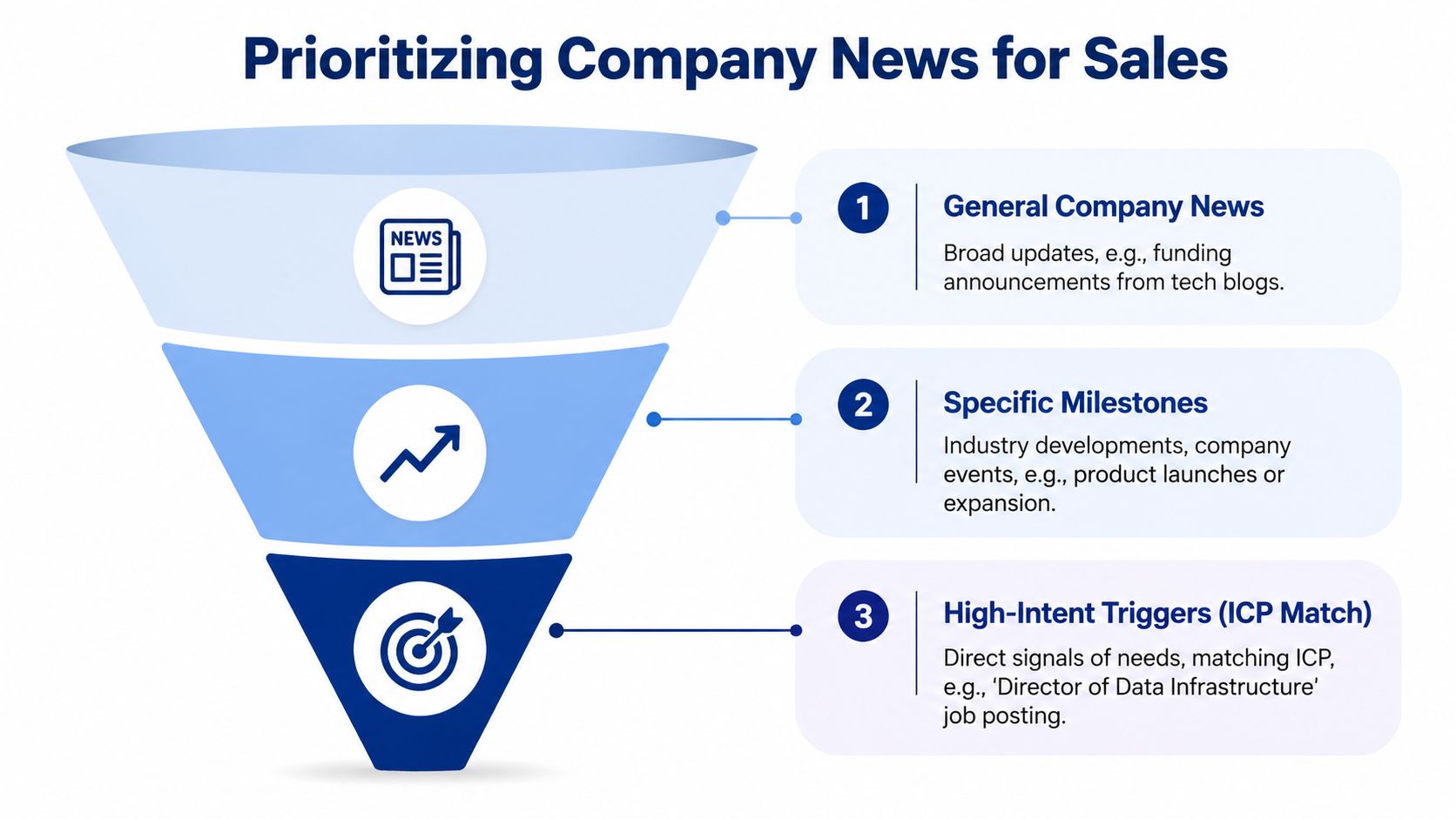
I like to sort company news into three buckets.
| Priority | Type of news | How to think about it |
|---|---|---|
| Low | Broad press releases, generic awards, routine brand announcements | Nice to know, rarely enough on its own |
| Medium | Funding, new office, product launch, leadership change | Useful if you can explain operational impact |
| High | Hiring that maps to your category, merger integration, major expansion, new initiative with clear execution needs | Strong signal when it aligns to your ICP |
What usually deserves action first
Some signals create much better outreach because they imply work, budget pressure, or execution risk.
- Job postings tied to your category. If a company is hiring around the problem you solve, they've already acknowledged the need.
- Leadership changes. A new executive often reviews vendors, priorities, and gaps.
- M&A activity. Integration creates operational friction fast.
- Expansion signals. New offices, new geographies, or new business units usually mean new infrastructure, process, or systems work.
- Product launches. These can be good, but only if your offer helps support launch execution, adoption, or scale.
What often gets overused
Some news items are real, but crowded.
Practical rule: If ten vendors can send the same congratulatory email, the signal is weak unless you have a sharper angle.
Funding is the classic example. It can matter. But “Congrats on the raise” is one of the most overused lines in outbound. The useful question isn't whether they raised capital. It's what they're likely to do with it.
That's the difference between a signal and a headline.

“The talking points are gold. If they're in Salesmotion, I know they're being discussed inside that business. That makes it easy to spark a real conversation, which is 90 percent of the battle.”
Andrew Giordano
VP of Global Commercial Operations, Analytic Partners
Translate News into a Compelling So What
Finding news is the easy part. Interpreting it is where you earn the right to a meeting.
Most reps stop at observation. They say they saw the announcement. Strong reps move one layer deeper and explain what the announcement probably means inside the business.

Use this translation pattern
A simple pattern works well:
- Identify the event
- Infer the business change
- Name the likely pressure point
- Connect that pressure point to your value
That gets you from “I saw your news” to “I understand what this means for your team.”
Examples that produce better email angles
New office opening
A new office isn't just a nice company milestone.
It usually signals geographic expansion, local hiring, operational coordination, and new vendor decisions. Depending on what you sell, that could mean new systems, onboarding pressure, distributed operations, compliance requirements, or regional go-to-market execution.
A weak opener:
- “Congrats on the new office.”
A strong opener:
- “Opening a new office usually creates pressure around hiring, onboarding, and keeping processes consistent across locations.”
New executive hire
A CRO, CIO, CMO, or operations leader changes the shape of a buying conversation.
New executives often inherit a mixed stack, legacy processes, and pressure to show movement quickly. Your angle should focus on the transition they've stepped into, not on a generic welcome message.
A better way to frame it:
- “When a new operations leader comes in, one of the first pain points is usually visibility into what's already working versus what needs to be standardized.”
Acquisition or merger
This is one of the best signals in outbound because the “so what” is rarely subtle.
Teams now need to integrate systems, reporting, workflows, vendors, and people. If your product touches efficiency, visibility, risk reduction, or standardization, this is usually a strong lane.
M&A news is useful when you speak to integration work, not when you admire the deal.
Product launch
This one is easy to misuse.
A launch matters only if you can tie it to execution. More demand. More onboarding. More support load. More sales enablement. More coordination across teams. If you can't connect your solution to one of those downstream realities, skip it.
Questions reps should ask before writing
Use a short diagnostic before you draft the email:
- What changed at the company because of this event?
- Which team is now under pressure?
- What problem is more urgent than it was before?
- Can we help with that exact problem?
- Can we explain the link in one or two sentences?
If the answer is fuzzy, the signal probably isn't strong enough yet.
The test for whether your angle is real
Here's the standard I use. If you remove your company name from the email, does the business logic still make sense?
If not, you're still too close to the headline.
The best signal-based outreach sounds like someone who understands what the event changes for the buyer's world. That's what makes the email feel consultative before the call ever happens.
Crafting Sales Emails That Actually Get Replies
A rep sees funding news at 8:15, writes an email by 8:25, and gets no response by Friday. The problem usually is not the signal. It is the jump from headline to copy.
Good news-based emails feel timely because they are built on a clear structure. Reps can repeat that structure across dozens of accounts without sounding templated. That is how this becomes a pipeline motion instead of a one-off win.
Vidyard lays out a useful framework for sales emails: explain who you are, why you reached out, why the buyer should trust you, and why they should care, in that order, while keeping the message short and easy to read on mobile, as outlined in Vidyard's sales email framework.
If you want to turn this into a repeatable process across a team, this guide on building signal-driven email personalization into outbound workflows gives a solid operating model.
Start with the subject line
Subject lines decide whether the rest of the email even gets a chance. Short, plain subject lines usually work better here because they look like a real business email, not campaign copy. They also hold up better on mobile, where long lines get cut off.
Good subject lines for news-based outreach are specific and current.
Examples:
- Idea for your new office rollout
- Question on the acquisition integration
- Thought on the recent product launch
- Your new VP of Operations
- Re new market expansion
Keep them boring in the right way. Curiosity helps. Cleverness usually hurts.
Use a four-part structure reps can repeat
This is the format I have seen scale best across teams because each part does one job.
1. Open with the trigger and the business implication
The first line should make the buyer think, “Yes, that is happening here.”
Weak:
- “I came across your company and wanted to connect.”
Stronger:
- “Saw the announcement about your new regional office. Expansions like that usually create pressure on onboarding speed and process consistency across locations.”
That second version earns the next sentence.
2. Describe your relevance in one line
Keep this tight. Buyers do not need your company story in a first email.
Example:
- “I work with operations teams that need to standardize rollout work during expansion.”
That is enough context to place you.
3. Add one sentence of proof
Use a proof point that supports the claim without turning the email into a mini case study.
Example:
- “We've helped similar mid-market teams tighten cross-functional coordination during growth periods.”
If you have a named customer and approval to use it, use it. If you do not, stay general and credible. A vague brag hurts more than a simple proof line.
4. End with a low-friction CTA
The CTA should feel easy to answer from a phone between meetings.
Examples:
- Worth comparing notes?
- Open to a brief conversation next week?
- If this is on your plate, happy to send a few ideas.
Asking for 30 minutes in the first touch is usually too much. Asking a question that starts a conversation is easier for the buyer and easier to scale for the rep.
Two practical email examples
Example one
Subject: Idea for your new office rollout
Hi Maya,
Saw your team is opening a new office. That usually creates a push on hiring, onboarding, and keeping processes consistent across locations.
I work with operations teams that need to support those rollouts without adding more manual coordination.
We've helped similar companies tighten execution around cross-functional handoffs during expansion.
Open to a short conversation if that is a priority right now?
Best, Jordan
Why this works
- The email starts with the buyer's current situation.
- The relevance line is clear without turning into a pitch.
- The proof line adds credibility in one sentence.
- The CTA is easy to answer.
Example two
Subject: Question on the integration work
Hi Elena,
Noticed the acquisition news. Deals like that usually create system overlap, process cleanup, and a lot of coordination across teams.
We help revenue leaders reduce the operational mess that shows up when separate orgs have to unify workflows.
We've supported similar teams during periods of operational change.
Would it be useful to compare notes for a few minutes?
Best, Chris
Keep the body tight
If the email does not fit comfortably on a phone screen, cut it.
Reps often add extra detail because they want to sound informed. In practice, long first emails usually signal uncertainty. Short emails with a clear point tend to perform better because the buyer can process them fast, understand the relevance, and decide whether to reply.
The standard is simple. One trigger. One insight. One proof point. One ask.
That is how you write emails that get replies, and how you give a team a format they can run every day without quality falling off.

“All of the vendors that I've worked with, all of the onboarding that I have had to deal with, I will say, hands down, Salesmotion was the easiest that I have had.”
Lyndsay Thomson
Head of Sales Operations, Cytel
Avoid These Common News-Jacking Mistakes
Using company news can improve outbound fast. It can also make your emails feel lazy, creepy, or spammy if the execution is off.
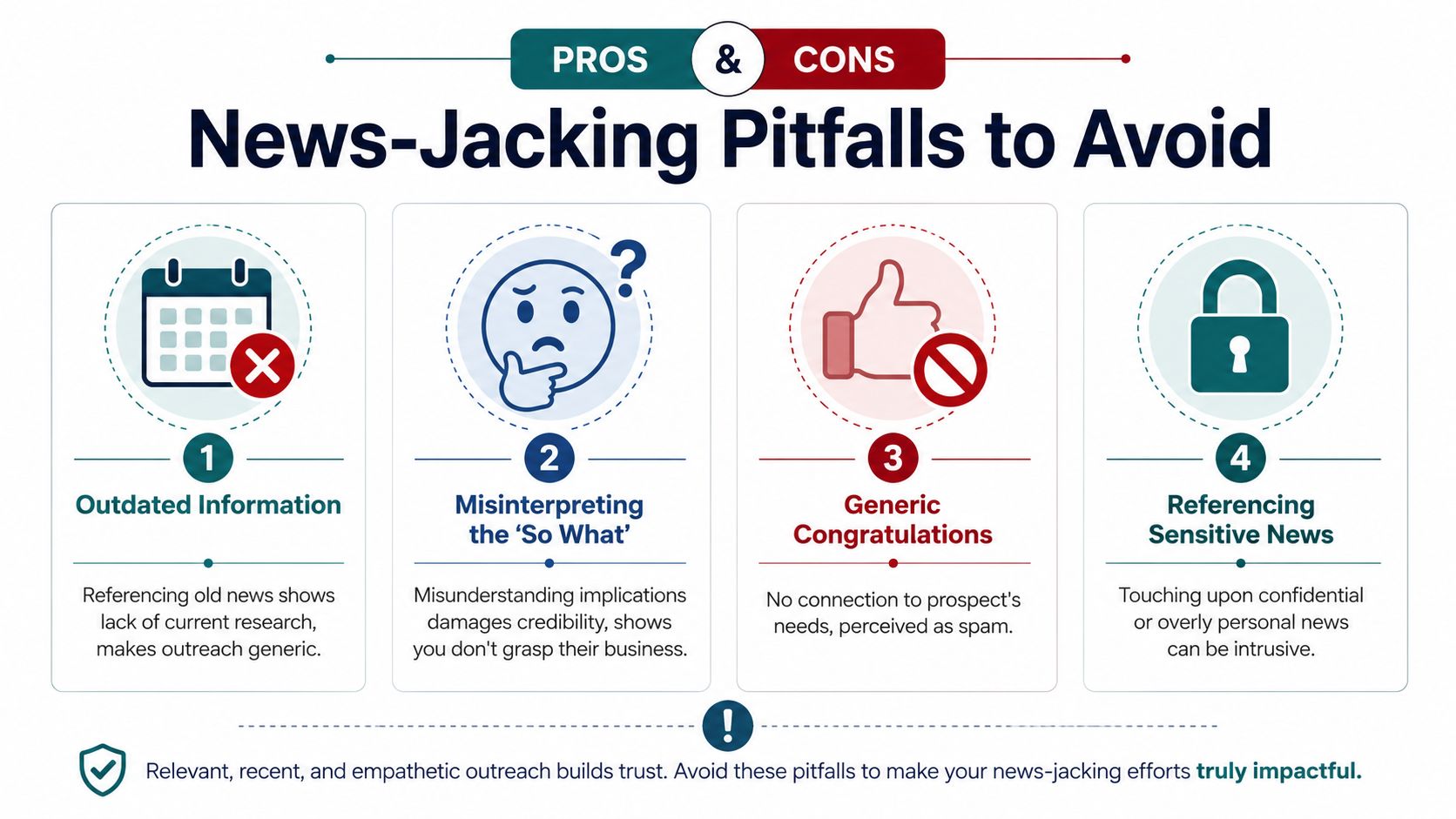
Mistake one: using stale news
If the announcement is old, the urgency disappears. Buyers can tell when a rep dug up something outdated just to fake relevance.
As a rule, if the event no longer feels current to the buyer, don't build the email around it. The exception is when the event created an initiative that is still clearly in motion.
Mistake two: misreading the event
This is the fastest way to lose credibility.
If a company opened a new office and you assume it means international scale when it was really a small local move, your email feels careless. If a new executive joined and you pitch a problem that doesn't map to their role, you sound like you skimmed the headline and guessed.
Mistake three: making the email about you
A lot of news-based emails start well and then collapse into a company pitch.
The buyer doesn't care that you're excited to connect. They care whether you understand what changed in their world. Lead with their business context, not your product tour.
Mistake four: using the same trigger too many times
This problem gets ignored in most sales advice. Personalization can hurt deliverability if teams over-repeat the same event, phrasing, or promotional style across large sends.
Most guidance focuses on relevance, but not enough on sender health. Outreach notes SPF, DKIM, and DMARC as part of best practice, and HubSpot warns against overloading emails with images or overly promotional content. That matters because repeated news-driven phrasing can still look low-quality to mailbox providers if the sending setup and content patterns are sloppy, as discussed in Outreach's sales email template guidance.
If every rep sends the same funding opener to a large list, the issue isn't only message quality. It's sender risk.
A quick mistake check before send
Use this short review:
- Is the news recent enough to matter now
- Did I explain the business implication, not just repeat the headline
- Does the first half of the email focus on them, not us
- Is this signal crowded and overused
- Does the copy sound repetitive across the sequence
There's one more judgment call worth making. Some news is public, but still feels sensitive. Layoffs, executive exits under pressure, legal issues, or personal milestones can be risky territory. Just because you can reference it doesn't mean you should.
Good signal-based outreach feels informed. It should never feel invasive.
Operationalize Your Workflow with Sales Intelligence
Manual news research works when a rep is preparing for one important account. It breaks when a team needs that level of relevance across a book of accounts every week.
That's why the true opportunity isn't just learning how to write one strong email. It's building a system that continuously finds triggers, interprets them, and turns them into outreach.
Build the workflow, not just the message
A usable operating model looks like this:
- Track target accounts continuously
- Surface meaningful changes
- Interpret the business impact
- Draft outreach anchored to that trigger
- Follow up only when you can add something new
Winning by Design is especially clear on that last point. Follow-ups should arrive every 4 to 8 business days and should add new information, such as industry insight or a more recent company event. “Checking in” emails without added value are called out as a common mistake in Winning by Design's sales email guidance.
Where automation helps
This is the point where tools become useful. Not because reps can't research, but because they can't do it consistently at scale.
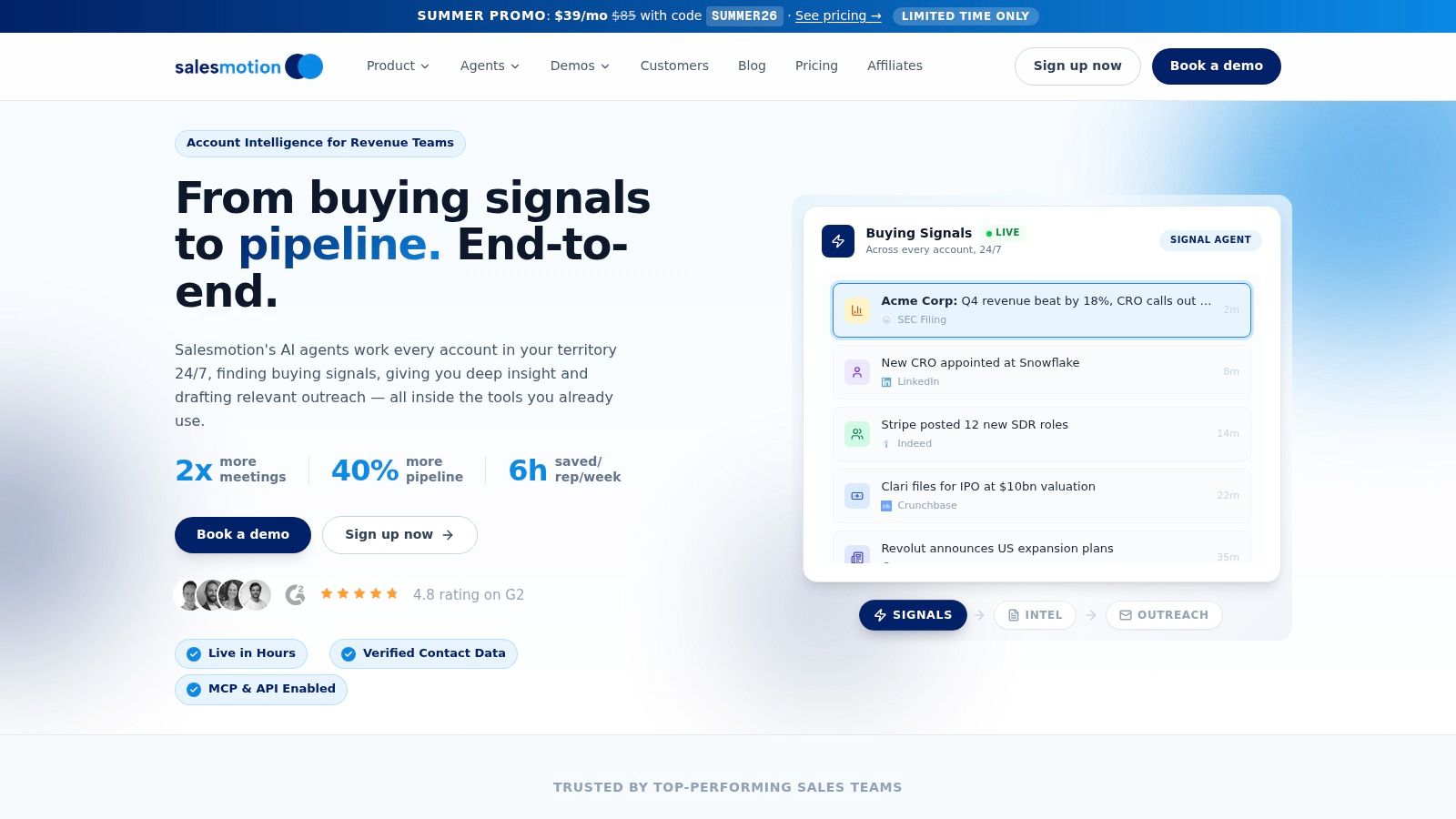
One option is how to automate sales research with AI. In practical terms, Salesmotion automates steps one through four of this workflow by detecting account news, interpreting what the event likely means, and drafting outreach that references the specific trigger.
That's useful because the bottleneck usually isn't writing. It's getting from raw signal to usable talk track quickly enough for the timing to still matter.
What a scalable motion looks like in practice
The reps still need judgment. They should review the trigger, check the “so what,” tighten the copy, and decide whether the signal is strong enough to act on.
But they shouldn't have to start from a blank page every time.
That's the difference between occasional personalized outreach and a repeatable signal-based selling system.
Sales teams don't need more generic templates. They need better timing, sharper context, and a reliable way to turn account changes into outreach that sounds informed. Salesmotion helps with that by monitoring target accounts, explaining why a trigger matters, and drafting outreach your reps can review and send.