Cold email outreach is about one thing: starting valuable conversations with potential customers. For it to work, your message has to land with pinpoint relevance, personalization, and impeccable timing. This isn't about generic email blasts; it's about providing genuine value from the very first sentence.
Why Your Cold Email Outreach Isn't Working
Let's get straight to the point—the days of blasting generic templates and hoping for replies are over. If your cold email campaigns are falling flat, the problem usually boils down to one missing ingredient: a compelling "why now."
Without a clear trigger event or a solid reason for contacting a prospect at that specific moment, your email just feels like an interruption. It gets buried in a sea of unsolicited messages, leading to dismal reply rates and frustrated sales teams.
The quotes in this guide come from more than 370 sales and customer calls in the twelve months to October 2026. A sales leader at a software firm told us: "I think people see those repetitive email campaigns that aren't prescriptive, that are very generic. That's like, I get five, six, seven of these a day." That is the inbox your email lands in.
The Hidden Cost of Manual Research
This is where many sales reps get bogged down, paying the "manual research tax." They burn hours digging through LinkedIn, news articles, and company websites, just to find one good reason to reach out. After all that work, they often end up with a weak, poorly timed message that doesn't connect.
This manual process isn't just inefficient; it’s a significant drain on resources. Reps spend valuable selling hours on research that doesn't produce a strong enough angle. The result is outreach that lacks the punch needed to capture a busy executive's attention.
A business development rep at a software firm told us: "I can't make it relevant for them if I don't do deep research." That is the tax in one sentence: relevance depends on research the rep has no time for.
Here's a fact: without a clear, signal-driven 'why now,' even the best-written email is just more noise. Top-performing teams understand this: timing isn't just a factor; it's the foundation of successful outreach.
The numbers paint a clear picture. While the B2B cold email outreach benchmark for response rates is around 5.1%, a deeper look at over two million emails reveals the reply rate often drops to just 2.09%. Of those replies, only 14.1% are positive.
Doing the math, that’s an effective "yes" rate of a mere 0.64%—or about 1 interested reply for every 157 contacts. For reps targeting specific events like a funding round or a product launch, this manual research tax is a major roadblock that leads to generic emails that simply don't work.
From Volume to Value
The solution isn't to send more emails. It's to send smarter ones. The highest-performing revenue teams are making a critical shift away from the high-volume, "spray and pray" mindset. They're embracing a precision-based strategy fueled by real-time signals and deep account intelligence.
Here’s a practical comparison of the two approaches:
Traditional vs. Signal-Driven Outreach
| Element | Traditional Outreach (The Old Way) | Signal-Driven Outreach (The New Way) |
|---|---|---|
| Trigger | Static lists, generic firmographics | Real-time events, company changes |
| Timing | Based on the seller's schedule | Based on the buyer's needs & timing |
| Message | Generic, "me-focused" pitch | Hyper-relevant, value-driven insight |
| Targeting | Broad, title-based outreach | Multi-threading across buying committees |
| Process | Manual, time-intensive research | Automated signal detection |
| Result | Low reply rates, high frustration | High engagement, quality conversations |
The new way is all about using real-time context to earn the right to be in someone's inbox.
Instead of those tired, generic openers, imagine leading with something hyper-relevant and timely:
- "Saw your company just secured a new round of funding to expand into Europe..."
- "Noticed your new VP of Engineering mentioned prioritizing cloud cost optimization in a recent podcast..."
- "Read about your recent partnership with [Company Name] and how it impacts your supply chain..."
This level of specificity instantly shows you’ve done your homework and have a legitimate reason for contacting them. It transforms your message from a cold pitch into a timely, valuable conversation starter.
By mastering these cold outreach best practices, your team can turn insights directly into opportunities. This isn't about sending more emails; it’s about sending the right one at the exact moment it matters, using real account intelligence to create conversations that lead to revenue.
See Salesmotion in action
Take a self-guided interactive tour — no signup required.
Building Your Foundation with Account Intelligence
Great cold emails don’t start with a clever subject line; they start with great intelligence. Before you write a single word, you need a solid foundation built on knowing your target accounts inside and out. This means going far beyond static data like company size or industry.
The problem with most outreach is that it’s based on outdated firmographic data. That tells you who a company is, but it says nothing about why you should reach out to them now. Powerful outreach is all about timing, and timing is driven by trigger events—specific, timely occurrences within an account that signal a real need for your solution.
This is where most cold outreach campaigns fall apart: they’re built on a weak foundation.
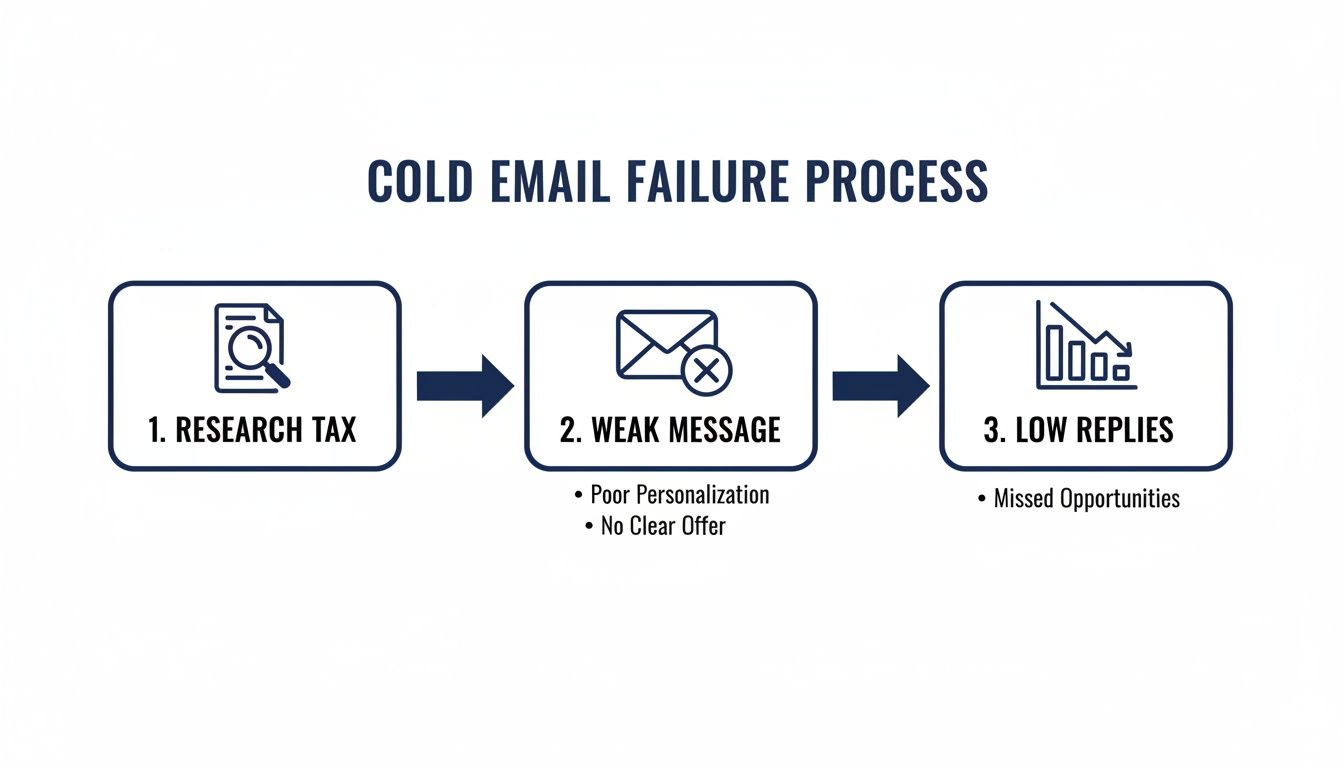
The takeaway is simple: when you lack the right intelligence, you're forced to spend hours on manual research. That leads to weak, generic messaging, which—unsurprisingly—gets low reply rates. The solution is to build a system that brings the right signals directly to you.
Moving from Static Lists to Dynamic Triggers
The best sales teams don't get lucky; they build systems. They create a process to spot and track the signals that matter most to their business, ensuring they engage prospects at the moment of peak relevance.
Consider the difference. Instead of emailing every VP of Engineering on your list, you can zero in on VPs of Engineering at companies that just announced a major cloud migration initiative. One is a shot in the dark; the other is a strategic, informed conversation.
Here are a few examples of what these dynamic triggers look like in the real world:
- Fintech: A company announces a new funding round to scale its payments platform. That’s a powerful signal for anyone selling infrastructure, security, or compliance solutions.
- IT Services: A new CIO is hired who has a public track record of championing digital transformation. This is the perfect time to pitch consulting or implementation services.
- Life Sciences: A biotech firm gets FDA approval for a new drug. This creates immediate needs for commercialization software, marketing agencies, and supply chain solutions.
A trigger event is the "why you, why now" that gives your outreach purpose. It elevates your email from just another interruption into a timely, valuable insight.
This signal-driven approach focuses your team's energy on accounts with the highest potential. It’s about building a system that filters out the noise and surfaces real, actionable opportunities.
Automating Intelligence Gathering
Let’s be realistic: manually tracking these signals across hundreds or thousands of accounts is impossible. This is where account intelligence platforms become essential. These tools do the heavy lifting for you, monitoring thousands of sources—from news and press releases to executive interviews and hiring trends.
A key part of this foundation is knowing who your ideal customer is, which helps you define which signals matter most. To sharpen that skill, it’s worth understanding how to generate B2B leads that actually convert as a core part of your strategy.
Once you’ve defined your critical signals, an intelligence platform works for you 24/7. It’s like having an always-on analyst finding key events and piping them directly into your team's workflow. This isn’t just about saving time; it’s about creating a massive competitive advantage. You can learn more about how to select the right account intelligence tools for your team in 2026 in our deep-dive guide.
When you build this foundation of automated intelligence, you’re not just sending better cold emails. You’re building a predictable pipeline engine where every message is backed by a clear, data-driven "why now." You shift your team from chasing leads to starting timely, relevant conversations that drive revenue.

“Salesmotion is instrumental in helping me prioritize net-new accounts, understand their strategic initiatives, and cover more ground. With a lot of green-field accounts, I'm heavily leaning on the AI insights to tier my accounts and focus my time. The platform is incredibly intuitive and easy to use.”
Rob Webster
Enterprise Account Executive, Synthesia
Crafting Hyper-Relevant Outreach Messages
Once you have a powerful "why now" signal, the next step is to turn that intelligence into an email that gets a response. A great cold email isn't just well-written; it's surgically precise. It connects a real-world event to a specific problem you know how to solve. This is how you stop pitching and start a valuable conversation.
The goal is to establish a strong Point of View (POV). You’re not just stating a fact like, "I saw you hired a new CIO." You're connecting that fact to a likely challenge and showing how you can help. That's what demonstrates real insight and cuts through the noise.
The Anatomy of a High-Impact Message
Every part of your email has a specific job. From the second it lands in their inbox, your message must earn their attention. Let's break down the components of a cold email that works.
-
The Subject Line: This is your first—and most important—hurdle. Your goal is to be intriguing, not clickbait. Reference the trigger you found directly. Something like "Question re: your new Chicago facility" or "Idea for your recent partnership with [Company]" works well. Keep it short, specific, and professional.
-
The Opening Line: This is where you immediately state your "why now." Lead with the signal you identified. It instantly proves you’ve done your homework and have a real reason for reaching out.
-
The Value Proposition: Now, connect that trigger to a probable pain point. This is your POV in action. For example, "Expanding into new markets often creates unforeseen supply chain complexities..." This shows you understand their world. You can learn more about building a compelling case by exploring this guide on creating a customer value proposition template.
-
The Call-to-Action (CTA): Keep your CTA clear, simple, and low-friction. Instead of asking for 30 minutes on their calendar, try an interest-based CTA. "Would you be open to learning how we helped [Similar Company] navigate this?" is much easier to say yes to.
Playbook Examples for Enterprise Sales
Generic templates are ineffective in complex enterprise sales. You have to tailor your message not just to the account, but to the specific person you’re contacting. This is the art of multi-threading—speaking the language of each stakeholder.
Let's walk through a plausible scenario. We're targeting "InnovateTech," a company that just announced a strategic investment to speed up its enterprise product roadmap.
Reaching Out to the VP of Product
A VP of Product is obsessed with execution, timelines, and staying ahead of the competition. Your email needs to reflect that.
Subject: Idea for InnovateTech's enterprise roadmap
Body: Hi [VP's Name],
Saw the news about your strategic investment to fast-track the enterprise product roadmap—congratulations.
Typically, when companies scale their enterprise offerings this quickly, engineering teams face immense pressure to deliver complex features like advanced security and compliance without derailing the core timeline.
We help SaaS leaders like [Competitor/Similar Co.] build and ship enterprise-ready features 50% faster by providing out-of-the-box components for things like SSO and role-based access control.
Would you be open to exploring if this could help your team hit its new roadmap goals?
Reaching Out to the CFO
The CFO, on the other hand, lives in a world of ROI, risk management, and capital efficiency. The trigger is identical, but the angle is completely different.
Subject: Capital efficiency for your new investment
Body: Hi [CFO's Name],
Congratulations on securing the new investment to accelerate InnovateTech's push into the enterprise market.
From a financial perspective, maximizing the ROI on that capital is paramount. One of the biggest risks we see is R&D budget overruns when engineering teams get bogged down building ancillary features instead of focusing on core IP.
We help CFOs at fast-growing SaaS companies de-risk their product roadmap and improve R&D efficiency by outsourcing non-core development. Our clients typically see a 2-3x return on investment within the first year.
Is this a priority for your team as you deploy the new capital?
By tailoring the message to each stakeholder's unique priorities, you drastically increase the relevance of your cold email outreach. The VP of Product gets a solution for speed; the CFO gets a solution for efficiency. Both messages are hyper-relevant, but they speak entirely different languages. This multi-threaded approach is critical for winning complex deals.
The Art of the Follow-Up Sequence
Sending one great cold email and then hoping for the best is a low-percentage play. The real breakthroughs in cold outreach almost always happen in the follow-up, where persistence meets renewed relevance.
The truth is, your prospect is busy. Your first email might have landed at a bad time, been buried under dozens of others, or simply been forgotten. A single email is rarely enough to cut through the noise of a modern executive's inbox.

Why Persistent Follow-Ups Are Non-Negotiable
This isn't about being annoying; it's about being strategically persistent. Data consistently shows that the magic happens in the sequence. While the initial email gets the most attention, follow-ups are the unsung heroes of successful cold outreach.
Research from Instantly shows that while the first email grabs 58% of replies, a staggering 42% come from follow-ups. Campaigns with 3-5 follow-ups can see an 8.3% reply rate—more than double the 4.1% from single-shot campaigns. For top-tier sales teams, an optimal sequence of 4-7 emails can push reply rates to 10% or higher, as detailed in their 2026 benchmark report on cold email.
In complex B2B verticals like industrial energy or financial services, where macro triggers like funding rounds or regulatory changes drive decisions, this kind of persistent, contextual follow-up is essential.
A follow-up isn't just a reminder; it's a new opportunity to provide value. The goal is to be helpfully persistent, not annoying.
Ditch the "Just Checking In" Mentality
The biggest mistake reps make is sending lazy follow-ups. Emails that start with "just checking in" or "bumping this up" add zero value and are deleted instantly. They make you sound desperate and generic.
Instead, every single follow-up needs its own purpose. Use new signals and insights as your legitimate reason to re-engage. This transforms your message from an annoyance into a timely, welcome touchpoint.
A business development director at a contract research organization told us: "once we need to follow up, we need to follow up with something relevant." That is the whole rule for this section.
Here’s how you can frame your follow-ups with fresh context:
- Reference a company announcement: "Hi [Name], I saw your team just launched its new integration marketplace. This often brings up challenges around partner API security..."
- Mention a recent interview: "Hi [Name], listened to your appearance on the [Podcast Name] podcast and your point about scaling go-to-market teams really stood out..."
- Share a new piece of content: "Hi [Name], following up on my last note. We just published a guide on [Relevant Topic] that I thought you’d find useful."
- Offer a different angle: "Hi [Name], when we first connected, I mentioned [Pain Point A]. Another challenge we help with is [Pain Point B]..."
Each of these provides a new "why now" for your outreach, making the follow-up feel just as relevant as the initial email.
Building a Value-Driven Follow-Up Sequence
A well-structured sequence is your playbook for turning silence into a conversation. The goal is to add a little more value and a different perspective with each touch.
Here’s a sample framework for a 5-step sequence spread over two weeks:
- Day 1 (Initial Email): Lead with your strongest, signal-based trigger and a clear point of view. Make it count.
- Day 3 (Follow-up 1): Reply in-thread to your first email. Keep it short. Offer an alternative perspective or a simplified CTA. For example, "Thought I'd add a quick link to a case study from [Similar Company]."
- Day 6 (Follow-up 2): Send a new email with a fresh subject line. Reference a different but related pain point or share a valuable piece of content (like a benchmark report or short video).
- Day 10 (Follow-up 3): Reply in-thread to the second email. This time, bring in some social proof. "Hi [Name], just saw that [Well-Known Company] in your space is tackling a similar challenge..."
- Day 14 (Follow-up 4 - The Breakup): A polite, professional closing email. "Hi [Name], I haven't heard back, so I'll assume now isn't the right time. Should I close your file for now?" This often gets a reply from prospects who were interested but simply busy.
For more guidance on this, check out our guide with tips for making an effective email cadence. By building a sequence that educates, informs, and respects your prospect's time, you dramatically increase your odds of getting that first meeting.

“The Business Development team gets 80 to 90 percent of what they need in 15 minutes. That is a complete shift in how our reps work.”
Andrew Giordano
VP of Global Commercial Operations, Analytic Partners
Measuring and Scaling Your Outreach Engine
If you can't measure your outreach, you can't improve it. Sending emails and hoping for the best isn't a strategy—it's a recipe for a stagnant pipeline. To build a predictable engine for your cold email outreach, you must look past vanity metrics and focus on the numbers that signal real pipeline growth.
Many sales teams get this wrong. They obsess over open rates, which are increasingly unreliable due to privacy features like Apple's Mail Privacy Protection. An "open" doesn't mean a prospect is interested; it's time to track what actually drives business forward.
The KPIs That Actually Matter
For a signal-driven outreach strategy, your key performance indicators (KPIs) must reflect real engagement and intent. Forget the metrics that make you feel busy and zero in on the data that shows if your message is landing with the right person at the right time.
These are the outreach KPIs you should be focused on:
-
Reply Rate: This is your most fundamental metric. It’s the raw percentage of emails compelling enough to elicit a response—good, bad, or indifferent. A low reply rate is your clearest sign that your targeting or messaging is off.
-
Positive Reply Rate: This is where the real insight lies. This metric isolates replies that show interest, ask for more information, or agree to a meeting. If you have a high reply rate but a low positive reply rate, it means your subject lines are getting attention, but your message isn't creating real buying intent.
-
Meeting Booked Rate: This is the ultimate goal of cold outreach. Tracking the percentage of prospects who book a meeting creates a direct line from your outreach efforts to your pipeline. For any outbound team, this is the North Star metric.
Don't get distracted by opens and clicks. Your success hinges on three core metrics: getting a reply, ensuring that reply is positive, and turning that positive reply into a scheduled meeting. These are the building blocks of a predictable revenue engine.
Analyzing Performance to Find What Works
Once you're tracking the right KPIs, you can start asking the right questions. Your data holds the keys to understanding which parts of your strategy are working. By segmenting your performance data, you can uncover powerful insights.
For instance, you can analyze your results based on:
- The Trigger Event: Do emails mentioning a new funding round get more positive replies than ones referencing a leadership change?
- The Persona: Do VPs of Engineering respond better to a technical, feature-focused message, while CFOs are more interested in the ROI angle?
- The Sequence Length: Do you see a meaningful lift in meetings booked when you move from a 4-step sequence to a 7-step one?
Here's a practical scenario: A sales team using an account intelligence platform like Salesmotion might find that emails referencing a competitor's recent product launch have a 12% positive reply rate. Meanwhile, emails mentioning a new office opening only get 3%. That data provides a crystal-clear directive: double down on competitive intelligence triggers.
This level of analysis turns your outbound motion from guesswork into a science. You're no longer just copying what your top rep does; you have hard data showing what works at scale.
Creating a Scalable, Repeatable Process
The ultimate goal is to move beyond individual heroics and build a system that any rep on your team can execute successfully. Once you know which triggers, messages, and sequences perform best, you can build a library of proven playbooks.
A revenue leader can then use this data to standardize excellence across the sales floor. Instead of every rep reinventing the wheel each morning, they can start with a proven template and spend their time personalizing it with the account's specific context. This not only creates consistency but also dramatically shortens the ramp time for new hires.
Your data-driven insights should feed back into every part of your outbound motion, from rep training and onboarding to quota setting and forecasting. Success stops being about luck and becomes a repeatable, fine-tuned process. This is exactly how you build a scalable engine for your cold email outreach that generates predictable revenue, quarter after quarter.
Answering Your Toughest Cold Outreach Questions
Even with a solid framework, shifting to a signal-driven strategy brings up real-world questions. Moving from high-volume blasting to high-precision outreach is a significant change.
Let's tackle the most common hurdles sales teams face when they get serious about this approach.
Where Do I Find the Right Buying Signals?
This is the essential question. The answer is simpler than you think: listen where your prospects are already talking. Signals aren't just in press releases; they're scattered across the business world. The trick is pulling all those sources together.
Smart signal gathering means monitoring a few key channels:
- Company News & Press Releases: Your source for major events—funding rounds, M&A, and big product launches.
- Executive Interviews & Podcasts: When a leader speaks publicly, they are often sharing their strategic priorities and biggest challenges.
- Hiring Trends & Job Postings: Is a company suddenly hiring a "Director of Cybersecurity"? That's a massive green light for anyone selling security software.
- Social & Professional Networks: A quick look at LinkedIn can reveal a key stakeholder's new project, a team expansion, or a brand-new initiative.
The challenge isn't finding these signals—it's managing the firehose of information. Trying to track this manually across hundreds of accounts is a recipe for burnout. This is exactly why automated account intelligence platforms are no longer a luxury, but a necessity for any modern sales team.
How Much Personalization Is Enough?
Let's be clear: personalization isn't mentioning the weather in their city. Real personalization connects your solution to their world, using the signal you found as the bridge. The goal is to be relevant, not just familiar.
You don't need to reinvent the wheel for every email. The best reps live by the 80/20 rule: 80% playbook, 20% personalization. Start with a proven template for a specific signal and persona, then weave in that crucial 20% of context you found.
For example, if the signal is a new product launch, that 20% might be a single sentence referencing a specific feature and how your tool helps get it adopted faster. It’s a small detail that shows, "I did my homework."
Quick Answers to Your Cold Outreach Questions
Handling the inevitable questions and objections that arise is a core part of any outreach strategy. Here's a quick cheat sheet for common scenarios.
| Question | Short Answer |
|---|---|
| What if they say 'Not interested'?' | Acknowledge it and ask for context. A simple, "Thanks for the quick feedback. So I can be more targeted, could you share what part wasn't a fit?" can often restart the conversation or at least give you valuable intel. |
| How to handle 'Not the right time'?' | This is usually a genuine brush-off, not a hard "no." Don't push. Instead, offer to be a resource. Try, "Understood. Is it okay if I check back in a few months? In the meantime, you might find this guide on [Relevant Topic] useful." |
| What if they say 'We use a competitor'?' | This is a buying signal, not a rejection! It confirms they have a budget and recognize the problem. Your job is to pivot to differentiation. "Great to hear—[Competitor] is a solid tool. We often talk to companies who use them but find they're missing [Your Key Differentiator]." |
Think of objections not as roadblocks, but as requests for more information or a clearer value proposition.
How Many Follow-Ups Are Too Many?
The line between persistent and pestering is drawn with value. As long as every touch offers something new—a different insight, a fresh resource, a new angle—you have a reason to be in their inbox.
A good sequence usually involves 4-7 touches spread out over a few weeks.
Research shows it takes an average of 5 touches just to get a response from a typical prospect. For executives, that number can jump to nearly 9. The key is to vary your approach. Mix in-thread replies with fresh subject lines, and alternate between different value props. If you run through a full sequence with zero engagement, it's time to send a professional "breakup email" to close the loop respectfully.
Ready to stop guessing and start building a predictable pipeline with signal-driven outreach? Salesmotion is an AI-powered account intelligence platform that tracks what matters across your target accounts and turns those signals into actionable opportunities for your sales team.