Most advice on buying signals points reps toward the obvious stuff first. Funding announcements. product launches. executive hires. Those matter, but they're also noisy, crowded, and easy for every competitor to see.
The more useful signal is often sitting in public view and getting ignored: hiring behavior.
A company doesn't add headcount by accident. When leaders open roles in one department, they're telling you where budget is moving, which initiative got approved, and what kind of operational strain is about to show up. That's why hiring surge as buying signal deserves a lot more attention than it gets.
TL;DR: A hiring surge is a buying signal because open roles show where a company has approved budget and what it is trying to build, fix or expand. Read it by department, score it on volume, velocity and clustering with other triggers such as a leadership change or funding, then write outreach to the initiative behind the hiring instead of the job post. Use the same model when you build 2027 account lists.
Why Hiring Is the Best Signal You're Ignoring
Most reps still treat job boards like a list-building tool. That's too shallow.
The better use is to read hiring activity as an investment signal. Companies that increase job postings by 30% or more in a quarter are 2.4 times more likely to purchase new software in the following quarter compared to companies with flat hiring, according to LinkedIn Economic Graph data summarized here. That's the kind of relationship sales teams should build motions around.

The reason is practical, not theoretical. New hires need tools, licenses, workflows, managers, reporting, and support. If a company is scaling one function quickly, something in its current stack usually stops being enough.
I've heard the alternative from teams too many times. Reps were "manually searching LinkedIn, picking companies randomly" before building any real signal monitoring. That approach creates activity, not precision. You end up contacting companies that look busy instead of companies that are entering a buying window.
Why public hiring data beats guesswork
Hiring data has two big advantages over generic prospect lists:
- It shows commitment: A posted role means a team got approval to spend.
- It shows direction: The department tells you where the business is pushing.
- It shows timing: Fresh roles often appear before procurement gets fully underway.
- It shows scale: One role and twelve roles mean different levels of urgency.
Hiring is one of the few public signals that reveals both intent and operational pressure at the same time.
A funding announcement tells you a company may spend. A hiring surge tells you where that spending has to land.
That's the difference between “good account” and “good account right now.”
See Salesmotion in action
Take a self-guided interactive tour — no signup required.
Decoding the Why Behind a Hiring Surge
A hiring surge isn't just headcount growth. It's a public clue about strategy.
When a company suddenly expands hiring in one area, leaders are usually responding to a concrete business need. They're trying to launch something, fix something, expand something, or catch up somewhere. The roles are the symptom. The initiative is the underlying story.
What the company is really saying
If a business posts a cluster of similar roles, read it as an internal sentence:
- More sales roles means “we need more pipeline and coverage.”
- More engineers means “we're building, shipping, or replatforming.”
- More compliance or legal roles means “risk, regulation, or governance just became urgent.”
- More customer success roles means “retention pressure or onboarding load is growing.”
That's why hiring surge as buying signal works so well. It helps you move from generic relevance to operational relevance.
A company posting twenty engineering roles in a month isn't merely hiring developers. It's likely investing in a product roadmap, platform migration, AI rollout, integration layer, or reliability effort that will require tooling, infrastructure, and outside help. If you sell cloud infrastructure, observability, dev workflow tools, implementation support, or security, that's not background noise. That's your opening.
Hiring tells you where budget is going
The most useful part isn't the count alone. It's the pattern.
Compare current openings against the company's normal behavior. A firm that usually has a few open roles but suddenly expands hiring is easier to interpret than a company that is always hiring at a high baseline. Department mix matters too. Sales growth means one thing. data governance growth means something very different.
That's also where adjacent business context matters. CFOs and operations leaders often have to decide whether to add in-house complexity or outsource support. If you sell into HR, payroll, workforce administration, or benefits operations, a resource like this PEO vs HRO guide for CFOs is useful because it shows how staffing and operating-model choices connect to budget and infrastructure decisions.
For reps building a broader trigger-based motion, this list of sales trigger event examples is a good companion to hiring data because a role spike rarely acts alone. It often sits next to a leadership change, market expansion, product launch, or funding event.
Practical rule: Don't ask, “Are they hiring?” Ask, “What business problem forced them to hire like this?”
That one shift makes your outreach sharper fast.

“There's been a big focus on hyper personalization and relevance in our outbounding efforts. Salesmotion has been a key partner in hitting our significantly increased meeting targets. What stands out is how simple it is. Reps can log in and get valuable account insights within 30 seconds to a minute.”
Joe DeFrance
VP of Sales, Incredible Health
Reading the Tea Leaves of Departmental Hiring
The strongest hiring signals get clearer when you stop looking at the company as one unit and start reading department by department.

A hiring pattern only becomes actionable when you can connect it to an implied initiative and then to the tools or services that initiative usually creates demand for.
Department signals and what they usually mean
| Department hiring pattern | Likely initiative | Common buying implication |
|---|---|---|
| Sales team expansion | Revenue push, outbound scale, territory buildout | CRM cleanup, sales engagement, data providers, enablement, RevOps support |
| Engineering hiring surge | Product build, infrastructure work, AI or platform expansion | Cloud tools, dev tooling, observability, security, implementation services |
| Compliance and governance hiring | Regulatory response, audit prep, policy formalization | GRC software, security tooling, advisory services, documentation systems |
| Customer success hiring | Retention focus, onboarding strain, account expansion motion | CS platforms, support tooling, training, workflow automation |
| Finance and procurement hiring | Process maturity, spending control, pre-scale operations | ERP, spend management, workflow approvals, reporting systems |
This isn't perfect. But it's far better than sending the same message to every company with open roles.
The SDR example reps should know cold
Take a simple pattern: a prospect posts 8 SDR roles in a short period.
That usually means they're scaling outbound. Not “thinking about pipeline.” Scaling it. If that's happening, they'll likely need cleaner account selection, better contact data, stronger sequencing, improved lead routing, tighter CRM hygiene, and clearer reporting on rep productivity.
A bad email says, “Saw you're hiring SDRs. We help growing teams.”
A better email ties the hiring signal to the operational consequences:
- new reps need accounts and contacts fast
- managers need activity visibility
- RevOps needs process consistency
- leadership needs confidence that the outbound build won't become expensive chaos
That's a real sales conversation.
Engineering, compliance, and the signals behind the signal
Engineering hiring has a different shape. If a company is adding backend, platform, DevOps, data, and security roles together, that usually points to a technical initiative with multiple dependencies. In that case, reading the stack references inside job descriptions becomes useful. The requirements section often reveals what they already use, what they're standardizing on, and what gaps may still exist.
Compliance hiring can be even more interesting because it usually follows pressure, not optimism. A cluster of privacy, governance, audit, or policy roles often means the company is preparing for market entry, customer due diligence, or internal controls work. If you sell into security, compliance operations, or services, that can be a stronger pain-driven trigger than broad growth hiring.
The department tells you the story. The role titles tell you the chapter.
Don't miss bullseye hiring
Not every valuable hiring signal shows up as broad expansion. Sometimes the better signal is selective replacement.
Tightening budgets are driving “bullseye hiring,” replacing mediocre workers with top talent, as a dominant 2026 trend, according to this Business Insider report. That often appears around new executive hires and in senior roles that may not even be widely advertised.
For sales teams, this matters because replacement hiring points to performance pressure. A company may not be growing headcount overall, but it may be upgrading the people, systems, and processes inside a function. That can create demand for specialized tools, consulting support, and workflow redesign.
Watch for clues like:
- a new CRO followed by selective sales leadership hiring
- a new CISO followed by governance and security architecture roles
- a new operations leader followed by process-heavy back-office roles
Those patterns often signal a team that isn't satisfied with the current setup.
Finding and Scoring Hiring Signals
Engineering leaders and recruiters rarely fail because signals are unavailable. They fail because they either monitor them manually or treat every open role as equally important.
The fix is simple. Collect signals from a few reliable places, then score them with a basic framework your reps can use.
Where to find the signal
You don't need exotic data to get started. The core sources are public:
- LinkedIn Jobs: Good for role freshness, department clustering, and fast changes in posting volume.
- Indeed: Useful when a company posts heavily outside its own brand channels.
- Company careers pages: Often the cleanest view of strategic hiring because some firms list important roles there first.
- Press releases and leadership announcements: Useful for context when hiring appears next to expansion or reorganization.
- Job descriptions themselves: Read the required tools, workflows, and responsibilities. That text often says more than the title.
Manual review works for a tiny account list. It breaks fast when your team covers a real territory.
If you're building a more scalable prospecting workflow, this ReachInbox guide on automated lead generation is helpful because it shows how automation can reduce the manual monitoring burden that usually kills consistency.
Use volume, velocity, and clustering
I like a three-part scoring model because it's simple enough for reps and useful enough for managers.
Volume
Start with how many roles are open in the relevant department. One strategic role can matter, but a cluster is stronger because it usually means a funded initiative rather than a one-off replacement.
Velocity
Look at how quickly those roles appeared. A burst matters more than a slow trickle because it suggests urgency. A company adding a stack of roles in a short window is more likely to be reorganizing or scaling aggressively.
Clustering
Signal quality improves significantly at this stage. Hiring is positive, but combining hiring with another trigger is far better.
Leadership transitions combined with hiring surges create the highest-conversion signal, with new leaders being 3x more likely to accept sales conversations within a 90-day window as they work to restructure their new department and technology stack. That means a new CRO plus SDR hiring deserves faster action than SDR hiring alone.
A broader framework for reading those patterns sits inside this overview of buying intent data, especially if your team needs to separate curiosity from actual purchase motion.
If a signal doesn't change who you contact, what you say, or how quickly you act, it isn't operational yet.
Turn raw monitoring into a repeatable queue
A practical scoring sheet can be as simple as this:
- High priority: Department hiring surge plus leadership change or expansion event
- Medium priority: Department hiring surge with clear role concentration
- Watch list: Scattered roles with no clear pattern yet
One option for operationalizing this is Salesmotion, which tracks job posting patterns and correlates them with other signals so reps see not just that a company is hiring, but why that hiring may matter right now. That matters because isolated job alerts create noise. Correlated signals create usable outreach triggers.

“This is my singular place that very simply summarizes a company's top initiatives, strategies and connects them to my solution. Something I would spend hours researching manually, now it's automated.”
Derek Rosen
Director, Strategic Accounts, Guild Education
Your Action Plan From Signal to Meeting
Signal-based selling falls apart when the handoff from “interesting account activity” to “actual rep action” is sloppy.
The goal isn't to admire the signal. The goal is to turn it into a booked conversation while the context is still fresh.
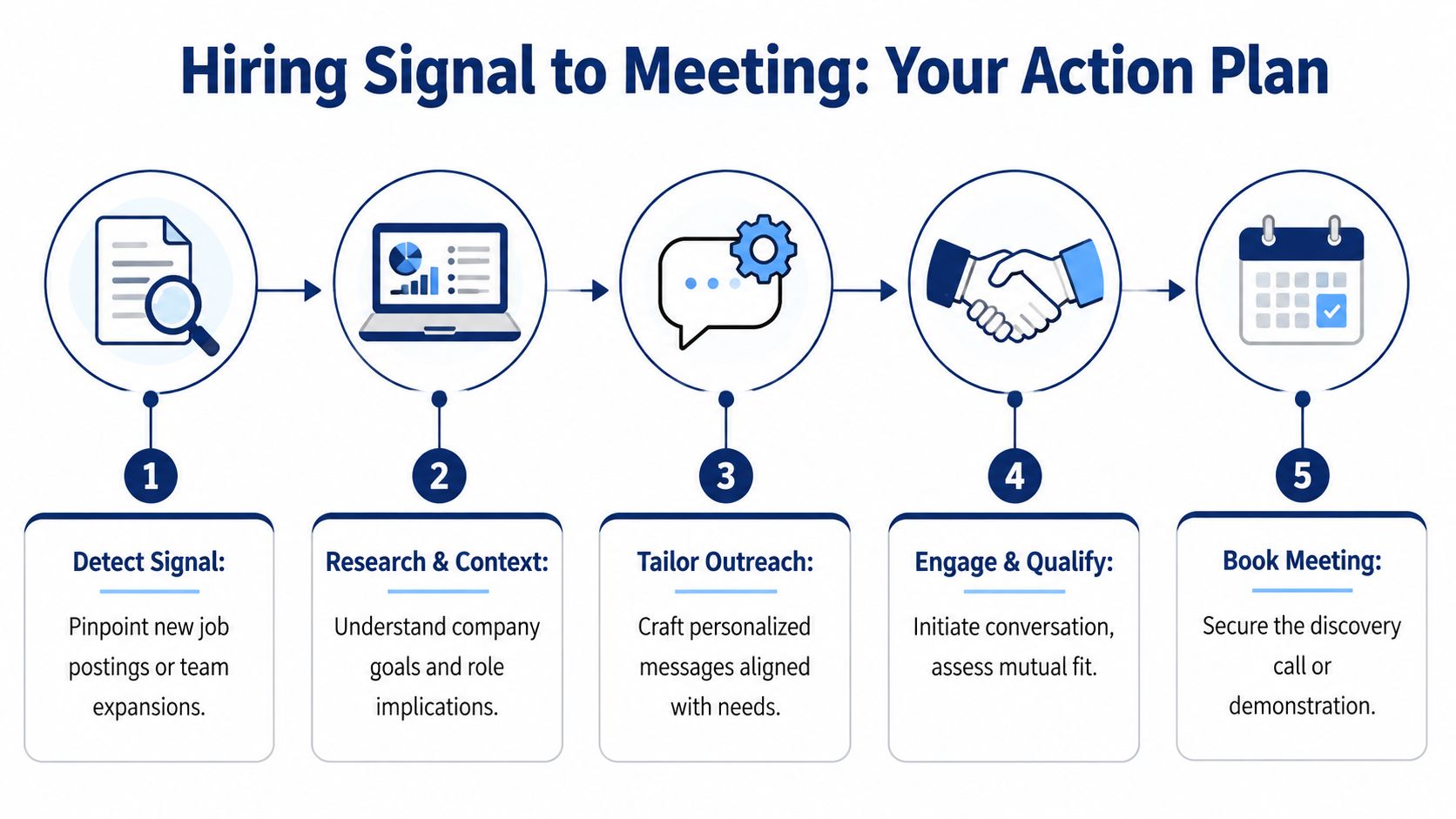
Step one, validate the business event behind the hiring
Start by checking whether the hiring surge stands alone or follows a bigger trigger.
High-conversion buying signals like funding events or major contract wins almost always trigger hiring mandates that overwhelm internal teams, with hiring needs peaking 60-90 days after the event, according to this staffing signal analysis. If your prospect just raised money, won a major account, or entered a new region, the hiring surge has a clear business explanation and a clearer reason to engage now.
That matters because your message gets stronger when you reference both the initiative and the staffing consequence.
Step two, map the roles to likely pain
Don't email based on titles alone. Translate the hiring pattern into operational friction.
If they posted SDR roles, likely pain points include:
- territory and account assignment
- prospect data quality
- rep ramp consistency
- sequence execution
- reporting on outbound efficiency
If they posted engineering roles, likely pain points include:
- developer environment setup
- infrastructure scaling
- delivery coordination
- testing and observability
- security and compliance support
If they posted compliance roles, likely pain points include:
- documentation sprawl
- audit preparation
- policy enforcement
- cross-functional process alignment
This step is what separates informed outreach from lazy relevance.
Step three, write to the initiative, not the job post
Most hiring-based emails fail because they sound like they came from someone skimming a job board.
Use this structure instead:
-
Observed signal
Mention the specific hiring pattern. -
Business interpretation
State what that usually means operationally. -
Relevant problem
Point to the bottleneck that tends to follow. -
Reason for talking
Offer a focused conversation, not a generic demo.
Here are three practical templates.
Template for sales hiring
Saw your team is adding several SDR roles. That usually means outbound coverage is expanding fast, and the next issue becomes rep ramp, account selection, and data quality. We work with teams that want new reps productive quickly without adding process chaos. Worth comparing notes on how you're handling that buildout?
Template for engineering hiring
Noticed the recent engineering hiring across platform and data roles. That usually points to a larger product or infrastructure push, and those initiatives often expose gaps in tooling and implementation bandwidth. If that's on your plate, I can share how teams approach the rollout without slowing delivery.
Template for compliance hiring
I saw the increase in compliance-related roles. That often shows up when governance work becomes urgent across systems, workflows, and documentation. If you're tightening controls while still trying to move quickly, I'd be happy to trade notes on where teams usually hit friction first.
Use the hiring signal to earn the first reply. Use the business problem to earn the meeting.
Step four, move fast and keep the cadence tight
Fresh signals lose value when reps sit on them.
A simple outreach rhythm works well:
- Day one: Personalized email tied to the hiring pattern
- Day two or three: LinkedIn touch referencing the same initiative in shorter form
- Day four or five: Follow-up email with one sharper operational angle
- Later that week: Call or voicemail if the role cluster is strong and the account fits well
- Following week: Final touch with a useful observation or question, not a generic bump
That timeline matters even more when hiring is paired with other triggers. This guide to sales trigger events is useful if you want your team to standardize which events deserve immediate outreach and which belong in nurture.
Step five, route the work so reps actually do it
Many organizations do not require additional signals. They instead need fewer manual steps.
The cleanest workflow is:
- alert lands in Slack, email, or CRM
- account owner sees the hiring summary
- context includes department, likely initiative, and related trigger events
- task is created automatically
- first-draft message is ready for review
That's how you stop signal-based prospecting from turning into “research theater.” The rep should spend time tightening the point of view, not hunting through LinkedIn tabs.
Measuring the Impact on Your Pipeline
If you want this motion to last, measure it like a system, not like a campaign.

The first mistake is judging success only by meetings booked. That's a lagging outcome. You also need leading indicators that show whether reps are reading signals well and acting on them correctly.
What to track first
Use a balanced scorecard with both leading and lagging metrics.
Leading indicators
- Time to first touch: How quickly the rep acted after the hiring signal appeared
- Reply quality: Whether responses mention the initiative, role expansion, or current project
- Message relevance by department: Which department-specific plays get better engagement
- Signal coverage: How many qualified hiring patterns actually received action
Lagging indicators
- Meetings booked from signal-led outreach
- Pipeline created from accounts with hiring-based triggers
- Stage progression for signal-sourced opportunities
- Sales cycle quality by signal cluster
A useful benchmark for program quality is whether clustered signals outperform isolated hiring alerts inside your own funnel.
Don't overvalue public volume
There's an important trap here. A critical mistake is chasing all public hiring surges while ignoring the mismatch where 84% of recruitment leaders expect growth but only 47% of companies plan to hire. That creates a hidden hiring crisis where non-posting triggers can matter more than job board volume alone.
So when you review pipeline impact, separate:
- public hiring surges with no supporting business context
- hiring surges tied to funding, leadership change, or expansion
- non-posting triggers that correctly predicted later hiring
That view will tell you whether your team is chasing noise or identifying genuine demand.
For managers tightening the rest of the funnel, this guide on how to increase B2B conversion rates is worth reading because the same discipline applies here. Better timing and tighter relevance usually beat sheer activity.
A practical internal dashboard should also connect hiring-signal outreach to standard sales pipeline metrics so leaders can compare this motion against territory-based outbound, inbound follow-up, and partner-sourced opportunities.
Stop Guessing Start Selling with Signals
Most prospecting fails because the rep has no real reason to reach out now.
Hiring fixes that. It gives you timing, direction, and a plausible business problem in one signal. Not perfectly. Not in isolation. But far more reliably than random account selection or generic firmographic targeting.
The working model is simple. Find the hiring pattern. Interpret the business initiative behind it. Act with a message tied to the actual pressure that hiring creates.
Teams that do this well stop sounding like vendors reacting to public news. They sound like people who understand what the company is trying to get done.
That is the advantage of using hiring surge as buying signal. You stop guessing which accounts might care and start prioritizing accounts that are already changing.
If you want to operationalize this without making reps live in job boards and spreadsheets, take a look at Salesmotion. It monitors hiring and other account signals, adds the business context, and helps teams turn those triggers into timely outreach that can create pipeline.