The life sciences sector spans far more than drug-stage biotechs. It includes contract research organizations managing $86 billion in outsourced trial work, medtech companies navigating 3,200 annual FDA 510(k) clearances, diagnostics firms in a $100 billion IVD market, and the big pharma companies tying it all together. For B2B sales teams, each sub-sector generates its own distinct buying signals, and the teams that understand those differences close deals while generalist competitors chase the wrong triggers.
TL;DR: Life sciences buying signals vary dramatically across pharma, CROs, medtech, and diagnostics. This guide covers sub-sector-specific signals, from CRO outsourcing shifts and clinical trial phase transitions to medtech GPO procurement cycles and IVD laboratory consolidation, along with the context for why each signal matters and how to act on it.
Why Life Sciences Requires Sub-Sector Signal Intelligence
Most guides to life sciences buying signals treat the industry as a monolith: list clinical trial milestones, mention FDA approvals, and call it a day. That approach works for biotech-specific selling (we cover that in our biotech buying signals post). But life sciences is far broader. A pharma company entering Phase III will spend heavily on CRO partnerships over a multi-year timeline. A medtech company that just received a 510(k) clearance needs to win group purchasing organization (GPO) contracts within months. A diagnostics company consolidating laboratory operations buys based on reagent economics and managed-service contracts, not trial milestones at all.
According to Deloitte's 2026 life sciences outlook, 51% of medtech leaders and 45% of biopharma leaders rank M&A as a top near-term strategic priority. And 93% of pharma and biotech executives plan to increase spending on data, digital, and AI, according to ZS's 2025 survey. These macro trends generate buying signals, but the specific signals differ by sub-sector. Teams that understand those differences engage accounts with precision.
The sections below cover four categories: pharma and pipeline signals, CRO-specific signals, medtech procurement signals, and diagnostics-specific signals. Each includes the signal, why it matters, and how to act on it.
Pharma and Pipeline Signals
These signals apply broadly to pharmaceutical and biopharmaceutical companies with active drug pipelines. If you are selling specifically into clinical-stage biotech, our biotech buying signals post covers those triggers in greater depth. The signals below focus on larger pharma dynamics.
PDUFA Dates and FDA Decisions
PDUFA dates are published months in advance and mark the exact date the FDA will act on a drug application. Why it matters: Approval unlocks commercial launch budgets (sales force expansion, analytics platforms, market access tools). Rejection redirects spending toward regulatory strategy and pipeline reprioritization. Either way, vendor evaluations happen in the 3-6 months before the date. How to act: Build a PDUFA calendar for your territory. Initiate outreach 4-5 months before the target date, positioning your solution for whichever outcome occurs.
Earnings Call Language
Quarterly earnings calls contain explicit purchase intent. When a CEO says "we are investing in commercial infrastructure" or "we are consolidating our vendor landscape," that is a direct statement about upcoming budget allocation. Why it matters: These statements tell you not just that spending is coming, but in which direction. "Consolidation" means incumbent vendors are at risk. "Investment" means new budget is opening. How to act: Search earnings transcripts for keywords: "digital transformation," "vendor consolidation," "commercial launch," "operational efficiency," and "AI." Platforms like Salesmotion surface these earnings mentions automatically in account briefs alongside hiring data and news, so reps see the full picture without reading every transcript.
Patent Cliff Pressure
The upcoming wave of patent expirations is one of the most consequential macro signals in pharma. Companies facing generic competition on blockbuster drugs must either fill the pipeline gap through R&D, acquire assets through M&A, or optimize operations to protect margins. Why it matters: Each response creates different buying opportunities. Pipeline investment drives CRO partnerships and clinical technology purchases. M&A drives integration projects and IT consolidation. Operational optimization drives analytics, automation, and digital transformation spending. How to act: Track patent expiration dates for your target accounts' top revenue-generating drugs. When a major patent expires within 24 months, the company is already making strategic decisions about how to respond.
Conference Presentations and Strategic Priorities
Major conferences (JPM Healthcare Conference in January, ASCO, ASH, AACR, BIO) reveal strategic direction. Investor presentations at JPM are particularly valuable because they outline the year's priorities explicitly. Why it matters: Conference presentations signal which therapeutic areas, geographic markets, and operational investments a company is prioritizing. How to act: Track which accounts are presenting, note strategic themes, and use those themes to personalize outreach within the following 2-3 weeks while priorities are fresh.

“The AI templates were a surprise delight. We expected the data, but the pre-built email suggestions turned out to be much better than expected and a huge help, especially for newer reps.”
Sabina Malochleb-Bazaud
Senior Sales Operations Administrator, Cytel
CRO-Specific Signals
Contract research organizations represent an approximately $86 billion market growing at 8.3% annually, with nearly three out of every four clinical trials now conducted by CROs. Selling into CROs or competing against them requires understanding their unique buying triggers.
Clinical Trial Phase Transitions (CRO Impact)
When a sponsor advances a drug from Phase II to Phase III, the CRO managing that trial faces a step-change in operational complexity: expanded site networks, larger monitoring teams, and new technology platforms. Why it matters: The CRO itself becomes a buyer during phase transitions, needing EDC systems, clinical trial management software, site monitoring tools, and biostatistics capacity. How to act: Track phase transitions on ClinicalTrials.gov not just for sponsors but for which CROs are listed as collaborators. A CRO managing multiple Phase III transitions simultaneously is under capacity pressure and more likely to invest in technology.
Regulatory Milestone Pressure
CROs face unique regulatory pressure points. When the FDA issues new guidance (such as the recent frameworks around decentralized clinical trials and real-world evidence), CROs must update their processes, train their staff, and often invest in new technology to stay compliant. Why it matters: Regulatory changes create compliance-driven buying that CROs cannot defer. The shift toward decentralized clinical trials, for example, has driven CRO investment in remote monitoring, e-consent platforms, and home health nursing networks. How to act: Monitor FDA guidance documents from the FDA and ICH. When new guidance drops, identify which CROs have the most exposure to the affected trial types and reach out within weeks, before they finalize vendor evaluations.
Outsourcing Model Shifts
The industry is moving away from traditional full-service CRO models toward hybrid outsourcing and Functional Service Provider (FSP) arrangements. FSP models, where sponsors outsource specific functions like biostatistics or monitoring while retaining others in-house, are growing at a 10.4% CAGR. Why it matters: This shift creates buying opportunities on both sides. CROs investing in FSP capabilities need specialized technology for distributed team management. Sponsors transitioning to hybrid models need oversight tools and vendor management platforms. How to act: Watch for CRO announcements about new service models, FSP practice launches, or strategic partnerships. These are explicit signals that the organization is investing in new capabilities and evaluating supporting technology.
Emerging Biopharma Client Growth
Emerging biopharma companies (EBPs) now account for 63% of clinical trial starts, up from 56% in 2019, and many outsource their entire clinical development to CROs. Why it matters: CROs winning EBP business need technology that supports smaller, more numerous client engagements rather than a few large pharma relationships, creating demand for portfolio management tools and scalable infrastructure. How to act: Track which CROs are winning EBP partnerships through press releases and ClinicalTrials.gov sponsor-collaborator pairings.
Medtech Procurement Signals
The medtech market exceeds $580 billion globally, but its procurement model differs fundamentally from pharma. Medtech buying is driven by FDA clearance timelines, GPO contract cycles, hospital capital budgets, and reimbursement decisions rather than clinical trial milestones.
FDA 510(k) Clearances
The FDA clears roughly 3,200 510(k) submissions per year. A clearance means a medtech company can legally market its device and will immediately shift to commercialization. Why it matters: Post-clearance, companies need sales enablement tools, market access support, health economics data, and distribution partnerships. Companies with newly cleared devices are in active buying mode. How to act: Monitor the FDA's 510(k) clearance database quarterly. Initiate outreach within 30 days of clearance. The commercial window is shorter than pharma because devices launch much faster than drugs.
Group Purchasing Organization (GPO) Contract Cycles
GPOs aggregate the purchasing power of hospitals and health systems, and most medtech procurement flows through GPO contracts. These contracts follow predictable renewal cycles, typically every 2-3 years. Why it matters: When a GPO contract is up for renewal, both the incumbent and challengers enter a competitive evaluation period. Medtech companies preparing to bid on GPO contracts need pricing analytics, competitive intelligence, and value demonstration tools. How to act: Track GPO contract timelines for your target accounts. Major GPOs like Vizient, Premier, and HealthTrust publish contract award schedules. The 6-12 months before a contract renewal is the peak window for vendor engagement.
Hospital Capital Budget Cycles
Most hospitals operate on fiscal years beginning in July or October, with capital equipment budgets finalized 3-4 months before the fiscal year starts. Why it matters: When a health system announces a capital expansion or new facility, every medtech company in their supply chain enters an evaluation period. How to act: Track hospital facility announcements and bond issuances (which fund capital purchases). A health system posting biomedical engineering or procurement roles is likely preparing for a capital cycle.
Reimbursement Decisions
When CMS or private payers issue new reimbursement codes or adjust payment rates for specific procedures, it directly affects medtech demand. A new CPT code for a minimally invasive procedure increases adoption of the devices used in that procedure. Why it matters: Reimbursement is the gatekeeper for medtech adoption. No code, no volume. A favorable reimbursement decision can turn a slow-selling device category into a high-growth market within a single year. How to act: Monitor CMS reimbursement updates, particularly the annual Physician Fee Schedule and Hospital Outpatient Prospective Payment System updates. When favorable coding changes occur, medtech companies in the affected category become active buyers of commercial and market access support.

“All of the vendors that I've worked with, all of the onboarding that I have had to deal with, I will say, hands down, Salesmotion was the easiest that I have had.”
Lyndsay Thomson
Head of Sales Operations, Cytel
Diagnostics-Specific Signals
The in-vitro diagnostics market alone is valued at approximately $100 billion in 2025, and the buying dynamics in diagnostics differ substantially from both pharma and medtech.
Laboratory Consolidation and Automation
Diagnostics laboratories are consolidating at an accelerating pace, driven by workforce shortages and cost pressure. The IVD market saw more than 60 M&A transactions in the past year alone. Why it matters: When two laboratory networks merge, they need to standardize on common platforms for laboratory information systems (LIS), instrument fleets, and reagent supply chains, creating a buying window for multi-site management and workflow integration technology. How to act: Track M&A activity among reference labs and hospital laboratory networks. Within 6-12 months of an acquisition, the combined entity will be evaluating technology standardization.
Managed-Service Contract Shifts
Diagnostics procurement is shifting from capital equipment purchases toward managed-service contracts that bundle instruments, reagents, maintenance, and digital tools into multi-year agreements. Why it matters: Diagnostics companies increasingly evaluate vendors on service breadth, not just product specs. Vendors offering total lifetime value propositions win over those selling hardware alone. How to act: When a diagnostics company announces a managed-service program or restructures its commercial model, they are actively building new vendor partnerships. Track these announcements in press releases and industry publications.
Regulatory Pressure on Laboratory-Developed Tests (LDTs)
The FDA's evolving framework for regulating laboratory-developed tests creates significant compliance-driven buying. Estimated compliance costs exceed $3.5 billion across the industry. Why it matters: Smaller diagnostics companies and hospital labs developing their own tests face new regulatory requirements they have never had to manage before. This drives demand for regulatory affairs consulting, quality management systems, submission preparation tools, and compliance software. How to act: Monitor FDA announcements about LDT regulation. Identify labs and diagnostics companies that rely heavily on laboratory-developed tests (often specialty and reference labs) and engage them as regulatory deadlines approach.
Point-of-Care and Home Testing Expansion
Point-of-care and home testing is the fastest-growing IVD segment, expanding at over 9% CAGR. Why it matters: Companies entering this market need distribution networks, consumer marketing capabilities, and digital health platforms that differ from traditional lab-based diagnostics. How to act: Track FDA clearances for at-home and point-of-care devices. Companies receiving these clearances are building new commercial capabilities and evaluating vendors.
Cross-Sector Signals That Apply Everywhere
Some buying signals transcend sub-sector boundaries but require sub-sector context to be actionable.
Leadership changes are high-value signals everywhere in life sciences, but their meaning differs. A new CTO at a CRO might signal a shift toward decentralized trial technology. A new CCO at a medtech company might signal a GPO strategy overhaul. A new CIO at a diagnostics firm might signal laboratory automation investment. The 6-12 month window after a leadership change is the highest-probability period for winning new business. Platforms like Salesmotion track these changes alongside account intelligence context so your team understands the "why" behind the hire.
M&A activity is especially frequent in life sciences. Acquisitions create integration buying (IT consolidation, compliance harmonization, commercial team restructuring). Divestitures create new standalone companies that need their own technology stacks from scratch. Track announcements from SEC filings, press releases, and BioPharma Dive.
AI and digital transformation investment is accelerating across the board. According to Gartner, inquiries about multi-agent AI systems surged 1,445% between Q1 2024 and Q2 2025. When a life sciences company names a Chief Digital Officer or Chief AI Officer, that signals a transformation budget has been allocated and vendor evaluations are underway.
Facility expansions signal growth in every sub-sector. A pharma company building a biologics facility needs process analytics and quality systems. A CRO opening a new clinical operations center needs trial management platforms. A diagnostics company building a new reference lab needs instruments and LIS infrastructure. These are high-value signals because the procurement cycle for build-outs is long, giving sales teams months to engage.
How to Operationalize Life Sciences Buying Signals
Knowing which signals matter is only half the problem. Operationalizing them requires three capabilities:
1. Centralized signal capture. Signals come from ClinicalTrials.gov, the FDA 510(k) database, SEC filings, GPO contract schedules, press releases, job boards, and earnings transcripts. No rep can monitor all of these manually. You need a system that aggregates signals into a single feed tied to your target accounts.
2. Contextual enrichment. A raw signal ("Company X received 510(k) clearance") is less useful than an enriched signal that adds the company's 3 open commercial roles, their new CCO's background, and their earnings call mention of launching into the cardiology market. Context turns a headline into an account intelligence briefing.
3. Workflow integration. Signals must reach reps where they work. Integration into Salesforce, HubSpot, or email workflows ensures signals trigger action, not just awareness.
Teams using Salesmotion for life sciences accounts consolidate these steps into one platform. Signals from earnings calls, leadership changes, clinical trials, regulatory events, and hiring surges flow into account briefs that update automatically and sync to the CRM.
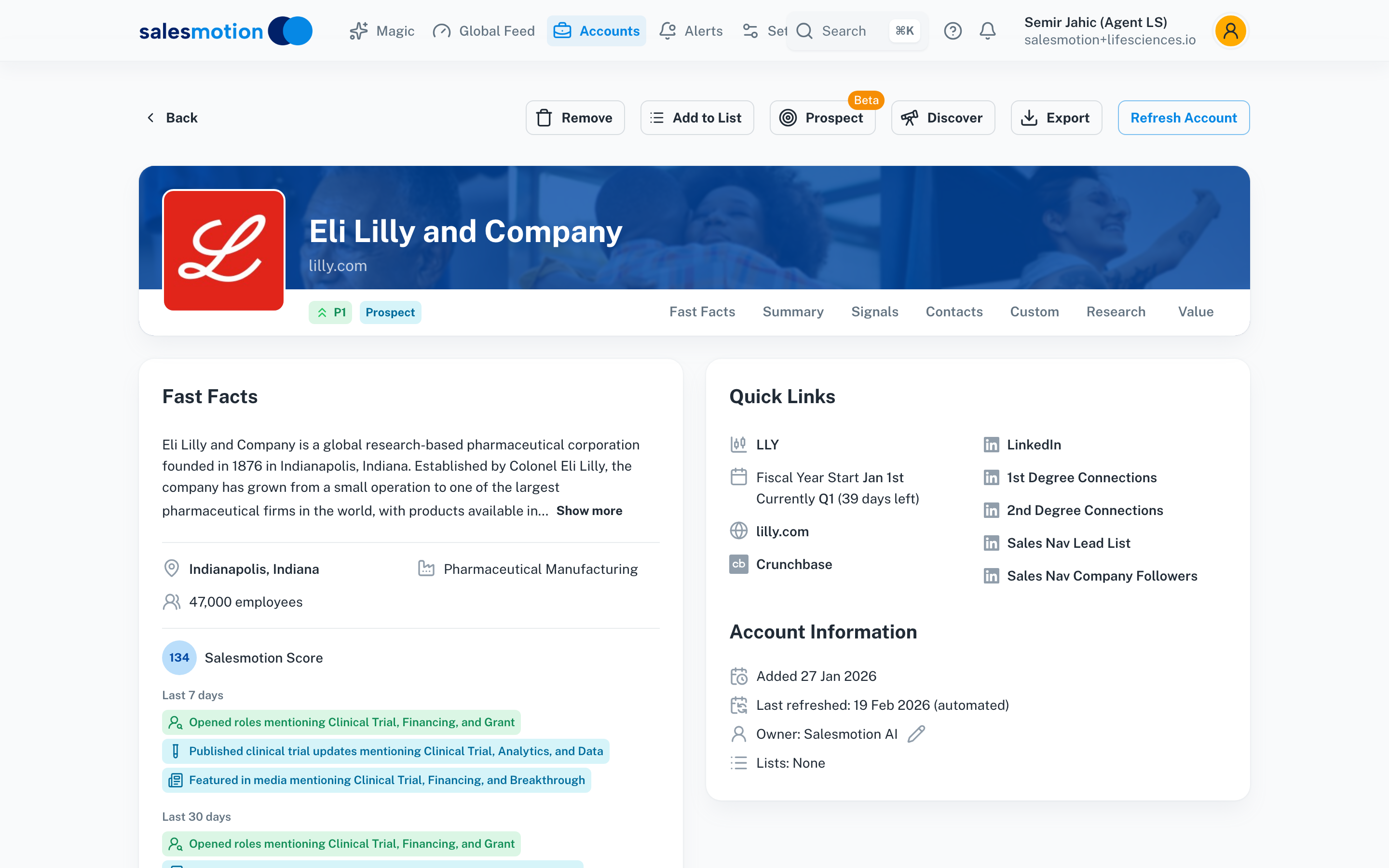 Salesmotion's Global Feed filtered to Clinical Trials — reps see new trial activity across their entire life sciences territory at a glance, with signal counts per account and direct links to source data.
Signal-Based Workflows in Practice
Pharma example: Salesmotion flags that a mid-cap pharma company reported positive Phase III data at a medical conference and posted a VP of Commercial Analytics role last week. The account brief auto-updates with the trial result, hiring data, and earnings call context (mentioning "building commercial readiness for a potential 2027 launch"). The rep reaches out to the VP of Commercial Operations referencing the Phase III readout and the company's stated analytics investment. The first meeting becomes a strategic conversation about launch readiness rather than a cold product pitch.
Diagnostics example: Salesmotion flags that a mid-size reference laboratory acquired a regional lab network, now operating in 12 states. Hiring data shows 4 open quality assurance roles. The rep reaches out to the VP of Quality, referencing the acquisition and the compliance challenges of multi-state operations under evolving LDT regulations. The conversation is immediately relevant because the lab is standardizing processes across the newly combined organization.
CRO example: Salesmotion surfaces that a CRO has been listed as collaborator on three new Phase III trials within 60 days. Hiring data shows a surge in clinical research associate postings. The rep contacts the VP of Clinical Operations, positioning their data platform as infrastructure for scaling trial operations without proportional headcount growth. The timing aligns with a capacity crunch the CRO is actively experiencing.
This is the difference between signal-based selling and traditional territory management. The signal creates the timing. The context creates the relevance. The workflow creates the action.
Connecting Signals to Your Life Sciences Sales Strategy
Life sciences buying signals are only as valuable as the strategy they feed. Here are three ways to connect signal tracking to pipeline generation:
Tier accounts by signal density and sub-sector. Rank accounts by signal activity: those with multiple recent signals should be top priority. Weight signals by sub-sector relevance. A 510(k) clearance is a stronger signal for a medtech account than a Phase III transition is for a diagnostics company. This aligns with account-based selling best practices.
Build sub-sector-specific plays. An FDA approval triggers a "commercial readiness" play for pharma. A 510(k) clearance triggers a "market access" play for medtech. A laboratory acquisition triggers an "integration readiness" play for diagnostics. A new Phase III collaboration triggers a "capacity scaling" play for CROs. Standardizing these plays makes signal-based selling repeatable.
Brief the team weekly by sub-sector. A 15-minute weekly signal review keeps everyone aligned. Organize by sub-sector so CRO-focused reps hear CRO signals and medtech reps hear medtech signals. Assign ownership and track outcomes.
For a deeper look at how signal-driven sales intelligence applies to life sciences, explore our sales intelligence for life sciences page, which covers the specific workflows and use cases for pharma, biotech, and CRO selling.
Key Takeaways
- Life sciences is not a monolith. CROs, medtech companies, diagnostics firms, and pharma each generate distinct buying signals tied to their unique regulatory, procurement, and commercial timelines.
- CRO-specific signals include clinical trial phase transitions (which create capacity pressure), regulatory guidance changes (which drive compliance buying), outsourcing model shifts toward FSP arrangements, and emerging biopharma client growth.
- Medtech procurement follows GPO contract cycles, hospital capital budgets, 510(k) clearance timelines, and reimbursement decisions, not the clinical trial milestones that dominate pharma selling.
- Diagnostics buying signals center on laboratory consolidation, managed-service contract shifts, LDT regulatory pressure, and point-of-care expansion, each creating distinct vendor evaluation windows.
- Cross-sector signals like leadership changes, M&A activity, AI investment, and facility expansions apply everywhere but require sub-sector context to be actionable. A new CTO at a CRO means something different than a new CTO at a diagnostics company.
- Operationalizing signals requires centralized capture, contextual enrichment, and CRM integration. Manual monitoring across ClinicalTrials.gov, FDA databases, GPO schedules, and earnings transcripts does not scale.
Frequently Asked Questions
What are the most important buying signals in life sciences sales?
The highest-value signals depend on the sub-sector. For pharma, track PDUFA dates, Phase III transitions, and patent cliff exposure. For CROs, track clinical trial phase transitions, regulatory guidance changes, and outsourcing model shifts. For medtech, track 510(k) clearances, GPO contract cycles, and reimbursement decisions. For diagnostics, track laboratory consolidation, LDT regulatory changes, and point-of-care expansion. Cross-sector signals like leadership changes and M&A announcements apply everywhere.
How do CRO buying signals differ from pharma buying signals?
CROs are service providers whose buying patterns are driven by their clients' milestones rather than their own pipelines. When a sponsor advances a drug to Phase III, the CRO managing that trial faces operational scaling pressure that drives technology purchases. CROs also respond to regulatory guidance changes, outsourcing model shifts (FSP vs. full-service), and emerging biopharma client growth. Pharma signals center on pipeline milestones, commercial launches, and patent cliff responses.
What signals indicate medtech procurement readiness?
The strongest medtech signals are FDA 510(k) clearances (triggering commercialization), GPO contract renewal cycles (creating evaluation periods every 2-3 years), hospital capital budget timelines (finalized 3-4 months before fiscal year start), and CMS reimbursement decisions (directly affecting device adoption). A sales intelligence platform that tracks these medtech-specific triggers gives teams a significant advantage over competitors using generic intent data.
How can sales teams track life sciences buying signals at scale?
Manual monitoring of FDA databases, ClinicalTrials.gov, GPO schedules, SEC filings, and earnings transcripts is not feasible for a territory spanning multiple sub-sectors. Teams need a platform that aggregates signals automatically, enriches them with account context, and delivers alerts to the CRM. Salesmotion consolidates clinical, financial, organizational, and regulatory signals into enriched account briefs that update automatically.
Why do leadership changes matter so much in life sciences?
Life sciences organizations have high organizational inertia. New executives bring new strategies, new vendor preferences, and new budgets. Critically, the meaning varies by sub-sector: a new CTO at a CRO may signal decentralized trial technology adoption, while a new CTO at a diagnostics company may signal laboratory automation investment. These transitions create a 6-12 month window where new vendors have the best chance of winning business, which is why tracking buying signals tied to executive movement is critical.