Most sales teams pick a qualification framework the way they pick a CRM theme: someone senior says "we're doing MEDDIC now," and reps nod along without understanding the trade-offs. The result is a framework that lives in training decks but dies in pipeline reviews. According to Ebsta's research, MEDDPICC adoption among high-performing sales teams doubled from 11% to 21% between 2021 and 2022, yet most teams still struggle to answer a basic question: should we use MEDDIC or MEDDPICC, and what's actually different beyond two extra letters?
TL;DR: MEDDIC covers six core qualification criteria (Metrics, Economic Buyer, Decision Criteria, Decision Process, Identify Pain, Champion) and works well for teams new to structured selling or with shorter cycles. MEDDPICC adds Paper Process and Competition, making it the best sales methodology for big deals with complex procurement and crowded competitive landscapes. The real question isn't which framework to pick, but whether your team can actually execute it consistently at scale.
What MEDDIC and MEDDPICC Actually Stand For
MEDDIC was developed in the 1990s at Parametric Technology Corporation (PTC), where it helped the company hit revenue targets for over 40 consecutive quarters. The framework breaks complex deal qualification into six elements that force reps to understand the buyer's world before forecasting a close date.
MEDDIC:
- Metrics: The quantifiable outcomes your solution delivers. Not your metrics, the buyer's.
- Economic Buyer: The person who can say yes when everyone else says no. Not the project sponsor, the budget holder.
- Decision Criteria: What the buyer will evaluate solutions against. Technical requirements, business outcomes, vendor stability, integration capability.
- Decision Process: The actual steps from "we're interested" to signed contract. Who approves what, in what order, with what timeline.
- Identify Pain: The specific business problem driving urgency. Not a general challenge, the pain that makes the status quo unacceptable.
- Champion: Your internal advocate who has power, influence, and a personal stake in your solution winning.
MEDDPICC adds two elements:
- Paper Process: The legal, procurement, and administrative path to a signed contract. Security reviews, vendor onboarding, legal redlines, MSA negotiations.
- Competition: Who else is in the deal, what their strengths are, and how to position against them.
These two additions reflect how enterprise buying has changed since the 1990s. Decision-making committees have expanded from 3-5 stakeholders to 8-12. Procurement teams now run parallel evaluation processes. And in most B2B categories, buyers evaluate 3-5 vendors simultaneously.
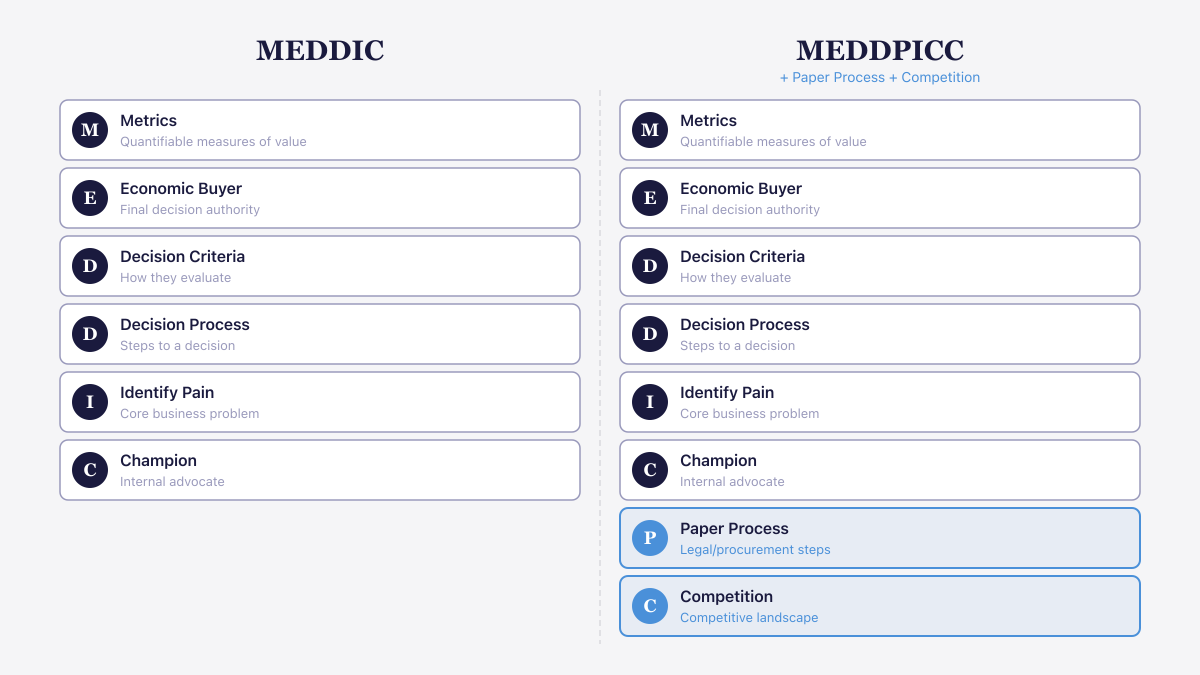 MEDDIC covers six core qualification criteria. MEDDPICC adds Paper Process and Competition for complex enterprise deals.
See Salesmotion on a real account
Book a 15-minute demo and see how your team saves hours on account research.
Why the Extra "P" and "C" Matter More Than You Think
The gap between MEDDIC and MEDDPICC isn't theoretical. It shows up in two specific places where enterprise deals die.
Paper Process: Where 30% of "Won" Deals Go to Die
Ask any enterprise AE about their worst quarter, and they'll tell you about the deal that was "verbal yes" in week 10 of a 12-week quarter and then spent 8 more weeks in legal review. The Paper Process element forces reps to map procurement timelines before they commit a close date to their forecast.
This means understanding: Does the buyer need a security review? How long does their MSA process take? Is there a vendor onboarding requirement? Do they need board approval above a certain threshold? Who has signature authority?
Teams that track Paper Process consistently report forecast accuracy improvements from 60-70% to 85% or higher. That's not because the deals are better qualified. It's because the close dates are actually based on procurement reality, not rep optimism.
Competition: The Element That Changes Your Positioning
MEDDIC assumes your champion will tell you about competitive threats. They often won't, either because they don't know the full picture or because they're using competitive pressure as leverage. The Competition element in MEDDPICC makes competitive intelligence a first-class qualification criterion, not an afterthought.
This means mapping: Which alternatives is the buyer evaluating? What are those competitors' strengths? Where does your solution have clear differentiation? What narrative is the competition pushing, and how do you counter it?
In crowded categories like sales intelligence, where buyers might evaluate ZoomInfo, Apollo, and three other vendors alongside you, understanding the competitive landscape before your demo shapes your entire positioning strategy.

“Salesmotion empowers me to cultivate a great buyer experience. I'm able to challenge prospects' thinking and be a trusted consultative seller. A major part of this is Salesmotion insights.”
Austin Friesen
Account Executive, FY25 #1 President's Club, Clari
When MEDDIC Is the Right Choice
MEDDIC isn't the junior version of MEDDPICC. It's the right framework for specific selling environments.
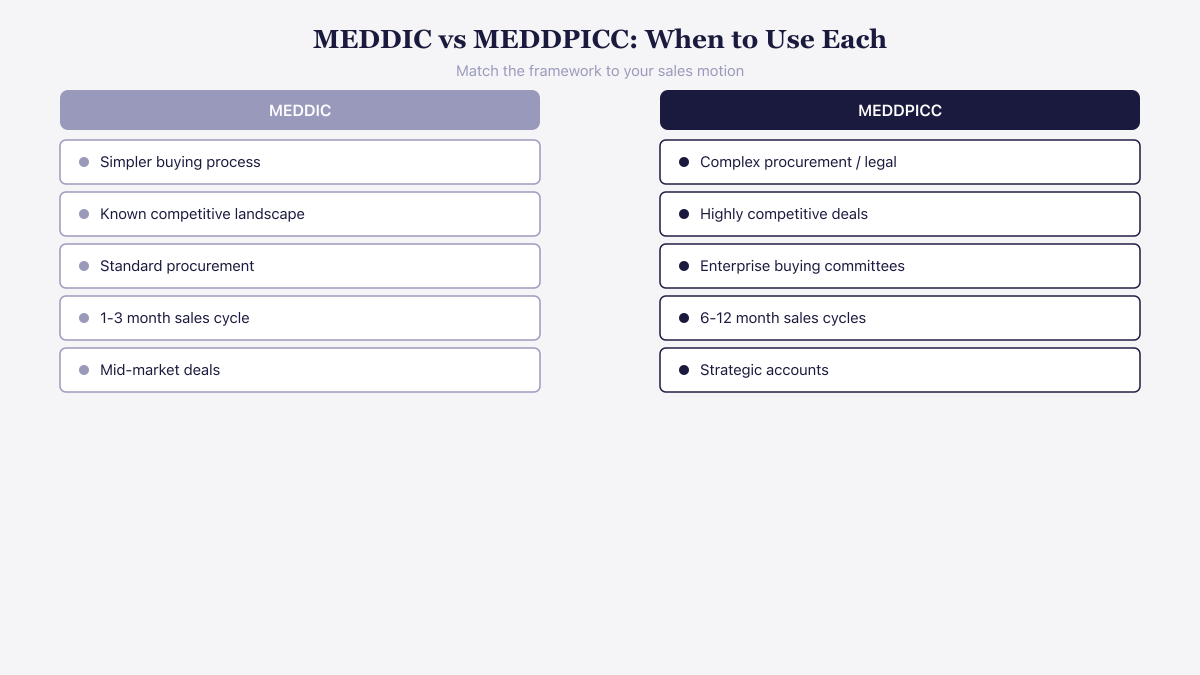 Use MEDDIC for mid-market deals and MEDDPICC when procurement and competition are deciding factors.
Choose MEDDIC when:
- Your team is new to structured qualification. Six elements are hard enough to master. Adding two more before reps have internalized the core framework leads to checkbox compliance, not genuine qualification discipline.
- Sales cycles are under 90 days. Shorter cycles often mean simpler procurement. If your buyer can sign a contract without a 6-week legal review, the Paper Process element adds overhead without value.
- You're selling a new category. When there are no established competitors, the Competition element is less relevant. Your real competition is the status quo and internal priorities, which the Identify Pain and Champion elements already address.
- Average deal sizes are under $50K. Smaller deals typically have simpler decision processes and fewer procurement hurdles.
According to MEDDIC Academy, 73% of SaaS companies selling solutions above $100K ARR use some version of MEDDIC. But many of those started with the core six and graduated to MEDDPICC as their deals grew more complex.
When MEDDPICC Is the Enterprise Standard
MEDDPICC has become the default qualification framework for enterprise sales teams, and for good reason. Companies using MEDDPICC report average win rate increases of 20-30%, with high-performing implementations seeing even stronger results.
Choose MEDDPICC when:
- Deals regularly stall in procurement. If contracts take 4-8 weeks to move through legal, security review, and vendor onboarding, you need Paper Process discipline.
- You're in a competitive market. Any category with 3+ viable alternatives requires explicit competitive tracking. This includes account intelligence, CRM, sales engagement, revenue intelligence, and most enterprise SaaS.
- Buying committees have 5+ stakeholders. The more people involved, the more likely someone introduces a competitor late in the process or procurement adds requirements your champion didn't anticipate.
- Deal sizes exceed $100K. Larger deals trigger more scrutiny, longer review cycles, and formal procurement processes.
The data supports this. According to MEDDIC Academy, companies implementing MEDDPICC see an average 40% decrease in sales cycle length and a 35% increase in deal size, primarily because reps stop wasting time on deals that were never going to close on the timeline they forecasted.

“We're no longer fishing. We know who the right customers are, and we can qualify them quickly. Salesmotion has had a direct impact on pipeline quality.”
Andrew Giordano
VP of Global Commercial Operations, Analytic Partners
Why Both Frameworks Break at Scale (And What to Do About It)
Here's what the MEDDIC vs MEDDPICC debate misses entirely: the framework you pick matters less than whether your team can execute it consistently across 50, 100, or 500 active opportunities.
The hard truth about qualification frameworks:
- Reps don't update qualification fields after every call. By mid-quarter, your CRM data reflects what reps entered in week one, not what's actually happening in the deal.
- Champion status changes without warning. Your champion gets promoted, moves to a different division, or loses political capital. If you're not monitoring stakeholder changes, you find out when the deal stalls.
- Decision criteria shift mid-cycle. A new VP joins and adds requirements your original champion never mentioned. A competitor demo introduces a criterion you didn't anticipate.
- Paper Process timelines are guesses until you've mapped them. And the mapping requires intelligence about the buyer's procurement history, not just what your contact tells you.
- Competitive intelligence goes stale. The landscape you mapped in month one may not reflect the reality in month four.
The spreadsheet approach to MEDDIC or MEDDPICC works for 10 accounts. It collapses at 50+. The framework itself is sound. The execution layer is what fails.
This is where account intelligence changes the equation. When signals like leadership changes, new strategic initiatives, competitive moves, and procurement activity are monitored automatically, the data that powers MEDDIC and MEDDPICC stays current without requiring reps to manually research every account every week.
For example, Salesmotion monitors over 1,000 sources to surface the signals that directly map to MEDDIC elements: executive changes (Economic Buyer), strategic initiative announcements (Decision Criteria), hiring patterns (Identify Pain), and competitive moves (Competition). Teams like Frontify saw a 35% increase in win rates and a 31% reduction in sales cycle length after layering automated account intelligence on top of their qualification framework.
MEDDPICC + Signals in Practice: A Workflow Example
Here's how MEDDPICC actually works when backed by real-time intelligence instead of manual research.
Trigger: A target account posts a VP of Revenue Operations role on LinkedIn while simultaneously mentioning "sales process transformation" in their latest earnings call.
What the platform surfaces: Salesmotion flags the account with two converging signals. The account brief auto-updates: new leadership change (Economic Buyer may shift), plus earnings language suggesting a buying window for sales tools (Identify Pain confirmed). The brief also pulls recent competitive intelligence showing the account evaluated a competitor 6 months ago but didn't close.
What the rep does differently: Instead of a cold outreach, the rep enters discovery already knowing the likely pain (sales process inefficiency), the potential Economic Buyer (incoming VP RevOps), the competitive history (prior evaluation that stalled), and the strategic timing (public commitment to transformation). Every MEDDPICC field has context before the first call.
The result: Discovery calls become consultative conversations. Deal velocity increases because qualification data is pre-populated, not built from scratch. The rep focuses on validating what they already know rather than asking basic questions that make them sound unprepared.
This is how teams using Salesmotion cut account research from 3 hours to 15 minutes while simultaneously improving qualification accuracy.
How to Implement Either Framework Without Losing Your Team
Choosing between MEDDIC and MEDDPICC is step one. Making it stick is the harder problem. Here's a practical implementation sequence:
Start with Pain and Champion
Don't try to train all six (or eight) elements simultaneously. Start with Identify Pain and Champion. These two elements have the highest impact on pipeline quality and are the most intuitive for reps to learn. Pain determines if there's a real deal. Champion determines if you can win it.
Add Decision Process and Economic Buyer in Month Two
Once reps consistently identify pain and map champions, add the next layer. Decision Process forces reps to understand how deals actually get approved. Economic Buyer ensures they're not building relationships with people who can't sign.
Graduate to Full MEDDPICC When Deals Warrant It
If your average deal involves procurement cycles, legal reviews, and competitive evaluations, add Paper Process and Competition in month three. By this point, reps have the muscle memory to integrate new elements without abandoning the fundamentals.
Automate the Intelligence Layer
The biggest implementation failure isn't training. It's maintenance. Reps qualify a deal once and never update the data. Solve this by connecting your qualification framework to automated account intelligence that keeps deal context fresh. When a champion changes roles, when a competitor launches a new product, when procurement timelines shift, the data should surface proactively, not require manual research.
Key Takeaways
- MEDDIC's six elements (Metrics, Economic Buyer, Decision Criteria, Decision Process, Identify Pain, Champion) are sufficient for teams new to structured qualification or with sub-90-day sales cycles.
- MEDDPICC adds Paper Process and Competition, which are essential for enterprise deals with complex procurement and multiple competing vendors.
- Framework selection matters less than execution consistency. The best framework is the one your team actually uses on every deal.
- Qualification data goes stale fast. Automating the intelligence layer with tools that monitor buying signals keeps MEDDIC and MEDDPICC fields current without manual research.
- Start implementation with Pain and Champion, then layer in additional elements over 90 days to build lasting adoption.
- Teams that combine MEDDPICC with automated account intelligence see stronger results because reps spend less time researching and more time selling.
Frequently Asked Questions
What is the difference between MEDDIC and MEDDPICC?
MEDDIC has six qualification criteria: Metrics, Economic Buyer, Decision Criteria, Decision Process, Identify Pain, and Champion. MEDDPICC adds two more: Paper Process (the legal and procurement path to a signed contract) and Competition (tracking which alternatives the buyer is evaluating). The core qualification logic is the same. MEDDPICC extends it to cover the two areas where enterprise deals most commonly stall.
Which qualification framework has higher win rates?
Companies using MEDDPICC report average win rate increases of 20-30% compared to teams without structured qualification. However, the framework itself isn't the variable. Teams that rigorously execute any structured qualification methodology outperform those that don't. The key is consistency of execution, not which acronym you choose.
Can you use MEDDIC and MEDDPICC together?
Many organizations start with MEDDIC for initial qualification and graduate deals to MEDDPICC tracking once they enter later stages where procurement complexity and competitive dynamics become relevant. This hybrid approach reduces the burden on early-stage qualification while ensuring enterprise deals get the detailed tracking they need to close predictably.
How long does it take to implement MEDDPICC?
Most teams need 60-90 days to reach basic competency across all eight elements. The recommended approach is phased: start with Pain and Champion (weeks 1-4), add Decision Process and Economic Buyer (weeks 5-8), then layer in the remaining elements including Paper Process and Competition (weeks 9-12). Full fluency, where reps naturally qualify without thinking about the acronym, typically takes two full sales cycles.
Is MEDDIC outdated?
MEDDIC's core principles remain relevant. The buyer psychology it addresses (understanding pain, identifying decision-makers, mapping buying processes) hasn't changed. What has changed is the complexity of enterprise buying, which is why MEDDPICC's additional elements matter more in 2026 than they did when MEDDIC was first created. Think of MEDDIC as the foundation and MEDDPICC as the enterprise extension.