Most advice on press release tracking is aimed at PR teams trying to measure exposure after the fact. That's useful for communications. It's weak for sales. For a sales team, press release tracking means monitoring target accounts for announcements that signal a shift in priorities, budget, leadership or go-to-market motion, then routing each one to the rep who owns the account.
TL;DR: Press release tracking for sales is a live signal system, not a coverage report. Track the announcements that imply money, mandate or management change (funding, executive hires, expansion, partnerships), monitor corporate newsrooms for your named accounts, route each alert with context on why it matters, and measure the program by meetings and pipeline, not pickups.
Revenue teams don't need a prettier report on impressions. They need to know whether an announcement creates a reason to reach out now, who should act, and what angle is credible. If your process starts after the news cycle has passed, you've already lost the timing advantage.
Why Most Press Release Tracking Fails Sales Teams
Teams often track press releases like historians. They collect pickups, scan sentiment, count mentions, and package the results into a retrospective summary. Sales can't do much with that.
The primary miss is timing. By the time a rep sees a monthly PR dashboard, the company has already started hiring, reshaped priorities, or briefed its executive team on the initiative behind the release. Outreach becomes reactive when it should have been triggered immediately.
A big reason this gap persists is that most guidance still frames press release tracking as a PR audit. PR Newswire's overview of press release analytics captures the problem well: existing content overwhelmingly treats press release tracking as a post-campaign PR audit, but fails to answer how sales teams should track releases as real-time buying signals for prospecting; 73% of B2B buyers say they expect vendors to recognize their company's recent news when contacted, yet most tracking guides omit workflows that convert press release data into outreach triggers.
The wrong output
The old model produces artifacts sales rarely uses:
- Coverage summaries that tell you where the release landed, but not which accounts just entered a buying window.
- Vanity metrics that look polished in a stakeholder deck, but don't help an AE write a sharper email.
- Manual review cycles that arrive too late to influence live conversations.
That's one reason teams end up with intelligence tools reps abandon. The issue usually isn't access to data. It's lack of actionability, which is the same failure pattern described in why sales teams abandon intelligence tools.
Practical rule: If a tracked press release doesn't answer “why this account, why this contact, why now,” it isn't sales intelligence yet.
What sales actually needs
A rep doesn't need every announcement. A rep needs the announcements that signal change. Change creates budget movement, new initiatives, executive attention, and urgency. That's where pipeline starts.
So the failure isn't that companies don't monitor press releases. The failure is that they monitor them for the wrong outcome.
See Salesmotion in action
Take a self-guided interactive tour — no signup required.
Redefining Press Release Tracking for Revenue Growth
For revenue teams, press release tracking isn't a library. It's a live signal system.
Think of the difference between an archive and a stock ticker. An archive tells you what happened. A ticker tells you what's moving right now and whether you should act. Sales needs the second model.
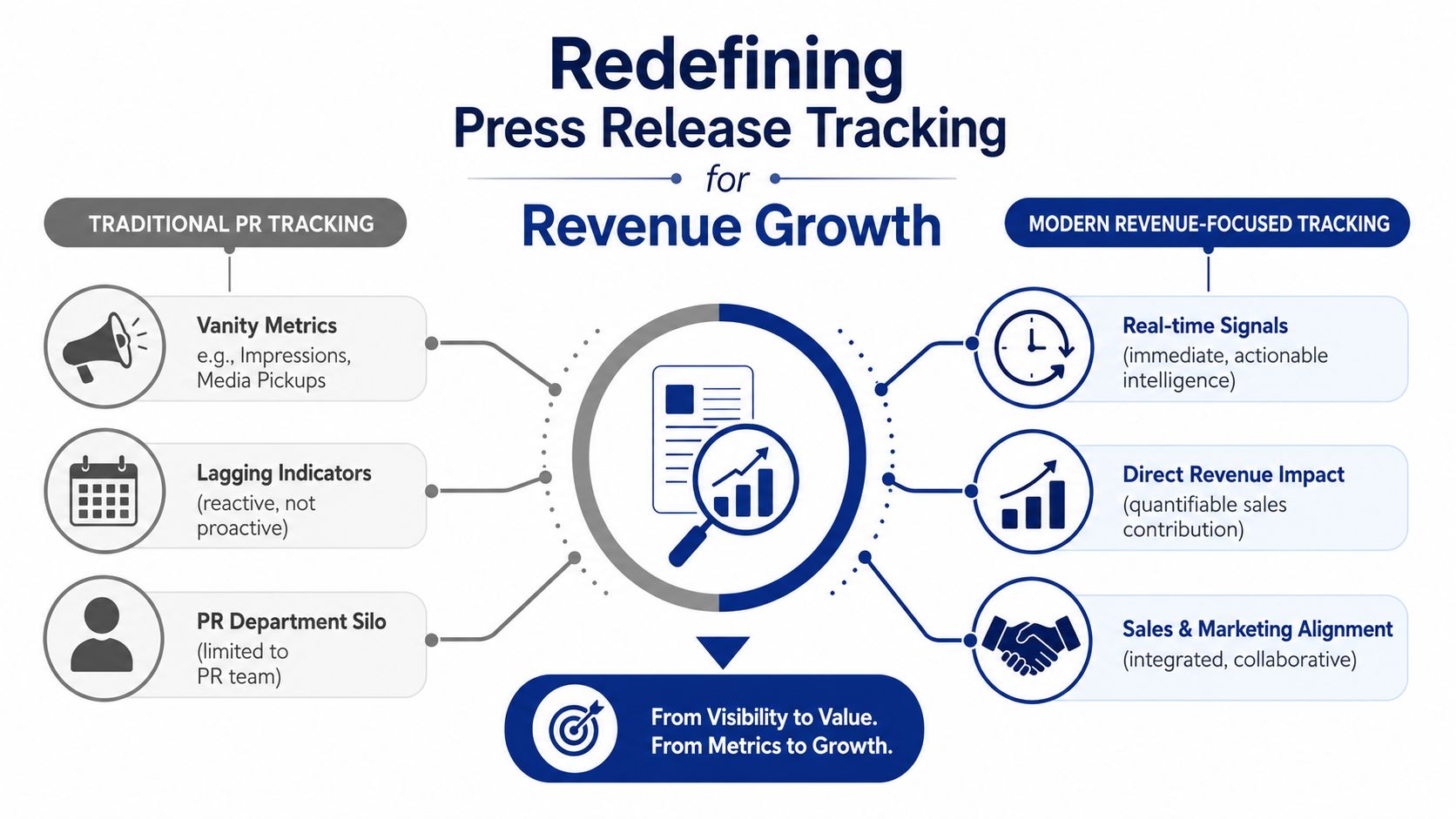
The broader market is already moving toward real-time monitoring. PRLab's 2026 statistics roundup notes that in 2025, 82% of public relations teams actively monitor media mentions using technology, reflecting a shift toward real-time signal detection. The same source points out why that matters for revenue teams: press releases are no longer just marketing artifacts but critical data points that, when tracked in real time, reveal actionable triggers like a new CRO hire or Series C funding.
A better definition
For sales, press release tracking is the process of monitoring target accounts for specific announcements that indicate a likely shift in priorities, budget, leadership, or go-to-market motion.
That means the workflow changes from “measure distribution performance” to “detect and route buying signals.”
Here's what belongs in that definition:
-
Target account monitoring
You don't need the whole internet. You need your named accounts, competitors, partners, and strategic whitespace. -
Trigger classification
Not every release matters equally. Funding, executive hires, expansion, partnerships, and strategic launches often carry sales relevance. Routine awards or generic brand statements usually don't. -
Immediate routing
Signals have to land where reps already work. Slack, email, and CRM are practical options because they turn awareness into a next step. -
Context attached to the alert
“Company announced partnership” is not enough. The alert should explain what changed and which outreach angle is now stronger.
What good looks like
A modern workflow treats a release as a trigger, not a content asset. If a prospect announces a new chief revenue officer, sales leadership should ask:
- Who owns the account
- Which stakeholders are now likely involved
- Whether the new executive implies process change or tooling evaluation
- How fast outreach should happen
Press release tracking only becomes useful when the alert includes an opinion on what the sales team should do next.
What this changes operationally
This reframing fixes a common disconnect between sales and marketing. Marketing often sees the release as the finish line. Revenue teams should see it as the start of a monitored window.
That's why mature teams don't review press releases in batches. They use them as structured inputs into account prioritization, territory planning, and outbound timing.
The result is simple. Reps stop asking, “Did this announcement get coverage?” and start asking, “Does this announcement create a reason to engage?”

“Salesmotion helps you spot signals from prospect accounts, news items / job hiring alerts etc that indicate that now is a good time to reach out with a well-crafted message.”
Rob Douglas
Director of Sales, icit business intelligence
The Signals That Matter What to Actually Track
Not all news carries the same sales value. Teams get overwhelmed when they treat every press release as urgent. The fix is to sort signals by what they imply about buying behavior.
The highest-value signals are the ones tied to organizational change. Life Science Newswire's discussion of press release measurement highlights the hierarchy clearly: recent 2025–2026 industry reports show that funding announcements and executive hiring signals drive 40% more inbound sales inquiries than product launches, yet traditional tracking frameworks still prioritize vanity metrics like total impressions over revenue impact.
High-value signals vs noise
Funding and executive moves tend to matter because they change decision-making conditions. Funding can enable investment. A new executive often triggers evaluation of vendors, processes, and team structure.
Product launches are more mixed. Some launches signal strategic investment. Others are mostly market messaging. You need context before assigning urgency.
Routine brand announcements usually belong in the background unless they connect to a larger initiative.
| Press Release Type | What It Signals | Recommended Sales Action |
|---|---|---|
| Funding announcement | Budget availability, growth plans, pressure to scale | Review likely investment areas, map new stakeholders, send outreach tied to execution risk and speed |
| Executive hire | Strategic change, new buyer influence, fresh evaluation window | Reach out with a point of view relevant to the new leader's remit |
| Partnership announcement | New channel strategy, integration priorities, market expansion | Position around enablement, coordination, data flow, or ecosystem fit |
| Expansion announcement | Hiring, territory growth, operational complexity | Tie outreach to scaling workflows, reporting, and execution consistency |
| Product launch | Competitive positioning or category push | Use selectively. Lead with differentiation only if the launch affects your value story directly |
| Award or brand milestone | Visibility, reputation, limited buying signal on its own | Usually monitor only. Don't force outreach unless another trigger supports it |
How to prioritize by likely pipeline value
A practical way to sort signals is to ask two questions.
First, does this release imply money, mandate, or management change?
Second, does it create a plausible reason for your solution to become more relevant right now?
If the answer to both is yes, move it forward.
If your team works with early-stage or growth companies, it also helps to watch where those companies distribute announcements beyond their own newsroom. Founders often combine official releases with listings, launch posts, and ecosystem visibility efforts. A resource like startup directory submission service can help teams understand where startup news is being syndicated and surfaced, which is useful when you want broader signal coverage around younger accounts.
What reps should ignore
The easiest way to ruin a signal program is to trigger outreach from low-context news.
Ignore or down-rank releases that are:
- Ceremonial and disconnected from current operations
- Too broad to tie to a business pain
- Purely promotional with no evidence of internal change
- Repeated themes from the same company with no new substance
For more signal categories that map better to enterprise outreach, this breakdown of best signals for enterprise sales is worth reviewing.
A press release matters when it changes the account, not when it simply markets the account.
How to Build Your Tracking and Alerting Workflow
Manual searching doesn't scale. If reps are checking newsroom pages one by one, the system breaks the moment account lists grow.
The better approach is a monitored workflow with clear routing rules, alert thresholds, and account tiers.
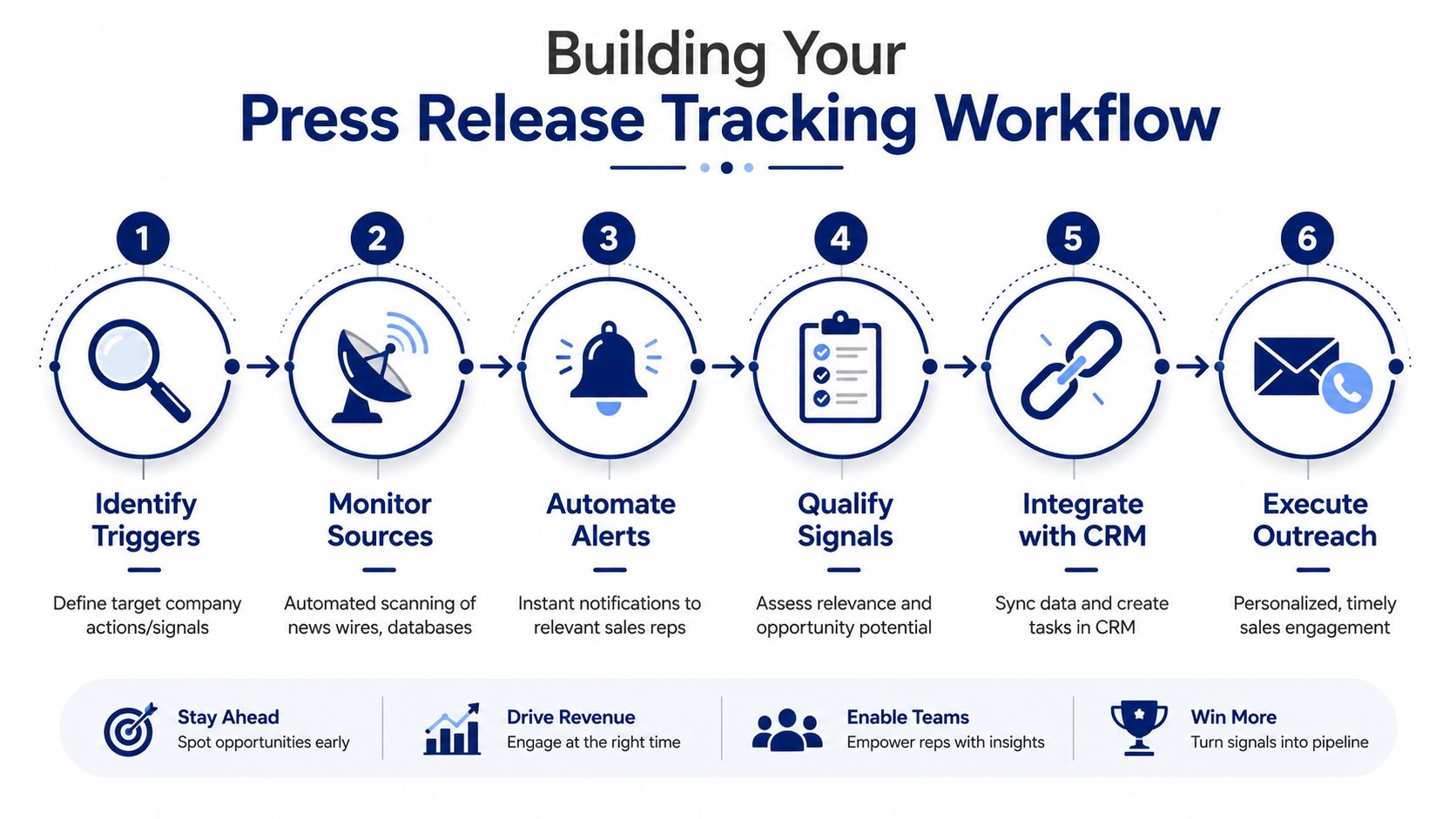
PageCrawl's write-up on press release monitoring offers one of the most useful operational details: automated monitoring achieves superior signal detection by targeting corporate newsroom pages directly. For high-value targets, the industry benchmark for monitoring frequency is every 1-2 hours with instant team alerts, a strategy that reduces signal overload by 70% compared to blanket monitoring.
Start with monitored sources
Corporate newsroom pages should sit at the center of the workflow because they're the cleanest source of official announcements. Press wire services matter too, but company newsrooms usually give you the earliest and most complete version of the signal.
A practical source stack usually includes:
- Corporate newsroom pages for official releases
- Press wire platforms for wider distribution visibility
- Industry publications for context on how the market interprets the release
- CRM account lists so alerts map to ownership immediately
Use account tiers
Treating every account the same creates alert fatigue fast.
A more reliable model:
- Tier 1 accounts get frequent monitoring and instant alerting because timing matters most.
- Tier 2 accounts are monitored less aggressively, with grouped alerts when urgency is lower.
- Watchlist accounts stay in the background until they emit a stronger trigger.
Teams frequently require automation support. Tools that monitor newsroom pages, route alerts into Slack or CRM, and attach short rationale save a lot of operational friction. One option is Salesmotion, which tracks account signals across public sources and sends real-time alerts with the “so what” attached. The larger point is the workflow, not the vendor. Reps need fewer alerts, better ranked.
Add context before routing
An alert that says “new press release detected” is barely useful. The alert should answer:
- What happened
- Why it matters
- Who should act
- What outreach angle is now stronger
That can be done manually by sales ops for a small book of accounts. It should be automated for a larger one.
If your team is still assembling this process by hand, this guide on how to automate sales research with AI is a useful reference for designing the handoff from signal detection to seller action.
A simple operating model
- Define trigger categories based on your ideal customer profile.
- Map sources to named accounts so monitoring stays focused.
- Set alert rules by tier rather than blasting every event to everyone.
- Attach account context before the signal hits the rep.
- Create a follow-up SLA so high-value triggers don't sit untouched.
That's what makes the workflow durable. The technology matters. The operating discipline matters more.

“Automatic account profile detail I can use to manage my territory. Using Salesmotion AI to generate value statements per persona, account, etc. Using Salesmotion to give me a starting point based on new hires, or news alerts is critical.”
Adam Wainwright
Head of Revenue, Cacheflow
Turning Press Release Signals into Sales Outreach
A signal doesn't create pipeline on its own. The rep does. The job is to translate the announcement into relevance without sounding like a bot that copied the first line of the release.

The best outreach doesn't congratulate for the sake of it. It connects the news to an execution challenge. That's what turns “I saw your announcement” into “I understand what this likely means internally.”
Example 1 funding announcement
Weak outreach:
Congrats on the funding. We help fast-growing teams scale. Open to chatting?
That message is lazy because it doesn't show any point of view.
Stronger outreach:
Saw the funding announcement. Teams usually feel pressure right after a raise to convert growth plans into execution across hiring, territory planning, and forecasting. If revenue leadership is about to add headcount or enter new segments, the biggest issue is usually not strategy. It's getting reps relevant account context fast enough to act. Worth comparing notes if that's on your plate this quarter.
The difference is simple. The second note ties the release to likely operational consequences.
Example 2 new executive hire
A new CRO, CMO, or operations leader often creates a fresh evaluation window. The outreach should acknowledge that a new leader inherits expectations and often reassesses process quickly.
A practical message might look like this:
- Opening tied to the hire, not generic congratulations
- Observation about what usually changes under a new executive
- Hypothesis about a priority area
- Call to action framed as a short exchange, not a product demo ambush
If your team needs a tighter qualification lens before responding to every signal, this framework on how to build a pipeline that closes is a useful complement because it forces reps to separate interesting news from winnable opportunities.
Use traffic data to sharpen the follow-up
Signals aren't only for outbound. They also improve inbound attribution when your company distributes releases or gets picked up in coverage.
Business Wire's guidance on tracking inbound traffic from a press release makes the technical requirement clear: effective press release tracking requires implementing UTM parameterization on all embedded hyperlinks to isolate inbound traffic attributed specifically to the campaign. Without this, analytics often misclassify traffic, leading to a 40-60% underreporting of campaign ROI.
That matters for sales outreach because it tells you which announcement topics create engaged traffic. If your funding-related content consistently brings in stronger visits or conversions than broad product announcements, your outbound messaging should reflect that pattern.
Keep the rep's voice human
The safest structure is simple:
- Reference the news briefly
- State the likely business implication
- Offer a relevant perspective
- Ask for a low-friction next step
For more examples of how to turn company updates into useful messaging, this guide on how to use company news for sales outreach is worth keeping in the team playbook.
Relevance is what buyers notice. Personalization without relevance is just formatting.
Measuring the True ROI of Your Tracking Efforts
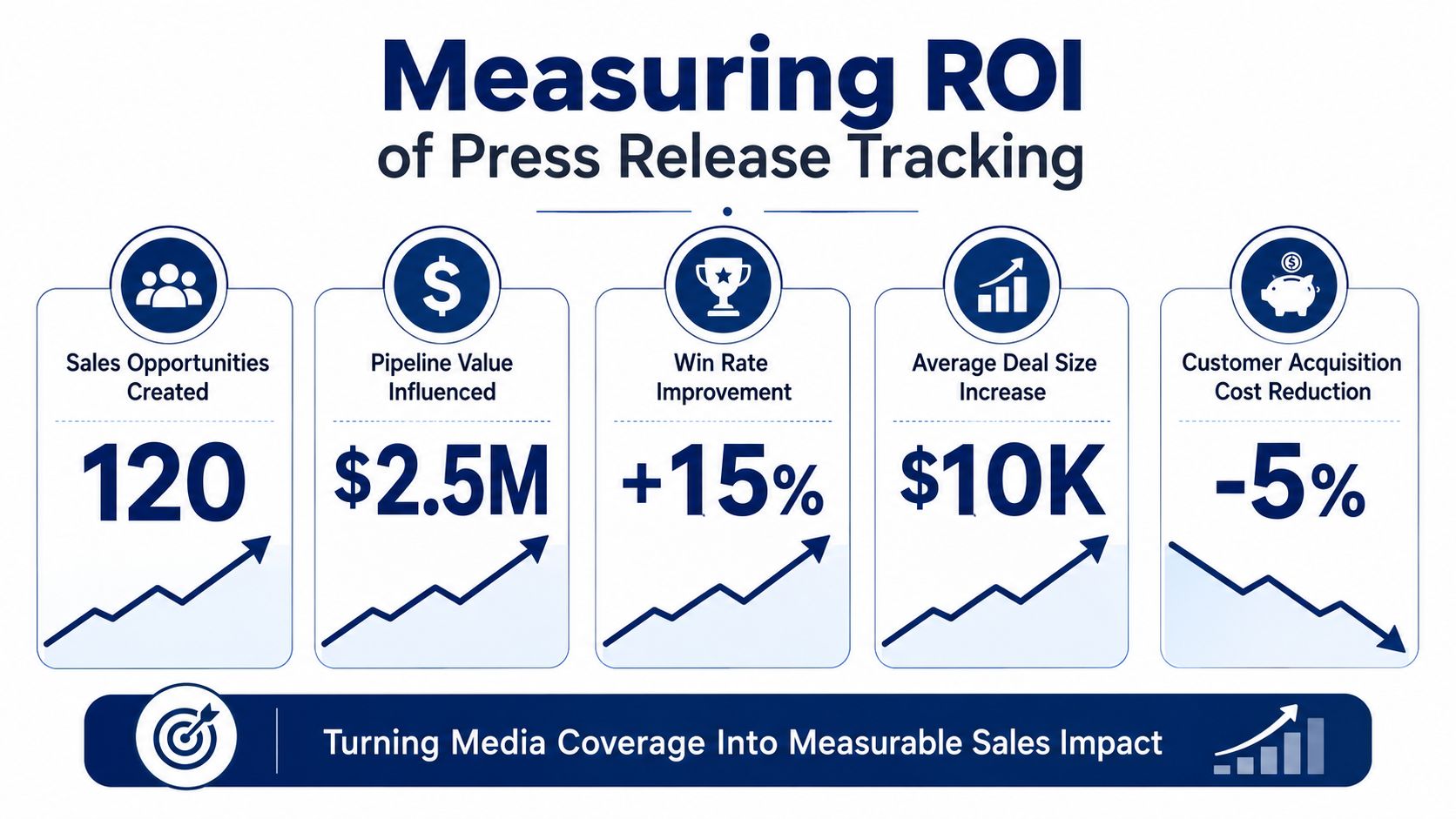
If you only measure pickups, views, or sentiment, you're still evaluating press release tracking like a PR team. Revenue leaders need a funnel view.
The right question is not “Did the release perform?” It's “Did the signal create better opportunities, faster action, or higher-quality conversations?”
Start with attributable lead flow
The most concrete setup comes from traffic attribution. Instant Press explains press release analytics in a way revenue teams can actually use: to track press release effectiveness for sales, embed UTM parameters in every link and configure Google Analytics to create a custom audience for “press coverage traffic.” This allows Revenue Leaders to calculate the exact percentage of leads originating from an announcement, turning a PR metric into a hard sales funnel number.
That's the bridge between communications activity and revenue accountability.
If you can't isolate traffic and leads tied to a specific announcement, you're still guessing at impact.
The metrics that matter
A workable scorecard usually includes a mix of activity, conversion, and pipeline influence.
-
Signal-to-meeting rate
How often does outreach tied to a press release signal become a booked conversation? -
Opportunity influence
Which open opportunities had a tracked announcement as a key trigger or acceleration point? -
Pipeline quality
Are signal-sourced conversations creating stronger-fit deals than generic outbound? -
Response quality by signal type
Which topics consistently produce better replies, meetings, or forward motion? -
Lead attribution from distributed announcements
Which specific releases drove visits, demo requests, or identifiable conversions?
Combine PR analytics with sales analytics
Many teams miss the mark. They keep PR and sales data in separate systems, then wonder why ROI looks fuzzy.
A stronger operating model links three layers:
| Measurement Layer | What You Track | Why It Matters |
|---|---|---|
| Press release engagement | Clicks, visits, referral traffic from tagged links | Shows whether the announcement generated identifiable interest |
| Sales response | Outreach sent, replies, meetings booked after a trigger | Proves whether reps acted on the signal effectively |
| Pipeline outcome | Opportunities influenced, stage progression, revenue impact | Shows whether the tracking program deserves budget and process attention |
For teams building the reporting side, Silva Marketing's guide to ROI is a helpful companion because it reinforces the discipline of tying channel activity to business outcomes rather than stopping at surface metrics.
What good reporting changes
Once you measure press release tracking this way, budget conversations get easier. The program stops looking like a nice-to-have alert feed and starts looking like a source of timely pipeline creation.
It also improves rep behavior. Sellers pay attention when they can see which signals produce meetings and which ones waste cycles. That feedback loop matters as much as the monitoring itself.
Most companies already have the raw material. The key is treating announcements as inputs to revenue workflows, then measuring them with revenue standards.
If your team wants to operationalize this without adding more manual research, Salesmotion helps reps monitor account signals, get the “so what” in real time, and turn company news into actionable outreach across Slack, email, and CRM.