You already know the pattern. A rep spots a funding announcement, copies the headline into a cold email, adds “congrats,” and calls it personalization. Another rep ignores news entirely and keeps running the same sequence across every account on the list. Both approaches create activity. Neither reliably creates pipeline.
The difference is interpretation.
If you want to know how to use company news for sales outreach, stop treating news as a conversation starter and start treating it as evidence. A press release, leadership hire, partnership, expansion, or regulatory update can tell you what changed inside the account, who now feels pressure, and why your outreach might matter today instead of next quarter.
That's the playbook. Not “I saw your news.” More like, “This change likely created a new operational burden, budget discussion, or timeline risk. Here's where we fit.”
Beyond "Congrats on the Funding"
The weakest version of news-based outreach sounds familiar:
Congrats on the funding. Would love to show you how we can help.
That email usually fails for one reason. It proves the rep saw the headline, but it doesn't prove the rep understood what the headline means.
A funding round, acquisition, or expansion announcement is not the message. It's the trigger. Effective outreach starts when you translate that trigger into a business implication. If a company opens a new distribution center, that can imply new operational complexity, system integration work, or data handling needs. If they hire a new revenue leader, that can imply a shift in process, tooling, reporting, or accountability.
That's where signal-anchored selling starts. You don't reference the news to sound current. You reference it to establish a credible why now.
Personalized outreach built on account-specific intelligence performs better than generic messaging. Demandbase reports 53% open rates compared to 29% and 10% reply rates versus 4.5% when outreach incorporates account intelligence, as outlined in its guide to using data for B2B sales prospecting.
What amateur outreach sounds like
Amateur outreach usually has one of three problems:
- It repeats the headline instead of interpreting it. “Saw your Series B” is observation, not insight.
- It jumps to a demo ask before earning relevance. The rep wants a meeting before making a useful point.
- It treats every trigger the same. Funding, hiring, product launches, and partnerships all get the same message shape.
You can see the difference in one pass.
| Approach | Message style | Likely reaction |
|---|---|---|
| Spray-and-pray | “Congrats on the announcement. Want to connect?” | Ignored |
| Surface-level personalization | “Saw you launched in Europe. We help companies scale.” | Mildly relevant, still generic |
| Signal-anchored outreach | “Your move into Europe likely adds localisation and compliance pressure across onboarding and support. We help teams tighten that handoff.” | Worth reading |
What pros do instead
Pros build a point of view around the event. They ask:
- What changed at the account?
- Who now owns the problem?
- What project, risk, or initiative became more urgent?
- How does our offer reduce friction tied to that change?
Practical rule: If your email could still make sense after replacing the company name with another one, it's not signal-anchored yet.
Funding is a good example. If you search early-stage venture capital rounds, you'll find plenty of announcements. The announcement itself isn't enough. A good rep looks at stage, hiring pattern, go-to-market motion, and likely pressure from new investors.
That's also why strong teams build around trigger logic, not random personalization. If you need a broader set of examples, this guide on sales trigger events examples is useful for thinking about what should prompt outreach.
See Salesmotion in action
Take a self-guided interactive tour — no signup required.
Identifying High-Impact News Signals
Commonly, teams do not face a news problem. They face a prioritization problem.
One rep monitors Google News. Another scans company blogs. A third reads industry magazines manually for announcements. That can work for a handful of named accounts. It breaks fast when each rep owns 200 accounts and every account produces a steady stream of low-value updates.
The central question isn't “What happened?” It's which events should route to SDRs, AEs, or account managers, and which should be ignored as noise? That matters because signal overload is now a bigger problem than signal scarcity, as noted in ZoomInfo's sales outreach infographic on routing the right sales signals.
Signals that usually deserve attention
Not all news has equal selling value. Some items create curiosity. Others create buying conditions.
Here's a practical way to rank them.
| News Signal | What It Implies | Priority Level |
|---|---|---|
| Leadership hire | New mandate, new operating preferences, possible process or tooling change | High |
| Geographic expansion | New compliance, localisation, hiring, and operational complexity | High |
| Strategic partnership | New integrations, channel motion, co-sell pressure, execution risk | High |
| Product launch | Need for enablement, adoption, customer communication, support readiness | Medium to high |
| Regulatory change affecting the company or sector | Urgent process, reporting, governance, or compliance work | High |
| Generic brand announcement | Visibility move with unclear operational impact | Low |
| Award, sponsorship, or community post | Limited evidence of buying urgency | Low |
How to read the signal behind the headline
A strong rep doesn't stop at category level. They interpret the likely internal conversation.
Leadership hires
A new CRO, CFO, CMO, or COO often brings a fresh agenda. The title matters, but the context matters more. If the company is also hiring aggressively, entering a new market, or changing product packaging, that hire may signal active change rather than routine replacement.
Questions to ask:
- Was this person hired to scale, fix, or rebuild?
- What functions will they pressure first?
- Does your product help them show early traction?
Product launches and partnerships
A launch can look exciting from the outside but weak from a pipeline standpoint if it doesn't create new operational burden. A launch tied to a new segment, pricing model, or region is different. Now the company may need onboarding changes, support readiness, new data flows, or sales enablement.
Partnerships can be similar. A logo-swap announcement is usually weak. A partnership that changes distribution, integrations, or go-to-market coverage can be strong.
Geographic expansion and regulatory changes
These often create sharper urgency than reps realize. Expansion means more than “growth.” It often means new rules, new systems, and new process failures waiting to happen. Regulatory change works the same way. If your product helps manage risk, data, reporting, or workflow control, this category can be one of the cleanest bridges to outreach.
The best signals don't just show activity. They reveal a new constraint, deadline, or owner.
If you're building a repeatable system, classify signals by likely revenue impact and next action. A useful operating model is the one behind signal-based selling, where the point isn't collecting alerts. It's attaching the right motion to each alert.

“The talking points are gold. If they're in Salesmotion, I know they're being discussed inside that business. That makes it easy to spark a real conversation, which is 90 percent of the battle.”
Andrew Giordano
VP of Global Commercial Operations, Analytic Partners
Connecting News to Your Value Proposition

Most outreach falls apart at this stage. The rep finds a relevant event, then wastes it with a vague message.
“Noticed your APAC expansion.” “Congrats on the partnership.” “Saw the new product launch.”
None of those lines are wrong. They're just incomplete. Prospects ignore outreach that feels like spraying and praying, while relevance improves response only when the note is specific and contextual, as Highspot explains in its article on making sales outreach specific and contextual.
Use the three-part translation
The cleanest formula is simple:
Observed news event + implied business problem + your solution as a bridge
That middle part is where the value lives.
Here's what that looks like in practice:
-
Observed event
“You expanded into APAC.” -
Implied problem
“That likely adds localisation, compliance, and handoff complexity across regional teams.” -
Bridge to value
“We help teams standardise those workflows so launches don't stall in legal and ops review.”
That's a useful email opening because it shows judgment. It tells the buyer you're not monitoring them for trivia. You're interpreting a business move.
Examples that sound informed, not creepy
The goal isn't to prove how much you know. It's to make a reasonable business hypothesis.
Example one
A company announces a strategic partnership.
Weak:
- “Saw the partnership. Congrats.”
Better:
- “The partnership suggests you're expanding distribution and probably coordinating more shared pipeline activity. Teams usually feel that pressure first in reporting, lead routing, or partner enablement.”
Example two
A software company launches a new enterprise product tier.
Weak:
- “Congrats on the launch. We help enterprise teams.”
Better:
- “A move upmarket usually creates extra load in onboarding, security review, and stakeholder coordination. We help revenue teams tighten that process so new enterprise deals don't get stuck between sales and delivery.”
Example three
A company hires a new operations leader.
Weak:
- “Saw you hired a new COO.”
Better:
- “New ops leaders often get pulled into standardisation quickly, especially if the business is scaling unevenly across regions or teams. If process visibility is part of that mandate, this may be relevant.”
Don't mention a detail just because you found it. Mention it because it changes the buyer's priorities.
A quick test before you send
Use this checklist:
- Is the signal recent enough to matter?
- Does it imply a change in budget, urgency, risk, or ownership?
- Can you connect that change to a problem your product solves?
- Would the message still sound intelligent if the prospect asked, “Why do you think that?”
If the answer to the second or third question is no, skip the outreach. Not every announcement deserves a sequence.
Crafting the Signal-Anchored Outreach Sequence
A good signal earns attention. A coordinated sequence earns a conversation.
Teams lose a lot of value by treating news as a one-line personalization token in a single email. The better move is to act fast and use the signal across channels while the event is still fresh inside the account.
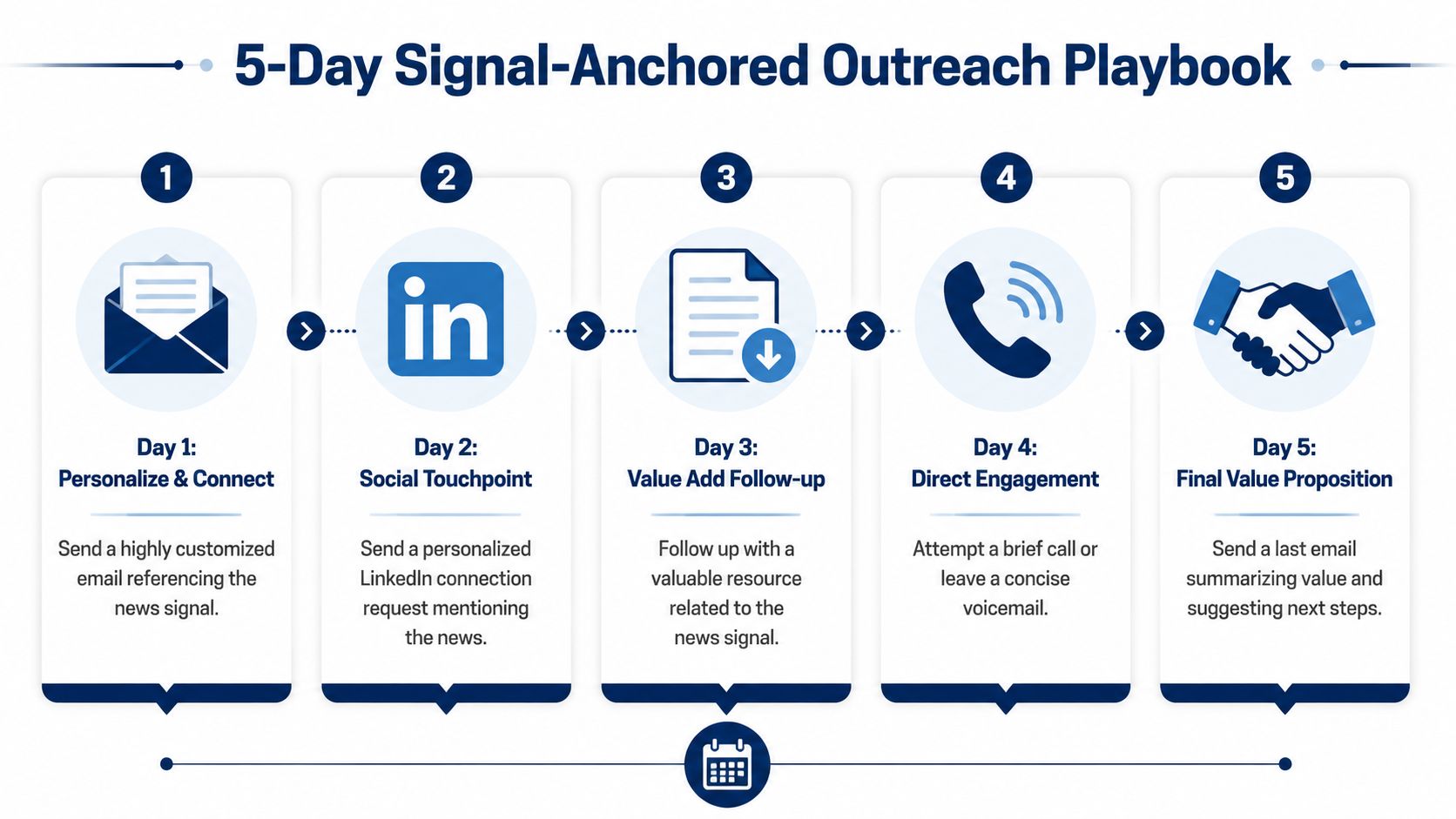
Prospeo's trigger-event playbook recommends sending the first personalized email within 24 to 48 hours and notes that the first seller to contact a decision-maker after a trigger event is 5x more likely to win the deal. It also recommends a five-step sequence of Day 1 email, Day 2 LinkedIn comment, Day 3 case study, Day 4 call, and Day 5 breakup email with a benchmark report, as described in its guide to company announcements in sales outreach.
The five-day operating rhythm
Day 1 email
Lead with the trigger and your interpretation.
Example:
Saw the announcement about your APAC expansion. Moves like that usually create localisation and compliance pressure before the commercial team feels fully ready. We work with teams that need tighter coordination between launch, ops, and regional execution. If that's on your plate, I can send over a few patterns we've seen work.
Short. Specific. No fake familiarity.
Day 2 LinkedIn touch
Don't paste your email into a connection request. Add a thoughtful comment on the announcement or a related executive post. Keep it business-oriented.
Try something like:
- “Interesting move. Expansion announcements usually hide a lot of behind-the-scenes operational work.”
- “Strong signal. Curious how you're thinking about rollout sequencing across markets.”
Day 3 value-add follow-up
This is the right place for a case study, benchmark report, or implementation perspective. Make sure the asset fits the trigger. Don't send a generic brochure.
A product launch trigger should get launch-readiness insight. A new leader trigger should get process or org-design relevance. A partnership trigger should get integration or channel-execution relevance.
Finish the sequence like a professional
Day 4 call
Call with a tight opener tied to the event. If you reach voicemail, reference the trigger and leave one useful hypothesis. Don't recite your company overview.
Day 5 breakup email
This isn't a guilt trip. It's a clean final note that summarizes why you reached out and gives the buyer an easy out.
Example:
- “Closing the loop on this. I reached out because your recent expansion likely created some new coordination and compliance work. If it's not a priority, no problem. If it is, happy to share what similar teams usually tackle first.”
A signal-based sequence should feel cumulative. Each touch should add context, not repeat the same line in a new channel.
If you want a structure your team can adapt, these sales cadence templates are a solid starting point.

“All of the vendors that I've worked with, all of the onboarding that I have had to deal with, I will say, hands down, Salesmotion was the easiest that I have had.”
Lyndsay Thomson
Head of Sales Operations, Cytel
Scaling News-Based Outreach Across Your Team

Here's where good strategy usually breaks. A rep can monitor a handful of accounts manually. A team cannot run that way across hundreds of accounts without drift, delays, and uneven execution.
I've seen reps try to hold this together with saved Google News searches, industry newsletters, LinkedIn browsing, and manual notes from trade magazines. That's fine for occasional account prep. It's not a system. It's a patchwork.
What the manual model gets wrong
Manual monitoring creates three predictable problems:
- Coverage gaps because reps miss announcements outside the sources they personally follow
- Slow response times because someone has to notice the trigger, interpret it, and draft outreach
- Inconsistent quality because one rep sees a headline as meaningful and another ignores it
That matters even more when you're running coordinated outreach. Landbase reports that campaigns using three or more coordinated channels achieve 287% higher purchase rates than single-channel approaches, and notes that AI-powered sales platforms help by automating the identification and distribution of company news triggers in real time in its roundup of multi-channel outreach statistics.
What a scalable system looks like
A practical team setup usually includes four layers:
-
Source aggregation
Pull from company news, press releases, industry publications, LinkedIn activity, interviews, and hiring signals. -
Signal filtering
Separate high-impact triggers from low-value mentions. -
Routing logic
Decide whether the trigger belongs with an SDR, AE, account manager, or customer success owner. -
Draft generation with review
Give reps a strong first draft anchored to the actual event, then let them edit before sending.
One option for this is Salesmotion, which monitors news and account signals across 1,000+ sources and generates outreach drafts tied to the specific trigger. That matters because the hard part isn't just finding the event. It's giving the rep the “so what” fast enough to act on it.
The operating standard for 200-plus accounts
At scale, the team needs shared rules. Not just better tools.
Use a simple operating model:
- Rank signals by actionability rather than headline visibility
- Set time windows for first-touch response after high-priority triggers
- Require a business hypothesis in every news-based email
- Review sequence quality by signal type, not just by rep
- Track which triggers create meetings and qualified pipeline
That's how you turn company news from a nice research habit into a repeatable outbound motion.
Measuring the ROI of Signal-Based Selling
If you only measure opens, you'll miss the point.
Signal-based selling should be judged by whether it creates better conversations, faster movement, and stronger opportunities than your default outbound motion. The easiest mistake is to call it a success because the emails “felt more personalized.” That's not enough.
What to measure
Start with a side-by-side comparison between your standard outreach and your signal-anchored plays.
Track:
- Meetings booked from trigger-led sequences
- Positive reply rate by signal type
- Stage progression for opportunities sourced from news-based outreach
- Pipeline velocity for deals that started from a trigger
- Average deal quality by trigger category
- Rep response time from signal detection to first touch
Those metrics tell you whether the signal is producing pipeline or just engagement.
Build the dashboard around decisions
Your dashboard should answer practical coaching questions.
For example:
- Which signals produce meetings but not qualified pipeline?
- Which reps are fast to act but weak at interpretation?
- Which triggers consistently lead to second meetings?
- Which segments respond best to leadership changes versus expansion news?
A lot of teams already track the raw ingredients. They just don't isolate signal-based plays as a distinct motion. Once you do, the patterns become obvious. Some triggers are noisy. Others consistently open real opportunities.
The point of measurement isn't proving that personalization is good. It's proving which signals justify rep time.
If you need a framework for the broader dashboard, this guide to sales pipeline metrics is a useful reference point.
A mature team eventually builds a feedback loop. Revenue leaders review which triggers created pipeline, RevOps adjusts scoring and routing, and frontline managers coach reps on the business hypothesis inside the message. That's when news-based outreach stops being a clever tactic and becomes part of how the team prioritizes the market.
If your team is sitting on account news but struggling to turn it into timely, relevant outreach, Salesmotion is built for that workflow. It monitors target accounts continuously, highlights the signals that matter, explains the likely sales implication, and gives reps a draft they can review and send without starting from a blank page.