Your CRM can tell you every meeting your team has ever logged. It almost certainly cannot tell you who on your team actually knows the CFO at your top target account. That gap is what relationship intelligence software exists to close, and it is why firms in venture capital, private equity, and professional services pay thousands of dollars per seat for it.
But relationship intelligence answers only half of the question that matters in B2B sales. It tells you who you know. It says nothing about who is ready to buy. This guide covers what relationship intelligence is, how it works, who the main players are, and why the best teams pair it with account intelligence instead of treating it as a complete answer.
TL;DR: Relationship intelligence software mines your team's email, calendar, and CRM activity to map who knows whom and how well. It is strongest in network-driven industries like VC, PE, and professional services. It tells you who you know, not who is ready to buy. Pair it with account intelligence, which monitors buying signals, to get both the warm path and the timing.
What Is Relationship Intelligence?
Relationship intelligence is technology that automatically captures, analyzes, and scores the professional relationships across your organization. It mines communication exhaust, the emails, calendar invites, and CRM activity your team generates every day, to build a living map of who knows whom, how strong each connection is, and which colleague can open a door at a target company.
The core promise: no rep should ever cold-email a company where a colleague already has a warm relationship.
That promise has real economics behind it. Warm introductions and referrals convert at 15 to 25 percent, far above cold outreach, according to Launch Leads. And Referral Rock's roundup of B2B referral statistics found that companies with referral motions report 71 percent higher conversion rates and close deals 69 percent faster. The warm path wins when it exists. Relationship intelligence is the software category built to find it.
The category sits adjacent to CRM rather than replacing it. A CRM stores what your team chooses to log. Relationship intelligence works passively in the background, reading signals nobody had to enter by hand.
See Salesmotion on a real account
Book a 15-minute demo and see how your team saves hours on account research.
How Does Relationship Intelligence Work?
Relationship intelligence platforms work in three steps: capture communication data automatically, score each relationship's strength, and surface connection paths when you need an introduction. No manual data entry is involved, which is the entire point.
Here is what each step looks like in practice:
1. Automatic data capture. The platform connects to your team's email and calendar (Google Workspace or Microsoft 365), plus the CRM. Every sent email, reply, and accepted meeting becomes a data point. Some platforms add enrichment data on top: job titles, company moves, news.
2. Relationship scoring. Algorithms weigh frequency, recency, and reciprocity of communication. A colleague who exchanged forty emails with a contact last quarter scores higher than one who met them once at a conference in 2023. Scores decay over time, because relationships do too.
3. Network activation. When a deal team targets an account, the platform answers "who knows someone there?" with a ranked list of colleagues and the strength of each path. Some tools also alert you when a contact in your network changes jobs, since that person just became a warm path into a new company.
The output is a network graph of your entire firm's collective relationships, instead of each rep's private mental Rolodex. When a partner leaves, their relationship history stays visible. When two teams chase the same account, they find out before stepping on each other.

“The account and contact signals are key for reaching out at important times, and the value-add messaging it creates unique to every contact helps save time and efficiency.”
Daniel Pitman
Mid-Market Account Executive, Black Swan Data
Who Uses Relationship Intelligence?
Relationship intelligence delivers the most value in industries where deals start with introductions rather than demand generation. Four groups dominate the customer base:
Venture capital and private equity. Deal flow is sourced through networks, and the best firms systematize it. A VC platform team uses relationship scores to decide which partner should reach out to a founder, and tracks whether the firm's network is growing in target sectors.
Investment banking. Coverage bankers live and die by who they know at sponsors and corporates. Relationship intelligence shows which managing director has the strongest path into a buyer during a sell-side process.
Professional services. Law, accounting, and consulting firms use it for cross-selling. The audit partner's contacts become visible to the advisory team, which is precisely the collaboration that siloed CRMs fail to produce.
Enterprise sales teams. The use case here is multi-threading and warm paths. With Gartner putting typical complex-purchase buying groups at 6 to 10 decision makers, no single relationship carries a deal. Knowing that your CTO once worked with the prospect's VP of Engineering can shortcut weeks of outreach. Our guide to multi-threading in enterprise deals covers why single-threaded deals stall.
The common thread: long cycles, high deal values, and decisions made by people who prefer introductions to pitches.
The Relationship Intelligence Tool Landscape
Three platforms define the category in 2026, each with a distinct center of gravity. Here is an honest read of who each is for.
Affinity is the category leader for private capital. It is a full CRM built around automated relationship capture, used heavily by VC and PE firms for deal sourcing and pipeline management. Pricing is sales-quoted; Vendr's transaction data puts it at roughly $2,000 to $2,700 per user per year, with Essential-tier contracts for 5 to 15 users typically landing between $12,000 and $35,000 annually. AI notetaking sits on the higher tier and SSO is gated to Enterprise, which reviewers flag as expensive add-on territory. Best for: investment firms that want relationship intelligence as their system of record, not a bolt-on.
Introhive is the enterprise heavyweight, with $132M raised and over 750,000 users across 90+ countries. It layers relationship intelligence on top of your existing CRM rather than replacing it, and its core market is professional services: law, accounting, and consulting firms mapping firm-wide connections for cross-selling. In October 2025 it shipped its AI-powered Intelligence Suite. Best for: large firms with thousands of employees whose collective network is genuinely unmapped.
4Degrees is a relationship-intelligence-first CRM aimed at deal-driven teams in VC, PE, and investment banking. It is the lighter-weight Affinity alternative: automatic contact enrichment, relationship strength scores, customizable deal pipelines, and recent AI additions like an assistant that answers natural-language questions about your CRM data and document intelligence that drafts deal records from uploaded files. Best for: smaller investment teams that want Affinity-style capture without Affinity-level contracts.
Where Salesmotion Fits
Honest answer: we are not a relationship intelligence platform. We do not connect to your inbox to score who knows whom. If your core problem is mapping your firm's network, the three tools above do that job.
What we build is the other half: account intelligence. The platform monitors 50+ signal types across 1,000+ sources, leadership changes, earnings calls, hiring patterns, funding, product launches, and turns them into account briefs and alerts. That includes the warm-path signals relationship tools care about, like job changes that put a past champion inside a target account, surfaced as buying signals rather than inbox-derived scores. Every account also gets a Relationship Maps tab: a drag-and-drop stakeholder map that flags when someone on the map changes roles. Pricing is $85/mo for individuals, self-serve monthly with no annual commitment, and custom team pricing with unlimited users on team plans. See it on the interactive demo.
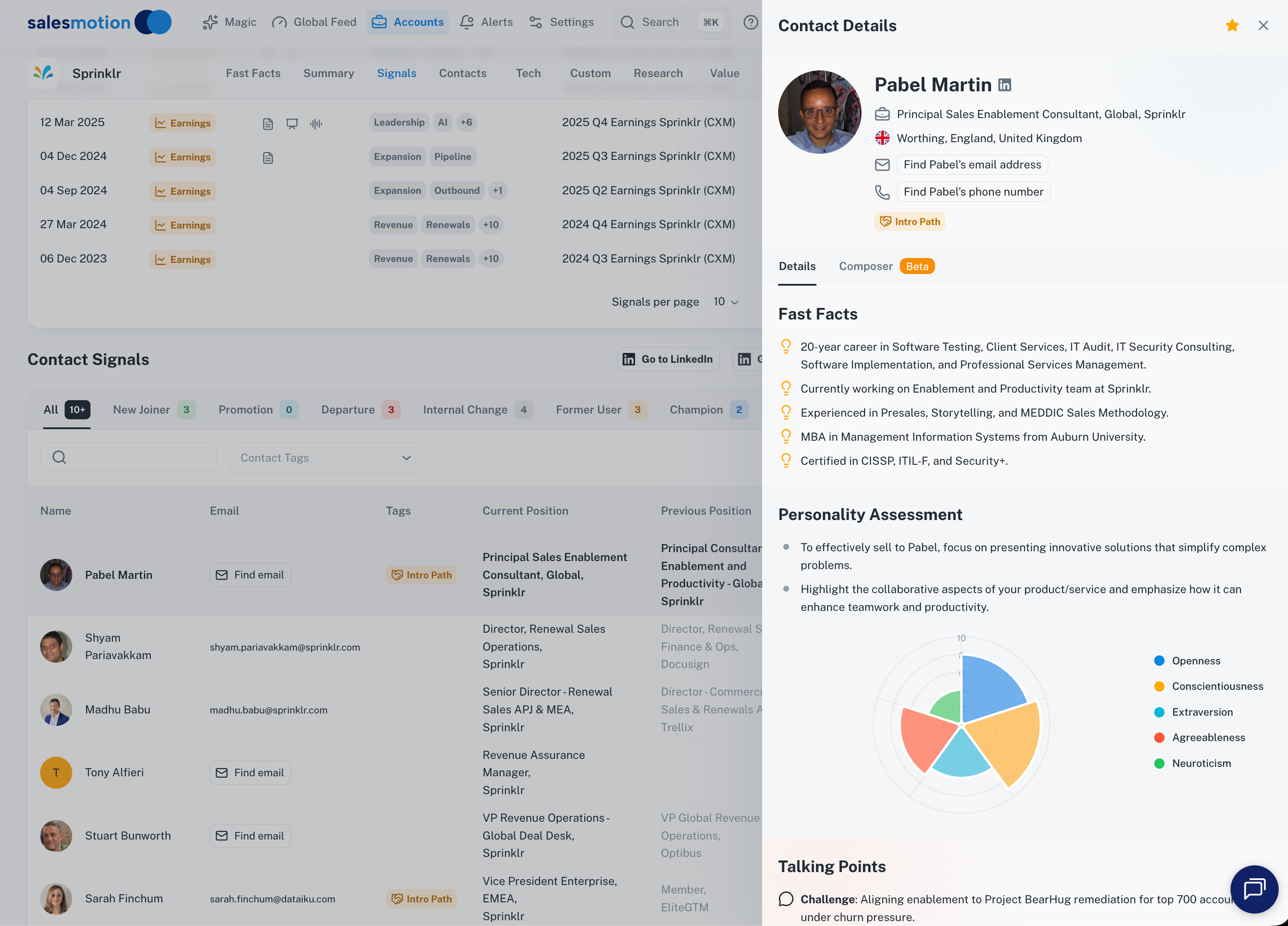 Contact signals on an account: job changes, promotions, and role history per stakeholder, with career background and talking points for the selected contact.

“It's not even just about saving time — it's about uncovering things we otherwise might not research. Salesmotion helps us connect Guild to what's already publicly important to the company.”
Derek Rosen
Director, Strategic Accounts, Guild Education
Relationship Intelligence vs Account Intelligence
Relationship intelligence tells you who your team knows. Account intelligence tells you which accounts are ready to buy and why. The first maps warm paths from your own communication data. The second monitors external signals, earnings calls, leadership changes, hiring, funding, to surface timing and context. They answer different questions, and neither substitutes for the other.
Here is the practical difference:
| Relationship intelligence | Account intelligence | |
|---|---|---|
| Core question | Who do we know there? | Who is ready to buy, and why now? |
| Data source | Your email, calendar, CRM exhaust | External signals: earnings, news, hiring, job changes |
| Output | Relationship strength scores, intro paths | Account briefs, signal alerts, talking points |
| Blind spot | Says nothing about timing or need | Does not score your internal network |
| Best users | VC, PE, banking, professional services | B2B sales and account teams |
The blind spots are the interesting part. A relationship intelligence platform will happily route you a warm intro into an account that has a hiring freeze, a new CFO cutting spend, and no budget. The path is warm; the timing is dead. Conversely, an account showing strong buying signals is worth pursuing even when nobody in your firm knows a soul there, you just enter through relevance instead of referral.
The teams that win combine both: use account intelligence to decide which accounts deserve attention this week, then use relationship data to pick the warmest door in. For a deeper look at the account side of that equation, see our comparison of account intelligence tools.
There is one place the two categories genuinely overlap: job-change tracking. When a contact moves companies, that is simultaneously a relationship event (your network now extends into a new account) and a buying signal (new leaders change vendors in their first months). Job-change signals feed pipeline from both directions, which is why both categories now track them.
A Combined Workflow: Warm Path Plus Timing
Here is what pairing the two looks like for a strategic account team, end to end.
Trigger. A Signal Agent flags two events on a target account in the same week: the company posted three RevOps roles, and a director who championed your product at a previous customer just joined as VP of Operations.
Platform action. The account brief updates automatically: the job change, the hiring pattern, and a line from the latest earnings call about an "operational efficiency initiative." A Research Agent compiles the stakeholder picture so the rep is not starting from a blank page.
Rep action. The rep checks who owned the relationship at the previous customer, gets ten minutes of context from that AE, and sends the new VP a note referencing the initiative and their shared history. The former champion goes on the account's relationship map as the entry point, with two more stakeholders flagged to multi-thread.
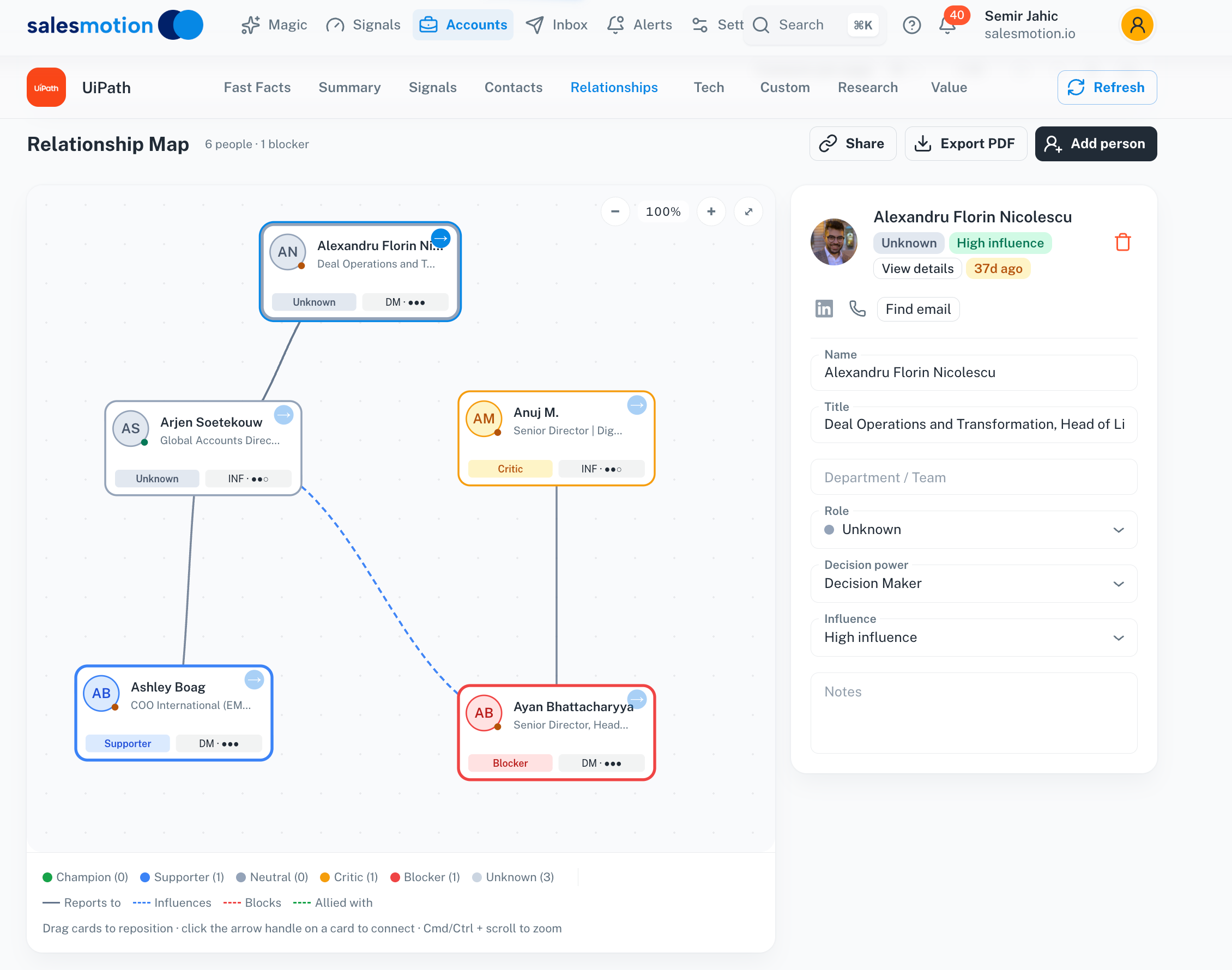 A relationship map on a target account: champion, supporter, critic, and blocker roles with reports-to and influence edges, flagged when someone on the map changes jobs.
Outcome. Meeting booked within the week, and discovery is half-done before the call starts. The relationship provided the door; the signals provided the reason to walk through it now.
This is the pattern behind the numbers in our Guild Education case study: on enterprise deals that run up to 24 months and exceed $20M, Derek Rosen's strategic accounts team saves 6+ hours per rep per week with Salesmotion because the research and monitoring layer runs continuously instead of being rebuilt before every touchpoint. Long-cycle deals are relationship deals, and relationships are maintained with relevance.
Key Takeaways
- Relationship intelligence software maps who your team knows by mining email, calendar, and CRM activity, then scoring relationship strength automatically.
- The category is strongest where deals start with introductions: Affinity for private capital, Introhive for professional services, 4Degrees for lean investment teams.
- Warm paths convert far better than cold outreach, with referral-driven deals closing up to 69 percent faster, but a warm path with dead timing is still a dead deal.
- Relationship intelligence tells you who you know; account intelligence tells you who is ready to buy and why. They have opposite blind spots.
- Job changes are the overlap: one move is both a network extension and a buying signal. Track them systematically, not by accident.
- The winning workflow: let signals pick which accounts deserve attention this week, then use relationship data to choose the warmest way in. See the signal side on a real account.
Frequently Asked Questions
What is relationship intelligence?
Relationship intelligence is software that automatically captures and analyzes your organization's email, calendar, and CRM activity to map professional relationships. It scores how well each person on your team knows each external contact, so reps can find warm introduction paths instead of going in cold. Leading platforms include Affinity, Introhive, and 4Degrees.
What is the difference between relationship intelligence and account intelligence?
Relationship intelligence maps who your team knows, using your own communication data as the source. Account intelligence monitors external signals like earnings calls, leadership changes, and hiring to show which accounts are entering a buying window and why. One provides the warm path, the other provides timing and context. High-performing teams use both rather than choosing between them.
What is relationship intelligence in CRM?
In a CRM context, relationship intelligence replaces manual contact logging with passive, automatic capture. Instead of relying on reps to record every interaction, the platform reads email and calendar metadata, builds the contact graph itself, and scores relationship strength based on frequency, recency, and reciprocity of communication. Tools like Affinity build this into a standalone CRM, while Introhive layers it onto an existing CRM such as Salesforce.
Do small B2B sales teams need a relationship intelligence platform?
Usually not as a first purchase. Relationship intelligence pays off when a large network is invisible, which is a big-firm problem; a ten-person sales team mostly knows who knows whom. Small teams typically get more pipeline impact from account intelligence, since their constraint is knowing which accounts to focus on and when, with Gartner-sized buying groups of 6 to 10 stakeholders making timing and multi-threading the harder problems.