Single-threaded deals have a 5% close rate. Multi-threaded deals with five or more stakeholders engaged close at 30%. That is a 6x difference, and it is the single biggest lever most sales teams are not pulling. Despite the data, 70% of B2B opportunities still have only one point of contact in the CRM.
TL;DR: Multi-threading in sales means engaging multiple stakeholders within a target account rather than relying on a single champion. It is a core tactic of account-based selling. The impact on win rates is dramatic: multi-threading boosts win rates by 130% in deals over $50K (Gong), and cross-department threading increases win rates by 56% (Outreach). The average enterprise deal now involves 11-13 stakeholders, and over 40% of deals stall because stakeholders fail to align internally. The key is sequencing: build a champion first, then expand to the buying committee around the third touchpoint. Leading too early with executives drops win rates by 6%.
Why Single-Threading Kills Enterprise Deals
Most reps work a single contact at each account. They find someone willing to take meetings, run discovery, deliver a demo, and hope that person sells internally on their behalf. This strategy fails for a predictable reason: buying committees do not rubber-stamp decisions that one person champions without organizational alignment.
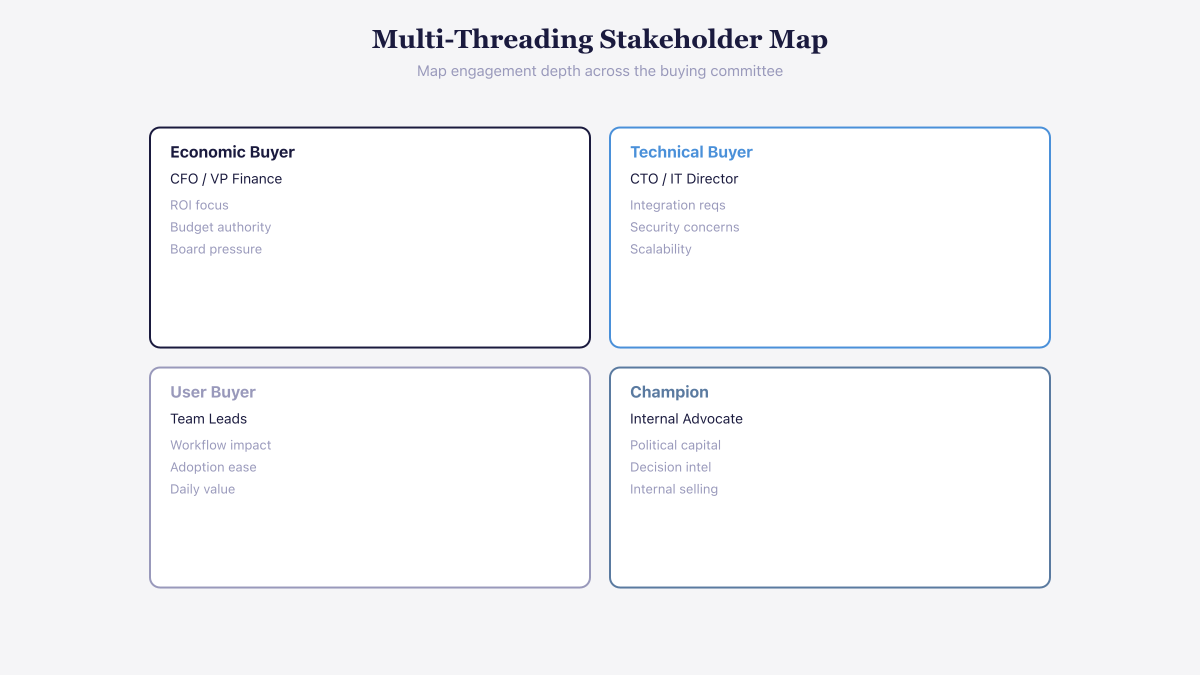 Map every deal across four buying roles to prevent single-thread risk.
The data is clear. After analyzing 1.8 million opportunities, Gong found that deals that close successfully have twice as many buyer contacts as those that do not. Strategic enterprise deals involve an average of 17 contacts. Won deals worth $50K to $250K typically include at least 10 stakeholders.
Over 40% of B2B deals stall not because a competitor won, but because stakeholders fail to align internally. The dreaded "no decision" outcome, where the buying committee cannot agree on priorities, budget, or timing, kills more pipeline than any competitor. Multi-threading is the strategy that prevents this by building consensus across the organization before the decision moment arrives.
See Salesmotion on a real account
Book a 15-minute demo and see how your team saves hours on account research.
The Sequencing That Matters
Multi-threading is not about contacting everyone at the account simultaneously on day one. Sequencing determines whether the approach builds momentum or creates chaos.
Start with a champion (touchpoints 1-2). Your first goal is identifying and developing a single strong champion: the person who experiences the pain your product solves, understands the potential impact, and can navigate internal politics. Not every friendly contact is a champion. For a systematic approach to finding and enabling advocates, see our champion tracking guide. A true champion can map the buying committee, anticipate competing priorities, and articulate why this purchase matters relative to other demands on budget and attention.
Expand to the buying committee (touchpoint 3+). Gong's data shows that win rates rise approximately 5% when executives are introduced around the third touchpoint. Conversely, win rates drop 6% when an executive is the first person contacted. The reason is intuitive: reaching an executive without an internal champion who has done the groundwork means your message arrives without context or urgency.
Engage each persona with role-specific messaging. The end user cares about daily workflow improvement. The budget holder cares about ROI and cost justification. The IT evaluator cares about security, integration, and implementation. The executive sponsor cares about strategic alignment. Same solution, different conversation for each.
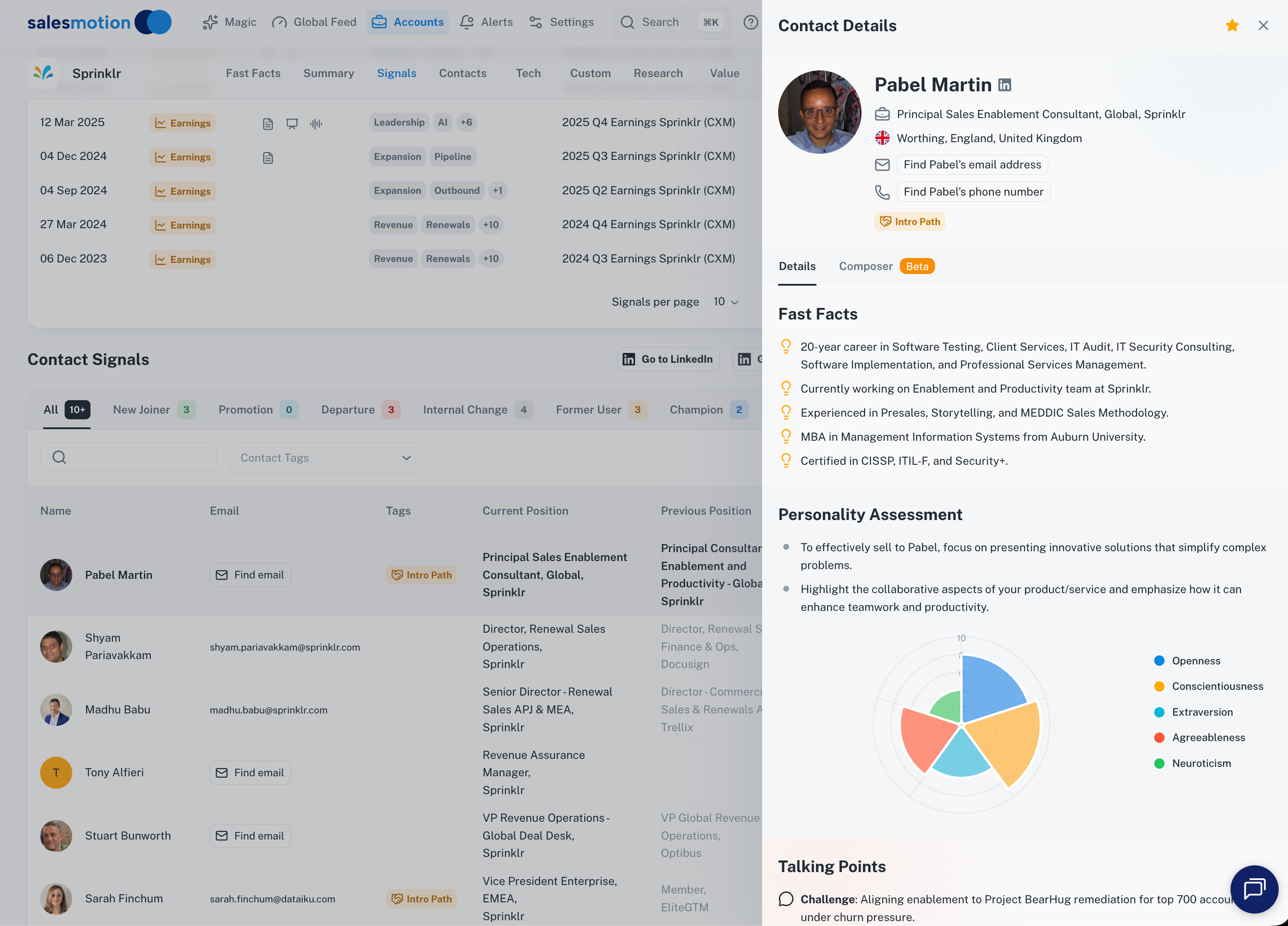 Salesmotion maps the buying committee at each account, giving reps the stakeholder intelligence needed to multi-thread with role-specific messaging.

“The talking points are gold. If they're in Salesmotion, I know they're being discussed inside that business. That makes it easy to spark a real conversation, which is 90 percent of the battle.”
Andrew Giordano
VP of Global Commercial Operations, Analytic Partners
Three Tactical Moves for Expanding the Thread
1. Ghostwrite the Introduction
Do not ask your champion to write an email introducing you to their boss or colleagues. That creates work and friction. Instead, draft the introduction email yourself and send it to your champion for review and forwarding. Make it easy for them to say yes by doing the heavy lifting.
A well-crafted internal forward looks like: "[Champion] shares a brief summary of the problem you discussed, why this warrants a broader conversation, and a proposed 30-minute meeting." Include a specific meeting agenda, not just "let us chat."
2. Open Group Meetings With Problem Alignment
When you get the group meeting, resist the temptation to demo. Start by aligning the room on the problem definition. Each stakeholder experiences the problem differently. The VP of Sales sees pipeline predictability issues. The RevOps leader sees data fragmentation. The CFO sees rising customer acquisition costs.
Ask the group: "We have heard from [champion] about the challenge around X. How does this show up for each of your teams?" This surfaces perspectives you would never hear in a one-on-one and identifies the stakeholders who feel the most urgency.
3. Invite Disagreement Early
The worst time to discover hidden objections is during contract review. Actively surface disagreement during the problem alignment phase by asking: "Who has a different view on how we have outlined this problem?" or "What would prevent this from being a priority for the next quarter?"
Objections voiced early can be addressed. Objections suppressed until the decision moment become deal-killers that your champion cannot resolve alone.
Building the Business Case Across Functions
Multi-threading is not just about access. It is about building a business case that spans multiple functions, which is what justifies six and seven-figure purchases.
A business case built with one champion covers one function's pain. A business case built with five stakeholders quantifies the cost of inaction across sales, marketing, operations, IT, and finance. The aggregate number is always larger and more compelling than any single department's problem.
A practical framework for co-building the business case:
- Identify who most likely experiences the problem in each function
- Document how each team currently works around it
- Establish the negative consequence of the status quo for each team
- Quantify how often the problem occurs and what it costs
- Present a benchmark showing how comparable companies solve it
- Have each stakeholder assess the gap between their current state and the benchmark
This approach produces a grounded, credible business case that the buying committee co-authored rather than one your champion must sell internally alone.

“My ultimate goal is to know more about the company than they know themselves. Before, that took hours across multiple tools. With Salesmotion, I can get there in 30 minutes or less and walk into a Fortune 500 conversation fully prepared.”
Jeff Dalo
Senior Director Business Development, Analytic Partners
Multi-Threading With AI in 2027
The practical barrier to multi-threading has always been time. Researching each stakeholder, crafting role-specific messages, tracking engagement across multiple contacts, and coordinating outreach timing across the buying committee is labor-intensive.
Account intelligence tools now automate much of this work. AI can identify the likely buying committee members based on org chart data and buying signals. It can draft role-specific outreach referencing each stakeholder's likely priorities. It can track engagement patterns across the account and flag when a key stakeholder has gone silent.
Top reps using AI for multi-threading generate 77% more revenue because the technology removes the administrative overhead that previously limited how many accounts a rep could multi-thread simultaneously.
Key Takeaways
- Single-threaded deals close at 5%. Multi-threaded deals with five stakeholders close at 30%. This is the highest-leverage improvement most teams can make.
- Sequence matters: build a champion first, then expand to the buying committee around the third touchpoint. Leading with executives too early drops win rates.
- Won enterprise deals involve twice as many buyer contacts as lost deals. Strategic deals average 17 contacts.
- Open group meetings with problem alignment, not demos. Surface disagreement early to prevent late-stage deal collapse.
- Build the business case across functions. A multi-department cost-of-inaction analysis justifies larger deals and builds broader organizational commitment.
- Use AI prospecting tools to automate stakeholder research and engagement tracking. The time savings let reps multi-thread more accounts without sacrificing depth.
Frequently Asked Questions
How many stakeholders should you engage in an enterprise deal?
The research says the more the better, up to a point. Gong's data shows won deals in the $50K-$250K range involve at least 10 stakeholders. For strategic deals, the average is 17 contacts. A practical minimum is three to five: champion, economic buyer, and one to two technical or functional evaluators. The key is not just the count but the coverage. Ensure you have contacts from every function that influences the decision: the user team, IT, finance, and executive leadership.
When should you bring executives into a deal?
Around the third touchpoint, not the first. Gong's analysis of over one million executive sales cycles found that win rates drop approximately 6% when an executive is the first contact but rise approximately 5% when executives are introduced around the third touchpoint. Use early interactions to build a champion who can provide context and urgency. When the executive enters the conversation, they should already understand the problem through their team's lens, not yours.
What is the biggest risk of multi-threading?
Overwhelming the account with uncoordinated outreach. If your SDR, AE, and marketing team all contact different stakeholders with different messages in the same week, the account experiences chaos, not coordination. Use account-level coordination rules: one primary rep owns the account, all outreach is sequenced intentionally, and every touchpoint builds on the previous one. The goal is orchestrated engagement, not a multi-channel spam campaign targeting the same company from different angles.