When a VP of Sales at your best customer takes a new role at a company you have never sold to, two things happen simultaneously: your existing account is at risk, and a new account just became significantly more likely to buy. Most teams treat that moment as an anecdote. This post treats it as a channel, with its own conversion rates, volume assumptions, and pipeline contribution you can forecast and measure. Job change signals are a powerful form of buying signal, and the economics behind them are better documented than almost any other trigger.
TL;DR: Job change signals behave like a pipeline channel, not a lucky break. Vendor-published benchmarks put win rates on deals with prior product experience at roughly double those of cold outbound, and a tracked list of 1,000 contacts typically produces 12-38 qualified conversations a year from this signal alone. This post covers the math: which moves are worth acting on, the conversion benchmarks, and how to measure the channel's pipeline contribution.
This is the economics companion to our full guide on how to track job changes, which covers the manual methods, the tool landscape (UserGems, Champify, Salesmotion), and the alert-to-outreach workflow step by step.
Why Job Changes Are a Powerful Buying Signal
Job changes work as buying signals for three reasons that are consistent across industries.
New leaders have a mandate for change. Executives are hired to improve performance. They evaluate existing tools, processes, and vendors with fresh eyes and limited loyalty to incumbents. Harvard Business Review's research on leadership transitions describes the first 100 days as the period when new leaders set direction and make their early moves, which in practice includes vendor reviews.
Champions carry vendor preferences. When a VP of Revenue Operations who used your product at Company A joins Company B, they bring their experience with them. Champify's value report quantifies the effect: opportunities with former advocates won at 39% on average, versus under 19% for the SaaS average.
The transition window is finite. Openness to new vendors is highest in the first 90 days and declines steadily. By the end of year one, the new leader has settled into existing processes. Speed is what converts the signal into pipeline.
See Salesmotion on a real account
Book a 15-minute demo and see how your team saves hours on account research.
Which Job Changes Are Worth Acting On
Not all moves carry the same expected value. Ranked by conversion potential:
Customer Champions Moving to New Companies
The highest-value signal. A contact who used your product and can speak to its value from personal experience is now at a new organization. They know the ROI, the implementation, and the story to tell internally. Champify's report found former advocates convert 6.3x more efficiently from first touch to closed-won.
Prospect Contacts Changing Roles
Contacts from deals that stalled or were lost sometimes land where the budget, timing, or strategic priority aligns better. A "not now" from 18 months ago can become a "yes" at a new company.
Decision Makers Entering Your Target Accounts
When a target account hires a new CTO, VP of Sales, or other key decision maker, that is a buying window regardless of prior relationship. New hires evaluate vendors during their first 90 days, and reaching them early puts you on the shortlist.
Internal Promotions and Lateral Moves
Often overlooked. When your champion at an existing account gets promoted from Director to VP, they gain budget authority. When they move between divisions, they can carry your product into a new business unit.

“Automatic account profile detail I can use to manage my territory. Using Salesmotion AI to generate value statements per persona, account, etc. Using Salesmotion to give me a starting point based on new hires, or news alerts is critical.”
Adam Wainwright
Head of Revenue, Cacheflow
The Pipeline Math: What a Tracked List Produces
Here is the portfolio-level arithmetic that turns this from a tactic into a forecastable channel.
Assume you track 1,000 contacts across customers, past evaluators, and closed-lost opportunities. In a typical year, around 20% of those contacts change jobs, a figure UserGems cites from its tracking data, which yields roughly 200 moves. Of those, perhaps 40-50% land at companies that fit your ICP: 80-100 qualified signals. With a 15-25% response rate on warm outreach to known contacts, that produces 12-38 qualified conversations per year from this single signal source.
Compare the cold equivalent. A 2-3% response rate on 10,000 cold emails produces 200-300 responses, many unqualified, at far higher effort per conversation. Job change signals produce fewer but significantly higher-quality conversations: UserGems reports previous customers are 3x more likely to buy again, and Champify's win-rate data (39% vs under 19% for the SaaS average) implies each conversation is roughly twice as likely to become a closed deal.
Put dollar values on it and the channel sizes itself. At a $50,000 ACV, 20 qualified conversations converting at 25% to opportunities, with a 37% win rate, is roughly $90,000-$100,000 in closed revenue per 1,000 tracked contacts per year. Scale the tracked list and the channel scales linearly, which is exactly the property that makes it worth instrumenting properly.
Teams running systematic job change programs alongside broader buying signals typically report this channel generating 10-20% of total pipeline with conversion rates 2-3x higher than cold outbound. The key is treating it as a process with owned metrics, not a one-time play.
Detection: The Variable That Moves the Math
Every number above degrades with detection lag. A move caught in week one lands in the high-conversion window; a move caught at the next quarterly CRM audit has burned 6+ weeks of a 90-day window before the first touch.
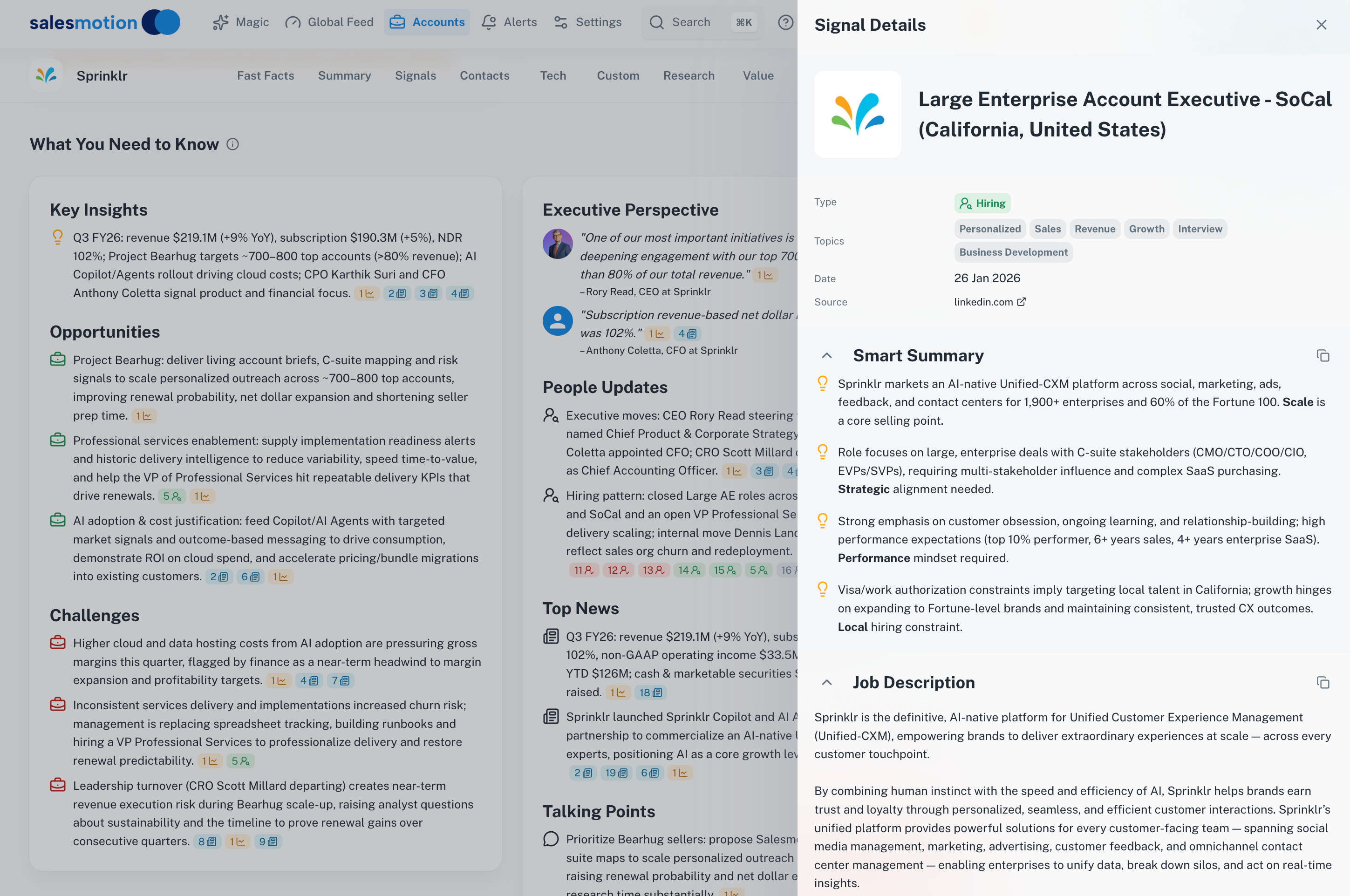 A hiring signals view surfaces new roles and leadership changes at target accounts, so reps act on job change buying windows within days rather than discovering them months later.
The detection options range from free and slow (LinkedIn audits, Sales Navigator alerts) to dedicated champion-tracking tools like Champify, to multi-signal platforms such as UserGems and Salesmotion. Salesmotion monitors job changes alongside dozens of other signal types, including hiring patterns, earnings commentary, funding rounds, and strategic announcements, so the move surfaces with the new company's context attached: whether it fits, what they are working on, and what the outreach angle is. The full breakdown of methods, tools, and pricing lives in our job change tracking guide.
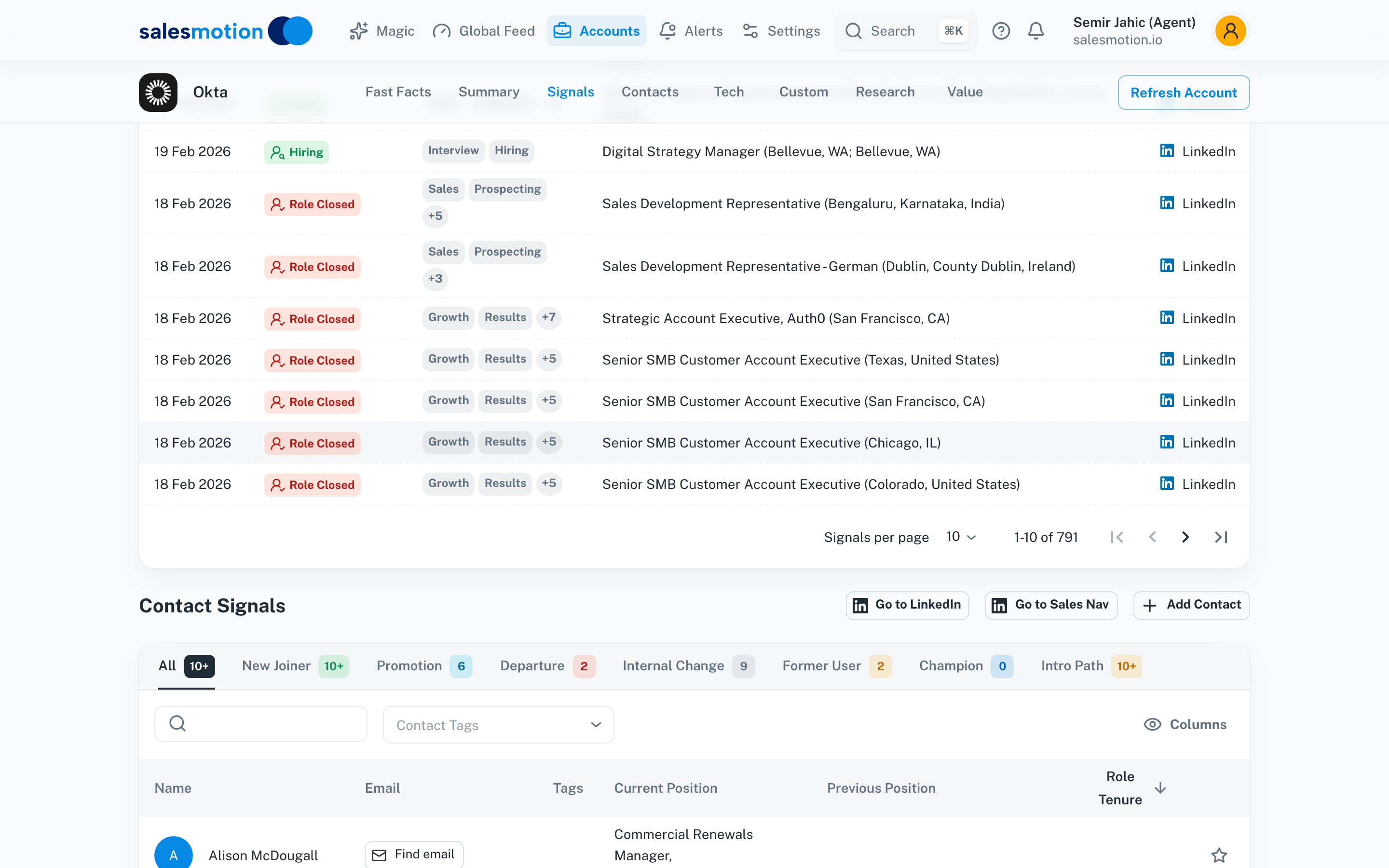 Salesmotion tracks job change signals with full details, including role titles, keywords, and sources, so reps can act on hiring-driven buying windows before competitors.
For the math, what matters is one number: median days from move to first touch. Everything downstream improves when it shrinks.

“The account and contact signals are key for reaching out at important times, and the value-add messaging it creates unique to every contact helps save time and efficiency.”
Daniel Pitman
Mid-Market Account Executive, Black Swan Data
The Outreach That Converts the Signal
The outreach for job change signals follows a distinct pattern that differs from cold prospecting.
Timing: speed wins. Reach out within 30 days of the move, while the new leader is mapping the landscape and forming opinions. Champify's data shows engaging former customers produced a 100% increase in response rate compared to cold outreach.
Tone: congratulatory, not salesy. Start with congratulations. Reference shared history or the specific challenge their new organization faces. Do not pitch in the first message; the goal is re-establishing the relationship.
Content: make it about their new context. The best job change outreach references the new company's situation: "Congratulations on the new role at Acme Corp. I noticed they recently posted several data engineering roles, which suggests you are scaling data infrastructure. When we worked together at Beta Co, you mentioned this was a priority. Happy to share what has changed since then." It demonstrates real research, memory of the relationship, and value specific to the new role.
Multi-touch: plan for 3-5 touches. Email, LinkedIn message, email with relevant content, then a call. Every touch must add new value; never just ask if they saw the last message.
Measuring the Channel
To run job change signals as a pipeline channel, instrument four metrics and review them quarterly:
- Detection lag: median days from the actual move to the alert
- Response time: alert to first touch
- Conversion rate: signal-sourced outreach to meetings, and meetings to opportunities
- Pipeline contribution: dollars of pipeline and closed-won sourced from job change signals, tagged at the opportunity level
Tag the source in your CRM the day the opportunity is created, not retroactively. Channel attribution done after the fact systematically undercounts signal-sourced pipeline because reps remember the meeting, not the trigger that created it.
Key Takeaways
- Job change signals are a forecastable pipeline channel: 1,000 tracked contacts typically yield ~200 moves, 80-100 ICP-fit signals, and 12-38 qualified conversations per year
- Vendor-published benchmarks (Champify, UserGems) put win rates on deals with former advocates at roughly 2x the SaaS average, with 6.3x more efficient first-touch-to-close conversion for former advocates
- Detection lag is the variable that moves the math most: a move caught in week one lands inside the high-conversion 90-day window, a quarterly audit burns half of it
- Warm outreach to known contacts who changed jobs converts at 2-3x the rate of cold outbound, and the channel typically contributes 10-20% of total pipeline once systematized
- Single-signal data tells you a contact moved; combining it with account intelligence tells you whether the new company is worth pursuing and with what angle
- Measure four numbers quarterly: detection lag, response time, conversion rate, and tagged pipeline contribution
Frequently Asked Questions
How much pipeline can job change signals generate?
Teams running systematic programs typically report 10-20% of total pipeline from this channel. The unit math: per 1,000 tracked contacts, expect roughly 200 moves per year, 80-100 of which fit your ICP, converting to 12-38 qualified conversations at warm-outreach response rates of 15-25%. At a $50,000 ACV that supports roughly $90,000-$100,000 in closed revenue per 1,000 tracked contacts annually.
How quickly should I reach out after a contact changes jobs?
Within 30 days. The first month in a new role is when leaders are most open to evaluating vendors and meeting known contacts. After 90 days the window narrows significantly as they settle into existing processes. Set up alerts so you detect changes within days; our job change tracking guide compares the detection methods and tools.
What is the difference between UserGems and Salesmotion for job change signals?
UserGems started with job-change tracking among your CRM contacts and now covers 30+ native signals with AI agents for outbound and ABM. Salesmotion tracks job changes alongside dozens of other signal types, including hiring patterns, earnings commentary, funding rounds, and strategic initiatives. The difference is the starting point: UserGems builds from the contacts and history in your CRM, while Salesmotion monitors 1,000+ public sources and delivers a cited account brief that shows the new company's strategic context and whether the account is showing other buying signals that make it worth pursuing.
Should I reach out differently to former customers versus former prospects?
Yes. Former customers get a warmer approach: reference specific outcomes you delivered, offer to replicate that success, and share relevant case studies. Former prospects get a lighter touch: acknowledge the prior conversation, reference what has changed since then (new features, new customer results), and offer a fresh evaluation. In both cases, lead with value, not a pitch.