Most sales teams don't have a next-step problem. They have a fake next-step problem. Reps leave calls saying, “We're aligned, I'll follow up next week,” then wonder why the deal stalls, the forecast slips, and the CRM turns into a museum of hopeful notes.
TL;DR: A real sales next step has five parts: a specific action, a buyer-side deliverable, a date and time, a single owner on each side, and a benefit the buyer can explain internally. Match the ask to the deal stage, let account signals change it, and manage the team on next-step coverage, next-step adherence and mutual action plan coverage instead of activity volume.
The fix is not to “always book the next meeting.” That advice is too lazy for real deals. A real sales next step is a deliberate decision about how to advance conviction, reduce risk, or align the buying committee, with clear ownership and a due date that both sides can repeat back.
Why Most Sales Next Steps Are an Illusion
The problem starts with false momentum. A rep sends a recap, drops a calendar hold, and logs a vague task, then calls the opportunity healthy because something is on the board. In reality, a deal with no valid next step, no due date, and no named owner is not progressing, it's unmanaged. Revenue leaders know that when next steps are missing or vague, forecast quality drops, follow-up becomes inconsistent, and deal momentum weakens. That's why the useful metrics are next-step coverage rate, next-step adherence rate, and mutual action plan coverage rate, not just activity volume. Sales process metrics and next-step definitions
The three questions that expose weak next steps
If you run deal reviews, ask these every time.
- What exactly happens next? If the answer is “we'll reconnect,” the rep doesn't have control.
- Who owns the buyer-side action? If nobody on the buyer side has a deliverable, the step is just a hope.
- What changes after this step? If the answer is nothing measurable, the step is decorative.
The other illusion is linguistic. Reps say things like “circle back,” “touch base,” or “send the proposal,” and those phrases feel productive because they're common. They're not productive. They don't tell the buyer what to do, when to do it, or why it matters, and they give managers nothing useful to inspect in a forecast call.
Practical rule: If the next step can't be explained in one sentence without hand-waving, it isn't a next step.
That's why I push back hard when I hear, “We're aligned, follow-up next week.” Aligned on what? A calendar hold is not alignment. A real next step is a buyer-visible action that proves the deal moved, not a rep's intention to keep the file warm.
See Salesmotion in action
Take a self-guided interactive tour — no signup required.
Anatomy of a Next Step That Actually Moves a Deal
A qualified next step has five parts, and if one is missing, the rep should rewrite it before the call ends. The step needs a specific action, a buyer-side deliverable, a date and time, a single owner on each side, and a mutual benefit the buyer can explain internally. That turns a polite ending into something you can audit later in CRM, deal review, and forecast inspection.
A real discovery call, not a fake one
A rep is on a discovery call with a Series B fintech. The VP of RevOps says they're rebuilding outbound sequences because current ones aren't producing enough meetings. A lazy rep jumps straight to the demo and says they'll send “some materials.” A better rep proposes a 30-minute working session with the buyer's CRO and the rep's solutions engineer to pressure-test the sequencing change.
That next step works because it has a purpose the buyer values. It's not “book time for the sake of time.” It's a working session to validate a live operational problem, surface internal alignment issues, and move the buyer one step closer to consensus.
What to say instead of weak language
Use language that is concrete and easy to forward internally. “I'll send the proposal” becomes “I'll send a redlined scope by Tuesday at 3, and you'll confirm which stakeholders need to review it.” “Let's circle back next week” becomes “Let's hold Thursday at 10 for a working session with your CRO and our solutions engineer to confirm whether the sequence redesign is worth prioritizing.”
Buyer-friendly next steps sound useful, not pushy. The buyer should hear a clear reason to say yes, not a rep trying to force calendar motion.
If you want a clean transcript of what was agreed, use a transcript tool and keep the follow-up in one place. A practical companion resource is the Zoom meeting transcript guide, because the issue after the call is often less memory than documentation. For prep, I also like a structured account briefing process, like the one in this pre-call research checklist, because the quality of the next step usually depends on the quality of the opening questions.

“Consolidation of prospect company information that I can use frequently to be way better informed when I'm doing my outbound, preparing for a meeting, or building relationships. Ease of use and Customer Support is excellent.”
Werner Schmidt
CEO & Co-Founder, Lative
Matching the Next Step to the Deal Stage
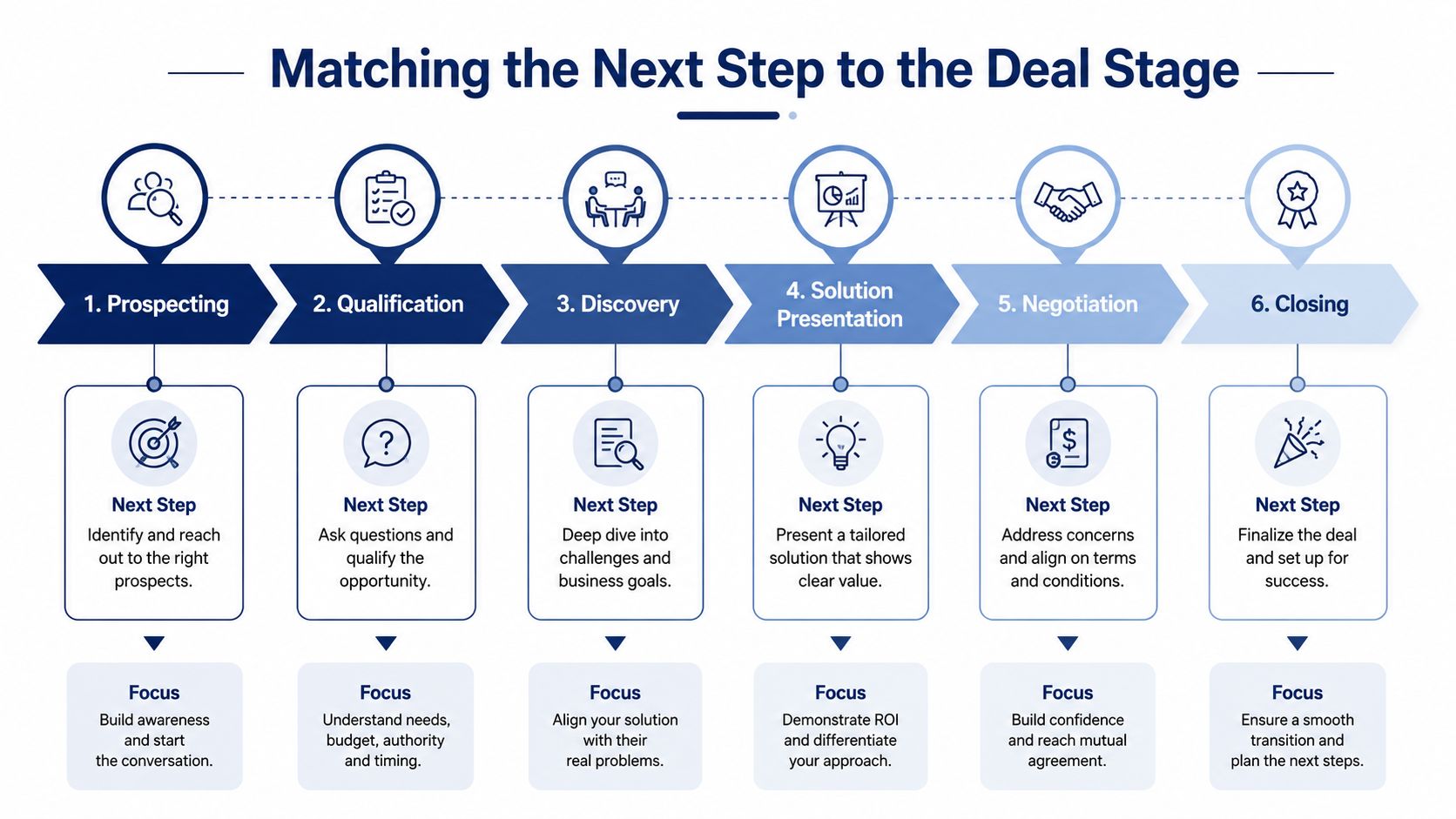
The right next step depends on where the deal is, who's involved, and how ready the buyer really is. Early discovery doesn't need a hard close. Enterprise evaluation doesn't need another generic demo. Treating both the same is how reps waste cycles and keep asking for meetings that don't change the deal.
Discovery needs low-friction motion
A single-thread pilot at a 50-person startup usually needs a light ask. The next step might be a problem-validation call, a recap email, or a short review of the current workflow with the operator who feels the pain most directly. If the buyer is still clarifying the problem, forcing a demo just creates work they're not ready to do.
That's why a low-pressure follow-up often beats a bigger meeting in early discovery. The goal is to keep the conversation open while helping the buyer sharpen the issue. If you ask for too much too soon, you don't look confident. You look impatient.
Evaluation needs stakeholder movement
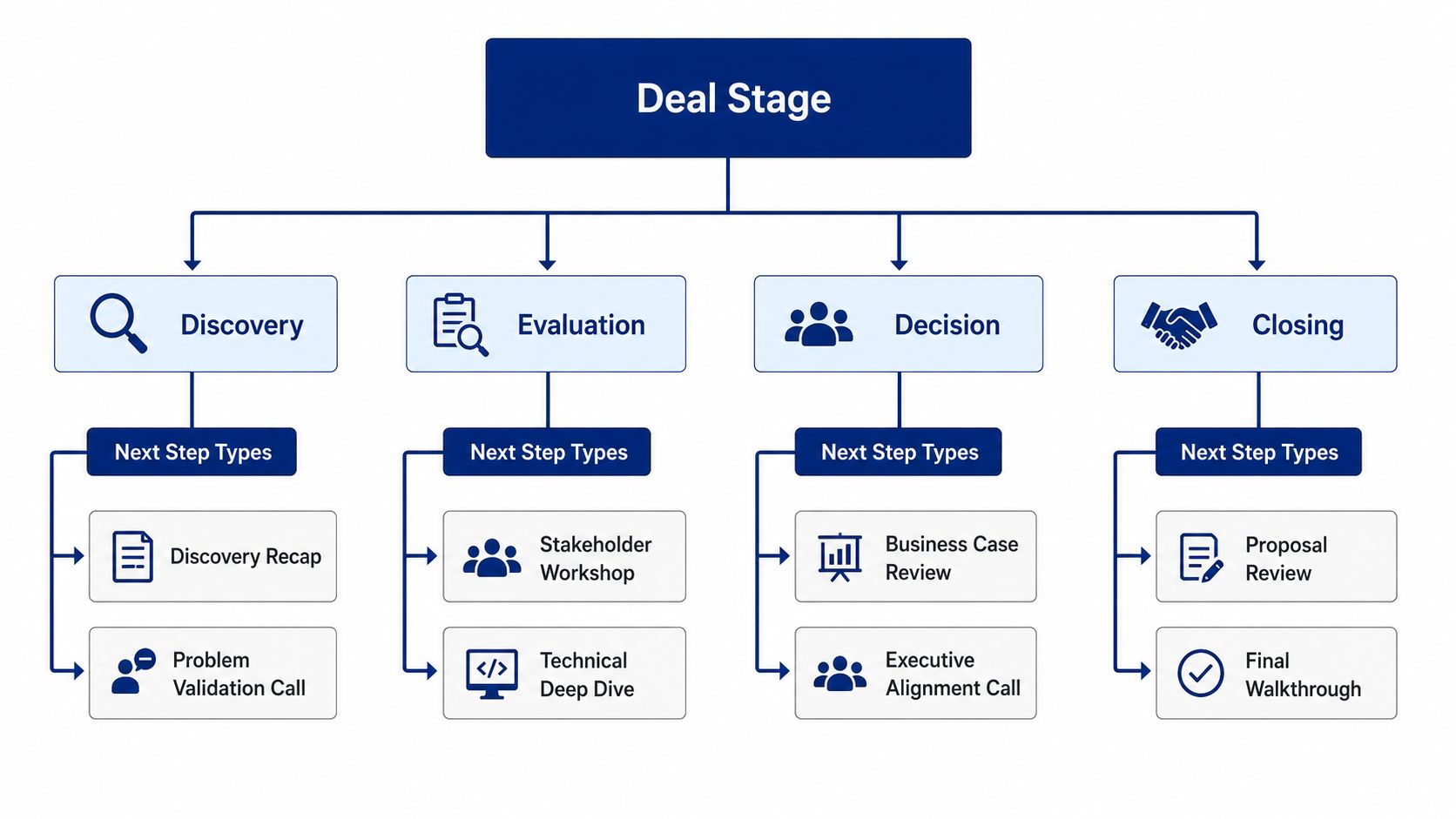
A six-stakeholder enterprise deal is different. At that point, the next step should usually be something that improves alignment, not just curiosity. That could be a stakeholder workshop, a technical deep dive, or a mutual action plan review, depending on where the friction sits.
One useful lens is this. Ask whether the step advances conviction, alignment, or risk reduction. If it does none of those, don't book it. Another useful test is whether the buyer would still need the step if they were considering a competitor. If the answer is no, it's probably filler.
The basic sequence logic is simple.
- Discovery recap: Use it when the buyer needs clarity and the rep needs confirmation.
- Stakeholder workshop: Use it when the deal is blocked by competing opinions.
- Technical validation: Use it when implementation risk is slowing the buyer down.
- Mutual action plan: Use it when later-stage momentum needs structure.
- Executive alignment: Use it when the champion can't move the deal alone.
- Commercial close: Use it when the buyer is ready to decide and terms are the only issue.
If you want content that helps with outbound relevance across those stages, the content for B2B lead generation resource is a useful reference point for shaping message timing, especially when the ask changes by stage.
The stage tells you what kind of yes you need
In discovery, you need a yes to a problem review. In evaluation, you need a yes to a decision-making activity. In closing, you need a yes to a commitment rule or commercial condition. The seller's job is to match the ask to the deal stage and the committee complexity, not to keep asking for “one more meeting.”
Ready-to-Use Templates for Every Channel
A good template should make the rep faster without making the buyer feel processed. The trick is to keep the ask narrow, the value obvious, and the fallback easy. If the buyer can't do the main step, the message should still give them a path forward instead of turning into silence.
Email that sounds like a human wrote it
Subject: Next step on your outbound sequence rebuild
Hi Jordan,
Thanks for the call today. You said the team is rebuilding outbound sequences and wants to pressure-test what's working before changing the rest of the process.
I'd like to set up a 30-minute working session next Tuesday at 10 a.m. with you, your CRO, and our solutions engineer. We can review the current sequence logic, identify where replies are getting lost, and decide whether a deeper technical review is worth it.
If that time doesn't work, send me two slots and I'll adjust.
Best, [Rep Name]
That works because it starts with the trigger, names the outcome, sets a date, and gives a graceful fallback. A weak version would be: “Just checking in to see if you had thoughts.” That line creates work for the buyer and gives them nothing to react to.
Slack that doesn't disappear into the void
Slack works when the buyer already lives there. Keep it short.
Hi Jordan, following up on the sequence rebuild we discussed. Would a 30-minute working session next Tuesday with your CRO and our solutions engineer help you pressure-test the approach? If not, send me a better time and I'll work around it.
The point is not to be clever. The point is to make the ask easy to understand in one glance.
CRM task that managers can actually inspect
Task name, Sequence rebuild working session scheduled. Owner, rep. Due date, Tuesday 10 a.m. Deliverable, confirm buyer attendance and agenda. Buyer-side action, CRO reviews sequence priorities before the meeting.
That kind of field structure matters because managers need to see whether the next step is real, not just whether a task exists. If you want template libraries for broader sequencing, this sales cadence templates resource is a useful companion.

“This is my singular place that very simply summarizes a company's top initiatives, strategies and connects them to my solution. Something I would spend hours researching manually, now it's automated.”
Derek Rosen
Director, Strategic Accounts, Guild Education
Signal-Driven Triggers That Change the Ask
Static ICP rules are too slow for real selling. The right next step often comes from a live trigger, not from last quarter's segmentation. A newly hired CRO, a competitor mention in an earnings call, or an office expansion filing all change the ask because they change what the buyer cares about right now.
A new CRO means the buyer map changed
A new CRO is not just a hiring event. It usually means priorities are being reset, internal language is changing, and old assumptions need to be revalidated. The next step should not be a product demo. It should be a 20-minute priorities call to understand what the new leader is trying to fix first.
That's the so-what work reps need to do in under five minutes. The signal tells you something changed. Your job is to decide how that change affects urgency, stakeholder ownership, and timing. If the role changed, the conversation should change too.
Competitor mentions shift the frame to risk
When a competitor shows up in an earnings call, the next step becomes a side-by-side conversation. That's the moment to propose a workshop that compares outcomes, implementation risk, and switching friction. Buyers are usually more open to that than to another generic product walkthrough because the trigger itself has raised the stakes.
An office expansion filing opens a different door. That signal usually points toward a hiring-signal play, which means the next step should reference the role that matters most, not the broad company event. If the expansion supports a larger team or new region, the ask should match the operational change, not the press release wording.
Use signals to sharpen the ask, not to decorate the email. The buyer does not care that you noticed the event. They care that you understood what it means for their decision.
A platform like Salesmotion can surface monitored account events, provide an opinionated “so what,” and draft a next action from that signal, which saves reps from doing the research manually every time. That matters because timing is everything in this part of the workflow, and stale context kills relevance. For broader sales trigger ideas, the sales trigger events guide is worth bookmarking.
KPIs That Tell You If Next Steps Are Working
Many sales teams track activity and assume discipline is present. It isn't. Calls, emails, and demos confirm a rep was busy. They do not reveal whether the buyer advanced. A small dashboard built around a few next-step metrics serves as a much better management tool.
What to measure
Track next-step coverage rate, the share of open opportunities with a valid action, owner, and date. Track next-step adherence rate, the share of planned next steps completed by the agreed due date. Track mutual action plan coverage rate for later-stage deals where a shared close plan should exist. These are the mechanics that turn deal management into something you can inspect instead of something you feel.
The easiest way to use them is in weekly pipeline reviews.
- Coverage rate: Shows whether deals are managed.
- Adherence rate: Shows whether reps are keeping commitments.
- MAP coverage: Shows whether late-stage deals have buyer-side structure.
You don't need a giant dashboard. You need a clean one. The conversation should move from “Did you follow up?” to “Did the buyer advance?” because that's the only question that really matters for revenue.
What managers should do with the numbers
If coverage is weak, the rep isn't ending calls properly. If adherence is weak, the rep is overpromising or failing to calendar the next action with the buyer. If MAP coverage is weak in late-stage opportunities, the deal is probably relying too much on hope and too little on shared execution.
A practical sales process should also define stage exit criteria and required CRM fields, so reps can't move deals forward without buyer proof. That structure keeps the system honest. It also makes next-step hygiene a management standard, not a nagging exercise.
For teams building out the broader reporting stack, the sales pipeline metrics guide is a practical companion to this scorecard approach.
Your 30-Day Next-Step Rollout Plan
The fastest way to fix this on a team is to make the process simpler than the current mess. Don't add a big program. Don't flood CRM with fields. Install a tighter rule set, teach it in live deals, and inspect it every week.
Week one through week four
| Week | Focus | Owner | Output |
|---|---|---|---|
| Week 1 | Diagnostic | Manager | Pull coverage and adherence by rep and segment |
| Week 2 | Workshop | Manager and RevOps | Rewrite stage exit criteria and buyer deliverables |
| Week 3 | Implementation | Reps and manager | Practice templates in CRM and rewrite weak next steps live |
| Week 4 | Review | Manager | Inspect the first dashboard and refine the process |
Week one is not a training week. It's a truth week. Pull the numbers, look for weak patterns, and identify which reps are improvising instead of managing. Week two is where you rewrite stage exit criteria so every transition requires a buyer-side deliverable, not a rep activity.
Week three is where the team practices the templates and rewrites three weak next steps on the spot during a live deal review. That's the fastest way to change behavior without asking for faith. Week four is when the new scorecard gets wired into the forecast call and the one-on-one template, so managers stop asking for updates and start inspecting buyer movement.
What to avoid
- Rolling it out in Q4: Teams are already overloaded, and the process gets blamed for existing pressure.
- Adding twelve CRM fields at once: Reps won't comply, and managers won't inspect them anyway.
- Letting vague language survive: If “circle back” lives, the old habits live too.
Manager checklist: If the deal has no buyer-side deliverable, no due date, and no named owner, it is not ready for the pipeline review.
Expect the first 90 days to surface ugly truth. Some forecast conversations will get easier because the next step is now visible. Some deals will reveal that they were already lost, just hidden behind polite follow-up. That's a good outcome. You can't manage what you refuse to name.
If you want a tighter system for sales next steps, Salesmotion helps teams turn account signals into the right follow-up action, faster. It monitors triggers across target accounts, surfaces the context that matters, and gives reps a clearer next move instead of another blank follow-up task. Visit Salesmotion if you want your team to spend less time guessing the next step and more time advancing real deals.