Scaling outbound does not require a bigger team. It requires better intelligence, sharper prioritization, and automation that multiplies what your existing reps can do. Most sales leaders default to the same playbook when pipeline targets go up: post a job listing for three more SDRs and hope they ramp fast enough. But the math on that approach is getting worse every year, while the math on AI-powered sales intelligence is getting dramatically better.
This guide breaks down four strategies for scaling outbound research and pipeline generation without adding headcount, with real cost comparisons and case studies from teams that have done it.
TL;DR: Hiring 3 SDRs costs $210K-$270K+ per year when you factor in salary, tools, and management overhead. AI-powered account intelligence platforms like Salesmotion can deliver the same research output for $12K-$24K per year, freeing your existing reps to focus on selling instead of researching.
Key Takeaways
- The fully-loaded cost of scaling through headcount is 10-20x more expensive than scaling through AI automation.
- Signal-based prioritization eliminates the spray-and-pray problem that makes SDR teams inefficient.
- AI-drafted outreach anchored to real account research outperforms generic templates written by junior reps.
- Consolidating your tool stack into a single intelligence layer removes the 3-5 hours per week reps lose to context switching.
- Real teams are saving 6+ hours per seller per week and booking 50% more meetings with this approach.
See Salesmotion on a real account
Book a 15-minute demo and see how your team saves hours on account research.
The Real Cost of Hiring More SDRs
Before exploring alternatives, let us be honest about what it actually costs to add three SDRs to your team.
Direct costs
| Line item | Per SDR | 3 SDRs |
|---|---|---|
| Base salary (US market) | $50,000-$65,000 | $150,000-$195,000 |
| OTE / variable comp | $10,000-$15,000 | $30,000-$45,000 |
| Tools (CRM seat, sequencer, data provider) | $8,000-$12,000 | $24,000-$36,000 |
| Recruiting costs (agency or internal) | $5,000-$10,000 | $15,000-$30,000 |
| Year 1 total | $73,000-$102,000 | $219,000-$306,000 |
Hidden costs most leaders underestimate
The table above does not include several expenses that quietly erode your ROI:
- Ramp time. The average SDR takes 3-4 months to reach full productivity. That is a quarter of lost output per hire.
- Management overhead. Every 5-8 SDRs needs a dedicated manager. If you already have a team of 6 and add 3 more, you may need another manager at $120K-$150K OTE.
- Turnover. Average SDR tenure is 14-18 months according to Bridge Group research. By the time a rep is fully productive, the clock is already ticking on their departure.
- Quality dilution. More reps sending more emails does not automatically mean more pipeline. Without better intelligence, you are just scaling the same mediocre outreach to more inboxes.
The fully loaded cost of 3 SDRs in year one, including ramp, management, and turnover, often exceeds $300,000. And you are rebuilding that investment every 18 months.
The alternative: scaling with AI
What if you could get the research output of 3 SDRs for a fraction of the cost?
| Approach | Annual cost | Research output | Ramp time |
|---|---|---|---|
| 3 new SDRs | $219,000-$306,000 | Limited by hours in the day | 3-4 months |
| AI intelligence platform + sequencer | $12,000-$24,000 | Unlimited accounts, 24/7 | Days |
An account intelligence platform like Salesmotion starts at $85/mo for individuals, with flat, account-based custom pricing for teams (unlimited users — you scale by accounts monitored, not seats). Pair it with a sequencer like Apollo or Outreach, and your total tool cost stays well below the price of new headcount, while your existing reps gain the research capacity that would otherwise require multiple new hires.

“It's not even just about saving time — it's about uncovering things we otherwise might not research. Salesmotion helps us connect Guild to what's already publicly important to the company.”
Derek Rosen
Director, Strategic Accounts, Guild Education
Strategy 1: Automate Account Research
The biggest time sink for SDRs is not writing emails or making calls. It is the research that happens before those activities. Reps spend 3-5 hours per week gathering account context from LinkedIn, news sites, earnings transcripts, and company websites, just to figure out what to say.
What automation looks like
Instead of each rep manually researching every account, an AI-powered research layer does the heavy lifting:
- Company summaries pulled from 1,000+ sources and updated continuously, not just when a rep remembers to check.
- Stakeholder mapping that identifies decision-makers, their priorities, and recent public statements.
- Competitive intelligence showing what tools and vendors an account currently uses.
- Financial context from earnings calls, funding rounds, and hiring patterns.
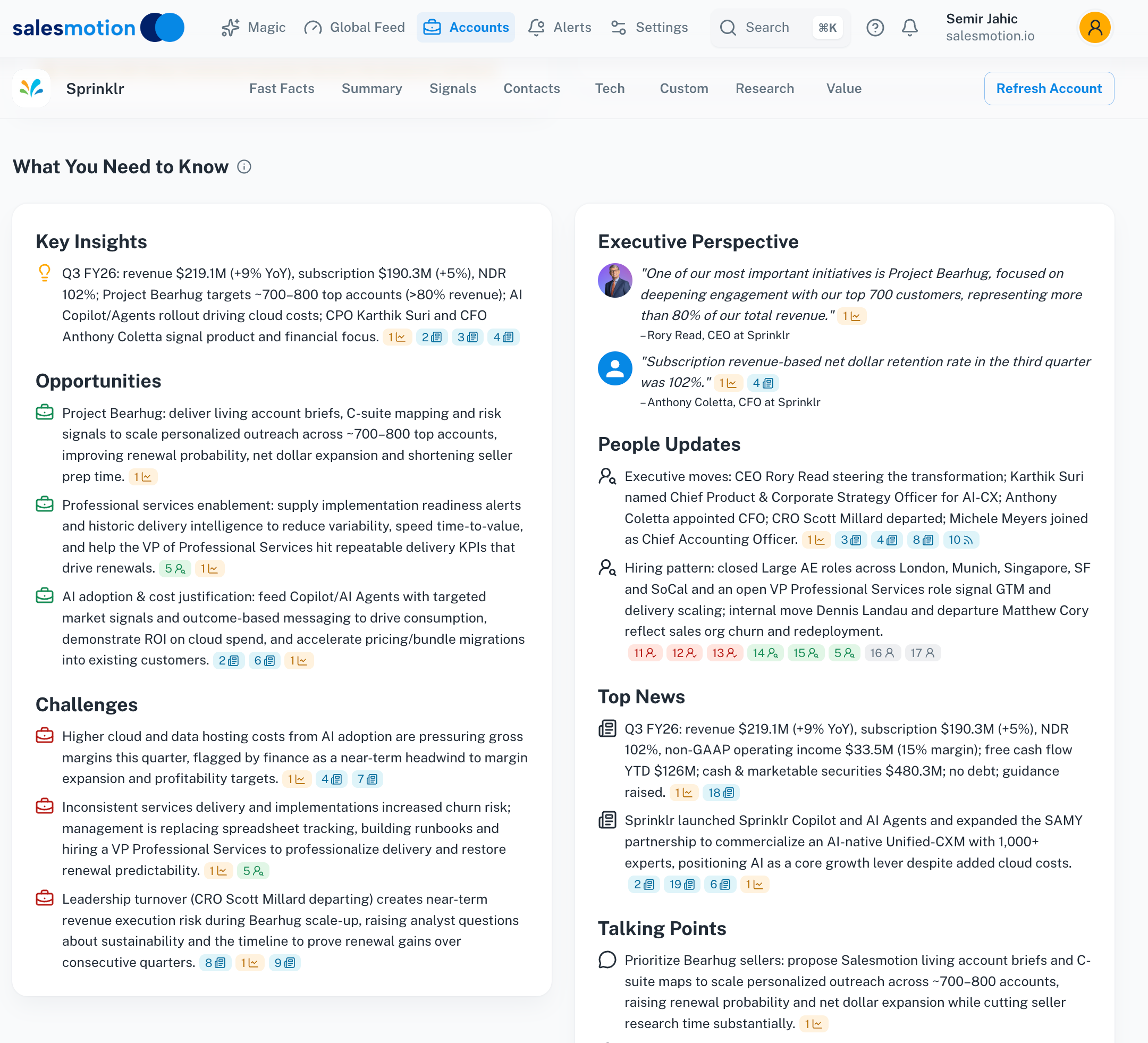 Salesmotion's Research Agent compiles insights from 1,000+ sources into a single account view, eliminating hours of manual research.
Salesmotion's Research Agent does exactly this. It continuously monitors your target accounts and compiles everything a rep needs to know into a one-click account brief. Guild Education's strategic accounts team uses this to save 30 minutes per account, which adds up to over 6 hours saved per seller per week across their portfolio. You can read the full story at /customers/guild.
Practical implementation
- Upload your target account list or sync it from your CRM. Most teams start with their top 200-500 accounts.
- The Research Agent automatically generates briefs for every account, pulling from earnings transcripts, news, SEC filings, job postings, podcasts, and more.
- Reps open a brief before any call or email and get full context in 30 seconds instead of 30 minutes of manual searching.
- Briefs update automatically as new information surfaces, so reps never work from stale data or miss a key development.
- Share briefs with your team. When an AE is pulling in an SE or executive sponsor for a deal, everyone can access the same account context instantly.
The key insight here is that research quality actually goes up when you automate it. A human scanning Google News for 15 minutes will miss things that an AI monitoring 1,000+ sources continuously will catch. An SDR rushing through pre-call prep will overlook the earnings call quote that could open a conversation. You are not trading quality for speed. You are getting both.
Strategy 2: Use Signal-Based Prioritization
The second problem with scaling through headcount is that more reps usually means more spray-and-pray outreach. When SDRs have a list of 500 accounts and no clear way to prioritize, they default to alphabetical order or gut feel. That is a waste of everyone's time.
What signal-based selling looks like
Instead of treating every account the same, signal-based selling tells reps exactly which accounts to focus on right now and why:
- Leadership changes — A new CRO or VP of Sales is 3-5x more likely to evaluate new tools in their first 90 days.
- Funding rounds — Companies that just raised are actively investing in growth infrastructure.
- Hiring surges — A company posting 15 new SDR roles is clearly scaling their outbound motion and may need better tooling.
- Earnings call mentions — When a CEO publicly commits to "improving sales productivity," that is a buying signal you can reference directly.
- Tech stack changes — If an account just churned off a competitor, they are actively looking for a replacement.
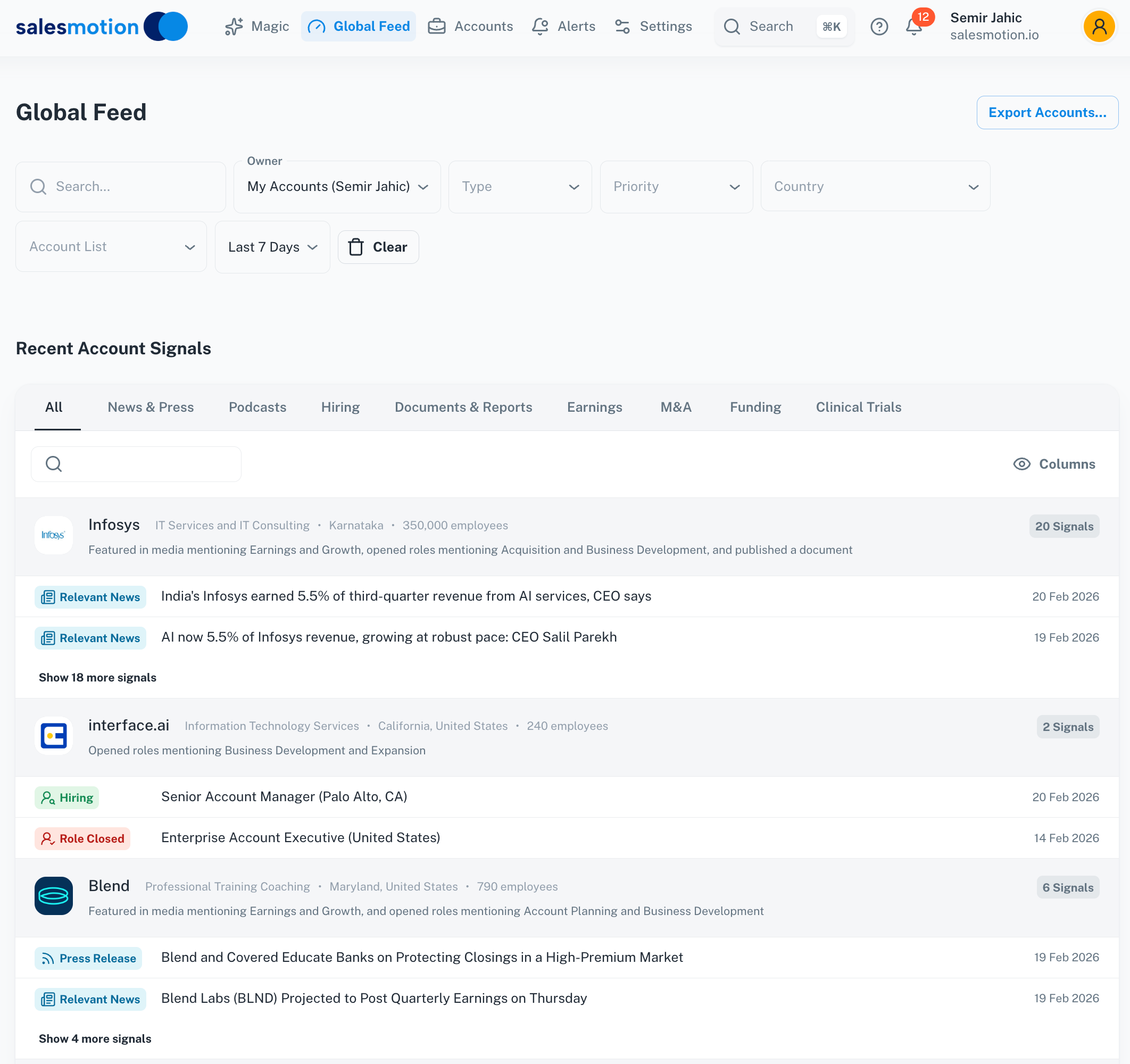 The Signal Agent monitors 50+ signal types across all your accounts and surfaces the ones that matter right now.
Salesmotion's Signal Agent monitors these signals across your entire territory 24/7. Instead of reps spending time figuring out who to call, the platform tells them which accounts have active buying signals and gives them the context to start a relevant conversation.
Why this matters for scaling
When you combine signal-based prioritization with automated research, something powerful happens: your existing reps start focusing exclusively on high-probability opportunities. Instead of making 100 generic calls hoping to find 3 interested prospects, they make 20 highly targeted calls where the timing and relevance are already validated.
Think about the economics. An SDR making 80 generic cold calls per day might book 2-3 meetings. An SDR making 25 signal-triggered calls per day, each backed by specific account intelligence, can book the same number of meetings or more, while covering a fraction of the volume. For a comparison of tools that enable this workflow, see our roundup of the best B2B sales automation tools with AI agents. The difference is that the second SDR's meetings are with accounts that have active buying signals, meaning they convert to pipeline at a much higher rate.
This is how you scale pipeline without scaling headcount. You do not need more dials. You need better dials.
Incredible Health saw this play out directly. After implementing Salesmotion, their team increased quarterly new meetings by 50%, not by adding headcount but by giving their existing SDRs better intelligence on which accounts to prioritize and what to say. The implementation took just 3 days from signature to go-live. Read the full case study at /customers/incredible-health.

“There's been a big focus on hyper personalization and relevance in our outbounding efforts. Salesmotion has been a key partner in hitting our significantly increased meeting targets. What stands out is how simple it is. Reps can log in and get valuable account insights within 30 seconds to a minute.”
Joe DeFrance
VP of Sales, Incredible Health
Strategy 3: AI-Drafted Personalized Outreach
The third bottleneck in outbound scaling is the writing itself. Personalized outreach works, but it does not scale when a human has to write every email from scratch. Generic templates scale, but they do not work. AI-drafted outreach anchored to real research breaks this tradeoff.
What good AI outreach looks like
The key word is "anchored." AI-generated emails that reference generic company descriptions are not much better than templates. What works is outreach that references specific, timely, verified information about the account:
- Referencing a specific earnings call quote from the CEO about their priorities for the quarter.
- Mentioning a recent leadership hire and connecting it to a relevant capability.
- Tying your value proposition to a publicly stated initiative or strategic shift.
This is the difference between "I noticed your company is growing" and "I saw your CEO mentioned on the Q4 earnings call that reducing sales cycle length is a top priority for 2026. We helped Cacheflow cut their prep time by 60% and triple their average deal size."
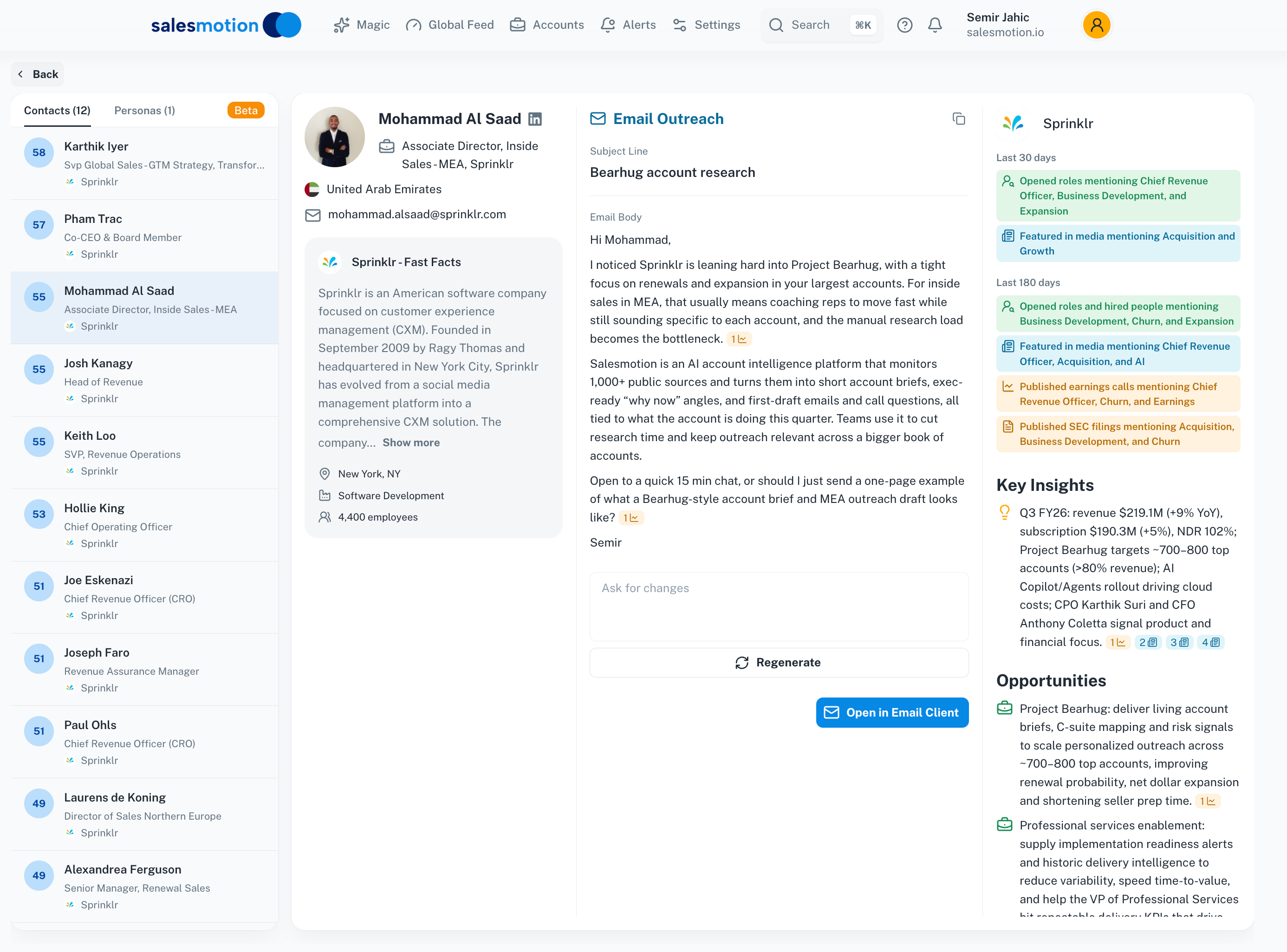 The Outreach Agent drafts emails anchored to real account intelligence, not generic templates.
Salesmotion's Outreach Agent generates these personalized messages automatically, pulling from the research and signals already gathered by the Research and Signal agents. Each email is grounded in verified account data, so reps can review, edit if needed, and send, rather than starting from a blank page.
The multiplier effect
When you layer all three together (automated research, signal-based prioritization, and AI-drafted outreach) each rep can effectively cover 3-5x more accounts without working longer hours. The research is done for them. The prioritization is done for them. The first draft of every email is done for them. Their job shifts from "gather information and write emails" to "review, refine, and build relationships."
This is fundamentally different from generic AI email tools that just rewrite templates with a company name swapped in. Buyers can spot those from a mile away, and they end up in the trash. The difference is whether the AI is generating content from deep, real-time account research or from a one-line company description. When a rep sends an email that references the CEO's quote from last week's earnings call, the recipient knows this is not a mass blast.
At Cacheflow, this approach reduced prep time by 60% and contributed to the team nearly tripling their average deal size from $5,000-$7,000 to $18,000-$20,000 within 6 months. With a lean team of just three AEs and one SDR, they were able to handle a surge in inbound demand and scale their outbound motion simultaneously. The full story is at /customers/cacheflow.
Strategy 4: Consolidate Your Tool Stack
The fourth strategy is less obvious but equally important. Most sales teams run 5-8 separate tools for prospecting, research, and outreach. Each tool solves one piece of the puzzle, but together they create data silos and context switching that kills productivity.
The typical stack and what it costs
| Tool | Annual cost | What it does |
|---|---|---|
| ZoomInfo or Cognism | $25,000-$60,000 | Contact data |
| Bombora or 6sense | $20,000-$50,000 | Intent data |
| LinkedIn Sales Navigator | $1,200-$1,800/seat | Prospecting |
| Google Alerts + manual research | Free (but costs hours) | Account monitoring |
| ChatGPT or similar | $240-$600/seat | Ad-hoc research |
| Outreach or Salesloft | $1,200-$2,400/seat | Sequencing |
| Total for a 10-person team | $80,000-$150,000+ |
Beyond the subscription costs, the real expense is the time reps spend switching between these tools and manually synthesizing information. Every time a rep switches from ZoomInfo to LinkedIn to their sequencer to a Google search, they lose context and momentum. Forrester estimates that sales reps spend less than 30% of their time actually selling. A fragmented tool stack is a major contributor to that problem.
We hear this constantly from sales leaders: "We are working 4-5 different sites just to prep for one meeting." That is not a process problem. That is an architecture problem. And it does not get better when you add more reps. It gets worse, because now you have more people navigating the same broken workflow.
What consolidation looks like
A single account intelligence platform replaces the research, signal monitoring, and outreach drafting functions of 3-5 separate tools:
- Research — Replaces manual Google searches, LinkedIn browsing, and ChatGPT prompting.
- Signals — Replaces Bombora, Google Alerts, and manual news monitoring.
- Outreach drafting — Replaces the "stare at a blank email" step that slows down sequencing.
- Contact data — Verified contacts surfaced alongside account research, reducing reliance on standalone data providers.
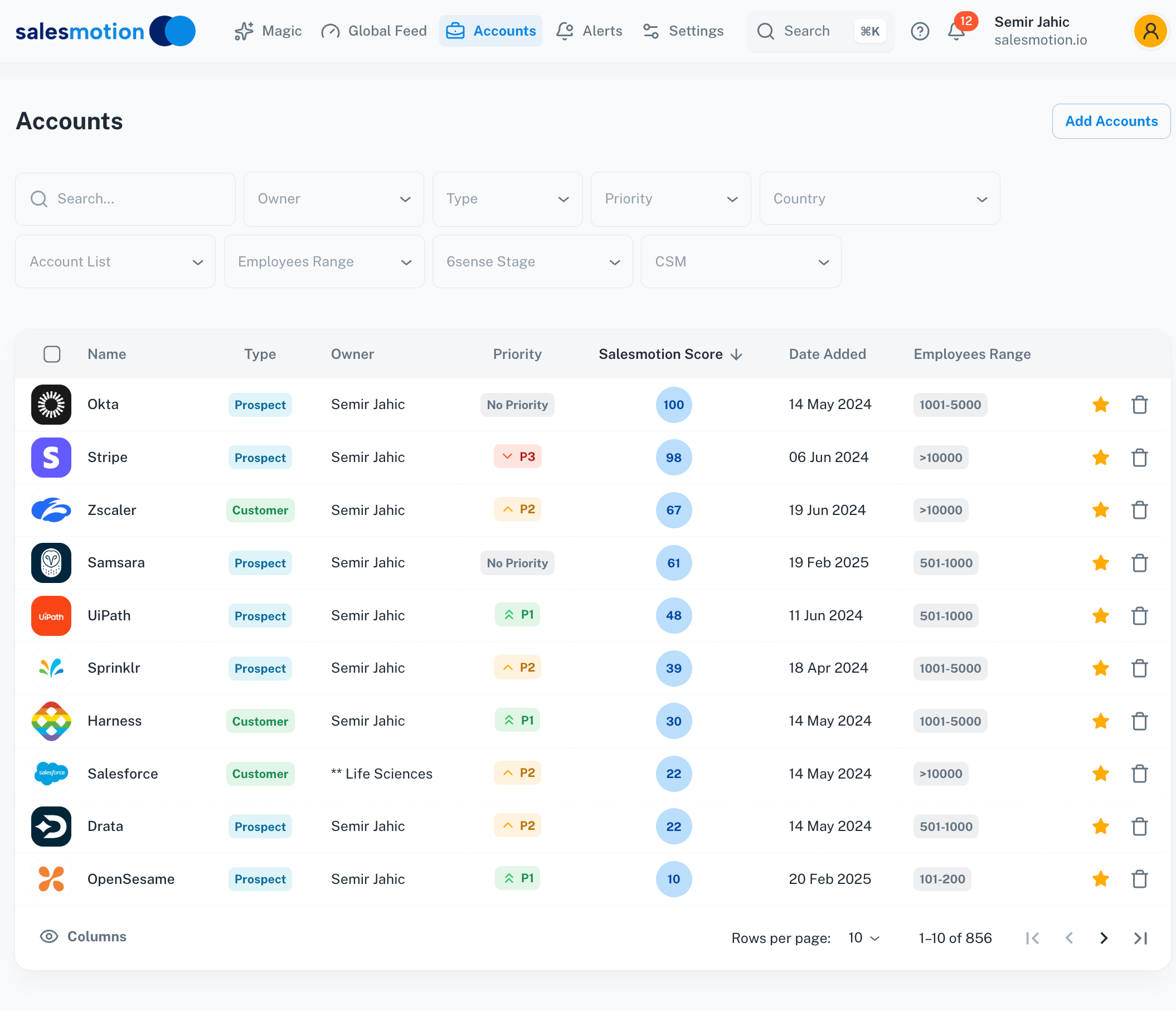 A unified account intelligence dashboard replaces the tab-switching workflow that costs reps hours every week.
Salesmotion's three AI agents (Signal, Research, and Outreach) cover these functions in one platform. With flat, account-based team pricing (unlimited users), it replaces $50,000-$100,000+ in overlapping tool subscriptions while giving reps a single place to get everything they need before any outreach.
The Scaling Playbook: From Setup to Results
Here is a practical timeline for implementing this approach on your team.
Week 1-2: Foundation
Goal: Get your intelligence layer up and running and establish baselines.
- Upload your target account list. Start with your top 200-500 accounts. Sync from your CRM if possible so new accounts are added automatically.
- Configure signal preferences. Choose which signal types matter most for your industry: leadership changes, funding, earnings, hiring, tech changes, or all of the above.
- Baseline your current metrics. Document your current meetings booked per rep, average research time per account, and pipeline generated per rep. You will need these numbers to measure improvement.
- Run a pilot with 2-3 reps. Do not roll out to the full team immediately. Pick your most open-minded reps and have them use the platform for all outreach for two weeks.
Week 3-4: Optimization
Goal: Refine your workflow and demonstrate early wins.
- Review signal-to-meeting conversion. Which signal types are generating the best conversations? Double down on those.
- Audit outreach quality. Look at the AI-drafted emails your pilot reps are sending. Are they editing heavily or sending mostly as-is? Adjust prompts and preferences based on what you learn.
- Measure time savings. Compare research time per account before and after. Most teams see a 50-80% reduction within the first month.
- Expand to the full team. Use results from the pilot to make the case for broader adoption. Nothing sells an internal tool change like a rep who just booked 3 meetings from signal-triggered outreach.
Month 2+: Scaling
Goal: Increase account coverage and pipeline output without adding headcount.
- Expand your account list. With automated research, you can monitor 2-5x more accounts than reps could manually track. Add your full TAM.
- Build signal-triggered sequences. When a leadership change or funding round is detected, automatically enroll the account in a relevant outreach sequence.
- Track pipeline attribution. Measure how much pipeline is generated from signal-triggered outreach versus traditional prospecting. This data builds the case for continued investment in intelligence over headcount.
- Reallocate SDR time. As research and prospecting become more efficient, shift SDR focus from volume activities to higher-value tasks like multi-threading into accounts and supporting AEs on strategic deals.
Measuring ROI: What to Track
To prove this approach is working and build the case for continued investment in intelligence over headcount, track these metrics:
- Research time per account. Measure before and after. Most teams see a 50-80% reduction within the first month.
- Meetings booked per rep per week. This should increase as reps spend more time on outreach and less on research.
- Signal-to-meeting conversion rate. What percentage of signal-triggered outreach results in a booked meeting? This tells you which signals are most valuable for your business.
- Pipeline generated per rep. The ultimate measure of whether your existing team can scale output without new hires.
- Cost per meeting. Compare the fully-loaded cost of an SDR-booked meeting versus a signal-triggered meeting. The difference is usually dramatic.
When Hiring Still Makes Sense
This is not an argument that you should never hire SDRs. There are scenarios where adding headcount is the right call:
- You are entering a brand new market segment where you need reps with specific domain expertise and existing relationships.
- Your AEs are drowning in qualified opportunities and need SDRs to handle early-stage qualification so they can focus on closing.
- You need human judgment for complex, multi-stakeholder deals where an AI cannot navigate internal politics or read a room.
- You are expanding into a new geography where local language skills and market knowledge are essential.
The argument is that hiring should not be your default answer when pipeline targets go up. If your reps are spending 30-50% of their time on research and prospecting busywork, the highest-ROI move is to automate that work first, and then evaluate whether you still need more people. You may find that your existing team, equipped with the right intelligence tools, can handle significantly more pipeline than you expected.
In most cases, the right order of operations is: automate first, measure the impact, and then hire strategically to fill the gaps that AI genuinely cannot cover.
What This Looks Like in Practice: Three Case Studies
Guild Education: 6 hours saved per seller per week
Guild Education sells workforce education solutions to large enterprises with deal sizes exceeding $20 million and sales cycles spanning up to 24 months. Their strategic accounts team needed to stay deeply informed about every account without spending all day researching.
After implementing Salesmotion, each seller saved over 6 hours per week on account research. The Research Agent automated earnings call tracking, surfaced executive podcast appearances, and compiled weekly account digests. Reps shifted from gathering information to using it strategically in conversations with C-suite buyers.
Key result: 30 minutes saved per account, 6+ hours saved per seller per week, with improved deal velocity on $20M+ opportunities.
Read the full story: Guild Education case study
Incredible Health: 50% more quarterly meetings
Incredible Health, a healthcare technology company valued at $1.65 billion, needed to increase their quarterly meeting targets by 50% while maintaining hyper-personalized outreach to hospital systems. Their SDR team had been spending hours manually researching each prospect.
With Salesmotion providing centralized account intelligence, the team hit their increased targets. Implementation took 3 days from signature to go-live, and reps were getting value from the platform within 30 seconds of logging in.
Key result: 50% increase in quarterly new meetings with the same team size and a 3-day implementation.
Read the full story: Incredible Health case study
Cacheflow: 60% less prep time, 3x deal sizes
Cacheflow, a startup in the CPQ and billing space (since acquired by HubSpot), had a lean team of three AEs and one SDR handling a surge in demand. They needed to qualify leads faster, research accounts deeper, and increase average deal sizes.
Salesmotion reduced their prep time by 60%, from 1.5 hours per meeting to about 30 minutes across multiple daily calls. The team grew their average selling price from $5,000-$7,000 to $18,000-$20,000 within 6 months by showing up more prepared and consultative in every conversation.
Key result: 60% less prep time, 3x increase in average deal size, full platform adoption within 24 hours.
Read the full story: Cacheflow case study
Frequently Asked Questions
How do you scale outbound sales research without hiring more SDRs?
The most effective approach is to automate the research and prioritization layers of your outbound process using AI-powered account intelligence. Instead of hiring reps to manually research accounts, use a platform that monitors your target accounts 24/7, surfaces buying signals, and generates account briefs automatically. This gives your existing reps 3-5x more account coverage without working longer hours. Pair automated research with signal-based prioritization so reps focus on the accounts most likely to convert right now, and use AI-drafted outreach to eliminate the blank-page problem. Real teams using this approach report saving 6+ hours per seller per week and increasing meetings booked by 50% or more.
Can AI replace SDRs for outbound prospecting?
AI does not replace SDRs entirely, but it dramatically changes what they spend their time on. The research, data gathering, and initial outreach drafting that consume 50-70% of an SDR's day can be automated with tools like Salesmotion's Signal Agent, Research Agent, and Outreach Agent. What AI cannot replace is the human judgment needed for complex conversations, relationship building, objection handling, and reading a room. The best approach is to use AI to handle the information-gathering work so your SDRs can focus exclusively on the high-value human interactions that actually move deals forward. Teams that adopt this model often find that each SDR becomes 3-5x more productive, effectively scaling output without scaling headcount.
What are the best B2B sales automation tools with AI agents?
The most effective B2B sales automation stacks in 2026 combine an AI-powered intelligence layer with a sequencing or engagement platform. For the intelligence layer, Salesmotion provides three specialized AI agents for signal monitoring, account research, and outreach generation, starting at $85/mo for individuals, with custom team pricing (unlimited users). For sequencing and execution, tools like Apollo, Outreach, or Salesloft handle multi-step cadences and call tracking. The key differentiator is whether the AI is generating outreach from real, verified account data or from generic company descriptions. Platforms that combine proprietary research with outreach generation, rather than just rewriting your templates, produce significantly better results. Try the interactive demo to see how this works in practice.
The Bottom Line
The old scaling formula of "more pipeline targets equals more SDRs" made sense when research was something only humans could do. That is no longer true. AI-powered account intelligence can now handle the research, signal monitoring, and outreach drafting that consume the majority of an SDR's time, at a fraction of the cost and with better quality.
The teams that figure this out first will have a structural advantage: lower customer acquisition costs, faster ramp times, and reps who spend their time selling instead of searching. The teams that keep defaulting to "hire more SDRs" will keep burning budget on ramp time, turnover, and mediocre outreach that gets ignored.
The data from our customers is clear. Teams using Salesmotion's three AI agents are saving 6+ hours per seller per week, booking 50% more meetings, and reducing prep time by 60%. That is the kind of leverage that makes the difference between hitting your number and missing it.
If you want to see what this looks like for your team, book a demo or try the interactive demo to explore Salesmotion's Signal, Research, and Outreach agents on a real account.