A buying window opens when a target account shows concrete, time-sensitive signals that it is actively evaluating solutions, restructuring priorities, or allocating budget toward a problem your product solves. Unlike generic intent data that tells you someone clicked on a blog post, buying window signals are structural changes inside an organization -- leadership shifts, public financial commitments, hiring surges, funding events -- that create a narrow period where the account is genuinely receptive to a new vendor conversation. If you miss that window, you are back to cold outreach against a closed door.
The difference between a data point and a buying window signal is context and urgency. A single job posting is a data point. A new CRO, twelve open sales roles, and a mention of "go-to-market transformation" in the latest earnings call -- that convergence is a buying window. And in 2026, the teams that can detect these convergences faster than their competitors are the ones building pipeline while everyone else is still writing cold emails.
I have spent the last three years building Salesmotion, an account intelligence platform, and working with hundreds of B2B sales teams. This playbook distills what I have learned about identifying buying windows into a practical framework you can use today -- whether you automate it or not.
Key Takeaways
- A buying window is a time-limited period when an account is structurally ready to evaluate new solutions, driven by concrete organizational changes rather than vague intent signals.
- There are seven high-reliability signal types that indicate a buying window: leadership changes, earnings call language, hiring surges, funding events, technology changes, competitive displacement, and strategic initiative announcements.
- Signal stacking -- monitoring multiple signal types simultaneously and looking for convergence -- is far more predictive than tracking any single signal in isolation.
- Manual signal detection does not scale beyond 20-30 accounts; automation is required to monitor hundreds or thousands of accounts across 1,000+ sources in real time.
- Teams using signal-based selling see measurably better results: Analytic Partners increased qualified pipeline by 40%, and Frontify achieved a 42% increase in sales velocity after adopting automated signal detection.

“The account and contact signals are key for reaching out at important times, and the value-add messaging it creates unique to every contact helps save time and efficiency.”
Daniel Pitman
Mid-Market Account Executive, Black Swan Data
Why Buying Windows Matter More Than Intent Data
Most sales teams today rely on some form of intent data -- typically third-party signals from providers like Bombora or 6sense that track anonymous content consumption across publisher networks. Intent data has its place, but it answers a limited question: "Is someone at this company researching topics related to our category?"
That is useful but insufficient. Intent data does not tell you why the research is happening, who is driving it, or how long you have before a decision is made. A company researching "CRM migration" might be a VP running a strategic initiative with budget approval, or it might be an intern writing a report. Intent data cannot distinguish between the two.
Buying window signals are different. They are observable, structural changes inside an organization that create both the motivation and the means to purchase. When a company hires a new CTO, announces a digital transformation initiative on its earnings call, and posts fifteen engineering roles in a month, that is not ambiguous intent -- that is a buying window with a shelf life.
The practical difference is conversion rate. In my experience working with B2B sales teams, outreach timed to a buying window converts at three to five times the rate of outreach based on intent data alone. The reason is simple: you are reaching out at a moment when the account needs what you sell, rather than a moment when someone there happens to be browsing content.
Here is a useful mental model. Think of buying signals as a hierarchy with three levels:
- Behavioral signals (weakest): Website visits, content downloads, ad clicks. These indicate someone is doing research, but the context is thin and the urgency is unknown.
- Intent signals (moderate): Topic-level research spikes tracked by third-party providers across publisher networks. These indicate an account is exploring a category, but they do not tell you who is driving it or why.
- Buying window signals (strongest): Structural organizational changes -- new leaders, public commitments, funding, hiring -- that create both the budget and the urgency to purchase. These are the signals this playbook focuses on.
The teams that outperform in 2026 are the ones that monitor level three signals and use levels one and two as supporting evidence, not the other way around.
See Salesmotion on a real account
Book a 15-minute demo and see how your team saves hours on account research.
The 7 Signals That Indicate a Buying Window
After analyzing patterns across hundreds of Salesmotion customers and thousands of closed-won deals, these are the seven signal types that most reliably indicate an account is entering a buying window. I will break down each one: what it looks like, why it matters, and how to detect it.
1. Leadership Changes
What it looks like: A new CRO, VP of Sales, CMO, CTO, or other senior executive joins the company. This also includes promotions into new leadership roles and lateral moves into positions with expanded scope.
Why it indicates a buying window: New leaders almost always bring new priorities, new vendors, and new budgets. Research from LinkedIn shows that 70% of new executives make at least one significant technology purchase within their first 100 days. They are under pressure to deliver results quickly, and they typically bring vendor relationships and preferences from their previous role. A new CRO who used your product at their last company is one of the highest-value signals in B2B sales.
How to detect it:
- Manually: Monitor LinkedIn for job change announcements at your target accounts. Set Google Alerts for "[Company Name] + hires" or "[Company Name] + appoints." This works for 10-20 accounts but breaks down at scale.
- Automated: Salesmotion's Signal Agent monitors leadership changes across your entire account list in real time, correlating them with the executive's background to surface the most relevant opportunities. It tracks the person's previous company, their tech stack preferences, and their historical purchasing patterns.
2. Earnings Call Language
What it looks like: Public companies discuss specific initiatives, challenges, or investment areas during quarterly earnings calls, investor days, or shareholder letters. Keywords like "digital transformation," "consolidation," "efficiency," "new go-to-market," or "technology modernization" signal internal priorities.
Why it indicates a buying window: Earnings calls are the most honest public signal a company produces. When a CEO tells analysts they are "investing heavily in sales technology" or "restructuring our go-to-market motion," that is a commitment backed by board-level accountability. The company will spend money on this. The question is whether they spend it with you or your competitor.
How to detect it:
- Manually: Download earnings call transcripts from SEC filings or services like Seeking Alpha. Read them for keywords related to your value proposition. This is time-consuming but produces high-quality insights for your top 5-10 accounts.
- Automated: Salesmotion monitors earnings calls for every public company in your account list and extracts the passages most relevant to your product's value proposition. Instead of reading 50-page transcripts, your reps get a summary of exactly what matters.
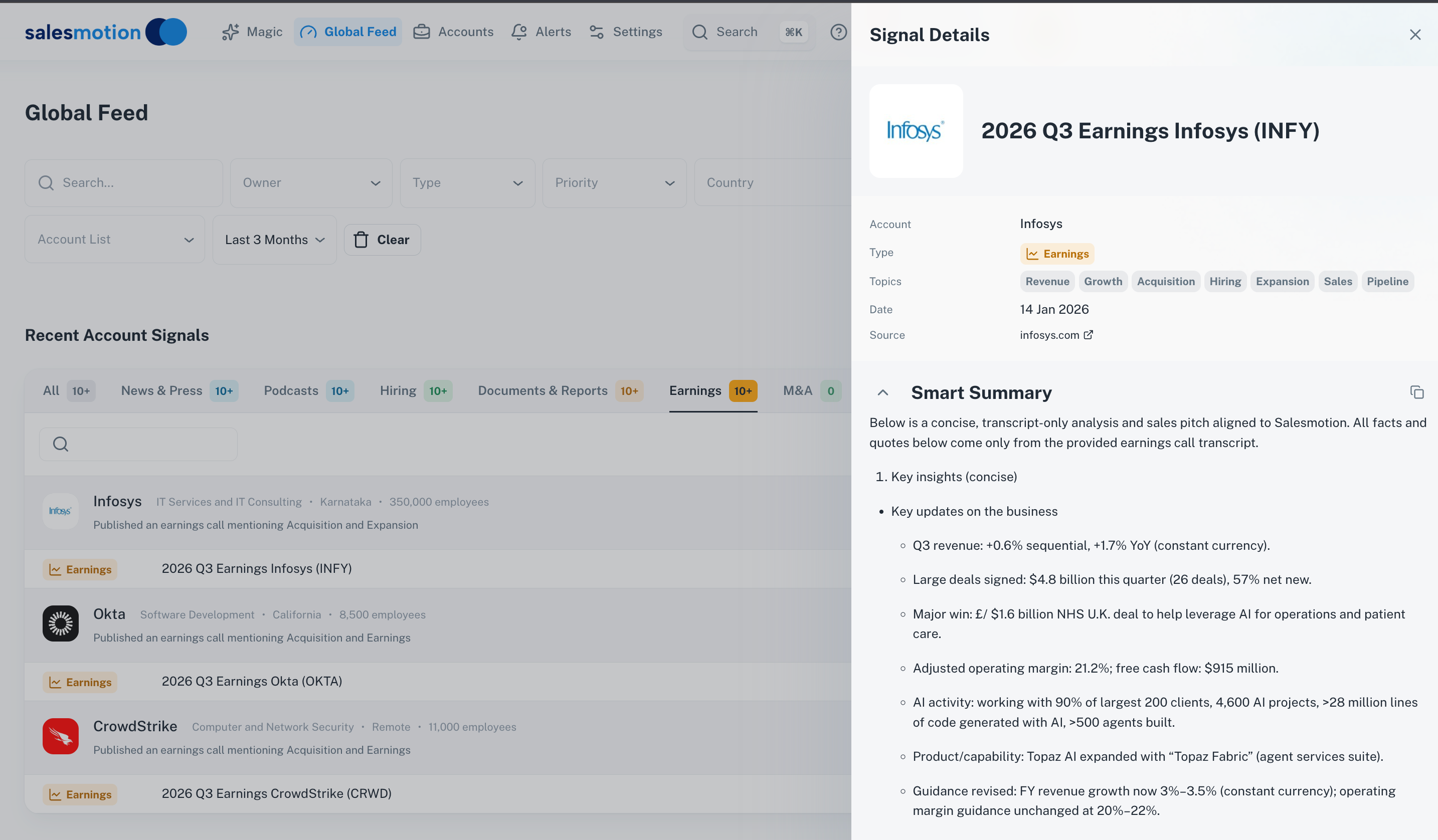 Salesmotion automatically extracts strategic themes and executive quotes from earnings calls, highlighting the passages most relevant to your value proposition.
3. Hiring Surges
What it looks like: A company posts a cluster of related job openings -- fifteen sales roles in a month, a sudden spike in engineering hiring, or new positions in a function that did not previously exist (like "Head of AI" or "Director of Revenue Operations").
Why it indicates a buying window: Hiring surges reveal where a company is investing. If a company is hiring aggressively for a sales team, they will need sales tools, training, and infrastructure. If they are building out a data engineering team, they will need data platforms and analytics tools. The job descriptions themselves often contain explicit mentions of the tools the company plans to buy or replace.
The key is to distinguish between replacement hiring (backfills for attrition) and expansion hiring (new headcount in a growing function). Replacement hiring is neutral. Expansion hiring -- especially in a function adjacent to your product -- is a strong buying window signal.
How to detect it:
- Manually: Check LinkedIn Jobs or company career pages weekly for your target accounts. Track the volume and type of postings over time to identify surges versus normal hiring. Pay attention to the seniority mix: if they are hiring a VP and multiple ICs in the same function simultaneously, that is a new team being built.
- Automated: Signal Agent tracks hiring patterns across your accounts and alerts you when there is a statistically significant spike in relevant job postings. It also parses job descriptions for mentions of your category, competitors, or complementary technologies.
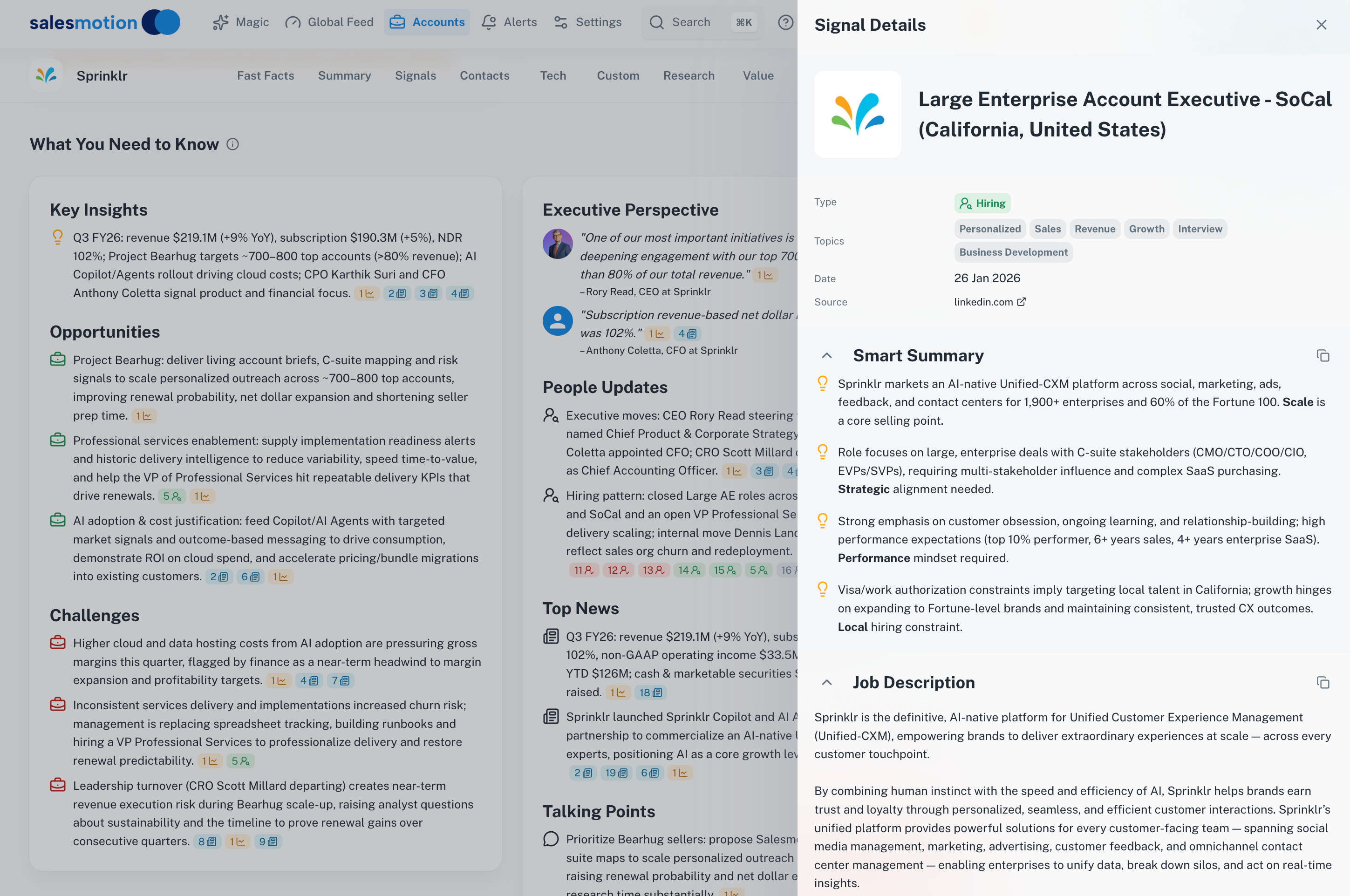 Signal Agent surfaces hiring surges with role-level detail, so reps can see exactly which functions are scaling and what tools are mentioned in job descriptions.
4. Funding Events
What it looks like: A company raises a new round of funding (Series A through IPO), secures a credit facility, or completes a significant M&A transaction. This also includes private equity recapitalizations and secondary transactions.
Why it indicates a buying window: Fresh capital means fresh spending. Companies that just raised funding are actively building teams, buying tools, and scaling operations. The 90 days following a funding announcement is one of the most reliable buying windows in B2B -- the company has money, mandate, and urgency to deploy it. Similarly, M&A events create integration needs that often require new technology.
How to detect it:
- Manually: Monitor Crunchbase, PitchBook, or TechCrunch for funding announcements. Set up Google Alerts for your target accounts plus "raises," "funding," or "acquisition."
- Automated: Salesmotion tracks funding events and M&A activity across your account list and correlates them with hiring patterns and leadership changes to build a complete picture of the opportunity.
Pro tip: The type of funding matters. A Series A company is building its first real tech stack and needs everything. A Series D company is optimizing and consolidating. A PE-backed recapitalization often triggers cost-cutting and vendor consolidation. Tailor your outreach angle to the funding stage.
5. Technology Changes
What it looks like: A company adopts, drops, or replaces a technology in their stack. This might surface through job postings (mentioning specific tools), technographic data providers, or public announcements about technology partnerships.
Why it indicates a buying window: Technology changes rarely happen in isolation. When a company switches CRMs, they often reevaluate their entire sales stack. When they adopt a new marketing automation platform, adjacent tools come under review. If a competitor's product appears in job postings at your target account, that is a signal the account is actively evaluating the space -- and may be open to alternatives.
How to detect it:
- Manually: Review job postings for technology mentions. Check sites like BuiltWith or Wappalyzer for web technology changes. Follow company engineering blogs or tech announcements.
- Automated: Salesmotion monitors technology adoption and displacement signals, alerting you when a target account adds or removes tools relevant to your competitive landscape.
6. Competitive Displacement
What it looks like: A company publicly signals dissatisfaction with a current vendor. This could be a negative review on G2 or Gartner Peer Insights, a LinkedIn post from an employee complaining about their current tools, a job posting that mentions migrating away from a specific platform, or an RFP publication.
Why it indicates a buying window: When a company is actively unhappy with a competitor's product, they are already motivated to change. Your job shifts from creating demand to capturing it. These are among the highest-conversion signals because the account has already decided to buy -- they just have not decided from whom.
How to detect it:
- Manually: Monitor G2 reviews for competitor products. Set Google Alerts for "[Competitor] + migration" or "[Competitor] + alternative." Check RFP databases in your industry.
- Automated: Signal Agent tracks competitive displacement signals including review patterns, job posting mentions of competitor migrations, and public RFP activity across your target accounts.
7. Strategic Initiative Announcements
What it looks like: A company announces a major strategic initiative -- entering a new market, launching a new product line, restructuring its sales organization, or committing to a digital transformation program. These announcements appear in press releases, earnings calls, executive interviews, and company blogs.
Why it indicates a buying window: Strategic initiatives create cascading purchasing needs. A company expanding into Europe needs localization tools, compliance software, and regional sales infrastructure. A company launching an AI product line needs data platforms, ML tools, and specialized talent. The initiative itself is the buying window -- it creates budget, urgency, and a clear set of problems to solve.
How to detect it:
- Manually: Monitor press releases, company blogs, and industry news for your target accounts. Follow key executives on LinkedIn for announcements about new initiatives.
- Automated: Salesmotion scans 1,000+ sources to detect strategic initiative announcements and maps them to your value proposition, so your reps know exactly how the initiative connects to what you sell.
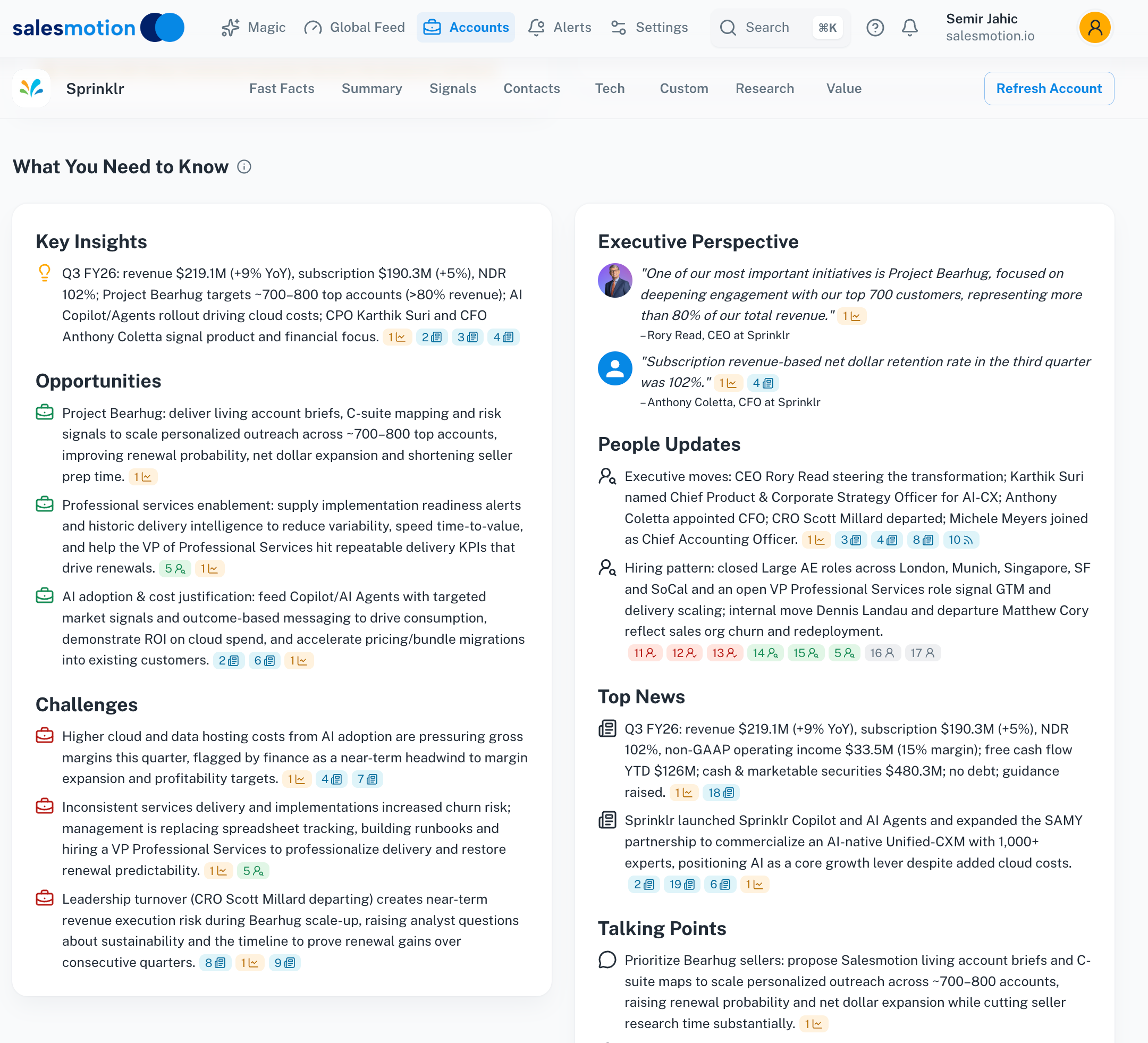 Salesmotion consolidates all seven signal types into a single account view, so reps can assess buying window strength at a glance.
Buying Window Signal Scoring Framework
Not all signals carry the same weight. A new CRO joining a company is a stronger buying window indicator than a single job posting. This framework helps you score and prioritize accounts based on signal strength.
| Signal Type | Weight (1-10) | Detection Method | Example |
|---|---|---|---|
| Leadership change | 9 | LinkedIn monitoring, news alerts, Signal Agent | New CRO hired from a company that used your product |
| Earnings call language | 8 | Transcript analysis, Signal Agent | CEO mentions "sales technology investment" in Q4 call |
| Hiring surge | 7 | Job board monitoring, Signal Agent | 15 new sales roles posted in 30 days |
| Funding event | 8 | Crunchbase, news alerts, Signal Agent | Series C announced at $50M valuation |
| Technology change | 7 | Technographic tools, job postings, Signal Agent | Job posts mention migrating from Competitor X |
| Competitive displacement | 9 | Review sites, RFP tracking, Signal Agent | Negative G2 review of competitor + RFP published |
| Strategic initiative | 8 | Press monitoring, earnings calls, Signal Agent | "Digital transformation" program announced publicly |
How to use this framework:
- Single signal (score 7-9): Worth a targeted outreach. Personalize the message to the specific signal.
- Two signals converging (score 14-18): High-priority account. Assign to a senior rep and initiate multi-threaded engagement.
- Three or more signals (score 21+): Red-hot buying window. This is your top-priority account. Mobilize your best resources immediately.
The key insight is that signal convergence is exponentially more predictive than any individual signal. A new CRO alone is interesting. A new CRO plus twelve sales job postings plus an earnings call mentioning "go-to-market transformation" is a buying window you cannot afford to miss.

“We're no longer fishing. We know who the right customers are, and we can qualify them quickly. Salesmotion has had a direct impact on pipeline quality.”
Andrew Giordano
VP of Global Commercial Operations, Analytic Partners
How to Build a Buying Window Detection System
There are three approaches to buying window detection, ranging from manual to fully automated. The right choice depends on the size of your account list and the maturity of your sales operation.
Approach 1: Manual Monitoring (1-25 accounts)
If you are an individual contributor covering a small territory, you can build a lightweight buying window detection system using free tools:
- Google Alerts for each account name plus key terms ("hires," "raises," "announces," "appoints")
- LinkedIn saved searches for job changes at target accounts
- Quarterly calendar reminders to check earnings transcripts for public accounts
- Weekly 30-minute block to review job postings on company career pages
This approach works but does not scale. At 25 accounts, you are spending 3-5 hours per week just on signal monitoring -- time that could be spent selling.
Approach 2: Tool Stack Assembly (25-200 accounts)
Mid-market teams often assemble a stack of point tools -- a job tracking tool, a funding alert service, a technographic data provider, and a news monitoring platform. This covers more ground than manual monitoring but creates its own problems:
- Cost: Four to five tools at $200-500/month each adds up quickly.
- Integration: Signals arrive in different dashboards with no unified view.
- Context gap: You know what happened but not why it matters for your specific value proposition.
- Maintenance: Someone has to configure, update, and monitor each tool.
Approach 3: Unified Signal Intelligence (200+ accounts)
This is where platforms like Salesmotion come in. Instead of assembling point tools, you get a single platform that monitors all seven signal types across your entire account list, scores accounts based on signal convergence, and delivers actionable insights -- not just raw data -- to your reps.
Salesmotion's Signal Agent monitors 1,000+ sources continuously and correlates signals across types. When a new CRO joins a target account that also just posted twelve sales roles and mentioned your category in their earnings call, Signal Agent surfaces that convergence as a high-priority buying window -- with the context your reps need to have a relevant first conversation.
The platform starts at $85/mo for individuals, with custom pricing for teams that includes unlimited users. It scales by accounts monitored, not headcount, which means your entire team can act on buying window intelligence without per-seat costs eating into your budget.
Signal-Based Selling in Practice: Real Results
Theory is useful, but results matter more. Here is what buying window detection looks like when it is operationalized at scale.
Analytic Partners: 40% Increase in Qualified Pipeline
Analytic Partners, a worldwide leader in marketing analytics, was struggling with a research problem that limited pipeline generation. Reps spent two to three hours per account just to build a baseline understanding of each target. With limited time, they could only cover three to five accounts per week, leaving large portions of their ideal customer profile untouched.
After implementing Salesmotion, account research time dropped from three hours to fifteen minutes -- an 85% reduction. More importantly, the ability to detect buying window signals across their entire account list meant reps could pursue the right accounts at the right time. The result was a 40% increase in qualified opportunities year over year.
As Andrew Giordano, VP of Global Commercial Operations at Analytic Partners, described it: the team shifted "from a fishing expedition toward a targeted, value-based approach." That shift was powered by buying window detection at scale. The commercial team now identifies Fortune 500 accounts entering buying windows and can respond within days -- recently advancing a $1M+ opportunity by acting on signals that would have previously gone unnoticed for weeks.
Read the full story: How Analytic Partners Increased Qualified Opportunities by 40%
Frontify: 42% Sales Velocity Boost
Frontify, a brand management platform, faced a similar challenge as it scaled its enterprise motion. Manual research methods varied by rep and region, and there was no structured way to detect buying windows across their account list.
After adopting Salesmotion, Frontify saw a 42% increase in sales velocity year over year. Self-sourced revenue grew 4x as AEs could identify and act on buying windows independently. Win rates increased 35% because reps entered conversations already understanding the account's strategic context -- they knew why the account was in a buying window, not just that it was showing intent. Sales cycles shortened by 31% because reps no longer wasted early meetings establishing basic account context -- they walked in prepared from day one.
One deal exemplified the approach: Salesmotion surfaced strategic changes at a target company, tracked relevant job hires, and identified management intent. Armed with this intelligence, the team broke into the account during an active buying window, built multi-threaded relationships, and closed a high six-figure deal.
Read the full story: How Frontify Grew Self-Sourced Revenue 4x
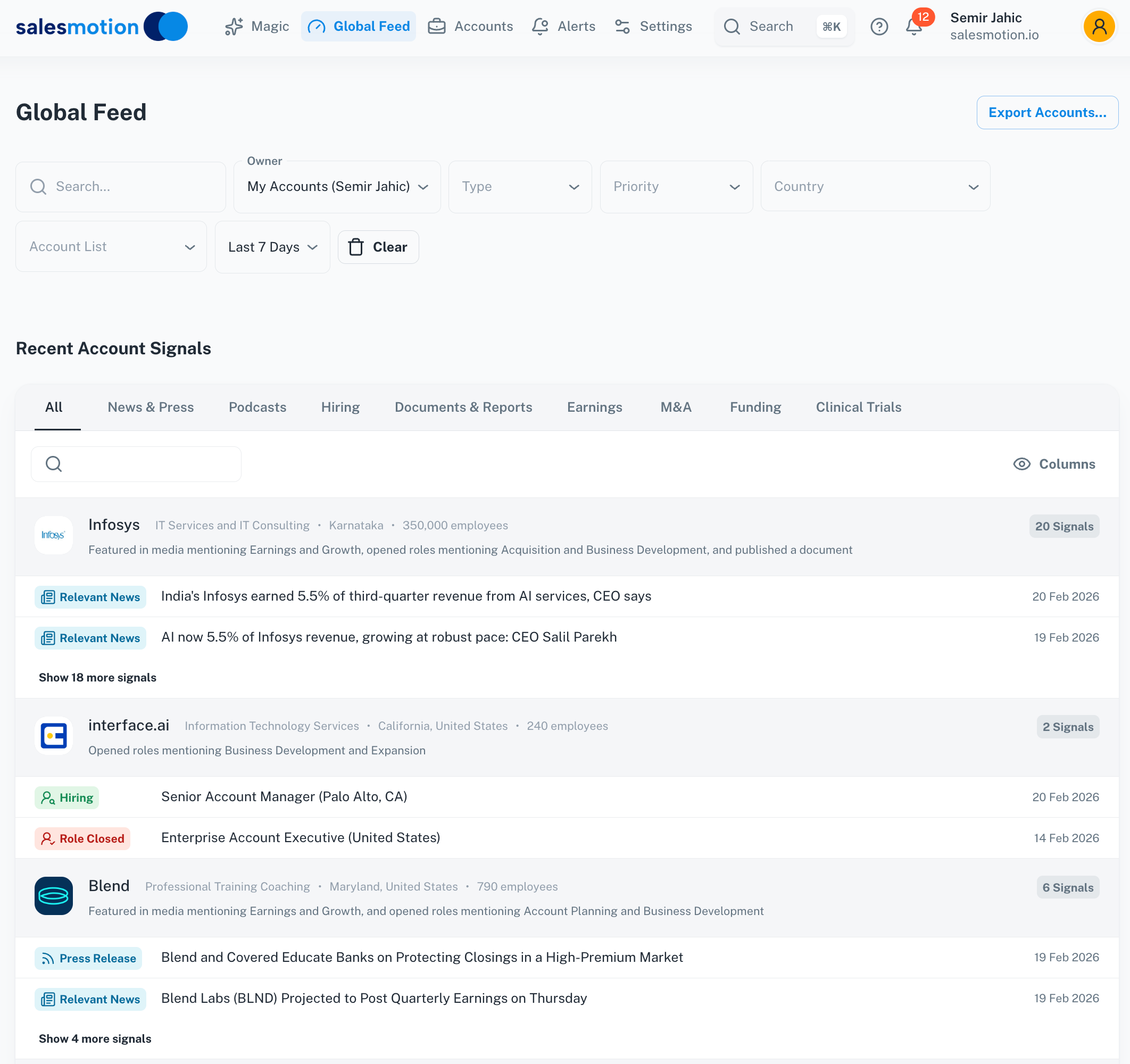 The global signal feed surfaces buying window signals across all your monitored accounts in real time, so no opportunity slips through the cracks.
The Half-Life of a Buying Window
One of the most overlooked aspects of buying window detection is timing decay. Not all signals stay relevant forever. Understanding the shelf life of each signal type helps you prioritize outreach and avoid wasting effort on stale opportunities.
| Signal Type | Window Duration | Peak Receptivity |
|---|---|---|
| Leadership change | 30-100 days | First 30 days in role |
| Earnings call commitment | 1-2 quarters | Immediately after the call |
| Hiring surge | 60-120 days | While roles are still open |
| Funding event | 60-90 days | First 30 days post-announcement |
| Technology change | 30-90 days | During evaluation phase |
| Competitive displacement | 30-60 days | While dissatisfaction is active |
| Strategic initiative | 1-3 quarters | First quarter after announcement |
The implication is clear: speed matters. If your signal-to-outreach process takes two weeks, you have already burned through a significant portion of the buying window for fast-decaying signals like competitive displacement or funding events. The best sales teams aim for same-day or next-day outreach on high-priority signals.
This is where manual processes fail most dramatically. By the time you notice a leadership change through LinkedIn scrolling, the new executive may already be three weeks into their role and have a shortlist of vendors. Automated detection closes that gap, putting the signal in front of your reps within hours of it appearing.
Common Mistakes When Tracking Buying Windows
After working with hundreds of sales teams, I see the same mistakes repeatedly. Avoid these:
Treating all signals equally. A website visit and a new CRO hire are not equivalent. Weight your signals based on the framework above and focus rep time on the highest-scoring accounts.
Monitoring signals without context. Knowing that a company raised a Series C is useless without understanding how that funding connects to your value proposition. Always map signals back to the specific problem your product solves.
Tracking too few accounts. If you are only monitoring 50 accounts manually, you are missing buying windows at the hundreds of companies in your ICP that you are not watching. The whole point of automation is to expand your coverage without expanding your headcount.
Acting too slowly. Buying windows have a half-life. A new CRO is most receptive in their first 100 days. An earnings call commitment creates urgency for one to two quarters. If your signal-to-outreach time is measured in weeks rather than hours, you are losing to faster competitors. Build a process where high-priority signals trigger same-day outreach.
Relying on a single signal type. No individual signal is reliable enough to drive outreach on its own. Always look for signal convergence before committing resources. A single job posting is interesting. A cluster of job postings plus a new VP plus an earnings commitment is actionable.
Confusing signal volume with signal quality. Some teams celebrate having "thousands of signals" flowing into their CRM. Volume is meaningless if the signals are not filtered, scored, and contextualized. Ten high-quality buying window signals that your reps actually act on will generate more pipeline than a thousand unfiltered alerts that get ignored.
Building Your First Buying Window Playbook
If you want to implement buying window detection on your team, start here:
-
Define your top three signal types. Based on your product and ICP, which of the seven signals are most predictive of a purchase? For most B2B software companies, leadership changes, earnings call language, and hiring surges are the top three.
-
Set up basic monitoring. Even if you start manually, begin tracking those three signal types for your top 25 accounts. Use the tools I described above -- Google Alerts, LinkedIn, and a weekly review cadence.
-
Create signal-specific outreach templates. For each signal type, write an outreach message that references the signal, explains why it is relevant, and offers a specific next step. "I noticed you recently hired a new VP of Sales -- when teams are building out their sales motion, they often evaluate [your category]" is dramatically more effective than a generic cold email.
-
Score and prioritize weekly. Every Monday, review your signal data and rank your accounts by buying window strength. Assign your best accounts to your best reps.
-
Automate when you hit the wall. When manual monitoring consumes more than five hours per week, or when you need to cover more than 50 accounts, it is time to invest in a signal tracking platform. The ROI is immediate: more coverage, faster detection, and less time spent on research that does not directly generate pipeline.
-
Measure and refine. Track which signal types produce the highest conversion rates for your specific product and ICP. After 90 days, you will have enough data to adjust the weights in your scoring framework. Some teams discover that hiring surges are more predictive than leadership changes for their category -- the only way to know is to measure.
-
Integrate signals into your CRM. The biggest risk with any signal-based approach is that insights die in a separate dashboard. Push buying window alerts directly into Salesforce, HubSpot, or whatever CRM your reps live in. If they have to check a separate tool to see signals, adoption will drop. Salesmotion integrates natively with Salesforce, so signals appear directly in the account record where reps are already working.
For a deeper comparison of signal detection tools, see our guide to buying signals software.
Frequently Asked Questions
How to identify accounts entering a buying window?
To identify accounts entering a buying window, monitor seven key signal types: leadership changes (new executives joining), earnings call language (public commitments to investment areas), hiring surges (clusters of related job postings), funding events (new capital raised), technology changes (stack additions or removals), competitive displacement (signs of vendor dissatisfaction), and strategic initiative announcements (new programs or market expansions). The most reliable approach is to look for signal convergence -- when two or more signal types appear simultaneously at the same account, the probability of an active buying window increases dramatically. Manual monitoring works for 10-25 accounts, but teams covering larger territories need automated signal detection tools like Salesmotion's Signal Agent to track all seven signal types across 1,000+ sources in real time.
What are the best tools for tracking buying signals?
The best tools for tracking buying signals depend on the signal types you prioritize and the size of your account list. For intent data, providers like Bombora and 6sense track anonymous content consumption. For job change signals specifically, UserGems is a focused option. For comprehensive buying window detection that covers all seven signal types -- leadership changes, earnings calls, hiring, funding, technology shifts, competitive displacement, and strategic initiatives -- Salesmotion provides a unified platform that monitors 1,000+ sources and delivers context-rich alerts rather than raw data. The key differentiator between tools is whether they tell you what happened or why it matters for your specific value proposition. For a detailed comparison, see our best signal tracking platforms guide.
What is signal-based selling and how does it work?
Signal-based selling is a sales methodology where outreach timing and messaging are driven by observable buying signals rather than calendar-based cadences or generic lead scores. Instead of emailing every account on a fixed schedule, signal-based sellers monitor their target accounts for structural changes -- leadership hires, funding events, earnings commitments, hiring surges -- and initiate outreach only when those signals indicate the account is entering an active buying window. The approach works because it aligns seller activity with buyer readiness: you reach out when the account has both the motivation and the means to purchase, which produces significantly higher response rates and conversion rates than traditional cold outbound. According to Cognism research, signal-personalized outreach achieves response rates up to 5x higher than generic messaging. Teams operationalizing signal-based selling at scale use platforms like Salesmotion to automate signal detection, scoring, and routing so that reps spend their time selling into open buying windows rather than manually researching accounts.
Identifying buying windows is not a new concept -- great sellers have always tried to time their outreach to moments of change. What is new is the ability to do it systematically, across hundreds or thousands of accounts, in real time.
The gap between teams that detect buying windows and teams that rely on spray-and-pray outbound is widening every quarter. In 2024, signal-based selling was an advantage. In 2025, it became table stakes for top performers. In 2026, it is the dividing line between sales organizations that consistently hit quota and those that wonder why their outbound is not working.
The playbook in this guide gives you everything you need to get started -- from the seven signal types to the scoring framework to the implementation approaches. Whether you start manually with 25 accounts or deploy automated detection across your entire ICP, the core principle is the same: reach out when accounts are ready to buy, not when your cadence tool tells you it is time.
If you want to see how automated buying window detection works in practice, try the interactive demo or book a call with our team.