Selling to CROs and CDMOs means selling through the buyer to the buyer's buyer: tie your offer to what pharmaceutical sponsors expect of them. CROs buy around trial execution, scientific depth and sponsor visibility. CDMOs buy around capacity, quality systems and supply reliability.
TL;DR: Multi-thread early across Business Development, Operations, Quality and Scientific leads. Time outreach to operating changes such as new client wins, facility expansions, capability announcements and executive hires. Enter through a tightly scoped pilot with clear success criteria so Quality and Procurement can assess the risk.
Your emails are probably getting ignored for a simple reason. You're pitching a CRO or CDMO the way you'd pitch a normal enterprise account, and they aren't normal enterprise accounts. They sell trust, delivery, compliance, and continuity to pharmaceutical clients who can punish mistakes hard and fast.
That changes everything about how you prospect, how you frame value, and who you need involved before a deal moves.
The opportunity is real. The global CRO services market was valued at USD 92.27 billion in 2025 and is projected to reach USD 199.28 billion by 2034, with North America holding 50.08% of the market in 2025 and a projected 9.0% CAGR, according to Fortune Business Insights' CRO services market analysis. Big market, concentrated buyers, real growth.
But growth doesn't make this vertical easy. It makes it noisier.
If you're selling to CROs and CDMOs, the winning move isn't just understanding what they do. It's understanding how they win business from pharma sponsors, where they feel operational pressure, and what signal tells you they need help now. That's the playbook.
Your Guide to a Booming and Complex Market
Selling to CROs and CDMOs sits in an awkward middle ground. They're advanced operators, but they're also service businesses under constant client pressure. They need to look excellent in front of sponsors while protecting margins behind the scenes.
That means generic value props fall apart quickly. "We improve efficiency" isn't a message. Neither is "we help life sciences teams scale." Every vendor says that. What buyers want to hear is whether you can help them win a sponsor, deliver faster, survive an audit, reduce handoff risk, or scale a capability without making their internal teams absorb the chaos.
The rep who gets meetings in this market usually does three things better than everyone else:
- They sell through the buyer, not at the buyer. They tie their offer to sponsor expectations.
- They know the operating model. They understand the difference between clinical delivery pressure and manufacturing pressure.
- They lead with relevance. They show why this matters to BD, Ops, Quality, and Science at the same time.
Practical rule: If your message wouldn't help the CRO or CDMO sound smarter in front of a pharma client, it probably won't get traction.
A CRO leader reading your note is asking: will this help us execute trials, support sponsors, and protect our reputation?
A CDMO leader is asking something different: will this help us manufacture reliably, manage scale-up, protect quality, and avoid introducing supply risk?
Those are different deals, even if the account list looks similar in your CRM.
Decoding the CRO and CDMO Buyer Mindset
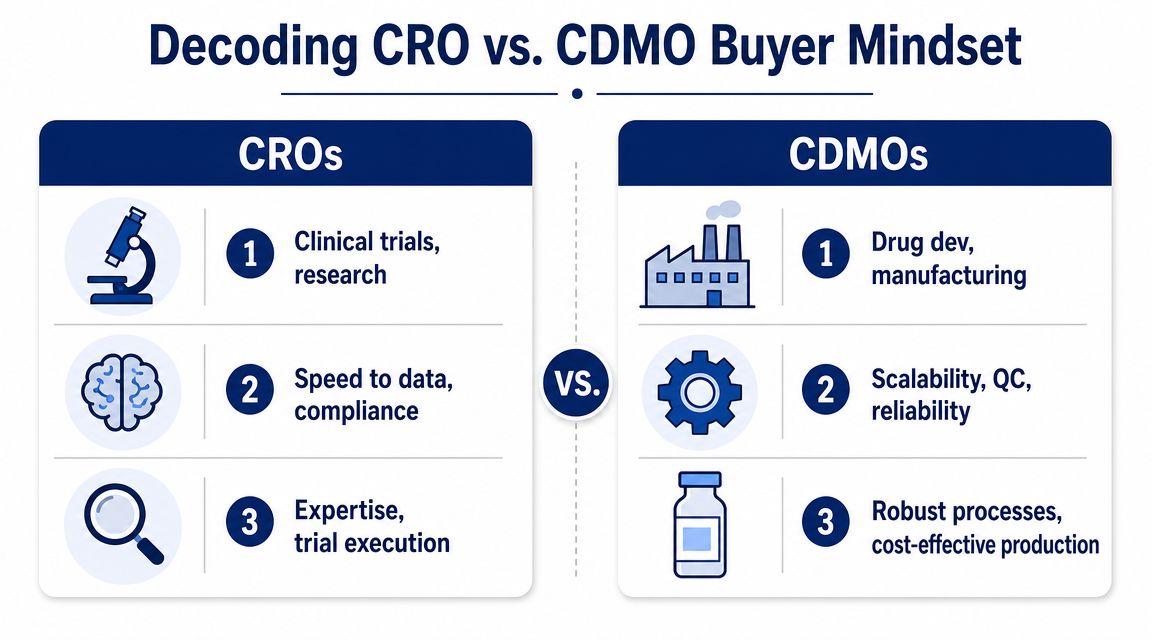
The easiest way to lose credibility is to treat CROs and CDMOs as interchangeable. They overlap in the outsourcing market, but they don't buy the same way because they don't sell the same thing to pharma.
The broader pharmaceutical CRO and CDMO market was valued at USD 233.93 billion in 2024 and is projected to reach USD 459.33 billion by 2032, according to Credence Research's pharmaceutical CRO and CDMO market report. That size matters, but the bigger lesson for a seller is structural. CROs focus on research and clinical development. CDMOs provide integrated development and manufacturing. Your entry point depends on that distinction.
What CRO buyers care about
CRO buyers usually orient around sponsor delivery. Their commercial team wins work by convincing biotech and pharma companies that they can run studies cleanly, on time, and with enough therapeutic depth to avoid expensive missteps.
In practice, CRO buyers tend to care about:
- Speed of delivery. Can they move from proposal to study startup to execution without friction?
- Scientific expertise. Do they have credible depth in oncology, CNS, rare disease, or whatever area they sell into?
- Regulatory track record. Can they demonstrate disciplined execution under scrutiny?
- Therapeutic area experience. Sponsors want pattern recognition, not just manpower.
- Technology infrastructure. If their systems create reporting lag or sponsor visibility problems, they lose trust.
If you sell software, services, data, or enablement into a CRO, don't pitch "better workflows." Pitch fewer operational misses, cleaner sponsor communication, faster internal coordination, and stronger confidence during client diligence.
What CDMO buyers care about
CDMO buyers live closer to the physical world. Capacity, quality, tech transfer, and supply chain reliability matter because their customers need molecules turned into material, then into repeatable production.
The priorities sound different:
| Buyer type | What matters most | What your pitch should connect to |
|---|---|---|
| CRO | Trial execution, science, compliance, sponsor visibility | Speed to data, operational coordination, therapeutic fit |
| CDMO | Manufacturing capacity, quality systems, reliability, scale-up flexibility | Throughput, quality control, continuity, speed to market |
A CDMO executive will care less about abstract innovation and more about whether your offering helps them prevent bottlenecks, support scale-up changes, maintain documentation discipline, and stay flexible when sponsor plans shift.
Sell to the pressure they feel from their client, not the category they operate in.

“Salesmotion helps you spot signals from prospect accounts, news items / job hiring alerts etc that indicate that now is a good time to reach out with a well-crafted message.”
Rob Douglas
Director of Sales, icit business intelligence
Mapping the Buying Committee and Key Stakeholders
Single-threaded deals die in this market. You might get enthusiastic feedback from one stakeholder, then watch the deal stall because Quality wasn't bought in, Operations saw implementation risk, or Scientific leadership didn't trust the fit.
The internal map usually runs wider than reps expect.
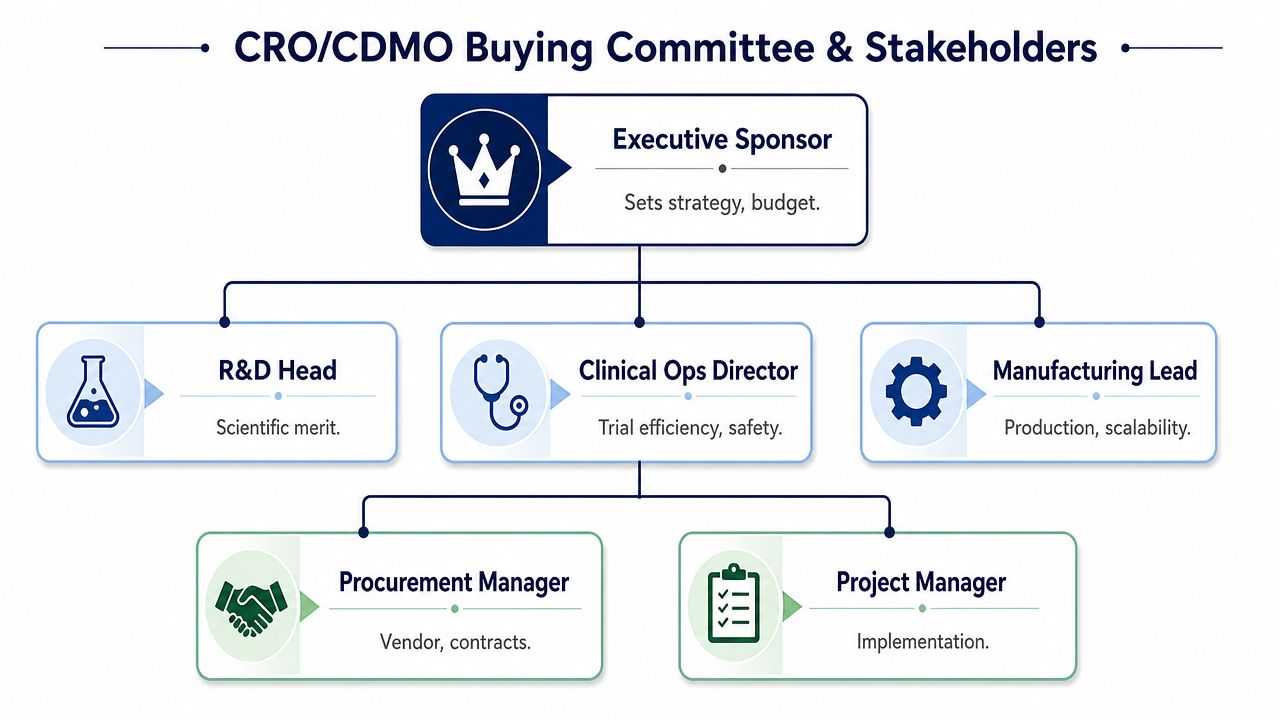
A strong first step is doing disciplined account research for life sciences sales before outreach. The point isn't to gather trivia. It's to understand which functions own growth, delivery, compliance, and technical validation inside the account.
Business Development
BD wants help winning sponsor work. Their lens is external and competitive.
Their real questions sound like this:
- Can this help us look stronger in proposals?
- Will this shorten response time to sponsor requests?
- Does this improve the story we tell around capability and execution?
What to say:
"Your sponsors aren't buying features from you. They're buying confidence that you can deliver. We help you show that confidence earlier, with less internal scramble."
If the CRO just expanded into a therapeutic area or the CDMO announced a new modality capability, BD will care about anything that helps package and operationalize that story.
Operations
Operations owns the mess after the contract is signed. They care about throughput, staffing pressure, implementation burden, and margin leakage.
They're often the hardest honest buyer in the room because they know where nice sales promises go to die.
What to say:
- For CROs: "If demand rises faster than your team can absorb it, your sponsor experience degrades. We help standardize the handoffs that usually create delays."
- For CDMOs: "Scale-up flexibility only matters if the execution model holds when the program changes. We help your team manage the transitions cleanly."
Quality
Quality isn't there to help you close. Quality is there to stop avoidable risk from entering the vendor base.
Their biggest fear isn't paying too much. It's introducing a vendor that creates documentation gaps, compliance exposure, or rework during an audit or client review.
What to say:
- Acknowledge the burden first. "You don't need another vendor that creates exceptions for your team to manage."
- Then narrow the scope. "Let's define a pilot with clear controls, limited exposure, and documentation your team can evaluate."
Scientific leads
Scientific leaders validate whether your offer fits how the work is really done. They care about technical credibility and domain relevance.
This is where lazy messaging gets punished. If you pitch a generic platform to a group built around assay expertise, clinical operations discipline, or formulation transfer, they won't engage.
A useful pattern is to mirror their world back to them:
- Therapeutic fit
- Program-stage relevance
- Technical workflow impact
- Sponsor-facing implications
If your rep can't explain how the product affects protocol delivery, study coordination, batch readiness, deviation risk, or tech transfer continuity, Scientific will tune out fast.
Aligning Your Pitch with Their Business Model
The best message in selling to CROs and CDMOs usually doesn't start with your product. It starts with the buyer's buyer.
That's the key shift. You're not just helping a CRO run a cleaner operation or a CDMO support a plant more efficiently. You're helping them look more capable, more reliable, and easier to trust in front of a pharmaceutical sponsor.
Lead with therapeutic and capability alignment
If the CRO focuses on oncology, don't send a generic note about operational efficiency. Tie your relevance to the demands of oncology trials. If the CDMO specializes in biologics, don't open with broad manufacturing language. Connect your offer to the complexity of biologic development, scale-up, documentation, or supply continuity.
Buyers in this market organize credibility around specialization. They don't want broad. They want fit.
A practical opening sounds like this:
You're building around sponsors that need stronger continuity across [therapeutic area or modality]. If that growth is creating pressure on delivery, reporting, or handoffs, that's where we fit.
Short. Specific. Commercially aware.
Use regulatory and delivery proof the right way
Regulatory wins and audit outcomes are useful proof. The important nuance is how you use them.
Don't vaguely say, "I saw your strong compliance history." That's weak. Instead, point to the pattern those wins imply. For example, if a CRO publicly emphasizes inspection readiness or a CDMO highlights quality systems in its market messaging, use that as a clue. Your framing should show that you understand compliance isn't a badge. It's part of how they win and retain clients.
Good language:
- For CROs: "You've clearly positioned regulatory discipline as part of your client promise. We help operational teams maintain that standard when programs multiply."
- For CDMOs: "Quality systems only create commercial advantage if they hold up during tech transfer and scale-up. That's the gap we help close."
Show you understand sponsor-side digital expectations
One of the most overlooked selling angles is digital operating readiness. PPD's perspective on integrated CDMO-CRO early engagement makes a useful point: early planning should ensure datasets, templates, and platforms support real-time data flow, and full-service integration can compress timelines, improve continuity and reduce risk.
That changes your pitch. Scientific capability alone isn't enough. A CRO or CDMO also needs to integrate with sponsor-side systems, real-time alerts, and cross-functional handoffs.
If your offering touches data, workflow, visibility, coordination, reporting, or planning, this is your lane.
Use language like:
- "This helps your team plug into how sponsors already operate."
- "This reduces lag between internal activity and sponsor visibility."
- "This gives BD a stronger story because Operations can back it up."
For teams prospecting into active development organizations, clinical trial tracking and account context can also help sharpen messaging around therapeutic focus, sponsor priorities, and likely operational pressure points.
Sell the integrated model when continuity matters
A fragmented vendor story creates handoffs. Handoffs create delay, interpretation risk, and accountability gaps.
If your product helps preserve continuity across research, development, manufacturing, or sponsor communication, say that directly. This is especially effective when the account is expanding capabilities and trying to present a more connected model to the market.
What works:
- Framing your solution as a continuity layer
- Showing how one team can hand off to another without loss of context
- Tying internal coordination to sponsor confidence
What doesn't:
- Feature dumping
- Talking only about internal productivity
- Pretending procurement won't ask hard questions later

“Automatic account profile detail I can use to manage my territory. Using Salesmotion AI to generate value statements per persona, account, etc. Using Salesmotion to give me a starting point based on new hires, or news alerts is critical.”
Adam Wainwright
Head of Revenue, Cacheflow
Using Business Signals to Time Your Outreach Perfectly
Great messaging sent at the wrong time still loses. In this vertical, timing often determines whether your note is relevant or ignored.
The best outreach usually follows an operating change. Not random news. Not vanity PR. A change that creates pressure.
The signals worth acting on
Some signals matter because they imply growth. Others matter because they imply strain. The sweet spot is both.
A few high-value triggers:
- New client wins. A new sponsor engagement often means new delivery commitments, reporting requirements, and internal coordination load.
- Facility expansions. For CDMOs, expansion can signal future capacity, but also implementation, staffing, validation, and supplier complexity.
- Capability announcements. A new therapeutic area, modality, lab service, or manufacturing line changes who they can sell to and what they need to operationalize.
- Executive hires. New BD, Operations, or technical leadership often creates appetite for evaluating current systems and partners.
There are also financial signals that matter. This guide to valuing CROs and CDMOs notes that book-to-bill and backlog growth are primary benchmark metrics for CRO health, and that CROs with a book-to-bill ratio consistently above 1.2x can command a 2 to 4 turn EBITDA multiple premium. For a seller, the practical meaning is simple. If they're winning work faster than they're completing it, they may need help scaling without damaging delivery.
When growth outpaces execution capacity, your message stops being a pitch and starts sounding like relief.
For teams that don't want reps manually checking press releases, hiring pages, and sponsor announcements every day, Salesmotion's CRO sales intelligence can track CRO/CDMO business signals such as new client wins, facility expansions, and capability announcements, then turn those changes into outreach context. Our playbook on CRO and CDMO sales prospecting covers the prospecting side in more depth.
You can also build a cleaner trigger framework by reviewing common pharma buying signals and adapting them to CRO and CDMO accounts.
Turn one signal into one sharp message
Take a CDMO facility expansion. Most reps send some version of: "Congrats on the new facility. We help manufacturers scale."
That's useless.
A better note ties the signal to the operational burden:
Subject: Supporting scale-up without adding handoff risk
Saw the expansion announcement and the added capacity focus. When CDMOs add capability, the pressure usually lands on coordination across operations, quality, supply chain, and client communication, especially as programs move toward larger-volume execution.
We help teams tighten those handoffs so new capacity doesn't create new friction. If that's a priority this quarter, happy to compare notes.
That works because it doesn't celebrate the news. It interprets the news.
A simple signal-driven sequence
Use a short sequence with a different angle in each step.
- Email one: Reference the trigger and name the likely operational consequence.
- Email two: Shift to sponsor impact. "How are you keeping client visibility high as workload expands?"
- Call or voicemail: Mention the business event and your point of view in one sentence.
- LinkedIn message: Keep it light. Confirm relevance, don't re-pitch.
- Follow-up email: Offer a narrow conversation around one workflow, not a platform demo.
The point isn't persistence for its own sake. It's showing the account that you understand what changed and why it matters.
Navigating Procurement and Proving Your Value
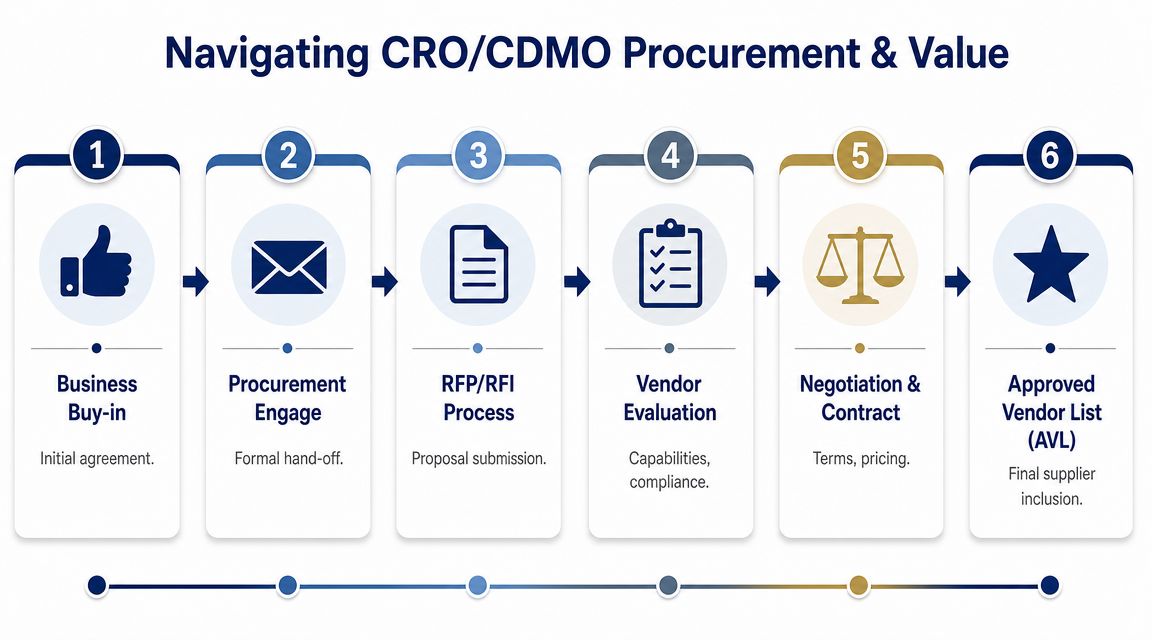
Many otherwise solid deals often fall apart at this stage. The business stakeholder likes you. The use case is real. Then Procurement and Quality step in, ask harder questions, and expose how little of the deal was de-risked.
That isn't bad news. In this market, procurement is part of the sale.
Start smaller than your champion wants
A pilot is often the cleanest path into an approved vendor list. Not a vague proof of concept. A paid, scoped engagement with clear success criteria, limited operational exposure, and named stakeholders from the start.
Why this works:
- Quality can assess control. They see process, documentation, and boundaries.
- Operations can test reality. They learn whether your implementation creates drag.
- BD gets an internal proof point. They can advocate for expansion with something concrete.
- Procurement sees lower initial risk. The deal is easier to approve when the blast radius is contained.
If you're responding to a formal process, it helps to prepare the same way buyers do. This is especially true when handling security reviews, implementation scope, and commercial terms inside RFP response workflows for complex sales.
Frame vendor selection as risk management
The strongest procurement argument in this market isn't price. It's continuity.
CellCarta's overview of CRO, CMO, and CDMO partner selection notes that a CDMO model can simplify communication and timelines for companies seeking a simplified handoff, while relying on a single vendor can limit flexibility. Either way, buyers weigh partners on continuity and risk.
That's highly usable in a sales conversation.
If your offering reduces handoffs, creates cleaner traceability, improves continuity from research to manufacturing, or strengthens collaboration across functions, say that in procurement language:
- Reduced transition risk
- Cleaner ownership
- Lower coordination burden
- Better continuity under timeline pressure
Those phrases land better than "innovation" and "transformation."
Procurement doesn't buy potential. Procurement buys reduced downside.
Be ready for compliance questions that aren't your usual script
In life sciences, buyers may ask about standards, material handling, data governance, supplier controls, and region-specific regulatory exposure. If your product touches manufacturing, chemicals, materials, or compliance workflows in Europe, it can help to understand frameworks such as the EU's REACH chemical regulation, especially when your buyer's Quality or regulatory team evaluates downstream obligations.
You don't need to posture as a regulatory expert if you aren't one. You do need to show that you respect the environment your buyer operates in.
Keep one eye on deal structure
If you're selling into a CRO ownership transition or founder-led sale process, timing gets even more delicate. Objective's strategic guide to selling a CRO notes that selling a CRO typically spans six to nine months, and that buyers evaluate financial performance, contracts, compliance records, contracted backlog and pipeline visibility. For a vendor, that means two things. First, internal priorities may shift before the org admits it publicly. Second, stakeholders may become far more sensitive to implementation risk, reporting discipline, and anything that affects perceived operational quality.
When a buyer says, "We like this, but timing is tricky," believe them. Then offer a structure that matches the moment.
Frequently Asked Questions
How should I prospect CROs differently from CDMOs?
Start with their business model. CROs buy around trial execution, scientific depth, regulatory credibility, and sponsor visibility. CDMOs buy around capacity, quality systems, supply reliability, and flexibility during scale-up.
Your first email should reflect that difference. If the same sequence could go to both, it's too generic.
Who should I contact first?
Usually start where the pain is easiest to articulate, then multi-thread fast. BD is often a good opening if your solution helps them win or support sponsor work. Operations is often stronger if your value shows up in delivery, throughput, or coordination.
Don't wait to bring in Quality and Scientific stakeholders. In this market, late validation is where deals get stuck.
What's the best opening angle in outreach?
Lead with capability alignment to their therapeutic focus, modality, or delivery model. Then connect that to an operational consequence.
For example:
- A CRO expanding oncology services may need stronger sponsor-facing coordination and reporting discipline.
- A CDMO adding capacity may need tighter handoffs across manufacturing, quality, and supply chain.
That lands better than pitching features.
Should I mention their clients in my pitch?
Yes, but carefully. You're selling to a company that sells to pharma. Show that you understand what their clients expect without pretending you know confidential account details.
Useful framing includes sponsor readiness, client visibility, continuity, speed to market, and reducing handoff risk.
How do I get onto the approved vendor list?
The cleanest path is often a tightly scoped pilot. Keep the scope narrow, define success clearly, and involve the functions that will later influence expansion. A pilot isn't just about proving the product. It's about proving that your company is easy to work with in a regulated environment.
What usually kills these deals?
A few repeat offenders:
- Single-threading the account
- Generic life sciences messaging
- Ignoring Quality until late
- Talking only about internal efficiency
- Failing to connect your value to the sponsor experience
The deal gets much easier when the buyer can repeat your value internally in one sentence: this helps us win, deliver, and de-risk client work.
If your team is selling to CROs and CDMOs, Salesmotion's Signal Agent can help you track account signals, research stakeholders, and turn business changes into timely outreach with clearer relevance.