
Account research for life sciences sales starts with clinical, regulatory, and commercialization events, not generic growth markers. The job is to understand where an account sits in its development and commercial timeline, who is now under pressure, and what that pressure means for your deal.
TL;DR: Prioritize life sciences accounts by trial and regulatory momentum, not company size. Build the brief from ClinicalTrials.gov, FDA.gov, SEC EDGAR, investor relations pages, PubMed, and LinkedIn. Treat Phase 3 readouts, PDUFA dates, commercial leadership hires, and earnings language about launch preparation as high-intent triggers. Map the scientific, clinical, and commercial stakeholders, and end every brief with one outreach angle.
Most advice on account research assumes every industry buys the same way. It treats a biotech like a SaaS company with a different logo.
That's the mistake.
In life sciences, the strongest buying signals usually don't come from generic growth markers like headcount, website traffic, or a fresh funding announcement. They come from clinical, regulatory, and commercialization events that change urgency inside the account. A company moving toward a Phase 3 readout, preparing for a PDUFA date, adding commercial leadership, or signaling launch preparation in earnings language is operating on a very different clock than a company that only looks large on paper.
That's why account research for life sciences sales needs its own playbook. The job isn't to build a prettier company profile. The job is to understand where the account sits in its development and commercial timeline, who now has pressure on them, and what that pressure means for your deal.
Why Generic Sales Research Fails in Life Sciences
The standard playbook says to rank accounts by firmographics. Bigger company, bigger budget. More employees, more opportunity. Recent funding, good target.
That logic breaks down fast in life sciences.
Public guidance on life sciences account prioritization often still leans on company size, funding, therapeutic area, and buying hierarchy, but it misses the harder question: what signals near-term commercial urgency. A more useful approach is to prioritize by trial and regulatory momentum, because not all growth signals carry the same timing value. A new approval or increased trial activity can matter more than a large but static account because those events often create budget movement, new stakeholders, and a real need for new vendors, as noted in this life sciences ABM guide.
What generic tools miss
Most generic sales platforms are built to answer broad B2B questions:
- Who raised money
- Who hired salespeople
- Which accounts grew headcount
- Who changed executive titles
Those signals aren't useless. They're just incomplete. In life sciences, they often sit downstream of the underlying story.
A biotech can look quiet in generic business databases while its pipeline is approaching a decisive milestone. A pharma account can look stable while one late-stage asset changes the entire commercial planning agenda. If your research workflow doesn't include clinical and regulatory context, your outreach lands late or sounds generic.
Generic research tells you the company exists. Good life sciences research tells you why the account might care right now.
That's why teams need a more signal-driven view of life sciences sales intelligence. The point isn't more data. It's better timing.
What actually changes conversations
The highest-value accounts in life sciences are often the ones where something is moving:
| Account type | Generic view | Better life sciences view |
|---|---|---|
| Large pharma | Mature, likely budgeted | Which assets are nearing launch, approval, or competitive pressure |
| Clinical-stage biotech | Small, maybe early | Is pipeline momentum accelerating and creating operational strain |
| Commercial biotech | Recently funded, growing | Are new approvals, label changes, or launch prep creating urgency |
That shift changes outreach quality. Instead of “saw your company is growing,” you can speak to the reason a clinical, regulatory, or commercial team may suddenly be re-evaluating tools, partners, or workflows.
The Essential Research Stack for Life Sciences Sales
The life sciences data environment is getting richer and more complex. Market research estimates the global life science analytics market at USD 10.55 billion in 2024 and projects growth to USD 16.33 billion by 2030, which is consistent with expanding use of clinical trials, real-world evidence, genomics, and sales and marketing data in commercial decision-making, according to this BioSpace market coverage. For sellers, that means the opportunity is there, but the research burden is heavier if you rely on generic tools alone.
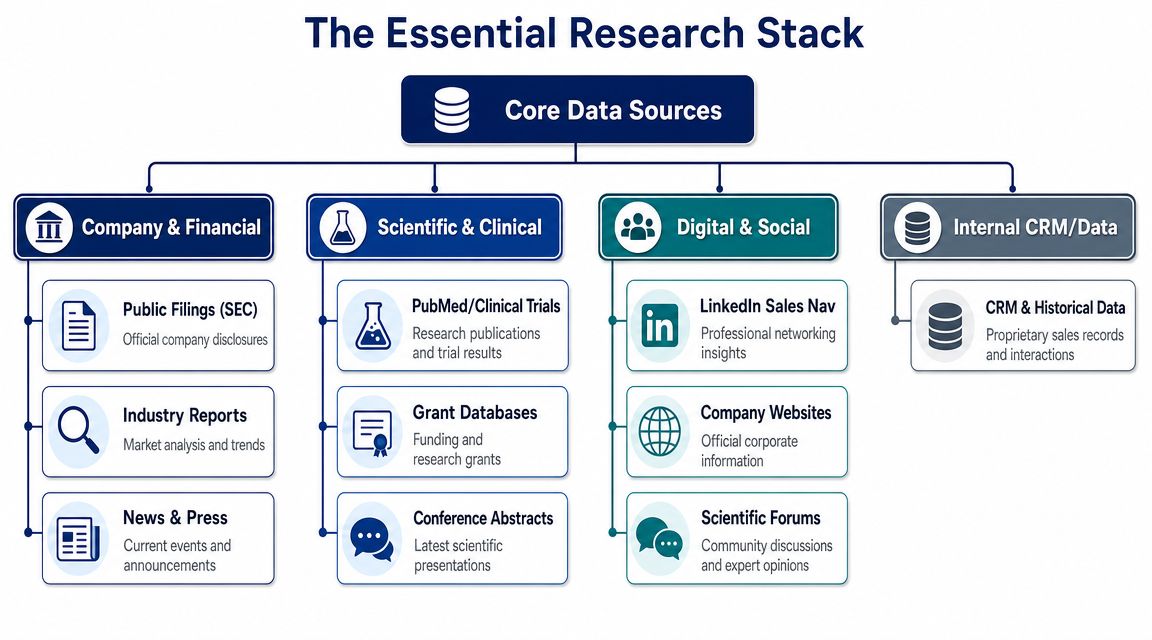
ClinicalTrials.gov and FDA.gov
Start with the scientific and regulatory spine of the account.
On ClinicalTrials.gov, don't just count active trials. Look for changes in status, phase progression, primary completion timing, enrollment updates, and whether the company is expanding into additional indications. A Phase transition matters because it often changes internal planning, vendor needs, and who gets involved in decisions.
On FDA.gov, look for approvals, label expansions, advisory committee activity, safety communications, inspection history, and anything that changes the regulatory path or launch timeline. If the company is nearing a major regulatory event, that often creates urgency across clinical operations, market access, medical affairs, and commercial planning.
SEC EDGAR and investor relations pages
At this stage, you separate healthy momentum from pressure.
For a pre-revenue biotech, SEC filings often tell you whether the company has room to make decisions calmly or whether time is tightening. You're looking for management commentary, operating priorities, risk factors, and practical clues around funding needs and runway. For commercial-stage pharma or biotech, focus more on revenue trajectory, launch commentary, portfolio prioritization, and any language that signals preparation for commercialization.
Investor relations pages help because they package the current story management wants the market to understand. Earnings decks, transcripts, and press releases often reveal where spending is concentrating and which assets matter most.
PubMed, conference materials, and LinkedIn
PubMed and conference abstracts add the scientific context many reps skip. You don't need to become a domain expert in every molecule. You do need to know whether recent publications or presentations strengthen the company's narrative, expose competitive pressure, or signal a shift in development focus.
LinkedIn is useful, but only after you know the account story. Then it becomes a way to identify who was hired, how teams are being built, and whether the account is leaning toward clinical scale-up, launch readiness, market access buildout, or commercial execution.
Practical rule: If a source can't tell you something about pipeline momentum, regulatory timing, financial pressure, or stakeholder change, it probably shouldn't drive account prioritization.
A lot of teams now combine these sources with real-time account monitoring tools so they don't have to check each site manually. That matters because life sciences signals lose value when you find them after the market has already reacted.
The stack that actually gets used
A practical working stack usually looks like this:
- Scientific base layer: ClinicalTrials.gov, PubMed, scientific conference materials
- Regulatory layer: FDA databases and related announcement pages
- Financial layer: SEC EDGAR and company investor relations pages
- People layer: LinkedIn and company leadership pages
- Commercial context layer: company websites, press releases, and your internal CRM notes
Generic sales tools can still help with contacts and broad company activity. They just can't be the whole stack.

“Salesmotion helps you spot signals from prospect accounts, news items / job hiring alerts etc that indicate that now is a good time to reach out with a well-crafted message.”
Rob Douglas
Director of Sales, icit business intelligence
How to Build an Opinionated Life Sciences Account Brief
Raw data doesn't help a rep unless it leads to a point of view.
A practical framework for life sciences recommends a 10-minute account review centered on company snapshot, pipeline status, leadership changes, competitive context, and a synthesized outreach angle. It also flags Phase 3 readouts, PDUFA dates, commercial leadership hires, and earnings language about launch preparation as high-intent triggers, with key public inputs including ClinicalTrials.gov, FDA databases, SEC filings, and scientific conference materials, as outlined in this life sciences account research framework.
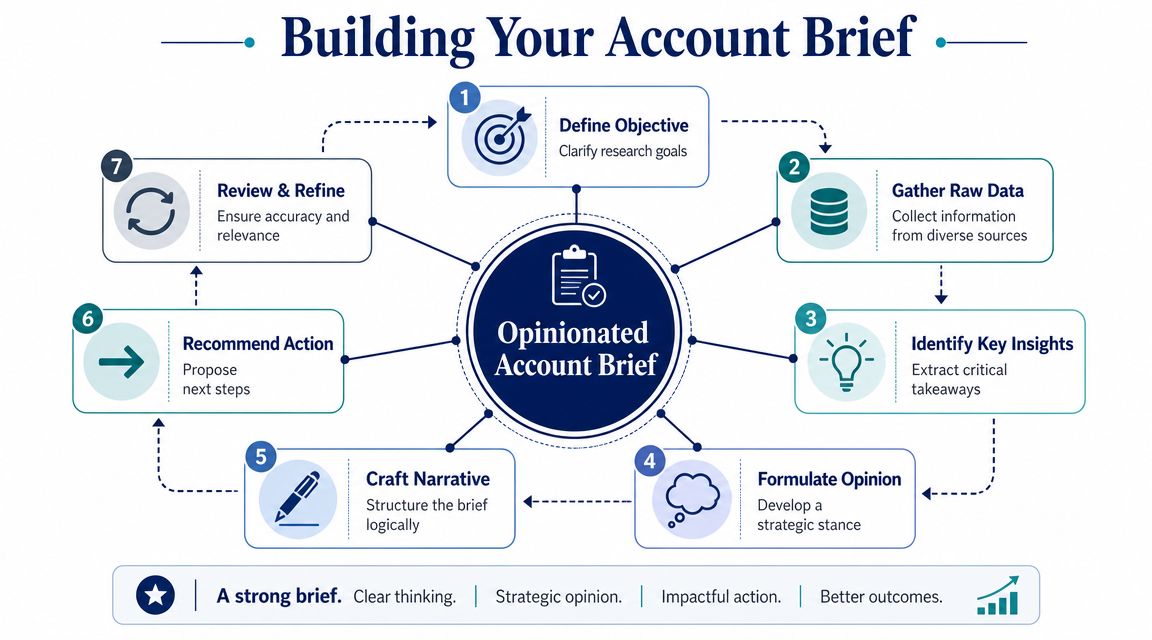
The key word is opinionated. A useful brief doesn't dump facts. It answers a commercial question: why this account, why now, and who is most likely to care?
Start with the company snapshot
The first block should be short enough to scan in under a minute.
Include:
- Business model: pharma, biotech, CRO, CDMO, diagnostics, or another segment
- Therapeutic focus: oncology, rare disease, immunology, CNS, or whatever drives their portfolio
- Pipeline stage: discovery, clinical, late-stage, approved and commercial, or mixed
- Recent approvals or major milestones: only if they change current urgency
- Current commercial posture: still building, actively launching, or managing a broader portfolio
This isn't administrative. It sets message discipline. You shouldn't send the same note to a pre-commercial biotech and a mature pharma account, even if both work in oncology.
Add the clinical trial landscape
Account research for life sciences sales presents material differences compared to generic B2B prep.
Summarize the handful of trials or programs that matter most. Focus on what changed, what's approaching, and what likely follows.
A good clinical section answers questions like these:
- Which active trials look most strategic?
- Are they early validation studies or late-stage programs with commercial implications?
- Were results recently reported, delayed, expanded, or reframed?
- Is there a regulatory timeline implied by the current status?
- Does trial activity suggest budget expansion, vendor scrutiny, or operational complexity?
You're not writing for an academic journal. You're translating scientific motion into commercial relevance.
If a late-stage oncology asset is moving toward a major readout, a rep should immediately ask which teams now face launch, evidence, data, or field execution pressure.
Read the financial health in context
The financial lens changes by account type.
For a biotech, the practical question is simple: do they have breathing room, or are they under pressure to prioritize hard? SEC filings and investor materials often reveal how management is framing that reality. If resources are constrained, the pitch needs to be sharper, tied to immediate value, and aligned with the few programs that matter most.
For a pharma company, the question is different. You're looking at revenue trajectory, portfolio dependence, launch concentration, and whether management language points toward commercial acceleration, restructuring, or competitive defense.
A quick comparison helps:
| Account type | What to assess | Why it matters |
|---|---|---|
| Clinical-stage biotech | Cash pressure and program focus | Decisions get concentrated around a few milestones |
| Late-stage biotech | Readiness to support launch or approval | New stakeholders appear quickly |
| Established pharma | Revenue and portfolio priorities | Spending follows strategic assets, not company size alone |
Build the competitive context
Most reps either skip this or make it too broad.
You don't need a full market overview. You need enough context to know whether the account is advancing from strength, reacting to competition, or trying to defend a narrowing window.
Check:
- Similar drugs in development
- Competing mechanisms or indications
- Recent approvals that changed market expectations
- Whether the company looks differentiated or crowded
This tells you whether your message should lean toward speed, efficiency, risk reduction, launch coordination, or evidence support.
Cover regulatory status and key people
Regulatory status is where urgency often becomes real. Note current FDA interactions, known approval paths, important review milestones, and any inspection or compliance history that changes risk or timing.
Then map the people who matter. The obvious commercial contact is rarely enough.
Include roles such as:
- Chief Scientific Officer
- VP of Clinical Operations
- Head of Commercial
- Medical affairs leaders
- Market access or reimbursement leaders
- Procurement or operational stakeholders when relevant
The brief should end with one sentence: the outreach angle. Not three. One.
For example: the account's lead oncology asset is nearing a meaningful inflection point, commercial leadership is taking shape, and the likely pain is coordinating scientific, regulatory, and launch readiness decisions across a changing stakeholder group.
That's a brief a rep can use.
Prioritizing Signals and Mapping Key Stakeholders
A lot of teams do decent research and still prioritize badly. They treat every change as equal.
It isn't.
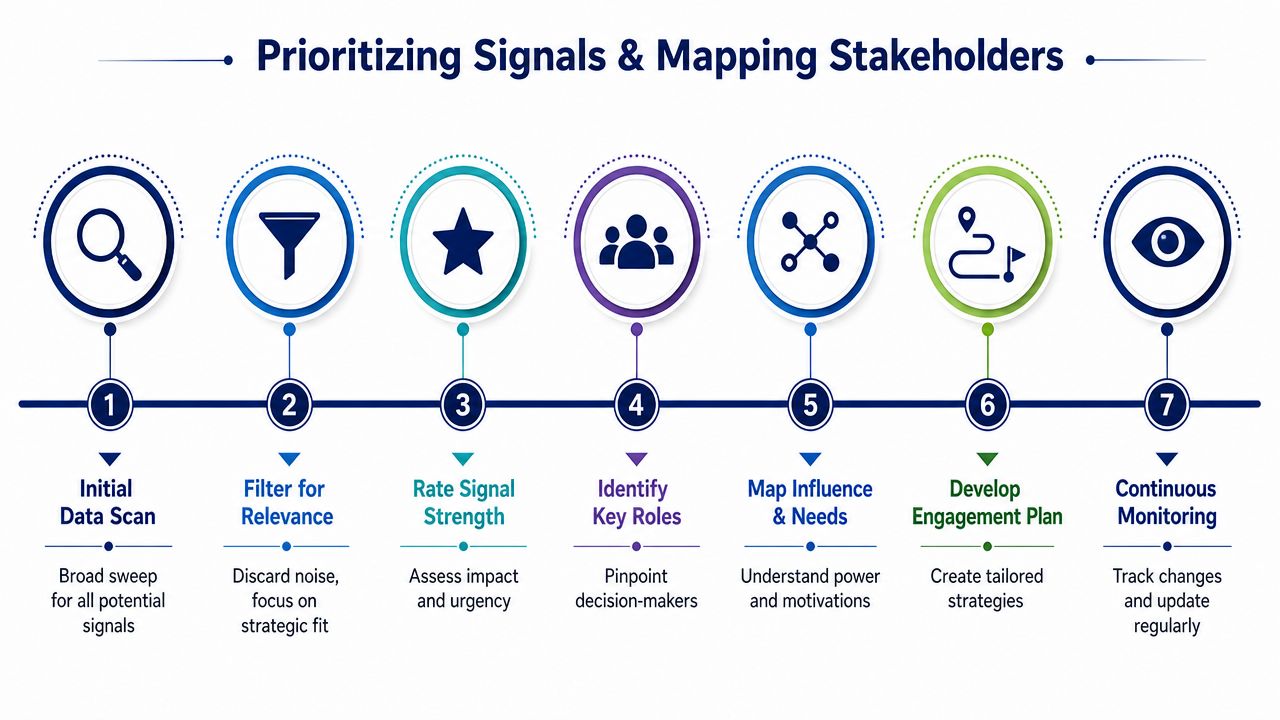
Public life sciences ABM guidance often encourages detailed personas, but it usually stops short of showing how account research should change when the buying committee includes scientific and operational influencers beyond the obvious commercial contact. One useful takeaway is that the best account is often not the largest one, but the one with the clearest internal coordination problem, which creates openness even in mature-looking organizations, as discussed in this account-based selling guide for life sciences.
Which signals deserve attention first
A simple way to judge signal quality is to ask three things:
- Does this event change urgency?
- Does it create or reshuffle stakeholders?
- Does it likely affect budget, process, or timelines?
A new product webpage usually scores low. A Phase 3 readout, a major approval path event, or a new commercial leader usually scores high because each can change internal decisions quickly.
Here's a practical ranking model:
- High-priority signals: major clinical readouts, approval path milestones, launch-preparation language, key leadership hires tied to commercialization or science
- Medium-priority signals: broader hiring patterns, conference presentations, portfolio reprioritization, partnership activity
- Lower-priority signals: generic press mentions, minor site updates, surface-level social activity
The point isn't to create a perfect scorecard. It's to keep reps from spending premium time on low-conviction movement.
Map the real buying committee
In life sciences, the org chart rarely tells the full story.
A VP of Clinical Operations may shape requirements long before procurement gets involved. A CSO may not own budget for your category but can influence whether your solution is credible. A Head of Commercial may be the natural economic buyer for sales intelligence or launch-related tooling, but medical, access, and reimbursement leaders may still shape the final decision because they live with the downstream implications.
A good stakeholder map answers four practical questions:
| Role | What they usually care about | What your research should uncover |
|---|---|---|
| CSO | scientific credibility and program risk | pipeline priorities, evidence posture, strategic focus |
| VP Clinical Operations | execution, timelines, trial complexity | active studies, operational load, milestone pressure |
| Head of Commercial | launch readiness and field execution | asset timing, market entry pressure, team buildout |
| Access or reimbursement leader | value story and constraints | payer pressure, evidence needs, commercialization friction |
Mature accounts often open up when leadership changes, priorities shift, or scientific and commercial teams stop moving in lockstep.
That's why stakeholder mapping isn't a contact exercise. It's a tension-mapping exercise. You're trying to identify who feels pressure, who can sponsor change, and who can block it.

“Automatic account profile detail I can use to manage my territory. Using Salesmotion AI to generate value statements per persona, account, etc. Using Salesmotion to give me a starting point based on new hires, or news alerts is critical.”
Adam Wainwright
Head of Revenue, Cacheflow
Automating Research to Turn Signals into Action
Manual research works for a handful of strategic accounts. It breaks when the territory gets bigger.
The issue isn't just time. It's consistency. One rep checks ClinicalTrials.gov carefully. Another only reads press releases. One manager wants a structured brief. Another accepts scattered notes in CRM. By the time the team compares accounts, everyone is using a different standard.
That's why automation matters. Not because reps should stop thinking, but because they shouldn't spend their best hours stitching together obvious inputs.
What good automation should actually do
SalesHive's guidance is useful here. It argues that the benchmark for stronger account research is not more data but downstream conversion quality, and recommends verifying accounts with at least two tools, defining what “research complete” means, and tracking meeting show rate, opportunity creation, and win rate by list source and tier in this account research guide.
Applied to life sciences, that means your workflow should do a few things reliably:
- Monitor specialized sources continuously: not just generic company news, but trial, regulatory, financial, and leadership changes
- Standardize the brief format: so every rep sees the same decision-ready summary
- Filter by account tier: deeper analysis for top accounts, lighter monitoring for the rest
- Route alerts into working channels: CRM, Slack, or email, not a dashboard no one checks
- Preserve source visibility: reps need to verify what changed and why it matters
A lot of teams over-invest in low-value accounts because manual research makes every account feel equally expensive. Automation helps fix that by letting the team reserve human judgment for accounts that show real movement.
One practical tooling model
A workable setup usually combines your CRM, one broad contact data source, and a specialist monitoring layer for life sciences signals. In that model, a platform like Salesmotion can synthesize general business intelligence with life sciences-specific inputs into unified account briefs, while broader sales tools still handle contacts and workflow execution. That's the right division of labor because generic platforms usually miss the scientific and regulatory details that drive urgency.
If you're evaluating workflows, this guide on using AI for account research is worth reviewing for the operating model, not just the tooling angle.
The practical test is simple. If the system helps reps know what changed, why it matters, who to contact, and what to say next, it's useful. If it only creates more alerts, it isn't.
Activating Your Research with Precise Outreach Triggers
Most bad outreach in life sciences has the same problem. It sounds informed, but not timely.
“Saw your company works in oncology” is not relevance. Neither is “congrats on your growth.” That language tells the buyer you found a few facts, not that you understand the pressure they're under.
The outreach should tie directly to the trigger.
Better trigger-based messaging
Use the account brief to write from the event, not from the industry label.
-
After a positive clinical result
Generic: “Saw your recent update and thought it made sense to connect.”
Better: “I saw the recent clinical update on your lead program. Teams in that position often start pressure-testing how they'll coordinate evidence, stakeholder alignment, and commercial readiness if momentum continues. Is that now becoming a focus internally?” -
After a commercial leadership hire
Generic: “Congrats on the new leadership addition.”
Better: “Noticed the new commercial leadership appointment. That usually comes with a fresh look at launch planning, account prioritization, and where teams are still working from fragmented intelligence. Is that review already underway?” -
Ahead of a regulatory milestone
Generic: “Thought this might be relevant as your company grows.”
Better: “With an important regulatory milestone approaching, a lot of teams start tightening how they monitor account shifts, stakeholder changes, and competitor movement. If that's happening on your side, I can share how others structure it.”
Match the message to the stakeholder
The same signal should sound different depending on the person.
A CSO will care about scientific credibility and operational implications.
A VP of Clinical Operations will care about execution and complexity.
A Head of Commercial will care about launch timing, field readiness, and account focus.
That's why one trigger can support multiple messages. The event stays the same. The angle changes.
The fastest way to lose credibility is to reference a signal without explaining why it matters to that person's job.
A lot of teams now monitor these moments through pharma buying signals so outreach starts when the account's priorities are shifting, not weeks later when the moment has passed.
A simple outreach formula that works
Keep the structure tight:
- Name the signal
- Interpret the likely business implication
- Connect it to the stakeholder's likely pressure
- Offer a relevant next conversation
For example:
“I saw your team's recent trial milestone in oncology. At that point, companies often start dealing with a more complex mix of clinical, regulatory, and commercial decisions across different leaders. If account visibility and coordination are becoming more important, I can share a practical way teams structure that.”
That's what good account research for life sciences sales should produce. Not a big file. A precise reason to start a credible conversation.
If your team is drowning in manual research, Salesmotion is built to monitor account signals, generate structured briefs, and route timely context into rep workflows so sellers can spend less time gathering information and more time acting on it.