Responding to a Request for Proposal (RFP) often feels like a resource-draining marathon you're not meant to win. But what if the problem isn't the RFP? What if it's your approach?
A winning response isn't about answering every single question. It's about having a smart framework to decide which deals are worth your time and how to land the knockout punch when you go for it. This guide will show you how to reframe the process so you only pour your energy into the deals you can actually close.
A Modern Framework for Winning RFP Responses
For too many sales teams, an incoming RFP kicks off a frantic scramble. People are pulled from every corner of the business, only to get a polite "thanks, but no thanks" email weeks later.
The problem? Most teams treat RFPs as a reactive chore—a long checklist to get through—instead of a strategic opportunity to be won.
That old-school approach no longer works. Procurement teams are getting smarter. The RFP software market was valued at USD 3.6 billion in 2024 and is expected to hit USD 6.1 billion by the end of 2025. Buyers are using sophisticated platforms to score proposals. Your generic, copy-paste response doesn't stand a chance. For more on this trend, check out market analysis from 6wresearch.com.
Shifting from Response to Strategy
To win, you need a different mindset. Your first question shouldn't be, "How do we answer this?" It must be, "Should we even respond?"
Our framework is built on three simple but powerful pillars:
- Intelligent Qualification: Learn to spot the difference between an open RFP and one that's already wired for a competitor.
- Deep Personalization: Move beyond bland answers. Craft a narrative that speaks directly to the buyer's pains and back it up with hard evidence.
- Strategic Timing: Use real account intelligence to prove you understand their world better than anyone, showing up with the right message long before the RFP lands.
The goal is to turn your RFP process from a chaotic cost center into a predictable revenue engine. That means getting comfortable saying "no" more often, so when you do say "yes," your team can go all-in with a clear path to victory.
This is about working smarter, not harder. It's about using proactive insights from modern approaches like signal-based selling, which helps you understand an account's priorities before they're written in a document. When you focus your efforts with this precision, your win rate will climb, and you'll stop wasting time on bids that were lost from the start.
Mastering RFPs is less about writing skills and more about strategic discipline. Let's dive into how you can build a process that puts you in the winner's circle.
Here's a quick look at the core components we'll break down. This framework provides a structured path from receipt to submission, ensuring every action is purposeful.
The Winning RFP Response Framework at a Glance
| Phase | Primary Objective | Key Activities |
|---|---|---|
| Phase 1: Triage & Qualify | Decide whether to respond (Go/No-Go). | Score the opportunity, analyze buyer relationships, assess competitive landscape, confirm resource availability. |
| Phase 2: Plan & Strategize | Develop the core win themes and response plan. | Hold a kickoff meeting, assign roles & responsibilities, create a detailed timeline, define the core value proposition. |
| Phase 3: Craft & Refine | Build a compelling, evidence-based proposal. | Draft responses, gather proof points (case studies, data), tailor messaging, ensure a consistent voice and narrative. |
| Phase 4: Review & Submit | Ensure quality, accuracy, and compliance before delivery. | Conduct internal reviews (SME, legal, executive), final proofreading, package the submission, and deliver on time. |
This table isn't just a set of steps; it's a blueprint for discipline. Following this structure ensures every RFP you pursue gets the strategic attention it deserves, dramatically increasing your chances of success.
See Salesmotion in action
Take a self-guided interactive tour — no signup required.
Making the Critical Go/No-Go Decision
The most important moment in the RFP process happens before your team writes a single word. It's the decision to commit your resources or politely walk away.
Chasing every request is a surefire way to burn out your best people and sink your win rate. The hard truth is that many RFPs are already wired for a competitor, issued for due diligence, or are simply a terrible fit for your solution.
A disciplined 'Go/No-Go' decision is your first line of defense against wasted time.
Building a Practical Scoring Framework
To move from a gut feeling to a data-driven choice, you need a simple, repeatable scoring system. This isn't about creating a massive spreadsheet no one uses. It's about forcing an honest conversation around four critical areas before you commit.
A solid framework helps you quickly size up each opportunity, making sure you only chase deals you have a real shot at winning.
Consider these four pillars for your evaluation:
- Solution Fit: How well does your offering match their needs? A fit over 80% is a strong green light. Below 60%, you're likely trying to jam a square peg into a round hole.
- Relationship Strength: Do you have a champion inside the account? An RFP that arrives completely cold slashes your odds of winning from the start.
- Competitive Landscape: Do you know who you're up against? More importantly, can you clearly explain why you're the better choice? If the requirements read like they were written by your main competitor's product manager, that's a massive red flag.
- Strategic Value: Does this deal align with your company's long-term goals? A high-profile logo in a new market might be worth pursuing even with lower odds. A low-revenue deal far outside your core focus probably isn't.
The goal of a Go/No-Go framework isn't to eliminate risk—it's to make calculated bets. By consistently applying these criteria, you shift from a reactive, hopeful approach to a strategic one that protects your team's most valuable asset: time.
Spotting the Green Flags and Red Flags
Over time, you'll recognize the patterns that signal whether an RFP is a genuine opportunity or a time-wasting exercise. Learning to spot these clues early is a superpower.
This flowchart gives you a high-level view of how a winning RFP response should flow, starting with that crucial qualification step.
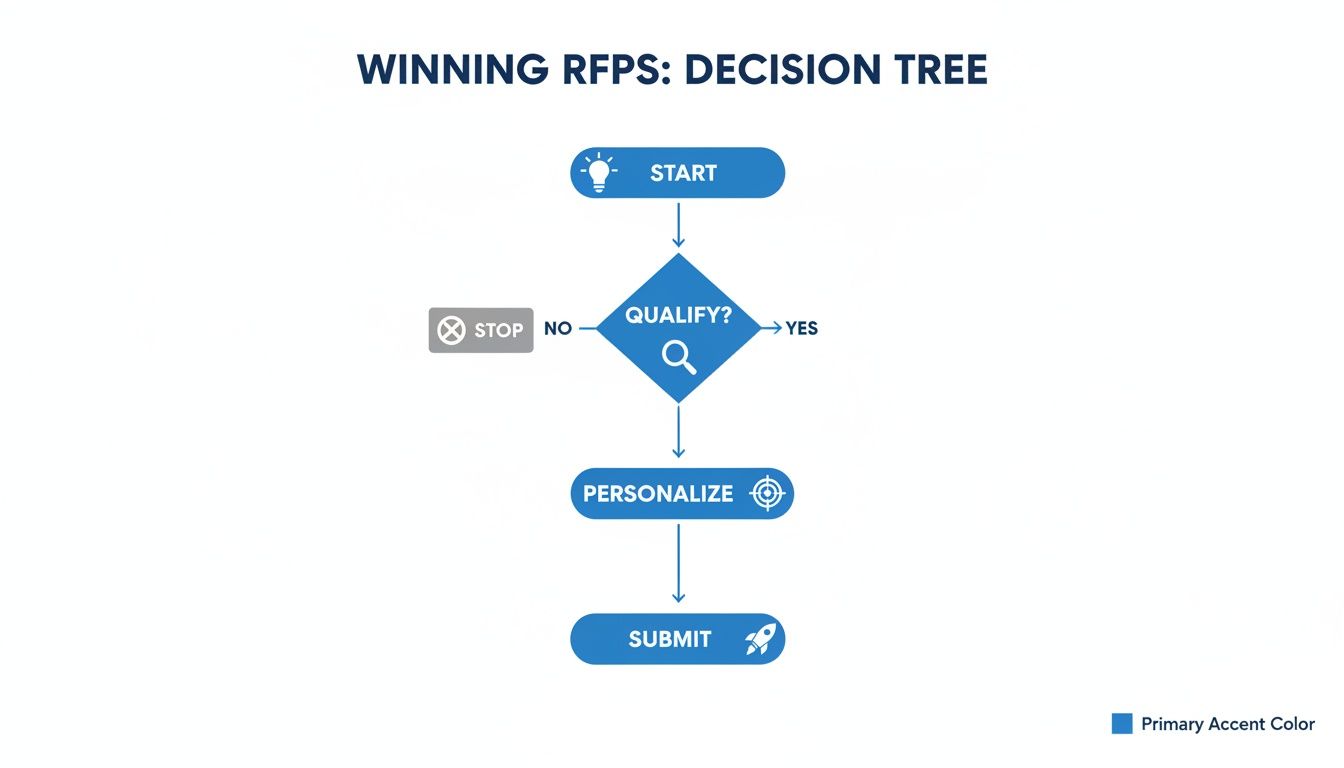
The visual makes one thing clear: qualification is the foundation. Without it, the effort you pour into personalizing and submitting your response will likely go to waste.
Here are some real-world examples to help you tell the difference:
Green Flags (Signals to Proceed)
- You helped shape the requirements or had conversations with the buyer before the RFP was issued.
- The prospect has engaged with your marketing content, attended a webinar, or had a recent demo.
- The RFP focuses on business outcomes, not just a rigid checklist of technical features.
- You have a strong case study from a similar company in their industry.
Red Flags (Signals for Caution)
- The requirements include proprietary features or language specific to a known competitor.
- The deadline is unusually short, suggesting they have a preferred vendor and just need a backup bid.
- You have zero existing relationships with anyone at the company.
- The prospect is unwilling to answer clarifying questions or engage in dialogue before the deadline.
Using Account Intelligence to Inform Your Decision
Beyond the RFP document itself, modern account intelligence platforms give you needed context. These tools monitor triggers that tell you what's really happening inside a target account, making your Go/No-Go decision much clearer. For more on this, learn about RFP request signals and how they can shape your strategy.
Imagine your SaaS company gets an RFP from a huge financial institution. On paper, it looks like a perfect fit. But your account intelligence tool reveals the institution just hired a new CIO who previously worked at a company that is a longtime customer of your main competitor.
That single piece of information changes the dynamic. It doesn't automatically make it a "No-Go," but it raises the competitive risk from a 2 to a 9. This insight forces a strategic conversation: is our solution strong enough to overcome that pre-existing relationship?
Without that intelligence, you'd be flying blind. This is just one example of how responding to RFPs becomes far more strategic when you have the right data upfront.

“Salesmotion empowers me to cultivate a great buyer experience. I'm able to challenge prospects' thinking and be a trusted consultative seller. A major part of this is Salesmotion insights.”
Austin Friesen
Account Executive, FY25 #1 President's Club, Clari
Assembling Your Deal Team and Project Plan
Alright, you've given the RFP a green light. Now it's a real project. Winning isn't a solo sprint; it's a coordinated effort that demands the right people in the right roles, all working from the same playbook.
Success hinges on assembling a dedicated 'deal team' and creating a realistic project plan. This structure turns potential chaos into a manageable workflow, ensuring everyone knows their part and preventing the dreaded last-minute scramble to hit "submit."

Defining Key Roles and Responsibilities
A well-oiled RFP team has clearly defined roles from the start. While titles might change depending on your company, the core functions are essential for a winning response.
Your deal team should include:
- Proposal Manager/Project Lead: This is your quarterback. They own the entire process—creating the project plan, assigning tasks, chasing down content, and making sure the final submission is polished and compliant.
- Account Executive (AE): The AE is the voice of the customer. They bring relationship history, competitive intel, and a deep understanding of the prospect's pain points to shape your win themes.
- Subject Matter Experts (SMEs): These are your technical and functional gurus from product, engineering, legal, or security. They provide the detailed, accurate answers that form the proposal's backbone.
- Executive Sponsor: This senior leader is your internal champion. They can remove roadblocks, offer strategic oversight, and give a final review. Our guide on how to develop internal champions can be a huge help here.
A classic mistake is piling the Proposal Manager's duties onto the Account Executive. While the AE's input is critical, their focus should be on strategy and customer insight, not managing document versions and chasing deadlines.
Building a Bulletproof Project Plan
With your team in place, map out the journey from kickoff to submission. The most effective way to do this is by working backward from the final due date. This simple trick immediately clarifies your timeline.
For example, if the deadline is three weeks away, your timeline should break down into key milestones.
Sample Reverse Timeline:
| Milestone | Deadline (Working Backward from Due Date) | Owner(s) |
|---|---|---|
| Final Submission | Friday, Week 3 (EOD) | Proposal Manager |
| Executive Review | Thursday, Week 3 | Executive Sponsor |
| Final Draft & Formatting | Wednesday, Week 3 | Proposal Manager |
| SME Content Review | Monday, Week 3 | SMEs, AE |
| First Full Draft Due | Friday, Week 2 | All Contributors |
| Kickoff Meeting | Monday, Week 1 | Proposal Manager |
This reverse-timeline approach is non-negotiable for successfully responding to RFPs. The average RFP response takes a serious time commitment, eating up between 20 and 28 hours per proposal. Even top-performing teams still sink around 25 hours into each one, which shows why a rock-solid plan is necessary.
This structure also makes it easier to manage contributions from busy SMEs. Instead of a vague ask for "help on the RFP," you can give them specific sections with concrete deadlines, which respects their time and improves the quality of their input.
Crafting a Proposal That Truly Stands Out
A generic, copy-paste proposal is a guaranteed way to lose. Once you've made the "Go" decision, the real work begins. It's time to transform a simple Q&A document into a compelling narrative that evaluators actually want to read.
This isn't about just filling in the blanks. It's about crafting a story that connects your solution to the buyer's most critical business goals. Winning proposals don't just list features; they prove you understand the prospect's world better than anyone else.

Developing Your Core Win Themes
Before writing, your deal team needs to lock in your win themes. Think of these as the two to four core messages you'll weave throughout the entire response. They are the strategic pillars that consistently reinforce why you are the only logical choice.
A strong win theme connects a prospect's specific problem to your unique solution and the tangible business outcome it delivers.
The difference between a weak theme and a strong one is stark.
| Weak Theme (Feature-Focused) | Strong Theme (Outcome-Focused) |
|---|---|
| "Our platform has advanced AI capabilities." | "Reduce manual data entry errors by 90% with our AI-powered validation, freeing your team for strategic work." |
| "We offer 24/7 customer support." | "Achieve seamless operational continuity with our dedicated 24/7 support, ensuring 99.9% uptime for your critical systems." |
| "Our software integrates with other tools." | "Eliminate data silos and accelerate decision-making by seamlessly integrating our platform into your existing tech stack in under 30 days." |
These themes should come from the intelligence you gathered during your "Go/No-Go" analysis. What did you learn about their strategic initiatives, recent challenges, or executive priorities? That's the raw material for messages that resonate.
Speaking the Prospect's Language
One of the fastest ways to build trust is to use the prospect's own language. Scour the RFP, their website, and recent press releases for the specific terms and phrases they use.
If they talk about "enhancing patient outcomes," don't respond by talking about "improving user efficiency." If they mention a "supply chain visibility initiative," make sure that exact phrase appears in your proposal. This shows you've paid close attention and understand their world.
A proposal filled with your internal jargon screams "generic." A proposal that reflects the buyer's language whispers, "We get you." This subtle shift makes your response feel less like a sales pitch and more like a collaborative solution.
This alignment needs to be everywhere, from the executive summary down to the technical details. As you write, constantly ask: "Does this sound like us talking, or does it sound like we're speaking directly to them?" For more on getting this right, check out our guide on how to write a powerful executive summary.
From Features to Value-Driven Benefits
Procurement teams have seen a thousand feature lists. What they rarely see is a clear explanation of what those features will actually do for their business. Your job is to translate every feature into a tangible, value-driven benefit.
A simple but powerful framework is "Feature -> Advantage -> Benefit."
- Feature: What your product does (e.g., "Automated reporting dashboard").
- Advantage: Why that's helpful (e.g., "Provides real-time data access").
- Benefit: The real-world business impact (e.g., "Saves the finance team 15 hours per week, allowing them to focus on strategic forecasting").
Let's put this into a real-world scenario. Imagine responding to an RFP from a healthcare company. Your account intelligence from a platform like Salesmotion shows they recently announced an initiative to reduce administrative overhead.
Standard Response (Feature-focused): "Our platform includes a centralized document management system with role-based access controls and version history."
Value-Driven Response (Benefit-focused): "To directly support your initiative to reduce administrative overhead, our centralized document management system cuts audit preparation time by an estimated 40%. Role-based controls also ensure HIPAA compliance is maintained effortlessly, protecting sensitive patient data while giving your team secure, instant access."
The second response is infinitely more powerful. It connects a feature directly to a known business priority, quantifies the value, and addresses a critical industry concern. This is how you stop being just another vendor and start looking like a strategic partner.

“We have very limited bandwidth, but Salesmotion was up and running in days. The template made it easy to load our accounts and embedding it in Salesforce was simple. It was one of the easiest rollouts we've done.”
Andrew Giordano
VP of Global Commercial Operations, Analytic Partners
Key Takeaways
- A structured go/no-go decision framework prevents wasted effort on RFPs you cannot win. Evaluate fit, competitive position, and resource availability before committing to a response.
- Assembling a dedicated deal team with clear roles, a project plan, and internal deadlines ensures your proposal is thorough, consistent, and delivered on time.
- Winning proposals lead with business outcomes, not feature lists. Connecting every answer to the evaluator's strategic priorities and quantifying value separates you from commodity responses.
- Dedicated RFP software with centralized content libraries and AI-assisted drafting significantly improves both speed and quality of responses.
- Account intelligence platforms give you the pre-RFP context needed to craft a personalized narrative, turning a standard response into a strategic proposal that proves you understand the prospect's world.
Using Technology to Improve RFP Efficiency and Quality
Let's be honest: manual processes are the enemy of a winning RFP strategy. If your team is still piecing together proposals from scattered documents and endless email chains, you're set up for burnout and mediocre submissions. The right technology doesn't just make you faster; it makes you smarter.
Modern proposal teams are adopting tools that provide a genuine competitive edge, shifting the focus from efficiency to dramatically improving the quality of their responses.
The Role of Dedicated RFP Software
Dedicated RFP software acts as a central nervous system for your response process. These platforms are designed to solve common headaches, like finding that perfect, pre-approved answer to a tricky security question without bothering an SME for the tenth time.
Think of it as your team's collective memory—always on and instantly searchable. The primary benefits are:
- Centralized Content Libraries: Store and tag your best answers, case studies, and compliance documents in one place.
- Collaboration Workflows: Assign questions to specific SMEs, track progress, and manage review cycles in a single platform.
- Automated First Drafts: Many tools use AI to suggest answers for common questions, saving your team from repetitive work.
To elevate your game, consider integrating AI powered knowledge management solutions. This helps you quickly access the most relevant, up-to-date information from across the company.
Go Beyond Automation with Account Intelligence
While RFP software is great for managing the response, the real game-changer is technology that helps you win before the RFP lands. This is where AI-powered account intelligence platforms like Salesmotion come in. They focus on the critical "why now" research that fuels a personalized proposal.
These platforms monitor your target accounts for real-world signals—a new strategic initiative, a key executive hire, or a spike in hiring. This isn't just background noise; it's the raw material for a winning narrative.
Instead of just helping you write faster, account intelligence helps you write smarter. It connects the dots between a company's public signals and your unique value proposition.
This proactive approach is becoming the standard. The 2025 Financial Services RFP Report found that by 2025, approximately 65% of proposal teams were using dedicated RFP software, and 68% had incorporated generative AI. This tech adoption is paying off, with the average global RFP win rate hitting around 45% that same year.
Turning Signals into a Winning Narrative
So, how does this work in practice? Imagine you get an RFP from a manufacturing company. The standard approach is to answer their questions based only on what's in the document.
Now, consider the intelligence-driven approach:
- The Signal: Your account intelligence tool alerts you that the company recently announced a $50 million investment in "supply chain resilience."
- The Insight: This is a top-tier strategic priority, likely driven by recent global disruptions.
- The Narrative: Instead of leading with generic features, your executive summary opens by directly addressing their supply chain resilience initiative. You then frame every relevant feature as a direct contributor to that goal.
This is the power of using technology for more than just process management. When you combine the efficiency of RFP software with the strategic insight from account intelligence, you stop simply responding to RFPs and start delivering strategic proposals that prove you understand the prospect's world better than anyone else.
At Salesmotion, we believe that winning more proposals starts long before the RFP arrives. Our AI-powered platform helps your team monitor the signals that matter, so you can build relationships and shape opportunities before they become competitive. Turn real account activity into measurable pipeline growth. Learn more at https://salesmotion.io.
Frequently Asked Questions
How do you decide whether to respond to an RFP?
Use a structured go/no-go scoring framework that evaluates four areas: solution fit (does your offering match their needs above 80%), relationship strength (do you have a champion inside the account), competitive landscape (can you clearly articulate why you are the better choice), and strategic value (does the deal align with your long-term goals). Consistently applying these criteria protects your team from wasting time on bids that were lost from the start.
How much customization does an RFP response need?
The executive summary should be 100% unique to the prospect, addressing their specific goals and reinforcing your win themes. Case studies and proof points should mirror their industry, scale, and challenges. Standard technical questions can draw from your content library, but any section addressing the prospect's stated key priorities needs to be meticulously tailored with relevant data and examples.
What should you do if you cannot meet a mandatory RFP requirement?
Address it head-on rather than trying to hide the gap. State clearly that you do not meet the requirement as written, then immediately pivot to how you solve the underlying business problem differently. If the feature is on your product roadmap, mention it with a specific timeline, but avoid vague promises. Honesty builds trust, while fudging an answer guarantees you lose credibility.
How long does it typically take to respond to an RFP?
The average RFP response takes between 20 and 28 hours of total team effort, even for top-performing organizations. Using a reverse timeline from the submission deadline, teams typically need at least two to three weeks for a thorough response that includes a kickoff meeting, content drafting, SME review, and executive sign-off.
What role does account intelligence play in winning RFPs?
Account intelligence platforms provide context that goes beyond the RFP document itself, revealing strategic initiatives, executive priorities, and competitive dynamics inside the target account. This information helps you craft proposals that demonstrate deep understanding of the prospect's world, transforming a standard response into a strategic narrative that resonates with evaluators.
What are the biggest red flags that an RFP is wired for a competitor?
Watch for requirements that include proprietary features or language specific to a known competitor, unusually short deadlines suggesting a preferred vendor just needs a backup bid, zero existing relationships with anyone at the company, and an unwillingness by the prospect to answer clarifying questions or engage in dialogue before the deadline.