
A lot of teams miss pharma opportunities for a simple reason. They treat the press release as the start of the buying window.
It usually isn't.
TL;DR: A pharma buying signal is a verifiable event that suggests a pharmaceutical company is changing priorities, reallocating budget, or entering a decision window. The four types are clinical and regulatory (PDUFA dates, Phase III transitions, CRLs, patent cliffs), commercial (new indications, geographic expansion, co-promotes), organizational (executive hires, medical affairs or market access buildouts), and financial (guidance changes, R&D reprioritization). Act months before the public milestone, rank converging signals above isolated ones, and tie each to a budget owner and a specific outreach angle.
A rep sees an approval announcement, congratulates the company, and starts prospecting the launch team two weeks later. By then, the serious evaluation work often happened months earlier. Procurement already has a shortlist. Medical affairs has already scoped content support. Market access has already mapped evidence gaps. The account looks “hot” in the CRM, but the actual window has cooled.
That's why pharma buying signals need a different lens. The useful signals aren't just news items. They're events that change budget urgency, decision ownership, or launch timing before the headline hits. In a market this large, that timing matters. The global pharmaceutical market was estimated at about $1.6 trillion in 2023, and one industry analysis projects that U.S. pharma spending alone will exceed $1 trillion by 2030 (pharmaceutical market analysis). When budgets move in an industry of that scale, even a narrow change in trial timing, access strategy, or exclusivity planning can create meaningful vendor demand.
Most sales teams already know pharma is complex. Fewer teams build a repeatable way to read the signals early, map them to the right buyer, and act before everyone else does.
If you sell into life sciences, that shift matters more than another generic outbound sequence. It's the difference between reacting to events and getting in front of them. If you need a broader view of how pharma accounts buy, selling to pharmaceutical companies is a useful companion read.
Why Selling to Pharma Requires a Different Playbook
Pharma doesn't buy on the same rhythm as most B2B categories.
A software company may buy after a board meeting, a budgeting cycle, or a new VP hire. A pharmaceutical company often buys when a scientific, regulatory, or exclusivity event forces internal teams to make decisions under time pressure. That changes everything about prospecting. It changes when outreach should happen, who should receive it, and what message will land.
News is usually a lagging indicator
A public announcement feels actionable because it's visible. But in pharma, visibility and timing are not the same thing.
Take a likely scenario. A company nears a major regulatory milestone. The launch team starts tightening plans. Medical affairs reviews evidence needs. Commercial leadership revisits field readiness. Market access pressure builds. None of that starts on the day the public headline appears. It starts when internal teams realize the milestone is real enough to fund against.
The mistake isn't missing the news. The mistake is confusing public confirmation with internal buying onset.
That's why generic triggers underperform in this segment. Website visits, broad intent spikes, and random hiring alerts can help at the margin, but they rarely tell you whether budget is moving.
The buyer is responding to deadlines, not curiosity
Pharma teams operate against hard milestones. Those milestones create real work. Real work creates resourcing gaps. Resourcing gaps create buying behavior.
The most reliable signals are the ones tied to operational consequences, such as:
- Regulatory dates: Teams prepare for the work around the decision, not only the decision itself.
- Clinical progression: Late-stage development often changes vendor needs across execution, data, and commercialization.
- Exclusivity pressure: Revenue protection planning starts before loss of exclusivity becomes a crisis.
- Access friction: Payer, reimbursement, and distribution issues can trigger spending even without a new trial result.
A general enterprise rep can get away with broad account monitoring. A pharma rep usually can't. You need a way to connect account events to specific budget owners and immediate business pressure.
See Salesmotion in action
Take a self-guided interactive tour — no signup required.
The Four Types of Pharma Buying Signals
A pharma buying signal is a verifiable event that suggests a pharmaceutical company is changing priorities, reallocating budget, or entering a decision window. The strongest signals don't sit alone. They stack.
When multiple weak indicators appear together, signal quality improves. An executive move plus hiring in a new therapeutic area plus a regulatory milestone is often more meaningful than any single event on its own. Independent industry analysis also points to R&D pipeline movement, patents, and legal activity as especially high-value signals because they point to future revenue paths rather than surface-level news (review of pharma and biotech alpha signals).
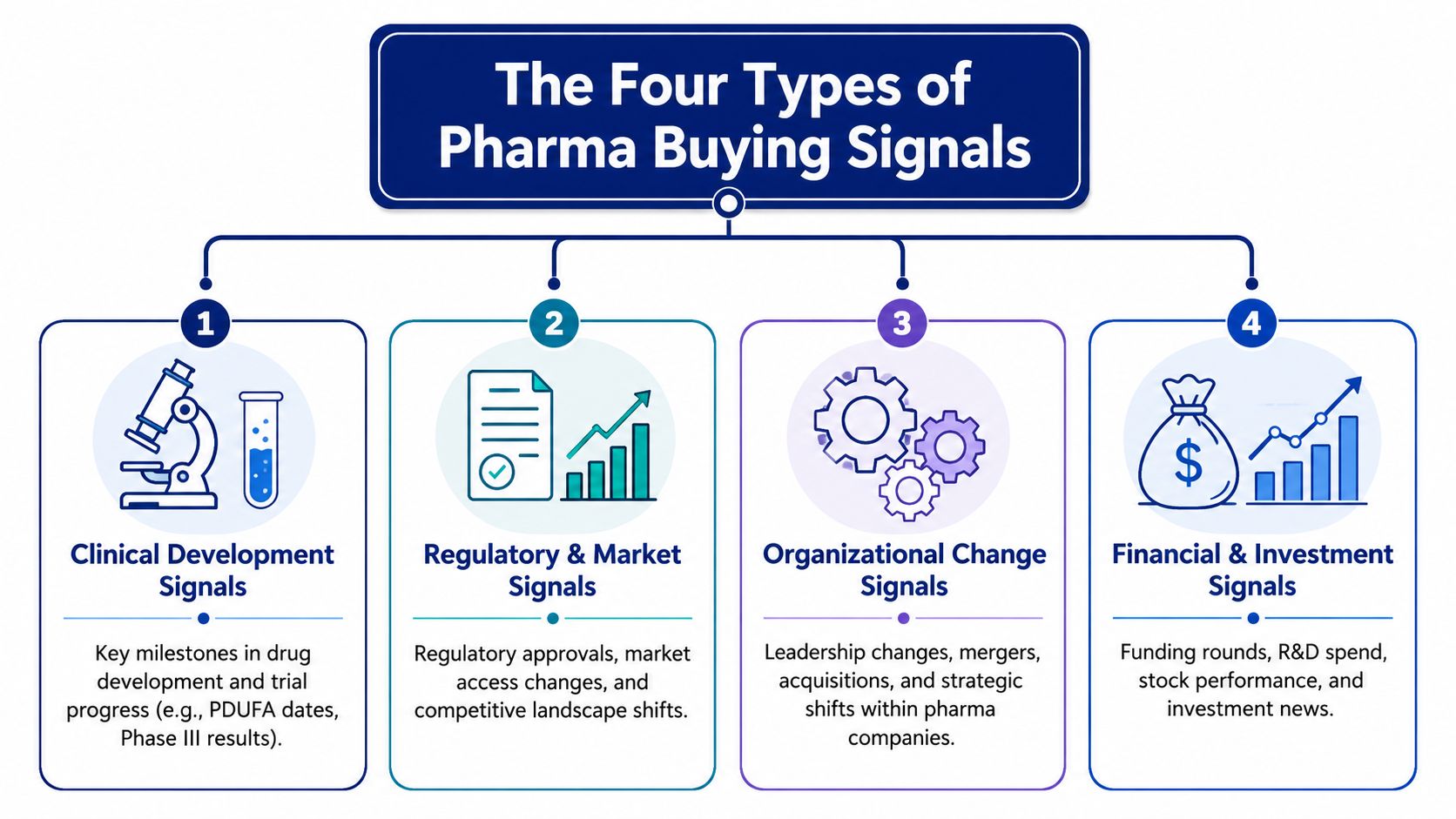
Clinical and regulatory signals
These are usually the highest-urgency triggers.
They include milestone events such as PDUFA dates, Phase III transitions, advisory committee activity, CRLs, patent cliff exposure, and competitive biosimilar pressure. These signals matter because they force planning across regulatory, medical, clinical operations, launch, and market access teams.
If you sell services, data, software, or consulting into pharma, this category often gives you the clearest “why now.”
Commercial signals
Commercial signals tell you the company is moving from science to execution, or expanding execution into new terrain.
Common examples include a new indication launch, geographic expansion, co-promote agreements, direct-to-patient program launches, or major shifts in provider or patient engagement strategy. These don't always generate the same public attention as clinical milestones, but they often come with immediate workflow and resourcing consequences.
Organizational signals
Org changes are often the clue that strategy has become budget.
A new CCO may review the commercial stack. A new CMO may reshape evidence strategy. A CRO hire may change how trial execution is managed. Medical affairs expansion can point to publication planning, field medical scale-up, and scientific communication needs. Health economics team buildout can indicate payer pressure or a coming market access push.
Practical rule: Treat senior hires as a trigger to reassess decision maps, not just update contact records.
Financial signals
These are easy to misuse if you read them too strictly.
An earnings guidance change, R&D investment shift, or therapeutic area reprioritization doesn't automatically mean “more budget” or “less budget.” It means the company is telling you where management attention is moving. The smart move is to connect that shift to a likely buyer, a likely initiative, and a likely budget line.

“The moment we turned on Salesmotion, it became essential. No more hours on LinkedIn or Google to figure out who we're talking to. It's just there, served up to you, so it's always 'go time.'”
Adam Wainwright
Head of Revenue, Cacheflow
Decoding Clinical and Regulatory Signals
Clinical and regulatory signals are where a lot of pharma deals are won or lost. They're time-bound, they carry real commercial consequences, and they often create urgency across several teams at once.
Pharma buying signals are strongest when they map to regulatory and exclusivity timelines because those events create a hard deadline. Guidance focused on life sciences selling recommends acting 4 to 5 months before a trigger such as a PDUFA date, rather than after it becomes old news (life sciences buying signals guidance). If you wait for the event itself, you're often stepping into an account after the planning cycle has already started.

If your solution touches early research workflows, assay support, scientific collaboration, or preclinical teams, it also helps to understand where activities stop being exploratory and start becoming commercializable. This short guide on research use only is useful context because it explains a boundary many sellers gloss over when they message life sciences teams.
PDUFA dates and advisory committee activity
A PDUFA date is not just a calendar item. It's a forcing function.
By the time a company is inside that window, launch teams, medical affairs, market access, and commercial operations are often working through readiness plans. If you sell field readiness tools, evidence platforms, advisory-board support, training, market access analytics, or launch services, the strongest angle is not “congratulations in advance.” It's “here's where teams like yours usually hit execution bottlenecks before the decision.”
Advisory committee votes sit in a similar category, but with a sharper pressure curve. They increase the need for response planning, stakeholder communication, and scenario management. Positive momentum can accelerate preparation. Uncertainty can create demand for tighter cross-functional coordination.
Phase III results and trial execution stress
A Phase III transition or late-stage readout usually changes the internal conversation from “can this asset work?” to “what do we need to be ready if it does?”
That shift affects more than commercial teams. Clinical operations may need support with execution. Data teams may need more reporting or workflow structure. Medical affairs may start preparing for heavier evidence communication.
One reason this matters so early is that trial operations themselves create buying pressure. One industry source reports that it takes 19 months on average to enroll patients in trials, and that 30% of patients discontinue trials because of a poor non-clinical experience. The same source notes that 61% of surveyed pharma companies have defined goals to improve clinical-trial diversity (pharma industry statistics on trial operations). For vendors, that means a real signal can appear before approval, when enrollment, retention, or diversity goals become operational pain.
If a company is struggling with enrollment or retention, don't pitch the future launch first. Pitch the current execution problem.
A rep who notices late-stage trial progress alongside patient-engagement friction should think about clinical operations, digital engagement, recruitment, site support, and data capture buyers before chasing the future commercial org.
CRLs, patent cliffs, and biosimilar competition
A Complete Response Letter changes the account, but not always by freezing it.
Some budgets tighten. Other budgets appear. Regulatory strategy work intensifies. Data review, remediation planning, and internal alignment become urgent. The seller's mistake here is assuming “bad news means no spending.” Often it means spending shifts to different teams with different goals.
Patent cliffs and biosimilar competition work differently. They don't create surprise. They create a countdown. As exclusivity pressure gets closer, brand teams, access teams, finance, and portfolio leaders focus on revenue protection, contracting, lifecycle strategy, and launch sequencing for replacement assets.
The practical outreach angle is simple. Don't lead with the patent event itself. Lead with the business problem it forces. That might be provider retention, evidence differentiation, payer defense, channel performance, or portfolio transition planning.
For broader account monitoring around these milestone events, life sciences sales intelligence is a useful operational reference.
Clinical and Regulatory Signal Playbook
| Signal | What It Means for the Buyer | Outreach Timing & Angle |
|---|---|---|
| PDUFA date approaching | Cross-functional teams are tightening launch, access, and evidence plans | Reach out months before the date. Focus on readiness gaps, not the event itself |
| Phase III transition or positive late-stage data | Confidence is increasing, and execution demands are rising across clinical and commercial functions | Lead with support for scale, coordination, and the operational load that follows late-stage progress |
| FDA advisory committee activity | The company needs scenario planning, stakeholder communication, and tighter coordination | Offer help with preparation, response workflows, and decision support before the meeting |
| CRL received | The account may shift from launch mode to remediation, regulatory strategy, and evidence review | Change targets and message quickly. Talk to teams managing response work, not just commercial leaders |
| Patent cliff exposure | Revenue-protection planning starts before loss of exclusivity hits the P&L | Engage early with lifecycle, access, and portfolio teams around defense and transition planning |
| Biosimilar competition intensifying | Competitive pressure can create new needs in access, analytics, messaging, and channel execution | Anchor outreach to differentiation and market defense, not generic competitor commentary |
Acting on Commercial and Organizational Changes
Commercial and organizational signals rarely look as dramatic as a regulatory milestone. They're often more useful because they point directly to the people who are about to make decisions.
A positive clinical event may tell you that budget is likely to move. A new CCO, a field reorg, or a medical affairs buildout can tell you who will own the initiative and how the buying process may change.
Commercial changes that usually deserve fast follow-up
A new indication launch often creates work that looks familiar on the surface but behaves differently underneath. The company may need fresh messaging, new evidence packaging, updated field training, and revised patient or provider engagement programs because the buyer set changes with the indication.
Geographic expansion creates a different kind of demand. Teams now have to deal with local market access realities, country-specific evidence expectations, channel decisions, and affiliate coordination. If your product helps standardize workflows across markets, that's your opening. If it doesn't, generic “global growth” messaging won't land.
Co-promote agreements are another strong signal. They create coordination problems immediately. Shared planning, aligned messaging, reporting structures, and partner communication become much harder. Sellers who understand joint-go-to-market friction can get traction quickly here.
Direct-to-patient program launches tell you the company is investing in patient support, education, adherence, or engagement workflows. That signal is especially useful for vendors in patient services, orchestration, communication platforms, analytics, and support operations.
Org changes that usually mean budget is in motion
A new commercial leader often reviews inherited systems before adding net-new spend. That means the first conversation shouldn't be a hard pitch. It should be a diagnosis.
Ask what they're keeping, what they're centralizing, and what they think the current stack can't support. A new CCO may care about segmentation, field execution, and launch readiness. A new CMO may care more about scientific communication, evidence planning, or KOL engagement. A new CRO can signal changes in trial partnerships, oversight, and operational control.
Medical affairs expansion matters because it usually reflects an increase in scientific engagement needs. More field medical headcount, more publication work, more congress activity, or more evidence dissemination often means new process and content demands. Health economics or market access team buildout can indicate a different pressure point entirely. The company may be preparing for tougher payer conversations and needs better evidence workflows, analytics, or dossier support.
The best outreach after an org change sounds like informed pattern recognition, not applause for the new hire.
Good outreach ties the event to a likely owner
A few examples make this concrete:
- New CCO hired: Contact commercial operations, enablement, and strategy leaders. Talk about stack rationalization, launch planning, and visibility across teams.
- Medical affairs expansion: Contact heads of medical excellence, scientific communications, or field medical. Focus on content scale, review processes, and insight capture.
- Commercial reorganization: Reach out to the operators managing handoffs, territories, data quality, and reporting. Reorgs expose workflow gaps fast.
- Geographic expansion: Talk to regional commercial leaders, affiliate teams, and market access stakeholders. Offer support for consistency without pretending every market buys the same way.
“Automatic account profile detail I can use to manage my territory. Using Salesmotion AI to generate value statements per persona, account, etc. Using Salesmotion to give me a starting point based on new hires, or news alerts is critical.”
Adam Wainwright
Head of Revenue, Cacheflow
Finding Hidden Signals in Market Access and Finance
Many sales teams over-index on trial results and FDA calendars because those signals are obvious.
Some of the most actionable pharma buying signals sit outside those headline moments. They show up in payer pressure, reimbursement friction, underserved-market strategy, distribution economics, and management commentary about where investment is going next. In practice, these signals can be more useful because they point to budget decisions that don't depend on a dramatic press release.
Industry reporting notes that some of the most actionable signals in pharma may be regulatory, reimbursement, or access-related rather than scientific, because payer pressure, underserved-market strategy, and distribution economics can create demand for technology, analytics, and workflow support even when there's no new FDA event (analysis on access-related pharma triggers).
Market access signals most teams miss
A formulary shift, tougher payer environment, or stronger internal focus on underserved patient access can drive buying behavior across HEOR, market access, analytics, field reimbursement, and patient support teams.
These aren't always noisy signals. Sometimes they surface in subtle ways:
- Health economics team buildout: The company may be preparing for more payer scrutiny.
- Distribution model changes: The commercial org may need better visibility into channel performance and patient access friction.
- Patient access language in executive commentary: That can indicate a broader strategy change, not just CSR messaging.
If you sell into market access or commercialization, these are often better entry points than a generic launch congratulations email.
Financial shifts that deserve interpretation, not overreaction
Financial signals are valuable when they show direction.
An earnings guidance change, a stated R&D investment shift, or therapeutic area reprioritization can tell you where management wants focus. The outreach mistake is treating every positive financial signal like a budget increase. Sometimes leadership is freeing capital for one area by tightening another. Sometimes a reprioritization means one business unit is buying while another is frozen.
That's why finance-related prospecting needs more homework. Read management language carefully. Look for what's being emphasized, deprioritized, or tied to future performance. If your team does that consistently, SEC filings for sales prospecting becomes a practical source of early account context rather than just a compliance document.
A Modern Framework for Signal-Based Selling
Teams often don't have a signal problem. They have an operational problem.
They can spot events. They can't consistently decide which ones matter, who should act, and what message should go out. A usable framework has to do three things well: detect signals early, prioritize them intelligently, and turn them into next actions for the right rep.
One reason this matters in pharma is that buying windows often open before launch. Trial execution itself can create opportunity. As noted earlier, clinical programs face enrollment and retention pressure well before approval, which means sellers need a system that catches operational strain early rather than waiting for a commercial milestone.
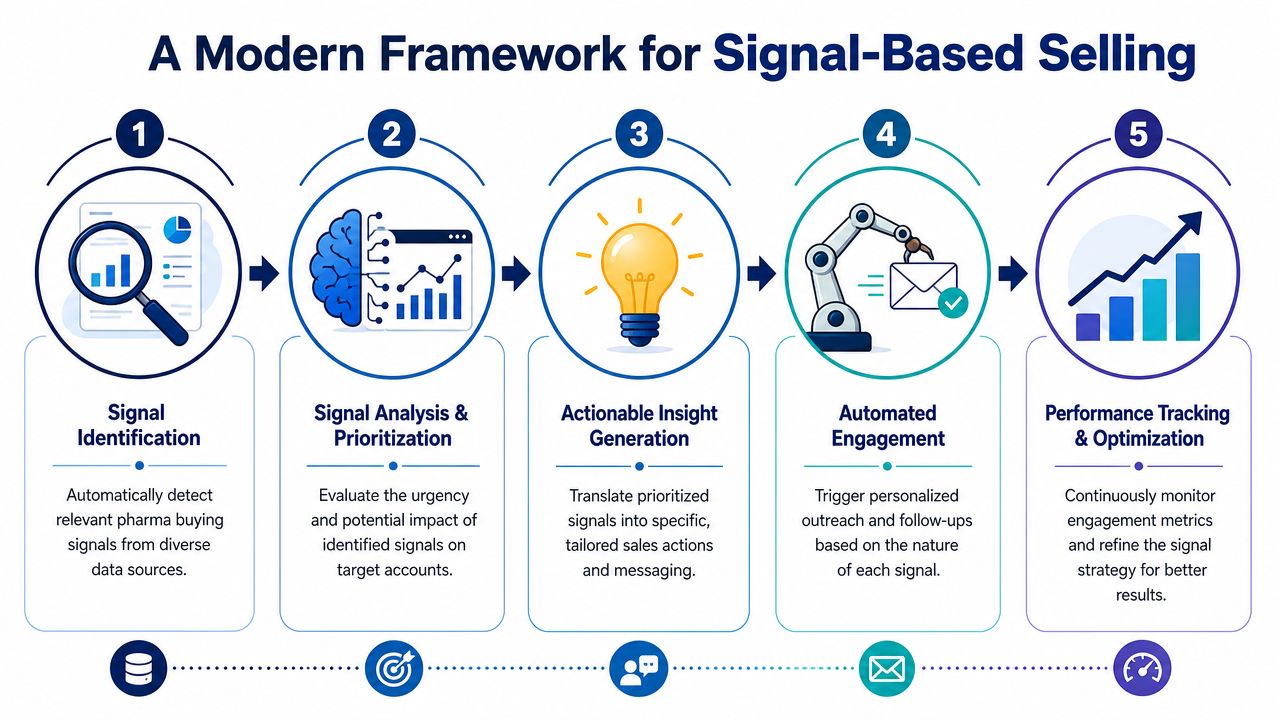
Detection needs coverage, not heroics
Manual tracking breaks fast in pharma. Reps can't reliably monitor pipeline milestones, executive moves, hiring, access language, legal activity, and financial commentary across a full territory by hand.
Build detection around a few signal families:
- Milestone events: Regulatory dates, clinical progress, launch moves, and exclusivity pressure.
- Org movement: Executive hires, team expansion, restructuring, and capability buildouts.
- Commercial friction: Market access activity, partnership complexity, patient program changes.
- Capital direction: Guidance changes, portfolio focus shifts, and stated investment priorities.
The aim isn't to collect more alerts. It's to reduce blind spots.
Prioritization should reflect fit and timing
Not every signal deserves action. A smart scoring model usually weighs three things.
First, account fit. Does this company match your ideal customer profile by segment, therapeutic focus, maturity, and use case? Second, signal strength. Is this a hard milestone or a weak clue? Third, time sensitivity. Does this event create a decision window now, or only general interest later?
A single strong signal can matter. A cluster of medium signals often matters more.
A practical prioritization habit is to rank converging signals higher than isolated ones. A new HEOR team plus a market access push is stronger than hiring alone. A PDUFA window plus medical affairs expansion is stronger than either event by itself.
Action should be role-specific
At this stage, most programs fall apart.
The same signal means different things to different buyers. A patent cliff matters to brand leaders, access teams, portfolio strategy, and finance, but for different reasons. A Phase III transition matters to clinical operations, data teams, and future launch stakeholders, but not with the same message.
Your playbooks should answer four questions every time:
- Who moves first
- What budget line is likely involved
- What pressure the signal created
- What outreach angle matches that pressure
A rep shouldn't receive an alert that says only “positive Phase III result.” They should receive context that says who to call, why now, and what problem is likely urgent.
How Salesmotion Automates Your Signal Strategy
This is where tooling matters. Not because software replaces judgment, but because pharma signal work falls apart when reps have to monitor everything themselves.
A workable system usually needs three jobs covered. One layer detects relevant events across accounts. Another explains why the event matters commercially. A third helps turn that context into usable outreach.
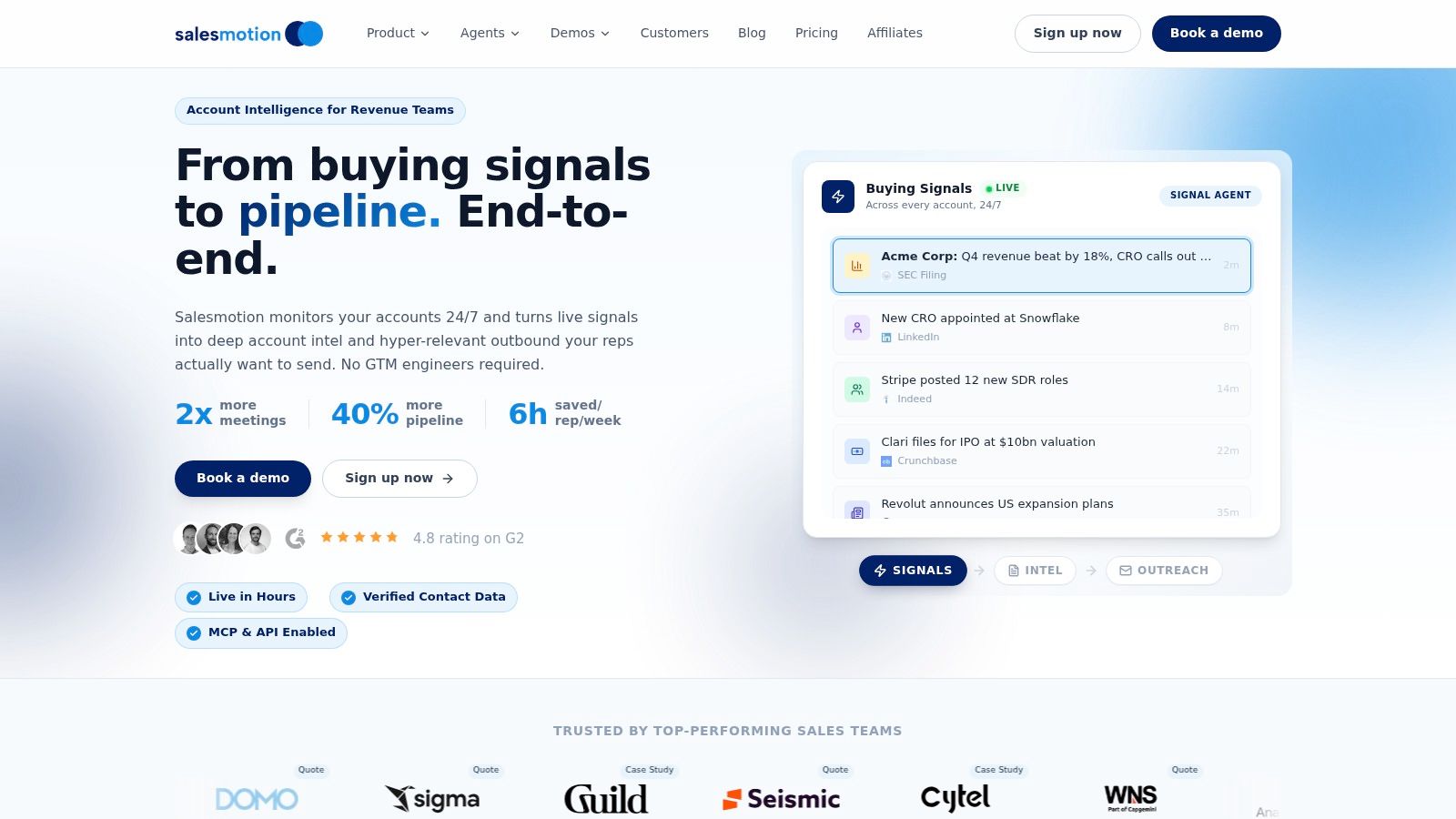
What the workflow looks like in practice
Using Salesmotion buying signal workflows as an example, a platform can monitor account changes continuously, pull context from public sources, and route signal-based insights into rep workflows.
The useful part isn't just alerting on an event. It's turning that event into account-specific context. If a target company shows a late-stage development milestone, commercial hiring, and a market access team buildout, the rep shouldn't have to piece together the story manually. The system should surface the likely initiative, the likely stakeholders, and a reasonable next action.
That matters because pharma signals often arrive in clusters, not clean sequences. A rep may see an executive hire one week, a trial milestone next, and a new support program later. If no tool connects those dots, the account still looks like noise.
Where automation helps most
Automation is most useful in a few places:
- Signal monitoring: Watching pipeline, hiring, leadership, filings, press releases, and interviews across all target accounts.
- Context generation: Summarizing what changed and why that change matters to a likely buying team.
- Outreach preparation: Drafting specific messaging anchored to the signal, instead of generic industry copy.
- Routing and timing: Getting the alert to the right rep while the window is still open.
The key standard is simple. If the platform only delivers raw alerts, reps still do the hard part manually. The better setup explains the “so what” clearly enough that a seller can act the same day.
Measuring the ROI of Your Signal Program
If you can't measure the program, leadership will treat it like a nice idea.
The right ROI view is not “how many alerts did we generate?” That's activity, not value. Measure what happens after the signal enters the workflow.
Metrics that actually matter
Track outcomes by signal type, not just in aggregate.
A simple dashboard should include:
- Meeting booked rate by signal category: Which signals create conversations most reliably.
- Pipeline influenced by signal-driven outreach: Which opportunities were opened or accelerated after signal-based engagement.
- Speed to first touch after a meaningful signal: Fast response matters in time-bound windows.
- Conversion rate by buyer role: Some signals are strong, but only with the right stakeholder.
- Opportunity progression for signal-sourced accounts: Are these deals moving differently from generic outbound deals?
What good looks like
A healthy signal program gets sharper over time.
You'll learn that some events are overrated for your offer. Others will unexpectedly outperform. You may find that a medical affairs expansion beats a flashy approval headline, or that access-related signals create better meetings than broad commercial hiring. That's the point. The system teaches the team where real buying behavior starts.
Strong pharma selling isn't about noticing more news. It's about acting on the right signal, with the right buyer, before the account finalizes its plan.
That's the discipline behind effective pharma buying signals. Detect early. Prioritize hard. Tie every event to an owner, a budget, and a concrete outreach angle.
Sales teams that want a more systematic way to monitor pharma buying signals can use Salesmotion to track account changes, surface the commercial relevance of those changes, and turn them into outreach-ready context for reps.