Companies are now spending $2 in sales and marketing to earn $1 of new ARR, a 14% jump from 2024 according to Benchmarkit's 2025 report. That ratio is unsustainable. The teams reversing it share one trait: they stopped treating every account the same and started letting buyer behavior dictate where time and budget goes.
TL;DR: Signal-based marketing replaces static targeting with real-time buyer behavior as the primary input for GTM decisions. Instead of blasting your entire ICP list, you prioritize accounts showing active buying signals, like hiring patterns, funding events, tech changes, and content engagement. Teams running signal-based plays report 3x higher meeting booking rates and dramatically lower customer acquisition costs. The shift requires aligning sales, marketing, and RevOps around shared signal definitions and automated workflows.
What Signal-Based Marketing Actually Means
Signal-based marketing is a GTM approach where buyer behavior, not static firmographics, drives targeting, timing, and messaging decisions. The premise is straightforward: prospects reveal their intentions through actions. Your job is to detect those actions and respond before competitors do.
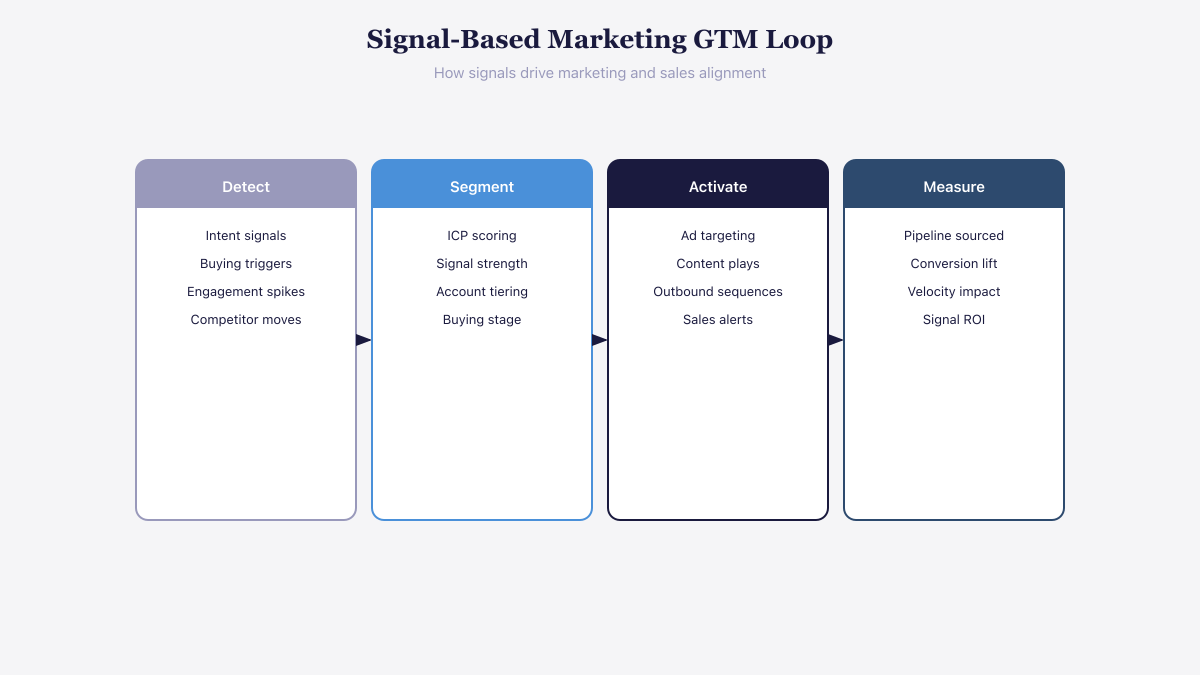 Signal-based marketing creates a continuous loop from detection to measurement.
A signal is any observable change that indicates a shift in buying readiness. Some signals are obvious: a demo request, a pricing page visit, or a direct inquiry. Others are subtler: a company posting three new sales roles, a new VP of Revenue starting, or a spike in competitor comparison research on G2.
Traditional marketing starts with a list and pushes messages at it. Signal-based marketing starts with behavior and engages only when the timing is right. The difference shows up in conversion rates, pipeline quality, and rep efficiency.
See Salesmotion on a real account
Book a 15-minute demo and see how your team saves hours on account research.
Why Signal-Based GTM Is Replacing Traditional Outbound
Three structural shifts are forcing this transition.
Buyer self-service has accelerated. Over 80% of buyers finalize mid-market SaaS decisions within six months, often completing most of their research before engaging a vendor. By the time a prospect talks to your rep, they already have a shortlist. If you are not on it, a cold email will not change that. Signals help you enter the conversation during the research phase, not after the decision is made.
Outbound costs keep rising. The blended CAC ratio is 10% higher than 2022, and generic outbound response rates continue to decline. Cold email open rates have dropped from 36% to under 28% in two years. Teams cannot outspend this trend. They need to out-target it.
AI made volume worthless. When every competitor can generate thousands of "personalized" emails for the cost of a coffee, the value of volume drops to zero. The new differentiator is not how many messages you send. It is whether you reach the right account at the right moment with relevant context. Understanding what intent data is and how to act on it separates effective teams from everyone else.

“We're saving about 6 hours per week per seller on account research alone. That's time they can reinvest in actually selling.”
Derek Rosen
Director, Strategic Accounts, Guild Education
The Signals That Matter Most
Not every piece of account news deserves a response. Signal-based marketing requires filtering for signals that correlate with actual buying behavior.
Tier 1: High-intent signals (act within hours)
- Multiple contacts from the same account visiting your website
- Pricing or demo page visits from ICP-fit accounts
- Past champions changing jobs to new companies
- Competitor evaluation research on review sites
Tier 2: Buying-readiness signals (act within days)
- New executive hires in relevant roles (VP Sales, CRO, Head of RevOps)
- Funding rounds or positive earnings that signal budget availability
- Strategic announcements indicating market expansion
- Job postings for roles your solution serves
Tier 3: Awareness signals (nurture, do not sell)
- Blog or content consumption in your category
- Social media engagement with industry topics
- Event attendance or webinar registration
- General industry research activity
The critical distinction is between signals that indicate "researching solutions" versus "browsing casually." Your highest-value plays should fire on Tier 1 signals. Tier 2 signals warrant personalized outreach. Tier 3 signals enter automated nurture sequences. For a deeper look at which signals drive the most enterprise pipeline, see our guide on the best signals for enterprise sales.
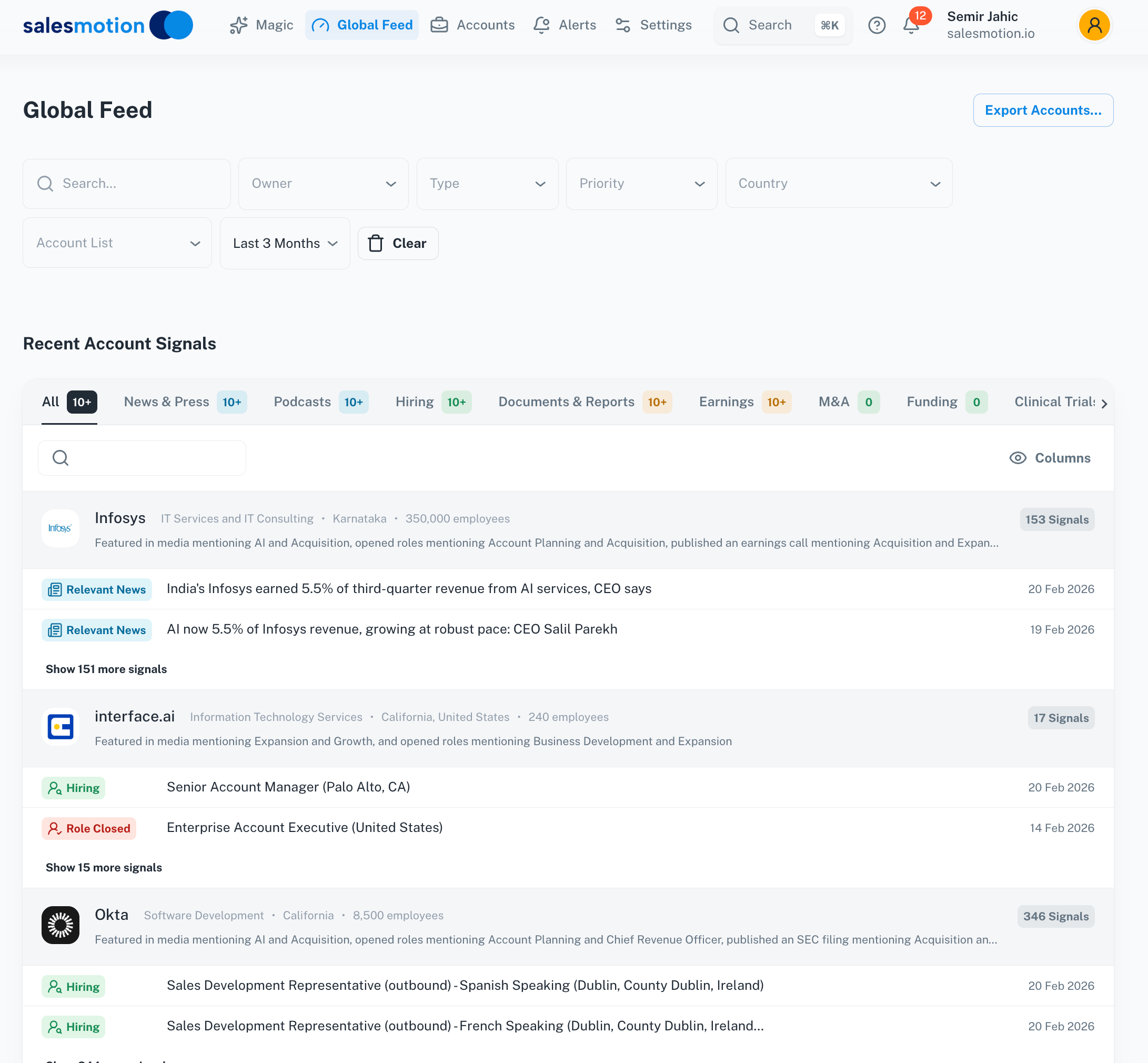 Filtering a signal feed by type (hiring, earnings, funding, news) and account tier lets marketing teams coordinate campaigns around the signals most likely to drive pipeline.
Building a Signal-Based GTM System
Moving from traditional outbound to signal-based marketing requires changes to process, technology, and team alignment. Here is a practical implementation path.
Step 1: Start With One High-Impact Signal
Do not try to operationalize every signal simultaneously. Pick the one that your team can act on immediately with existing tools. For most B2B teams, the highest-impact starting point is one of these:
- Website intent signals (which target accounts are visiting and what pages they view)
- Job change signals (past customers moving to new companies)
- Hiring signals (companies posting roles that indicate they need your category)
Build a complete workflow around that single signal: detection, routing, messaging template, and follow-up sequence. Prove it works before expanding.
Step 2: Define Clear Workflows for Each Signal
Every signal needs a defined response: who acts on it, how quickly, and with what message. Without this, signals become noise.
For example, a "new CRO hired at target account" signal might route to:
- Marketing: Add account to targeted ad campaign within 24 hours
- SDR: Send personalized connection request referencing the new role within 48 hours
- AE: Prepare account brief for when the SDR books the meeting
This coordination between marketing and sales is what transforms signals from alerts into pipeline.
Step 3: Align Revenue Teams Around Shared Signal Definitions
Signal-based marketing fails when marketing and sales define signals differently. Marketing might consider a whitepaper download a "high-intent signal" while sales sees it as noise. This misalignment creates friction and distrust.
Establish shared definitions: what qualifies as a Tier 1 signal? What response time is expected? When does an account move from marketing nurture to sales outreach? Document these agreements and review them monthly.
At Guild Education, Derek Rosen and his strategic accounts team save over 6 hours per week per rep by having all account intelligence and signals consolidated in one platform. That time goes directly into strategic selling instead of research.
Step 4: Measure, Iterate, and Scale
Track signal-to-pipeline conversion rates for each signal type. Some signals will outperform expectations. Others will not justify the workflow investment. Let data determine which signals deserve more resources and which get deprioritized.
Key metrics:
- Signal-to-meeting rate: What percentage of actioned signals result in booked meetings?
- Signal-to-pipeline rate: What percentage of signal-sourced meetings generate qualified pipeline?
- Response time: How quickly does your team act on Tier 1 signals?
- False positive rate: What percentage of signals turn out to be irrelevant after investigation?

“Automatic account profile detail I can use to manage my territory. Using Salesmotion AI to generate value statements per persona, account, etc. Using Salesmotion to give me a starting point based on new hires, or news alerts is critical.”
Adam Wainwright
Head of Revenue, Cacheflow
Common Pitfalls in Signal-Based Marketing
Collecting signals without acting on them. The most common failure mode. Teams buy intent data platforms, configure alerts, and then let notifications pile up unread. Signals without workflows are just expensive notifications.
Treating all signals equally. A pricing page visit from a target account and a blog post read from an unknown company are not equivalent. Tiered prioritization is essential.
Over-automating responses. Automated sequences work for Tier 3 nurture signals. But Tier 1 signals, the ones most likely to convert, deserve human attention and personalized outreach. Automating your highest-value moments is a false economy.
Ignoring signal fatigue. If the same account receives outreach from your SDR, your AE, and your marketing team in response to three different signals in one week, you have a coordination problem. Build suppression rules that prevent overlapping touches.
Key Takeaways
- Signal-based marketing replaces static lists with real-time buyer behavior as the primary GTM input.
- Companies spending $2 to earn $1 of new ARR cannot sustain volume-based outbound. Signal-driven targeting is the efficiency lever.
- Start with one high-impact signal, build a complete workflow around it, then expand.
- Tier your signals: high-intent signals get immediate human attention, buying-readiness signals get personalized outreach, awareness signals enter automated nurture.
- Align sales and marketing around shared signal definitions, response times, and handoff protocols.
- Measure signal-to-pipeline conversion rates to continuously optimize which signals deserve investment.
Frequently Asked Questions
What is the difference between signal-based marketing and ABM?
ABM targets a predefined list of accounts with coordinated campaigns. Signal-based marketing targets accounts showing real-time buying signals, regardless of whether they were on a predefined list. The two approaches complement each other: ABM defines your target universe, and signals tell you which accounts in that universe to prioritize right now.
How many signals should we track to get started?
Start with one or two. The most common starting points are website intent data (which target accounts are visiting your site) and job change signals (past champions moving to new companies). Build complete workflows for these before expanding. Teams that try to operationalize 10 signal types simultaneously usually fail at all of them.
Does signal-based marketing replace outbound sales?
No. It makes outbound dramatically more effective. Reps still send emails, make calls, and build relationships. The difference is they focus those activities on accounts showing active buying behavior instead of working down a static list. Signal-based outbound typically produces 3 to 5x higher response rates than traditional cold outreach because every message has a reason to exist.