Let's be direct: your annual Sales Kick Off (SKO) can either be a high-cost motivational rally or the single most impactful revenue-generating event of the year. The difference comes down to one thing: a strategic approach to sales kick off enablement.
This guide moves beyond rah-rah speeches and product demos to arm your team with the specific plays, tools, and context they need to win complex deals. We’ll show you how to turn your SKO from an expense into a powerful revenue engine.
Why Your SKO Needs More Than Just Motivation
Every year, you pour significant time and money into your Sales Kick Off. While inspiring keynotes and team-building dinners are great for morale, they rarely translate into tangible revenue growth on their own.
The real value comes from turning short-lived inspiration into sustained execution. That’s the entire point of sales kick off enablement.
Instead of a one-off training event, think of your SKO as the launchpad for a continuous motion that converts momentum into consistent, measurable results. It’s a non-negotiable strategy for modern revenue teams, especially those navigating long, multi-stakeholder deals in industries like life sciences or enterprise SaaS.
The Shift From Event To Strategic Program
The market has caught on. We've seen a profound shift in how top-performing organizations view these yearly gatherings. As a testament to this, 76% of organizations now have a dedicated sales enablement function—a huge jump from just 32% five years ago.
This isn't just a trend; it's a strategic evolution. It shows that SKOs are no longer just morale boosters but are being redesigned as critical launchpads for the year ahead. You can dig into more data on this shift in Sifthub's latest report on sales enablement statistics.
A well-designed program finally answers the one question every single rep has after the closing party: "Okay, but what do I actually do differently on Monday morning?"
A great SKO doesn't just motivate your team; it equips them. It provides the specific 'how'—how to approach a new market, how to beat a key competitor, and how to use new tools to find opportunities. Without that practical application, the energy fades within weeks.
The Old Way vs. The New Way
The contrast between a traditional, motivation-focused SKO and one driven by enablement is stark. The old way is an event; the new way is the start of a year-long revenue strategy. This change in mindset directly impacts how you plan, execute, and measure the success of your biggest annual investment in the sales team.
For a deeper dive into modernizing your sales strategies, it's worth exploring these current sales enablement trends.
Let's break down the key differences in a quick comparison.
| Focus Area | Traditional SKO | Enablement-Driven SKO |
|---|---|---|
| Primary Goal | Motivate, inspire, celebrate past wins. | Equip reps with actionable plays, skills, and tools for future wins. |
| Agenda Focus | Back-to-back presentations, product demos, leadership speeches. | Hands-on workshops, role-playing real deals, peer-to-peer learning. |
| Key Content | High-level strategy, product feature dumps. | Signal-driven plays, competitor battlecards, MEDDICC-aligned talk tracks. |
| Success Metric | Post-event survey scores ("Did you enjoy it?"). | Play adoption rates, pipeline velocity, impact on Q1/Q2 win rates. |
| Rep Takeaway | "I'm pumped for this year!" | "I know exactly how to use this new play on my top 3 accounts." |
Ultimately, by embracing sales kick off enablement, you transform your SKO from a costly expense into a powerful engine for predictable growth.
See Salesmotion in action
Take a self-guided interactive tour — no signup required.
Laying the Groundwork for a High-Impact SKO
A killer Sales Kick-Off doesn’t start with the opening keynote. It starts weeks, sometimes months, in advance with thoughtful, strategic planning. This pre-SKO phase is your launchpad, separating a game-changing event from just another corporate meeting.
The goal is to ensure everyone arrives ready to engage, practice, and apply new skills—not just passively sit through presentations. This is where your sales kick off enablement program kicks into gear, building a bridge from high-level company goals to the day-to-day plays your sellers will run. It all starts with defining what winning looks like before anyone packs their bags.
Define Your Objectives with Precision and Purpose
Vague goals lead to vague outcomes. If you want an SKO that drives real results, you must start with specific, measurable, and relevant objectives tied directly to the company's revenue and operational targets.
Work backward from your annual benchmarks. If the company needs to grow its enterprise market share by 15%, what specific skills and behaviors does your sales team need to master?
Your SKO objectives should be concrete, like these plausible examples:
- Increase pipeline generated from signal-driven plays by 30% in Q1.
- Improve the win rate against Competitor X by 20% through targeted battlecard training.
- Achieve a 90% adoption rate of the new MEDDICC-aligned qualification framework within 60 days.
By setting concrete goals, you give your SKO a clear mission. Every agenda item, every workshop, and every piece of content should directly support these objectives. This turns the event from a collection of talks into a focused, mission-critical enablement program.
Segment Your Audience for Maximum Relevance
Your sales team isn’t a monolith. A brand-new sales development representative (SDR) has different needs than a seasoned enterprise account executive managing strategic accounts. A one-size-fits-all SKO is a recipe for disengagement.
The key is to segment your audience and deliver tailored pre-briefing materials that speak directly to their roles and challenges.
Example of Audience Segmentation:
- New Hires (0-6 months): Focus on core methodology, product knowledge fundamentals, and a deep dive into the ideal customer profile.
- Mid-Market AEs (1-3 years): Provide advanced competitive intelligence, hands-on training with new sales plays, and peer-led sessions on breaking into new accounts.
- Enterprise Sellers (3+ years): Deliver strategic workshops on multi-threading in complex organizations, executive-level communication, and leveraging account intelligence for expansion opportunities.
By personalizing the pre-work and even the agenda tracks, you show your team you respect their time and are invested in their individual success. For more on creating this kind of targeted approach, you can explore our detailed guide on building a sales enablement framework.
This process flow shows how a great SKO moves from initial motivation to practical enablement—the core of a successful pre-kickoff strategy.
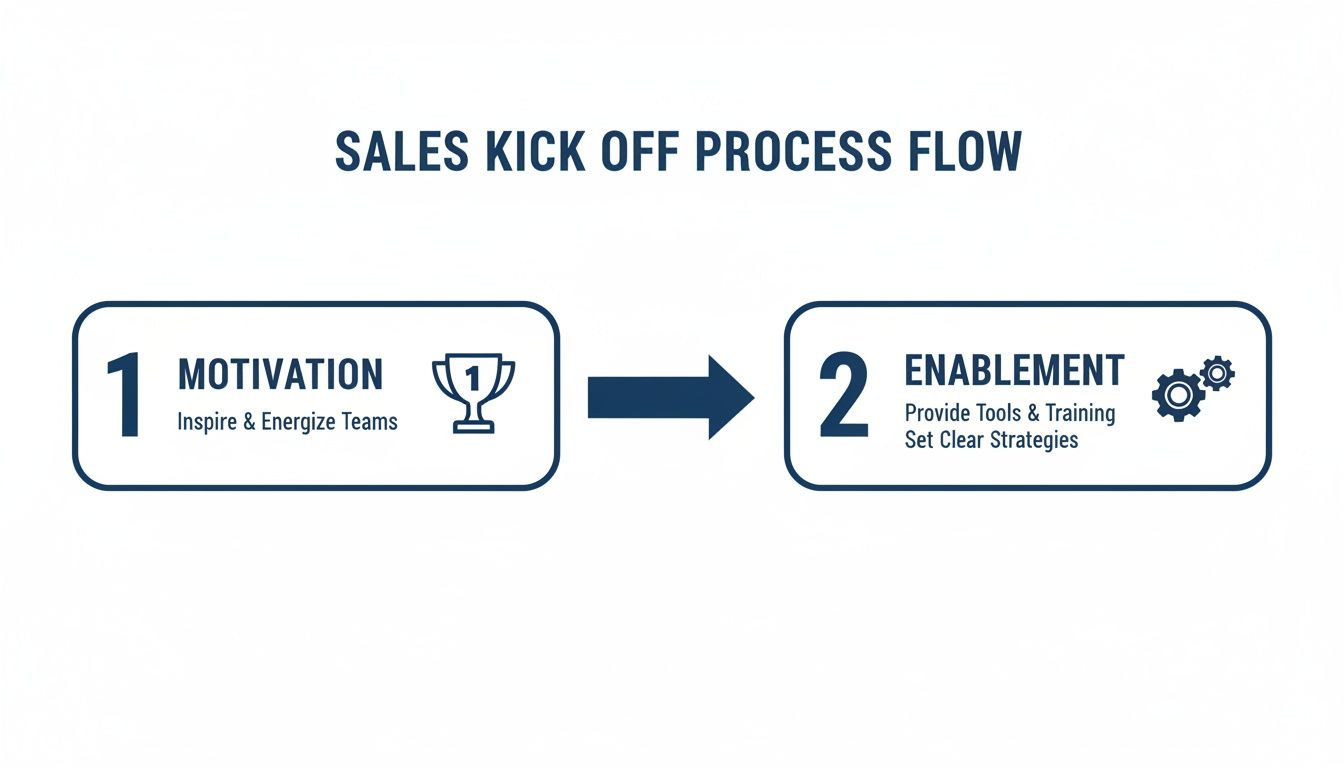
The visual makes a crucial point: inspiration gets people fired up, but the real work happens when you give them the tools and strategies to turn that energy into action.
Eliminate the Manual Research Tax
One of the biggest drags on a seller’s time is manual research. They burn countless hours trying to piece together context on their accounts, find the right content, and figure out the "why now" for their outreach. A core part of pre-SKO planning is to kill this burden.
Fact: some revenue teams waste up to 440 hours per year—that's 11 full work weeks—just hunting for information. This is a massive productivity drain that great enablement can solve.
Imagine if your account executives received a concise, signal-driven brief on their top accounts a week before the SKO. This brief could highlight that a target account just secured a new round of funding, announced a product expansion, or hired a new executive from a company you’ve sold to before.
By arming them with this intelligence upfront, you enable them to walk into workshops ready for strategic discussions, not basic fact-finding. This is the essence of effective sales kick off enablement.

“Salesmotion helps you spot signals from prospect accounts, news items / job hiring alerts etc that indicate that now is a good time to reach out with a well-crafted message.”
Rob Douglas
Director of Sales, icit business intelligence
Designing an Agenda That Actually Enables Sellers
Let's be honest: the traditional Sales Kick Off agenda is broken. It's a marathon of back-to-back presentations that leaves reps feeling overwhelmed, not empowered. To make your SKO a real engine for revenue, you have to ditch the "death by PowerPoint" model.
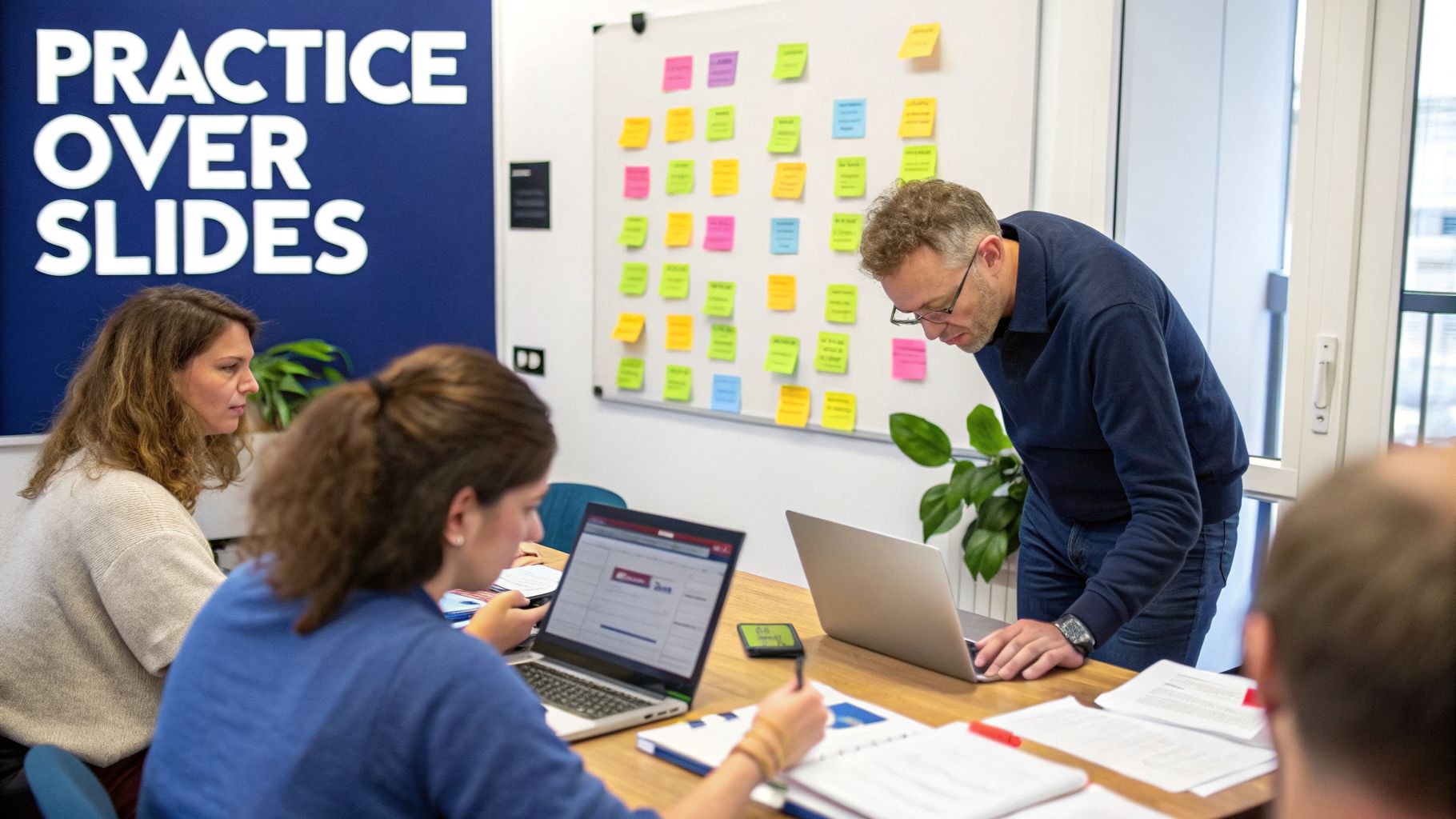
The goal is to build an agenda around interactive, hands-on workshops that connect directly to your company’s revenue goals. This is about giving sellers skills they can use on Monday morning. Your sales kick off enablement strategy comes to life here, prioritizing application over theory. High-performing organizations get this; they make sure at least 50% of their SKO agenda is dedicated to interactive sessions. This simple shift turns reps from passive listeners into active participants who practice and master new skills.
From Theory to Action-Oriented Workshops
The most effective enablement sessions are built around real-world selling scenarios. Instead of just talking about a methodology like MEDDICC, run a live workshop where teams actually apply it. This is how you bridge the gap between knowing and doing.
A powerful workshop format uses real-time buying signals to build an opportunity plan right on the spot.
Example Workshop: Signal-Driven Opportunity Planning
- The Signal: Present a real, recent trigger for a target account. For instance, a key competitor’s major customer just announced a leadership shakeup in their operations department.
- The Task: In small groups, have your reps use this signal to build a point of view. Who is the new leader? What challenges are they likely facing? How does this create an opening for your solution?
- The Application: The teams then use this context to update their MEDDICC framework for that account. They identify new Champions, re-evaluate the Metrics, and craft a talk track for their initial outreach that is hyper-relevant and timely.
This format turns a theoretical concept into a repeatable, practical skill. Reps don’t just learn what MEDDICC is; they learn how to use it in response to real market events.
Building Assets That Live in the Workflow
One of the biggest failures of any SKO is when valuable assets—like battlecards and account plans—are created, celebrated, and then immediately forgotten in a shared folder. Your agenda must focus on building and integrating these tools directly into your sellers' daily workflows, especially your CRM and communication hubs like Slack.
The goal isn't to create static files; it's to build living documents.
- Dynamic Talk Tracks: Ditch the generic scripts. Build modular talk tracks that reps can assemble based on specific signals. The leadership change signal, for example, would trigger a talk track focused on operational efficiency and risk mitigation.
- Actionable Battlecards: Move beyond simple feature comparisons. Your battlecards should include "if-then" scenarios. If a prospect mentions Competitor X’s integration issues, then pivot the conversation to your seamless API and share a specific case study.
- CRM-Native Account Plans: Guide reps to build their account plans directly within your CRM. This ensures the plan is always accessible, easily updated with new signals, and visible to leadership for coaching opportunities.
The real measure of successful sales kick off enablement isn't whether reps have a battlecard; it's whether they can pull up the right competitive counter-point within seconds during a live call because it's integrated into their workflow.
Integrating Tools for Lasting Skill Adoption
For new skills and processes to stick, they have to be practiced within the tools reps use every single day. An effective SKO agenda seamlessly integrates your tech stack into every workshop. When you introduce a new sales play, you should also show them exactly how to execute it within your CRM, Slack, and account intelligence platform.
Think of it as building muscle memory. If reps practice logging a new type of discovery call in a sandbox CRM during the SKO, they are far more likely to do it correctly with real prospects. This hands-on approach removes friction and boosts adoption from day one.
By designing an agenda that prioritizes doing over listening, you ensure your SKO investment pays dividends long after the event ends.
Integrating Your Tech Stack for Seamless Enablement
Your tech stack should be the engine driving your sales kick off enablement, not a clunky, disconnected set of tools reps ignore. If you want new plays and behaviors to stick, your tools must feel like a natural part of a seller's daily grind. A fragmented stack creates friction, guaranteeing those great SKO ideas die a quiet death in a forgotten slide deck.
The real win is weaving your core sales tools—CRM, account intelligence platforms, and communication channels—into the very fabric of your kickoff. This isn't about showing reps another dashboard. It's about demonstrating a frictionless workflow where technology actually helps them sell.
Creating a Connected Workflow
A truly connected stack turns information overload into a seller's unfair advantage. It creates a clear, fast path from signal to action, showing reps exactly what to do with the intelligence they receive. This process should be a central theme in your SKO enablement sessions.
Don't just talk about it—show it. Walk them through a real-world scenario during a breakout session:
- The Signal Hits: A real-time Slack alert fires. A key target account just announced a major expansion into a new market.
- Context is Added: The alert provides the “so what.” It connects the expansion to a specific pain point (like scaling their security infrastructure) and links directly to the press release and key executive LinkedIn profiles.
- Action is Triggered: This signal automatically launches a pre-built sales play inside your CRM, complete with a MEDDICC-aligned talk track tailored to this exact scenario.
- Interaction is Logged: The rep immediately kicks off the play, and every touchpoint is automatically logged against the opportunity in the CRM.
This is the kind of seamless flow that makes enablement stick. It's not a theoretical exercise; it’s a live demo of how technology makes their job easier and more impactful.
Fusing Your CRM and Communication Tools
Your CRM is the system of record, but your sales team lives and breathes in tools like Slack. For any modern sales kick off enablement plan, integrating them is non-negotiable. The goal is to bring critical data and alerts directly into the conversational flow of their work.
During your SKO, showcase practical integrations that deliver immediate value. Show reps how a new opportunity in your CRM can automatically spin up a dedicated Slack channel, pulling in the core account team to start strategizing instantly. Demonstrate how deal progression updates can be pushed to a channel, keeping everyone in the loop without anyone having to run a report.
The most powerful integrations are the ones that eliminate context-switching. If a rep can get a buying signal, huddle with their team, and access the right sales play all within Slack, you’ve demolished the biggest barriers to adoption.
The industry is leaning hard into this integrated approach. Globally, 68% of sales leaders are boosting their AI investments for 2026 SKOs, recognizing that connected tech stacks drive 24% higher productivity. Reps who can act on insights within their existing workflow just get more done.
Leveraging Account Intelligence Platforms
Think of your account intelligence platform as the brain of your sales operation, feeding timely and relevant signals into every other system you use. This is non-negotiable if you’re selling into complex industries like enterprise software or life sciences, where timing is everything. For too many organizations, the tech stack is a source of frustration, but you can learn more about why your sales tech stack isn't enough on its own and how intelligence ties it all together.
To make sure your entire sales ecosystem works as a single, cohesive unit, bringing in expert platform integration services can make all the difference. When you show reps how these platforms talk to each other, you’re not just training them on tools—you’re training them on a smarter, signal-driven way of selling.

“Automatic account profile detail I can use to manage my territory. Using Salesmotion AI to generate value statements per persona, account, etc. Using Salesmotion to give me a starting point based on new hires, or news alerts is critical.”
Adam Wainwright
Head of Revenue, Cacheflow
Making It Stick: A Post-SKO Activation Playbook
So, you’ve just wrapped up an incredible Sales Kick Off. The energy is electric, the team is fired up, and everyone is aligned on the new strategy. But what happens next Monday? Or the Monday after that?
The biggest mistake companies make is assuming SKO inspiration automatically translates into action. It doesn't. That initial momentum is fragile. Without a deliberate plan, reps will slowly but surely slide back into their old habits, and those beautiful new slide decks will start gathering digital dust.
This is where the real work begins. To turn SKO energy into lasting revenue growth, you need a concrete post-SKO activation playbook. It’s all about a continuous loop of reinforcement, coaching, and measurement.
Build Reinforcement into the Daily Workflow
Here's a hard truth: your team is going to forget most of what they learned. The human brain simply can't retain that much information at once. In fact, without reinforcement, reps are likely to forget up to 70% of the SKO content within a single week.
The solution isn't another round of training. It's about building automated sequences that deliver bite-sized reminders and actionable content directly into their daily workflow. Think of it as a drip campaign for their brain.
Instead of a single "SKO Follow-Up" email, create a multi-week campaign that keeps the core themes top of mind:
- Week 1: Send a quick video recap of the new competitive battlecard for Competitor X, with a direct link to it in your enablement platform.
- Week 2: Push a Slack notification with a success story from a rep who just used a new signal-driven play to book a key meeting.
- Week 3: Email a short, practical quiz on the key discovery questions from the new qualification framework.
These nudges should live where your reps work. Embedding these reminders directly into their daily communication channels is key. For some great ideas on how to do this, check out this guide to a Modern Sales Enablement Strategy That Lives In Slack.
Equip Managers for Bite-Sized, Actionable Coaching
Your front-line managers are the linchpin of your entire post-SKO strategy. They are the ones who turn high-level theory into on-the-ground execution through their daily coaching. You have to equip them with a clear plan to inspect and reinforce the new behaviors.
Don't let them fall into the trap of asking generic questions like, "How are you using the new plays?" Guide them to be more specific during one-on-ones and deal reviews.
For instance, if a major SKO theme was using buying signals, a manager can look at the CRM and ask, "I see this account just hired a new CFO. How can we use that new talk track we workshopped to open a conversation around their Q1 financial priorities?"
The most effective post-SKO coaching is contextual. It’s not about reviewing a checklist; it’s about applying the new skills to live opportunities and removing the real-world obstacles your reps are facing.
This approach transforms managers from simple deal inspectors into true performance coaches who drive behavior change.
Here is why I think that matters. If the top 10% of reps get 10% better, that's fine. But what if the other 90% get 10% better? If you're a CRO, that is what you should focus on.
Measure What Matters: Adoption and Revenue
You can't prove the ROI of your SKO if you can't measure what changed. A solid measurement framework tracks both the early signs of behavior change and the long-term impact on revenue. It’s how you connect your enablement efforts directly to business outcomes.
Start by tracking leading indicators. These are the early signs that the new behaviors are sticking. Are reps actually using the new sales plays? Are account plans being updated in the CRM with the new framework? Use your account intelligence platform to see if reps are acting on the high-priority buying signals you covered during the kickoff. These adoption metrics tell you if the message actually landed.
Over time, you can connect this adoption to the lagging indicators—the hard metrics that leadership cares about. We know from research that effective post-SKO reinforcement can lead to 32% higher quota attainment in mature programs. The link between sustained enablement and performance is undeniable.
To make this practical, here is a simple framework you can adapt to track your progress and ensure your SKO investment pays off quarter after quarter.
Post-SKO Activation and Measurement Framework
This framework provides a clear path for activating and measuring the impact of your SKO in the crucial weeks and months that follow.
| Timeframe | Activation Activity | Key Metric to Track |
|---|---|---|
| Weeks 1-4 | Reinforcement sequences and manager check-ins. | Play Adoption Rate: Percentage of reps using new plays in the CRM. |
| Weeks 5-8 | Peer-led best practice sharing and deal reviews. | Pipeline from SKO Plays: New pipeline dollars created from targeted initiatives. |
| End of Quarter | Correlate top performers with high adoption rates. | Win Rate Improvement: Change in win rate for deals using the new methodology. |
| End of H1 | Full ROI analysis and program iteration. | Sales Cycle Velocity: Average time to close deals post-SKO vs. pre-SKO. |
By following this continuous cycle of action, measurement, and iteration, you ensure your SKO isn't just a single event, but a true catalyst for transformation.
For a deeper look into the KPIs that matter most, check out our complete guide on essential sales enablement metrics.
A CRO’s Take: Why SKO Enablement is Non-Negotiable
As a CRO, my annual Sales Kick Off is hands down the single largest investment I make in my go-to-market team all year. The stakes couldn't be higher, and the pressure to show a real return on that investment is immediate. We've long moved past the days of treating the SKO as just a rah-rah motivational event; it's now a critical lever for hitting our board-level goals.
A well-designed sales kick off enablement program is what turns that massive spend into a predictable, scalable revenue engine. It's how we de-risk our annual forecast. Instead of just crossing our fingers and hoping for the best, we embed the specific skills, plays, and intelligence our team needs to actually hit their numbers.
Building a Scalable Revenue Engine
The entire focus has shifted. It's no longer just about hitting a quarterly number; it's about building a sustainable growth model that we can count on.
For us, this means putting account intelligence and signal-driven selling right at the heart of our SKO. We're training sellers to stop guessing and start acting on real-world triggers—things like a target account hiring a new executive, announcing a strategic shift, or even mentioning a key challenge on an earnings call.
This approach completely changes the game for our front-line managers, empowering them to be better coaches. They can now review deals based on whether a rep is actually using the new plays we taught them, not just on the pipeline value. This shift is what creates a genuine culture of accountability and continuous improvement.
The modern SKO isn’t about a two-day burst of energy. It’s about building a system that equips every seller to conquer the complexities of modern B2B selling and drive higher, more predictable revenue.
This strategic pivot is proving its worth. In major markets, this shift is fueling 27% higher customer lifetime value, proving that well-enabled kickoffs turn inspiration into scalable pipeline growth. It's all about aligning your RevOps with real-world triggers to get those outsized results, a trend you can explore by reviewing research on sales enablement statistics.
Ultimately, a next-generation SKO ensures our team leaves not just motivated, but genuinely equipped to execute. They walk out the door with the tools, the context, and the confidence to go win the deals that will define our year.
Answering Your Toughest SKO Enablement Questions
Even with a solid game plan, revenue leaders often run into the same tricky questions when building out a high-impact sales kick off enablement program. I've heard them all over the years.
Here are my straight-up answers to the most common ones.
How Far in Advance Should We Really Plan Our SKO?
If you want an SKO that actually moves the needle on revenue, you need to start planning 90-120 days out. This isn't just about booking a venue; it's about building a strategic event.
Starting this early gives you the runway to do things right:
- Pin down clear, revenue-focused objectives that have full leadership buy-in.
- Properly segment your audience so you can deliver personalized pre-work and agenda tracks.
- Build out meaningful, hands-on workshops and all the collateral that goes with them.
- Assign pre-work and, more importantly, track it to make sure everyone shows up ready to go.
Trying to cram all this into 30 days? You'll end up with a meeting focused on logistics, packed with presentations. You won't get deep, lasting enablement.
What's the Single Biggest Mistake to Avoid in an SKO Agenda?
Easy. The biggest mistake is creating a passive, one-way agenda that's just a series of back-to-back presentations. This is the classic "death by PowerPoint" scenario, and it guarantees your team will tune out and retain almost nothing.
The goal is for your sellers to do, not just listen. To avoid this trap, make sure at least 50% of your agenda is interactive. Focus on hands-on workshops, role-playing with real account scenarios, and competitive drills that build real muscle memory.
How Can We Actually Measure the ROI of SKO Enablement?
Measuring the return on your SKO investment means looking at both leading and lagging indicators. This dual approach is critical because it shows you the early signs of behavior change and connects them directly to long-term business results.
Leading Indicators (Weeks 1-8): These tell you if the new behaviors are sticking.
- Adoption rate of your new sales plays in the CRM.
- Quality and completion of updated account plans using the new framework.
- Number of meetings booked using the new talk tracks.
Lagging Indicators (Quarters 1-2): These are the hard business numbers that prove the impact on the bottom line.
- Improved win rates against your key competitors.
- Shorter average sales cycles for the deal types you targeted.
- An increase in average deal size.
- Overall quota attainment for the reps who actually adopted the new methods.
When you track both, you get the full picture. You can prove that your investment in sales kick off enablement didn't just create a good event—it directly fueled revenue growth.
By automating research and transforming signals into usable points of view, Salesmotion helps revenue teams scale personalization, win timely conversations, and turn real account activity into measurable pipeline growth. Find out how we can help you turn your next SKO into a revenue-generating machine at https://salesmotion.io.