SPIN Selling was published in 1988 based on the largest-ever study of sales effectiveness: 35,000 sales calls analyzed over 12 years. Neil Rackham's core finding was that successful reps in complex sales don't pitch. They ask questions in a specific sequence that helps buyers discover the full magnitude of their problems. Situation questions establish context. Problem questions uncover difficulties. Implication questions make those problems feel urgent. Need-payoff questions let the buyer articulate the value of solving them. Nearly four decades later, the framework remains one of the most effective approaches for consultative selling. But the selling environment has fundamentally changed. Buyers arrive with research already done. Attention spans for discovery calls are shorter. And real-time signals now provide context that reps used to spend entire calls uncovering.
TL;DR: SPIN Selling's question sequence (Situation, Problem, Implication, Need-payoff) remains highly effective for complex B2B sales in 2027, but the framework needs adapting to buyers who arrive informed and discovery calls that run shorter. Modern reps should minimize Situation questions by using pre-call research and account intelligence to arrive informed. This shifts more call time to the high-value Implication and Need-payoff questions that create urgency and commitment. Signal-informed SPIN selling combines the framework's proven psychology with real-time account data.
The SPIN Framework: A Quick Refresher
For those unfamiliar with the methodology or needing a refresh:
Situation Questions gather facts about the buyer's current state. "How many reps are on your team?" "What CRM do you use?" "How do you currently handle account research?"
Problem Questions uncover difficulties, dissatisfactions, and challenges. "Where do your reps spend the most time outside of selling?" "What's your biggest challenge with pipeline accuracy?"
Implication Questions explore the consequences of those problems. "When reps spend 3 hours researching each account, how does that affect the number of accounts they can cover?" "What happens to your forecast when pipeline data is inconsistent?"
Need-payoff Questions guide the buyer to articulate the value of a solution. "If your reps could access account research in 15 minutes instead of 3 hours, how would that change your pipeline coverage?" "What would it mean for your forecast if every deal had consistent qualification data?"
The original research found that top performers asked significantly more Implication and Need-payoff questions than average performers, while spending less time on Situation questions. The insight is counterintuitive: the questions that feel most natural (asking about the buyer's situation) are the least valuable, while the questions that feel most challenging to ask (exploring consequences and envisioning outcomes) drive the most commitment.
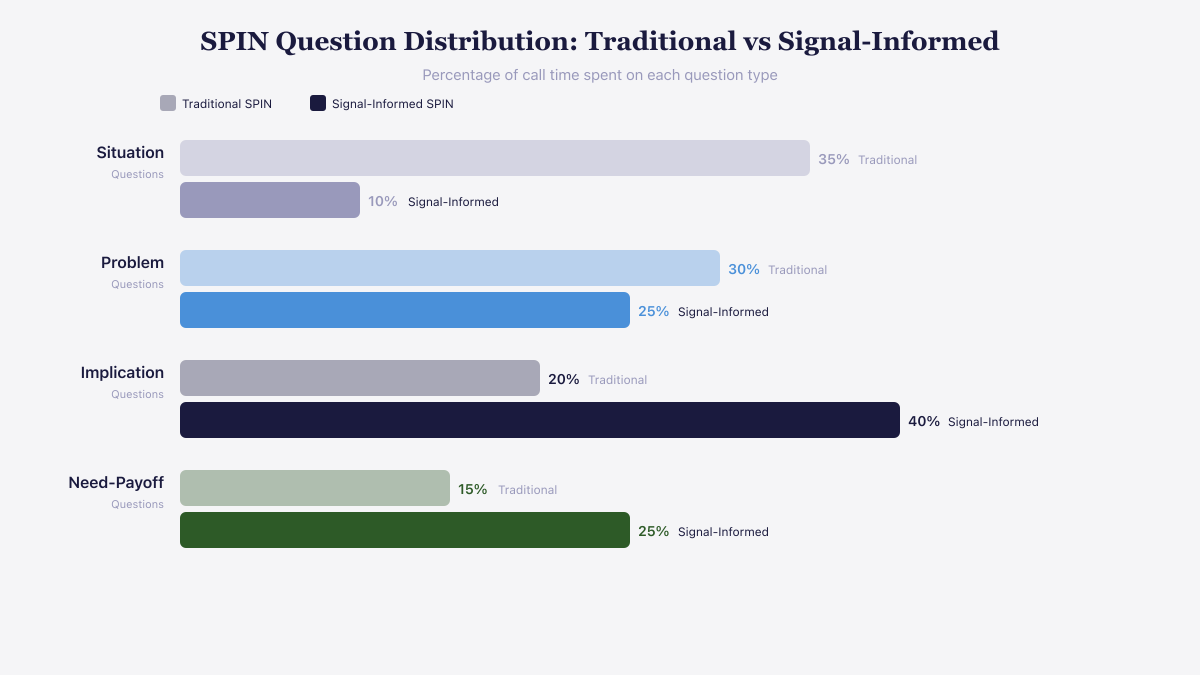 Signal-informed SPIN shifts call time from low-value Situation questions (35% to 10%) to high-value Implication questions (20% to 40%).
See Salesmotion on a real account
Book a 15-minute demo and see how your team saves hours on account research.
Why SPIN Needs Adaptation in 2027
Buyers Have Already Done Situation Research on You
In 1988, buyers had limited information before a sales call. The rep was often the primary source of industry knowledge and solution information. Today, by the time a buyer takes a meeting, they've typically reviewed your website, read comparison articles, checked review sites, and possibly spoken with peers who use your product.
The implication for SPIN: buyers tolerate fewer Situation questions. A rep who opens with "Tell me about your company" or "How many employees do you have" signals that they haven't done their homework. The buyer's unspoken reaction: "You should already know this."
Attention Windows Are Shorter
The average B2B discovery call is 30 minutes, down from 45-60 minutes a decade ago. With less time, reps can't afford to spend 15 minutes on Situation questions before reaching the Problem and Implication phases where value is created.
Real-Time Signals Provide Pre-Call Context
Salesmotion surfaces buying signals that previously required extensive Situation questioning: leadership changes, strategic priorities from earnings calls, hiring patterns indicating growth areas, competitive evaluations underway, and technology stack composition. These signals arrive in the rep's Salesforce workflow before the call, eliminating the need for 80% of Situation questions and providing ammunition for sharper Problem and Implication questions.
The difference is concrete. Without pre-call account intelligence, a rep opens with "Tell me about your sales team structure." With it, the rep opens with "I noticed you've hired 12 AEs in the last quarter and your CRO mentioned 'scaling enterprise' on the last earnings call. Is the ramp time for new reps the bottleneck, or is it pipeline generation for the expanded team?" That second opener creates an entirely different conversation.

“The moment we turned on Salesmotion, it became essential. No more hours on LinkedIn or Google to figure out who we're talking to. It's just there, served up to you, so it's always 'go time.'”
Adam Wainwright
Head of Revenue, Cacheflow
Signal-Informed SPIN: The 2027 Adaptation
Here's how to adapt each SPIN phase using modern intelligence and signal data.
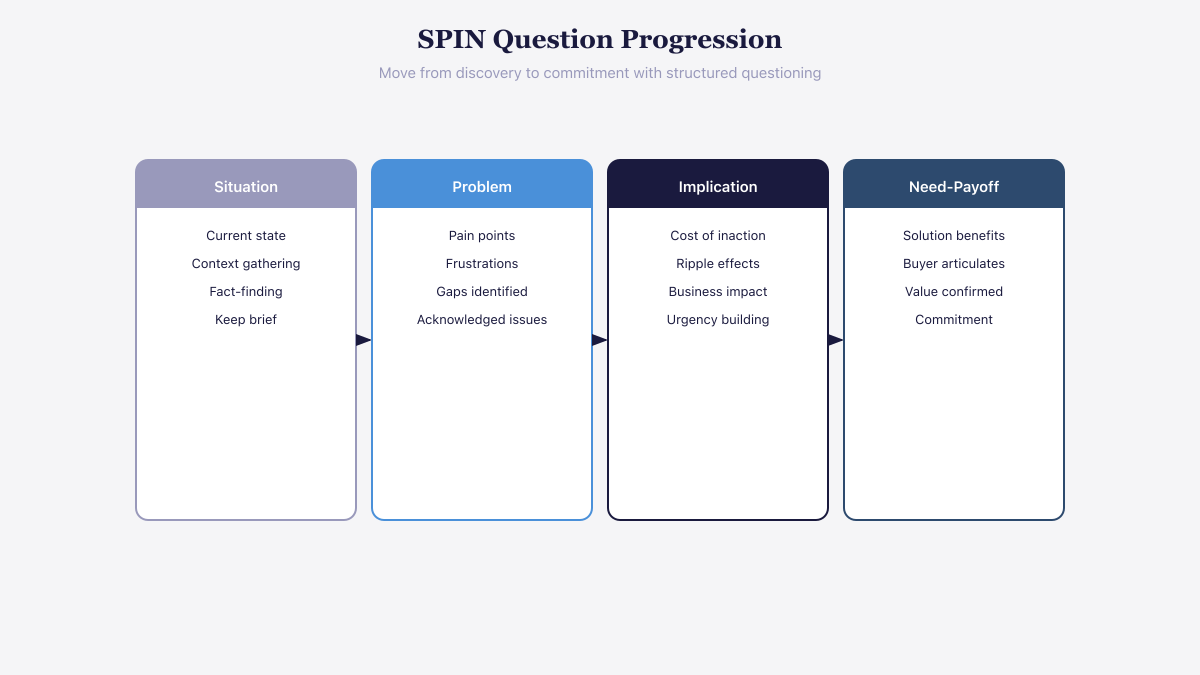 The SPIN progression moves from gathering context to building urgency and confirming value.
Phase 1: Situation — Replace Questions with Research
Traditional approach: Ask 5-10 questions to understand the buyer's environment.
Signal-informed approach: Arrive with 80% of situational context already mapped. Use the call to confirm or refine rather than discover.
Before the call, know:
- Company size, growth trajectory, and recent funding or earnings data
- Current technology stack (CRM, engagement tools, data providers)
- Organizational structure and key stakeholders
- Recent leadership changes, strategic initiatives, or market moves
- Hiring patterns indicating investment priorities
On the call, ask only:
- One or two confirmation questions: "I noticed your team has grown from 15 to 40 reps this year. Is scaling the sales org the primary focus right now?"
- One refinement question: "Your 10-K mentioned a push into enterprise. Is that being led by the existing team or a new group?"
This approach demonstrates preparation, builds credibility, and shifts 10-15 minutes of call time from low-value Situation questions to high-value Implication discussions.
Phase 2: Problem — Use Signals to Ask Sharper Questions
Traditional approach: Ask open-ended questions hoping to uncover a relevant pain point.
Signal-informed approach: Use signals to hypothesize the problem, then validate with targeted questions.
Example without signals: "What are the biggest challenges your sales team faces?"
Example with signals: "I saw you're hiring 15 new enterprise reps this quarter. When teams scale that quickly, the two most common problems are inconsistent pipeline quality from new reps and the existing team getting stretched across too many accounts. Which of those resonates more?"
The signal-informed version does three things the generic version doesn't: it shows you've researched the company, it frames the problem based on real evidence, and it gives the buyer a structured way to respond rather than asking them to self-diagnose from scratch.
Phase 3: Implication — Quantify With Account-Specific Data
Implication questions are where SPIN creates urgency. The goal is helping the buyer feel the full weight of their problem.
Traditional approach: "What happens when reps don't have enough pipeline?"
Signal-informed approach: "With 15 new reps ramping this quarter and your current 4-month ramp time, you're looking at approximately 60 rep-months of sub-quota performance. At your average quota of $500K per rep per quarter, that's potentially $2-3M in pipeline risk. How are you planning to accelerate ramp?"
The quantification makes the implication concrete. And the data driving it (team size, ramp time, quota) can be estimated from signals like job postings, company size, and industry benchmarks before the call even starts.
Phase 4: Need-Payoff — Anchor to Specific Outcomes
Need-payoff questions let the buyer sell themselves on the solution. Signal data makes these questions more specific and compelling.
Traditional approach: "If you could reduce ramp time, how would that help?"
Signal-informed approach: "If your new reps could access the same account intelligence as your top performers from day one — the same stakeholder maps, earnings insights, and competitive intelligence — and that cut ramp time from 4 months to 2, that's 30 additional rep-months of productive selling this year. What would that mean for your annual target?"
The buyer doesn't just agree that faster ramp would be nice. They calculate the specific dollar impact for their specific situation. This creates internal urgency that survives after the call ends.
Putting It Together: A Signal-Informed SPIN Call Structure
Pre-call (10 minutes): Review account intelligence brief. Identify 2-3 signals that suggest specific problems. Prepare targeted Problem and Implication questions anchored to those signals.
Call opening (2-3 minutes): Share what you already know. Confirm with 1-2 Situation questions. Establish credibility through preparation.
Problem exploration (8-10 minutes): Use signal-hypothesized problems to ask sharp, validated Problem questions. Let the buyer confirm, correct, or expand.
Implication development (10-12 minutes): Quantify the consequences using account-specific data. Help the buyer feel the full scope of the problem across their organization.
Need-payoff (5-8 minutes): Guide the buyer to articulate the value of solving the problem in their specific context. Anchor to measurable outcomes.
Next steps (2-3 minutes): Based on the buyer's articulated needs, propose a specific next step that advances the deal.
This structure works within a 30-minute call and spends 70% of the time on Implication and Need-payoff questions — exactly the pattern Rackham's research identified in top performers.
SPIN + Salesmotion in Practice:
- Trigger: Salesmotion detects that a target account's CFO mentioned "sales productivity" three times on the latest earnings call, while the company simultaneously posted a VP of Revenue Operations role.
- Platform action: The account brief auto-updates with the earnings language, the new role details, and the account's current tech stack (5 tools for sales research, based on job posting requirements).
- Rep action: The AE enters the SPIN call already knowing the Situation. They skip straight to Problem questions: "With productivity as a board-level priority and a new RevOps leader incoming, where's the biggest drag on rep efficiency right now?" Then Implication: "If each of your 30 reps spends 10 hours/week on manual research, that's 15,600 hours a year. At $100/hour fully loaded, that's $1.56M in selling time redirected to non-revenue activity."
- Outcome: The discovery call covers in 25 minutes what traditionally takes two calls. The buyer leaves with a quantified problem they hadn't fully calculated, and the AE has a natural bridge to a demo.
Cacheflow cut deal preparation time by 60% by replacing manual research with automated intelligence briefs, giving reps the pre-call context that makes signal-informed SPIN possible without adding hours of research per account.

“The talking points are gold. If they're in Salesmotion, I know they're being discussed inside that business. That makes it easy to spark a real conversation, which is 90 percent of the battle.”
Andrew Giordano
VP of Global Commercial Operations, Analytic Partners
Key Takeaways
- SPIN Selling's core psychology (questions that help buyers self-discover problems and envision solutions) remains as effective today as it was in 1988.
- The adaptation needed is reducing Situation questions from 30% of call time to under 10% by using pre-call research and account intelligence.
- Signal-informed Problem questions are dramatically more effective than open-ended fishing. "I noticed X about your company, which typically creates Y challenge" beats "What are your biggest challenges?" every time.
- Implication questions create the most urgency when they're quantified with account-specific data: team size, growth rate, revenue targets, and competitive pressure.
- Need-payoff questions should anchor to specific outcomes measurable in the buyer's context, not generic value propositions.
- Pre-call preparation using automated intelligence briefs is what makes signal-informed SPIN scalable. Without it, the research burden makes this approach impractical for reps managing 50+ accounts.
Frequently Asked Questions
Is SPIN Selling still effective in 2027?
Yes. SPIN Selling's question-based approach is grounded in buyer psychology that hasn't changed: people are more committed to solutions they discover themselves than solutions they're told about. What's changed is the information environment. Buyers arrive more informed, so reps must arrive equally informed. The framework's effectiveness depends on adaptation: spending less time on Situation questions and more time on Implication and Need-payoff questions that create urgency and commitment.
What is the difference between SPIN Selling and Challenger Sale?
SPIN Selling guides buyers through self-discovery using a question sequence. The Challenger Sale teaches buyers something new that reframes how they think about their problem. SPIN works best when the buyer has a problem they haven't fully explored. Challenger works best when the buyer has a problem they think they understand but are wrong about. Many effective reps combine both: using Challenger-style insights to reframe the problem, then SPIN-style questions to deepen the buyer's understanding of implications.
How do you train a team on SPIN Selling?
Start with the framework concepts, then practice on real pipeline deals rather than hypothetical scenarios. Record discovery calls and review the question balance: what percentage of questions were Situation vs. Problem vs. Implication vs. Need-payoff? Top performers spend less than 15% on Situation and more than 50% on Implication and Need-payoff. Coach toward that ratio. Pair the training with pre-call intelligence tools that provide the account context reps need to skip past Situation questions.
How many questions should you ask in a SPIN call?
Rackham's research found that the number of questions matters less than the type. Top performers didn't necessarily ask more questions overall. They asked proportionally more Implication and Need-payoff questions. For a 30-minute discovery call, aim for 1-2 Situation questions (confirming what you already know), 3-4 Problem questions (validating signal-informed hypotheses), 4-6 Implication questions (quantifying impact), and 2-3 Need-payoff questions (envisioning outcomes). Quality and sequencing matter more than quantity.