Let's be direct: the way B2B sales teams operate has fundamentally changed. Hiring remote sales reps is no longer a temporary trend; it’s a core strategic decision for any company seeking a durable competitive advantage. This isn't about adapting to a new reality—it's about seizing a powerful opportunity to access a global talent pool, build a more resilient organization, and scale with an agility that was impossible a decade ago.
TL;DR: Building a high-performing team of remote sales reps takes four things. Recruit for autonomy and written communication with a precise job description and interview questions that test both. Onboard on a 30-60-90 day plan that moves from tools and culture, to practice, to live accounts. Replace manual research with real-time buying signals so reps know who to contact and why. Coach asynchronously from call recordings and outreach data, keep live 1:1s for deal strategy, and measure outcomes such as signal-to-meeting rate, pipeline velocity, and average deal size.
The Strategic Shift to Remote Sales Reps
The move to build teams of remote sales reps is driven by powerful market forces that extend far beyond cost-cutting. It represents a fundamental shift in how modern businesses approach growth, talent acquisition, and market expansion.

Unlocking a Global Talent Pool
Not long ago, your sales hiring was dictated by geography. You were limited to recruiting the best candidate within a commutable radius of your office. A remote model shatters these limitations.
Now, you can recruit elite performers from anywhere, whether they’re in a major tech hub or a smaller city you would have previously overlooked. Your talent pool explodes from local to global, giving you access to an unparalleled range of skills, deep industry experience, and diverse perspectives that your geographically-bound competitors simply can't match.
Gaining a Competitive Edge with Agility
Remote sales teams are inherently more agile. They can be scaled up or down to meet shifting market demand without the logistical friction and financial burden of physical office space.
Consider this scenario: you identify a burgeoning market in a new region. With a remote model, you can immediately hire a local expert with an established network and deep cultural understanding. This translates to faster market penetration and a more responsive go-to-market strategy than competitors tied to brick-and-mortar expansion plans.
Key Takeaway: Going remote isn't a compromise. It's a strategic decision to build a more resilient, scalable, and talented sales organization engineered for the dynamics of modern markets.
Before making the transition, it's crucial to understand the practical implications. Here's a clear comparison of how a remote team stacks up against a traditional in-office setup.
Remote Sales Team vs. Traditional In-Office Team
| Attribute | Remote Sales Team | Traditional In-Office Team |
|---|---|---|
| Talent Pool | Global; access to top-tier talent regardless of location. | Local; limited to a specific geographic radius. |
| Overhead Costs | Significantly lower (no office lease, fewer utilities). | High (real estate, office supplies, utilities). |
| Scalability | High; ability to scale up or down quickly with low friction. | Low; constrained by physical space and long-term leases. |
| Market Penetration | Rapid; can hire local experts in new territories instantly. | Slow; often requires establishing a physical office. |
| Productivity | Often higher due to fewer distractions and no commute. | Can be impacted by office distractions and commute times. |
| Team Culture | Requires intentional effort and digital tools to build. | Develops organically through daily, in-person interactions. |
| Onboarding | Highly structured and reliant on digital processes. | Often a mix of structured and informal, in-person training. |
| Management | Requires trust and a focus on outcomes and KPIs. | Often based on observing activity and physical presence. |
The question isn't which model is "better" in a vacuum, but which provides the strategic levers needed to win in your specific market. For a growing number of B2B companies planning 2027, the advantages of a remote structure are hard to ignore.
The Economic Drivers of Remote Sales
The data speaks for itself. The global remote sales agents market has seen explosive growth, skyrocketing from $4.5 billion in 2023 to a projected $12.8 billion by 2032, fueled by a massive 12.5% CAGR. This aligns with the broader remote work trend, particularly in the tech sector, where 67.8% of the workforce was remote in 2023. With a reported 80% of B2B sales now happening virtually, it is clear that a skilled remote sales force is a competitive necessity. You can explore the full research on the growth of the remote sales market to see these trends for yourself.
This growth is not a reactive trend; it's a proactive strategy. Businesses are realizing tangible benefits that appear directly on their bottom line through:
- Reduced Overhead: Slashing significant costs tied to office leases, utilities, and other expenses associated with a physical workplace.
- Increased Productivity: Many sales professionals report higher levels of focused, high-value work without the daily commute and constant office interruptions.
- Improved Retention: Offering the flexibility of remote work is a powerful tool for retaining top performers who value work-life integration.
Modern sales intelligence platforms are the engine making this possible, providing the structure, data, and automation needed to turn the challenge of distance into a data-driven opportunity. By embracing this model, you’re not just adapting—you’re positioning your company for expanded reach and significant pipeline growth.
See Salesmotion in action
Take a self-guided interactive tour — no signup required.
How to Recruit Elite Remote Sales Talent
Finding top sales talent has always been competitive. But finding elite remote reps who consistently exceed quota with minimal supervision requires a specialized playbook.
This isn't about filling a seat; it's about surgically identifying self-sufficient professionals who don't just tolerate remote work—they thrive in it. You're looking for natural self-starters, masters of digital communication, and individuals with a proven track record of excelling in autonomous roles.
Crafting a Job Description That Attracts Winners
Your job description is your most important initial filter. A vague, uninspired posting will attract a flood of applicants seeking any remote job, not the right one. To attract top-tier talent, your language must be precise and compelling.
Avoid generic phrases like "looking for a motivated individual." Instead, describe the actual challenge and opportunity: "We need a proven sales professional who can independently build and manage a multi-million dollar pipeline in a new territory using our virtual tech stack."
Don't just list responsibilities; showcase the advantages of your remote setup:
- The Tech Stack: Name the specific tools that will make their job easier, like Salesforce, Slack, and your sales intelligence platform.
- The Support System: Detail your remote coaching model, virtual team events, and clear paths for career progression.
- The Culture: Be specific about what makes your remote culture unique. Is it radical transparency? Publicly celebrating wins in Slack? Deep strategic collaboration on deals? Provide concrete examples.
Moving Beyond Crowded Job Boards
To find the best remote sales talent, you have to go where they are—and that's often not on large, generic job boards. While sites like Indeed have their place, they are noisy and can attract a high volume of unqualified candidates. Focus your efforts on more targeted channels.
Job market data from 2026 reveals that while 37% of all job seekers are hunting for fully remote roles, the demand is much higher for senior talent. 17% of senior-level candidates are seeking remote positions, compared to just 10% of entry-level ones. This means experienced, high-performing reps are actively looking for companies like yours. With the tech industry's remote workforce share already at 67.8%, you'll find a talent pool well-versed in the digital workflows you rely on.
Instead of a "post and pray" approach, actively source candidates on specialized portals where you can find remote jobs and connect directly with professionals who fit the remote-first DNA. Niche online communities, industry-specific forums, and highly targeted LinkedIn outreach are where the most valuable conversations happen.
Asking Interview Questions That Reveal True Character
The interview is where you distinguish the talkers from the doers. Standard questions are insufficient. You need to probe for concrete evidence of the self-discipline, resourcefulness, and communication skills that are non-negotiable for remote success.
Here are a few powerful questions designed to get past rehearsed answers:
- On Autonomy: "Describe a time you had to build a pipeline from scratch in a new territory without any in-person meetings. Walk me through your first 90 days."
- On Resourcefulness: "Walk me through a complex deal you closed where you had to coordinate with multiple internal teams you’d never met face-to-face. How did you build consensus and maintain alignment?"
- On Communication: "How do you prefer to communicate with your manager and team in a remote setting? Give me a specific example of how you would update your manager on a critical deal that is at risk."
- On Motivation: "Without a team physically around you, how do you maintain your motivation and momentum after a tough week or a significant lost deal?"
Listen for answers that demonstrate proactive problem-solving and a genuine thrive-in-autonomy mindset, not just a casual preference for working from home. Finding the right talent is paramount, and understanding the nuances between different sales roles will sharpen your search. The profile of an SDR differs from a BDR or ADR, and you can learn more about how top B2B companies are hiring for these specific roles to refine your strategy.
Ultimately, this process is about identifying professionals who don't just work remotely—they excel because of it.

“Salesmotion has been a game-changer for me. I used to spend 12 hours a week on prospect research, now it's down to 4. Plus I'm finding stuff I was totally missing - podcasts, news mentions, the good bits.”
George Treschi
Account Executive, FY25 President's Club, Sigma
Onboarding Remote Reps for Peak Performance
Elite remote sales teams aren't just found; they're built through a world-class onboarding experience that transforms a promising new hire into a quota-crushing team member. Without a structured plan, even the most talented remote reps will struggle to integrate and perform.
A strategic onboarding process is your best opportunity to immerse new reps in your company culture, make them fluent with your tech stack, and build their confidence before they ever engage with a prospect. The objective is to shorten the ramp to productivity.
The 30-60-90 Day Plan for Remote Success
Onboarding a remote rep cannot be a one-week information dump. It requires a phased approach that prevents overwhelm and builds skills sequentially. The 30-60-90 day framework is a proven model for structuring this journey from foundational learning to full independence.
Recruiting flows directly into this critical onboarding phase.
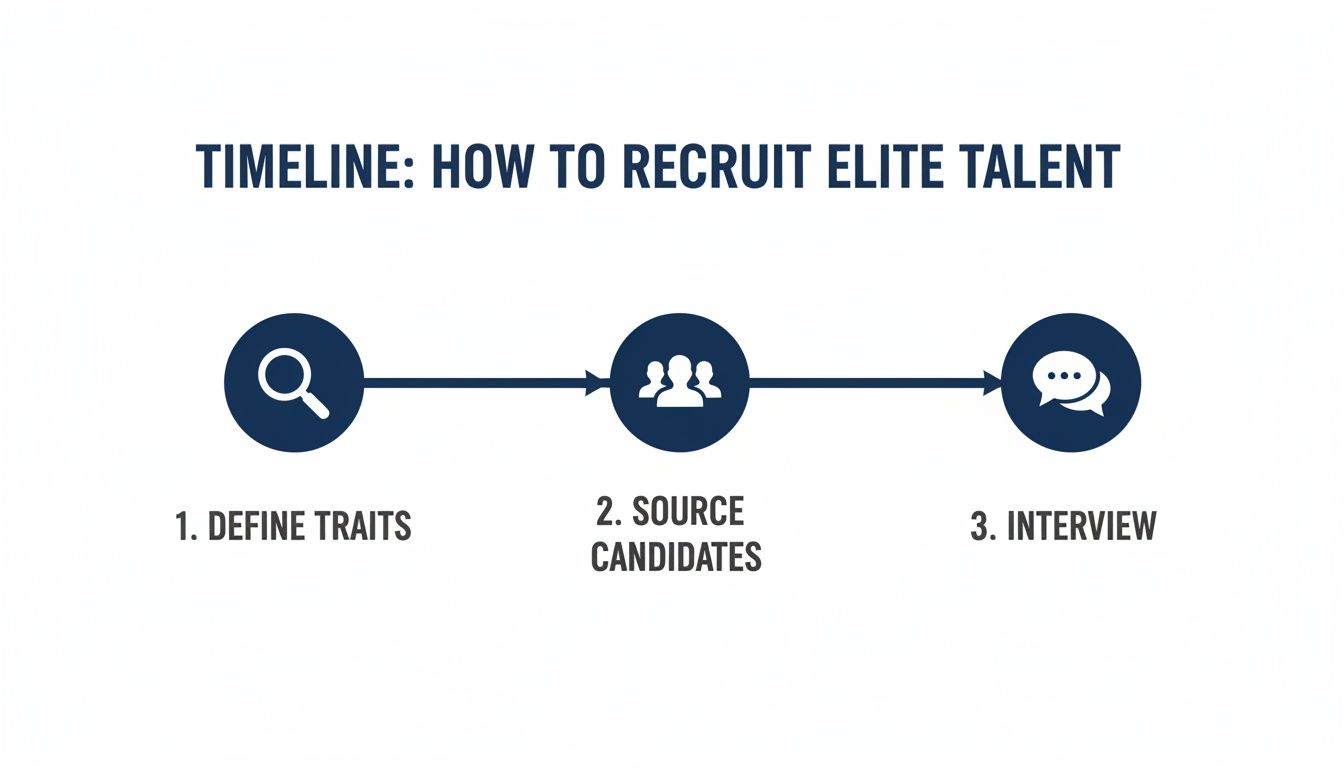
Having covered recruiting—defining traits, sourcing, and interviewing—we now focus on what happens after the offer is signed.
Days 1-30: Immersion and Enablement
The first month is dedicated to absorption. The goal is to fully integrate your new rep into the team’s ecosystem and arm them with the core knowledge they need to operate confidently.
- Tech Stack Mastery: Provide hands-on training for your CRM, communication tools like Slack, and sales intelligence platforms. By day 30, they should navigate these systems without assistance.
- Cultural Connection: Schedule a series of virtual coffee chats with key individuals from sales, marketing, and customer success. This builds the internal network they'll rely on for collaboration and problem-solving.
- Product and Market Fluency: Use a blend of self-paced learning modules and live sessions to cover your product, ideal customer profile (ICP), and the competitive landscape. Reinforce learning with brief assessments.
Key Insight: The first 30 days are less about performance and more about connection and competence. A rep who feels connected to the team and confident with their tools is set up for long-term success.
Days 31-60: Practice and Confidence Building
The second month is where knowledge translates into skill. This phase is centered on practice, feedback, and building the muscle memory required for high-stakes sales conversations.
- Virtual Shadowing: Have the new rep listen in on calls with top performers. Provide a checklist for observation, and schedule debrief sessions to analyze strategy and tactics.
- Mock Call Scenarios: Conduct role-playing exercises that simulate common objections and buying scenarios. AI-powered tools can provide instant feedback on pacing, clarity, and keyword usage.
- Initial Outreach Practice: Let them begin drafting outreach emails for practice accounts. This allows you to coach them on messaging and tone in a low-risk environment. To ensure new team members are fully integrated, it's wise to supplement your sales training with general employee onboarding best practices.
Days 61-90: Execution and Ramp-Up
In the final phase, the training wheels come off. The rep is now ready to apply their skills in a real-world setting with their first set of accounts and clear initial objectives.
They must transition from practice to active execution. This involves managing their first assigned accounts, using AI-generated account briefs to prepare for calls, and responding to real-time buying signals from your intelligence tools. The focus shifts to hitting initial activity metrics and building their first pipeline.
By the end of this period, your remote sales rep should be operating as a fully functional and contributing member of the team. A robust onboarding program is a cornerstone of a complete sales enablement strategy, which you can explore further in our comprehensive guide to building a sales enablement framework.
On a traditional sales floor, you could gauge the team’s energy by walking around. You knew who was hustling, who was on a great call, and who was stuck. For a remote sales team, that visibility is gone. You can no longer manage by presence; you must manage by performance.
This is your opportunity to shift your team's workflow from reactive to proactive—from guessing to knowing—by using real buying signals to guide their daily activities.
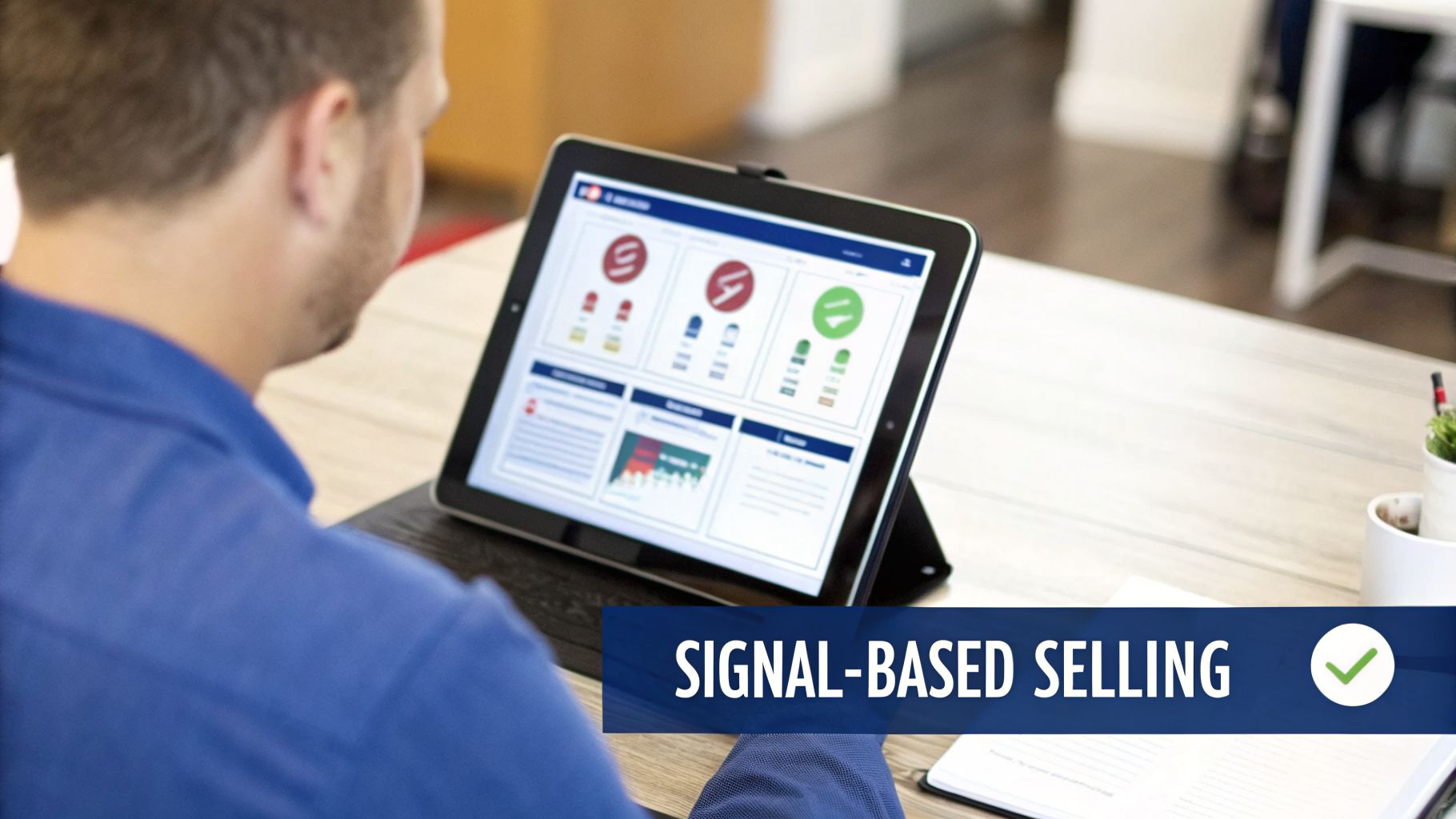
Imagine your best remote rep starting their day. Instead of staring at a static list in your CRM, they open a prioritized feed of real-time account alerts. This isn't a futuristic concept; it's the core of a modern, high-performing remote sales motion.
From Manual Research to Intelligent Alerts
Signal-based selling replaces hours of manual research with AI-powered precision. The system does the heavy lifting, surfacing the critical "why now" moments that provide a legitimate and compelling reason to reach out.
The right tech stack acts as a virtual research assistant, working 24/7.
These aren't just generic news clippings; they are curated, actionable triggers tied directly to your ideal customer profile. Here are a few powerful examples:
- Key Personnel Changes: "Acme Corp just hired a new VP of Operations. You sold to her at her last company." This transforms a cold call into a warm introduction.
- Strategic Growth Initiatives: "Zenith Inc.’s stock jumped after they announced a major expansion into the European market." This signals a need for scalable infrastructure.
- New Tech Adoption: "A job posting from Apex Industries mentions they are hiring a team to implement a new cloud data warehouse." This reveals a clear technology gap your solution can address.
This approach completely changes the daily workflow for your reps. It empowers them to focus their energy on accounts that are actively demonstrating intent, which skyrockets their efficiency and, more importantly, their results.
By arming your team with real-time buying signals, you shift their focus from "who should I call?" to "how should I approach this warm opportunity?" It’s a move from high-volume, low-relevance activity to targeted, high-impact engagement.
Turning Signals Into Compelling Outreach
The real magic happens when your reps learn to translate these signals into outreach that is impossible to ignore. This is the difference between a generic "just checking in" email that gets deleted and a conversation starter that demands a reply.
Let's break down how to use a signal effectively. Say your rep gets an alert: "Prospectus Corp just announced a $50 million Series C funding round to accelerate product development."
A weak outreach simply offers congratulations. A powerful, signal-based approach goes much deeper.
Here’s an email template that turns that signal into a meeting:
Subject: Congrats on the Series C - a question about scaling
"Hi [Contact Name],
Saw the exciting news about your $50 million funding round to speed up product development. Congratulations to the team at Prospectus Corp.
When we helped [Similar Customer Name] scale their engineering team after their Series B, they ran into unexpected challenges with [Problem X] and [Problem Y].
Is that something on your radar as you prepare for this next growth phase?
Best,
[Your Name]"
This email works for several reasons:
- Acknowledges the Signal: It immediately demonstrates you've done your homework.
- Demonstrates Relevance: It connects their funding to a specific, credible business problem.
- Builds Credibility: It name-drops a similar customer, providing instant social proof.
- Asks a Provocative Question: It opens a strategic conversation, not a sales pitch.
This level of personalization is nearly impossible to execute at scale manually, but it becomes the default for a remote team equipped with the right intelligence tools. You can go deeper on this strategy in our complete guide on what signal-based selling is and why it works. When you systematize relevance, you empower every rep to communicate like your absolute best performer.
Coaching and Scaling Your Distributed Sales Force
Coaching a remote sales team is a different discipline. You can’t swing by a desk to check in or rely on office chatter to gauge performance. You need a system—one that builds skills and drives results without adding another recurring meeting to everyone's calendar.
This is where an 'Asynchronous-First' coaching model provides a practical solution. It allows you to maximize the impact of every coaching interaction by separating feedback from live meetings, creating a more effective and scalable system.
The Asynchronous-First Coaching Model
Asynchronous coaching isn't about being hands-off; it’s about being more strategic with your time and your reps'. The concept is straightforward: review performance and share feedback on your own schedule, allowing your reps to digest it when they are best prepared to learn.
This model centers on two key activities:
- Reviewing Call Recordings: Use your conversation intelligence tool to analyze call recordings. Pinpoint specific moments where a rep excelled or struggled. Did they handle a tough objection perfectly? Tag it and praise them. Did they miss an opportunity to ask a critical discovery question? Highlight it with a quick, actionable note.
- Analyzing Outreach Data: Examine the performance of your outreach sequences. What are the open rates and reply rates? Which messages are booking meetings? This data reveals what's working far more effectively than raw activity numbers.
Deliver your feedback through a quick video recording or detailed notes directly in the CRM, linked to the specific call or account. This way, a rep can review your thoughts right before their next big call, not a week later when the context is lost.
Key Takeaway: Asynchronous coaching transforms feedback from a scheduled event into a continuous, contextual learning loop. It empowers reps to self-correct and improve on the fly, making every interaction a coachable moment.
Making Synchronous Meetings Strategic
When tactical feedback is handled asynchronously, your live 1:1 meetings become incredibly valuable. You can finally stop using this precious time for pipeline interrogations and basic activity reviews.
Instead, your synchronous time can be dedicated to high-value strategic work that moves deals forward. These meetings should now focus on:
- Complex Deal Strategy: Brainstorming how to navigate a difficult multi-stakeholder deal or break into a key target account.
- Career Growth and Development: Discussing long-term goals, new skills to acquire, and what they need to advance in their career.
- Removing Roadblocks: Identifying and solving the real obstacles preventing them from hitting their numbers.
This simple shift turns 1:1s from dreaded check-ins into collaborative, forward-thinking work sessions that both you and your reps will find valuable. Mastering this balance is a core skill for any modern sales leader, and you can explore different sales coaching methods that fit a remote environment to find the right blend for your team.
Seamless Scaling with Systems and AI
This coaching framework is the key to scaling your team without performance degradation. As you bring on new remote sales reps, AI-powered systems can handle the heavy lifting on prospecting, while your coaching model ensures everyone receives consistent, high-quality development.
The remote sales market is set to explode, projected to grow from $4.5 billion in 2025 to an incredible $150 billion by 2033. This massive growth is only manageable with the right technology, especially as leaders express concerns about their distributed teams. With 30% fearing a decline in culture and 29% admitting they lack effective ways to track productivity, the need for better systems is clear. Platforms that automate research, ensure consistent account planning, and deliver real-time alerts enable revenue teams to scale performance without being in the same room. For more details, you can read the full research about the remote sales market.
By systematizing your intelligence and coaching, you build a scalable engine for growth. New reps plug into a proven system from day one, and your ability to coach effectively expands with the team. This ensures that both performance and culture remain strong, no matter how large your distributed sales force becomes.

“The Business Development team gets 80 to 90 percent of what they need in 15 minutes. That is a complete shift in how our reps work.”
Andrew Giordano
VP of Global Commercial Operations, Analytic Partners
Your Top Questions About Managing Remote Sales Reps, Answered
Transitioning to a remote sales model raises valid questions. Even with the right strategy, leaders often worry about maintaining team culture, preventing productivity dips, and keeping everyone connected.
Here are direct, practical answers to the most common concerns for sales leaders building distributed teams.
How Do You Actually Maintain a Strong Sales Culture Remotely?
A great remote sales culture is not built on forced virtual happy hours. It is forged through shared success. The strongest bond a sales team can have is the feeling of winning together.
When your reps are hitting their numbers because they have the right tools and support, the culture reinforces itself.
Focus on these three pillars to build a culture that lasts:
- Total Transparency: Operate with radical transparency. Use shared dashboards where every KPI is visible to the entire team. Celebrate every win—big or small—in a public Slack channel. Momentum is contagious.
- Deliberate Connection: Schedule regular, non-work "virtual coffees" where the only rule is you cannot discuss deals. Critically, budget for an annual in-person kickoff. The relationships built face-to-face will fuel collaboration for the rest of the year.
- A System That Works: The ultimate culture-builder is a unified, effective selling system. When reps trust the playbook and see it driving tangible results, they feel part of a cohesive, successful machine.
What Are the Most Critical Tools for a Remote Sales Team?
Your tech stack should be a force multiplier, not just a collection of tools. It must automate low-value tasks and free your reps to do what they do best: sell. While every team's stack will differ slightly, a few components are non-negotiable.
The absolute essentials are:
- A CRM (like Salesforce) as your single source of truth.
- A Communication Hub (like Slack) for real-time collaboration.
- A Sales Engagement Platform (like Outreach or Salesloft) to structure and automate outreach.
However, the real game-changer for a remote team is a Sales Intelligence Platform. This is the "brain" that automates account research, flags buying signals, and drafts personalized outreach. It's the one piece of technology that shifts your team from being merely busy to being truly effective.
The cardinal sin of remote management is trying to digitally replicate the physical office. This leads to endless Zoom meetings, constant check-ins, and massive burnout. You must embrace an 'asynchronous-first' mindset.
Equip your team with tools that enable autonomy. Give them AI that delivers account briefs and outreach drafts on demand. Then, use your live meetings for high-value work like deal strategy and creative problem-solving. Trust your people, provide them with the best tools, and measure them on results.
How Can I Measure Productivity Without Micromanaging?
The secret is to measure outcomes, not just activity. In a remote environment, counting calls or emails is a fast track to micromanagement and anxiety. It tells you if your reps are busy, not if they are effective.
Instead, shift your focus to metrics that directly reflect the quality of their work.
Focus on KPIs like these:
- Signal-to-Meeting Rate: Of all the buying signals your reps receive, what percentage are they converting into qualified meetings?
- Pipeline Velocity: How quickly are deals moving through the sales stages?
- Average Deal Size: Is the quality of their outreach leading to larger, more strategic wins?
When your reps have AI agents feeding them opportunities and signals, accountability is built into the system. You can see which signals they act on and what the results are. Trust is built on systems that validate high performance, not on monitoring a status light in a chat application.
At Salesmotion, we deploy autonomous AI agents that transform real-time signals into actionable intelligence and ready-to-send outreach. Our platform eliminates manual research and ensures every rep can engage prospects with a compelling point of view, helping you turn account activity into measurable pipeline growth. Learn how Salesmotion can empower your remote sales reps.