Most advice on sales development rep training is backward.
It treats training like an event. Bring new hires in, run them through product slides, hand them a script, let them shadow a few calls, then push them onto the floor and hope repetition does the rest. That model is still common, and it’s one of the main reasons SDR teams stay inconsistent.
The better approach is to treat training as an operating system. Good SDRs don’t just memorize messaging. They learn how to research, prioritize, personalize, recover from rejection, and improve their execution week after week. That matters even more now because the job has changed. Reps need classic fundamentals, but they also need to work inside modern workflows that use AI-driven account intelligence to focus effort where it counts.
Sales development rep training works when it’s practical, continuous, and tied to live selling motion. It fails when it’s generic.
Why Most SDR Training Fails (And How Yours Won't)
The biggest mistake sales leaders make is assuming onboarding is training.
It isn’t. Onboarding introduces the job. Training builds the capability to do it well under pressure, consistently, with judgment. Those are different things, and the gap between them is where most SDR teams lose time, confidence, and pipeline.
What I see in most companies: everybody goes through the enablement boot camp. Lots of slides, here is our culture, here is our product. Meanwhile the rep's quota clock is already running.
The cost of getting this wrong is not subtle. High-performing teams achieve a 353% ROI on training investments, yet 46% of companies fail to provide training beyond initial onboarding, contributing to 20% of reps leaving within their first 45 days due to poor training or unclear expectations, according to Hyperbound’s sales training statistics roundup.
The firehose model breaks fast
Most weak programs follow the same pattern:
- Too much product detail: New reps get flooded with features before they understand buyer problems.
- Generic scripting: Teams teach lines to repeat instead of situations to recognize.
- No reinforcement: Once initial sessions end, managers move back to forecast calls and deal pressure.
- No workflow training: Reps are told to personalize, but nobody shows them how to do it at scale.
That last one matters more than many leaders admit. A rep can sound confident in role-play and still fail in production if they can’t turn account context into relevant outreach. That’s where modern training programs need to evolve.
What actually sticks
Training sticks when three things are true:
| Condition | What it looks like in practice | What happens if it’s missing |
|---|---|---|
| Relevance | Reps learn through real accounts, real personas, and real triggers | Training feels theoretical and gets ignored |
| Reinforcement | Managers coach weekly, review calls, and inspect application | Reps revert to old habits quickly |
| Resilience | Teams train recovery, not just execution | Reps tighten up after rejection and performance gets streaky |
Practical rule: If a rep can't explain why they’re reaching out to this account now, they are not ready to prospect on their own.
A strong sales development rep training program is less about teaching “the perfect opener” and more about building repeatable judgment. That means teaching reps how to identify a credible reason to engage, shape a point of view, and adjust based on what the buyer gives back.
Build a system, not a bootcamp
The teams that improve fastest usually stop asking, “Did we train them?” and start asking, “What behavior are we reinforcing every week?”
That shift changes everything. Product knowledge becomes situational. Messaging becomes account-aware. Coaching becomes part of the manager’s job, not a side activity. Reps stop acting like list processors and start acting like commercial operators.
Buyers describe the same shift in their own words. A RevOps lead at a software firm told us: "our salespeople, they have to work more like consultants."
That’s the standard worth building toward.
See Salesmotion in action
Take a self-guided interactive tour — no signup required.
The Onboarding Blueprint Your First 30 Days
The first month decides whether a new SDR feels clear or overwhelmed.
Week one is overloaded, week two is under-coached, and output is expected by week three. That’s how you create fake readiness. The rep can recite positioning but still freezes when they need to write a first-touch email or make a live call.
A better first month builds confidence in layers. The rep should understand the business, learn the buying context, master the workflow, and then apply it in supervised reps before they carry a full book.
The sequence matters
Sales development reps spend just 30% of their workweek on core selling activities, while 70% is consumed by non-selling tasks like manual research and data entry, according to SalesHive’s overview of the SDR role. That’s why onboarding has to attack wasted motion immediately. If you wait until later to teach research discipline, prioritization, and tool usage, you bake bad habits into the role.
Here’s the schedule I’d use.
| Week | Focus Area | Key Activities & Learning | Tech Integration |
|---|---|---|---|
| Week 1 | Business immersion | Company story, market category, customer problems, basic process, CRM hygiene, meeting standards, call shadowing | Set up core systems, communication tools, CRM, sequencing platform |
| Week 2 | ICP and account understanding | Persona training, industry patterns, competitor context, account brief writing, discovery of business pain | Use the Research Agent to generate structured account briefs and compare them to manual notes |
| Week 3 | Outreach activation | Email writing, cold call frameworks, social touches, objection basics, daily practice blocks | Use the Outreach Agent to draft personalized sequences from real account intelligence |
| Week 4 | Supervised production | Live call blocks, manager-reviewed emails, list prioritization, account planning, certification | Use signal monitoring to choose active accounts and coach timing, relevance, and next steps |
Week one should calm people down
The first week isn’t about volume. It’s about orientation and standards.
New reps need to understand four things quickly:
- Who the company helps
- What problems buyers care about
- How your team defines a good outbound motion
- What good execution looks like day to day
Skip the product deep dive at this stage. Give enough context so they can follow conversations, but spend more time on buyer language than internal jargon. Have them listen to calls, read winning emails, and sit in on team huddles.
If your SDRs are remote, make the workflow explicit. Don’t assume they’ll “pick it up.” A practical guide to managing remote sales reps helps frame the habits that keep distributed teams aligned, especially around visibility, coaching access, and daily operating rhythm.
New reps don’t need more information in week one. They need less confusion.
Week two is where account intelligence starts
Many programs still rely on old habits. Reps get a persona deck, maybe a few industry notes, then they’re told to “research accounts.”
That instruction is too vague.
Train them to build an account view with structure. They should be able to answer:
- What is this company likely trying to achieve
- What changed recently
- Which stakeholders probably care
- Where does our solution connect to those priorities
- What would make outreach timely
This is the right point to introduce the Research Agent. Not as a shortcut, but as a standard. Reps should compare their own account notes against the agent’s structured brief and learn what they missed. That creates judgment, not dependency.
Week three should feel like a workshop, not a lecture
Now the rep starts converting research into outreach.
This week should include:
- Email teardown sessions: Review weak emails and rewrite them live
- Cold call practice: Use real accounts, not made-up companies
- Sequence construction: Build touch patterns tied to account context
- Daily manager review: Inspect messaging before launch
The Outreach Agent helps here because it gives reps a usable first draft anchored to actual account signals and priorities. The manager’s job is still essential. They should review whether the message sounds specific, credible, and worth responding to.
Week four is controlled exposure
Week four is not “good luck.”
It’s supervised production. Give the rep a small patch, narrow the target accounts, and inspect everything. A new SDR should spend this week with tight loops between action and feedback.
Use a simple live-fire rhythm:
- Morning planning: Pick accounts and define outreach angles
- Midday execution: Calls, emails, follow-ups
- Afternoon review: Inspect what was sent, what landed, and what needs adjustment
That structure reduces anxiety and speeds up pattern recognition. By the end of the month, the rep shouldn’t know everything. They should know how to work.

“The talking points are gold. If they're in Salesmotion, I know they're being discussed inside that business. That makes it easy to spark a real conversation, which is 90 percent of the battle.”
Andrew Giordano
VP of Global Commercial Operations, Analytic Partners
Building the Core SDR Training Curriculum
Once onboarding ends, the core sales development rep training begins.
Many teams falter at this point. They had a launch plan, but not a curriculum. Without one, managers coach whatever is noisy that week. One rep gets help on calls, another gets feedback on email, a third gets nothing because they look busy. That isn’t development. That’s improvisation.
A durable curriculum gives every SDR the same core foundation while still leaving room for individual coaching.
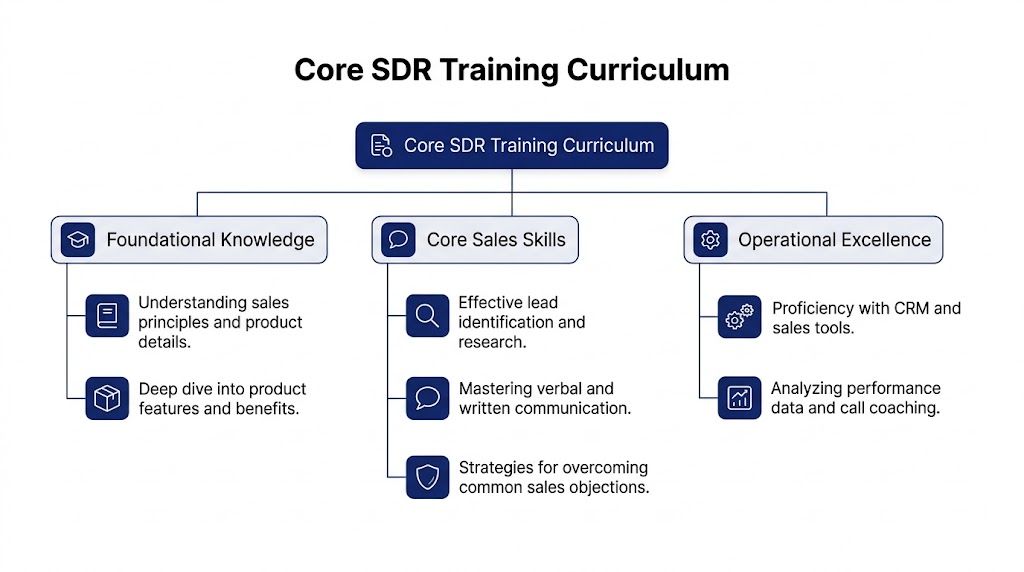
Pillar one Product and market intelligence
The first pillar is not product training in the usual sense.
Weak teams teach reps what the platform does. Strong teams teach reps how to connect what the platform does to what the account is trying to change. That difference shapes every outbound message that follows.
The Research Agent is useful here because it helps reps build a business-level view of the account. Instead of scraping disconnected notes from LinkedIn, press releases, and job posts, they can work from a synthesized brief that highlights initiatives, risks, stakeholder context, and likely relevance.
Teach reps to answer these questions before they write a word:
- What business motion is visible in this account
- Why would that create pain, urgency, or opportunity
- Which persona is most likely to care first
- What point of view can we credibly bring
A good curriculum turns research from a scavenger hunt into a decision-making process.
Pillar two Point-of-view messaging
Generic personalization is one of the biggest wastes of time in outbound.
Adding a sentence about a funding round or a recent hire isn’t enough if the message still sounds like every other vendor email. Reps need to learn how to convert a trigger into a point of view. That means explaining why the event matters, why the buyer should care, and why your team is reaching out now.
The Signal Agent should be integrated into training, not just execution. The agent surfaces changes worth acting on, but the rep still has to interpret them well.
Gartner predicts a 40% SDR productivity boost from AI agents by 2025, yet a critical training gap exists, with most programs failing to teach reps how to integrate real-time AI signals into hyper-personalized outreach, according to Salesloop’s analysis of SDR training.
That gap is real. Teams buy intelligence tools and still send bland outreach because nobody trained the reps on signal interpretation.
A practical messaging framework looks like this:
| Signal type | Weak message | Stronger point of view |
|---|---|---|
| Executive hire | Mentions the hire and asks for time | Connects leadership change to likely operational priorities |
| Expansion move | Notes growth in generic terms | Links expansion to complexity, scale, or process strain |
| New initiative | Repeats the company announcement | Explains where execution often breaks and why it matters now |
For teams refining copy, good external examples can help. I like reviewing practical libraries of cold email best practices because they force reps to think about specificity, clarity, and relevance instead of template tricks.
The best SDR messages don't prove the rep did research. They prove the rep understands why the research matters.
Pillar three Multi-channel prospecting
Many organizations say they run multi-channel. Fewer train it well.
What usually happens is this: email gets all the strategic thinking, calls become a volume exercise, and social touches are random. A proper curriculum teaches orchestration. The channel choice should follow the account context and the buyer’s likely attention pattern.
Here’s what to train:
- Calls for interpretation: Use phone when a signal creates a timely reason to ask a smart question
- Email for precision: Use written outreach when context needs to be framed clearly
- Social for familiarity: Use it to reinforce relevance, not to spray low-value comments
The point isn’t to force every rep into the same cadence. The point is to teach why one touch should follow another.
If you’re documenting this as a system, a useful reference on sales training methodologies can help teams formalize how skills are taught, observed, and reinforced over time.
Pillar four Strategic objection handling
Objection handling is often taught as theater.
Reps memorize rebuttals, wait for the cue, then fire off a line. Buyers can hear that instantly. It sounds defensive because it is.
Train objections as diagnosis. The rep’s first task is to understand what the pushback means in context.
A few examples:
- “Not a priority” can mean bad timing, weak relevance, or no internal sponsor
- “Send me something” can mean polite dismissal, curiosity, or interest without enough context
- “We already have a solution” can mean satisfaction, switching cost concern, or internal politics
The rep needs enough account context to pick the right follow-up path. That’s why objection training should use live account intelligence. If the company just made a strategic hire, launched an initiative, or signaled expansion, the rep can frame a sharper follow-up than someone reciting a canned line.
That’s what a modern curriculum should produce. Not polished actors. Operators who can read a situation and respond like professionals.
Activating Skills with Role-Plays and Coaching
Training that stays in the LMS dies in the LMS.
Reps don’t improve because they watched a lesson. They improve because they practiced a scenario that felt real, got specific feedback, then ran the next version better. That’s the bridge between knowing and doing, and many still underinvest in it.

Use live context in practice
Generic role-plays create generic reps.
If the scenario is “You’re calling a VP of Operations at a software company,” the rep learns almost nothing about timing, judgment, or message construction. Use real accounts and current triggers instead. A company hired a new CRO. A target account expanded into a new market. A buyer posted publicly about a process problem. Those are situations reps face.
That’s where the Signal Agent becomes a coaching input. Pull a real trigger, assign a persona, and ask the rep to write the email, open the call, and handle the first brush-off. The practice gets sharper because the context is sharper.
Coaching has to be scheduled, not aspirational
Reps forget 87% of sales training content within a month without reinforcement. Consistent, manager-led coaching is the single biggest driver of application, contributing to 57% of sales increases, according to The Sales Collective’s training statistics summary.
That matches what most good sales floors already know. If managers only coach when a rep is missing target badly, the team never develops consistent habits.
A useful weekly rhythm looks like this:
| Coaching moment | What manager reviews | What rep should bring |
|---|---|---|
| Call review | Opener, relevance, question quality, objection response | One recorded call and self-assessment |
| Message review | Specificity, timing, credibility, CTA strength | Recent emails or sequence steps |
| Account huddle | Prioritization logic and next-action planning | Active accounts with visible triggers |
| Skill drill | One narrow competency such as openers or follow-up | A revised version after feedback |
A more detailed view of sales coaching methods is useful if you’re trying to make manager coaching more systematic across a team.
Coaching works best when the rep knows exactly what is being evaluated before the practice starts.
Certify the work, not the attendance
A lot of teams certify presence. They should certify competence.
Don’t sign off because someone completed modules. Sign off because they can do the work in realistic conditions. That means setting clear pass criteria for key skills such as account briefing, signal interpretation, first-touch email writing, cold call opening, and objection response.
Use a simple scorecard:
- Context quality: Did the rep identify a credible reason to engage?
- Message relevance: Did they connect the context to buyer priorities?
- Execution clarity: Did they communicate clearly and directly?
- Recovery ability: Could they adjust when the conversation shifted?
Those standards reduce ambiguity for everyone. Reps know what “good” means. Managers coach against visible criteria. Team leaders spot weak spots early.
Make feedback narrow and immediate
The worst coaching sounds like this: “You need to be more consultative.”
That’s too broad to apply.
Better coaching sounds like this:
- On the opener: Lead with the trigger, not your company
- On the question: Ask about the operational implication, not just whether they saw the change
- On the objection: Slow down and clarify whether the issue is timing or relevance
- On the close: Ask for the next step directly and make it easy to accept
That kind of feedback changes behavior because the rep can use it on the next attempt. The goal isn’t a brilliant debrief. The goal is a better next rep.

“All of the vendors that I've worked with, all of the onboarding that I have had to deal with, I will say, hands down, Salesmotion was the easiest that I have had.”
Lyndsay Thomson
Head of Sales Operations, Cytel
Measuring Success with KPIs and Ramp Plans
Most SDR training programs are judged too late.
Leaders wait for meeting volume or pipeline contribution, then decide whether a rep is “working out.” By then, you’ve already lost time. Good measurement starts earlier, with indicators that show whether the rep is building the right habits.
That matters because performance problems are usually visible before they show up in quota attainment. A rep who can’t prioritize accounts, can’t turn account intelligence into outreach, or can’t recover after rejection will eventually miss target. You can see those issues much sooner if you track the right things.
Use a 30 60 90 ramp plan that reflects real work
A strong ramp plan mixes activity, effectiveness, and behavioral evidence. It doesn’t just ask whether the rep is busy. It asks whether the rep is becoming commercially useful.
Here’s a practical model.
| Ramp window | Focus | What to inspect |
|---|---|---|
| First 30 days | Workflow adoption and message quality | Account research quality, relevance of drafts, tool usage, call readiness |
| Next 30 days | Controlled execution | Quality of launched sequences, live call consistency, follow-up discipline, prioritization |
| Next 30 days | Independent contribution | Meeting creation consistency, account progression, judgment on next actions, self-correction |
Notice what’s missing. Vanity activity targets without context.
Instead, inspect leading indicators such as:
- Accounts researched with an AI agent
- Signal-based sequences launched
- Manager-approved first-touch messages
- Calls reviewed and revised after feedback
- Playbook usage by trigger type
Those indicators tell you whether the rep is adopting the system you trained.
For teams building a more disciplined measurement framework, it helps to align the ramp plan to broader sales enablement metrics so training outcomes connect back to team performance.
Build a living playbook
Most playbooks fail because they’re static.
A useful playbook is closer to a field manual. It should contain tested patterns tied to actual situations your SDRs encounter. Not generic “email templates,” but specific plays such as how to approach an executive hire, a hiring spike, a strategic expansion, or a public initiative shift.
A good playbook includes:
- Trigger type
- Who to contact first
- Likely buyer concern
- Suggested email angle
- Suggested call opener
- Common objections
- Best follow-up path
If your team uses structured readiness tools, sales readiness platforms like Mindtickle can support certification, reinforcement, and content governance. The point isn’t the platform itself. The point is making sure your best patterns become teachable and repeatable.
A playbook should help a rep make a better decision on a live account today. If it can't do that, it's documentation, not enablement.
Measure resilience like it matters
This is the part many teams skip.
SDR turnover often exceeds 35% annually, driven more by burnout and stress than skill gaps. Yet, most training programs completely overlook mental resilience, a practice that can yield up to 25% higher quota attainment, according to Trellus on SDR training.
That should change how leaders design training. Resilience is not a side topic for wellness week. It’s a job skill. SDRs hear no constantly, work under visible pressure, and often operate in repetitive cycles. If you don’t train recovery, you train fragility.
Practical ways to build resilience into the program:
- Normalize reset routines: After a bad call block, reps should know exactly how to regroup
- Coach emotional patterns: Managers should ask what the rep is hearing, not just what they sent
- Use peer debriefs: Let reps swap what worked after rough stretches
- Protect early confidence: Don’t give new hires a chaotic patch with no signal quality or support
You don’t need to make this soft or abstract. Make it operational. A rep who can recover quickly protects output. A rep who spirals after rejection doesn’t.
Judge the program by trend, not mood
Training success should show up as cleaner execution from each new cohort, stronger early consistency, and better retention across time.
If your newest reps still struggle with relevance, still waste time on bad-fit accounts, and still rely on manager rescue in live situations, the issue isn’t effort. The issue is the training system.
That’s fixable. But only if you measure the work closely enough to see it.
From Training Program to Pipeline Engine
A serious sales development rep training program is not overhead. It’s pipeline infrastructure.
When teams rely on one-time onboarding, generic scripts, and ad hoc coaching, performance stays uneven. Some reps figure it out. Most don’t. That’s not a scalable model for enterprise growth.
The stronger model is continuous, intelligence-driven, and manager-enforced. Reps learn how to work accounts, not just touch them. They build messages from real context. They practice with live scenarios. They get coached on execution, not just activity. They follow a ramp plan that measures behavior before results lag.
Modern tools make that system faster and more consistent. They don’t replace the rep. They remove the dead time, sharpen prioritization, and give managers better inputs for coaching. The human work still matters most. Judgment, relevance, tone, persistence, and recovery are still human skills.
But the teams that combine those skills with AI-driven account intelligence will build pipeline with more consistency than teams still training for a world of static lists and generic templates.
That’s the difference between having SDRs and building a pipeline engine.
Frequently Asked Questions
How does this training plan adapt for a small vs. a large enterprise SDR team?
The principles stay the same. Smaller teams usually run the program through the frontline manager, with more informal daily huddles and tighter feedback loops. Larger teams can add structured certifications, peer mentors, and dedicated enablement support. What shouldn’t change is the emphasis on account intelligence, reinforcement, and live coaching.
What’s the best way to measure long-term ROI?
Track trend lines across cohorts. Look at time to first meaningful output, quality of outreach during ramp, early meeting creation consistency, and retention over time. Compare the current system against your prior baseline. The goal is not just more activity. It’s faster readiness, better execution, and stronger durability.
How do you keep training content and playbooks from getting stale?
Review them on a regular cadence with managers and top performers. Pull apart what’s landing, what objections are showing up more often, and which trigger-based plays still feel relevant. The best playbooks evolve from live account work, not classroom theory.
If you want to operationalize this kind of training model with AI-driven account intelligence built into daily rep workflows, take a look at Salesmotion. It helps sales teams turn research, signals, and personalized outreach into a repeatable system, so SDRs spend less time stitching context together and more time starting relevant conversations.