Every enterprise prospect receives 100+ vendor emails per week. Most of those emails talk about features, integrations, and AI capabilities. Almost none of them answer the only question the buyer actually cares about: "What's this worth to my business?" Value selling is the methodology that makes that answer the center of every conversation. Instead of leading with what your product does, you lead with the measurable business outcomes it creates. Instead of selling features, you sell the gap between where the buyer is now and where they could be, quantified in dollars, hours, or percentage points they care about.
TL;DR: Value selling shifts the conversation from product capabilities to business outcomes. The framework has four stages: discovering the buyer's business impact (what the problem costs them), quantifying the value of solving it (ROI modeling), aligning stakeholders around the business case (consensus building), and reinforcing value post-sale (retention and expansion). The methodology is most effective for deals above $50K where buyers need internal justification and multiple stakeholders must agree on the investment.
What Value Selling Actually Means
Value selling is not saying "our product delivers great value." That's marketing. Value selling is a structured methodology where every sales conversation quantifies the economic impact of the buyer's current problem and the financial return of solving it with your solution.
The shift in practice:
| Feature Selling | Value Selling |
|---|---|
| "Our platform integrates with 50+ tools" | "Your team spends 3 hours/day switching between tools. Integration eliminates that, giving each rep 15 hours/week back for selling" |
| "We use AI to generate insights" | "Your reps research 5 accounts/day manually. AI research covers 50 accounts in the same time, tripling your pipeline coverage" |
| "We have the most comprehensive database" | "Your current data accuracy is ~70%. Our 95% accuracy eliminates 250 bounced emails/month, improving deliverability scores and response rates by 30%" |
The difference isn't cosmetic. Feature selling asks the buyer to connect the dots between capability and benefit. Value selling does that work for them with specific, quantified outcomes.
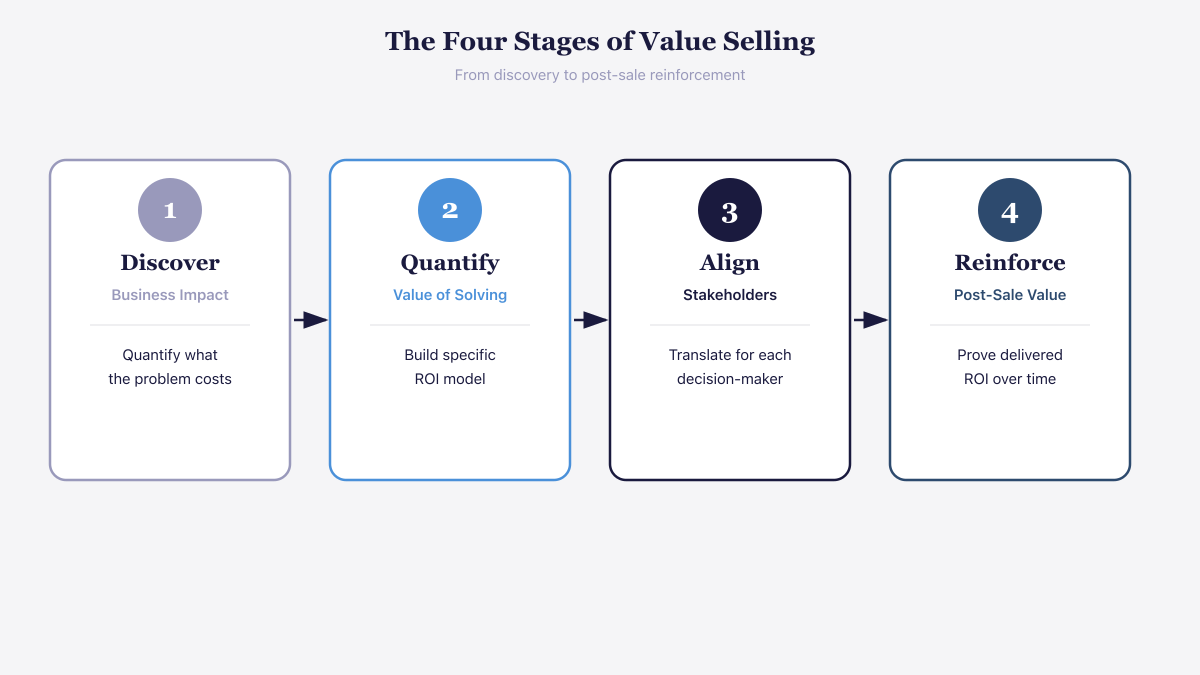 The four stages of value selling: discover the business impact, quantify the value of solving, align stakeholders around the business case, and reinforce value post-sale.
See Salesmotion on a real account
Book a 15-minute demo and see how your team saves hours on account research.
The Four Stages of Value Selling
Stage 1: Discover the Business Impact
Before you can sell value, you need to understand what the problem costs the buyer. This requires quantitative discovery, not just qualitative.
Quantitative discovery questions:
- "How many hours per week does your team spend on [activity your solution addresses]?"
- "What's the cost per hour of a rep's time, fully loaded?" (Usually $75-150 for mid-market AEs)
- "How many accounts can each rep realistically cover per quarter with current tools?"
- "What's your current win rate? What do you think it should be?"
- "What's the revenue impact of each percentage point improvement in win rate?"
The math matters. If a buyer tells you reps spend 15 hours per week on manual research and you have 20 reps at $100/hour fully loaded, that's $30,000 per week ($1.56M per year) spent on research instead of selling. That number is the foundation of the value case.
Here's the practical advantage: Salesmotion generates one-click account briefs that surface company financials, strategic priorities, leadership changes, and competitive landscape before your discovery call. Instead of walking in blind and hoping the buyer reveals quantifiable pain, you arrive with specific hypotheses: "Based on your earnings call, your CEO committed to 30% revenue growth, but you've only added 5 reps. That math suggests you need 3x more productivity per rep." Pre-call account intelligence turns discovery from exploration into validation.
Stage 2: Quantify the Value of Solving
Build a specific ROI model for each opportunity using the data gathered in discovery.
A basic value model template:
| Value Driver | Current State | With Solution | Annual Impact |
|---|---|---|---|
| Research time per account | 3 hours | 15 minutes | Save 2.75 hrs × 500 accounts × $100/hr = $137,500 |
| Accounts covered per rep | 30/quarter | 80/quarter | 167% more coverage → proportional pipeline growth |
| Win rate improvement | 22% | 28% | 6 points × $10M pipeline = $600K additional revenue |
| Signal response time | 5-7 days | Same day | 3x higher meeting rate on triggered outreach |
| Tool consolidation | 5 tools at $2K/month each | 1 platform | $96,000/year in tool cost savings |
Total quantified value: $833,500+ per year for a mid-size sales team.
The numbers must be defensible. Use the buyer's own data (from discovery) supplemented with industry benchmarks and customer proof points. Overinflating value destroys credibility.
Stage 3: Build Stakeholder Consensus Around the Business Case
In enterprise deals, the person who experiences the pain isn't always the person who approves the budget. Value selling requires translating the value case into language each stakeholder cares about:
For the end user (User Buyer): Lead with time savings and workflow improvement. "You'll get 2.75 hours back per account, which means you can cover 2.5x more accounts per quarter without working longer hours."
For the technical evaluator (Technical Buyer): Lead with integration, security, and maintenance. "The platform integrates natively with Salesforce, reducing your team's integration maintenance burden and eliminating the data sync issues you mentioned."
For the economic buyer (CFO/VP): Lead with the financial model. "Based on your team's data, the platform generates $833K in annual value against a $120K investment. That's a 6.9x return with payback in under 60 days."
For the champion: Equip them with an internal business case document they can share with peers and leadership. Include the quantified value, risk mitigation, and implementation timeline in a format that survives forwarding through email chains and Slack threads.
Stage 4: Reinforce Value Post-Sale
Value selling doesn't end at the contract signature. Post-sale value reinforcement drives retention and expansion.
First 30 days: Confirm baseline metrics. Document the "before" state so you can demonstrate improvement.
90-day review: Present actual vs. projected value. Show the buyer that the $833K value case is tracking to reality with specific data points.
Annual business review: Quantify total value delivered and present expansion opportunities anchored to additional value drivers.
This post-sale value tracking is what turns value selling from a closing technique into a retention and expansion engine.

“The talking points are gold. If they're in Salesmotion, I know they're being discussed inside that business. That makes it easy to spark a real conversation, which is 90 percent of the battle.”
Andrew Giordano
VP of Global Commercial Operations, Analytic Partners
Value Selling in Practice: When Prospects Push Back
"We're happy with the status quo"
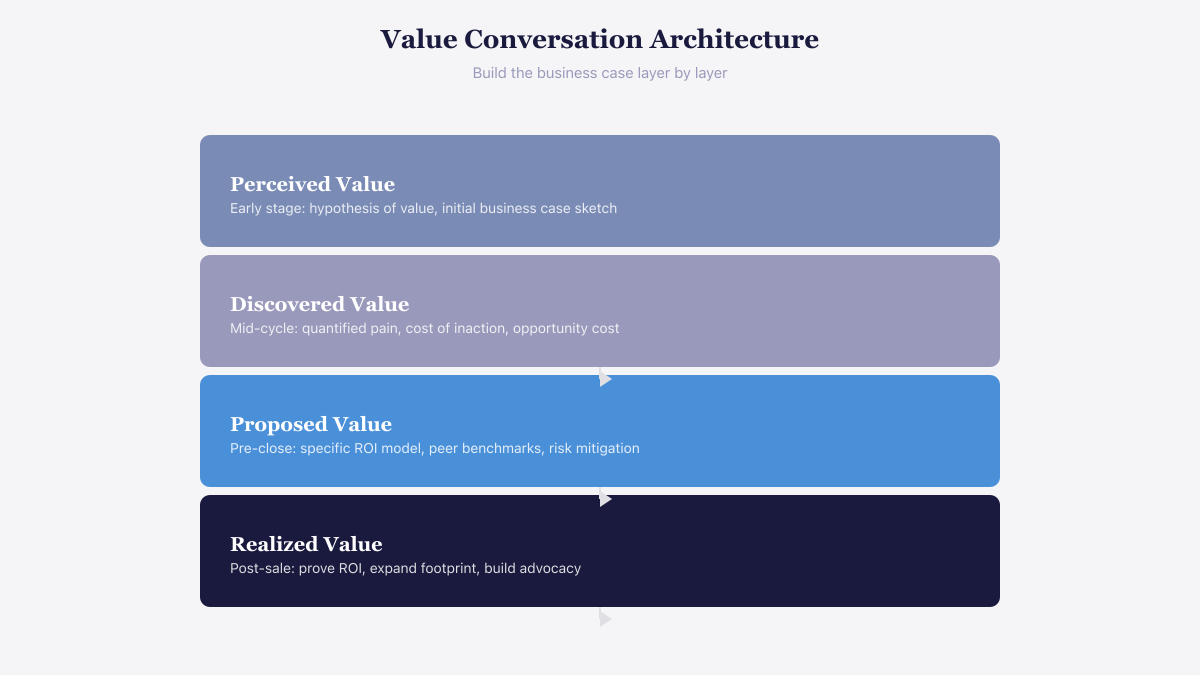 Build the business case progressively from initial hypothesis through discovery to proven ROI.
This is an Even Keel response. The buyer doesn't see a problem. Value selling addresses it by quantifying the hidden cost of the status quo.
"I understand. Many of the teams we work with felt the same way until they quantified the time cost. When we ran the numbers with [reference customer], they discovered their reps were spending $1.5M/year worth of selling time on manual research they assumed was just 'part of the job.' Would it be worth 15 minutes to see if your team has a similar hidden cost?"
"Your competitor is cheaper"
Value selling reframes price discussions from cost comparison to ROI comparison.
"If the question is which tool costs less, [Competitor] wins. If the question is which tool generates more revenue for your team, the comparison changes. [Reference customer] evaluated both and chose us because the additional $30K/year delivered $400K in pipeline value that [Competitor] couldn't match. Would it be useful to run that same analysis for your team?"
"We need to think about it"
This usually means the value case hasn't been built strongly enough for internal justification. Respond by strengthening the business case.
"Absolutely. To help with the internal conversation, I can prepare a business case document with the specific numbers we discussed — the $833K annual value, the 60-day payback, and the risk mitigation plan. Who else will be part of that conversation, and what metrics matter most to them?"
Value Selling + Salesmotion in Practice
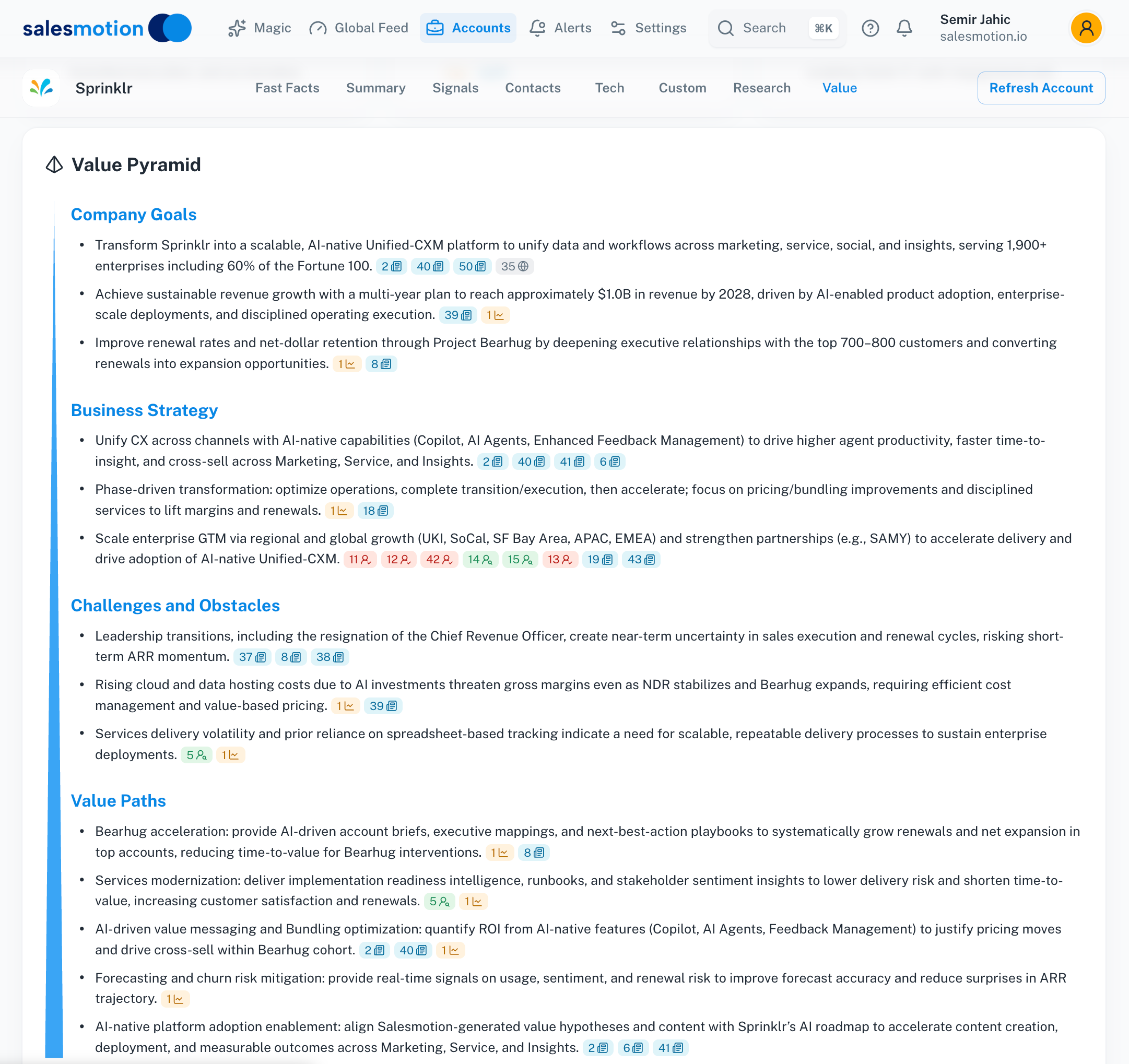 A value pyramid maps your solution's capabilities directly to the account's strategic priorities, giving reps a structured framework for quantifying business impact in every conversation.
Here's how the four-stage value selling framework works when reps have automated account intelligence.
The scenario: An AE is preparing for a first call with a VP of Sales at a 200-person SaaS company.
Stage 1 (Discovery prep): Before the call, Salesmotion's account brief surfaces three key data points: the company's recent earnings call mentioned "improving sales efficiency" as a top-3 priority, they've posted 8 new AE roles in the past 30 days (scaling the team), and their current tech stack includes three separate research tools based on job posting requirements. The rep now has specific hypotheses to test on the call instead of generic questions.
Stage 2 (ROI modeling): During discovery, the prospect confirms their reps spend 2-3 hours per account on manual research. With the scaling data from the account brief (8 new hires + 15 existing reps = 23 total), the rep builds a live ROI model: 23 reps × 12 hours/week × $100/hour = $119,600/month in research time. Even a 50% reduction represents $59,800/month in recovered selling capacity.
Stage 3 (Stakeholder alignment): The account brief identifies the CFO and CRO as likely additional stakeholders. The rep prepares stakeholder-specific value cases before being asked for a "next meeting with leadership," accelerating deal velocity because the business case is ready before the internal champion asks for it.
Stage 4 (Post-sale reinforcement): After implementation, the 90-day review shows the team reduced research time by 85% (consistent with Analytic Partners' results), giving the AE concrete proof points for the annual business review and expansion conversation.
The value selling framework is powerful. The bottleneck is always the research that feeds it. When that research is automated, reps build stronger value cases in less time, and the methodology scales across the entire team instead of only working for the two reps who actually do their homework.

“Salesmotion empowers me to cultivate a great buyer experience. I'm able to challenge prospects' thinking and be a trusted consultative seller. A major part of this is Salesmotion insights.”
Austin Friesen
Account Executive, FY25 #1 President's Club, Clari
Key Takeaways
- Value selling shifts conversations from features to quantified business outcomes. The buyer should never have to guess what your solution is worth to their organization.
- Discovery must be quantitative, not just qualitative. Knowing the buyer "has a problem with research time" is less actionable than knowing "20 reps spend 15 hours/week on manual research at $100/hour fully loaded."
- Build specific ROI models for each opportunity using the buyer's own data. Generic ROI claims don't survive procurement and CFO scrutiny.
- Translate the value case for each stakeholder: time savings for users, integration efficiency for technical buyers, financial returns for economic buyers.
- Equip champions with shareable business case documents that quantify value, address risks, and include implementation timelines. Deals die when the value case can't be explained by your champion to their peers.
- Continue value selling post-sale through 30/90/annual reviews that demonstrate actual vs. projected outcomes. This drives retention and expansion revenue.
Frequently Asked Questions
What is value selling in B2B sales?
Value selling is a sales methodology that centers every buyer conversation on quantified business outcomes rather than product features. Instead of describing what your product does, you calculate what it's worth to the specific buyer based on their data: time savings, revenue impact, cost reduction, and efficiency gains. The methodology includes quantitative discovery, ROI modeling, stakeholder-specific value communication, and post-sale value reinforcement.
When should you use value selling?
Value selling is most effective for deals above $50K ACV where the buyer needs to build an internal business case and get approval from multiple stakeholders. For smaller deals with a single decision-maker, the overhead of building a full ROI model may exceed its benefit. However, the principles (quantifying outcomes, speaking to each stakeholder's priorities) apply at every deal size. The formality of the value model should scale with deal size and buyer complexity.
How do you calculate ROI in a sales conversation?
Start with discovery: identify the specific problem, how much time or money it costs, and how many people it affects. Then model the improvement: how much time or money does your solution save, and how does that translate to business outcomes? The formula is typically: (Annual value of improvement - Annual cost of solution) ÷ Annual cost of solution = ROI percentage. Use the buyer's own numbers whenever possible. Supplement with industry benchmarks and customer case study data where the buyer lacks specific metrics.
What's the difference between value selling and solution selling?
Solution selling focuses on matching product capabilities to the buyer's stated needs — understanding the problem and proposing a solution that fits. Value selling goes further by quantifying the financial impact of both the problem and the solution. A solution seller might say "our platform solves your research bottleneck." A value seller would say "your research bottleneck costs your team $1.5M/year in lost selling time, and our platform reduces that cost by 85%, generating a 7x return on your investment." Value selling builds on solution selling by adding the quantification layer.