Intent data is behavioral information that indicates a company is actively researching a product category, business problem, or specific solution. When employees at a target account suddenly start reading articles about "CRM alternatives," visiting vendor comparison pages, and downloading buyer's guides, that pattern signals purchasing intent before anyone fills out a contact form or requests a demo.
TL;DR: Intent data tracks online research behavior to reveal which accounts are actively in a buying cycle. It comes in three types: first-party (your own website activity — most reliable), second-party (review sites like G2), and third-party (web-wide content consumption via Bombora, 6sense, etc.). The best teams layer all three types together, treat intent as one signal among many, and combine it with account intelligence for context on why an account is surging. For a comparison of top vendors, see our intent data providers guide.
For B2B sales teams, intent data answers the question CRM records alone cannot: which of your target accounts are in a buying cycle right now?
How Does Intent Data Work?
At its simplest, intent data tracks content consumption and compares it against a baseline. If an account that normally reads zero articles about "sales intelligence" suddenly consumes fifteen in a single week, something has changed inside that organization. Maybe they hired a new CRO. Maybe a contract is up for renewal. Maybe the board is pushing for change after a bad quarter.
The technical pipeline behind most intent data platforms follows a consistent pattern regardless of the vendor:
- Data collection. Thousands of B2B publishers embed tracking pixels or share content consumption logs. For first-party data, your own analytics stack handles this. For second-party, a direct integration with a partner like G2.
- Company identification. Web traffic is mapped to companies using reverse IP lookup, cookie matching, and probabilistic modeling. Accuracy varies: the best providers claim 80-90% match rates for enterprise accounts, but smaller companies using shared cloud infrastructure are harder to resolve.
- Topic classification. Content consumed is mapped to a taxonomy of topics using NLP. Bombora uses roughly 12,000 topics. The quality of this classification directly affects signal accuracy.
- Baseline comparison and scoring. Each company's recent consumption is compared against their historical baseline. A surge score of 85 out of 100 means significantly more content consumption on that topic than usual.
- Delivery. Scores are pushed to your CRM, sales engagement platform, or ABM tool, typically on a weekly cadence.
The entire pipeline depends on two assumptions: that content consumption correlates with purchase intent, and that IP-to-company mapping is accurate. Both are imperfect, which is why the best teams treat intent data as one input among many — layering it with account intelligence signals like leadership changes, earnings commentary, and hiring surges. See how Salesmotion combines these signals.
Here is the critical distinction most teams miss: intent data measures topic interest, not purchase readiness. A company researching "data security best practices" might be evaluating vendors, or they might be writing an internal policy document. The signal alone does not tell you which.
What Are the Types of Intent Data?
Not all intent data is created equal. The type you use determines its accuracy, scale, and how much you can trust it.
First-Party Intent Data
First-party intent comes from your own digital properties: website visits, product pages, pricing page, blog, and email campaigns. If a prospect visits your pricing page three times in a week, that is first-party intent data, and it is the most reliable signal you will find.
Strengths: High accuracy -- you know exactly who did what. Zero privacy concerns since you collected it directly. Free to generate.
Weaknesses: Extremely limited scope. You only see people who have already found you. Buyers stay anonymous for roughly 75% of their research journey according to 6sense research. First-party data misses that entire window.
Second-Party Intent Data
Second-party data comes from a partner organization that collects first-party data and shares it with you. The most common example: review sites like G2 or TrustRadius. When a buyer reads reviews in your software category on G2, G2 can tell you that account is actively comparing solutions, even if they never visited your site.
Strengths: Catches buyers who are evaluating your category but have not found you yet. More reliable than third-party because the source is known and the data collection method is transparent.
Weaknesses: Limited to the partner's audience. If your buyers do not use G2, this data set has blind spots.
Third-Party Intent Data
Third-party intent data is collected by aggregating web behavior across thousands of B2B websites, typically through a data cooperative. Bombora's Company Surge data tracks content consumption across a cooperative of 5,000+ websites, categorizing activity into roughly 12,000 topic clusters.
Strengths: Massive scale. You can identify accounts researching your category even if they have never heard of you.
Weaknesses: Noisy. IP-based identification means you know the company, not the person. Topic clusters can be broad. A company surging on "cloud security" might be a buyer, a competitor doing research, or a journalist writing a story. False positives remain a significant challenge, with researchers, students, and competitors all triggering the same signals as genuine buyers.
First-Party vs. Third-Party Intent Data Compared
| Attribute | First-Party Intent Data | Third-Party Intent Data |
|---|---|---|
| Source | Your own website, CRM, product analytics, and marketing platforms | A broad network of B2B publisher sites, forums, and review sites |
| Accuracy | Extremely high -- you control the collection and know the context | Varies by provider -- depends on their network and methodology |
| Scale | Limited to your existing audience and known contacts | Massive -- provides a market-wide view of anonymous research behavior |
| Use Case | Ideal for nurturing leads and identifying upsell/cross-sell opportunities | Perfect for top-of-funnel prospecting and discovering new accounts |
The most effective teams do not choose one over the other. They blend the precision of first-party data with the scale of third-party data. This creates a complete, 360-degree view of the buyer's journey, from their earliest anonymous research to their final clicks on your pricing page.
See Salesmotion on a real account
Book a 15-minute demo and see how your team saves hours on account research.
How Do B2B Sales Teams Use Intent Data?
Account Prioritization
The most common application. Instead of working a static list by company size or alphabetical order, reps prioritize accounts showing active research behavior. According to industry data, 96% of B2B marketers report success when using intent data for campaign targeting and prioritization.
Workflow example: Every Monday morning, your SDR team pulls a list of accounts that surged on your core topics in the past week. They cross-reference against ICP criteria. The accounts that match both filters go to the top of the call list.
Timing Outreach to Active Research
Intent data reveals when an account enters a buying cycle, allowing reps to engage at the optimal moment. A company researching "sales intelligence tools" this week is receptive to relevant outreach today. The same company six months ago would have ignored the identical message.
Personalizing Messaging
Knowing what topics an account is researching enables more relevant outreach than generic value propositions. Instead of "I'd like to introduce our platform," a rep can say "I noticed your team has been researching account intelligence solutions this month. We help companies like [reference customer] solve [specific problem]." That small shift creates relevance cold outreach lacks.
Competitive Displacement
Some providers detect when accounts research specific competitors. If a target account surges on your competitor's brand name, teams trigger competitive displacement plays with tailored messaging.
Reducing Customer Churn
Intent data is not just for finding new business. Customer success teams use it to monitor existing customers for churn signals, such as researching your direct competitors or searching for "alternative solutions." Early detection lets them proactively engage at-risk accounts before problems escalate.
How Is Intent Data Different From Buying Signals?
This is where a lot of confusion lives, and understanding the distinction matters.
Intent data tells you a company is researching a topic. It measures content consumption and says "this account is surging on cloud security." Useful, but inherently anonymous and topic-level. You know the company, not the person. You know the topic, not the trigger.
Buying signals are real-world events that create or indicate buying conditions. A new VP of Sales gets hired. An earnings call reveals a new strategic initiative. A competitor gets acquired. These are concrete, verifiable, with clear business implications.
| Dimension | Intent Data | Account Signals |
|---|---|---|
| Specificity | Topic-level ("sales intelligence") | Event-level ("New VP Sales hired Jan 15") |
| Verification | Anonymous, probabilistic | Named, verifiable |
| Actionability | "Someone at Acme researched sales tools" | "Acme's new VP Sales used your product at her last company" |
| Messaging impact | Generic ("I noticed you're evaluating sales tools") | Specific ("Congratulations on joining Acme...") |
The most effective teams use both. Intent gives breadth -- it tells you who is looking. Signals give depth -- they tell you why. Layer them together and you get timing plus context.
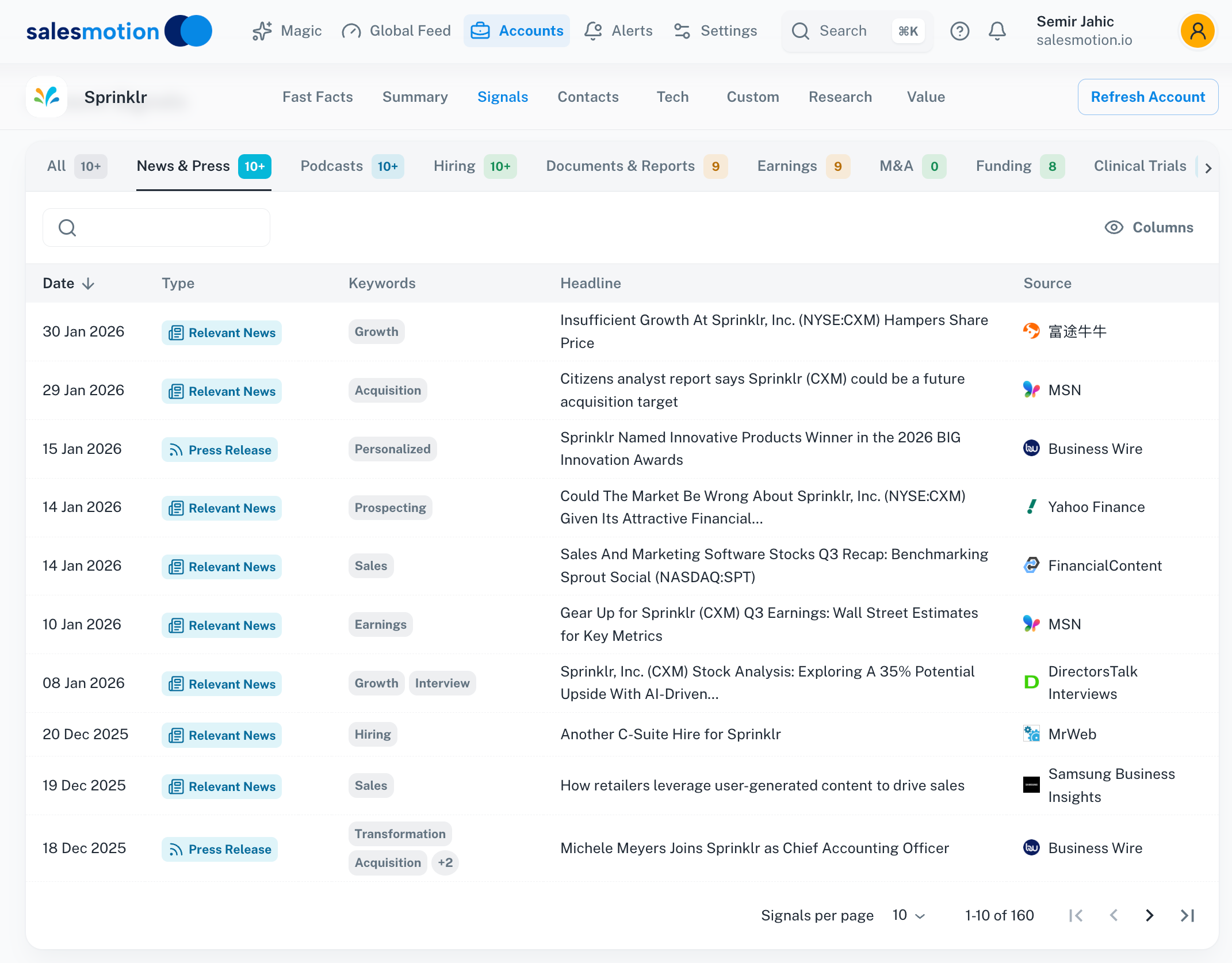 Verified, source-cited signals give reps immediate context rather than anonymous topic scores.

“The account and contact signals are key for reaching out at important times, and the value-add messaging it creates unique to every contact helps save time and efficiency.”
Daniel Pitman
Mid-Market Account Executive, Black Swan Data
How to Evaluate an Intent Data Provider
Choosing an intent data provider is a decision that will directly shape your sales efficiency and pipeline. Use this checklist to structure vendor conversations.
Data Quality and Transparency
An intent platform is only as good as its data. Press vendors on where their data comes from and how they keep it clean.
- Data sources: Where exactly do you source your intent signals? Is it publisher co-ops, the public web, financial filings, job postings? A mix of sources is a good sign.
- Collection methodology: Can you walk me through how you collect and process data? How do you ensure compliance with GDPR and CCPA?
- Signal validation: How do you separate real buying intent from casual web browsing? What is your process for filtering noise?
- Data freshness: How often is data updated? Do you offer real-time alerts? Most intent signals lose relevance within one to two weeks. Daily or better updates with timestamps on every signal is the minimum standard.
A provider that is vague about their data collection is a red flag. True partners are transparent because they are confident in their quality.
Signal Quality: Traditional vs. AI-Powered
The market has split into two camps. Traditional platforms track which companies are researching specific topics online. AI-driven platforms dig deeper, analyzing business activities like executive hires, funding announcements, and earnings call commentary to surface the why behind the what.
| Evaluation Criterion | Traditional Intent Data Provider | AI-Powered Account Intelligence |
|---|---|---|
| Core Function | Tracks topic-level research across publisher networks | Synthesizes multiple signal types for deep context |
| Signal Sources | Primarily third-party content consumption data | First-party data, public web, news, financial data |
| Key Insight | "Who" is researching a topic | "Who" is showing intent, "why" now, and "how" to engage |
| Actionability | Low -- requires significant manual research by the rep | High -- provides context, talking points, and sales plays |
| Time-to-Value | Slower -- requires training and process development | Faster -- automates research, enabling immediate action |
| Best For | Teams new to intent, focusing on top-of-funnel awareness | Teams focused on sales efficiency and pipeline generation |
Platform Actionability and Usability
The best data is useless if your sales team cannot act on it easily. The platform must fit into a seller's workflow, not pull them out of it.
- Contextual insights: Does the platform just give raw signals, or does it provide real context and talking points? Ask to see exactly how a signal becomes an actionable sales play.
- User interface: Is the platform intuitive for someone who is not a data scientist? A clunky UI kills adoption.
- Customization: Can you tailor topic tracking, lead scoring, and alerts to fit your ICP and GTM strategy?
- Workflow integration: Does it build account briefs, suggest messaging, or help reps prioritize their day?
Integration and Support
An intent provider should feel like an extension of your existing tech stack, not another siloed tool.
- CRM integration: How deep does the integration with Salesforce or HubSpot go? Does it offer two-way sync and embed insights on account records?
- Sales engagement tools: Can the platform connect with tools like Outreach or SalesLoft to automatically enroll contacts in sequences based on intent signals?
- Communication channels: Can high-priority signals push notifications to rep channels in Slack or Teams in real time?
- Onboarding and training: What does onboarding look like? Will they provide ongoing strategic help?
Pricing Transparency and Hidden Costs
Intent data pricing is rarely as simple as the initial quote. Understand the full cost of ownership.
Common hidden costs include implementation fees ($5,000-$15,000), topic and account caps with overage charges, per-seat licenses, integration fees, credit systems that can run out mid-quarter, and renewal price increases of 20-40% above the first-year price.
Budget 15-25% above the quoted license price for implementation, integration, and ongoing optimization costs.
How to Measure Intent Data ROI
Leadership does not care about the number of signals. They care about outcomes. Connect alerts to real business results.
Key Performance Indicators
- Lead-to-opportunity conversion rate: Compare the conversion rate of leads sourced from your intent provider against your baseline. A meaningful lift here is hard evidence of quality targeting.
- Sales cycle length: Are deals sourced from intent closing faster? Engaging accounts at the peak of their research should shorten time from first meeting to signed contract.
- Pipeline velocity: If velocity increases for intent-qualified accounts, your reps are having better conversations from the start.
- Signal-to-meeting conversion: Track what percentage of intent signals result in a booked meeting within 14 days. Industry benchmarks: 5-15% for topic-level intent, 15-30% for page-level intent.
Calculating ROI
Use a straightforward framework: tally total new revenue from deals sourced or influenced by intent data, subtract total cost of the provider (including setup and training), and divide the difference by the cost. If you generated $250,000 in new pipeline from a $50,000 investment, your initial ROI is 400%.
Realistic benchmarks for the first 90 days:
| Metric | Benchmark |
|---|---|
| Conversion rate improvement | 25-35% over non-intent-flagged accounts |
| Sales cycle reduction | 30-40% for intent-flagged deals |
| Signal-to-meeting rate (topic-level) | 5-15% |
| Signal-to-meeting rate (page-level) | 15-30% |
| Time to first actionable signal | 1-2 weeks |
| Time to measurable pipeline impact | 60-90 days |
Key Takeaways
- Intent data tracks anonymous company-level research behavior to identify accounts showing above-baseline interest in your solution category. It comes in first-party (your website), second-party (partner platforms like G2), and third-party (aggregated web behavior) forms.
- Intent data measures topic interest, not purchase readiness. Always layer it with other signals like leadership changes, earnings priorities, and hiring patterns for the most accurate targeting.
- Evaluate providers on five critical dimensions: signal quality and depth, data freshness, integration with your existing workflow, transparency of sourcing methodology, and privacy compliance.
- The real ROI shows up in lead-to-opportunity conversion rate, sales cycle length, and pipeline velocity -- not in the raw volume of signals delivered.
- Start with a focused pilot: give your best AEs access to intent-flagged accounts, measure conversion lift against your baseline, and expand only after proving clear results.
Frequently Asked Questions
What exactly is intent data?
Intent data is a collection of online behavioral signals that indicate a person or company is actively researching a product or service. This includes activities like reading articles on specific topics, visiting competitor websites, or searching for keywords related to a business challenge. Sales and marketing teams use these signals to identify who is "in-market" for a solution like theirs and prioritize outreach accordingly.
What is the difference between first-party and third-party intent data?
First-party intent data comes from your own digital properties: website visits, content downloads, email engagement, and product interactions. Third-party intent data is collected across thousands of external websites through data cooperatives and publisher networks. First-party data is more accurate but only captures activity from people who have already found you. Third-party data has broader reach but is noisier and relies on IP-to-company matching that can be imprecise. The most effective teams use both together.
How is intent data different from buying signals?
Intent data tracks topic-level research behavior -- it tells you a company is consuming content about "sales enablement." Buying signals are specific, verifiable business events: a new executive hire, a funding round, or a strategic shift mentioned in an earnings call. Intent data is probabilistic and anonymous. Buying signals are concrete and attributable. The best teams combine both for timing plus context. For a complete breakdown of signal-based approaches, see our guide to signal-based selling.
Can intent data replace our existing lead generation efforts?
No, intent data should augment your existing efforts, not replace them. It works best as a prioritization layer on top of your current pipeline. Use it to identify which accounts from your target list are showing active buying signals so your team can focus time and energy on the highest-probability opportunities rather than spreading effort evenly across all accounts.
How do I know if intent signals are accurate and not just noise?
Look for providers that offer signal transparency, meaning you can trace a signal back to its source rather than just receiving an opaque score. Cross-reference intent signals with other indicators like hiring activity, funding events, or direct website visits. Over time, track your conversion rates on intent-flagged accounts to build confidence in the data quality. Expect 30-50% of topic-level intent signals to be actionable; the remainder represents non-buying activity.
How much budget should we allocate for an intent data provider?
Costs range widely depending on the provider type and scale. Self-serve tools start at $50-100 per user per month. Dedicated mid-market platforms range from $15,000-30,000 per year. Enterprise ABM platforms with AI-powered analysis cost $50,000-150,000+ annually. A practical approach is to start with a pilot, measure the pipeline lift against your baseline conversion rates, and calculate the ROI before committing to a full-scale rollout. For detailed pricing across 12 platforms, see our intent data providers comparison.
Is using intent data compliant with GDPR and CCPA?
Yes, as long as you work with reputable partners. Trustworthy providers focus on account-level tracking using company IP addresses rather than personal information. When personal data is part of the mix, it is either anonymized and aggregated or collected only after explicit consent. Always press potential vendors on how they source data and stay compliant. A transparent partner will have no problem explaining their methodology.
Ready to turn scattered signals into a predictable pipeline? Salesmotion delivers AI-powered account intelligence that tells your team who to target, why now, and what to say. Start building your pipeline today.