
A common buying mistake looks like this. A sales team signs up for ZoomInfo to solve a prospecting problem, then ends up using it mostly for contact lookups while the intent, ads, workflow tools, and extra modules sit idle.
That mismatch gets expensive fast. Reps usually live in LinkedIn, the CRM, and an outbound tool. If that is your actual workflow, paying for a broad platform rarely produces better pipeline than a narrower stack built around the few jobs your team does every day.
The practical fix is to unbundle. Use a lower-cost data provider for names, emails, and phone numbers. Add a dedicated intelligence layer for account changes, buying signals, and message context. That setup often improves adoption because each tool has a clear job. It also cuts waste because you stop paying one vendor premium pricing to cover features your team never touches.
That is the logic behind a cheaper ZoomInfo alternative stack for B2B teams. You are not trying to recreate ZoomInfo feature for feature. You are building a stack that fits the motion your reps run.
If you're also rethinking the rest of your revenue stack, it helps to tighten the CRM side too. A lightweight small business CRM solution can often remove more overhead than another expensive database contract.
1. Salesmotion
Salesmotion isn't a cheaper clone of ZoomInfo. That's the point. If your team already knows it doesn't need a giant all-in-one data suite, Salesmotion gives you the part most reps are usually missing: timely account intelligence and signal monitoring that turns into action.
The platform runs three AI agents across your target accounts. One monitors changes continuously, one turns those changes into account briefs, and one drafts outreach tied to real account events. In practice, that means reps spend less time stitching together news, job posts, filings, and executive updates, and more time sending outreach that has a clear reason behind it.
Where Salesmotion wins
The strongest use case is pairing it with a cheaper contact tool like Apollo or Lusha. Let your contact vendor handle names, emails, and phones. Let Salesmotion handle research depth, signal monitoring, prioritization, and message context.
Practical rule: If your reps already have enough contacts but still send generic outreach, your problem isn't database size. It's missing context.
That matters because the true test of an AI agent is whether it creates value before a rep logs in by monitoring accounts, detecting changes, updating briefs, and prioritizing actions without human intervention, as outlined in Salesmotion's breakdown of AI agents vs automation in sales. That's a very different workflow from logging into ZoomInfo and manually searching for leads.
Trade-offs
The trade-off is simple. Salesmotion is best as a complement to cheaper contact data, not a standalone contact database replacement. It also doesn't publish public pricing, so buyers who want pure self-serve will need a conversation.
Still, for teams trying to escape bloated bundles, that combination can be the smarter play. This is the model behind many cheaper ZoomInfo alternatives for B2B data: unbundle contact data from intelligence, and only pay for the parts your team uses.
See Salesmotion in action
Take a self-guided interactive tour — no signup required.
2. Apollo.io
A common buying scenario looks like this. The team wants out of a ZoomInfo contract, still needs a large contact database, and does not have budget approval for a full rebuild of the outbound stack. Apollo usually makes the shortlist first because it covers a lot in one product and keeps the entry cost far lower.
Apollo combines contact data, sequencing, enrichment, and prospecting workflows in the same license. That can reduce tool sprawl for lean teams. It also creates a different trade-off than the one I usually recommend. If your goal is the absolute lowest cost with the best rep context, a lighter contact vendor plus Salesmotion is often the better design. If your goal is to keep sourcing and outreach in one system, Apollo is one of the more practical options.
Why teams buy Apollo
Apollo publishes self-serve pricing, which is a big part of its appeal. Its pricing page shows a free plan, plus paid tiers that let teams start small instead of signing an enterprise contract before they know adoption will stick.
That pricing model changes the evaluation process. Sales leaders can test list building, enrichment, and outbound workflow fit without waiting through a long procurement cycle. Finance also gets a cleaner cost model than the bundled, add-on-heavy pricing structure that pushes many teams to look for a cheaper ZoomInfo option in the first place.
Apollo also has broad market adoption, so most RevOps teams can find reps, agencies, and consultants who already know how to run it. That lowers rollout friction.
Where Apollo fits, and where it falls short
The upside is clear. Apollo gives smaller teams a lot of functional coverage for the money.
The downside is just as clear. Data quality can be less consistent than premium providers, especially if your motion depends heavily on direct dials or highly accurate mobile numbers. That does not make Apollo a bad choice. It means you need to be honest about the job you are hiring it to do.
Apollo is a strong fit when budget control, decent coverage, and built-in outreach matter more than getting the best phone data on every record.
I usually frame the decision this way. If you want one lower-cost platform that does a bit of everything, Apollo is easy to justify. If you want to unbundle ZoomInfo's bloated feature set and spend money where it changes win rates, pair a cheaper data source with a dedicated intelligence layer. That is often the better ROI play, and this sales data pricing comparison across common GTM tools helps show why.
If you want the side-by-side trade-offs in more detail, this ZoomInfo vs Apollo comparison is worth a look.

“There's been a big focus on hyper personalization and relevance in our outbounding efforts. Salesmotion has been a key partner in hitting our significantly increased meeting targets. What stands out is how simple it is. Reps can log in and get valuable account insights within 30 seconds to a minute.”
Joe DeFrance
VP of Sales, Incredible Health
3. UpLead
UpLead tends to appeal to operators who want fewer surprises. The platform is known for being self-serve, easier to price out, and more straightforward to manage than a heavyweight enterprise contract.
That matters if you're the person who has to explain spend to finance. A lot of ZoomInfo frustration isn't just the sticker price. It's unclear usage economics, add-ons, and renewal complexity. UpLead feels more predictable, which makes it easier to model cost per rep and cost per sourced opportunity.
Best fit and limitations
UpLead is strongest for teams that want solid US-focused contact data, firmographic filtering, and transparent plan structure. It's less compelling if your buying process depends heavily on deeper intent workflows or broad platform consolidation.
I'd be honest with leadership: UpLead can absolutely lower spend and cover core prospecting needs. But if your reps still spend too much time figuring out why an account matters right now, you'll still want a separate intelligence layer.
- Use UpLead when: You want transparent pricing and simpler contact sourcing.
- Skip UpLead when: You expect one tool to do data, signals, account research, and sequencing equally well.
- Pair it with Salesmotion when: Your reps have enough names but need stronger account prep and timely triggers.
For teams weighing several low-cost options, a broader pricing comparison across ZoomInfo alternatives can help frame where UpLead fits. It's a practical pick, especially for lean teams that care about cost discipline more than bundle breadth.
4. Lusha
Lusha is the tool I'd call lightweight on purpose. It doesn't try to be your whole GTM operating system. It helps reps find contact data quickly, especially from LinkedIn and company websites, and for many teams that's enough.
That simplicity is why Lusha often wins internal adoption. Reps don't need much training. They click, reveal, sync, and move on. If your current problem is paying enterprise rates for functionality your team never touches, that's a very healthy correction.
Why teams like it
The browser extension workflow is the biggest draw. For SDRs and AEs who prospect directly in LinkedIn, Lusha keeps the process fast. It also has a free tier, which lowers the risk of testing it with a pod before rolling it out more broadly.
The catch is that Lusha is a lookup tool first. It's not where I'd go for deep account strategy, thorough signal interpretation, or broad GTM orchestration. That's why it works well as the contact-data half of an unbundled stack.
Field note: Lusha is easy to adopt because reps understand it in one session. That's often worth more than a bigger platform that nobody uses consistently.
If you're deciding between the two common lightweight options, this ZoomInfo vs Lusha comparison is useful context. For small teams and rep-led prospecting motions, Lusha is one of the cleanest ways to cut software spend without disrupting workflow.

“This is my singular place that very simply summarizes a company's top initiatives, strategies and connects them to my solution. Something I would spend hours researching manually, now it's automated.”
Derek Rosen
Director, Strategic Accounts, Guild Education
5. LeadIQ
LeadIQ fits teams that prospect inside LinkedIn all day and care a lot about CRM hygiene. It's built around capture, enrichment, and getting records into the right system cleanly, without making reps fight the process.
That's a meaningful difference from larger databases. ZoomInfo is often bought top-down. LeadIQ tends to earn its place bottom-up because reps use it in the flow of work.
Where it works best
LeadIQ is good for reps who want quick contact capture, simple signals, AI-assisted copy, and solid integrations with CRMs and engagement platforms. It's especially practical when managers want activity to stay clean without adding admin friction.
A nuance worth watching is credit economics. Email retrieval is easier to justify at scale. Phone retrieval is more expensive from a usage standpoint, so teams that run call-heavy motions need to inspect that closely before rolling it out broadly.
- Strong fit: LinkedIn-first teams, SDR pods, and recruiters.
- Less ideal: Organizations that want one vendor to be their full account intelligence platform.
- Best operating model: Let LeadIQ handle fast capture. Layer in a stronger research and signals product if reps need better timing and message relevance.
LeadIQ is not a strategic replacement for everything ZoomInfo does. But if your real use case is prospect capture plus clean sync, it's often enough.
6. RocketReach
RocketReach fits a very specific buying decision. A team wants dependable contact lookups, fast exports, and a much lower bill than ZoomInfo. For that use case, it can do the job without forcing you into a bigger platform than you need.
I usually look at RocketReach for lean outbound teams that already know how they want to prospect. They are not asking one vendor to handle account intelligence, prioritization, and workflow orchestration. They just need names, emails, phone numbers, and a simple way to pull lists.
Cost profile and practical fit
RocketReach starts at $22.9 per month, which puts it in a different category from enterprise sales data suites. That pricing makes it practical to test with a small rep group before making a wider rollout decision.
That matters if you are trying to cut software spend without slowing pipeline creation. A low-cost lookup product can cover the data layer for a lot of teams, especially if reps already work from a defined ICP and outbound motion.
Where it falls short
The trade-off is pretty straightforward. RocketReach gives you contact data. It does not give you much help on who to contact first, why now is the right time, or how to tailor messaging around account changes.
A tool's low cost is irrelevant if it doesn't solve the core problem. If reps need context, timing, and prioritization, lookup credits alone will not improve conversion.
That is why RocketReach makes more sense as one piece of an unbundled stack. Pair it with a dedicated intelligence and signals platform like Salesmotion, and you can keep data costs low while giving reps the research and trigger context ZoomInfo buyers often want. That approach is usually the smarter path for teams trying to get ZoomInfo-level outcomes without paying for a bloated all-in-one suite.
7. Lead411
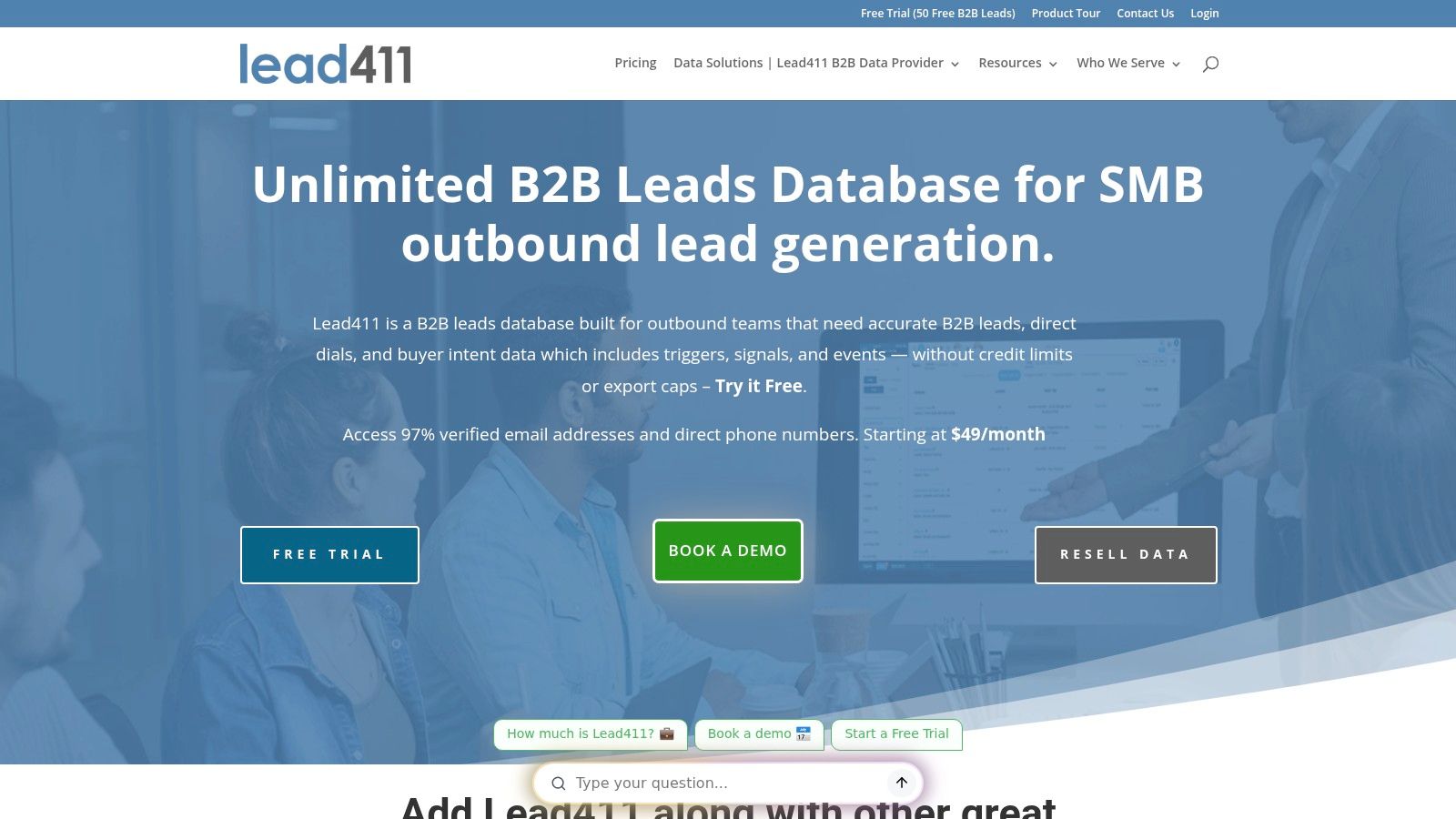
A common mistake in ZoomInfo replacement projects is buying for database size instead of rep output. Lead411 is worth considering if your team cares more about reaching the right person than licensing the biggest record count in the category.
That buying lens matters. A smaller dataset with better direct dials and cleaner emails usually produces more meetings than a massive dataset full of stale contacts.
The key trade-off
Lead411 fits teams that want a focused data tool, not another oversized platform contract. As RB2B's analysis of the ZoomInfo alternative market notes, cheaper tools are often judged on volume first, even though verified contact quality can matter more in day-to-day outbound performance.
That is the trade-off here. Lead411 gives up some breadth in exchange for a more practical setup for teams that value trusted contact data, buyer intent signals, and simpler pricing.
When Lead411 makes sense
Lead411 is a good fit for US-heavy outbound teams that need direct dials, emails, enrichment, and buying signals without paying for a broad all-in-one suite. If your reps already have a clear ICP and your process for account selection is handled elsewhere, that narrower scope can be a strength.
The unbundled approach usually wins on ROI.
Use Lead411 for contact data. Pair it with a dedicated intelligence and signals platform like Salesmotion for account research, prioritization, and timing. That stack often makes more financial sense than trying to force one expensive vendor to do everything, especially if your goal is ZoomInfo-level results at a much lower cost.
If your motion depends on precision over volume, Lead411 is one of the better ways to cut spend without asking reps to work around bad data.
8. SalesIntel
SalesIntel is where I'd point teams that are willing to spend more than Apollo or Lusha, but still want a more focused purchase than ZoomInfo. Its main appeal is data quality, especially for teams that care about human-verified contacts and intent-driven outreach.
That makes it a good fit for organizations that already have sequencing, CRM, and workflow tools in place and just need a stronger data layer.
Why it stands out
SalesIntel is highlighted as a strong option for intent data and human-verified B2B contacts in Coldreach's review of ZoomInfo alternatives. That combination is important because not every cheap database supports intent-led outbound well.
If your reps are calling into named accounts and direct dials matter, human verification can be worth paying for. You may spend more than you would on lighter tools, but the downstream effect can be cleaner connect rates and less rep frustration.
The trade-off
This is not the budget pick on the list. Public pricing isn't listed, and it's usually a sales-led purchase. So while it can be cheaper than ZoomInfo in some setups, it's better framed as a focused premium data choice than a bargain platform.
For teams that have learned the hard way that low-cost data can create more work than it saves, SalesIntel is one of the stronger “buy less, but buy better” options.
9. Adapt.io
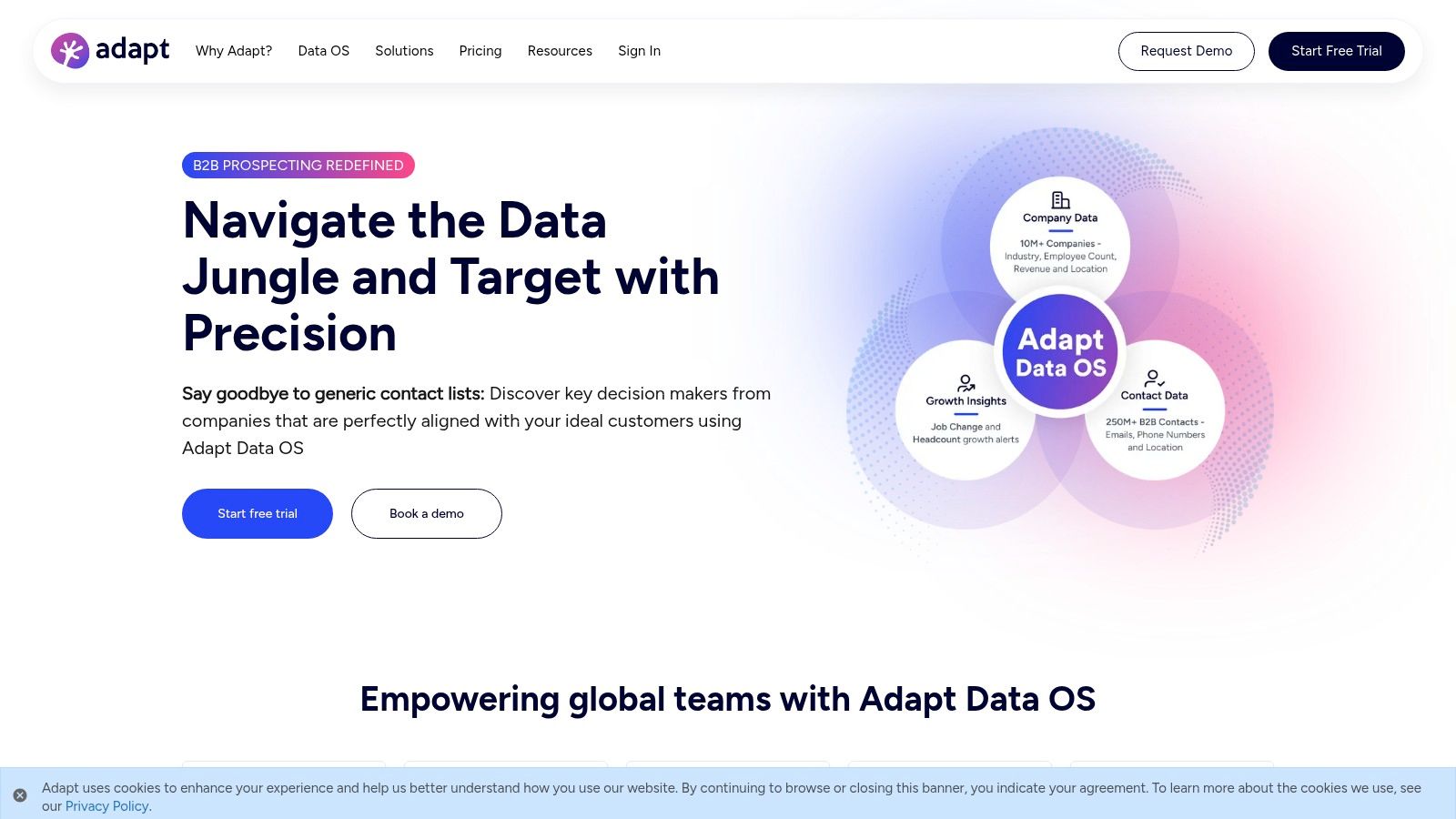
Adapt.io is aimed at lean teams that need workable contact data, some enrichment, and easier budget approval. It's the kind of tool that often gets traction in early-stage or resource-constrained environments because the buy-in is simpler.
That doesn't automatically make it the best fit. It makes it easier to test.
Best use case
Adapt.io makes sense when your prospecting motion is straightforward and your ICP isn't too niche. If the team mainly needs email data, some direct dials, exports, and basic list building, it can be enough to get outbound moving without enterprise-level spend.
I'd still treat it as a pilot-first tool. Lower-cost providers can be perfectly fine in common segments, then struggle once you move into harder-to-find titles, specific regions, or narrow verticals.
- Good for: Early outbound programs and lean teams building first-pass target lists.
- Watch for: Coverage depth, freshness, and edge-case records.
- Best buying move: Test on your real ICP before rolling out to the full team.
Adapt.io works when expectations are clear. If you buy it as a practical budget prospecting tool, it can do the job. If you expect ZoomInfo-level breadth and depth for far less money, disappointment comes quickly.
10. Snov.io
Snov.io is the most outreach-first option on this list. If your team's biggest pain is finding verified emails, launching campaigns, and keeping everything in one affordable place, Snov.io is often enough.
This is a different buying mindset from ZoomInfo. You're not paying for a heavyweight enterprise database. You're buying an affordable prospecting and email workflow engine.
Where it fits
Snov.io is strongest for email-heavy outbound motions. You get email finding, verification, sequencing, and related workflow support in one environment. For lean teams, that can reduce the number of separate tools required to launch outbound.
The limitation is obvious. Phone data is not the center of the product, and teams running call-first motions will likely want a different primary vendor for contact data.
Practical recommendation
Use Snov.io if your outbound model is mostly email and you want low-cost execution without much setup. Don't use it as your only strategic GTM intelligence platform.
For a lot of smaller teams, that's okay. They don't need a platform built for every revenue motion. They need something affordable that helps them start conversations. Snov.io can do that well enough when the motion is simple and the expectations are realistic.
Top 10 Affordable ZoomInfo Alternatives Comparison
| Product | Core capability | Unique selling point | Best for (target audience) | UX / Time-to-value | Pricing model |
|---|---|---|---|---|---|
| Salesmotion (Recommended) | Autonomous 3-agent workflow (Signal → Research → Prospector) across 1,000+ sources | Source‑verified, real‑time "so what" briefs + ready-to-send personalized outreach | Revenue leaders, CROs, AEs/SDRs, RevOps, ABM teams | Signals & briefs visible in minutes; onboarding in days; Slack/CRM alerts | Demo / quote (enterprise-focused) |
| Apollo.io | Large B2B contact & company database + sequencing & dialer | All‑in‑one outbound stack with credit model and integrated engagement | SMB / mid‑market US outbound teams | Self-serve sign-up; integrates with CRMs & engagement tools | Credit-based; in-app pricing; fair‑use caps |
| UpLead | Verified emails & dials with firmographic/technographic filters | Emphasis on data verification and public pricing | Teams needing high email accuracy and predictable costs | Self-serve; public plans; CRM integrations | Public plans & credit tiers |
| Lusha | Browser extension reveal + basic enrichment | Free tier + simple predictable credit model; strong LinkedIn flow | Small teams and reps using LinkedIn for prospecting | Low barrier to trial; easy browser reveal workflow | Credit model with free monthly credits; team plans via sales |
| LeadIQ | Chrome prospecting + signals + CRM sync | LinkedIn capture, clear credit mechanics and transparent plans | Reps who work heavily in LinkedIn and need CRM hygiene | Generous free trial; clean CRM syncing | Published credit rules; phone credits expensive |
| RocketReach | Email/phone lookup with batch exports and API | Simple lookup + export flow at lower sticker price | SDR groups needing bulk lookups & exports | Straightforward workflows; published plans | Published plans; team billing & API tiers |
| Lead411 | US-centric contact data + intent triggers | Human-verified contacts with intent signals and tiered plans | US mid-market teams seeking affordable alternatives | Multiple plan tiers; some higher tiers quote-based | Tiered plans (Spark/Ignite/Blaze); quotes for large needs |
| SalesIntel | Human-verified phone/email + research-on-demand | High connect rates and strong Salesforce integration | Teams wanting a quality data layer for existing GTM tools | Managed package for Salesforce; sales-led onboarding | Quote-based; promoted unlimited-user model |
| Adapt.io | Budget contact database with per-credit pricing | Clear low entry pricing; phone credits at low tiers | Lean teams needing email discovery + occasional dials | Free trial; CSV/CRM exports; ABM list building | Listed monthly tiers and per-credit pricing |
| Snov.io | Email finder/verify + sequencer + LinkedIn add-ons | Very affordable outreach-first bundle for volume senders | Low-cost volume senders and small outreach teams | Credit-based with rollover on many plans; add-ons available | Low-cost credits; add-on tokens and tiered plans |
Stop Overpaying, Start Out-Selling
The biggest mistake in this category is assuming you need one giant replacement for ZoomInfo. Not every team needs that. They need the part they use, plus a better answer for the gaps that hurt pipeline.
ZoomInfo still has real strengths. It gives teams broad contact coverage, strong direct dials, and useful technographic depth. If you use the full platform aggressively across sales, marketing, and operations, the contract can make sense. But that's not the reality for a lot of companies. Many teams use a narrow set of features while carrying enterprise-level cost.
That's why the smarter move is usually unbundling. Buy a contact data tool that fits your prospecting style. Apollo is the easiest recommendation for broad value and all-in-one coverage. Lusha is a strong lightweight option when reps live in LinkedIn. RocketReach works for affordable lookup use cases. Lead411 and SalesIntel are better fits when accuracy matters more than raw volume.
Then add intelligence separately.
That's where Salesmotion fits better than a direct database replacement. It gives teams continuous account monitoring, deeper research, and signal-driven outreach context that most cheaper data tools don't provide on their own. The result is a stack built around what reps need: who to contact, what changed, why it matters, and what to say next.
There's also a strategic reason to split these jobs. Contact data and account intelligence age differently. A phone number lookup is one problem. Understanding that a target account changed leadership, opened a new initiative, mentioned a competitor, or posted a role tied to your category is a different problem. Buying one bloated suite to handle both often leads to paying for a lot of surface area and using very little of it.
For enterprise teams, the practical first step is an audit. Look at who logs in, which features get used, which exports convert, and which modules sit idle. If you find that your team mainly needs names, emails, direct dials, and basic firmographics, you already have your answer. You don't need more platform. You need less waste.
A leaner stack can also support broader CAC discipline. If software bloat is pushing up acquisition cost, this Bazzly guide to reducing ad spend is a useful reminder that efficiency usually comes from better systems, not just lower media budgets.
The best cheaper ZoomInfo alternative isn't always one tool. Often it's a stack that's built with more intent than the one you inherited. Buy the database you need. Add the intelligence your reps act on. Drop the modules nobody touches. That's how you spend less and still create more pipeline.
If your team has solid contact sources but weak account context, Salesmotion is the missing layer worth testing. It turns signals, research, and outreach prep into a repeatable system so reps can act faster, message with more relevance, and build pipeline without spending hours doing manual account work.