Every vendor in your sales stack now claims to offer "AI agents." Gartner estimates only about 130 of the thousands of agentic AI vendors are real. The rest are rebranding existing automation with a new label, a practice analysts now call "agent washing." For sales leaders evaluating where to invest, the distinction between genuine AI agents and repackaged automation is not academic. It determines whether your team gets a structural advantage or just a more expensive version of what they already have.
TL;DR: AI agents reason, adapt, and act autonomously. Automation follows predefined rules. Gartner projects 40% of enterprise applications will include task-specific AI agents by end of 2026, but over 40% of agentic AI projects will be canceled by 2027 due to unclear ROI. The biggest mistake sales teams make is buying AI that automates sending (outreach agents) before solving the intelligence gap. An AI agent that sends personalized emails is useless if it pulls from stale data. Start with the intelligence layer, then build outreach on top of it.
What Actually Separates AI Agents from Automation
The difference is not about sophistication. It is about decision-making.
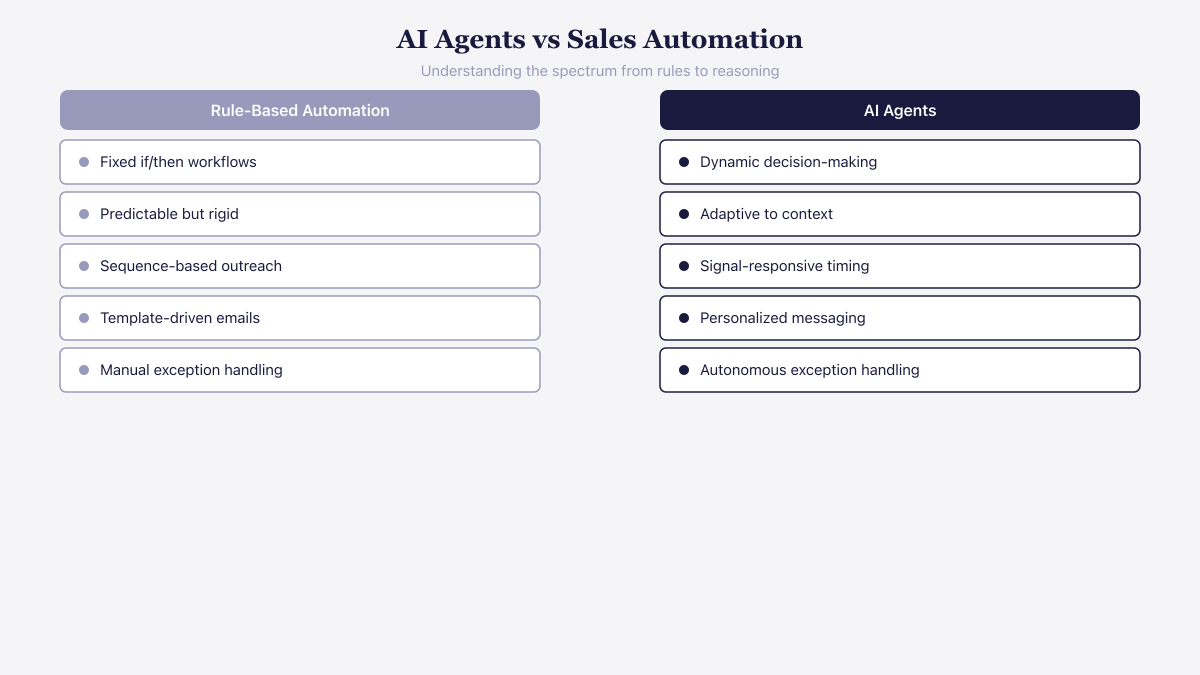 AI agents go beyond rule-based automation by making context-aware decisions in real time.
Automation executes a predefined sequence when triggered. If a lead fills out a form, automation routes it to the right rep, sends a confirmation email, and creates a CRM record. The steps never change. The logic is set during configuration. This is valuable, and most revenue teams already rely on it for data capture, lead routing, and basic sequencing.
AI agents perceive context, reason about options, and choose actions independently. An agent monitoring your target accounts might detect that a prospect's company just posted three VP-level roles in revenue operations, cross-reference that with recent earnings commentary about "sales transformation," and flag the account as high-priority, all without a human asking. The next time a rep opens that account, the brief is already updated with the hiring signals, leadership changes, and competitive context.
The practical test: if you can draw the entire workflow as a flowchart before it runs, it is automation. If the system makes choices based on live data that you could not predict in advance, it is an agent.
According to a 2026 CrewAI survey, 100% of enterprises plan to expand their use of agentic AI this year, and 54% are already deploying AI agents across the sales cycle. But McKinsey reports that fewer than 10% have deployed agentic AI at functional scale. The gap between intention and execution is where budget gets wasted.
See Salesmotion on a real account
Book a 15-minute demo and see how your team saves hours on account research.
The "Agent Washing" Problem Is Worse Than You Think
Gartner Senior Director Analyst Anushree Verma put it bluntly: "Most agentic AI propositions lack significant value or return on investment, as current models don't have the maturity and agency to autonomously achieve complex business goals." Constellation Research VP Holger Mueller agrees: "There is a lot of agent washing, where everybody re-labels automation as agents."
Here is what agent washing looks like in practice:
- A sequencing tool adds GPT-powered email rewriting and calls it an "AI agent"
- A CRM adds a chatbot that summarizes deal notes and markets it as "agentic intelligence"
- A dialer adds AI-generated call scripts and brands itself as an "autonomous sales agent"
None of these are agents. They are automation with a language model bolted on. They do not perceive new information, reason about what to do next, or act without being triggered.
The financial risk is real. Gartner predicts over 40% of agentic AI projects will be canceled by end of 2027 because of escalating costs, unclear business value, or inadequate risk controls. Sales leaders who cannot distinguish real agents from rebranded automation will waste significant budget on tools that deliver marginal improvements at best.
Three Questions That Expose Agent Washing
Before signing any contract, ask:
- Does it act without being triggered? A real agent monitors signals continuously and takes action when conditions change. If a human has to initiate every workflow, it is automation.
- Does it make decisions based on live context? An agent pulls from multiple real-time data sources (hiring data, news, earnings, CRM activity, engagement history) and weighs them to determine priority and next steps. If the logic is configured in advance, it is a rule engine.
- Does it adapt when conditions change? If an account's buying signals shift mid-quarter, does the system automatically reprioritize and adjust its recommendations? If it keeps running the same sequence regardless, it is not agentic.

“The Business Development team gets 80 to 90 percent of what they need in 15 minutes. That is a complete shift in how our reps work.”
Andrew Giordano
VP of Global Commercial Operations, Analytic Partners
Where AI Agents Actually Matter in the Sales Workflow
Most AI agent spending in sales today goes to outreach automation: tools that draft emails, schedule sequences, and handle follow-ups. That is the wrong place to start.
The research shows why. Sales reps spend an average of 20-30% of their time on manual account research. AI agents that solve this problem, the intelligence layer, deliver time savings that compound across every other activity. A rep who walks into a discovery call already knowing the prospect's strategic initiatives, recent leadership changes, competitive landscape, and likely pain points runs a fundamentally different conversation than one who spent 15 minutes skimming a LinkedIn profile.
The hierarchy matters:
Layer 1: Intelligence agents monitor signals across thousands of data sources, synthesize account context, and surface priority accounts before reps ask. This is the foundation. Without accurate, timely intelligence, every downstream action (outreach, sequencing, follow-up) operates on incomplete information.
Salesmotion operates at this layer. It continuously tracks hiring patterns, leadership changes, earnings commentary, product launches, and buying signals across 1,000+ public and private sources. When a target account enters a buying window, the platform flags it, generates an account brief with the relevant context, and delivers it inside the CRM. Analytic Partners cut account research from three hours to 15 minutes per account using this approach and grew qualified pipeline 40% year over year.
Layer 2: Engagement agents handle outreach sequencing, email personalization, and multi-channel cadence management. Tools like Outreach and Salesloft do this well. But their effectiveness depends entirely on the quality of intelligence feeding them.
Layer 3: Coaching and analytics agents analyze call recordings, identify patterns, score deal health, and surface coaching opportunities. Gong and Clari operate here.
The mistake most teams make is investing heavily in Layer 2 and Layer 3 while leaving Layer 1 to manual effort. You end up with AI that sends beautifully personalized emails based on stale or surface-level data, and AI that analyzes calls where the rep was underprepared. Fix the intelligence gap first.
A Practical Framework for Evaluating AI Agent Vendors
Skip the demo theater. Here is how to evaluate whether an AI agent will actually change how your team works:
1. Test with your real accounts
Ask the vendor to run their system against 10-20 of your actual target accounts. Compare what the AI surfaces against what your best reps already know. If the agent misses obvious signals or returns generic summaries, it is not ready.
2. Measure autonomy, not features
Count how many steps require human intervention. A real agent should be able to monitor accounts, detect changes, update briefs, and prioritize actions without a rep logging in. If the "agent" only works when someone clicks a button, it is a tool, not an agent.
3. Check the data layer
Ask where the data comes from. Agents that rely solely on CRM data are limited to what reps have already entered, which is often incomplete and outdated. Agents that pull from external sources (news, SEC filings, hiring data, intent data, technographic signals) deliver intelligence reps cannot get on their own.
4. Evaluate learning and adaptation
Run the system for 30 days and check whether its recommendations improve. Real agents learn from outcomes: which accounts converted, which signals predicted buying windows, which messaging resonated. If the outputs look the same on day 30 as day 1, there is no actual learning loop.
5. Test integration depth
The agent must connect natively to your CRM, engagement platform, and communication tools. Manual data transfers guarantee stale intelligence. If the vendor requires CSV uploads or API middleware you need to build yourself, the total cost of ownership is much higher than the license fee suggests.

“All of the vendors that I've worked with, all of the onboarding that I have had to deal with, I will say, hands down, Salesmotion was the easiest that I have had.”
Lyndsay Thomson
Head of Sales Operations, Cytel
What a Real AI Agent Workflow Looks Like
Theory is easy. Here is what changes operationally when you deploy a genuine account intelligence agent:
Monday morning, before your rep opens their laptop: The intelligence agent has been monitoring 500+ target accounts overnight. Three accounts triggered priority signals: one posted a VP of Revenue Operations role (hiring signal), another's CEO mentioned "modernizing our go-to-market" in a quarterly earnings call (strategic signal), and a third's current vendor just had a major outage (competitive signal).
When the rep opens their CRM: Each flagged account has an auto-generated brief with the signal that fired, updated stakeholder map, recent company news, and recommended talking points. The rep did not search for this. The agent delivered it based on what changed.
Before the first meeting: Instead of spending 45 minutes pulling together context from LinkedIn, the company website, news articles, and CRM notes, the rep reviews a two-minute brief that covers all of it. The meeting starts with "I noticed your team is hiring for RevOps and your CEO mentioned sales transformation on the last earnings call. Is that driving the timeline here?" instead of "So tell me about your business."
The result: Discovery is half-done before the call starts. Deal velocity increases because the rep asks better questions earlier. According to Bain & Company, AI adoption in sales increases seller satisfaction and performance by automating the research work that burns the most time with the least payoff.
This is the difference between an AI agent and automation. Automation would have sent a templated email when the job posting appeared. An agent synthesized three separate signals, assessed their combined significance, and prepared the rep with specific context for a consultative conversation.
Why Spreadsheets and CRM Fields Cannot Replace Intelligence Agents
Some sales leaders try to operationalize signal-based selling in CRM fields or spreadsheets: create custom fields for "hiring signals," "earnings mentions," and "competitive intel," then ask reps to update them.
This collapses at scale for predictable reasons:
- Reps do not consistently update fields after every research session. CRM hygiene degrades within weeks.
- Signals that matter most (hiring patterns, earnings language, technology adoption) live outside the CRM. Someone has to go find them, which is the manual research problem you are trying to solve.
- Static CRM fields cannot capture timing. A hiring signal from three months ago means something different than one from this week. Spreadsheets do not decay data automatically.
- Managers can see pipeline stage but not account readiness. Without real-time signals, they cannot distinguish between a stalled deal and one waiting for the right moment.
The spreadsheet approach works for 10 accounts. It collapses at 50. And for enterprise teams managing hundreds or thousands of named accounts, it is not a viable operating model.
Cytel's sales team consolidated from five separate account research tools to one platform, cut research time by 50%, and reduced account planning preparation by 30%. The simplification mattered as much as the capability. Fewer tools meant less context-switching, cleaner data, and higher adoption.
Key Takeaways
- AI agents reason and act autonomously. Automation follows predetermined rules. If you can flowchart the entire workflow in advance, it is automation.
- Gartner estimates only ~130 of thousands of "agentic AI" vendors are real. Over 40% of agentic AI projects face cancellation by 2027. Evaluate rigorously before committing budget.
- Start with the intelligence layer, not the outreach layer. AI that automates sending is only as good as the data feeding it. Fix account research first.
- Test vendors against your real accounts, not demo scenarios. Measure autonomy (how many steps need a human?) and data sourcing (CRM-only vs. external signals).
- The operational test: does the system deliver value before a rep logs in? Real agents work continuously, not on-demand.
- Build your AI stack in layers: intelligence first, then engagement, then analytics. Each layer depends on the one below it.
Frequently Asked Questions
What is the difference between AI agents and automation in sales?
Automation executes predefined workflows triggered by specific events, like routing a lead when a form is submitted or sending a follow-up email on day three of a sequence. AI agents perceive context from multiple data sources, reason about what action to take, and act autonomously. The key distinction is decision-making: automation follows rules you set, agents make choices based on live data you could not predict in advance. According to Gartner, 40% of enterprise applications will include task-specific AI agents by end of 2026.
How can I tell if a vendor is "agent washing"?
Ask three questions: Does the tool act without being manually triggered? Does it make decisions based on real-time contextual data from multiple sources? Does it adapt its behavior when conditions change? If the answer to any of these is no, you are looking at rebranded automation. Gartner estimates only about 130 out of thousands of vendors claiming agentic AI capabilities are genuine. Request a live demo with your actual account data, not prepared scenarios.
Should I buy an AI outreach agent or an intelligence agent first?
Start with intelligence. An AI agent that drafts personalized emails is only effective if the data feeding it is accurate and current. Teams that invest in outreach automation before solving the research gap end up sending well-written messages based on stale or surface-level information. The most effective approach builds from the intelligence layer up: signal monitoring and account research first, engagement automation second, coaching and analytics third.