ZoomInfo publishes no list price. Its own pricing page says so, because the model is consumption-based, and Vendr puts the average contract value at $33,500 across 1,012 anonymized deals. For mid-market sales teams managing tool budgets carefully, that math stops working fast. The credit-based model compounds the problem: reps ration contact reveals mid-quarter when pipeline pressure is highest, which defeats the purpose of having a data tool in the first place.
TL;DR: Seven alternatives deliver verified B2B contact data at a fraction of ZoomInfo's contract value. Apollo.io is the best all-in-one budget option. UpLead matches ZoomInfo's 95% accuracy guarantee on a published rate card. Salesmotion adds account intelligence, waterfall-enriched contact data, and buying signal detection that pure contact databases miss entirely.
The market for cheap ZoomInfo alternatives has matured. You no longer have to choose between affordable pricing and data quality. But "cheaper" means different things depending on whether your bottleneck is finding contacts, verifying phone numbers, prospecting in Europe, or knowing which accounts to prioritize. This guide compares seven platforms with publicly available pricing, verified accuracy claims, and real user feedback from G2 and Gartner Peer Insights.
ZoomInfo
Custom, consumption-based
no published price · Vendr avg $33.5k/yr
Salesmotion
From $85/mo
monthly contract · verified contacts included
ZoomInfo charges six figures for a contact list. Salesmotion is account intelligence + verified contacts at a fraction of the cost.
- 3 AI agents on every account: signals, research briefs, drafted outreach
- Live in an hour, monthly billing, no annual contract
- Verified contacts included; CRM integration on custom team & enterprise plans
What to Look for in a ZoomInfo Alternative
Before comparing tools, clarify what your team actually uses ZoomInfo for. Most teams use less than 30% of ZoomInfo's feature set, which means they are overpaying for capabilities they never touch.
Contact data accuracy. This is the baseline. Every tool claims high accuracy, but real-world bounce rates vary from 5% to 35% depending on the provider and the market segment. Look for platforms that verify emails in real time or offer accuracy guarantees with credit-back policies.
Phone number coverage. Direct dials and mobile numbers are the hardest data to source accurately. Some platforms excel at email but have sparse phone data. If your team runs call-heavy outbound, prioritize tools with phone-verified or human-verified numbers.
Waterfall enrichment. The best platforms don't rely on a single data source. They cascade lookups across multiple providers to maximize coverage and accuracy, so you get the best available contact for each prospect rather than settling for one database's gaps.
Signal monitoring and account intelligence. Contact data tells you who to reach. Buying signals tell you when and why. Platforms that monitor leadership changes, funding events, earnings calls, and hiring patterns give reps context that turns cold outreach into relevant conversations.
Pricing transparency. ZoomInfo's pricing requires a sales call, and because it is consumption-based, what you pay moves with usage rather than sitting on a rate card. The best alternatives publish pricing on their website, offer monthly contracts, and scale predictably as your team grows.
See Salesmotion on a real account
Book a 15-minute demo and see how your team saves hours on account research.
1. Salesmotion: Account Intelligence With Plug-and-Play Contact Data
Best for: Account-based teams who need both verified contact data and scalable "why now" context across their full book of business.
Salesmotion operates in a different category than most ZoomInfo alternatives. While traditional providers focus on building the biggest contact database, the platform combines high-accuracy contact data with account intelligence and buying signal detection in one system.
The contact data layer uses waterfall enrichment across multiple premium providers to deliver verified email addresses and direct-dial phone numbers for your target accounts. Instead of relying on a single database with coverage gaps, the platform cascades lookups to find the best available contact for each prospect, resulting in higher match rates and lower bounce rates than any single-source provider.
On top of the contact data, three AI agents handle the intelligence work that ZoomInfo cannot. The Signal Agent monitors 1,000+ sources around the clock for buying triggers: earnings call initiatives, leadership changes, funding rounds, hiring surges, and competitive moves. The Research Agent compiles account briefs from 42+ sources in seconds. The Outreach Agent drafts personalized messages anchored to detected signals rather than generic templates.
Setup is plug and play. Teams go live in hours, not weeks. There is no complex implementation, no developer resources required, and no multi-week onboarding process. The Salesforce and HubSpot integrations install as managed packages with bi-directional sync out of the box.
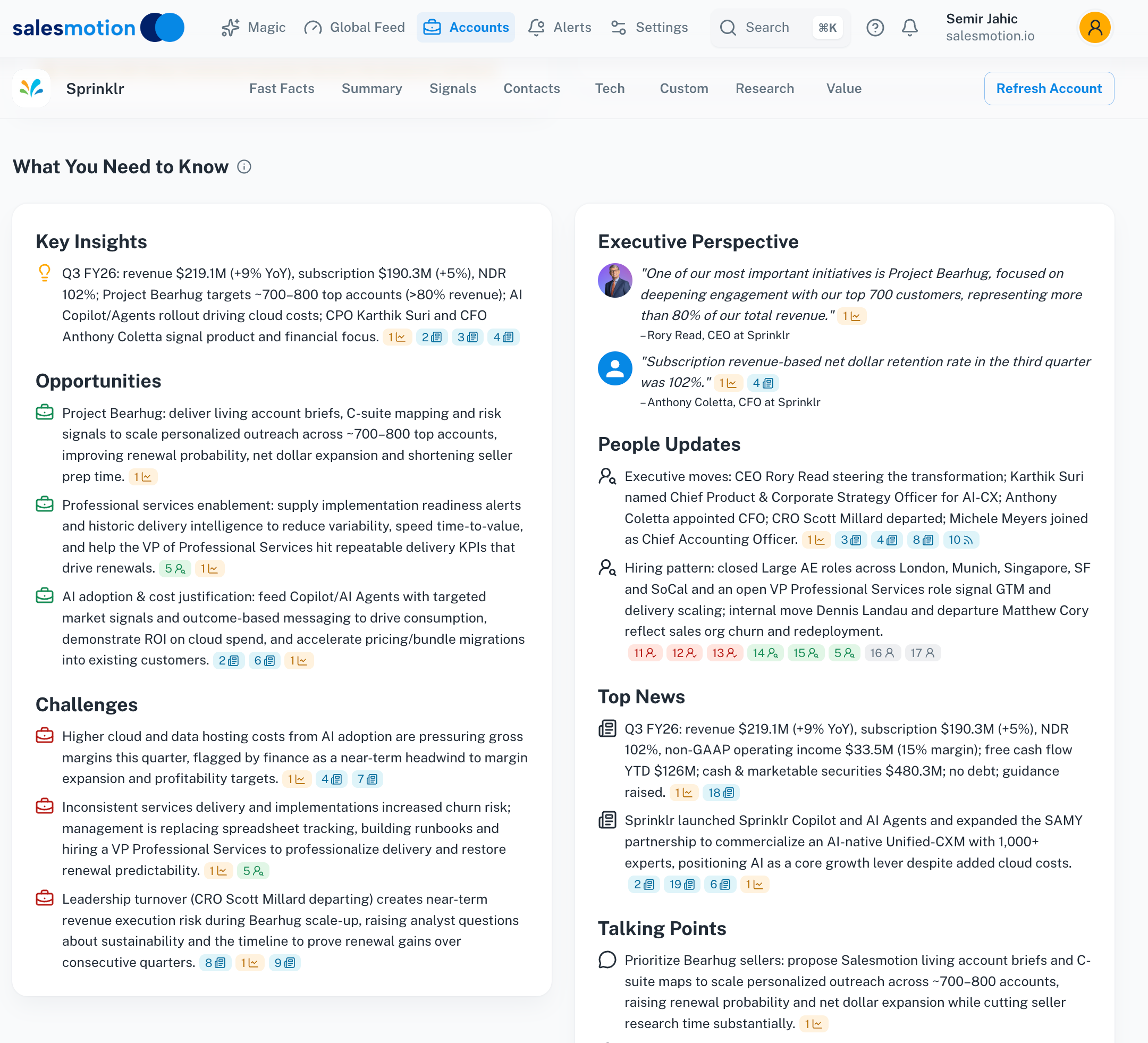 The platform combines waterfall-enriched contact data with account intelligence, buying signals, and AI-drafted outreach in one system.
Pricing: Transparent and built to scale. Individual plans start at $85/month, including 200 contact credits per month. Teams get custom, account-based pricing with unlimited users, no per-seat fees, and a contact credit volume sized to the team. As your team grows, the cost per rep drops significantly compared to per-seat platforms like ZoomInfo or Apollo.
G2 rating: 4.8/5
When to choose Salesmotion: You manage 200+ accounts and need more than a contact database. You want verified emails and phone numbers through waterfall enrichment, plus the account intelligence and signal detection that tells reps which accounts to prioritize and what to say. You value transparent pricing that stays affordable as your team scales.

“The Business Development team gets 80 to 90 percent of what they need in 15 minutes. That is a complete shift in how our reps work.”
Andrew Giordano
VP of Global Commercial Operations, Analytic Partners
2. Apollo.io: All-in-One Platform With Transparent Pricing
Best for: Startups and SMBs that need prospecting and outreach tools in one platform at startup-friendly pricing.
Apollo.io is the most frequently mentioned ZoomInfo alternative for good reason. It offers a 275-million-contact database with built-in email sequences, a dialer, and a meeting scheduler, plus a free plan (900 credits a year, two sequences) for teams testing the platform.
The value proposition is consolidation. Instead of paying separately for contact data and engagement tools, Apollo bundles everything in one interface. The trade-off is data accuracy: Apollo makes no published accuracy guarantee, where ZoomInfo self-reports 95%. For teams running cold outreach at scale, that difference compounds with every sequence.
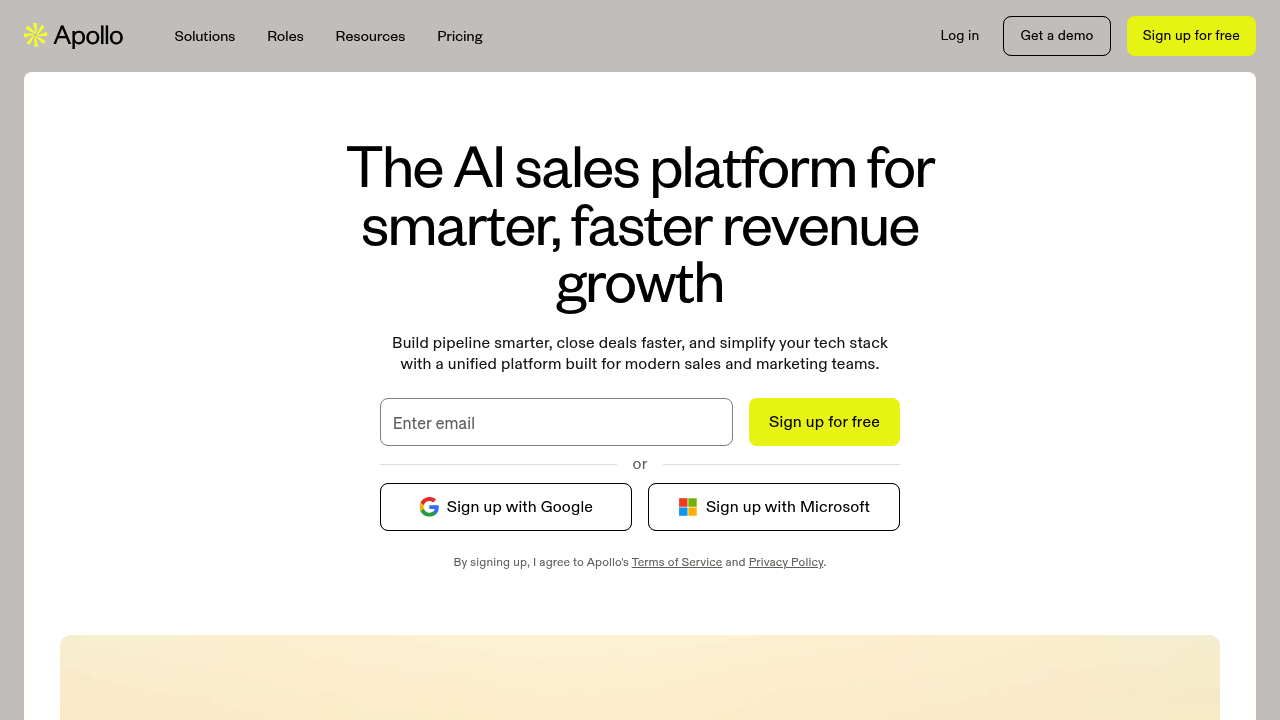 Apollo.io combines a large contact database with built-in sequencing, dialing, and email automation.
Pricing: Free plan available. Basic at $49/user/month, Professional at $79/user/month, Organization at $119/user/month (annual billing, 3-user minimum on Organization). A five-person team on Professional runs about $4,740/year, roughly a seventh of Vendr's average ZoomInfo contract.
G2 rating: 4.8/5
When to choose Apollo: You need an all-in-one prospecting and engagement platform without enterprise budget. You prioritize volume and workflow consolidation over maximum data accuracy. Compare Apollo vs Salesmotion for a detailed breakdown.
3. Cognism: EMEA-Focused Compliance and Phone Data
Best for: Teams selling into Europe who need GDPR-compliant, phone-verified contact data.
Cognism positions itself as the compliance-first alternative to ZoomInfo, with strong coverage in European markets and phone-verified Diamond Data. The platform emphasizes regulatory compliance and data quality over database size, making it the preferred choice for international teams selling into the EU and UK.
Cognism does not publish pricing. Vendr reports a median annual contract value of $36,000 across 108 purchases, with a range of $18,350 to $93,886 — the same order of magnitude as a typical ZoomInfo contract. Cognism sells Standard and Pro packages on a credit system where one credit reveals one contact, so like ZoomInfo, your real cost tracks usage.
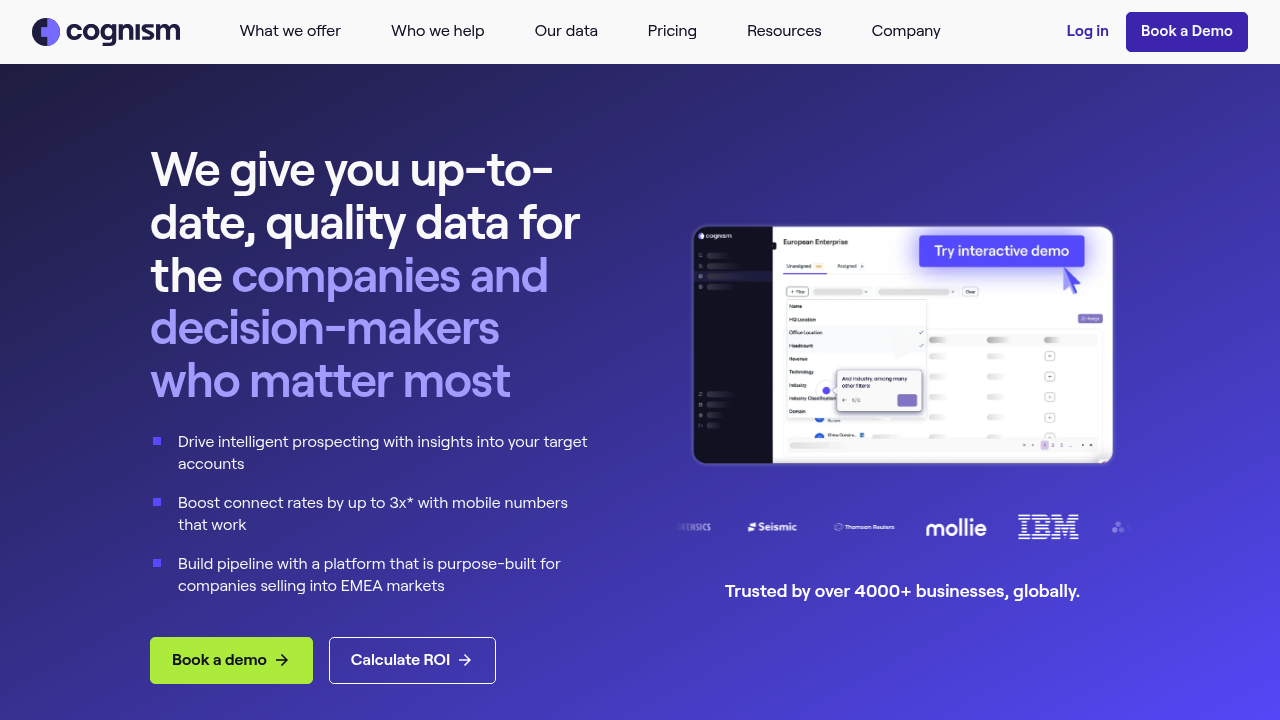 Cognism's Diamond Data provides phone-verified mobile numbers with GDPR compliance for European markets.
Pricing: Quote-based, on a credit system. Vendr's median across 108 purchases is $36,000/year. A free data sample is available before you commit.
G2 rating: 4.6/5
When to choose Cognism: Your target market includes EMEA. Your outbound motion relies on cold calling and connect rates matter more than database size. You need strict GDPR compliance.

“The moment we turned on Salesmotion, it became essential. No more hours on LinkedIn or Google to figure out who we're talking to. It's just there, served up to you, so it's always 'go time.'”
Adam Wainwright
Head of Revenue, Cacheflow
4. Lusha: LinkedIn Prospecting With Fast Lookups
Best for: SDRs and recruiters doing targeted, LinkedIn-first prospecting in North America.
Lusha built its reputation on a Chrome extension that pulls verified emails and direct dials from LinkedIn profiles in seconds. It is a favorite for reps who need rapid contact lookup without complex filtering or bulk exports.
The platform advertises 81% data accuracy, below ZoomInfo's 95% claim, across a database of 280M+ contacts. Coverage is strongest in North America and thins out in APAC and EMEA.
The credit system can get expensive at volume. An email costs one credit and a phone number costs five, so a rep who pulls both for every prospect burns through an allocation six times faster than the plan's headline credit count suggests.
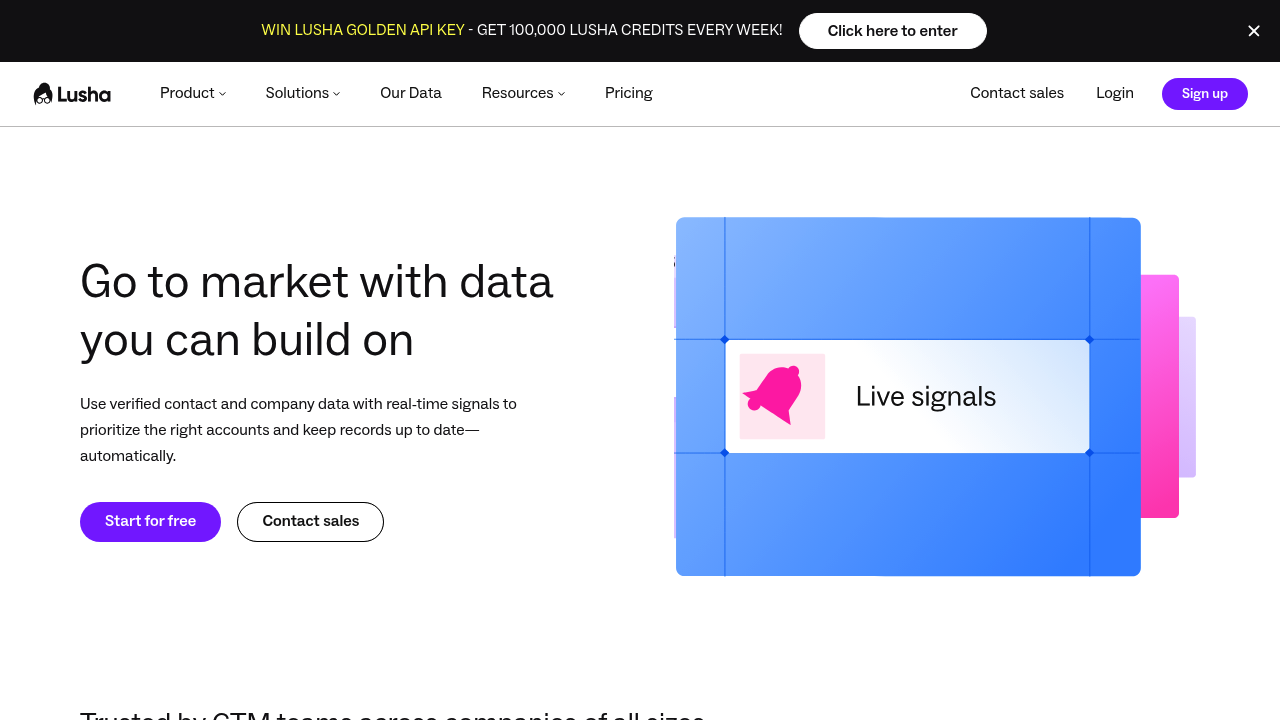 Lusha's Chrome extension reveals verified emails and direct dials directly from LinkedIn profiles.
Pricing: Free plan with 40 credits/month on one seat. Starter at $49.90/month, Pro at $69.90/month, Premium at $399.90/month (annual billing). Plans are priced per plan with seats included, not per user.
G2 rating: 4.3/5
When to choose Lusha: You do targeted LinkedIn prospecting and need fast, one-click contact reveals. You work primarily in North American markets. You do not need bulk enrichment or account intelligence.
5. UpLead: 95% Accuracy Guarantee at Transparent Pricing
Best for: Teams that prioritize data accuracy over volume and want verified contacts without credit risk.
UpLead markets a 95% data accuracy guarantee backed by real-time email verification. Every email is verified before download, so you do not pay for invalid contacts. The platform provides access to 160M+ contacts and 16M+ companies with 50+ search filters and intent data.
The real-time verification is a meaningful differentiator. Instead of discovering bad emails after burning credits and damaging sender reputation, UpLead filters them out upfront. G2 users consistently report high accuracy for both contact information and company data.
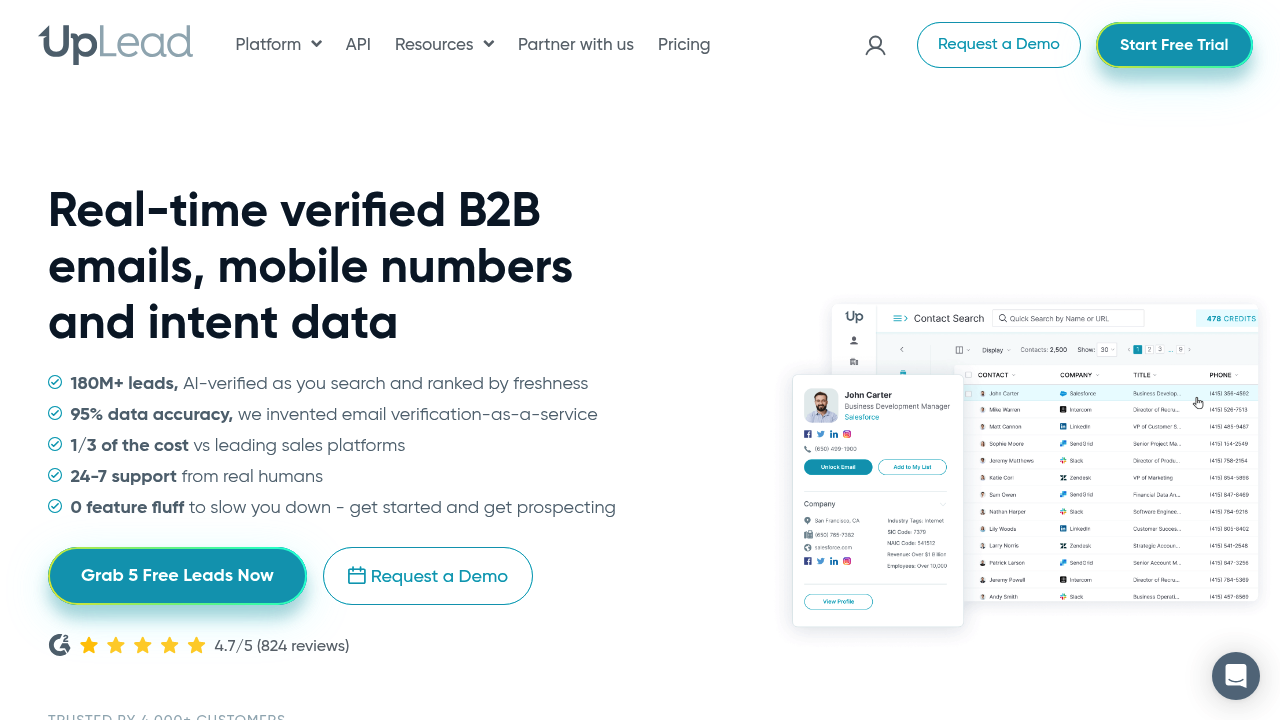 UpLead verifies every email in real time before download, backing its 95% accuracy guarantee.
Pricing: Essentials at $99/month (~170 credits). Plus at $199/month (~400+ credits). Professional at $399/month (1,000+ credits). 7-day free trial available. Roughly 85% cheaper than ZoomInfo's entry-level pricing.
G2 rating: 4.7/5
When to choose UpLead: Data accuracy is your top priority. You want a straightforward credit system with real-time verification. You need a mid-range option between Lusha's simplicity and ZoomInfo's depth.
6. RocketReach: Affordable Pay-as-You-Go Contact Lookup
Best for: Solo sellers, consultants, and small teams who need immediate access to contact data without annual contracts.
RocketReach offers transparent, published pricing with access to 700M+ contacts and 35M companies. The international database is larger than ZoomInfo's in some regions. The trade-off is depth: RocketReach excels at quick email and phone lookups but lacks technographic data, intent signals, and CRM automation.
RocketReach publishes no accuracy guarantee, where ZoomInfo claims 95%. For teams doing targeted outreach where volume is not the priority, RocketReach's affordability can offset that. You can sign up with a credit card and start prospecting in minutes.
 RocketReach provides pay-as-you-go contact lookup with a large international database.
Pricing: Essentials at $329/year ($27/month), Pro at $829/year ($69/month), Ultimate at $1,699/year ($142/month). Monthly billing runs $49/$99/$209. Annual plans include unlimited lookups; the 1,200/3,600/20,000 figures are export caps.
G2 rating: 4.5/5
When to choose RocketReach: You are a solo seller or small team. You need quick, affordable contact lookup without long-term contracts. You prioritize accessibility and speed over data depth.
7. Lead411: Growth Intent Data With Verified Contacts
Best for: Sales teams focused on ABM who need verified contacts plus intent data without enterprise-level pricing.
Lead411 combines verified B2B contact data with growth intent signals, tracking 30,000+ technologies and monitoring companies for expansion triggers like hiring surges and funding events. The platform advertises 96% data accuracy for direct dials and professional emails.
Lead411 integrates with major CRMs and includes training and support that smaller competitors charge extra for or skip entirely. A 7-day free trial with 50 exports lets teams test data quality before committing.
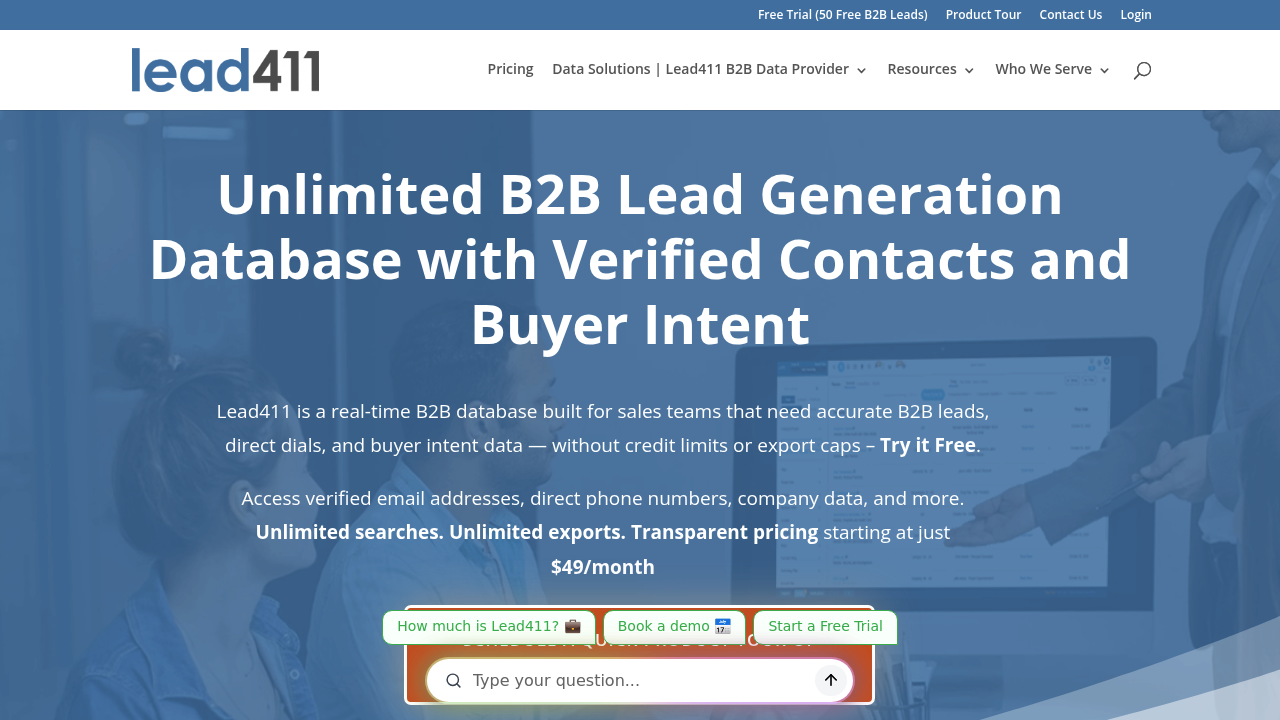 Lead411 pairs verified contact data with growth intent signals and technology tracking for ABM teams.
Pricing: Spark at $75/user/month. Ignite at ~$150/user/month. Blaze custom pricing from ~$3,000/year (all annual billing). 7-day free trial available.
G2 rating: 4.5/5
When to choose Lead411: You want intent data bundled with verified contacts at mid-market pricing. You run account-based campaigns and need expansion signals alongside contact data.
How to Choose the Right ZoomInfo Alternative
The best alternative depends on what you are actually trying to solve.
If your team spends hours Googling accounts and needs context beyond contact data, Salesmotion delivers waterfall-enriched contacts plus account intelligence and buying signal detection in a single platform with plug-and-play setup.
If you need an all-in-one platform for prospecting and engagement at startup pricing, Apollo.io bundles a large database with sequencing and dialing.
If you sell into EMEA and need GDPR compliance, Cognism's phone-verified Diamond Data is the strongest option for European markets.
If data accuracy is your top priority, UpLead's 95% guarantee with real-time verification eliminates the bounce-rate risk.
If you need affordable, no-commitment contact lookup, RocketReach and Lead411 offer pay-as-you-go and mid-market options respectively.
Most teams find that pairing a contact database (Apollo, Lusha, UpLead) with an account intelligence platform gives them both the "who" and the "why now" without paying ZoomInfo's premium, and both halves of that stack publish what they charge.
The real question is not "which tool is cheapest?" It is "which combination gives my team the data quality and workflow coverage we need without blowing the budget?" For teams sitting near Vendr's $33,500 average ZoomInfo contract and using a fraction of the feature set, the alternatives above offer a clear path to cutting costs without sacrificing buying signal detection or data quality.
Key Takeaways
- ZoomInfo does not publish a price, and Vendr's $33,500 average contract value is overkill for most mid-market teams. Several alternatives publish rate cards an order of magnitude below it.
- Waterfall enrichment (cascading lookups across multiple providers) delivers better contact coverage than any single-database approach. Look for platforms that use this method.
- Contact data alone is table stakes. The real competitive advantage comes from pairing verified contacts with account intelligence and buying signals that tell reps when and why to reach out.
- Transparent, per-account pricing without per-seat fees or annual lock-ins scales more predictably than per-seat models as teams grow, with a clear monthly contact credit allowance rather than metered research.
- Test before you commit. Most platforms on this list offer free tiers or 7-day trials. Run them against real accounts from your pipeline, not hypothetical use cases.
Frequently Asked Questions
What is the cheapest ZoomInfo alternative with good data?
Apollo.io offers the most accessible entry point with a free tier and paid plans starting at $49/user/month. For teams that need verified accuracy, UpLead starts at $99/month with a 95% accuracy guarantee. Lusha's free plan with 40 monthly credits works well for individual reps doing targeted LinkedIn prospecting. The cheapest option depends on volume: Apollo for high-volume outbound, Lusha for targeted lookups, UpLead for accuracy-first teams.
How does waterfall enrichment improve contact data quality?
Waterfall enrichment cascades contact lookups across multiple data providers in sequence. Instead of relying on one database (which inevitably has gaps), the platform checks a second, third, and fourth source until it finds a verified match. This approach delivers higher match rates and lower bounce rates than any single provider. Platforms that use waterfall enrichment, including Salesmotion, consistently deliver higher match rates and accuracy than single-source databases.
Can I replace ZoomInfo with a cheaper tool without losing data quality?
For most mid-market teams, yes. ZoomInfo's data advantage is strongest for large US enterprises. For mid-market companies, niche verticals, and international contacts, alternatives like Cognism (EMEA), UpLead (accuracy-guaranteed), and Apollo (breadth) often match or exceed ZoomInfo's coverage. The bigger question is whether you also need account intelligence and signal monitoring on top of contact data.
Should I use one tool or combine multiple alternatives?
Most high-performing teams combine two to three tools. A typical stack pairs a contact database (Apollo, Lusha, or UpLead) with an account intelligence platform that monitors buying signals and automates research. This gives reps both the contact data to reach the right people and the strategic context to know when and why to reach out, and because both tools publish their pricing you can total the cost before you talk to anyone.