Your rep gets an alert that a target biotech just raised fresh capital. On paper, that's a strong reason to reach out. In practice, the alert is only the start. Someone still has to figure out what changed, which team will feel the budget pressure first, who owns the initiative, and how to write a message that sounds informed instead of opportunistic.
That gap matters a lot in life sciences sales. Raw updates are useful, but teams typically don't lose time finding news. They lose time turning news into a relevant action. This is the true context for Zymewire vs Salesmotion. This isn't just a product comparison. It's a workflow decision.
Choosing Your Life Sciences Sales Intelligence Partner
A familiar scenario in biotech sales ops looks like this. A rep sees a funding alert, opens the company website, checks LinkedIn for new executives, scans a press release, and then jumps into Salesforce to see whether the account is already in play. Twenty minutes later, they know more than they did at the start, but they still haven't sent anything.
Meanwhile, another rep at a competing vendor has already connected the same event to a likely need. They reference the company's trial progression, mention the team buildout, and send a note to the right stakeholder while the event is still fresh.
That difference usually isn't about rep quality. It's about whether your tool stops at signal delivery or helps the team move from signal to action.

For life sciences teams evaluating sales intelligence for life sciences, the choice often comes down to two operating models. One model is built around curated biotech and pharma updates. The other is built around monitoring a wider signal set, adding context, and helping reps act inside the same workflow.
What usually breaks in the field
The trouble isn't getting alerts. The trouble is everything that comes after:
- Reps chase context manually and burn time across press releases, trial databases, job posts, and LinkedIn.
- Managers get inconsistent outreach because each rep interprets the same trigger differently.
- CRM hygiene suffers when intelligence lives in browser tabs instead of in the sales process.
- Good signals die on arrival because no one turns them into a useful point of view.
Most missed opportunities in life sciences outbound don't come from lack of data. They come from slow interpretation.
If your team only needs a focused stream of biotech developments, a specialized platform can work well. If your team needs to know what happened, why it matters, and what to send next, the bar is higher.
Zymewire
Custom (annual)
biopharma intel · annual
Salesmotion
From $85/mo
monthly contract · verified contacts included
Zymewire is a biopharma data tool. Salesmotion is broader account intelligence with signals across every industry, $85/mo to start.
- 3 AI agents on every account: signals, research briefs, drafted outreach
- Live in an hour, monthly billing, no annual contract
- Verified contacts included; CRM integration on custom team & enterprise plans
Zymewire and Salesmotion An Overview
At a high level, these platforms solve different problems.
Zymewire is a life-sciences-focused sales intelligence platform for biotech and pharma teams. It provides real-time company updates, lets users segment target lists by 150+ data points, and emphasizes human-verified AI, verified contact data, stealth-company discovery, and Salesforce integration, according to Zymewire's platform overview. That positioning tells you a lot. Zymewire is designed for teams that need a vertical tool with strong biotech and pharma relevance from the start.
Zymewire's core model
Zymewire answers the question, what just happened inside my target market.
That matters for teams selling into emerging biotech accounts, especially when they care about events like clinical movement, regulatory changes, funding activity, or stealth-company discovery. If your reps already know how to interpret those events and your managers have a disciplined follow-up process, a focused signal feed can be enough.
Zymewire is especially aligned with a narrow life sciences motion. It isn't trying to be a horizontal platform for every industry. It is trying to help biotech and pharma sellers stay close to their market.
Salesmotion's core model
Salesmotion is framed differently. It is positioned as a broader platform that monitors account activity across more signal types and turns that into account research and outreach assets, as shown in the Salesmotion product tour.
The practical difference is simple. Zymewire is closer to a specialized intelligence feed. Salesmotion is closer to a system for interpreting account movement and preparing reps to respond without assembling the whole story by hand.
The real distinction
This comparison is easiest to understand in three layers:
| Question | Zymewire | Salesmotion |
|---|---|---|
| What happened? | Strong fit for life sciences updates and account discovery | Covers life sciences signals plus broader account movement |
| Why does it matter? | Often requires rep interpretation | Built to add context and account synthesis |
| What should the rep do next? | Usually handled outside the platform | Extends into outreach preparation and workflow execution |
If your sales motion is discovery-heavy and vertically specialized, Zymewire makes sense. If your team wants intelligence to flow directly into messaging and rep action, the broader model has an advantage.

“There's been a big focus on hyper personalization and relevance in our outbounding efforts. Salesmotion has been a key partner in hitting our significantly increased meeting targets. What stands out is how simple it is. Reps can log in and get valuable account insights within 30 seconds to a minute.”
Joe DeFrance
VP of Sales, Incredible Health
Comparing Key Capabilities Zymewire vs Salesmotion
The cleanest way to compare these tools is by looking at what a rep can do after a trigger appears. That's where the operational difference shows up.
| Capability | Zymewire | Salesmotion |
|---|---|---|
| Signal types | Focused life sciences updates such as clinical, regulatory, and funding-related developments | Broader account intelligence with clinical and commercial triggers, plus earnings calls, SEC filings, job posts, leadership changes, podcasts, and tech stack changes |
| Research depth | Primarily signal delivery and company updates | AI account briefs with source attribution, executive summaries, talking points, and synthesized context |
| Contact intelligence | Present, but less central to the workflow described here | Broader contact workflow with verified contacts and enrichment-oriented motion |
| Outreach | No built-in outreach workflow described in the verified material | AI-drafted outreach anchored to verified signals |
| CRM integration | Salesforce integration | Native Salesforce and HubSpot integration |
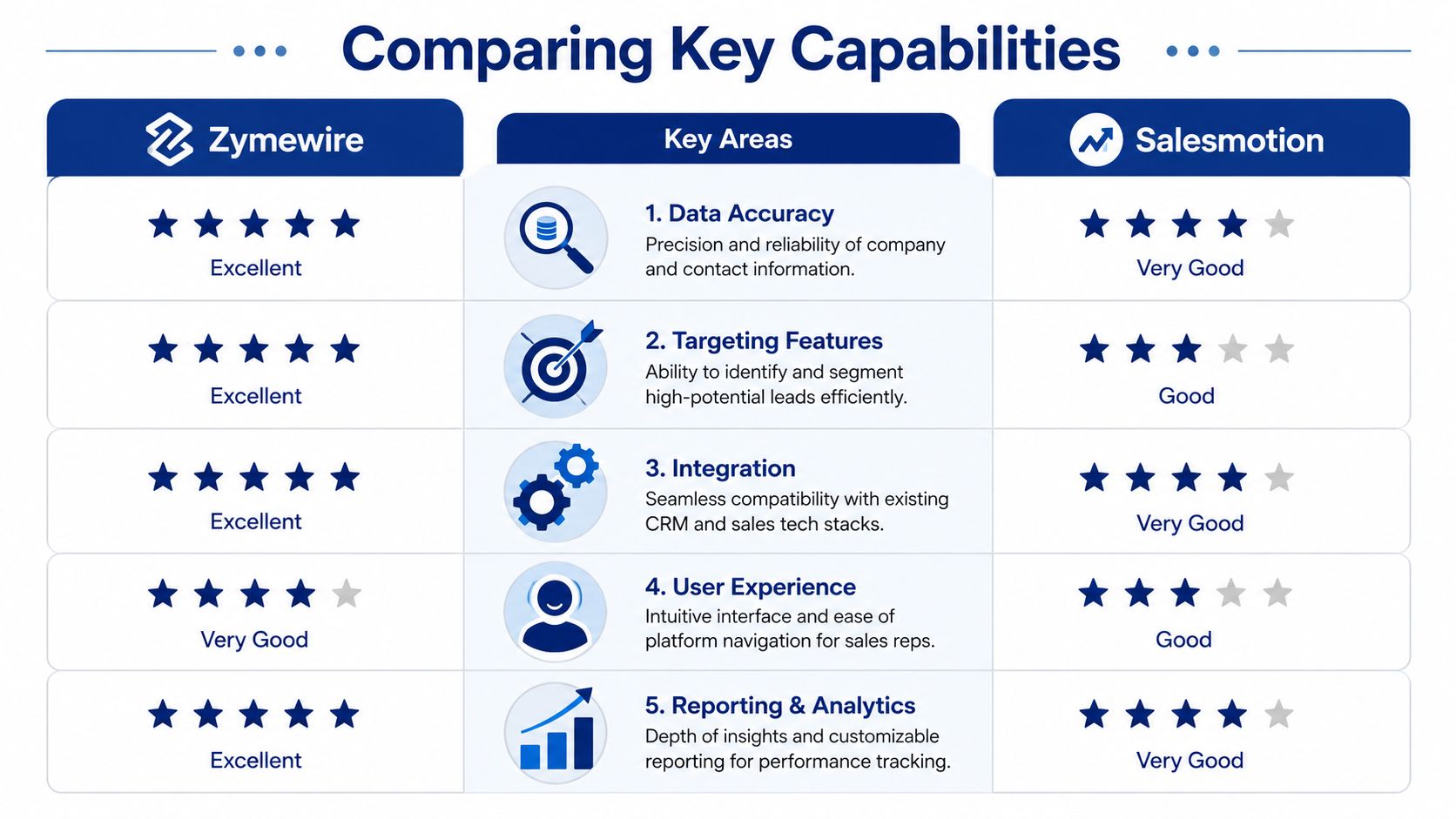
Signal coverage and trigger depth
Zymewire's strength is specialization. It is built for biotech and pharma teams and organized around the kinds of developments life sciences sellers care about most. In practical terms, that usually means a rep can stay closer to the market without relying on a general-purpose platform.
Salesmotion is positioned as a full-stack account intelligence platform that monitors 1,000+ real-time data sources 24/7, supports 50+ buying signal types, generates one-click AI account briefs with source attribution, and drafts AI outreach tied to verified signals, with native Salesforce and HubSpot integration and rollout in days rather than months, according to this capabilities comparison.
That broader architecture changes rep behavior. Instead of treating life sciences triggers as isolated events, the platform can place them next to commercial indicators like hiring, leadership shifts, and external commentary.
Research depth and synthesis
Here, many teams feel the biggest difference.
A signal by itself is not an account brief. A funding announcement may be relevant, but a rep still needs to know whether the company is building out clinical operations, moving into a new phase, hiring commercial leadership, or signaling expansion in adjacent functions.
Zymewire is more naturally suited to delivering the event. The rep or manager still has to interpret the implication.
Salesmotion is built to package that interpretation into a more complete research output. For a seller, that means less tab-hopping and less variation in account prep quality across the team.
Practical rule: If a rep still needs to open five extra tabs after reading the alert, the workflow isn't complete.
For sales ops leaders, that matters because inconsistency compounds. Top reps can always do manual synthesis. Average reps usually can't do it at speed.
Contact intelligence in the workflow
Contact quality matters in life sciences because the buying center shifts as companies evolve. The right contact for a preclinical services conversation isn't always the right contact after a financing event, a new executive hire, or a trial progression milestone.
Zymewire emphasizes verified contact data in its positioning. That's useful, especially in a market where titles change quickly and early-stage teams often have thin public footprints.
The trade-off is workflow breadth. In the author brief, Zymewire is framed as more limited on contact intelligence compared with a broader motion that includes verified contacts and waterfall-style enrichment. Even without adding unsupported specifics, the practical issue is clear. Some teams want contact data attached to the signal. Others want contact discovery and enrichment to be a deeper part of the same process.
Outreach and the last mile problem
A lot of intelligence tools stop one step too early. They help teams identify interesting accounts, then leave reps to write the first message from scratch.
That sounds manageable until you scale. Once a team is covering a large list of biotech and pharma accounts, outreach quality becomes uneven fast. Some reps know how to connect a trial update to your value proposition. Some don't. Some send a relevant note within hours. Some wait until the signal is stale.
Salesmotion is explicitly positioned to draft outreach based on verified signals. That matters because it closes the last mile between research and execution.
A rep covering life sciences accounts often needs these three things in one place:
- A trigger worth acting on
- Enough context to explain why it matters
- A usable message to the right person
If the platform gives only the first item, your team still carries a lot of manual burden.
CRM integration and operational fit
CRM integration is table stakes now. Both products support Salesforce in their positioning, and Salesmotion also cites native HubSpot integration.
The operational question isn't whether data can land in the CRM. It's whether the workflow remains intact once it gets there.
For some teams, a Salesforce-connected signal feed is enough. Managers review alerts, route accounts, and let reps handle the rest. For others, CRM integration only matters if the account context, contact path, and outreach draft move with the signal.
That distinction becomes obvious in account-based motions. If your process depends on coordinated action across SDRs, AEs, and sales ops, partial workflows create handoff friction.
What this means in practice
A biotech seller can use Zymewire effectively when the rep already knows how to read life sciences signals and doesn't mind doing the synthesis. That setup works best with experienced sellers, smaller books of business, and highly specific account lists.
A team that wants to monitor a broader set of triggers and move directly from alert to account brief to outreach will lean toward the more end-to-end model described in this guide to life sciences sales intelligence for biotech teams.
The core difference is simple. Zymewire helps you spot the event. Salesmotion is designed to help you operationalize it.
When to Choose Zymewire vs Salesmotion
The cleanest way to decide is to look at your team's actual selling motion, not the feature sheet.
“If you just need clinical trial alerts, Zymewire works. If you need to know why a signal matters and what to say about it, Salesmotion closes that gap.”
That line is directionally right because it reflects how the tools fit into day-to-day work.
Choose Zymewire if your workflow is narrow and specialist-led
Zymewire fits teams that want a life-sciences-specific signal environment and already have strong internal process around interpretation and outreach.
That usually means a few things are already true:
- Your reps know the market well. They can look at a funding event or regulatory update and quickly infer what it means for your offer.
- Your target list is tightly defined. You're not trying to monitor every possible commercial trigger across a wide account book.
- Your managers are comfortable with manual follow-up. The team has playbooks outside the platform.
- Stealth and early-stage biotech discovery matters. Zymewire's niche orientation is a real advantage here.
Independent business-data estimates put Zymewire at about $3.5 million in annual revenue with 31 employees, implying roughly $112,000 in revenue per employee, which suggests a relatively small, specialized vendor rather than a broad horizontal platform, according to Growjo's company estimate for Zymewire. For buyers, that doesn't automatically mean better or worse. It usually means focused.
Choose Salesmotion if you want signal-to-action workflow
A broader account intelligence model is a better fit when your issue isn't signal scarcity. It's execution speed and consistency.
That's the right choice when:
- Reps spend too much time interpreting alerts before they can do anything useful.
- Managers want more consistent account prep across the team.
- Your workflow spans more than biotech-only events, including hiring, leadership changes, commercial activity, or broader account movement.
- You want outreach to start closer to the trigger, not hours later after manual research.
This matters a lot in life sciences sales because the same event means different things to different sellers. A new VP hire could mean operational expansion, pre-commercial readiness, vendor review, or nothing at all. Teams that rely entirely on rep interpretation get uneven outcomes.
The practical buyer lens
Use this shortcut:
| Team situation | Better fit |
|---|---|
| You want specialized biotech and pharma discovery plus focused updates | Zymewire |
| You want a wider signal set plus synthesized research and outreach support | Salesmotion |
| Your reps are senior and comfortable doing their own synthesis | Zymewire |
| Your team needs a repeatable workflow that scales across average performers | Salesmotion |
Neither path is wrong. They solve different operational problems.

“This is my singular place that very simply summarizes a company's top initiatives, strategies and connects them to my solution. Something I would spend hours researching manually, now it's automated.”
Derek Rosen
Director, Strategic Accounts, Guild Education
Analyzing Cost and Return on Investment
The mistake buyers make with sales intelligence is treating subscription price as the whole story. In practice, the bigger cost is rep time.
If a platform gives your team a useful alert but still requires manual digging through trial registries, hiring pages, news coverage, and org-chart research, you're paying twice. Once for the software. Again in labor.
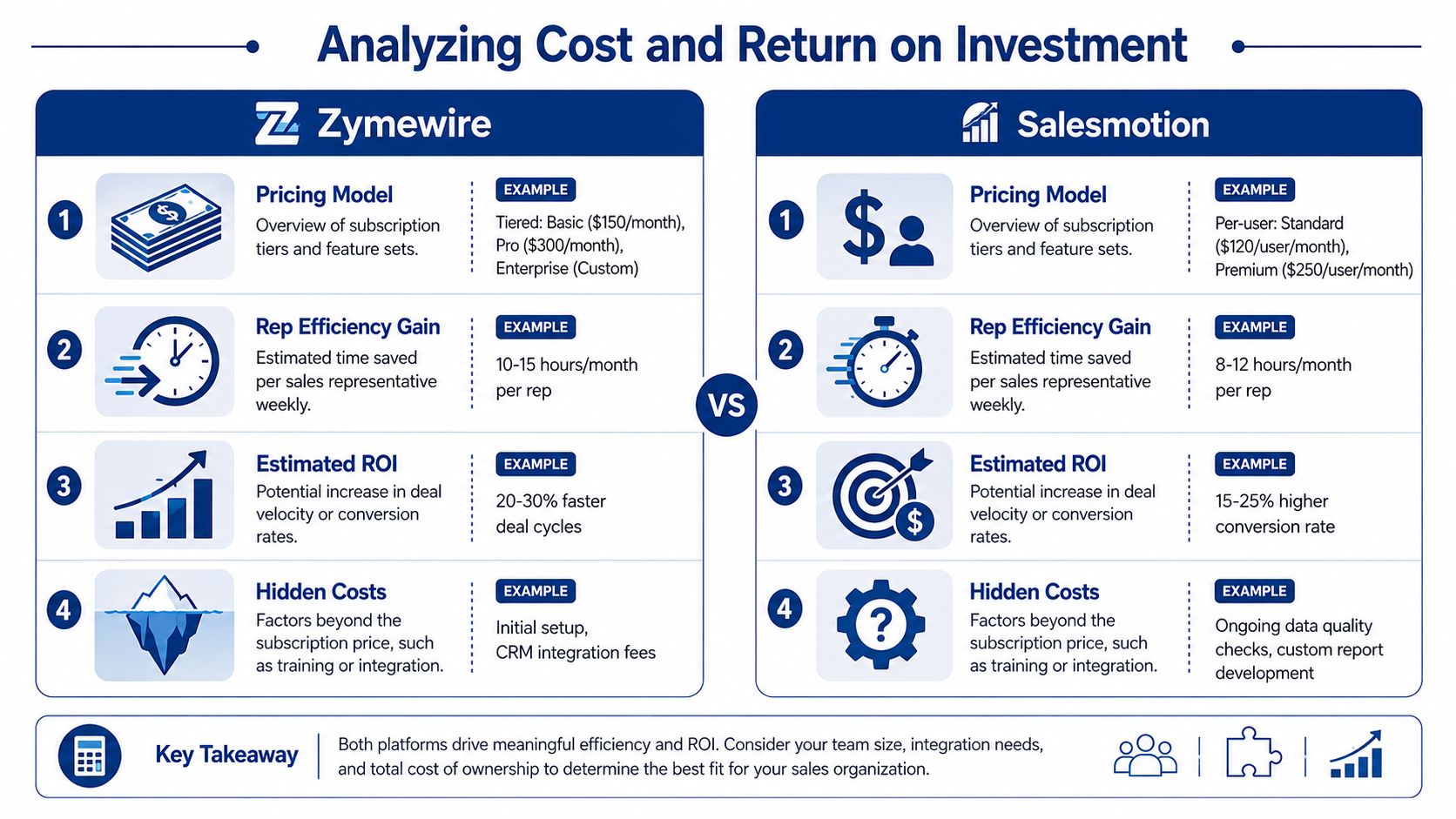
What to calculate instead of sticker price
For this category, I prefer a simple ROI question. How much does it cost your team to produce one actionable insight that a rep can use?
That calculation should include:
- Research time: How much manual synthesis still happens after the alert appears
- Contact-finding effort: Whether reps need a second tool to identify the right stakeholder
- Message creation: Whether the first-touch email starts from a blank page
- Operational drag: How much sales ops has to patch together across CRM, enrichment, and rep workflows
A focused signal platform can still deliver strong value if your team is disciplined and experienced. But if most opportunities require several manual steps after the signal lands, your true cost per usable action rises quickly.
Pricing flexibility and buying risk
The author brief calls for positioning Salesmotion as accessible, starting at $85/month with no annual lock-in. Since that figure is part of the brief but not part of the verified data set, I'm treating the comparison qualitatively rather than repeating it as a sourced market fact.
The practical distinction still holds. Some buyers prefer a specialized platform with a more traditional enterprise buying motion. Others want lower commitment and faster experimentation, especially if they're testing whether signal-driven selling will stick across the team.
A useful way to think about it is this:
A cheaper tool isn't cheaper if your reps still do the expensive part by hand.
In the context of teams evaluating spend discipline, a broader workflow platform can justify itself. If the software replaces multiple manual steps, the ROI conversation gets easier. For teams that only want a focused biotech alerting layer, the narrower option can be completely rational.
For a cost framework that digs into software spend beyond headline pricing, this breakdown of sales intelligence cost considerations is a useful lens.
The Final Verdict and Implementation Path
Zymewire is a strong fit for life sciences teams that want a specialized biotech and pharma intelligence environment. Its niche focus is real, and that focus becomes especially relevant if your team cares about early-stage discovery and hard-to-find accounts. Zymewire's own analysis says there are nearly 8,000 stealth biotechs worldwide, which reinforces the value of a platform built around that specific opportunity set, as noted on Zymewire's solutions page.
The decision comes down to workflow shape
If your process begins with alerting and your reps are comfortable doing the rest, Zymewire is a sensible choice. It gives specialist teams a focused starting point.
If your process needs to move faster from event to account context to outreach, the broader model is usually the better operational fit. That matters most when you want average reps to perform more like senior reps, or when managers need a more repeatable way to prioritize and act across a large set of accounts.
What tends to work after purchase
Whichever route you choose, implementation succeeds when you make three decisions early:
- Define your trigger list. Pick the handful of events that actually correlate with buying windows for your offer.
- Tie intelligence to owners. Every alert should have a next step and a person responsible.
- Standardize the follow-up motion. If reps all interpret signals differently, the platform won't fix inconsistency on its own.
The best summary is simple. In Zymewire vs Salesmotion, you're choosing between a specialized signal feed and a signal-to-action workflow. For life sciences teams that already know how to turn updates into outreach, Zymewire can do the job. For teams trying to reduce manual research and make action easier at scale, the broader workflow approach is the stronger fit.
If you're evaluating whether a signal feed is enough or your team needs a fuller signal-to-action workflow, take a closer look at Salesmotion and compare it against your current rep process, not just your feature checklist.