Sales intelligence costs anything from free to six figures a year: contact-data tools publish prices from free to about $120 per seat a month, Salesmotion's Individual plan is $85 a month, and the enterprise platforms (ZoomInfo, 6sense, Demandbase) publish nothing, with Vendr reporting median contracts of $33,500 to $68,591 a year. Apollo.io, writing on Stacker, puts average spend at $1,200 per rep a year on sales tools, with 67% of purchased features unused. Fortune Business Insights expects the sales intelligence market to grow from USD 5.37 billion in 2026 to USD 12.45 billion by 2034. Vendors know budgets are growing, and pricing structures have become deliberately complex: per-seat fees, credit systems, platform charges, and add-on modules all make it harder to compare apples to apples.
This guide strips away the complexity. If you are still deciding whether you need the category at all, start with what sales intelligence is. We break down what 11 sales intelligence platforms actually cost, expose the hidden fees most vendors bury in contracts, and give you a framework to calculate real ROI before you sign anything.
TL;DR: Sales intelligence costs range from free tiers to six-figure ABM contracts depending on team size, data needs, and platform scope: and most of the enterprise end publishes no pricing at all. Per-seat pricing punishes growing teams. Credit-based models create unpredictable costs. Flat-rate, per-organization pricing gives you cost certainty. Always calculate total cost of ownership, not just the sticker price.
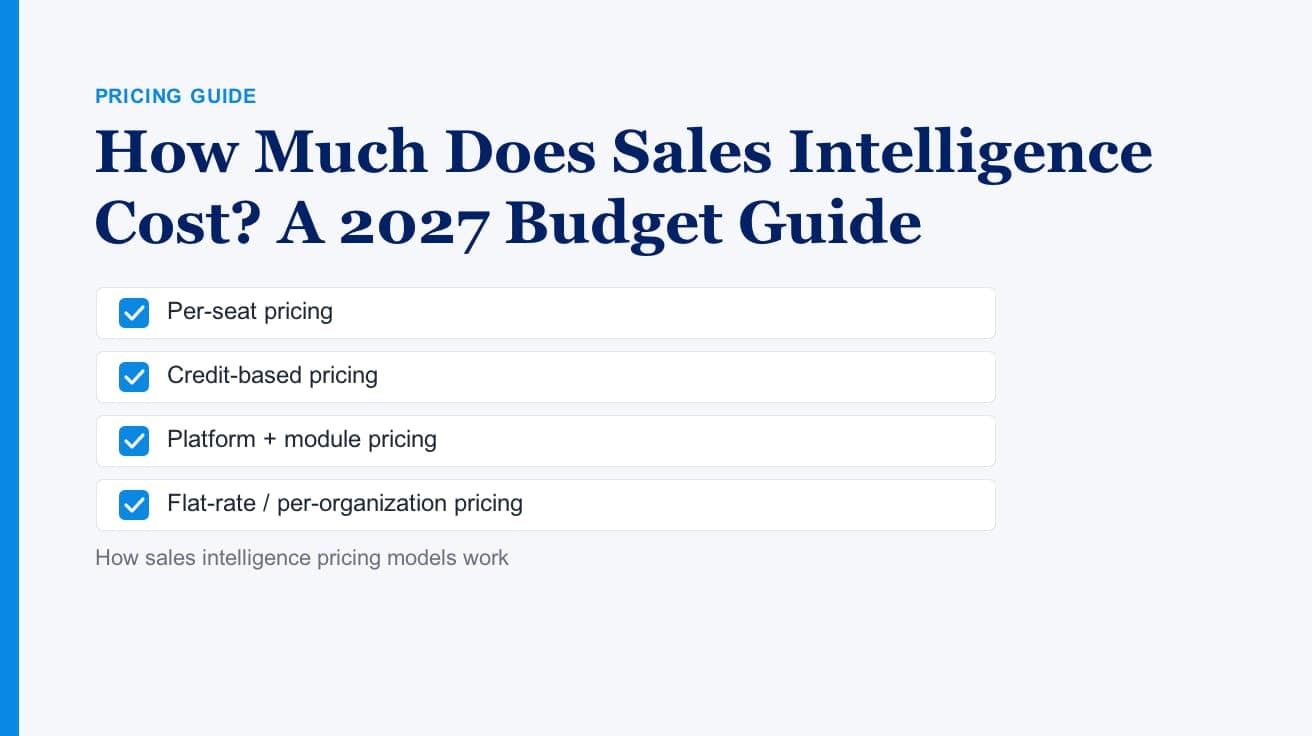
How Sales Intelligence Pricing Models Work
Before comparing specific platforms, you need to understand the four pricing models vendors use. Each has trade-offs that affect your total spend differently as your team scales.
Per-Seat Pricing
The most common model. You pay a base fee per user per month or year. Sounds simple, but it creates a perverse incentive: teams limit access to control costs, which means the intelligence you are paying for reaches fewer reps. A 20-person sales team at $1,500/seat/year already hits $30,000 before adding a single credit or premium feature. When you hire five more reps next quarter, the bill jumps instantly.
Credit-Based Pricing
You buy a pool of credits that get consumed when reps export contacts, enrich records, or run searches. The sticker price looks low, but usage spikes create surprise overages. One aggressive prospecting week can burn through a month's credits. Teams either under-use the tool to conserve credits or scramble for budget mid-quarter.
Platform + Module Pricing
Enterprise vendors like 6sense and Demandbase sell packaged configurations rather than a single list price. Demandbase describes a platform fee plus a flat fee per user, and 6sense sells Sales Intelligence in combinations with data credits and predictive AI. Neither publishes dollar amounts, so the total only becomes clear once you have a quote.
Flat-Rate / Per-Organization Pricing
The simplest model: one price for your entire team, regardless of headcount. No per-seat taxes, no credit metering. Every rep gets full access. This model is rare in sales intelligence, but it eliminates the cost-per-rep calculation entirely.
What Does Sales Intelligence Actually Cost? A Platform-by-Platform Breakdown
Here is what you will actually pay across 11 major platforms. These figures are based on each vendor's public pricing page and Vendr's marketplace data as of October 2026.
| Platform | Starting Price | Pricing Model | Per-Seat Cost | Credit System | Contract |
|---|---|---|---|---|---|
| ZoomInfo | Not published | Consumption-based | Not published | Yes (consumption credits) | Annual subscription |
| Apollo.io | Free-$119/mo/seat | Per-seat + credits | $49-$119/mo/seat (annual) | Yes (1 credit per email, 8 per phone number) | Monthly or annual |
| 6sense | Not published | Sales Intelligence packages with data credits | Not published | Data credits | Not published |
| Cognism | Not published | Credit-based packages | 5 seats included per package | Yes (1 credit = 1 contact) | Not published |
| Lusha | Free; Starter $37.45/mo, Professional $52.45/mo (annual) | Credit-based plans | Priced per plan | Yes (contact reveals) | Monthly or annual |
| Clay | Free; Launch $185/mo, Growth $495/mo | Usage-based | $0 (unlimited seats) | Yes (Actions and Data Credits) | Monthly or annual |
| Demandbase | Not published | Platform fee + per-user fee | Flat fee per user | Not published | Not published |
| UserGems | Core $40,000/yr | Tiered by credits | $0 (unlimited users) | Yes (credit tiers) | Priced per year |
| Common Room | Essential $2,500/mo (billed annually) | Per-org tiers | 5 seats included | Contact caps per tier | Annual |
| Pocus | Not published | Waitlist only since Apollo's March 2026 acquisition | n/a | n/a | n/a |
| Salesmotion | Individual $85/mo; custom for teams | Individual (up to 100 accounts) or team plans priced on account volume | $0 on team plans (unlimited users) | 200 contact credits/mo on Individual | Monthly (Individual) |
What the Numbers Hide
Half the table says "not published," and that is the first thing to notice. Actual costs diverge in three key ways.
First, ZoomInfo publishes nothing: its own pricing page says so, because pricing is consumption-based. The closest thing to a public benchmark is Vendr's marketplace data, which reports a median contract of $33,500 a year based on 1,576 purchases. Your quote will depend far more on credit volume and modules than on seat count.
Second, Apollo's free tier is useful for individual prospectors, but teams outgrow it fast: it allows 900 credits per seat a year, and an email reveal spends one credit while a phone number spends eight. Once you need unlimited sequences, AI lead scoring and unlimited daily sends, you are on Basic or Professional. A 15-person team on Professional pays $14,220 annually on annual billing, and that number scales linearly with every new hire.
Third, 6sense and Demandbase rarely sell standalone products. Most enterprise deals bundle intent data, display advertising, orchestration, and analytics, and neither publishes a rate card. Vendr reports a median of $62,220 across 386 6sense purchases and $68,591 across 187 Demandbase purchases, with Demandbase contracts ranging from $24,000 to $164,037: a spread that says more about module selection than about company size.

“The Business Development team gets 80 to 90 percent of what they need in 15 minutes. That is a complete shift in how our reps work.”
Andrew Giordano
VP of Global Commercial Operations, Analytic Partners
Hidden Costs Most Buyers Miss
The sticker price is rarely the whole first-year cost. Here is what vendors rarely volunteer upfront.
Implementation and Onboarding
Enterprise platforms often require professional services for implementation. Apollo's Stacker piece puts implementation at typically 20-30% of the annual cost for initial setup, CRM integration, and data mapping, and UserGems, one of the few vendors that publishes it, lists one-time implementation fees of $3,000 to $10,000 by tier. Some vendors include basic onboarding in the contract; others charge separately. Ask specifically: "What does onboarding cost, and what does it include?"
Integration and Maintenance
Keeping your sales intelligence tool connected to your CRM, marketing automation, and data warehouse often costs 20-30% of your total tech spend in ongoing maintenance, by the same Stacker estimate. Broken syncs, API rate limits, and schema changes create hidden labor costs for your RevOps team.
Credit Overages and Top-Ups
Credit-based platforms create a use-it-or-lose-it dynamic. Run out of credits mid-quarter and you either stop prospecting or buy an emergency top-up. ZoomInfo publishes no dollar amounts and Apollo credits expire at the end of each billing cycle, so get the per-credit top-up price in writing before you sign: it is the single most common surprise on a first-year invoice.
Renewal Price Increases
Annual contracts often include automatic price increases at renewal. Vendr puts typical ZoomInfo annual price escalation clauses at 5-10%, and the clause is easy to miss in contract terms. Compounded over a three-year term, that turns a $25,000/year contract into roughly $30,000.
Training and Adoption
A tool your reps do not use is the most expensive tool you own. Budget real training time per rep for complex platforms, and factor in the productivity dip while reps learn the system (Stacker's estimate is four to eight weeks). Simpler tools with faster time-to-value reduce this hidden cost significantly. Cacheflow went from contract signature to full platform utilization in 24 hours.
Seat Bloat
Per-seat models create an uncomfortable choice: pay for seats your team does not fully use, or restrict access and limit the intelligence's reach. Many organizations over-buy seats to accommodate new hires and cross-functional users (marketing, customer success, executives) who need occasional access.
How to Calculate Sales Intelligence ROI
Before signing any contract, run this framework against your own numbers. The goal is not to justify a purchase but to honestly assess whether the investment pays back.
Step 1: Quantify Current Research Cost
Calculate how much time your reps spend on manual account research today. Be specific.
- Hours per rep per week on research: ___
- Fully loaded cost per rep per hour: ___
- Number of reps doing research: ___
- Annual research labor cost = Hours x Cost x Reps x 50 weeks
For a team of 15 reps spending 4 hours/week on research at $75/hour fully loaded, that is $225,000/year in research labor alone.
Step 2: Estimate Time Savings
Use your own before-and-after measurements where you can. Published customer results give a range:
- Cytel cut research time by 50%
- Analytic Partners reduced research time by 85% after adopting Salesmotion
- Frontify reduced research time by 90%
Using the example above, an 85% reduction saves $191,250 in annual research labor.
Step 3: Factor in Revenue Impact
Reps who spend less time researching spend more time selling. Measure:
- Additional selling hours recovered per rep per week
- Historical conversion rate from meetings to pipeline
- Average deal size and win rate
Frontify saw a 42% increase in sales velocity and a 35% higher win rate after shifting reps from manual research to signal-driven selling. Even a 10% improvement in deal velocity across a $5M pipeline adds $500,000 in accelerated revenue.
Step 4: Calculate Total Cost of Ownership
Add up every cost component:
- Annual license/subscription fee
- Per-seat costs for your current and projected team size
- Estimated credit usage and potential overages
- Implementation and onboarding fees
- Integration maintenance (internal labor or vendor fees)
- Training time cost
Step 5: Compare Net ROI
Net ROI = (Research savings + Revenue impact) - Total cost of ownership
A useful rule of thumb is to look for a platform that costs well under the research labor it replaces. If a platform costs $50,000/year but saves $191,000 in research labor and drives measurable pipeline improvement, the payback period is under three months.
The inverse is also true. If a six-figure ABM deployment only saves $40,000 in labor because your team uses 30% of the features, the ROI is negative.

“The moment we turned on Salesmotion, it became essential. No more hours on LinkedIn or Google to figure out who we're talking to. It's just there, served up to you, so it's always 'go time.'”
Adam Wainwright
Head of Revenue, Cacheflow
Choosing the Right Pricing Model for Your Team
The best platform is not always the cheapest one. It is the one whose pricing model aligns with how your team operates.
Choose per-seat if your team is small (under 5 reps), stable, and you want granular control over who has access.
Choose credit-based if your usage is predictable and concentrated among a few power users. Track monthly credit consumption for at least one quarter before committing to an annual plan.
Choose platform + modules if you need ABM orchestration, display advertising, and intent data in one stack, and you have the budget and RevOps resources to fully deploy it.
Choose flat-rate or per-organization pricing if you want every rep, manager, and cross-functional team member to have full access without worrying about incremental cost. This model works best for growing teams where headcount changes quarter to quarter. Salesmotion publishes its Individual plan at $85/month on a monthly contract (up to 100 accounts and 200 contact credits a month); team plans are priced on account volume with unlimited users, so the per-person cost drops as the team grows.
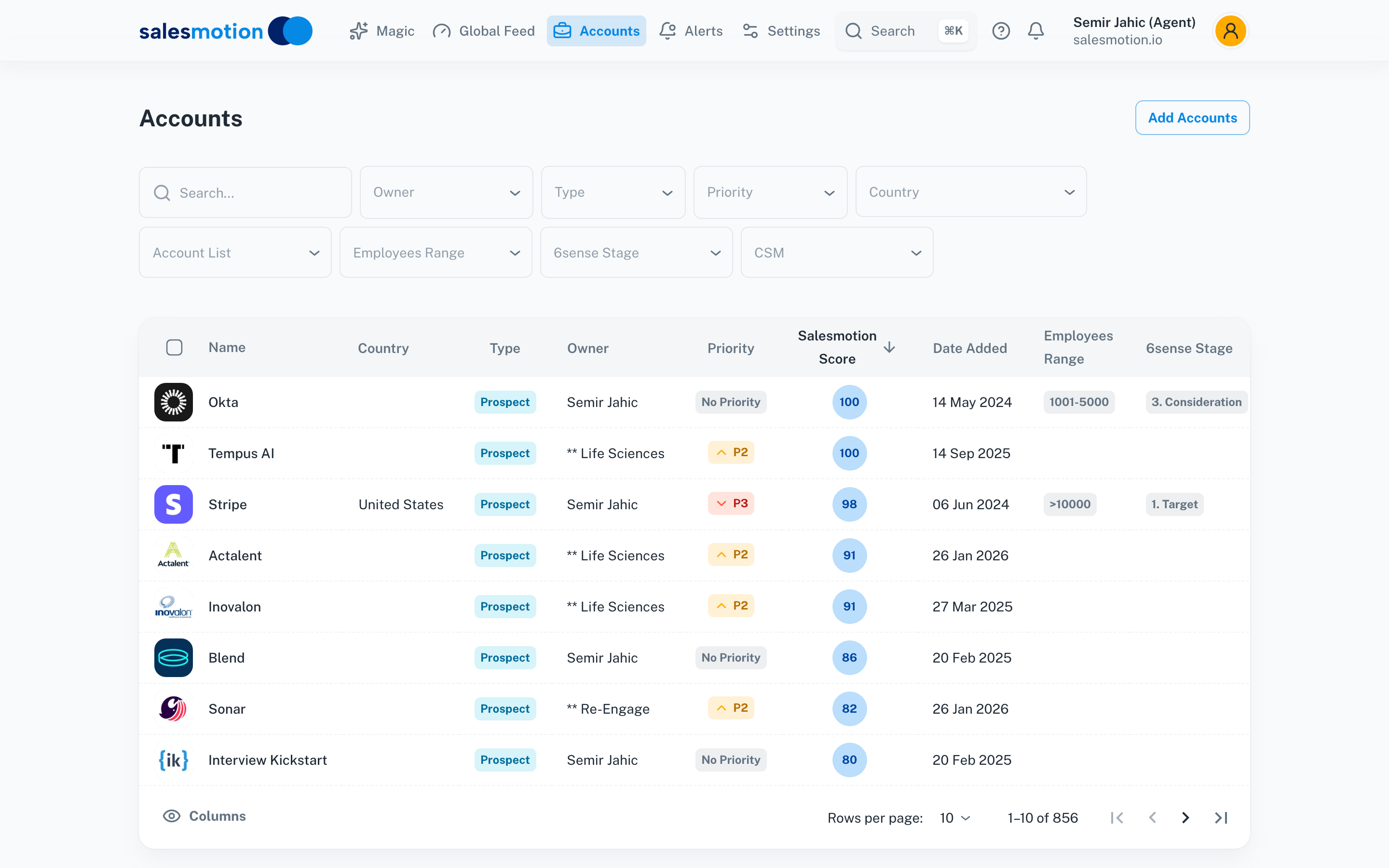 The Salesmotion accounts view: every monitored account with an owner, a priority and a Salesmotion score.
What to Ask Vendors Before You Sign
Regardless of which platform you evaluate, ask these eight questions during the sales process. The answers will reveal the true cost and protect you from surprises.
- What is the total annual cost for my team size, including all fees? Get a single number, not a build-your-own quote.
- What happens when I exceed my credit allocation? Ask for the per-credit overage rate in writing.
- What are the renewal terms? Specifically: is there an automatic price increase, and what is the cancellation notice window?
- What does implementation cost? Separate from the license fee. Include CRM integration, data migration, and training.
- How long until my team is fully productive? Ask for average time-to-value from their customer base, not their marketing site.
- Can I add seats mid-contract without re-quoting? Per-seat vendors often require a full contract amendment for seat changes.
- What is included versus what is an add-on? Intent data, enrichment, org charts, and buying signals are often sold as premium modules.
- Do you offer a pilot or proof-of-value period? Test the platform against your actual accounts before committing to a 12-month contract.
Key Takeaways
- Sales intelligence platforms cost anywhere from $0 (limited free tiers) to six figures a year for enterprise ABM suites. The range is vast because pricing models differ fundamentally: and because the vendors at the top of the range publish nothing, leaving Vendr's aggregated contract data as the only public benchmark.
- Per-seat pricing punishes growing teams. A 20-person team paying $1,500/seat already spends $30,000 before credits or add-ons.
- Hidden costs (implementation, credit overages, renewal uplifts, integration maintenance) add materially to the sticker price; get each one quoted.
- Calculate ROI using your actual research hours, rep costs, and pipeline data, not vendor-supplied benchmarks. Target a platform cost well below the research labor it replaces.
- Flat-rate and per-organization pricing remove per-seat math. Salesmotion's pricing starts at $85/month for an individual on a monthly contract; team plans are priced on account volume with unlimited users.
- Always get total cost of ownership in writing before signing, including overages, renewal terms, and implementation fees.
Frequently Asked Questions
How much does sales intelligence software cost on average?
Costs vary widely by platform type. Basic contact data tools publish their prices: Lusha runs from a free plan to $299.95/month for Premium on annual billing, and Apollo from free to $119/user/month. The enterprise end does not: ZoomInfo, 6sense and Demandbase all quote per organization, and the only public benchmarks are Vendr's aggregated contract medians: $33,500, $62,220 and $68,591 respectively. Fortune Business Insights puts market growth at an 11.1% CAGR through 2034.
Is per-seat or per-organization pricing better for sales teams?
Per-organization pricing is better for most growing teams. Per-seat models create a direct tension between cost control and intelligence distribution. When budget holders restrict seats to save money, they limit the tool's impact. Flat-rate models with unlimited users on team plans remove this trade-off. Every rep, SDR, manager, and executive gets full access without incremental cost.
What hidden costs should I expect with sales intelligence platforms?
The most common hidden costs are implementation fees (often 20-30% of the annual cost for enterprise platforms), credit overages (get the per-credit top-up price in writing on credit-based platforms such as ZoomInfo and Apollo), renewal price increases (Vendr puts ZoomInfo's typical annual escalation clause at 5-10%), integration maintenance (20-30% of total tech spend), and training/adoption time. Always request a total cost of ownership breakdown that includes all fees beyond the base license.
How do I calculate ROI for a sales intelligence tool?
Start by quantifying your current research cost: hours per rep per week multiplied by fully loaded hourly cost multiplied by team size multiplied by 50 weeks. Then estimate the time savings a platform provides (published customer results range from 50% to 90%). Add the revenue impact from faster deal cycles and higher win rates. Subtract the total cost of ownership. Look for a platform cost well below the research labor savings. See the detailed ROI framework above for a step-by-step walkthrough.
Why do some sales intelligence platforms cost so much more than others?
Price differences reflect scope. A Lusha Starter plan at $49.90/month on monthly billing gives you contact data reveals. A 6sense deployment, median contract $62,220 according to Vendr, gives you intent data, account scoring, advertising orchestration, and predictive analytics. The question is not which costs more but which capabilities you actually need. Many teams over-buy enterprise platforms, using a fraction of the features they pay for. Match your purchase to your actual use case, not your aspirational tech stack.