The best life sciences sales intelligence tools are Salesmotion for teams that sell into biotech and pharma and need trial, regulatory and funding signals turned into account briefs and outreach, GlobalData for a broad pharma research platform with a sales intelligence product on top, and Citeline for the deepest curated pipeline, trial and investigator data. Cortellis and DRG, Evaluate, AlphaSense, IQVIA, Definitive Healthcare and ZoomInfo each cover a more specific job, from consensus drug forecasts to healthcare provider data and general B2B contacts. Salesmotion is the only option here with a published subscription price; ZoomInfo has a free Lite tier, and the rest quote on request.
TL;DR: Pick Salesmotion if you sell software, lab services, CRO or CDMO services into drug developers and want signals, cited account briefs and contacts in one workflow, from $85 a month. Pick GlobalData if you want a pharma research platform with analyst-backed datasets, an AI sales analyst and delivery into your CRM or data warehouse. Pick Citeline if your team needs curated drug pipeline, clinical trial and investigator data for BD and trial planning. The others are strong for forecasting (Evaluate), R&D and market access research (Cortellis and DRG), document research (AlphaSense), commercial analytics (IQVIA), provider data (Definitive Healthcare) and broad contact data (ZoomInfo).
| Top pick | Best for | Starting price |
|---|---|---|
| Salesmotion | Teams selling into biotech and pharma that need signals, briefs and contacts | $85/mo |
| GlobalData | Pharma research with a sales intelligence product | Custom, demo-gated |
| Citeline | Curated pipeline, trial and investigator data | Custom, enterprise-only |
If you're selling into biotech, you know the pain of chasing buying signals across ClinicalTrials.gov, SEC filings, FDA dockets, and LinkedIn. By the time you piece everything together manually, the opportunity has moved to a competitor who showed up first with the right context.
Biotech and pharma sales intelligence tools solve this problem by monitoring the signals that indicate purchase readiness, such as Phase II transitions, FDA submissions, leadership changes, funding events and clinical milestones, and delivering them in one place so your team can act when it matters.
Why Trust This Guide?
Every price and product fact in this guide was checked against the vendor's own website on 10 October 2026. Where a vendor publishes no price, the guide says so and does not estimate. Where a figure comes from a third party, the third party is named in the same sentence.
Salesmotion publishes this guide and is listed first. Salesmotion sells dedicated Life Sciences plans, and the list is ordered for one specific buyer: a commercial team that sells products or services to drug developers. If your job is market analysis, forecasting or engaging healthcare providers, a tool further down the list is the better choice, and each review says when.
The first-party angle comes from our own conversations. We sat in 55 sales and customer calls between August and October 2026, 17 of them with life sciences teams. The recurring theme was timing: reaching a sponsor before the vendor decision is made.
"if we reach out too late, I don't care how well my messages ... If they've already signed for like their phase two study, they're just not going to be interested." Business development rep, CRO
The second theme was the number of places a rep has to look before making a call.
"it's a whole lot of Frankensteining ... having to go to multiple sources just to confirm each step of the way" Business development rep, CRO
The order of the list is based on fit for that buyer. Tools built around a selling motion come first. Research databases follow, ordered by how directly their data helps a seller choose and time an account. Commercial analytics, provider data and general contact data close the list.
See Salesmotion on a real account
Book a 15-minute demo and see how your team saves hours on account research.
Quick comparison: biotech sales intelligence tools at a glance
| Tool | Best for | Standout capability | Pricing | Free plan or trial |
|---|---|---|---|---|
| Salesmotion | Teams selling software, lab, CRO or CDMO services into drug developers | Trial, regulatory and funding signals with cited account briefs | $85/mo single seat; Life Sciences bundle $200/mo | Interactive demo |
| GlobalData | Pharma research plus sales intelligence | Analyst-backed datasets with an AI sales analyst | Custom, demo-gated | Trial on request |
| Citeline | BD, competitive intelligence and trial planning | Pharmaprojects, Trialtrove and Sitetrove | Custom, enterprise-only | None listed |
| Cortellis and DRG | R&D, regulatory and market access research | Seven Cortellis intelligence modules | Custom, enterprise-only | None listed |
| Evaluate | Forecasting and asset valuation | Consensus forecasts for almost 6,000 drugs | Custom, enterprise-only | None listed |
| AlphaSense | Research across filings, broker reports and expert calls | 500+ million searchable documents | Custom; annual subscriptions | Free trial |
| IQVIA | Commercial teams at established biopharma | OneKey HCP and HCO reference data | Not published; quoted on request | Not stated |
| Definitive Healthcare | Teams targeting providers and health systems | Reference, affiliation and claims data | Does not publish pricing | Not stated |
| ZoomInfo | Broad B2B contact coverage | 500M+ contacts with org charts | Custom, consumption-based | ZoomInfo Lite, 10 credits a month |
RxDataLab and BioCentury's BCIQ, which earlier editions of this list reviewed, also serve this space.

“Salesmotion is helping Cytel elevate our enterprise sales performance by embedding account intelligence directly into our workflow. The platform gives our commercial team real-time visibility into key account movements.”
Jonathan Burr
Chief Commercial Officer, Cytel
The 9 best life sciences sales intelligence tools, reviewed
1. Salesmotion
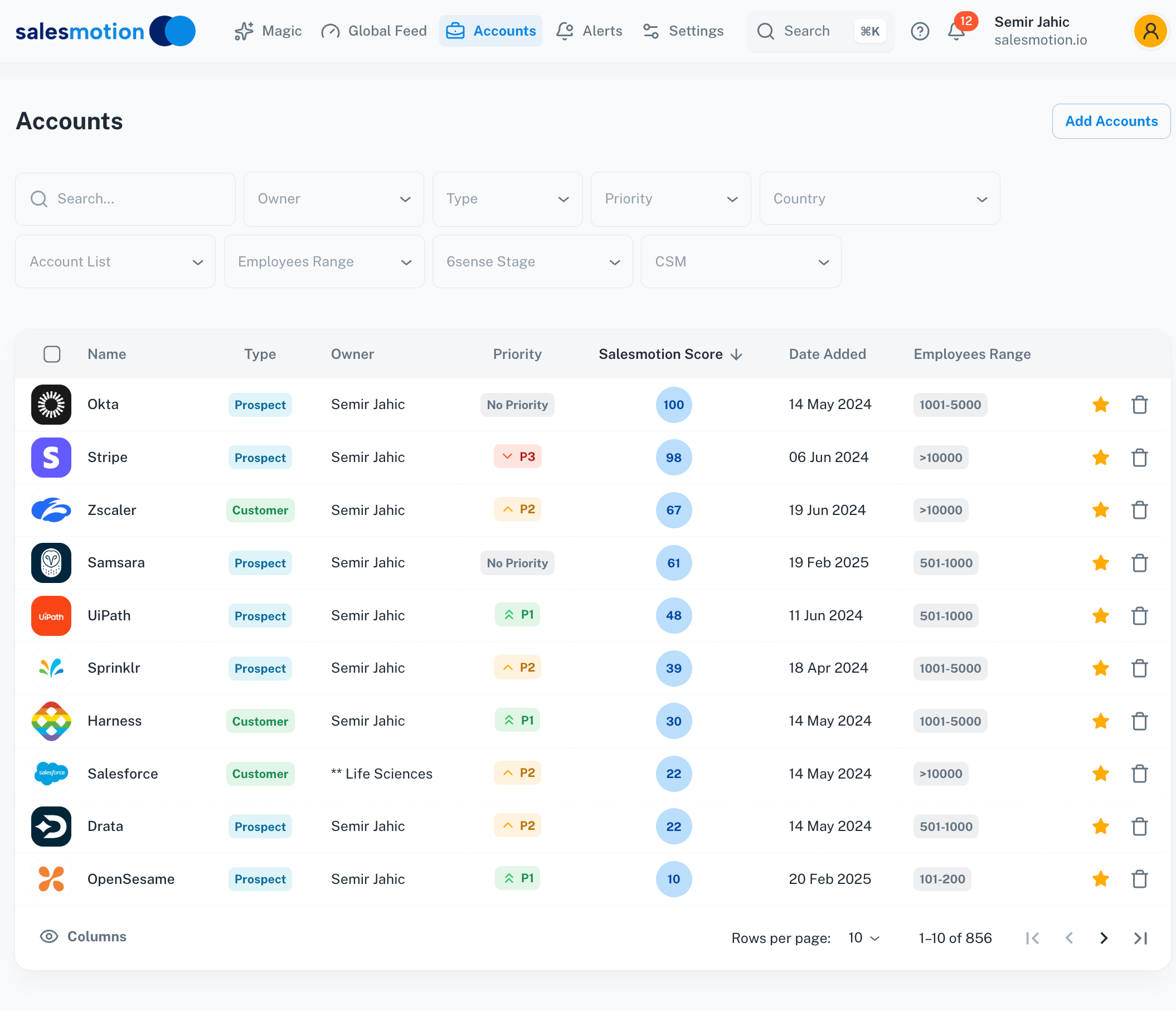 Salesmotion shows which biotech accounts have new buying signals, drawn from 1,000+ public sources.
Salesmotion is account intelligence for sales teams that sell into biotech and life sciences. The Signal Agent monitors 1,000+ public sources, including ClinicalTrials.gov, FDA databases, SEC filings, earnings calls, press releases, podcasts and job boards, to detect clinical milestones, regulatory events, hiring signals and funding rounds on the accounts you track.
Best for: Account-based sales teams selling software, lab services, CRO or CDMO services, or consulting into drug developers who need always-on monitoring and fast, research-backed outreach.
What it is strong at: Turning an event into a reason to call. Trial starts, phase transitions, readouts, approvals and financing are tracked per account, with the source cited on each signal. The Research Agent synthesizes those sources into account briefs that cite pipeline progress, recent leadership moves, therapeutic focus areas and strategic initiatives mentioned on earnings calls. The Outreach Agent then drafts messaging anchored to the trigger for a rep to review.
On the Life Sciences plans, Discover builds the account list with you: filter drug developers by therapeutic area, highest phase, modality and HQ country, save the search so new programs appear as they register, and add the matches to a tracked list. Modality covers small molecules, biologics, cell, gene, RNA, vaccines and radiopharmaceuticals. Contacts come by function across clinical operations, outsourcing and CMC, with email and phone enrichment. Signals and account context sync into Salesforce, HubSpot gets quick-links from the account, and an API and MCP server serve teams that want the data in their own tools.
Cytel, a leader in clinical trial analytics software, cut account research time by 50% using Salesmotion. Instead of reps searching each biotech account by hand and skimming trial databases, the platform surfaces which companies advanced a Phase III oncology trial or hired a new VP of Clinical Operations, the signals that indicate readiness to invest in trial design or statistical software.
Pricing: Published and monthly. A single seat is $85 a month for 100 accounts and 200 contact credits. The Life Sciences bundle is $200 a month for 200 tracked accounts and around five seats, with sponsor discovery included. The Life Sciences package is $500 a month for 500 tracked accounts and up to 20 users, and extra accounts are $1 per account per month in blocks of 100.
Choose it if: you carry a book of biotech and pharma accounts and the job is knowing which ones changed this week and what to say. Research databases go deeper for an analyst; Salesmotion is built around the specific reason to contact a specific person now. It is especially useful for teams with large account books (500+ accounts) who cannot track every biotech by hand.
2. GlobalData
GlobalData describes its pharma offering as a connected intelligence platform. Modules include Drugs Intelligence, Trials Intelligence, Therapeutic Analysis and Price Intelligence, built on over 290 proprietary datasets that it says are validated and analyzed by over 2,000 experts and pharma market specialists.
Best for: Organizations that want pharma market research and sales intelligence from one vendor, with analysts behind the data.
What it is strong at: Breadth, and more delivery options than most research vendors offer. GlobalData's Sales Intelligence solution uses buying signals drawn from patents, company filings, jobs, social media and news, and includes Sam, which it calls an AI sales analyst, with always-on monitoring and generated account plans and pitch scripts. Data can be delivered by REST API, into Snowflake, Databricks, Redshift or BigQuery, through an MCP server that works with Claude, Copilot, ChatGPT and Gemini, and as account intelligence inside Salesforce or HubSpot.
Pricing: GlobalData does not publish list pricing for its platform, though it lists prices for individual store reports and offers trials on request. Vendr reports a median of $68,500 a year (observed range $43,000–$73,875), so treat any single figure as approximate.
Choose it if: you need market sizing, pipeline and pricing research across therapy areas as well as account-level signals, and you want both on one platform subscription.
3. Citeline
Citeline, a Norstella company, sells three of the best-known databases in drug development. Pharmaprojects holds over 90,000 drug profiles, including 20,000 in active development, and has tracked the pipeline for over 40 years. Trialtrove is powered by more than 60,000 trusted sources. Sitetrove covers over 500,000 investigators and 190,000 sites across 185 countries.
Best for: Business development, competitive intelligence and clinical strategy teams that need curated pipeline, trial and investigator data.
What it is strong at: Depth and curation. Pharmaprojects subscribers get direct, unlimited access to therapeutically aligned analysts, Sitetrove links to Trialtrove through a shared trial identifier for site and investigator selection, and the newer Pharmaprojects+ and Trialtrove+ editions add Ella, an AI chat assistant that helps build and validate search strategies.
Pricing: Citeline does not publish pricing; Pharmaprojects, Trialtrove and Sitetrove are quoted per organization.
Choose it if: your work is pipeline analysis, trial benchmarking or site selection, and you want an analyst-curated source of record. For day-to-day account timing, a selling team would pair it with a signal tool.
4. Cortellis and DRG
Cortellis and DRG are the product families of the former Clarivate Life Sciences & Healthcare business, which has been owned by Altaris since 6 October 2026 and now operates as an independent company. Cortellis spans seven intelligence modules: Competitive, Deals, Product, CMC, Drug Discovery, Clinical Trials and Regulatory. DRG adds Market Assessment, Epidemiology Intelligence and Fingertip.
Best for: R&D strategy, regulatory, portfolio and market access teams at pharma and biotech companies.
What it is strong at: Deep, curated R&D and regulatory data, with market access and epidemiology research from DRG, BioWorld news and OFF-X translational safety intelligence. The business states 3000+ life sciences clients around the world and offers APIs and data products for integrating its data with existing portals, dashboards and systems.
Pricing: The former Clarivate Life Sciences & Healthcare business (Cortellis, DRG), owned by Altaris since October 2026, does not publish list pricing; contracts are quoted per organization.
Choose it if: you need deals, regulatory and competitive intelligence at analyst depth. For a selling team, it is a research source to pair with a tool that watches individual accounts.
5. Evaluate
Evaluate, a Norstella company, is best known for Evaluate Pharma, which gives access to consensus forecasts for almost 6,000 drugs and holds 1.5m+ consensus forecasts of 10,000 products dating back to 2003. The wider product list includes Evaluate Omnium, Evaluate Epi, Evaluate Medtech, Biomedtracker and CDMO Intelligence.
Best for: Forecasting, valuation, portfolio strategy and business development teams.
What it is strong at: The consensus-forecast dataset, and AI research on top of it. Ask Ella, which Evaluate describes as an AI analyst that lives inside its products, returns sourced, citable answers to questions asked in plain English.
Pricing: Evaluate does not publish list pricing; its pricing page states pricing is tailored to each organization's data requirements, users and workflows. The same page offers separate pricing routes for pharma, financial services, consulting, medtech, CDMO and CRO buyers.
Choose it if: you size markets, value assets or build a commercial case around drug sales forecasts. A service provider can use it to decide which programs and companies are worth pursuing, then work those accounts in a sales tool.
6. AlphaSense
AlphaSense is an AI platform for market intelligence. It aggregates 500+ million documents from premium private and public sources, including regulatory filings, earnings call transcripts, equity research from 1,000+ firms, expert call transcripts, and life sciences content covering clinical trials and biomedical research.
Best for: Competitive intelligence, corporate strategy and corporate development teams, including those at life sciences companies.
What it is strong at: Research-grade search and summarization across a very large content library. Generative Search and Deep Research, which AlphaSense describes as an AI agent that functions like a team of analysts, answer questions with citations, and Enterprise Intelligence adds a company's internal documents.
Pricing: AlphaSense does not publish list pricing; its pricing page says it sells annual subscriptions ranging from enterprise packages to per-seat options, and offers a free trial.
Choose it if: you want to read what a pharma company and its analysts are saying, across filings, broker research and expert calls, before a strategic conversation.
7. IQVIA
IQVIA is a global provider of advanced analytics, technology solutions and clinical research services, with approximately 93,000 employees in more than 100 countries. Its commercialization offering covers data and information management, analytics and consulting, and HCP and patient engagement.
Best for: Field sales, medical affairs and market access teams at established biopharma companies.
What it is strong at: Commercial execution. IQVIA describes its commercial offering as precision HCP and patient engagement backed by data, healthcare-grade AI and domain expertise. Its OneKey product is HCP and HCO reference data, its real world data includes patient data from EHRs and claims and longitudinal prescription datasets, and its Field Force Agent is an AI assistant that helps field teams plan and execute compliant HCP engagements.
Pricing: IQVIA does not publish pricing; its solution pages route to a contact or request-for-proposal form.
Choose it if: you launch and sell marketed drugs and need HCP-level data and analytics. Vendors selling into pre-commercial biotechs can pair it with a tool built around early-stage signals like clinical trial milestones or regulatory submissions.
8. Definitive Healthcare
Definitive Healthcare describes itself as a data and analytics company focused on the business side of healthcare. It serves life sciences companies, providers and healthcare-adjacent industries with reference and affiliation data, medical and scientific expert identification, and claims and consumer analytics.
Best for: Commercial and market access teams targeting providers, payers and health systems.
What it is strong at: A map of the provider side of healthcare: who is affiliated with which organization, which experts matter in a field, and what the claims data shows.
Pricing: Definitive Healthcare does not publish pricing. It sells solutions a la carte or as bundles, with add-ons for extra licenses, user seats and custom reports, by custom quote.
Choose it if: your buyers are hospitals, physician groups and health systems, or you need provider and claims data to plan a commercial launch. Teams that sell on clinical trial phase transitions usually pair it with a signal source built for biotech.
9. ZoomInfo
ZoomInfo is a general B2B data platform with verified data on 500M+ contacts and 100M+ companies. ZoomInfo Copilot, which it calls an AI sales agent, adds buyer signals, org charts, account history and company updates, and connects to Salesforce, HubSpot, Outreach, Salesloft and Gong.
Best for: Enterprise sales teams that need broad contact coverage across biotech and other industries.
What it is strong at: Contact and company data at scale, with human verification and an AI layer on top. It is built for every industry, so life sciences teams usually run it as the contact database next to a tool that supplies clinical and regulatory context.
Pricing: ZoomInfo does not publish list pricing; its own pricing page states that no specific dollar amounts are published because pricing is consumption-based. Vendr reports a median contract of $33,500 a year based on 1,576 purchases, with a range of $7,233–$156,053. ZoomInfo Lite is a permanent free tier with 10 credits a month.
Choose it if: contact coverage across many industries is the gap, and you already have a source for trial and regulatory signals.
How to choose the right biotech sales intelligence tool
The best platform depends on who you're selling to and what signals drive your deals.
If you're targeting clinical-stage biotechs and need to track biotech buying signals like phase transitions, FDA submissions and hiring activity, Salesmotion is built for that job: it monitors scientific, regulatory and funding events on your accounts and surfaces the ones experiencing a trigger moment.
If you need market research and sales intelligence from one vendor, with delivery into a data warehouse or CRM, GlobalData covers both.
If you're focused on pipeline analysis, deals and competitive intelligence, Citeline and Cortellis provide curated drug, trial and regulatory data at analyst depth. If the question is what a drug or a company is worth, Evaluate's consensus forecasts are the reference.
If you need to read filings, broker research and expert calls before a strategic meeting, AlphaSense is the research tool.
If you're selling into established biopharma companies and need HCP-level insights, prescription data, or provider affiliation maps, IQVIA and Definitive Healthcare are built for that.
And if you need broad B2B contact coverage across biotech and other industries, ZoomInfo provides it, and is often paired with a specialized life sciences tool for scientific context.
For most account-based sales teams managing 100+ biotech accounts, the winning approach is a combination: a core platform like Salesmotion for signal-based prospecting and account intelligence, supplemented by contact data from ZoomInfo or LinkedIn Sales Navigator.
Biotech sales moves fast, and the teams that win are the ones who show up when a trial advances or a round closes. If you want to see clinical, regulatory, and funding signals on your accounts, book a demo or try the interactive demo to see how Salesmotion surfaces the triggers that matter for biotech outbound.

“The AI templates were a surprise delight. We expected the data, but the pre-built email suggestions turned out to be much better than expected and a huge help, especially for newer reps.”
Sabina Malochleb-Bazaud
Senior Sales Operations Administrator, Cytel
Key Takeaways
- For a team that sells to drug developers, the useful signals are trial starts, phase transitions, readouts, approvals, financing and clinical hires. Pick a tool that tracks them per account.
- Salesmotion is the pick for selling teams: signals, cited account briefs, contacts and drafted outreach, from $85 a month for a single seat or $200 a month for the Life Sciences bundle.
- GlobalData, Citeline, Cortellis and DRG, and Evaluate are research platforms sold by quote. They go deeper for analysts and pair well with a sales tool.
- Cortellis and DRG are no longer Clarivate products. The business has been owned by Altaris since 6 October 2026.
- IQVIA and Definitive Healthcare are built for the provider and commercial side: HCP data, claims and affiliations.
- Only Salesmotion publishes a subscription price. ZoomInfo has a free Lite tier. For GlobalData, Vendr reports a median of $68,500 a year.
Frequently Asked Questions
What is the best life sciences sales intelligence tool?
For a team that sells products or services to biotech and pharma companies, Salesmotion is the best fit: it tracks trial, regulatory, funding and hiring signals per account, writes cited account briefs and drafts outreach, from $85 a month. GlobalData is the best fit if you also need broad pharma market research, and Citeline is the best fit for curated pipeline, trial and investigator data.
What is pharma sales intelligence?
Pharma sales intelligence is information that helps a commercial team decide which pharma and biotech companies to approach, when, and with what message. It combines company data and contacts with industry-specific events such as trial registrations, phase transitions, readouts, regulatory submissions, approvals and financing rounds. Research databases supply the depth; sales intelligence tools turn it into account-level alerts and briefs.
Which clinical-trial signals actually indicate a biotech is ready to buy?
The signals most often tied to purchase readiness are phase transitions (especially Phase II to Phase III), new study initiations, protocol amendments, and trial closeouts, the moments when a company is scaling its clinical operations or reworking its program. Pairing those with hiring signals (like a new VP of Clinical Operations) and funding events gives a clearer picture of intent than any single trigger alone. Tools that monitor ClinicalTrials.gov surface these moments as they are registered instead of weeks later. You can read more about reading these triggers in our guide to biotech buying signals.
How do platforms like IQVIA and Cortellis differ from signal-based tools?
IQVIA is built for commercial execution on marketed drugs: HCP and HCO reference data, real world data, and HCP engagement for established biopharma. Cortellis is a set of research modules covering competitive, deals, clinical trials and regulatory intelligence. Signal-based tools concentrate on account-level triggers like trial phase transitions or regulatory submissions and tie them to outreach. If you sell into pre-commercial or clinical-stage biotechs, a signal-monitoring platform surfaces the trigger events that drive your deals; if you sell into commercial biopharma field teams, the analytics platforms are built for that. Many teams run both for different segments.
Can these tools track FDA submissions and funding rounds as buying triggers?
Yes. FDA dockets, SEC filings, and funding announcements are among the highest-value triggers because they signal a step-change in budget and urgency. Salesmotion's Signal Agent monitors FDA databases, SEC filings, press releases, and earnings calls alongside clinical data to detect regulatory events and funding rounds. The advantage of a single platform is that you see the funding event and the related clinical or regulatory context together, instead of piecing them together manually.
Do I still need a contact database like ZoomInfo if I use a signal-based platform?
Often, yes. They solve different problems. Signal-based platforms tell you which accounts are experiencing trigger events and provide research context, while contact databases give you verified emails and direct dials at volume. A common setup is a core account-intelligence platform for prioritization and research, supplemented by ZoomInfo or LinkedIn Sales Navigator for contact coverage. See how this works in practice in our guide to signal-based prospecting for life sciences.
How much do life sciences sales intelligence tools cost?
Most do not publish a price. Citeline, Cortellis and DRG, Evaluate, AlphaSense, IQVIA and Definitive Healthcare all quote per organization. GlobalData does not publish platform pricing; Vendr reports a median of $68,500 a year, with an observed range of $43,000–$73,875. Salesmotion publishes its prices: $85 a month for a single seat, $200 a month for the Life Sciences bundle and $500 a month for the Life Sciences package, on monthly contracts.
How much time can a biotech sales team realistically save with these tools?
It depends on account-book size and how much manual research your reps do today, but teams managing large books see the biggest gains because they can stop tracking every account and focus on the handful with active triggers. Cytel, a clinical trial analytics company, cut account research time by 50% with Salesmotion by letting the platform surface which biotechs advanced a trial or hired a clinical leader. The savings come from replacing manual searching and trial-database skimming with always-on monitoring.