Comparison
Pocus is an AI prospecting platform that began in product-led sales; Apollo acquired it in March 2026, and pocus.com now offers a waitlist with no published price. Salesmotion is an account intelligence platform that monitors 1,000+ public sources for 50+ signal types and is available today from $85/month on a monthly contract.
 By Semir JahicCEO & Co-Founder, SalesmotionLast reviewed
 | Feature | Pocus | Salesmotion |
|---|---|---|
| Primary Function | AI prospecting: product usage, intent and website identification | Account intelligence: cited research, signals and outreach drafts |
| Availability | Waitlist for Pocus + Apollo since Apollo's March 2026 acquisition | Available today; monthly contract |
| Signal Source | Product usage, intent and website visitors | 1,000+ public sources (earnings, filings, news, hiring) |
| Core User | Go-to-market teams prioritizing accounts for outbound | B2B AEs and SDRs working named accounts |
| Pricing | Not published (waitlist only) | $85/mo for individuals. Custom pricing for teams & enterprise. |
| Best For | Existing Pocus and Apollo customers | Account-based selling on external business signals |
| Rating (G2) | 4.6/5 | 4.8/5 |
Pocus is an AI prospecting platform that Apollo acquired in March 2026. pocus.com now offers a waitlist for "Pocus + Apollo" rather than a demo or signup, and Pocus has told existing customers that nothing changes in the platform for now.
Pocus began in product-led sales and by 2025 positioned itself as an AI prospecting platform combining product usage, intent and website identification. Its site names three products, Pocus AI, Intelligent Inbox and Intent, under the line "Make outbound feel like inbound - with AI".
Pocus built its reputation on telling reps which account to work and why. It reports that teams at Asana, Canva and LaunchDarkly generate 30%+ more pipeline with it, and it published a customer story on how Asana fueled 76% of its outbound pipeline with Pocus.
Best for: Existing Pocus customers and Apollo users following the combined Pocus + Apollo product, especially teams whose strongest buying indicator is how people use their own product
G2 rating: 4.6/5
Pricing: Pocus does not publish pricing. Apollo acquired Pocus in March 2026, and pocus.com now offers a waitlist rather than a demo or signup.
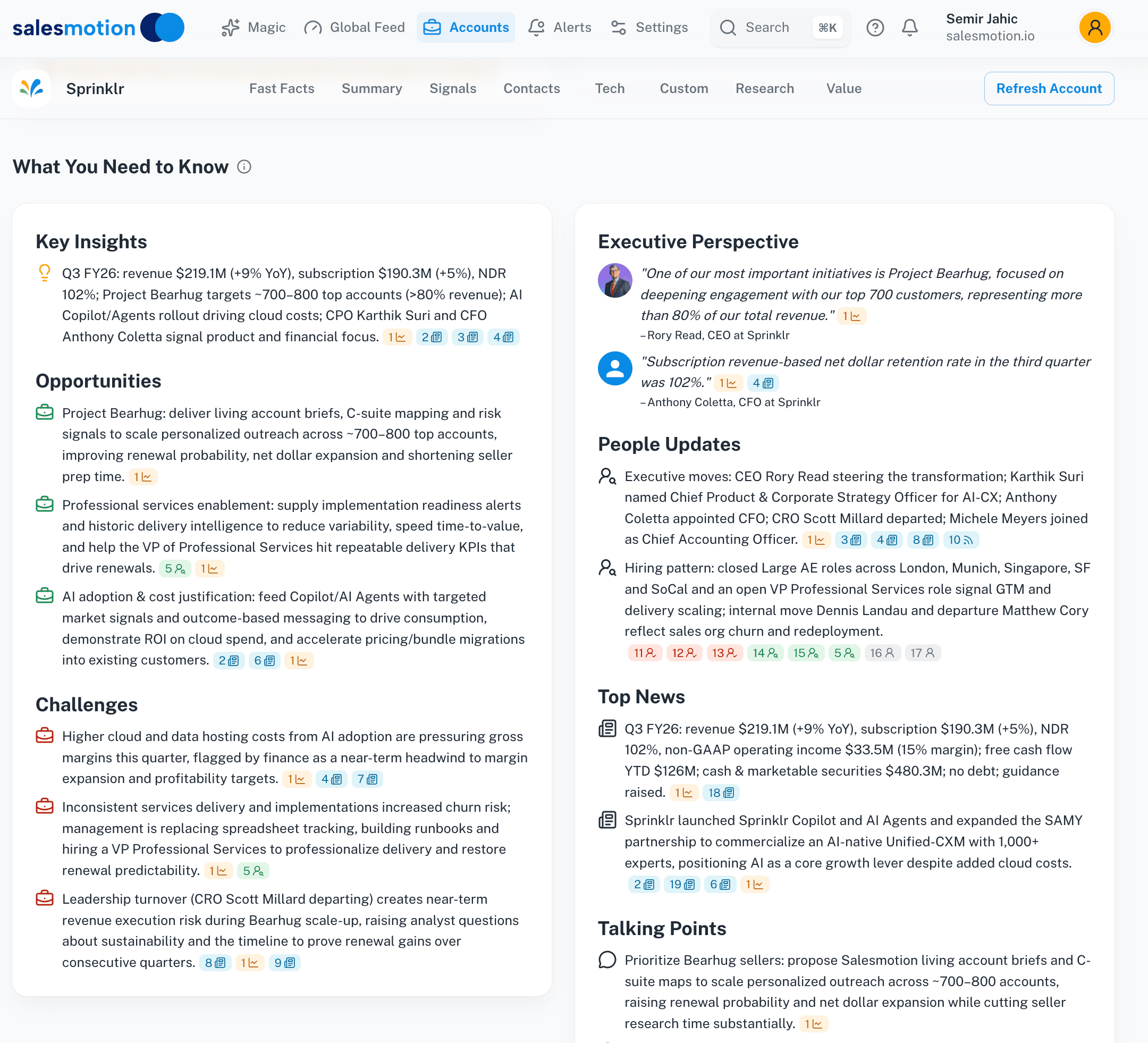
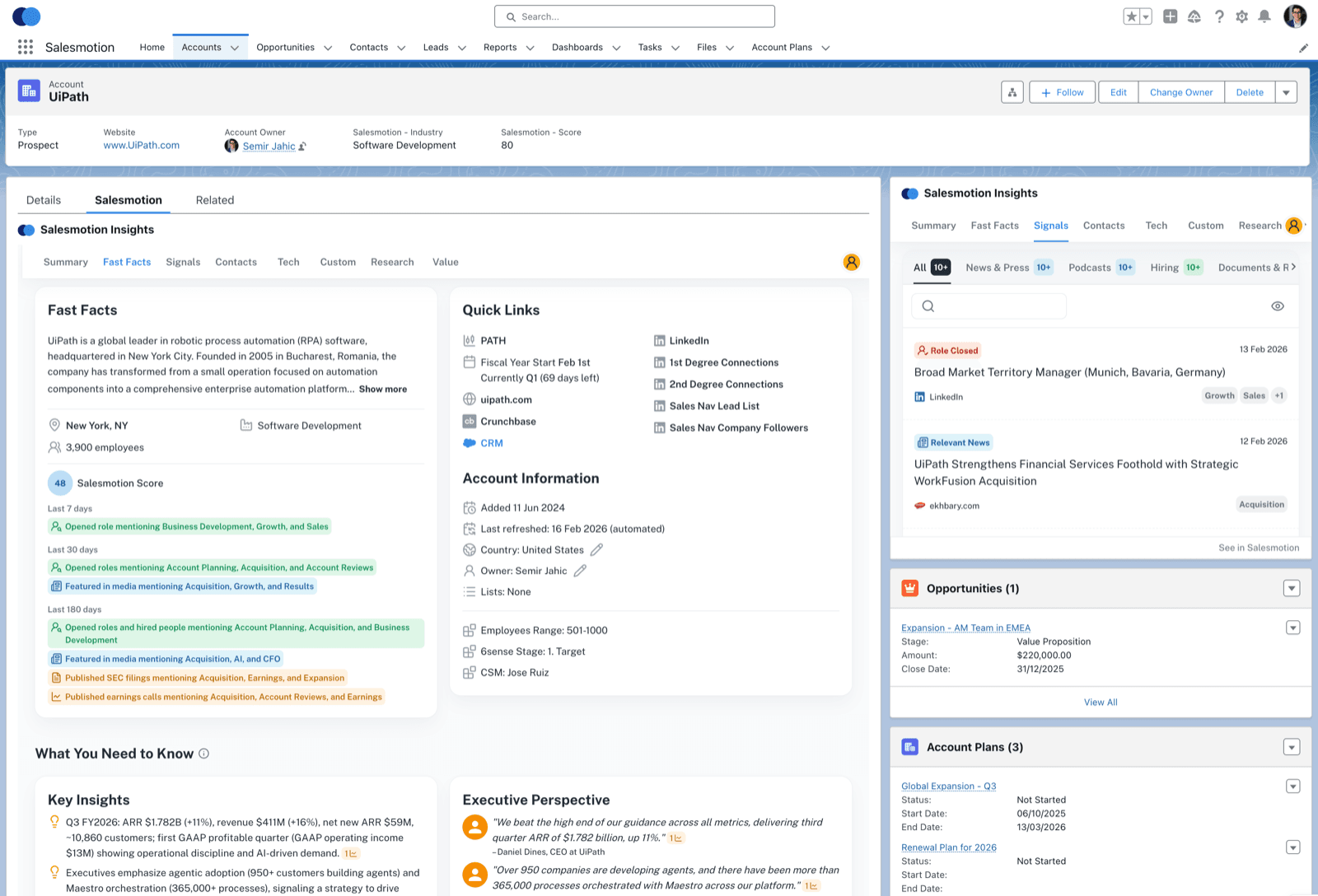
Salesmotion is an account intelligence platform for B2B sales teams. Three AI agents, Signal, Research and Outreach, monitor 1,000+ public sources, including earnings calls, SEC filings, news, job postings and patents, and turn them into cited account briefs, buying signals and outreach drafts.
The Signal Agent watches target accounts for 50+ signal types such as leadership changes, strategic initiatives, funding rounds and M&A activity. When a signal fires, the Research Agent adds the context and the Outreach Agent drafts a message tied to that event, with a link back to the source.
Salesmotion is available today on a monthly contract from $85/month. It integrates natively with Salesforce, integrates with HubSpot, and offers a REST API and an MCP server so Claude, ChatGPT and other assistants can call it.
Best for: B2B sales teams that sell on what is happening inside the buyer's business and want cited account research and signals they can start using today
G2 rating: 4.8/5
Pricing: $85/mo for individuals — flexible monthly billing. Custom pricing for teams and enterprise on request.
How Pocus and Salesmotion stack up across key capabilities.
| Feature | Pocus | Salesmotion |
|---|---|---|
| Product Usage Signals | Where Pocus began: product-led sales | Built for public-source business signals |
| Intent and Website Identification | Intent product with person-level website identification | Signals read from earnings calls, filings, hiring and news |
| Account Research | Pocus AI for AI prospecting | Cited account briefs from 1,000+ public sources |
| Signal Focus | Product usage, intent and website visitors | Business events: earnings calls with executive quotes, leadership, funding, hiring |
| Rep Workflow | Intelligent Inbox | Briefs and signals inside Salesforce and HubSpot; outreach drafts pushed to lemlist |
| Platform Direction | Joining Apollo to build an AI-native GTM operating system | Account intelligence layer with REST API and MCP server for Claude, ChatGPT and other assistants |
| How to Start | Join the Pocus + Apollo waitlist | Sign up on a monthly contract |
We held 55 sales and customer calls between August and October 2026. In 22 of them the buyer wanted to be told what changed at their accounts instead of going to look.
“I'm looking more for surveillance on my accounts to pick up the stuff that I might miss.”
“one of the things I'm always trying to figure out is the right timing”
“I just feel like we have a lack of visibility into ... what accounts are actually hot”
Pocus does not publish pricing. Apollo acquired Pocus in March 2026, and pocus.com now offers a waitlist rather than a demo or signup. Pocus has told existing customers that nothing changes in the platform for now, and that new features will roll out over the coming months.
Salesmotion publishes its entry price: $85/mo for individuals — flexible monthly billing. Custom pricing for teams and enterprise on request. The Individual plan tracks up to 100 accounts and includes 200 contact credits a month for verified emails and phone numbers.
The two products answer different questions. Pocus grew out of product-led sales, where the signal is how people use your own product and visit your site. Salesmotion is built for account-based selling, where the signal is what is changing inside the buyer's business. See Pocus alternatives and Salesmotion pricing.
We'd rather you pick the right tool than the wrong one. Salesmotion isn't for everyone — here's when another option on this page is the smarter call.
“There's been a big focus on hyper personalization and relevance in our outbounding efforts. Salesmotion has been a key partner in hitting our significantly increased meeting targets. What stands out is how simple it is. Reps can log in and get valuable account insights within 30 seconds to a minute.”

Joe DeFrance
VP of Sales, Incredible Health
Salesmotion gives your reps the account intelligence they need to book more meetings and close bigger deals.
Pocus offers a waitlist today. Apollo acquired Pocus in March 2026. pocus.com now offers a waitlist for "Pocus + Apollo" rather than a demo or signup, and Pocus has told existing customers nothing changes in the platform for now.
Pocus does not publish pricing. Apollo acquired Pocus in March 2026, and pocus.com now offers a waitlist rather than a demo or signup.
Salesmotion fits teams whose buying signals come from outside their own product. It monitors 1,000+ public sources for 50+ signal types, writes cited account briefs, and drafts outreach tied to the event. Teams that mainly want product usage and website intent should look at the wider list of Pocus alternatives.
The signals come from different places. Pocus began in product-led sales and combines product usage, intent and website identification. Salesmotion reads external buying signals: earnings calls, leadership changes, funding rounds, strategic initiatives and hiring. A company with both a self-serve product and an enterprise sales team can use the two side by side.
It depends on your go-to-market motion. If product usage is your main indicator of buying intent, that is the ground Pocus was built on. If your reps run account-based selling into companies that buy on business need, Salesmotion is the better fit.
Most teams are live within days. Salesmotion sources its own intelligence from 1,000+ public sources, so there is no data pipeline to build first. Incredible Health went live with Salesmotion in three days.
A Signal Agent, Research Agent, and Outreach Agent — working every day so your team spends less time researching and more time closing.