Deep account research is the work of understanding a target company well enough to say something specific and useful to the people who buy: what the business is trying to do, what has changed recently, who owns the problem you solve, and why now is the right time to talk. It is the difference between "I'd love to learn about your priorities" and "Your CFO said on the last call that consolidating vendors is a priority this year; here is how teams like yours approached it."
This guide covers the sources top reps use, a repeatable framework, how deep to go for each tier of account, and how to keep research current. For the basics, start with what account research is and why it matters.
What Deep Account Research Covers
A useful account picture has five layers. Most reps stop at the first.
- Business basics. What the company sells, to whom, how it makes money, its size, and its fiscal year.
- Stated priorities. What leadership has committed to in public: earnings calls, annual reports, investor days, executive interviews.
- Recent change. New executives, acquisitions, funding, layoffs, product launches, hiring surges, regulatory events. Change is what creates a buying window.
- People. The buying group: who decides, who champions, who evaluates, who could block, and what each of them has said in public.
- Your fit. Where your offer connects to a stated priority, what they use today, and what would have to be true for them to switch.
The Sources That Matter
| Source | What it tells you | Where to find it |
|---|---|---|
| Earnings call transcripts | Priorities and pressure in management's own words; the analyst Q&A shows what investors are worried about | Investor relations pages, free transcript sites (how to read one in 10 minutes) |
| SEC filings (10-K, 10-Q, 8-K, proxy) | Strategy, risk factors, material events, executive pay metrics | SEC EDGAR, investor relations pages |
| Job postings | Funded initiatives, team build-outs, the current tech stack | Careers pages, LinkedIn (job posting analysis) |
| Press releases and news | Launches, partnerships, acquisitions, leadership announcements | Company newsroom, news search |
| LinkedIn and executive content | Roles, tenure, shared connections, what each stakeholder posts about | LinkedIn, Sales Navigator, podcasts, conference talks |
| Your own CRM | Past deals, contacts, engagement, why previous opportunities stalled | Salesforce or HubSpot |
Private companies publish less, but press releases, funding news, job postings, executive interviews and the company blog still cover most of the same ground.

“Consolidation of prospect company information that I can use frequently to be way better informed when I'm doing my outbound, preparing for a meeting, or building relationships. Ease of use and Customer Support is excellent.”
Werner Schmidt
CEO & Co-Founder, Lative
A Repeatable Research Framework
Use the same order every time so the output is consistent across reps.
- Start with their priorities. Read the most recent earnings call or annual letter (or, for a private company, the CEO's latest interview). Write down two or three priorities in their words, with the date.
- List what changed in the last 90 days. Leadership, M&A, funding, launches, hiring clusters. Each change is a possible reason to reach out.
- Map the buying group. Name the likely economic buyer, champion and technical evaluator. Write "unknown" where you don't know; finding them becomes a task.
- Connect one priority to one problem you solve. Not three. One clear hypothesis you can test in a first conversation.
- Write the brief. One page: priorities, recent changes, people, hypothesis, opening angle, and sources. The account brief guide has a template.
The account research checklist turns these steps into a printable list.
How Deep to Go, by Tier
Not every account deserves the same effort.
- Tier 1 (strategic accounts): the full framework, a written brief, and a quarterly refresh. These are the accounts that justify an account plan.
- Tier 2 (good fit, no active trigger): a short brief and a watch list of signals that would move them up.
- Tier 3 (everything else): no manual research. Monitor for signals and research only when one fires.
The hard part is keeping Tier 1 research current and catching the moment a Tier 2 account changes. That is a monitoring problem, not a research problem.

“This is my singular place that very simply summarizes a company's top initiatives, strategies and connects them to my solution. Something I would spend hours researching manually, now it's automated.”
Derek Rosen
Director, Strategic Accounts, Guild Education
Keeping Research Current
Research done once goes stale fast. A business development rep at an HR software firm told us: "I might be pulling information from you know, a year ago, and it's not super relevant today."
Three habits prevent that:
- Refresh on events, not on a calendar. A leadership change, an earnings call or an acquisition should trigger an update to the brief.
- Date every fact. If you can't tell when a fact was true, you can't tell whether it still is.
- Automate the watching. Monitoring every account by hand does not scale past a handful. An account intelligence platform can watch filings, earnings calls, news, hiring and leadership changes across a territory; Salesmotion's Research Agent and Signal Agent do this from 1,000+ public sources. See what the output looks like in the interactive demo.
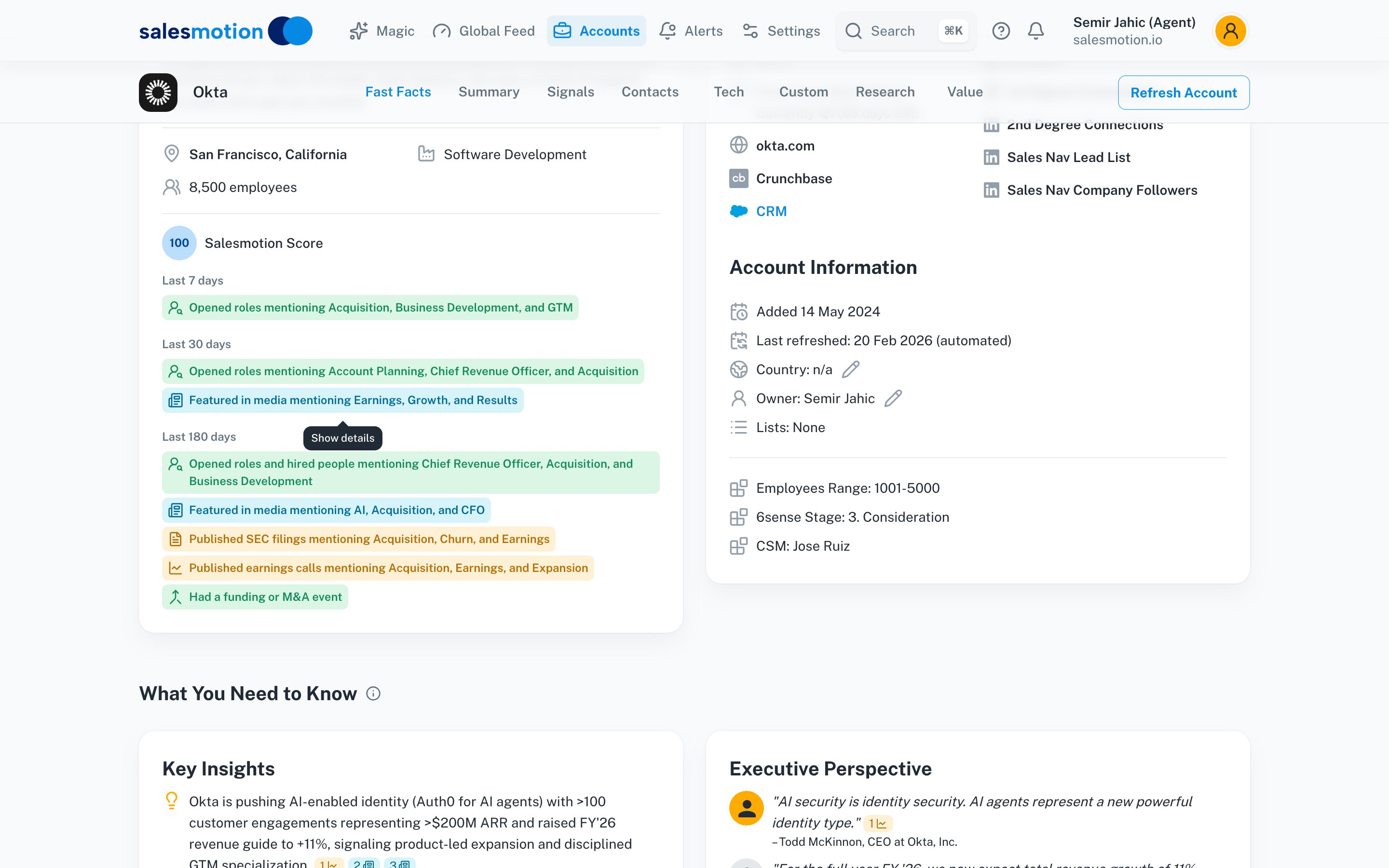 An automated account brief: score, recent signals, key insights and executive quotes, each with a source.
Common Mistakes
- Researching facts instead of priorities. Headcount and revenue don't give anyone a reason to reply. A stated priority does.
- Single-threaded research. Knowing one contact well and nobody else leaves the deal exposed when that person moves.
- No hypothesis. Research that doesn't end in "we think you're trying to do X, and we can help with Y" is reading, not preparation.
- Spending the same time on every account. Tier the list first.
- Undated, unsourced notes. They can't be checked, shared or refreshed.
Key Takeaways
- Deep account research covers five layers: business basics, stated priorities, recent change, people, and your fit.
- Earnings calls, SEC filings and job postings are the most underused sources, because they show priorities and funded initiatives in the company's own words.
- Use the same framework every time and end with a one-page, sourced brief and a single testable hypothesis.
- Match depth to tier: full research for strategic accounts, monitoring for the rest.
- Research goes stale; refresh it when something changes, not once a year.
Frequently Asked Questions
What is account research in B2B sales?
Account research is the structured process of gathering and analyzing information about target companies before sales outreach. It covers the company's business, stated priorities, recent changes, the people in the buying group, and where your offer fits, so that outreach is specific and timely.
How is AI changing account research?
AI automates the most time-consuming parts: reading earnings calls, filings, news and job postings across many accounts, and drafting a sourced summary. The rep's job shifts from collecting to checking and deciding. Look for tools that cite a source for every claim; our guide to AI account research covers how to evaluate them.
What tools are best for modern account research?
Most teams combine a CRM (Salesforce or HubSpot), LinkedIn Sales Navigator for people, primary sources such as earnings call transcripts and SEC filings, and an account intelligence platform that monitors those sources and summarizes them. The right mix depends on your territory size and how many accounts need deep research; this comparison of sales intelligence platforms is a starting point.
How often should sales teams update their account research?
Continuously for strategic accounts, and whenever a meaningful trigger event occurs: an executive hire, an acquisition, a funding round, an earnings call or a strategic shift. Date every fact so stale research is easy to spot.