Let's get one thing straight: boosting productivity in sales isn't about working harder. It’s about generating more revenue with less wasted effort. It means shifting your team's focus from raw activity—like making 100 cold calls a day—to the strategic impact that actually closes deals.
True productivity frees up your best reps to spend their time on the handful of actions that make or break a quarter. It's about working smarter, not longer hours.
Beyond Busy Work: The Real Definition of Sales Productivity
For too long, sales teams have operated like a ship with a powerful engine but no rudder. There's plenty of movement, but no clear direction. Reps burn out on mind-numbing manual research and administrative tasks, confusing sheer busyness with actual progress. This leaves almost no time for what really matters: engaging the right buyer, at the right time, with a message that resonates.
A modern, productive sales team is different. It operates with precision and purpose. Every action is intentional, driven by timely intelligence and repeatable processes.
This model is built on one simple, powerful premise: your best sellers should be selling, not researching.
To make that happen, you have to move beyond just tracking activity. It's about equipping your team with integrated tools, like the best CRM with email marketing platforms, that automate low-value work and provide a single source of truth.
Shifting from Activity-Based to Impact-Based Metrics
The real key to unlocking productivity in sales is changing how you measure success. It’s a fundamental shift from tracking output to measuring outcomes. For any revenue leader trying to build a scalable sales engine, this distinction is everything.
Instead of celebrating 100 generic cold calls, you celebrate 10 highly relevant conversations with key decision-makers. The goal isn't just to be busy; it's to be effective.
Instead of forcing reps to pay the "research tax"—those countless hours spent digging for account context—you automate it. Productive teams use modern tools to surface critical buying signals, freeing up reps to focus on strategy and building relationships. For example, knowing a target account just hired a new CIO from a company you’ve worked with before is a golden opportunity, but only if your rep sees it instantly.
And instead of relying on luck or individual heroics, you build a system. Top-performing organizations use repeatable, trigger-based playbooks that guide reps on the exact actions to take when a key event, like a funding announcement or executive change, happens.
Here’s a look at how that mental shift plays out in your KPIs:
Shifting from Activity-Based to Impact-Based Metrics
| Metric Category | Traditional Metric (The Old Way) | Impact Metric (The New Way) |
|---|---|---|
| Outreach | Number of Calls/Emails Sent | % of Target Accounts Engaged |
| Meetings | Number of Meetings Booked | Meeting-to-Opportunity Conversion Rate |
| Deal Health | Number of Open Opportunities | Stakeholder Coverage per Deal |
| Forecasting | Pipeline Value | Forecast Accuracy |
| Time Allocation | Time Spent on CRM/Admin Tasks | Time Spent in Active Selling Conversations |
By moving your focus to the right-hand column, you start building a system that amplifies your team's skills instead of draining their time.
This new definition is the foundation for everything else. It’s also closely tied to the difference between efficiency and effectiveness in sales. Once you get this right, you can start diagnosing the common blockers that hold teams back and build strategies that drive real, measurable results.
See Salesmotion in action
Take a self-guided interactive tour — no signup required.
Why Sales Productivity Stalls: The Time Allocation Crisis
Every revenue leader knows the feeling. You hire sharp, ambitious sellers, but something is holding them back. The frustrating truth is that your reps aren't spending enough time actually selling, and it’s stalling your team's productivity.
This isn't a problem of effort or motivation. It's a systemic issue—a time allocation crisis. A tidal wave of non-selling work washes over your reps’ calendars each week, pulling them away from the activities that actually generate revenue. They're caught in a constant battle against tasks that keep them busy but not productive.
This infographic nails the difference between a busy, low-impact rep and a truly productive, high-impact one.
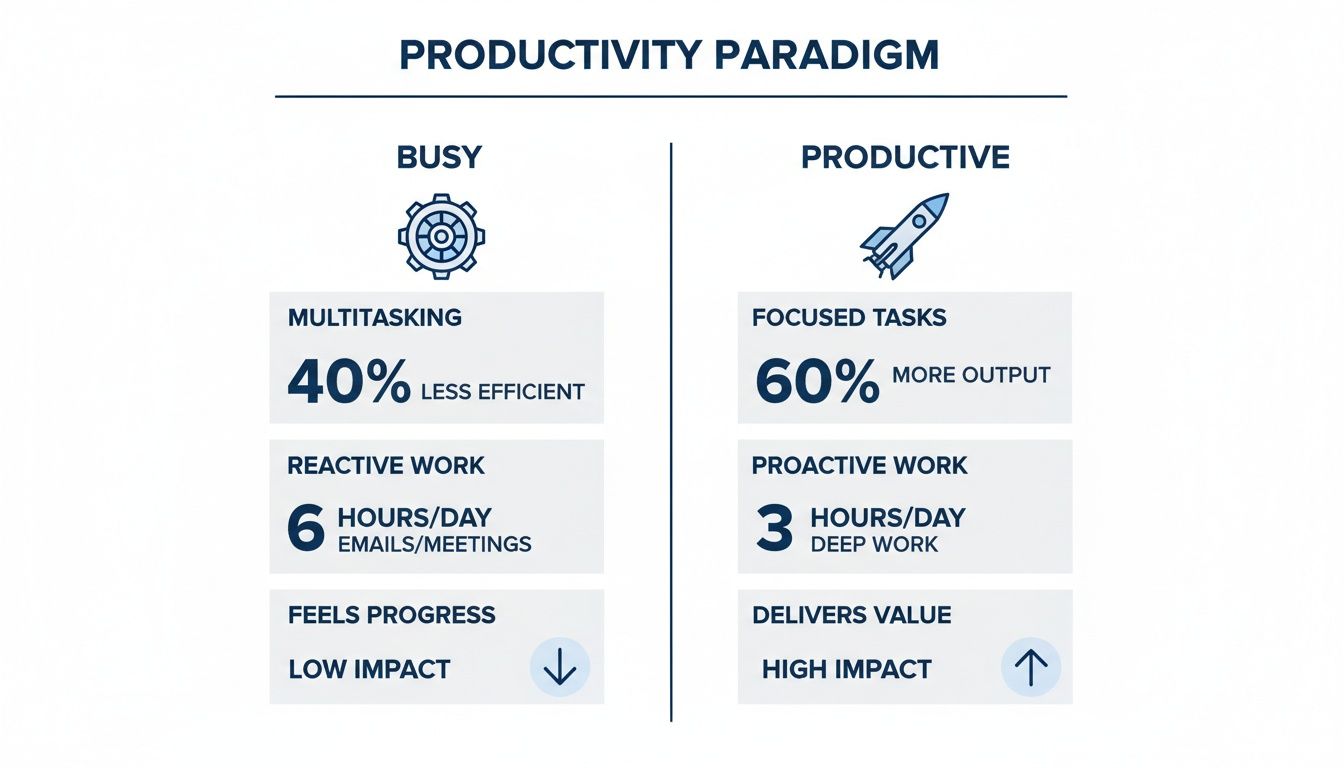
As you can see, "busy" work is scattered and unfocused. Productive work, on the other hand, is precise and laser-focused on the right activities, which naturally leads to better outcomes.
The Anatomy of Wasted Time
So where is all that precious selling time going? The culprits are usually hiding in plain sight, baked right into your team's daily grind. The biggest drains on your reps' time are almost always:
- Manual Account Research: Reps burn hours piecing together context from news sites, financial reports, and social media feeds just to find a single credible reason to reach out.
- Administrative Duties: This is the classic time-sink—logging activities, updating the CRM, wrestling with spreadsheets, and handling internal reporting.
- Internal Meetings: While some collaboration is key, reps often get sucked into a vortex of status updates and planning sessions that keep them from talking to customers.
That "manual research tax" is especially painful for B2B teams in complex spaces like enterprise software. For instance, a rep selling to pharmaceutical companies needs to know about recent clinical trial results or FDA approvals. Finding this information manually for dozens of accounts is both essential and incredibly time-consuming.
Telling your team to just "be more organized" is a losing strategy because it doesn't fix the root cause. For a closer look at this challenge, check out these effective sales rep time management strategies.
The Data Behind the Drain
This isn’t just a feeling; the numbers paint a stark picture. A widely cited study from Salesforce found that sales reps spend only about 28% of their week actively selling. The other 72% gets eaten up by all those non-selling tasks.
It's a remarkably consistent problem across the industry, pointing to a deep structural flaw in how most sales teams operate.
The gap gets even wider when you compare performance. Top-performing teams—those hitting over 90% of their quota—manage to spend 34% of their time selling. In contrast, lower-performing teams spend just 23% of their time on revenue-generating activities. That 48% difference in selling time has a direct and massive impact on revenue.
The core challenge for sales leaders is not a lack of effort from their teams, but a lack of time for high-impact activities. The data confirms that reclaiming even a small fraction of a rep’s day from manual tasks can create a significant lift in performance and quota attainment.
This systemic drain on time is why boosting sales productivity requires more than another training session. It demands a strategic, top-down approach that fundamentally changes how work gets done.

“Salesmotion empowers me to cultivate a great buyer experience. I'm able to challenge prospects' thinking and be a trusted consultative seller. A major part of this is Salesmotion insights.”
Austin Friesen
Account Executive, FY25 #1 President's Club, Clari
A Modern Framework for Building a High-Productivity Sales Engine
Figuring out where your reps' time is going is the first step. The next is to systematically remove the roadblocks that are eating up their day. Building a high-productivity sales engine isn't about a single silver bullet. It's about designing a system where efficiency is the default.
A modern framework for this comes down to three core pillars: People, Process, and Technology.
Think of it like building a high-performance race car. Your People are the skilled drivers—talented reps who know how to win. The Process is the race strategy and the pit crew—repeatable workflows that ensure a fast, consistent performance on every lap. And finally, the Technology is the car itself, an advanced machine with a powerful engine and real-time data that gives your driver a decisive edge.
When all three pillars are optimized and working together, your sales organization stops sputtering and starts accelerating. True productivity in sales happens when these elements combine to amplify human skill.
Empowering People Through Autonomy and Context
The first pillar is all about your people. The old-school model of sales leadership often defaults to micromanagement—fixating on activity quotas and rigid scripts. This approach treats reps like cogs in a machine, which kills initiative and leads to burnout.
A high-productivity culture flips the script from micromanagement to enablement. This means trusting your reps as professionals and giving them two things they need most: autonomy and context. Instead of just telling them what to do, you give them the why and the how, then get out of their way.
Empowered sellers don't need a manager tracking their every call. They need a leader who clears roadblocks and provides the strategic context to make smart decisions on their own. This shift fosters ownership and, ultimately, better results.
This approach gives your A-players the freedom to use their skills. They can adapt their approach based on real-time information, build genuine relationships, and think strategically about their accounts. This is the human element no technology can replace.
Standardizing Process with Trigger-Based Playbooks
The second pillar, Process, tackles the inconsistency that plagues most sales floors. Without a defined process, account planning becomes a guessing game. Some reps might devise brilliant strategies, while others just wing it, leading to unpredictable outcomes.
The solution is to replace those manual efforts with standardized, trigger-based playbooks. These are structured workflows that guide reps on the best actions to take when a specific buying signal occurs.
For instance, a playbook might get triggered when a target account announces a new funding round. The process could then automatically guide the rep to:
- Identify the key executives involved in the funding news.
- Generate a tailored message congratulating them and connecting the new capital to a problem your solution solves.
- Suggest a multi-threading strategy to engage both the new CFO and the Head of Innovation.
By standardizing these plays, you turn best practices from tribal knowledge into a scalable system. This dramatically improves the consistency and quality of outreach across the entire team and is central to boosting productivity in sales.
Activating Your Strategy with Technology
The final pillar, Technology, is the connective tissue for your people and processes. The single biggest drag on productivity is the manual "research tax," and this is where modern AI-powered platforms make all the difference.
An account intelligence platform like Salesmotion is the engine that drives this entire framework. It automates the painful, time-consuming work of monitoring accounts and surfacing relevant signals. Instead of reps wasting hours digging through news articles and financial reports, the technology does it for them, 24/7.
This is the tech that feeds your trigger-based playbooks. It's the system that detects a signal—like a key executive hire or a new strategic initiative—and then kicks off the automated workflow. By eliminating the manual research burden, you free up reps to focus entirely on high-value selling activities: building relationships, strategizing, and closing deals.
This is how you reclaim that 72% of non-selling time and turn it back into revenue-generating action.
How AI-Driven Workflows Turn Signals into Revenue
We all know the theory behind boosting sales productivity: focus on high-impact work. But how do you actually do that in practice? It starts by connecting the dots between raw market signals and real revenue opportunities. This is where AI-driven workflows become a game-changer for B2B revenue teams.

Think of an AI-powered account intelligence platform as your team's central nervous system. It’s constantly scanning the market for critical triggers—like a target account closing a major funding round, hiring a new C-suiter, or announcing a big strategic shift.
But instead of just dumping that raw data on your reps, it translates those signals into actionable sales plays they can execute immediately. This moves your team from a reactive, manual state to a proactive, automated one. It’s about systematically turning "what just happened" into a clear "so what" for your sellers, giving them a credible reason to engage at the perfect moment.
From Manual Research to Meeting Prep in Minutes
One of the quickest wins in productivity in sales comes from eliminating the hours reps waste on pre-call research. In a typical sales organization, a rep might burn an hour or more just cobbling together information from news sites, LinkedIn, and company reports to prepare for one important meeting.
An AI-driven workflow completely flips this dynamic.
By automatically pulling and summarizing key insights, AI tools can build comprehensive meeting briefs in minutes, not hours. We've seen this automation cut down account planning and research time by 40-60%, freeing reps to focus on strategy instead of grunt work.
This automated brief isn't just a messy list of links. It delivers a structured summary that includes:
- Recent company initiatives and how your solution fits in.
- Key stakeholder changes and their likely priorities.
- Potential risks or challenges the account is dealing with.
- AI-generated talking points and questions to guide the conversation.
This gives reps the confidence and context to walk into any meeting fully prepared, turning hours of manual effort into a few minutes of strategic review.
Crafting a Value-Based "Why Now" for Outbound
Generic outreach is a productivity killer. Reps waste countless hours sending messages that get ignored because they lack relevance and timeliness. An intelligent workflow solves this by helping reps build a compelling "why now" for every single interaction, grounded in real-time events.
Imagine a target account in the biotech space announces positive clinical trial results. An AI-driven workflow can instantly trigger a sales play. The system flags the news, identifies the head of R&D, and even helps generate a tailored outreach message that connects the trial's success to their new need for scaling commercial operations—a problem your solution happens to solve.
This creates a hyper-relevant reason to connect that is based in the prospect's world, not yours. It’s a world away from the generic "just checking in" email. You can learn more about how to scale this kind of personalization by using AI in your sales process.
The Tangible Outcomes of Smarter Workflows
When you embed these AI-powered workflows into your team’s daily routine, the results are direct and measurable. The impact goes way beyond just saving time.
By enabling a smarter, more relevant way of selling, you directly influence the health of your pipeline and the speed of your deals. Key outcomes include:
- Increased Pipeline Velocity: Reps engage leads with timely, relevant messaging, which leads to faster responses and quicker movement through the sales cycle.
- Higher Conversion Rates: Value-based conversations that address a prospect's immediate needs are far more likely to convert into qualified opportunities.
- Improved Quota Attainment: When reps spend more of their time on high-probability accounts with clear buying signals, they naturally close more deals and hit their targets more consistently.
Ultimately, these workflows bridge the gap between knowing something and doing something about it. They turn intelligence into action, creating a sustainable system for boosting sales productivity and driving predictable revenue growth.

“We have very limited bandwidth, but Salesmotion was up and running in days. The template made it easy to load our accounts and embedding it in Salesforce was simple. It was one of the easiest rollouts we've done.”
Andrew Giordano
VP of Global Commercial Operations, Analytic Partners
Measuring the New ROI of Sales Productivity
As technology reshapes how reps sell, it must also transform how leaders measure success. Sticking with yesterday's sales metrics is like trying to measure the speed of an electric car by the sound of its engine—you’re listening for something that isn't there anymore.
The old scoreboard is broken.
Relying on traditional activity metrics like "calls made" or "emails sent" creates a massive blind spot. These volume-based KPIs are becoming obsolete in a world where AI can automate outreach. A rep can look incredibly busy, hitting every activity target, while their actual impact on revenue stays flat. This is the measurement paradox: activity soars, but performance stagnates, giving you a false sense of security.
To get a real read on your team's performance and justify new tech investments, you have to adopt a new set of impact-driven KPIs.
From Volume to Value: New KPIs That Matter
Measuring modern sales productivity means shifting your focus from what reps are doing to the outcome of their actions. It’s no longer about counting inputs; it’s about quantifying impact. These are the next-generation metrics that show you who is truly moving the needle.
- Deal Acceleration Impact: Instead of just tracking the overall sales cycle length, measure how specific actions or insights directly shorten it. For example, did an AI-surfaced trigger about a competitor's misstep help your rep close a deal 30 days faster?
- Buyer Engagement Quality: Move beyond vanity metrics like email open rates. Track how many key stakeholders at a target account are actively engaging in meaningful conversations. That's a sign of genuine buying intent.
- Time-to-Relevant-Conversation: How quickly can a rep go from a raw signal (like a funding announcement) to a real conversation with a decision-maker? This KPI directly measures the efficiency of your team's intelligence and outreach process.
Ultimately, one of the clearest measures of this new ROI is successfully boosting your sales conversion rate. Higher quality engagement naturally leads to more wins.
Tracking the True Business Impact
The ROI of sales technology isn't just a vague promise of "doing more with less." It delivers a tangible return that you can—and should—measure. The most direct measures are the reduction in low-value work and the corresponding increase in high-value selling time.
When reps spend less time on manual research and admin tasks, that reclaimed time becomes your most valuable asset.
A core business case for modern sales tools lies in reclaiming wasted hours. Tracking the reduction in research time (e.g., from 4 hours per week to 45 minutes) and the increase in client-facing activities provides a clear, defensible ROI that executives can understand and support.
This is why it's so important to benchmark your team's time allocation before and after implementing new tools and processes. Seeing a 20% increase in time spent in strategic selling conversations is a powerful indicator of success. To go deeper on this, check out our guide on how to measure sales productivity effectively.
This shift is already happening. Gartner predicts that by 2025, 75% of B2B sales organizations will replace traditional sales playbooks with AI-based guided selling solutions. Furthermore, a Vivun report projects that by 2026, 35% of sales organizations will introduce emotional intelligence (EQ)-related productivity metrics as a direct result of AI’s role. You can discover more insights about how AI will redefine sales productivity metrics on Vivun.com.
By embracing these next-generation metrics, revenue leaders can finally get an accurate read on team performance, reward the right behaviors, and build an undeniable business case for the tools that drive sustainable growth.
Building a High-Productivity Sales Culture

Let's put all the pieces together. Boosting productivity in sales isn’t a quick fix or a one-off project. It's a strategic decision that rewires how your entire revenue team operates.
This means shifting from a culture of "busyness" to one of measurable impact. It’s about systematically cutting out low-value work so your sellers can focus on what humans do best: building relationships, thinking strategically, and closing complex deals.
This cultural change only happens when leaders stop accepting wasted time as the cost of doing business. It’s a commitment to building a modern sales engine where every action has a purpose.
From Manual Effort to Automated Intelligence
The foundation of a high-productivity culture is embedding intelligence directly into your team's daily workflow. When you automate the grueling work of manual account research and turn market signals into real insights, you fundamentally change a seller's job.
Reps no longer start their day staring at a CRM, wondering who to call or what to say. Instead, they get a prioritized list of accounts showing clear buying intent, complete with the specific "why now" they need to start a relevant conversation.
This is exactly what account intelligence platforms like Salesmotion are built for. They act as a co-pilot for your sales team, handling the repetitive tasks that drain energy and focus.
The reality is your team is probably already doing this on their own. One recent study found that 82% of workers use unsanctioned AI tools on the job. A high-productivity culture doesn't fight this—it provides secure, integrated tools to make it official.
Turning Activity into Measurable Growth
Ultimately, building this culture is about forging an unbreakable link between your team’s daily activities and real pipeline growth. It’s about giving your reps the ability to scale personalization, focus only on accounts ready to buy, and engage buyers with a point of view that actually matters.
By embedding intelligence directly into your team's process, you stop guessing and start knowing. You transform real account activity—from funding rounds to executive hires—into a predictable engine for revenue.
Imagine your team consistently engaging the right person at the perfect time with a message that resonates because it’s tied to a real event. This is how you win timely conversations, speed up deals, and build a culture where productivity isn't just a metric—it's just how you operate.
Frequently Asked Questions About Sales Productivity
Switching to a more strategic view of sales productivity always brings up a few practical questions for revenue leaders. Let's tackle some of the most common ones head-on with direct, no-fluff answers.
How Can I Improve Sales Productivity Without a Huge Budget?
Start small and focused. The biggest and easiest target is almost always the time your reps waste on manual research. You don’t need a massive, company-wide project to get started.
Instead, run a pilot program with a handful of reps aimed at a specific list of high-value accounts. The key is to measure everything. For example, you can show a clear "before and after" picture by tracking how much time reps spend on pre-call prep. Proving you can cut account planning from four hours a week down to less than one is a powerful business case that provides the hard ROI you need to justify expanding the initiative.
Will AI and Automation Make My Sales Reps Obsolete?
No, quite the opposite. These tools are designed to make your best reps even more valuable, not replace them. Think of AI and automation as a co-pilot, not the pilot. It takes over the repetitive, low-value work that currently bogs your team down.
This frees up your sellers to do what humans do best—the things AI can't. We're talking about building genuine trust, navigating messy deal politics, and applying creative, strategic thinking to solve real customer problems.
Think of it this way: automation handles the what (surfacing a key signal), so your reps can master the how and why (using that signal to build a compelling business case). It elevates them from information gatherers to trusted strategic advisors.
How Quickly Can We See a Measurable Impact on Productivity?
You’ll see the impact on leading indicators almost immediately. Within the first few weeks of using a proper account intelligence platform, your team will feel the difference. They'll spend dramatically less time on manual research and meeting prep. That’s your first quick win.
The impact on lagging indicators—the ones your board cares about, like pipeline growth and quota attainment—typically follows within a single sales quarter. This happens as your reps learn to consistently reinvest their saved time into engaging the right accounts with the right message. The best way to prove this is to track both: the immediate efficiency gains and the revenue impact that follows. That gives you the full picture.
Ready to stop wasting time and start building a modern, productive sales engine? With Salesmotion, you can turn real account activity into measurable pipeline growth. Discover how our account intelligence platform can accelerate your team's productivity.