A partner pings the BD team at 6:30 p.m. The pitch is tomorrow morning. Someone needs the client's latest earnings commentary, a view on their recent acquisition, a read on which rival consulting firms may already be in the account, and a fresh angle that sounds strategic instead of recycled. Two people start searching filings. Another scans LinkedIn. Someone else digs through old CRM notes. By midnight, you have a deck full of fragments and a brief nobody fully trusts.
That scene is common in consulting firms. It's also avoidable.
The problem usually isn't effort. It's that too much pre-pitch research still depends on individual heroics. A few partners know the account cold. A few marketers can build a strong brief under pressure. A few BD managers have a mental map of which signals matter. But none of that scales across sectors, regions, and hundreds of priority accounts.
That's why account intelligence for consulting firms matters now. It gives BD teams a way to turn scattered market data, internal relationship history, and real-world account signals into something operational. Not a static research file. A system that helps teams prioritize the right accounts, spot active demand, and walk into meetings with a point of view.
The timing matters because the prize is large. The global management consulting industry is valued at about $1 trillion, and the U.S. management consulting market was estimated at roughly $374 billion in 2023, according to Coresignal's account intelligence overview. In a market that size, better account selection and better timing aren't minor improvements. They shape pipeline quality, expansion revenue, and how efficiently a firm converts partner time into wins.
If your team still builds every brief from scratch, fix that first. A useful starting point is a practical framework for building an account brief that sales teams will actually use.
The End of Last-Minute Pitch Prep
Last-minute pitch prep has a recognizable pattern. The team gathers plenty of information, but very little of it is decision-ready. There's company news, a few analyst notes, old proposal language, scattered internal relationship history, and maybe one useful quote from an earnings call. The issue isn't access to data. The issue is synthesis.
In consulting, that gap hurts more than it does in many other B2B categories. Buyers expect your team to understand their strategy, their operating pressures, and the change agenda sitting behind the RFP or introductory meeting. If the conversation starts with generic credentials, you've already lost ground.
Why manual prep breaks down
The traditional model relies on whoever knows the account best. Sometimes that's a partner with long history in the client. Sometimes it's a sharp account manager who knows where to look. Sometimes it's a consultant who happens to have worked in the sector. That works until the firm needs consistency across dozens of active pursuits at once.
A manual process also creates hidden costs:
- BD time gets absorbed by repetitive research. Teams spend hours gathering facts that should already be captured and refreshed.
- Consultants get pulled into non-billable prep. Their input matters, but they shouldn't be doing first-pass data collection.
- Pitch quality varies by team. Some accounts get a rich point of view. Others get a rushed summary and a capabilities deck.
- Signals arrive too late. By the time someone notices a leadership change, acquisition, or strategic shift, the opportunity window may already be moving.
The firms that look most prepared in the room usually didn't work harder the night before. They built a better system weeks earlier.
What replaces the scramble
A modern intelligence function changes the sequence. Instead of starting from zero before each meeting, the account already has a living brief. The brief updates as new signals appear. The BD team knows what changed, why it matters, and who should act.
That's the fundamental shift in account intelligence for consulting firms. You move from reactive research to proactive coverage. The partner doesn't ask, “Can someone find me a hook for tomorrow?” The team already knows the client's likely priorities, current triggers, and where the conversation should go.
See Salesmotion in action
Take a self-guided interactive tour — no signup required.
What Great Account Intelligence Looks Like for Consultants
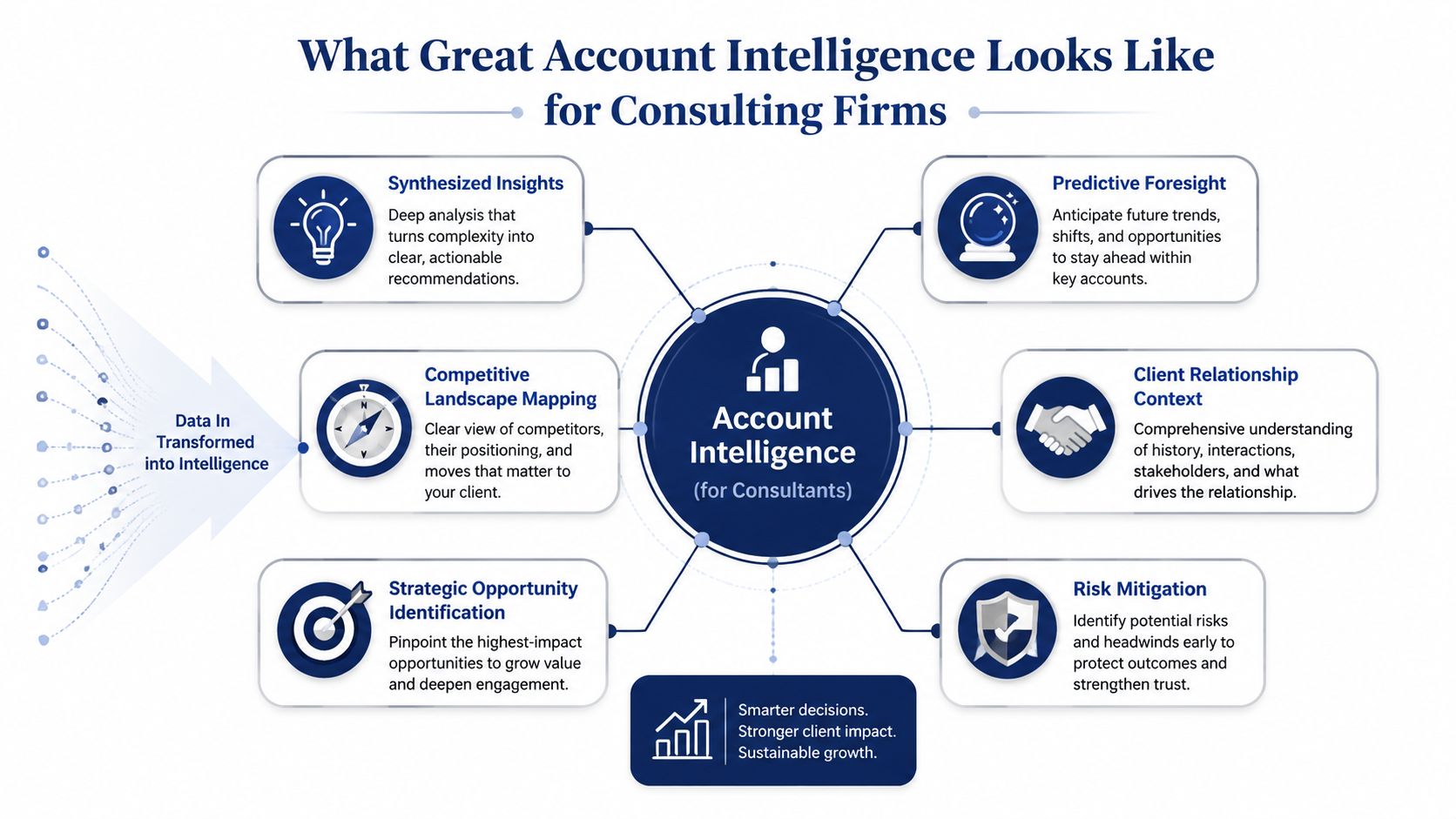
Great account intelligence gives a consulting team a usable commercial view of the client. It should help a partner see what the client is trying to achieve, where pressure is building, and which consulting conversations have the highest odds of turning into pipeline.
For consulting firms, that means less generic research and more decision support. The output has to be sharp enough for business development, specific enough for sector leaders, and light enough that billable consultants are not doing first-pass research before every meeting.
Start with the four data layers
The underlying model is simple. Strong account intelligence pulls together firmographic, technographic, intent, and engagement data, then turns those inputs into a point of view the account team can use.
In practice, the brief should combine:
- Firmographic context such as size, geography, business mix, ownership structure, and leadership footprint
- Technographic context including major platforms, transformation investments, and the client's current operating environment
- Intent signals such as repeated interest in a business problem, executive commentary, hiring patterns, or content engagement around a strategic theme
- Engagement history from CRM records, past pursuits, project history, partner relationships, and meeting activity
Those layers matter because consulting demand rarely appears as a clean inbound request. It builds when strategy, leadership pressure, operating friction, and relationship access line up at the same time.
That is why firms are investing in automating sales research with AI. The goal is not to replace judgment. The goal is to give account teams a current, usable base layer without asking expensive consultants to assemble it by hand.
What partners need in the brief
The best briefs answer a short list of commercial questions. If the document does not help a partner decide where to focus, whom to involve, and what to say, it is still research, not intelligence.
Client strategic priorities
Start with the agenda the leadership team is already signaling. Earnings calls, investor presentations, annual reports, executive interviews, hiring patterns, and business-unit commentary usually make the priorities clear. Margin pressure, integration work, cost discipline, digital modernization, supply chain redesign, growth expansion, and operating model change all point to different consulting plays.
The job is to identify the issues management is spending time on. That is where budgets and executive attention usually follow.
Competitive consulting footprint
Many firms remain too superficial in their approach. Before a serious pursuit, BD should know which strategy, operations, technology, or specialist firms are already in the account, where they sit, and how entrenched they are.
That information changes pursuit strategy fast. If a rival already owns the flagship transformation program, a broad pitch is usually weak. A better route may be a second opinion, a capability gap, a regional rollout problem, or a workstream the incumbent is not built to handle.
Change drivers inside the account
Strong intelligence highlights events that change budget, urgency, governance, or executive sponsorship. Leadership changes, acquisitions, divestitures, restructurings, hiring spikes in transformation roles, missed targets, new geographic expansion, or a major systems investment all belong here.
A useful brief does more than list those events. It explains what each event could create. Integration support, PMO work, cost takeout, post-merger operating design, data modernization, turnaround planning, and regulatory response all come from identifiable triggers.
Market and regulatory pressure
Clients do not buy consulting in isolation. They buy when internal priorities meet outside pressure. Regulation, pricing compression, labor constraints, supply risk, investor scrutiny, and new technology economics can all accelerate a decision that was previously sitting in the background.
This section should end with implications for the account team. State the likely buyer, the probable budget owner, the near-term issue, and the opening conversation. That is what turns intelligence into larger opportunities and better-timed outreach.

“The account and contact signals are key for reaching out at important times, and the value-add messaging it creates unique to every contact helps save time and efficiency.”
Daniel Pitman
Mid-Market Account Executive, Black Swan Data
From Ad Hoc Research to a Scalable Intelligence System
The biggest mistake firms make is treating account intelligence like a research task. It's an operating capability.
If you rely on individual consultants to understand every target account thoroughly, you'll get uneven coverage and high-prep friction. That model rewards heroics, but it breaks under scale. Consulting firms have too many sectors, offerings, and account teams for that to hold.
The hero model versus the system model
In the hero model, success depends on a handful of well-connected people. They know who moved roles, which client just made an acquisition, or why a transformation program stalled. Their insight is valuable, but it lives in heads, inboxes, and side conversations.
In the system model, intelligence is shared, refreshed, and routed into the workflow. That means the account team can see the same account state, the same trigger events, and the same recommendations without waiting for someone to manually assemble them.
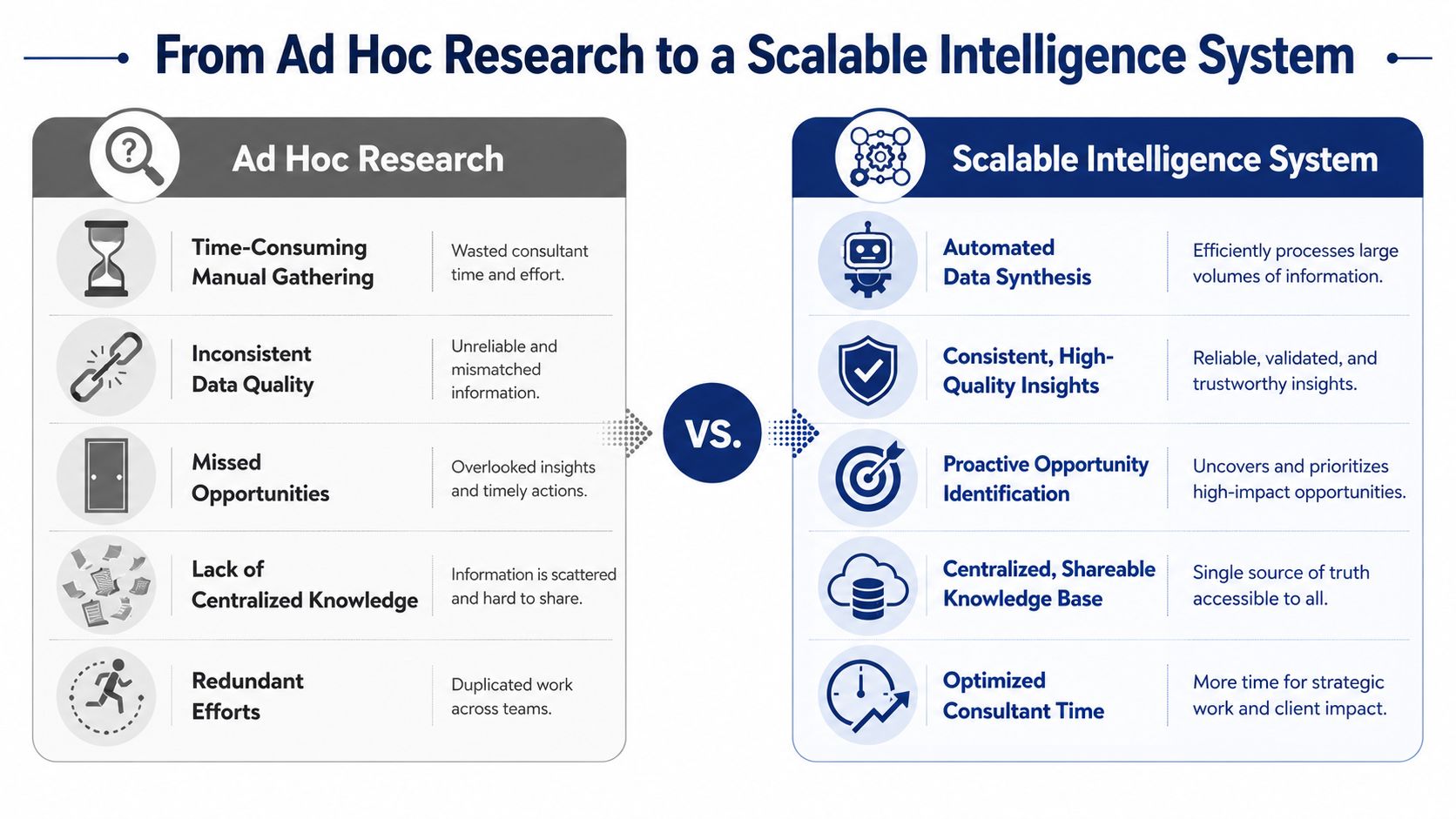
The shift is already underway. Modern account intelligence evolved from static research into an automated discipline. Platforms now unify data, integrate with CRMs, and deliver real-time alerts. In consulting and professional services, that change is especially relevant for spotting expansion opportunities and trigger events, with success increasingly measured through KPIs like engagement scores, deal velocity, and influenced revenue, as described in Contify's guide to setting up an account intelligence program.
What leadership actually cares about
You don't need a philosophical case for this. You need a business case.
Leaders usually respond to a few practical outcomes:
- Less prep drag on senior teams. Partners and consultants spend more time shaping the message and less time gathering raw material.
- Better prioritization. BD focuses on accounts where there's active motion, not just historic relationship comfort.
- Stronger expansion coverage. Existing clients get monitored systematically for new needs, not only at renewal or annual planning moments.
- More consistent pursuit quality. Every important account gets a baseline level of intelligence, even if the team is new to the relationship.
A good next step for teams trying to operationalize this is to automate sales research with AI instead of assigning the same manual prep work over and over.
What doesn't work
Three patterns usually fail.
- Buying a dashboard and stopping there. If the intelligence sits outside CRM and daily workflow, adoption fades.
- Tracking every signal equally. Not every news item matters. The system needs rules for what is commercially relevant.
- Leaving synthesis to the end user. A partner doesn't want fifteen alerts. They want one clear read on what changed and why it matters.
The firms that scale this well treat account intelligence as part of revenue operations, not a side library for curious sellers.
Key Signals and Triggers for Consulting Opportunities
Consulting demand often appears before a formal buying process. A trigger shows up, then a strategic question follows, then a workstream forms around it. If BD teams can recognize that sequence early, they can enter the conversation before the opportunity gets boxed into procurement language.
The signals worth monitoring
Some triggers matter across almost every consulting practice.
Leadership changes
A new CEO, CFO, COO, CIO, CHRO, or business-unit leader often means a reset in priorities. New executives review inherited programs, revisit vendor relationships, and look for visible wins. That can create openings in strategy, operating model, transformation governance, cost programs, digital acceleration, and organizational redesign.
M&A and portfolio moves
Acquisitions, divestitures, carve-outs, and joint ventures are classic consulting triggers. They create immediate needs around integration, synergy planning, process redesign, tech consolidation, cultural alignment, and PMO support. In many firms, these are among the highest-value signals because they usually imply executive attention and real delivery complexity.
Earnings and investor commentary
When leadership repeatedly discusses margin pressure, underperforming units, restructuring, delayed growth, customer churn, or a major investment theme, BD should treat that as strategic context, not background reading. The language executives use publicly often tells you what they're trying to solve internally.
Hiring and organization signals
A spike in hiring for transformation, data, cybersecurity, shared services, procurement, or program management can indicate internal investment. It can also reveal strain. If the company is building a capability quickly, they may need outside support to accelerate design and execution.
Market-entry and operating shifts
Expansion into a new market, a facility footprint change, a product portfolio pivot, or a new business model often introduces delivery risk. Those are natural entry points for strategy, go-to-market, operations, supply chain, and change work.
Mapping signals to likely demand
| Account Signal | Potential Consulting Need | Example Service |
|---|---|---|
| Acquisition announcement | Post-deal integration and synergy capture | PMI planning and integration management office |
| New CEO or business-unit leader | Strategy reset and operating priorities review | Growth strategy and operating model design |
| Earnings call mentions cost pressure | Margin improvement and efficiency work | Cost transformation program |
| Rapid hiring in digital or data roles | Capability build and execution support | Data strategy and transformation PMO |
| Divestiture or carve-out activity | Separation planning and standalone readiness | TSA planning and carve-out support |
| Expansion into new markets | Market-entry execution and local operating setup | Market-entry strategy and commercialization support |
| Public mention of supply chain issues | Resilience and network redesign | Supply chain transformation |
| Reorganization or restructuring | Governance, role clarity, and change support | Organization design and change management |
A broader set of practical examples appears in this guide to professional services buying signals.
The signal is not the pitch
Teams get this wrong all the time. They see a trigger and rush into a service-led message. That usually lands flat.
The better move is to translate the signal into the executive question behind it. An acquisition is not just an integration project. It may be a board-level concern about synergy credibility, operating disruption, tech complexity, or leadership bandwidth. That's where a useful first conversation begins.
Track the event, but sell into the consequence.

“All of the vendors that I've worked with, all of the onboarding that I have had to deal with, I will say, hands down, Salesmotion was the easiest that I have had.”
Lyndsay Thomson
Head of Sales Operations, Cytel
Building Your Intelligence Tech Stack and Workflow
A partner asks for a briefing at 6:30 a.m. before a client meeting. The worst setup sends BD into five tabs, two inboxes, and a CRM record that has not been updated in months. The better setup pushes a clear account brief into the tools the team already uses, with the trigger, the likely implications, and the owner.
That is the standard to build toward.
A consulting firm needs an intelligence layer that connects outside signals, internal account context, and day-to-day commercial workflows. Without that layer, firms keep relying on individual heroics. One strong account director can hold a book of knowledge together for a while. A large firm cannot scale that model across sectors, geographies, and service lines.
What the core stack should include
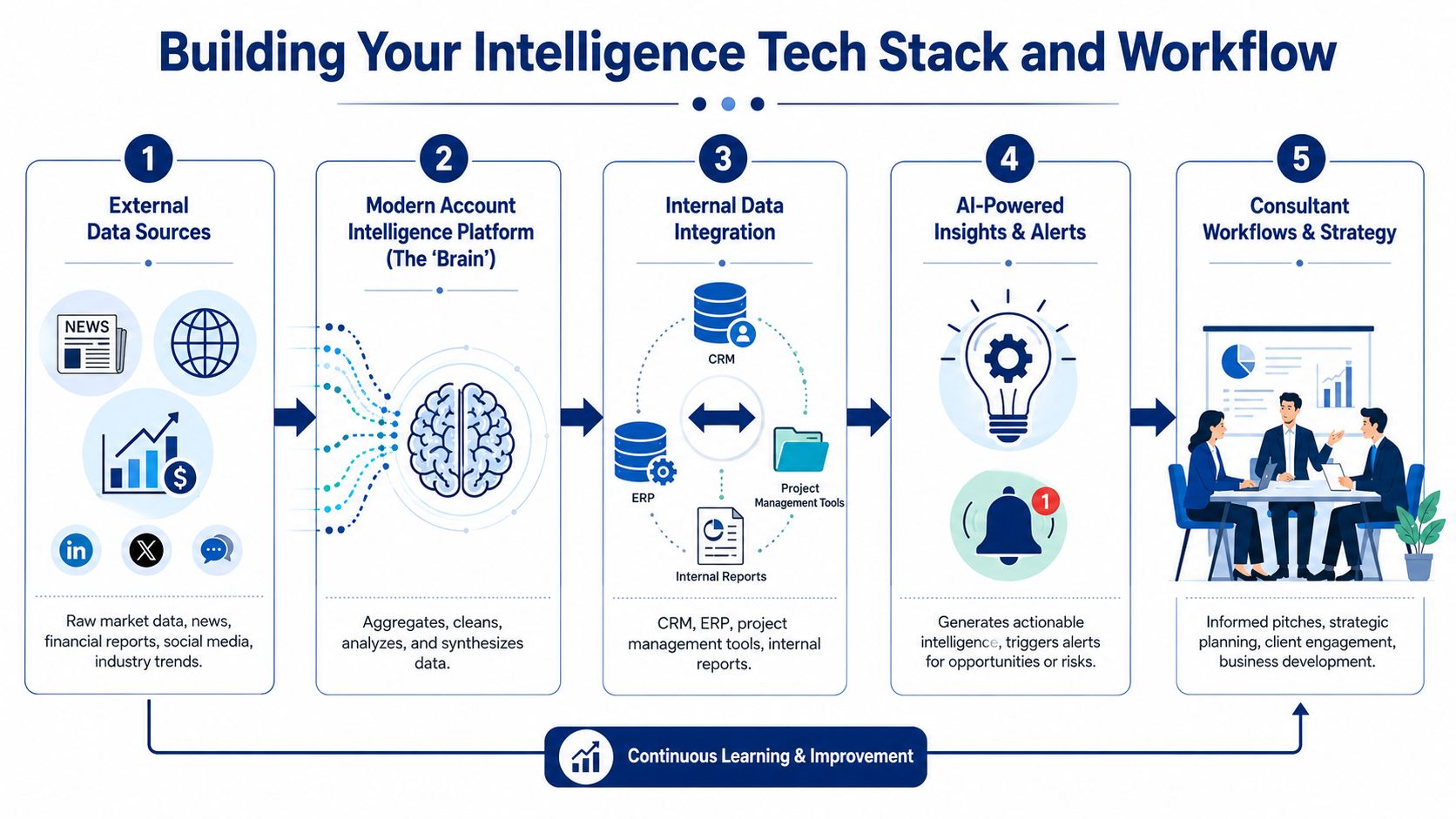
The stack has one job. Turn scattered information into usable commercial context without adding work for billable consultants.
Effective account intelligence platforms act as a multi-source decision layer, combining CRM data with third-party signals. For consulting firms with committee-driven sales, bringing firmographic, technographic, and intent data into one view helps teams spot transformation windows and respond faster, as outlined in MarketsandMarkets' analysis of account intelligence platforms.
A practical stack usually includes:
- External signal inputs such as earnings materials, news, executive moves, hiring patterns, company websites, and industry developments
- Internal system connectors to CRM, marketing automation, proposal systems, and knowledge repositories
- Processing and synthesis through AI or rules-based logic that turns raw activity into account summaries, alerts, and recommendations
- Workflow distribution through Salesforce, Microsoft Dynamics, Slack, email, and account team dashboards
- Governance for data quality, ownership, tagging, and alert thresholds
The trade-off is straightforward. More sources create better coverage, but they also create more noise. If the system cannot rank relevance by account, sector, and service line, teams stop trusting the alerts.
Where large consulting firms differ
Smaller firms can get value from a vendor dashboard and a few email alerts. Large consulting firms usually need the intelligence to flow into their own environment because revenue teams already work across established systems, approval paths, and knowledge layers.
That usually means structured outputs into:
- CRM so account teams can see signals alongside opportunity history, relationship maps, and active pursuits
- Proposal tools so pursuit teams can pull current account context into qualification and pitch content
- Knowledge systems so themes, briefs, and account developments can be reused across practices
- Internal copilots or enterprise search so partners can ask account-specific questions in natural language and get a grounded answer
API depth matters more than interface polish. If the platform cannot return structured data cleanly, the firm ends up back in copy-and-paste mode. That slows response time, fragments account knowledge, and weakens adoption.
For example, some firms build custom copilots using structured intelligence feeds from platforms like Salesmotion, which offer API and MCP integrations that can send intelligence into internal CRM, proposal, and knowledge workflows instead of forcing users into a separate destination.
This is usually the dividing line between a tool people demo and a system people use.
The workflow that gets adopted
The operating model needs to be simple enough to run every week and structured enough to improve over time.
- BD or RevOps sets target accounts and monitoring themes
- The platform monitors those accounts for relevant changes
- AI or analyst rules interpret what changed and why it matters commercially
- Alerts route to the right owner, such as the account director, sector lead, or partner
- The insight appears inside the team's working tools, not in a portal no one checks
- The team records outcomes so priorities, thresholds, and routing improve over time
If an alert does not show up inside the systems your team already works in, it becomes background reading, not pipeline activity.
The firms that get this right do not ask consultants to become researchers. They give BD, marketing, and RevOps a way to package signal-driven insight at scale, then deliver it at the point of action. That is how intelligence starts improving conversation quality, pursuit timing, and deal size across the firm.
From Signal to Conversation Example Outreach Plays
The value of account intelligence only shows up when it changes the conversation. A raw signal is just a trigger. The commercial value comes from the interpretation.
Play one after an acquisition
A target account announces an acquisition in a neighboring market. The obvious reaction is to send a note about integration services. Most firms will do exactly that.
A better read is broader. The acquisition likely creates pressure around synergy planning, operating model design, system overlap, governance, and leadership capacity. The account team now has a reason to ask how the client plans to protect business continuity while integrating.
A stronger opening sounds like this:
You've taken on two jobs at once. Capturing deal value and keeping the base business steady. We've seen leadership teams struggle most when integration governance, technology decisions, and operating model choices get sequenced too late.
That opens a strategic discussion. It doesn't sound like a canned service pitch.
Play two after executive commentary shifts
A company's latest earnings call emphasizes margin pressure, execution discipline, and delayed improvement in one business line. That's not just investor language. It often signals a management mandate that will cascade into transformation work.
The weak outreach says, “We help clients improve operations.”
The useful outreach says the team noticed a shift in management tone and has a hypothesis about what that means. For example, a partner might write to a division leader saying the public commentary suggests a need to balance short-term performance action with protecting customer experience and growth capability. That's a real executive tension. It earns attention.
Play three around thought leadership timing
This one is underused. Suppose multiple target accounts in one sector are signaling the same issue. Competitor mentions are rising. Executives are discussing the same strategic challenge in interviews and investor materials. Hiring patterns point to the same capability gap.
That isn't just an outbound moment. It's a content moment.
Independent coverage of consulting use cases shows that firms use competitive intelligence to monitor executives, client priorities, and digital footprints across media, social channels, and thought leadership so they can identify market shifts and gaps in competitor positioning. The same work helps firms shape narratives that win boardroom attention before a formal sales cycle begins, as shown in this Contify case study on thought leadership and competitive intelligence.
A smart BD team turns that pattern into a sector POV, roundtable topic, client note, or partner article. Instead of waiting for the opportunity, they shape the frame of the conversation first.
What good outreach has in common
The most effective signal-based outreach usually shares a few traits:
- It references a real business event. Not a vague personalization token.
- It interprets the event. The message explains the likely implication.
- It speaks to a decision-maker's problem. Not the sender's service line.
- It gives the client a reason to engage now. Timing is part of the value.
Generic cold outreach says, “We work with companies like yours.” Intelligence-led outreach says, “Here's what appears to be changing in your business, and here's the strategic question that deserves attention.”
That difference is what moves a message from noise into pipeline.
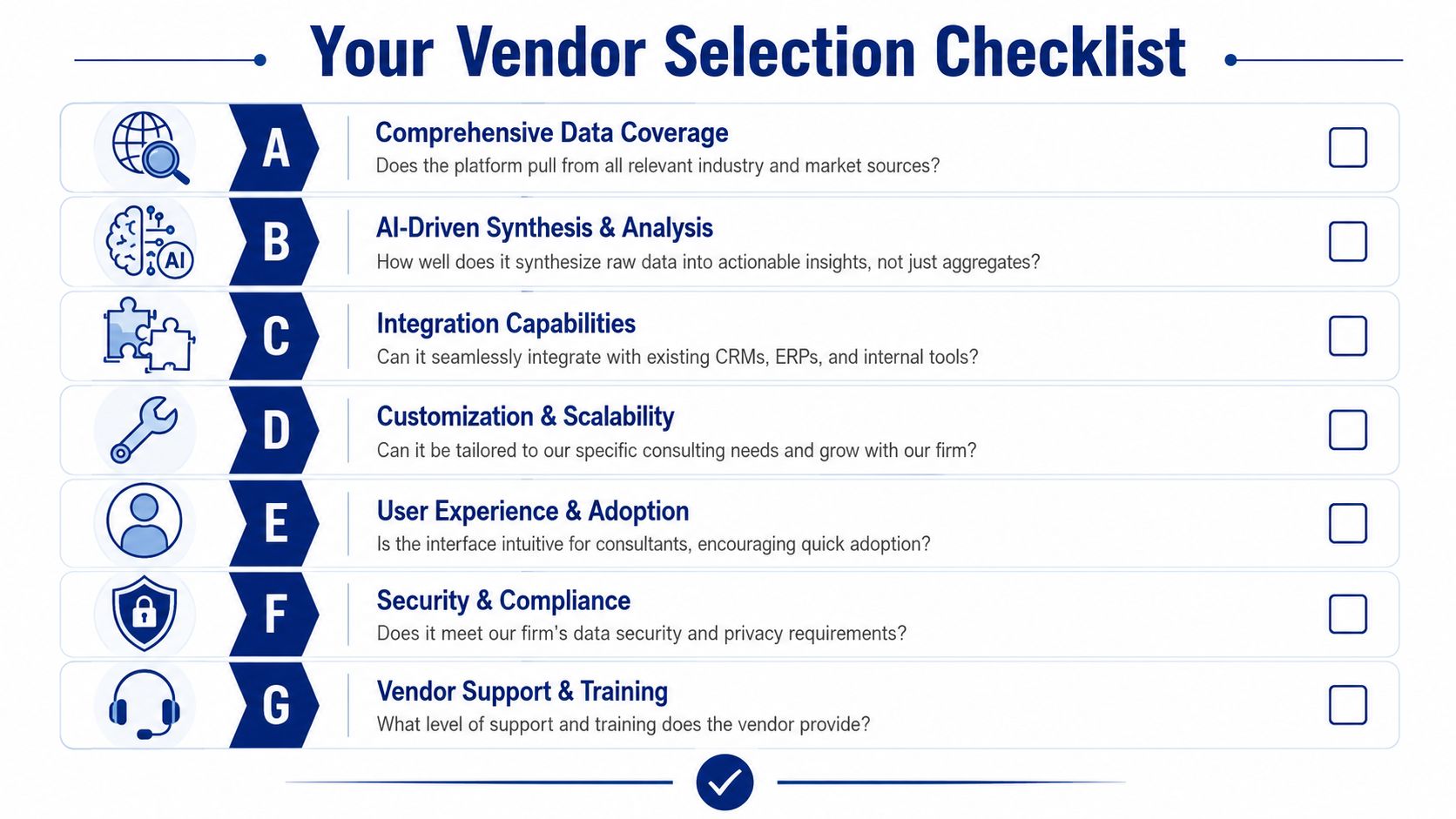
Your Vendor Selection Checklist
Most vendor evaluations go off course because firms compare feature lists instead of operating fit. For consulting firms, the primary consideration is whether the platform can support account planning, pursuit prep, and timely outreach without adding friction to already busy teams.
The shortlist criteria that matter
Data coverage
The platform should capture the kinds of signals consulting teams use. Executive changes, earnings commentary, filings, hiring activity, corporate events, strategic announcements, and market context all matter. If the feed is shallow, the brief will be shallow.
Synthesis quality
A stream of articles isn't account intelligence. Ask whether the tool can produce an interpretable account brief with themes, implications, and likely consulting angles. If users still have to do the hard thinking alone, you're buying aggregation, not intelligence.
Integration depth
This is the biggest filter for large firms. Can the vendor push structured data into Salesforce, Microsoft environments, proposal systems, and internal knowledge tools? Is there an API your internal teams are able to work with? If not, adoption will stay limited.
Alert configuration
You need control over what gets surfaced and to whom. Sector leads may care about market shifts. Account directors may care about account-specific events. Partners may only want high-signal triggers. One-size-fits-all alerts usually create fatigue.
Workflow fit
Busy BD teams won't live in six systems. The intelligence must show up where they already work. That can be CRM, Slack, Teams, email digests, or internal copilots.
Security and governance
Consulting firms need strong controls around access, permissions, internal data handling, and auditability. Don't leave this as a procurement footnote.
Support for scale
Pilot use is easy. Firmwide consistency is hard. Ask how the vendor supports account taxonomy, practice segmentation, rollout design, and feedback loops that improve relevance over time.
Buy for workflow adoption, not demo appeal.
A practical way to pressure-test options is to use a structured account intelligence buyer's guide for 2026 and score each vendor against your firm's actual operating model.
If your BD team wants to replace manual pitch prep with a scalable intelligence system, Salesmotion is one option to evaluate. It provides AI-driven account briefs, signal monitoring, and structured intelligence that can feed into CRM and internal workflows through API and MCP integrations, which is useful for consulting firms that need more than a standalone dashboard.